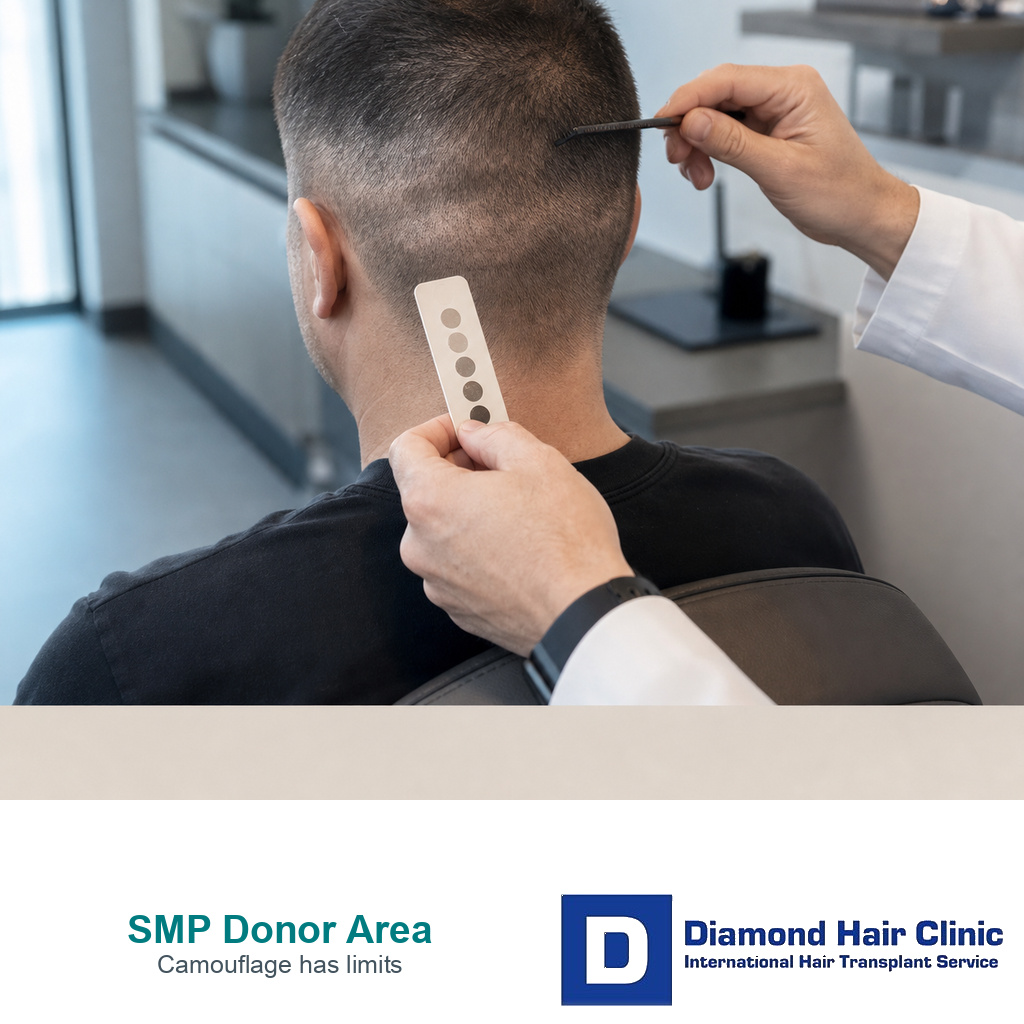
For a healed overharvested FUE donor area, SMP may soften the way scalp shows through short hair, but it cannot put donor hair back. I judge it as camouflage, not repair. That difference matters because pigment may reduce contrast between scalp and hair, while the extracted follicles, spacing pattern, and scar texture remain the same.
Look at the donor area in three separate ways before booking SMP. Color contrast may improve with pigment, but missing density and raised or uneven scar texture still need a realistic plan.
This is not simply about whether a technician can place dots. The safer question is whether the donor area is mature, the main problem is color contrast, the haircut goal is realistic, and future repair options will not be made harder. For me, SMP should be planned only after the donor problem is understood.
Check the donor in the haircut you actually want to wear, both dry and under normal daylight. Pigment can reduce color contrast, but it cannot flatten raised scarring or give a sparse donor the thickness of hair.
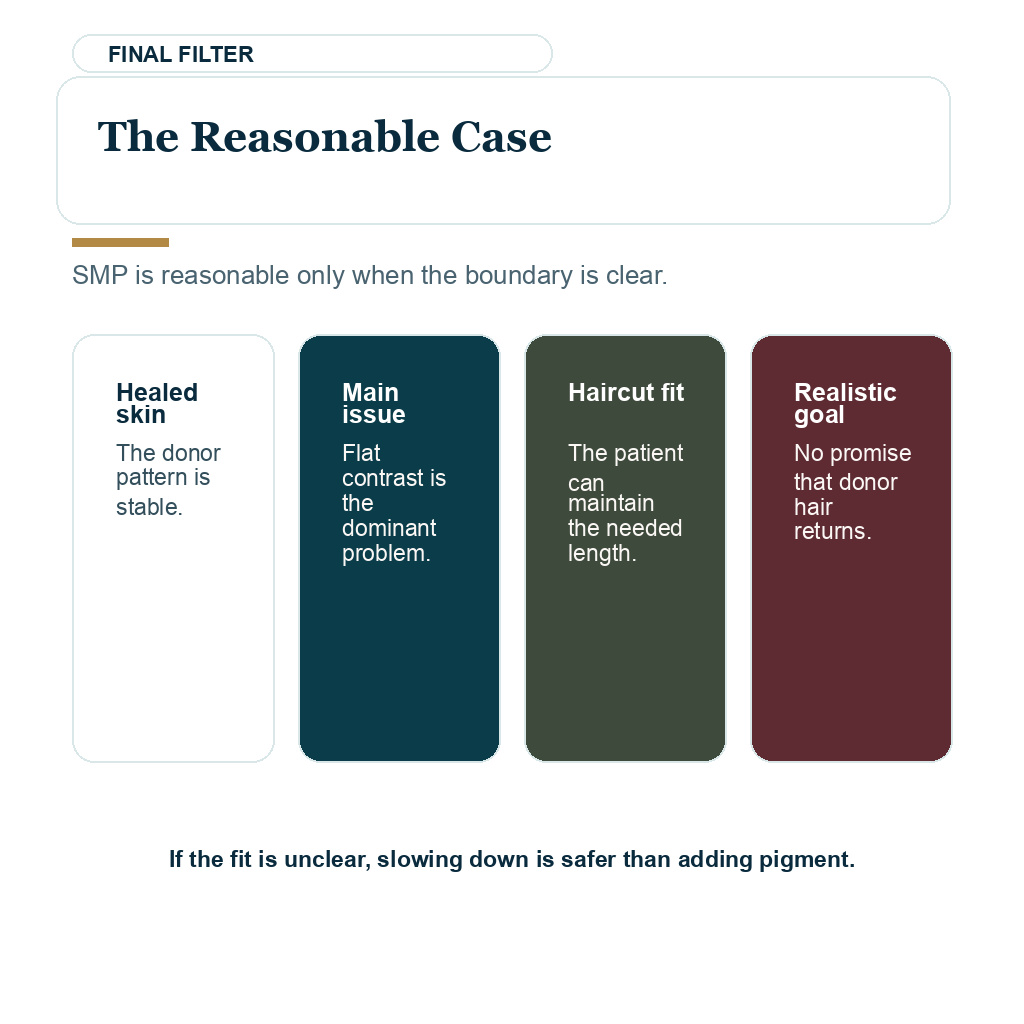
A reasonable case is a healed donor area where the main issue is flat contrast between pale scalp and short surrounding hair. A poor case is different when there are raised scars, active redness, unstable healing, very sparse remaining hair, or the belief that pigment will make the donor look full again. That distinction should be clear before any needle touches the skin.
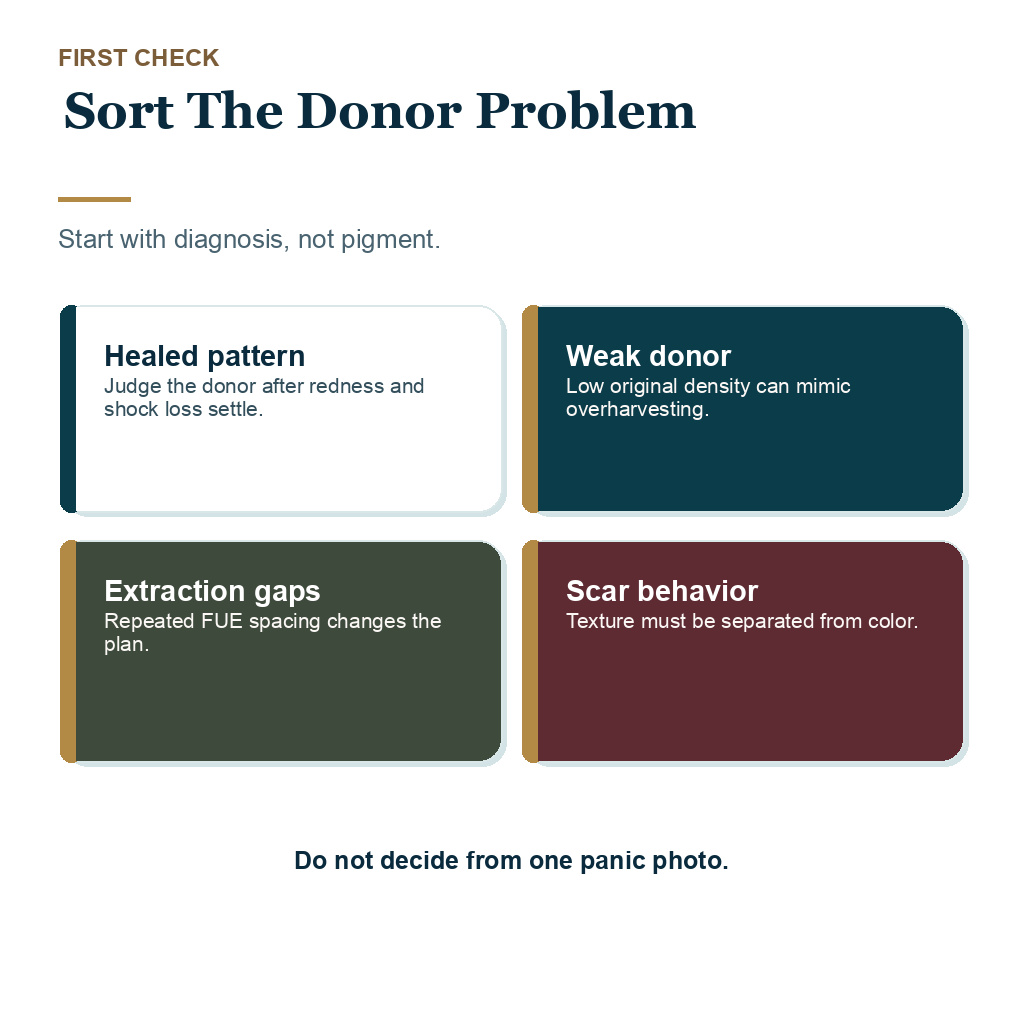
Donor diagnosis comes before pigment
A patient may say the donor area is overharvested because the back of the head looks patchy after a short haircut. Sometimes that is true. Sometimes the donor is still recovering, the haircut is exposing temporary shock loss, or the extraction pattern is only visible under harsh light. Before SMP is discussed, the donor area must be judged as a healed pattern, not as a panic photo.
I separate early healing from permanent donor loss before pigment is considered. If surgery is still recent, a patchy donor area after FUE can still change as redness, shock loss, and hair length settle. A mature overharvested donor is different. It shows depleted density, repeated extraction gaps, or visible dot scarring after enough time has passed for healing to settle.
The starting donor quality matters too. A donor area that was naturally sparse can look exposed even if the extraction was not extreme. In other patients, real donor area overharvesting has removed too much from zones that should have been protected. The SMP decision changes depending on which problem we are seeing.
The limits of what SMP can hide
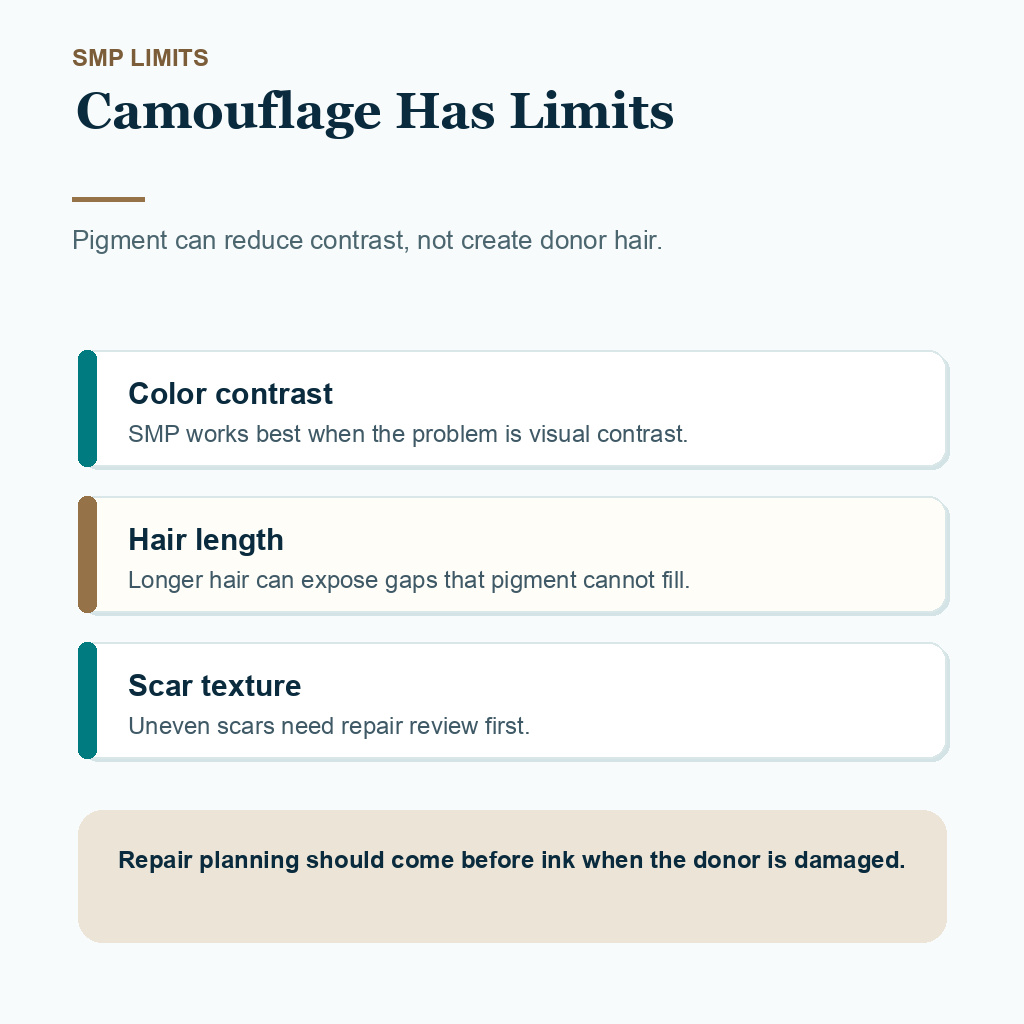
Donor SMP can reduce contrast, but it cannot replace missing hair.
Scalp micropigmentation creates tiny pigment impressions in the scalp. It can reduce the visual gap between pale skin and darker short hair. In a donor area, that may soften FUE dots, lighter patches, and the contrast around depleted zones. That contrast change may help selected patients at a tested clipper length, but it does not guarantee that a very short fade will hide extraction spacing, scar texture, or uneven donor density.
But SMP does not increase hair count. It does not thicken hair shafts. It does not rebuild a safe donor zone. The same limit applies when SMP is used for scars or thin density areas after a hair transplant. Pigment can create a shadow effect, but the eye still reads texture, hair direction, and density when the head moves in real light.
This is the main limit in an overharvested donor area. SMP may help when the issue is mostly contrast. When the issue is missing volume, raised scars, uneven extraction, or very thin remaining hair, pigment alone may make the scalp darker without making the donor look natural.
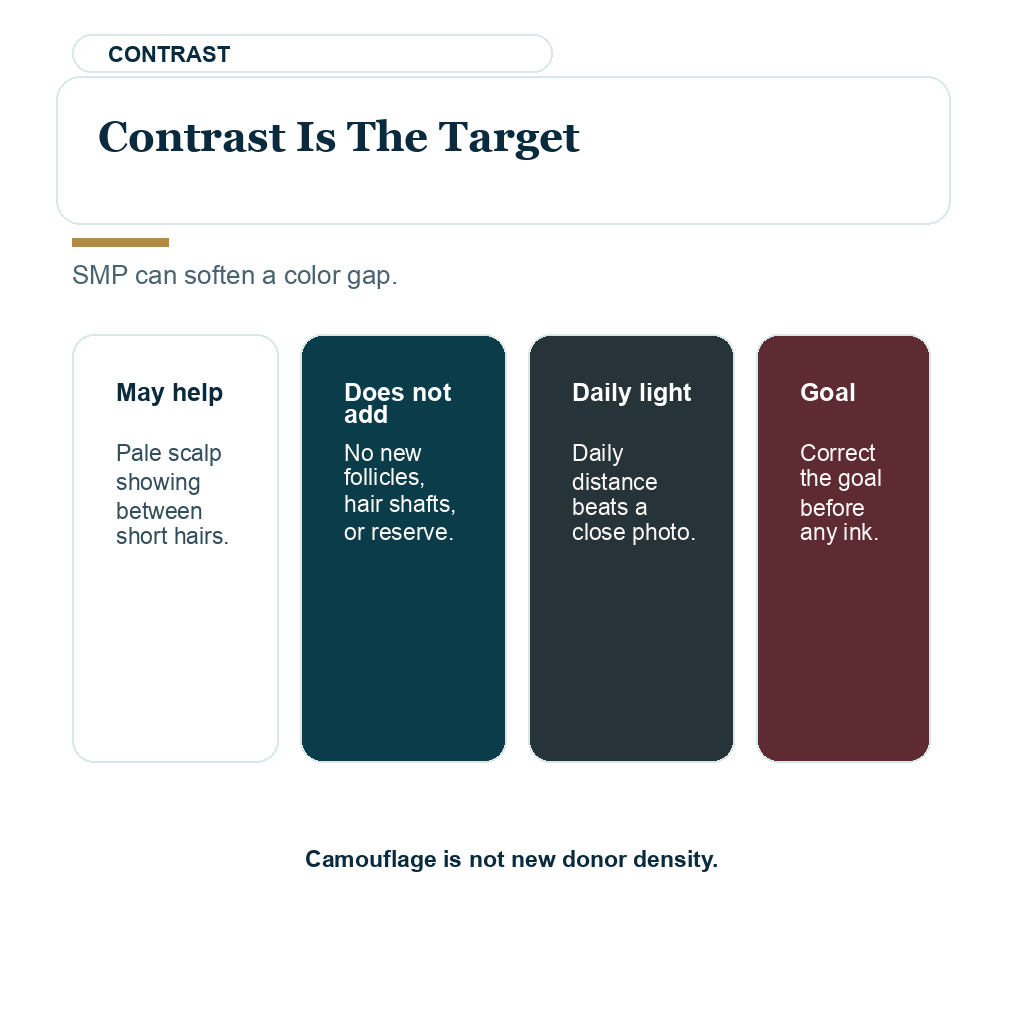
Use the four slide donor camouflage review below before treating pigment as a simple repair.
The 10 donor SMP slides separate diagnosis, contrast, scar texture, haircut length, donor reserve, timing, future repair, photo proof, pigment risk, and the final suitability boundary. Swipe sideways, use the arrows one slide at a time, or choose a number below the image.
Donor SMP limits reality filter
Where does SMP help, and where does it not?
SMP can reduce contrast in selected donor areas. It cannot restore donor hair, flatten scars, or undo unsafe extraction, so the expectation has to be clear.
Contrast gap
Pale scalp showing between darker surrounding hair is the kind of contrast SMP may soften. It can improve the visual blend from normal viewing distance, but it does not add donor hair.
This changes the decision from hair replacement to camouflage. The question is whether the color contrast is the main problem, not whether pigment can increase donor reserve.
Judge the contrast with realistic lighting and the haircut the patient will actually keep. A close cropped photo can make the illusion look stronger than daily life.
Pause if the patient expects new hair growth from pigment. That expectation needs correcting before any cosmetic SMP decision is made.
Scar texture
When the main problem is raised, shiny, depressed, or uneven scar texture, pigment has a clear limit. It can adjust color contrast, but it cannot make scarred skin normal.
The first step is to separate a color problem from a texture problem. Pain, unstable skin, or changing scars need medical or surgical review before camouflage.
Ask whether texture, pain, or instability needs review first. SMP should not be used to cover a scar that still needs diagnosis or repair planning.
Delay the decision if scars are painful, raised, unstable, or still changing. Understanding the scar behavior matters more than choosing pigment timing.
Short haircut
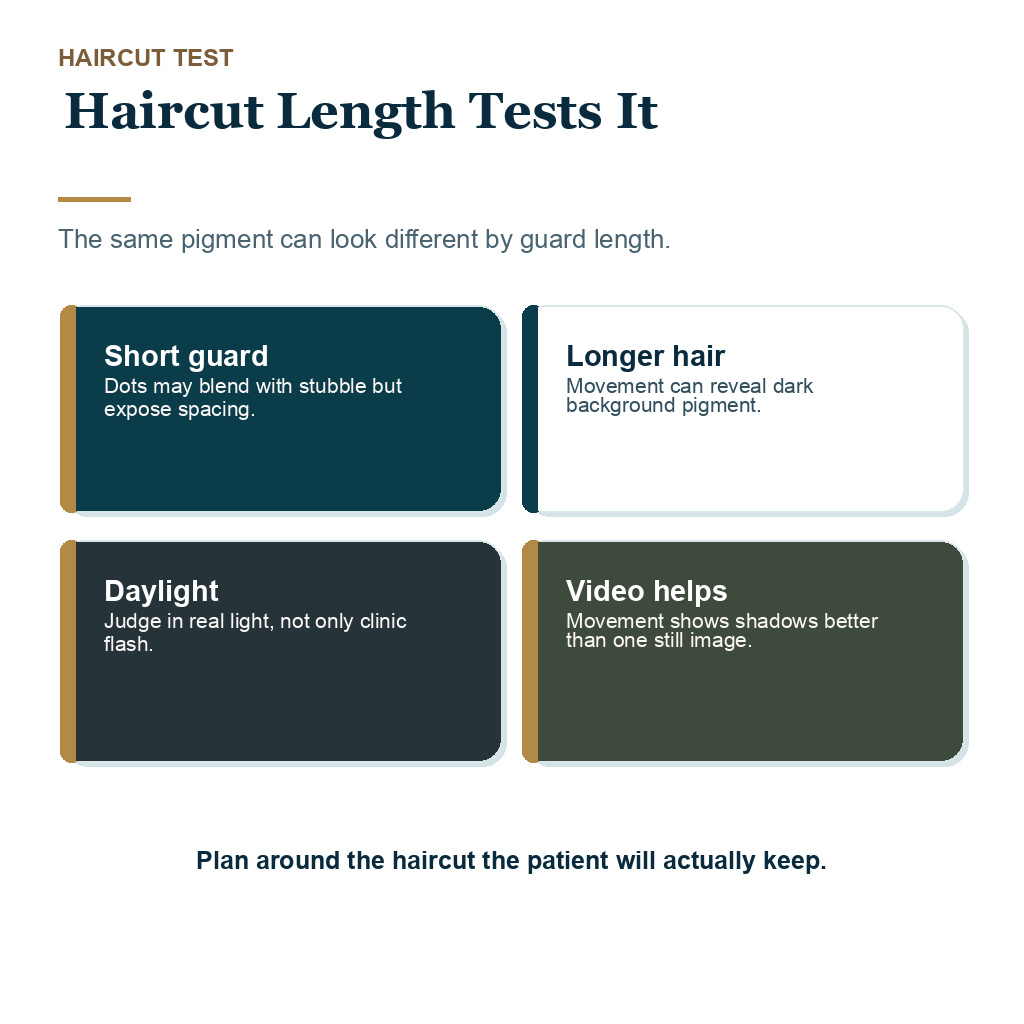
SMP works best when the intended haircut is short enough for pigment dots to blend with surrounding hair. If the hair is worn longer, the illusion can become less convincing.
If SMP only works at one guard length, that haircut becomes part of the treatment commitment, not a small styling detail.
Hair length changes whether the result works in daily life. The same pigment can look acceptable with one haircut and obvious with another.
Judge SMP with the haircut the patient will actually wear. Example photos only help if the hair length and density are close to the patient's real situation.
Be cautious if example photos use a haircut or density that does not match the patient. The comparison should not sell an illusion the patient cannot maintain.
Future surgery
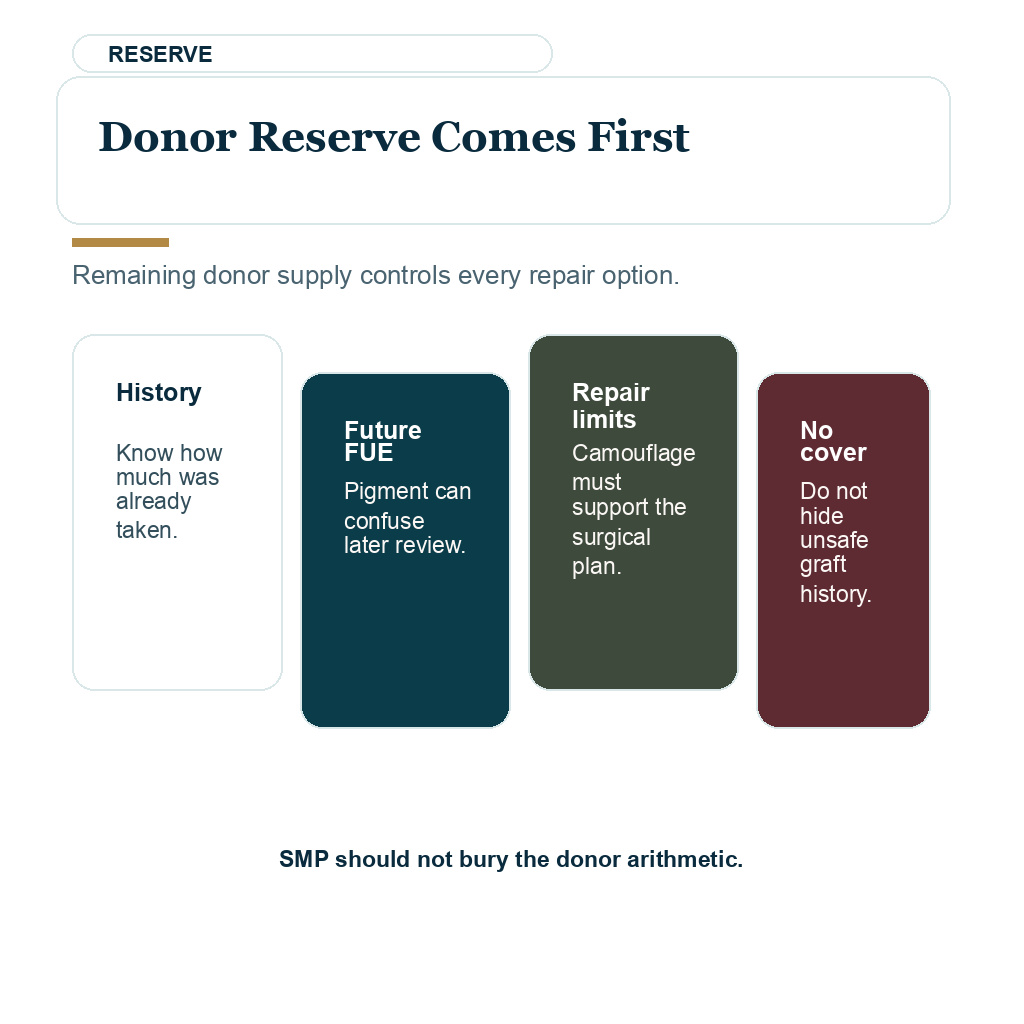
Future transplant repair might still be possible or needed. SMP should not hide donor planning questions that could affect surgery later.
This changes the order of decisions. Donor reserve, extraction history, and possible repair options should be reviewed before pigment choices become the main focus.
Review donor reserve and extraction history before pigment decisions. If the donor area still has surgical options, camouflage should support that plan rather than confuse it.
Stop if SMP is being used to cover an unsafe high graft history without understanding what donor remains. The cosmetic plan should not bury the donor safety question.
Expectation gap
A promise that SMP will replace donor hair, erase all scars, or make overharvesting invisible is a warning sign. Pigment can change contrast, but it cannot restore lost donor follicles.
That kind of promise is a cosmetic overclaim, not a biological restoration plan. The safer decision is to understand the limits before agreeing to treatment.
Get a second opinion before committing when the explanation is stronger on sales language than limits. A careful review should make the tradeoff clear, not hide it.
Hold the decision if the explanation is stronger on sales language than limits. Good camouflage planning should be clear about what pigment can and cannot change.
Hair length can expose the donor problem
Donor SMP is strongly connected to haircut length. A very short clipper guard may make pigment blend better with stubble, but it can also expose extraction spacing and scar texture. Longer hair may cover texture better, but pigment placed for a shaved look can appear as a dark background under moving hair.
I ask what haircut the patient actually wants to wear. Some patients want to shave the donor very short because longer hair looks uneven. Others want to grow it to hide scars. If FUE and SMP are being discussed together, the broader buzz cut hair transplant and SMP plan should be decided before pigment is used to hide a donor problem. Short hair after FUE donor scars shows why the same donor area can look very different at different clipper lengths.
The best SMP plan often uses less pigment than the patient imagines, because the shade has to survive normal daylight, movement, and the chosen guard length. If the patient keeps changing between a close fade and longer hair, pigment can become harder to match. The donor area should be tested under the haircut that will be used in normal life.
Timing matters more after overharvesting
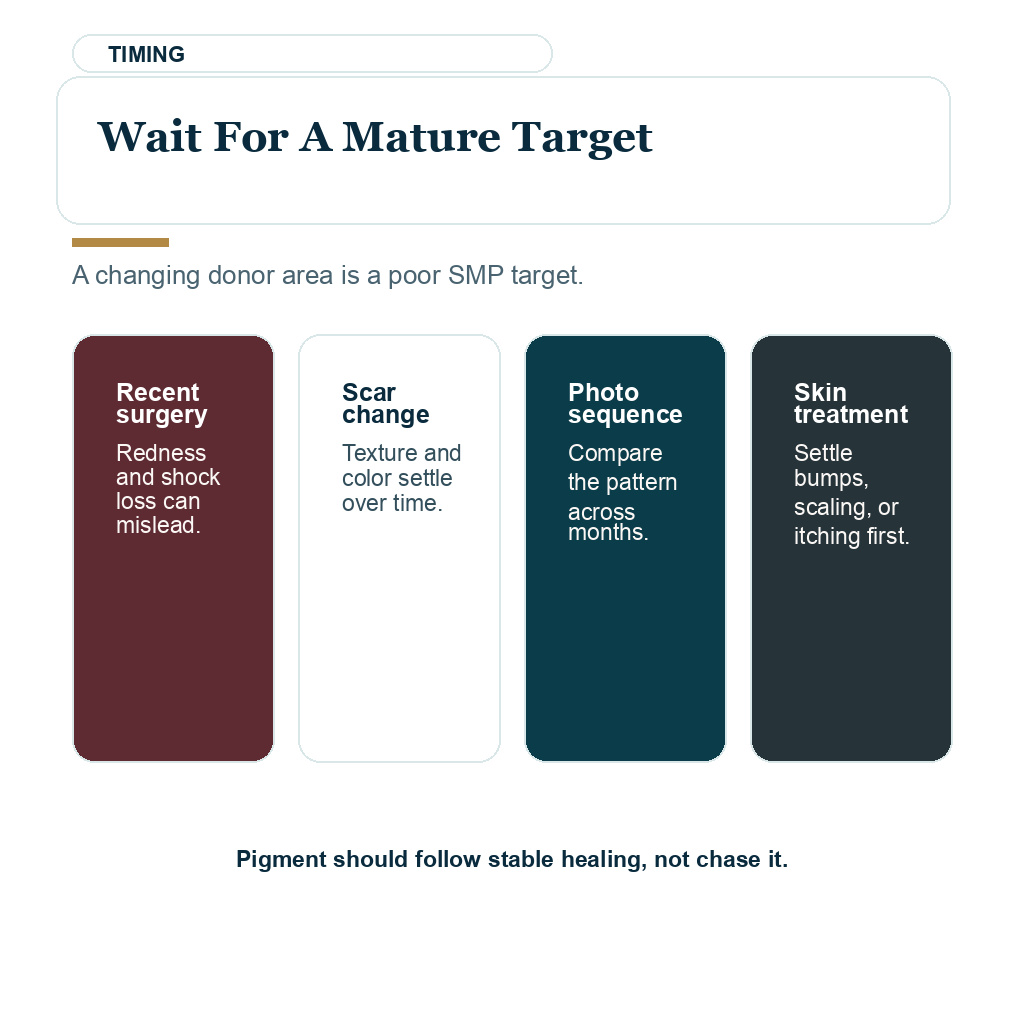
Rushing pigment into a recently operated donor area can create a poor target. Redness, sensitivity, crusting, temporary shock loss, and scar maturation can all change the way the donor looks. Pigment placed too early may chase a temporary pattern and then look wrong when healing changes.
The general guidance on scalp micropigmentation timing after a hair transplant still applies, but an overharvested donor area needs extra caution. Depleted zones, FUE dot scars, and weak remaining hair can make the pigment decision less forgiving.
Comparing photos over time gives a better target. A stable donor pattern supports a more confident SMP discussion. A changing donor pattern tells us to wait, treat the skin if needed, or review whether we are seeing overharvesting, shock loss, scarring, or a weak donor that was never suitable for aggressive extraction.
Before I advise donor SMP, I want to see the donor after the skin has settled, not during redness or shock loss. If the pattern is still changing, pigment is solving the wrong picture. The safer first step is usually photos in normal light at the patient’s real haircut length, then a review of whether the issue is contrast, texture, or missing donor reserve.
Scar texture is different from color contrast
FUE leaves small extraction sites. In a carefully managed donor, these marks may be difficult to notice once hair grows. In a poorly managed donor, the combination of too many extractions, large punches, tight spacing, and poor healing can make the pattern visible. SMP may reduce color contrast, but it cannot flatten raised marks or fill tissue irregularity.
This is where FUE punch size and donor scarring becomes relevant. Punch size is one factor, but spacing, distribution, skin behavior, graft count, and donor density all matter. The method name does not change the arithmetic. A small punch used too often in the wrong zone can still leave a visible donor problem.
When I see texture, I become more cautious. Pigment on uneven skin can collect light differently. In some cases it improves the first impression. In other cases it draws attention to dots, ridges, or a mottled pattern. That risk needs to be clear before SMP is treated as a simple cover.
SMP can make the donor look worse
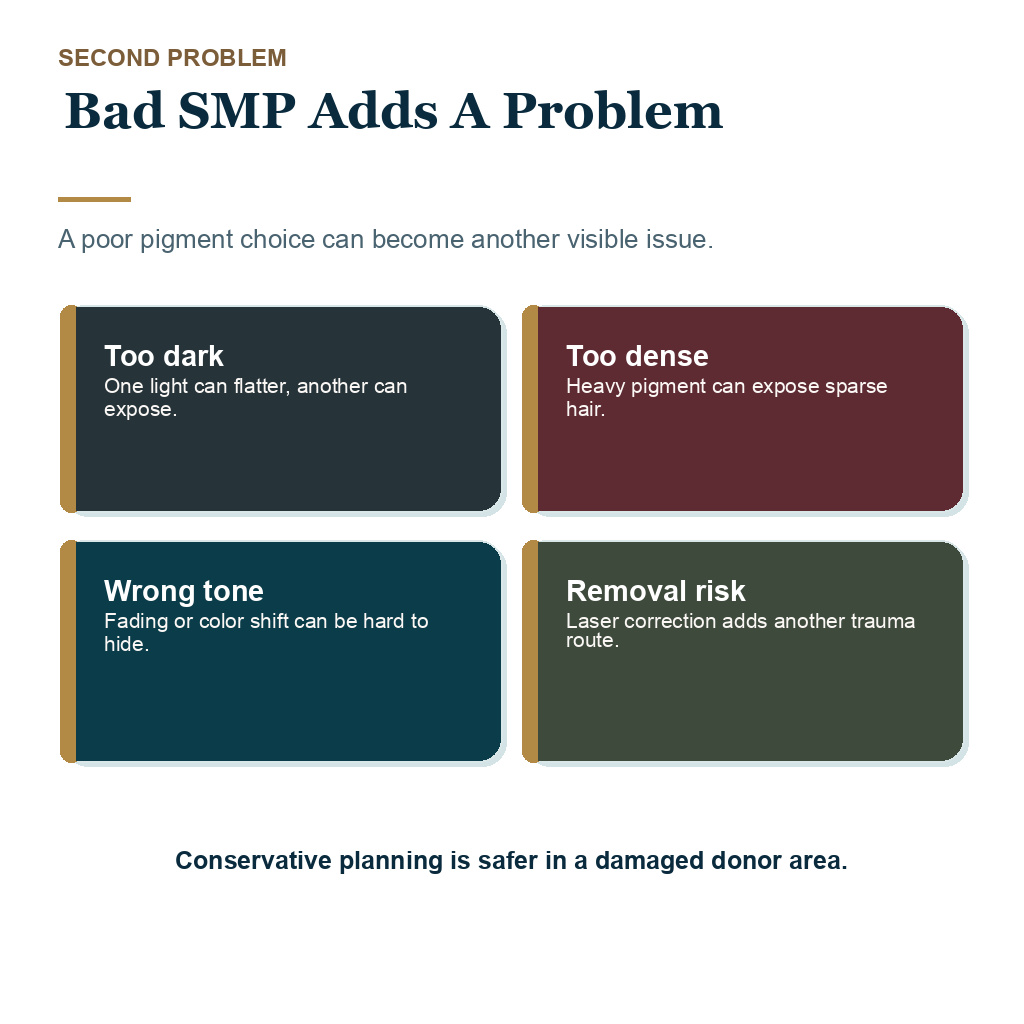
SMP can look worse when the pigment is too dark, too dense, too large, placed into unstable skin, or matched to the wrong haircut. It can also look worse when the surrounding donor hair is fine, gray, sparse, or worn longer than the pigment style assumes. A depleted donor area is not a blank canvas.
Active redness, itching, bumps, scaling, sensitivity, or recently healed scarring makes me slow down. The donor area should be settled before pigment is planned. I also pause when the patient expects SMP to make the donor look like hair grew back. That expectation is not realistic because donor hair does not grow back after FUE.
Pigment is also a more lasting commitment than changing a haircut. It can fade, blur, shift tone, need extra sessions, or be difficult to remove cleanly. Prior SMP, unusual tattoo reactions, infection risk, keloid tendency, or a history of poor scar healing should be reviewed before the donor area is treated as routine.
I also prefer a conservative first session when the donor is already damaged. A lighter approach is easier to adjust than pigment that is too dark from the beginning. If the patient would need laser removal later, the donor area has already been through enough trauma, so I would discuss that risk before the first SMP session.
Another risk is future regret. Dark pigment may make the donor look better in one lighting condition and worse in another. It may also complicate photo review if the patient later wants another transplant or repair. The point is not that SMP is bad. The point is that bad SMP can become a second visible problem.
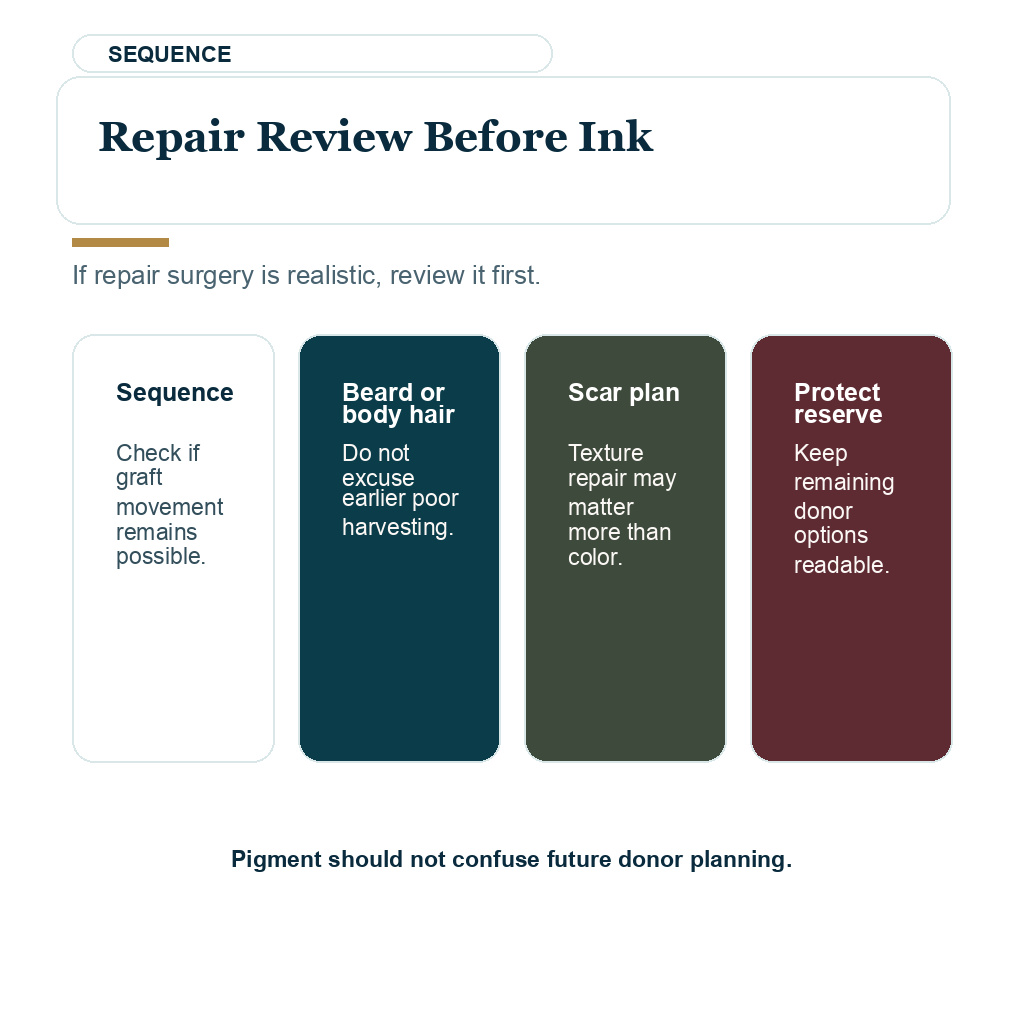
Repair planning should come before ink
Some overharvested donor areas are best managed with haircut strategy and careful SMP. Some need no procedure because the safer option is to grow hair longer and stop adding trauma. A smaller group may need broader overharvested donor area repair planning, which can include limited graft redistribution, beard or body hair discussion, scar review, or simply protecting what remains.
If another repair surgery is still realistic, the surgical sequence should be reviewed before pigment is placed. SMP can change how donor density, scars, and future extraction zones are judged in photos and in person. It does not necessarily block future surgery, but hair transplant after scalp micropigmentation requires planning because pigment, scars, and remaining hair all interact.
In a weak donor, repair ambition must stay realistic. A weak donor area planning review matters because donor reserve controls what can safely be done. In selected repair cases, beard and body hair as donor sources may support the plan in less visible zones, but they should not be presented as a way to refill a damaged scalp donor or justify earlier overharvesting.
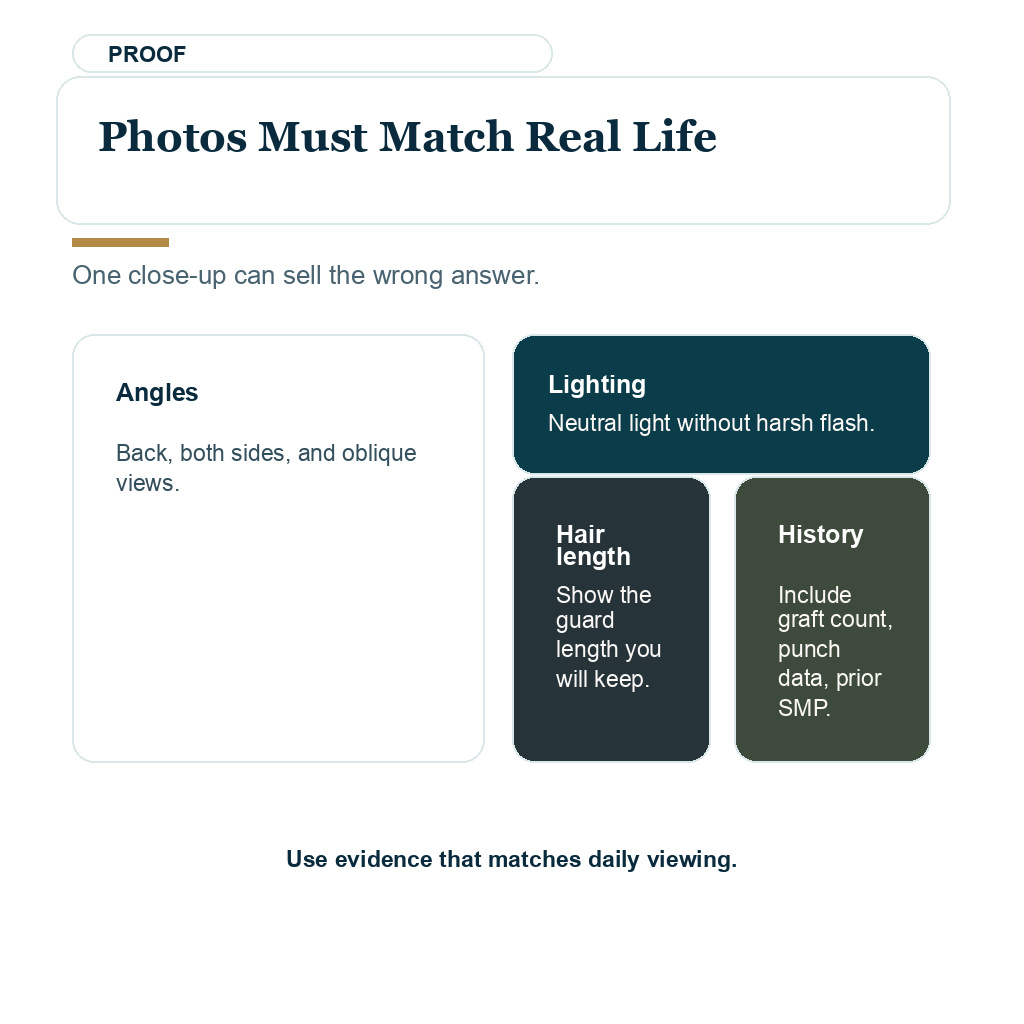
Photos that help before deciding
A single close-up can mislead. Before judging donor SMP, I need dry hair at the normal length, neutral light, no harsh flash, and views from the back, both sides, and both oblique angles. I also need to know the time since FUE, the graft count, punch information if available, prior SMP history, and whether the donor was weak before surgery.
Photos from before surgery are valuable because they show whether the donor was dense enough to begin with. Current photos at two haircut lengths can show whether the concern is mainly contrast or texture. Short video can sometimes help because real movement reveals shadows and thinning better than a still image.
The haircut goal matters as much as the photos. A patient who wants a shaved look needs different planning than a patient who wants to wear the donor at several millimeters. Without that goal, SMP planning becomes a guess.
Judge SMP at the haircut you will wear
For donor SMP, I ask to see the donor area at the haircut length the patient actually wants. Pigment can soften flat color contrast, but it cannot repair raised texture, weak donor supply, or an extraction pattern that still needs surgical review.
If the area is healed and the main issue is contrast, SMP may fit. If the skin is changing, scars are raised, surrounding hair is too sparse, or another repair may be needed, pigment should wait.
The useful check is ordinary light, side angles, and short hair, not a single dark photo. A lasting layer on a damaged donor area should make daily haircut choices easier, not hide a problem that still needs a plan.