



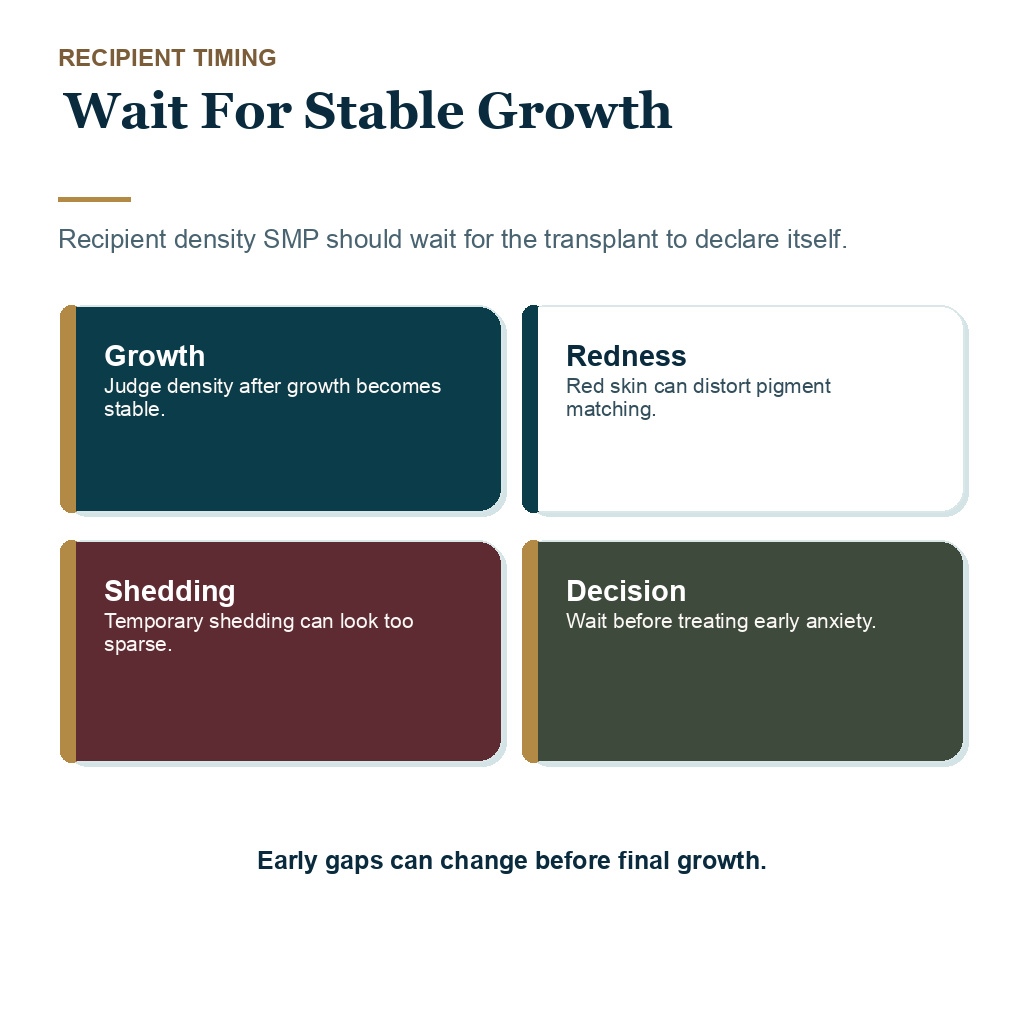
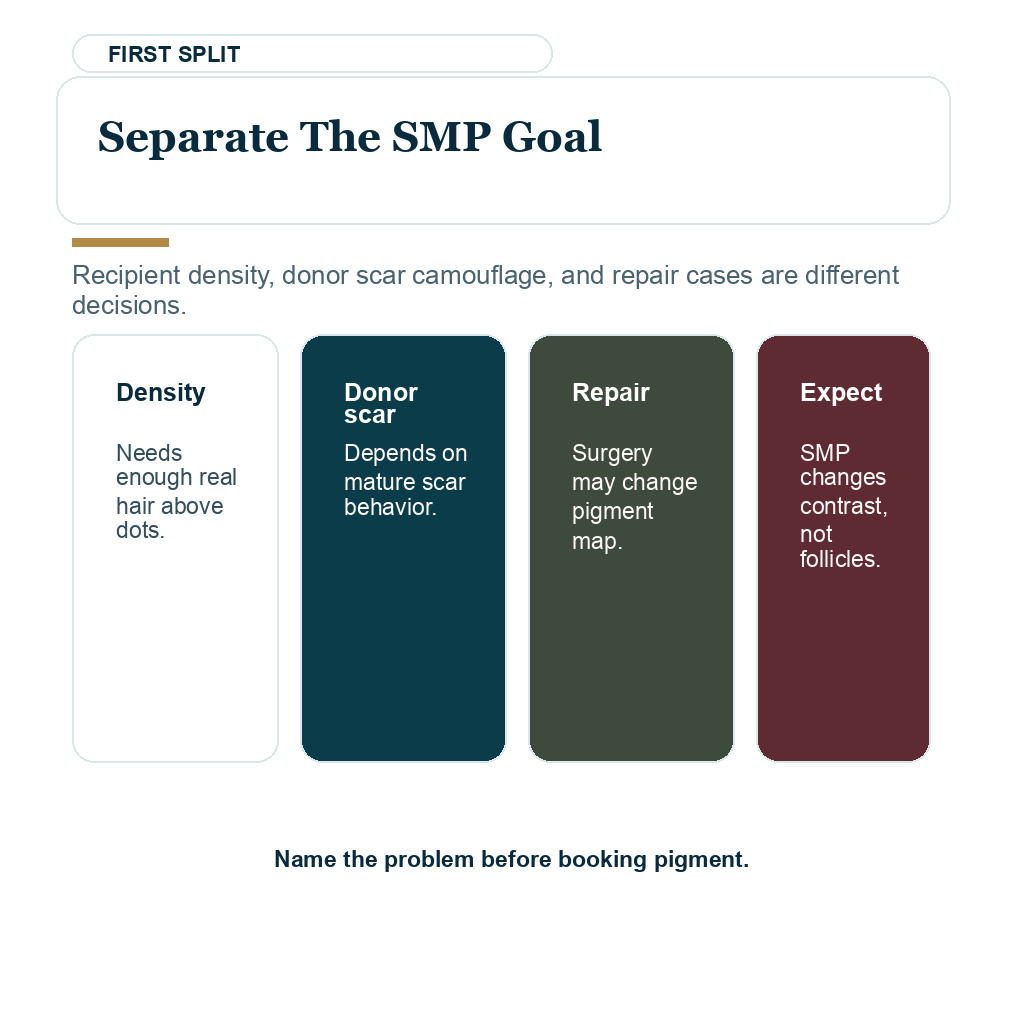
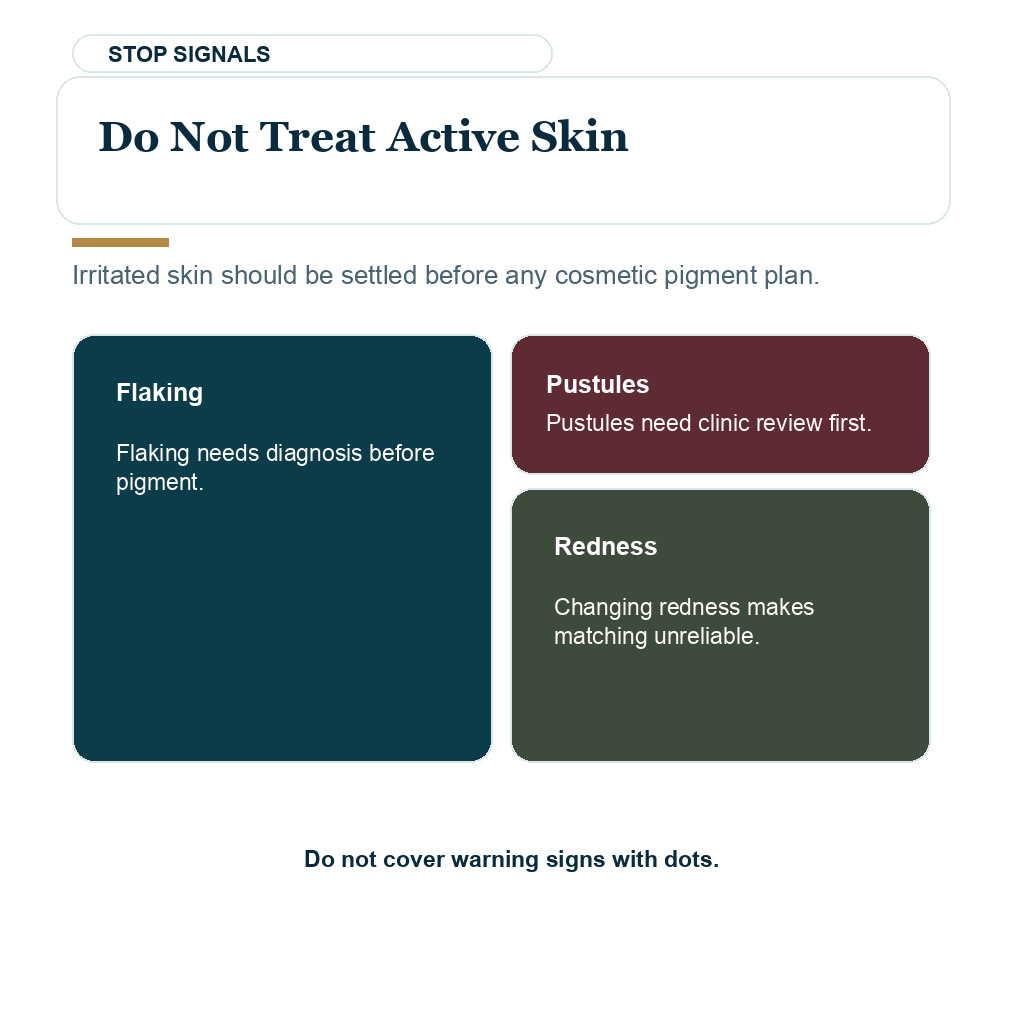
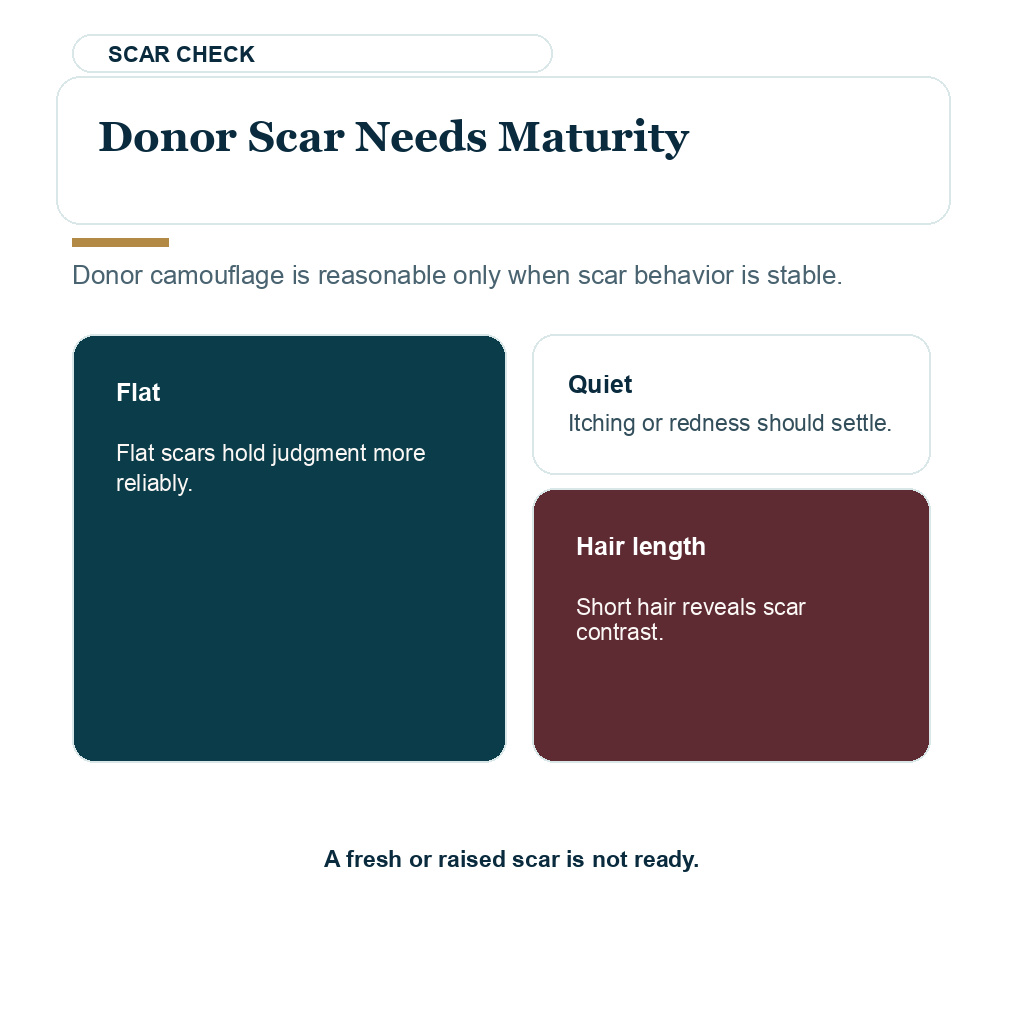
Early SMP can irritate skin that is still settling
For that reason, I do not treat a scalp that only looks clean on the surface as ready for pigment. The scalp has been punctured, cleaned, swollen, scabbed, and exposed to recovery products. Even when the surface looks closed, the tissue underneath may not be ready for another procedure. Adding pigment too soon can increase irritation, make redness harder to read, or create avoidable infection risk if recovery instructions are not followed.
There is also a design risk. The practitioner may try to fill gaps before we know which gaps are permanent. In the recipient area, dots placed between new grafts can look too dark once the hair grows. Around the hairline, pigment can make the border flatter or sharper than real hair. In the crown, pigment can improve density under one light and look obvious under another.
Do not use SMP to rush the healing clock. If the scalp is red, flaky, tender, infected, scabbed, or changing every week, pigment planning should wait. If pustules or irritation appear after surgery, the first job is to understand the skin problem before any warning sign is covered with dots.

Recipient density, donor scars, repair limits, and skin stability need different timing checks before SMP.
SMP can improve specific contrast and scar concerns
SMP can help in specific situations. It can reduce the contrast between pale scalp and darker hair when the hair is kept short. It can soften the look of small FUE dot scars or a mature strip scar. It can make a thin crown look less reflective in selected hair lengths. It can also help some repair cases where a shaved or very short style is the most realistic option. Haircut length changes the value of SMP, because pigment that helps a buzzed style may leave the same density worry at longer lengths. Test the haircut length first, because pigment that helps a close buzz may do little for a longer style that still depends on real hair coverage.
When shaving the scalp is the fallback, I judge SMP only after the repair limits are clear. Pigment may soften contrast at a short length, but it cannot make wrong graft angles, raised skin texture, or weak donor reserve disappear.
The key word is look. SMP changes the appearance of the skin. It does not change donor capacity, graft survival, hair caliber, or future hair loss. If transplanted hair is thinning years later, I look for progression, donor weakness, medication stability, or previous graft placement that needs review. That point is explained more fully in transplanted hair thinning years later.
It is also not a substitute for repair surgery when the concern is mechanical. If a hairline is too low, too straight, or filled with misdirected grafts, pigment may darken the area without fixing the hair direction. In those cases, I may review bad hairline graft removal or redistribution before SMP is considered.
SMP can help selected mature donor scars
Donor scar camouflage is one of the more reasonable uses of SMP after a transplant, but the scar must be ready. Fresh scars can be pink, raised, itchy, firm, or unpredictable. I also look at whether scar color, height, and texture have settled enough for pigment to be judged. A scar that is still remodeling may not hold pigment evenly. It may also change color after the first SMP session, which makes matching harder.
If an old FUT strip scar and newer FUE extraction marks may both need camouflage, I do not book them as two unrelated SMP jobs. I let the recent donor pattern settle, then review the strip scar, FUE dots, haircut length, and pigment match together. That combined map can avoid shaving and treating the same donor area twice before the newer pattern is mature enough to judge.
For FUE dot scars, the visible contrast depends on punch size, spacing, healing, hair length, and skin tone. I connect this with FUE punch size and donor scarring because the best scar plan starts before surgery, not after it. SMP may camouflage a stable pattern, but it should not be used as permission to ignore donor planning.
For people who like very short hair, donor scars matter more. The shorter the hair, the less natural coverage remains over extracted areas. If you want a buzzed look after surgery, I review short hair after FUE donor scars before promising that either surgery or SMP will be invisible.
SMP should not justify aggressive harvesting
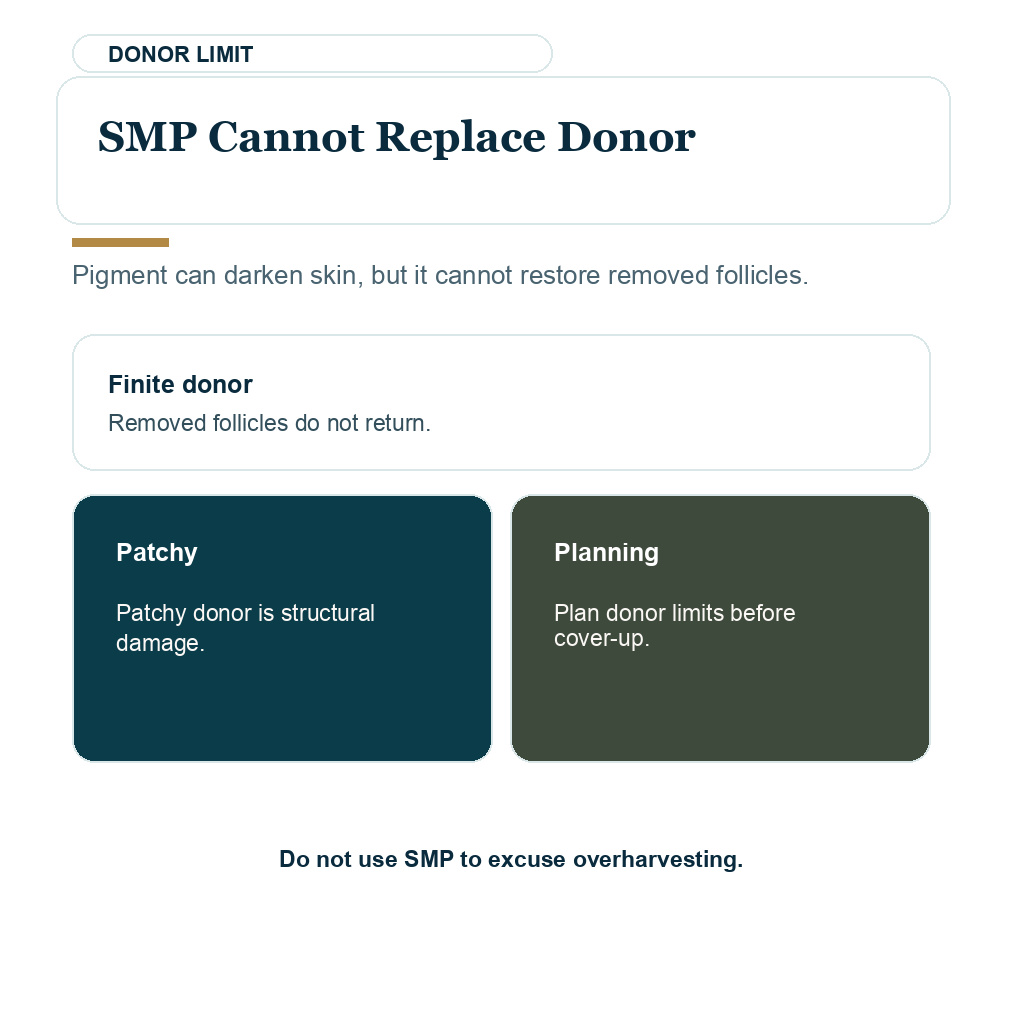
One dangerous idea is that SMP can hide overharvesting, so more grafts can be taken. I do not agree with that logic. Overharvesting is not only a color problem. It is a structural donor problem. The donor may look patchy, thin, and unstable with movement, short hair, and different lighting. Pigment cannot return removed follicles.
SMP cannot replace donor discipline. If the donor area is weak, I first ask whether another surgery is safe at all. I also ask whether beard or body hair could play a limited supporting role, but never as a magic replacement for scalp donor quality. The pages on weak donor area planning, body hair and beard as donor sources, and beard hair for crown transplant explain those limits.
If the donor has already been damaged, the plan may involve longer hair, selective graft redistribution, scar camouflage, or no further surgery. In that setting, overharvested donor area repair and donor area overharvesting need a repair mindset. SMP may be part of repair, but it should not be the reason the damage happened.
Density SMP can look wrong when real hair is too sparse
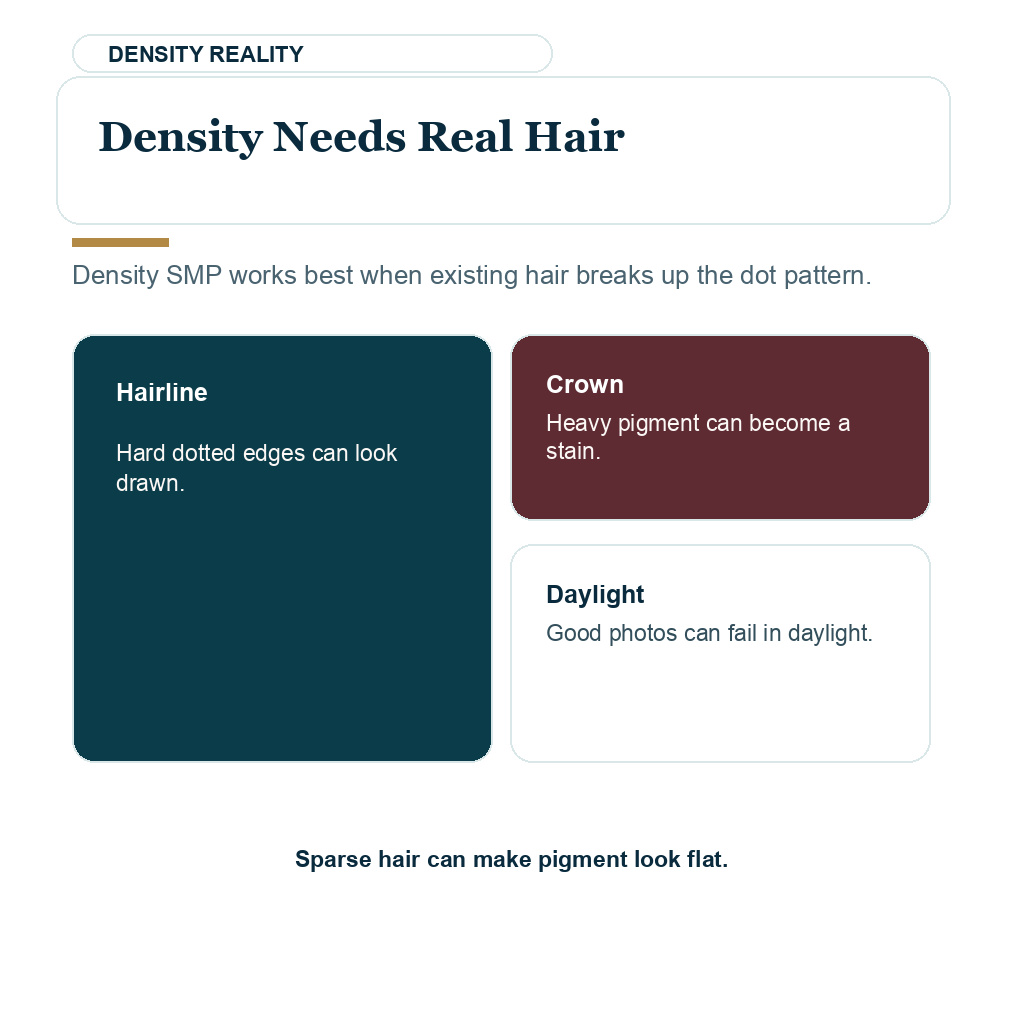
Density SMP works best when there is enough real hair to break up the dots. If the hair is kept long but the area is truly sparse, pigment can show through as a shadow rather than as hair. If the hair is curly, wavy, gray, very fine, or different colors across the scalp, the match becomes harder. The result can look acceptable in one photo and artificial in daylight.
The hairline is the least forgiving area. Natural hairlines have irregularity, different hair caliber, and soft transition. A dark dotted edge can make a transplant look drawn on. The same problem can happen in the temples. If the surgical hairline is already too low or too flat, SMP may make the shape look even more fixed.
For the crown, the decision depends on hair length and whirl pattern. A little pigment under enough real hair can reduce skin shine. Heavy pigment under thin hair can look like a stain. A lighter plan is safer than a result that forces you into one haircut forever. The same limits matter when judging scalp micropigmentation with hair transplant results.
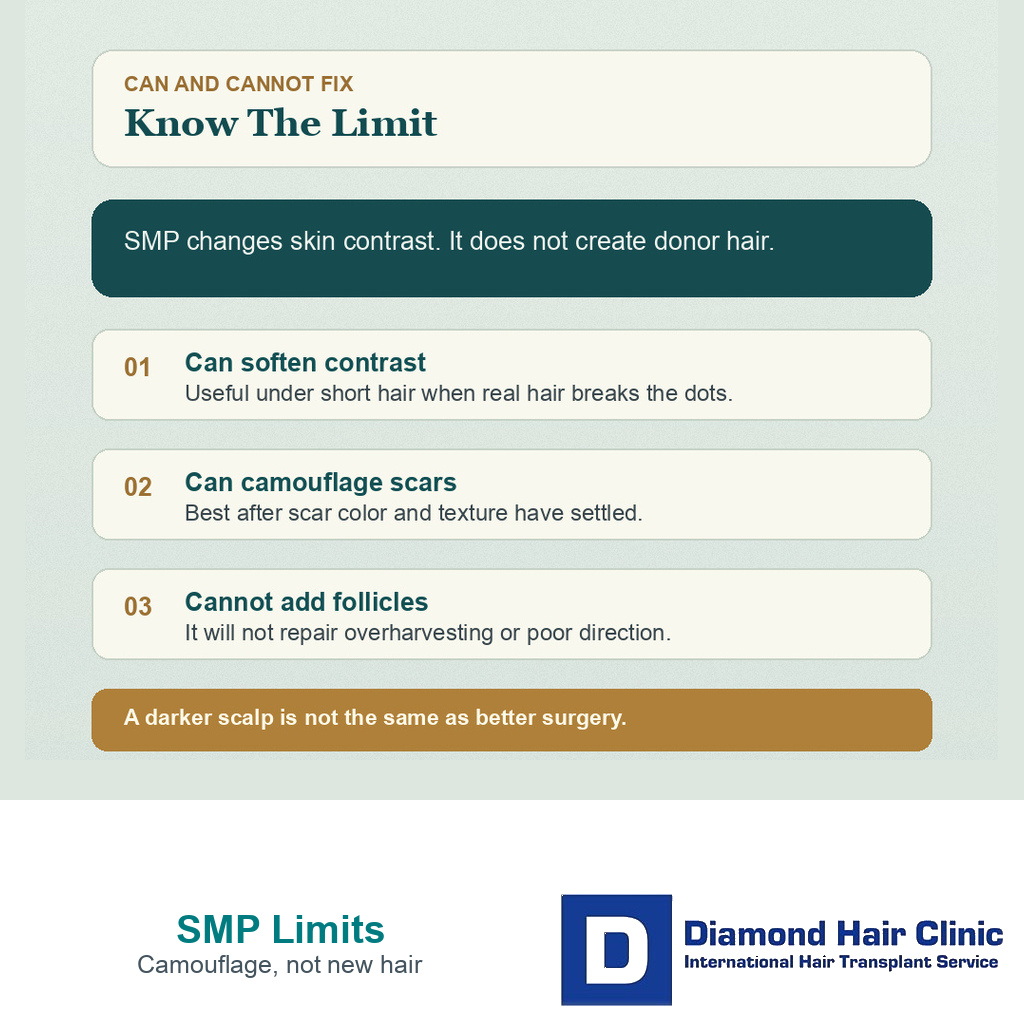
SMP can soften contrast or scar visibility, but it cannot create donor hair or repair a weak surgical plan.
Active skin conditions should pause SMP
Active skin disease changes the SMP decision. Psoriasis, dermatitis, folliculitis, scarring alopecia, alopecia areata, or unexplained inflammation can make pigment planning unsafe or unpredictable. SMP may look like a cosmetic fix, but unstable skin can reject that simple view.
If there is scarring alopecia, the first question is disease control. I would not rush pigment into a scalp that may still be inflamed. Visible psoriasis plaques or recurring irritation also need a pause before pigment is planned. I review these cases differently from routine cosmetic finishing, especially when there is scarring alopecia and lichen planopilaris or scalp psoriasis before hair transplant.
I also pause when there is keloid tendency, unusual scar thickening, poor wound healing, or previous reactions to pigment or tattoo products. SMP is less invasive than surgery, but it is still pigment placed into skin. Stable skin comes before cosmetic finishing.
Before SMP, I also ask practical pigment safety questions. Who is doing it, what hygiene steps are used, whether the needles are single use, which pigment will be placed, and whether the patient has reacted to tattoo pigment or formed thick scars before? I also want a clear plan for a color that heals too dark, fades unevenly, or ages poorly. Pigment is easier to add than to remove, so I make that call only after the scalp is quiet and the long-term hair plan is clear.
Check the real problem before adding pigment
Before SMP, I need to know what you expect it to solve. Is the concern a visible donor scar, weak crown coverage, scalp shine, thin midscalp, or regret after overharvesting? Each answer points to a different plan. Someone who wants to keep long hair needs different advice from someone willing to shave to a very short guard.
Before SMP, the transplant has to be finished enough to judge. If surgery was only a few months ago, density anxiety may be premature. If surgery was years ago and the result is stable, the review is different. If more hair loss is active, SMP may need to wait until the long-term plan is clearer.
The practitioner matters as well. SMP should be done by someone who understands scars, hair transplant patterns, and conservative hairline design. Pigment needs a soft match, not a hard frame. The plan also needs a clear discussion of touchups, fading, sun exposure, and the possibility that removal may be slower, imperfect, or more complicated than the original treatment.
After SMP, sun protection is still a skin and pigment issue. Sunscreen or a safe hat may help once the skin has healed, but pigment does not become a shield. If the scalp has an active rash, wound, changing mole, or rough patch from sun damage, I pause pigment timing instead of hiding the skin under dots.
SMP timing filter
Which SMP question should be answered first?
Choose the concern that best matches the scalp today. The answer changes whether pigment should wait, focus on a donor scar, stay light for density, or stop until a repair plan is clear.
Wait before pigment planning
If surgery was recent, the recipient area and donor area may still be changing. Redness, shedding, uneven early growth, and short hair can make a temporary phase look like a permanent density problem.
Review next. Document the scalp in normal light and wait until growth and tissue behavior are stable enough to judge.
Judge the scar before the dot pattern
Donor scar camouflage can be reasonable when the scar is mature, flat, quiet, and visible mainly because of contrast. Fresh, pink, raised, itchy, or changing scars are not ready for a cosmetic match.
Review next. Check scar maturity, haircut length, skin tone, and whether pigment would camouflage rather than promise missing donor hair.
Keep density SMP conservative
Recipient area SMP only works when enough real hair breaks up the pigment. If the area is too sparse, dark dots can look like a shadow, a stain, or a hard hairline edge instead of natural density.
Review next. Judge final growth, hair length, hair color, daylight visibility, and future hair loss before adding pigment between grafts.
Pause when the scalp is not quiet
Flaking, pustules, tenderness, dermatitis, psoriasis, folliculitis, poor healing, or a history of unusual scarring changes the risk. Pigment should not hide a warning sign that needs diagnosis first.
Review next. Settle the scalp condition and discuss hygiene, pigment reaction history, and scarring tendency before any SMP session.
Set the repair plan first
If the concern is overharvesting, a low hairline, misdirected grafts, or unstable future loss, SMP should not be the first move. Surgery may change the map, and pigment placed too early can end up in the wrong place.
Review next. Decide whether surgery is safe, whether graft removal or redistribution is needed, and only then decide if SMP belongs in the plan.
Sequence SMP after the repair plan is clear
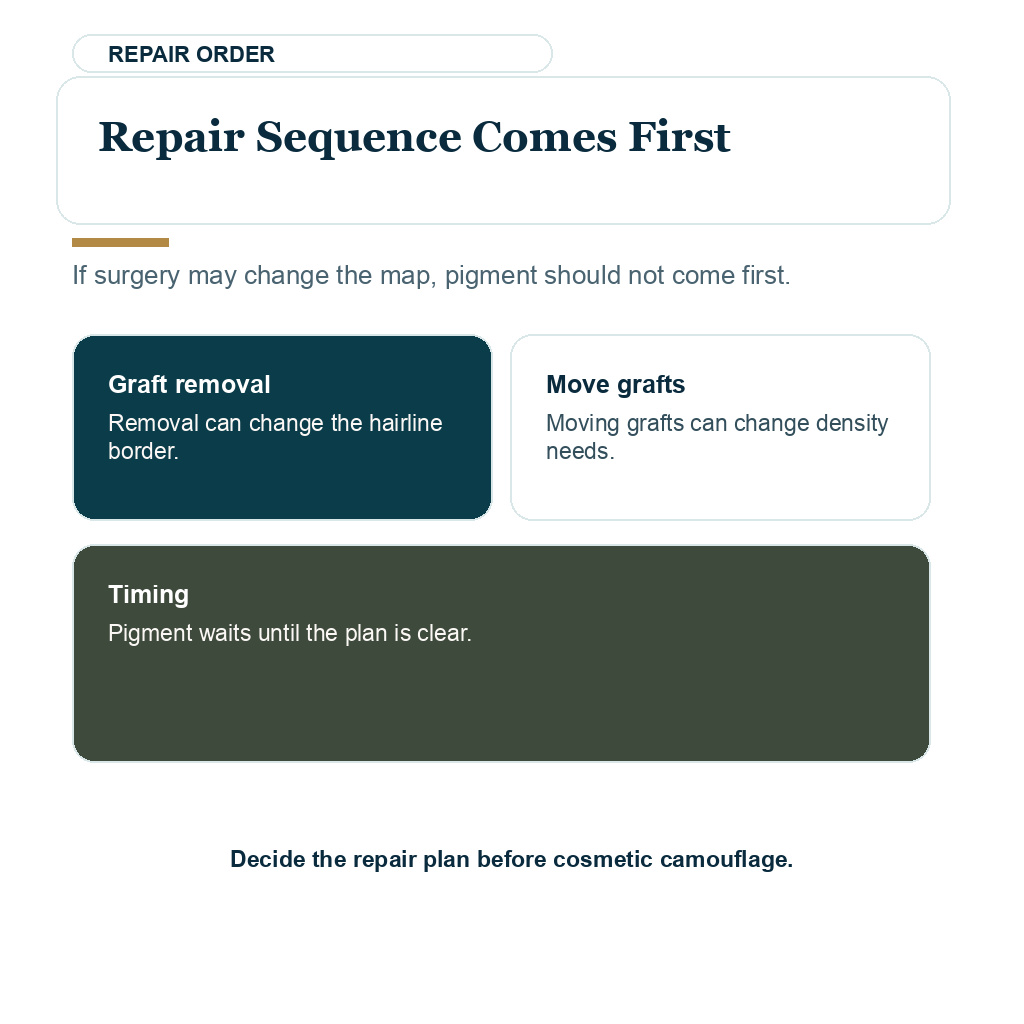
In repair cases, I usually decide the surgical plan first. If more grafts are safe and useful, surgery may change the density map. SMP done before that can end up in the wrong location or become darker than needed. If grafts are not safe, SMP may become a camouflage option, but you need to know why surgery is limited.
For donor repair, I first assess the extraction pattern, hair length, and whether any graft redistribution is possible. Sometimes the best plan is to keep hair slightly longer and avoid more donor trauma. Sometimes selective SMP helps soften contrast. Sometimes the donor has limits no cosmetic dot pattern can fully hide.
For recipient repair, I look at hairline shape, graft direction, density, and future loss. If the hairline needs graft removal or redesign, SMP should wait. If the transplanted hair is stable but visually thin under short hair, a light SMP approach may be considered after the surgical picture is settled.
Add pigment only after growth and skin are stable
If you are ten days or a few weeks after FUE, SMP is usually too early. If you are several months after surgery and the skin is quiet, donor scar camouflage can be reviewed, but I still want the scar to look mature before pigment is placed. For a donor scar, the clock is scar maturity. For recipient density, the clock is final growth, so waiting close to the final growth window is usually wiser than treating the early recovery phase.
The best SMP plan starts with careful timing. It should respect graft growth, donor protection, scar behavior, skin stability, and the haircut you can realistically maintain. When those points are clear, SMP can sometimes be a useful finishing tool. When they are ignored, it can make a transplant look darker without making it look better.
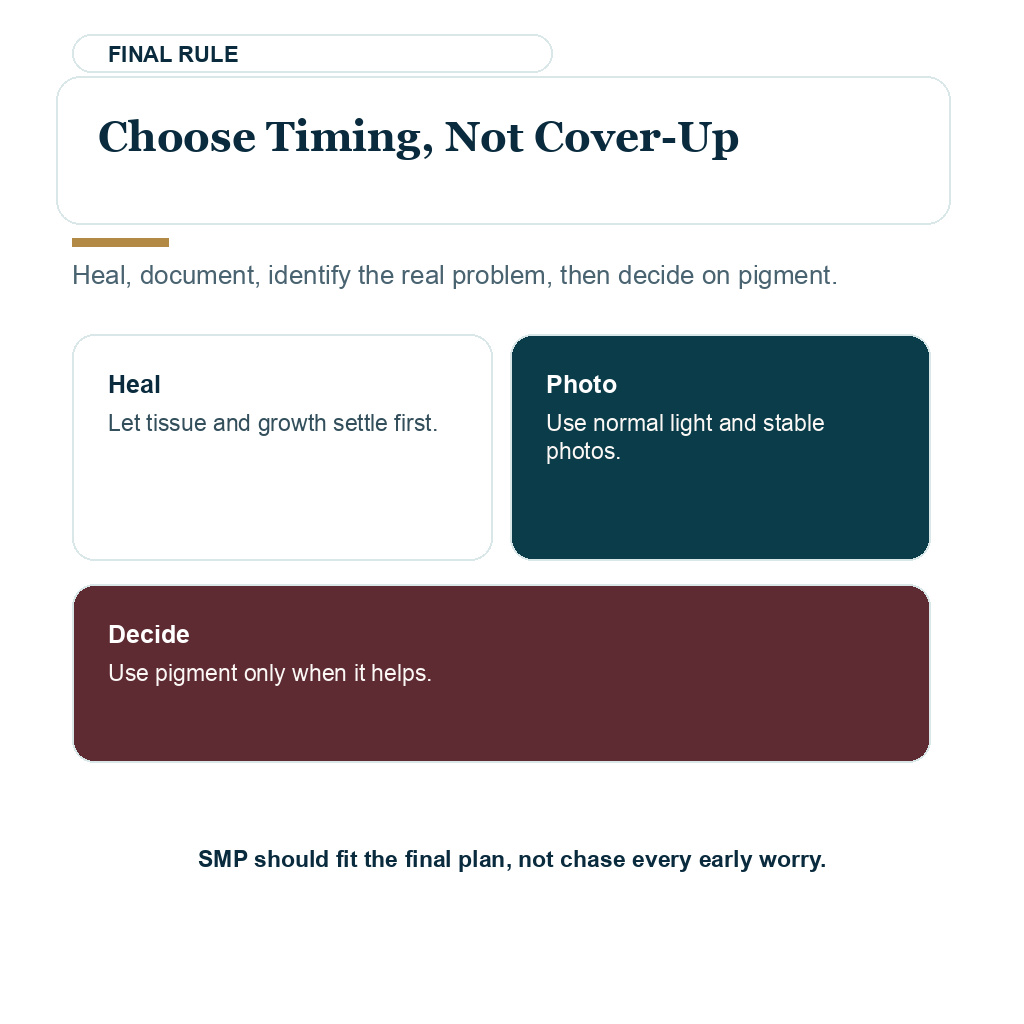
The sequence I use is simple. Let the transplant heal, document the result in normal light, decide whether the concern is scar contrast, density illusion, or surgical design, and only then choose whether pigment should be part of the plan. That sequence protects the result better than rushing to cover every early worry.

Read this review excerpt
Upon arriving home, I sent 4 photos (of each side of head) after every washing process to doctor for checking where I was given personal advice for how to take care of my healing head.