



Ozempic, Weight Loss, and Hair Transplant Timing
Many patients can have a hair transplant while taking Ozempic or another weight loss medicine, but I do not treat it as an automatic yes.
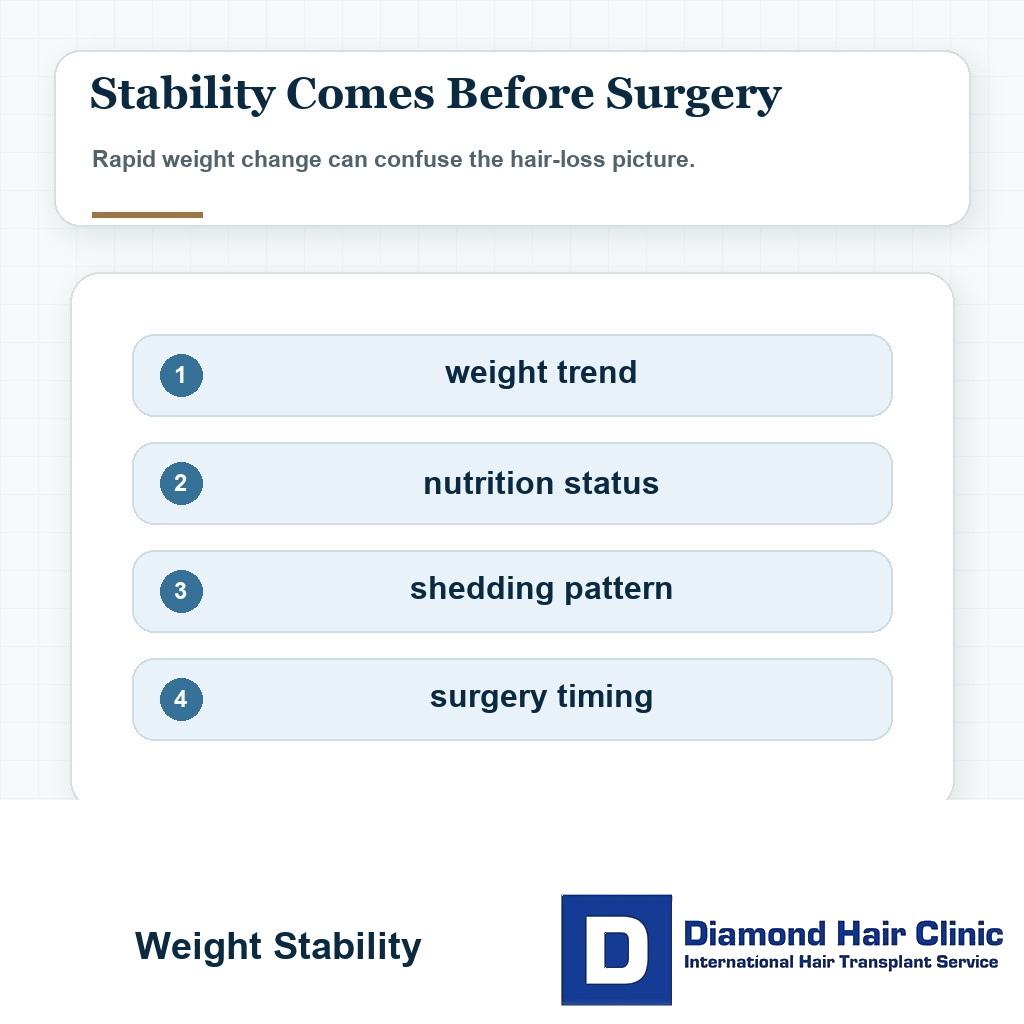
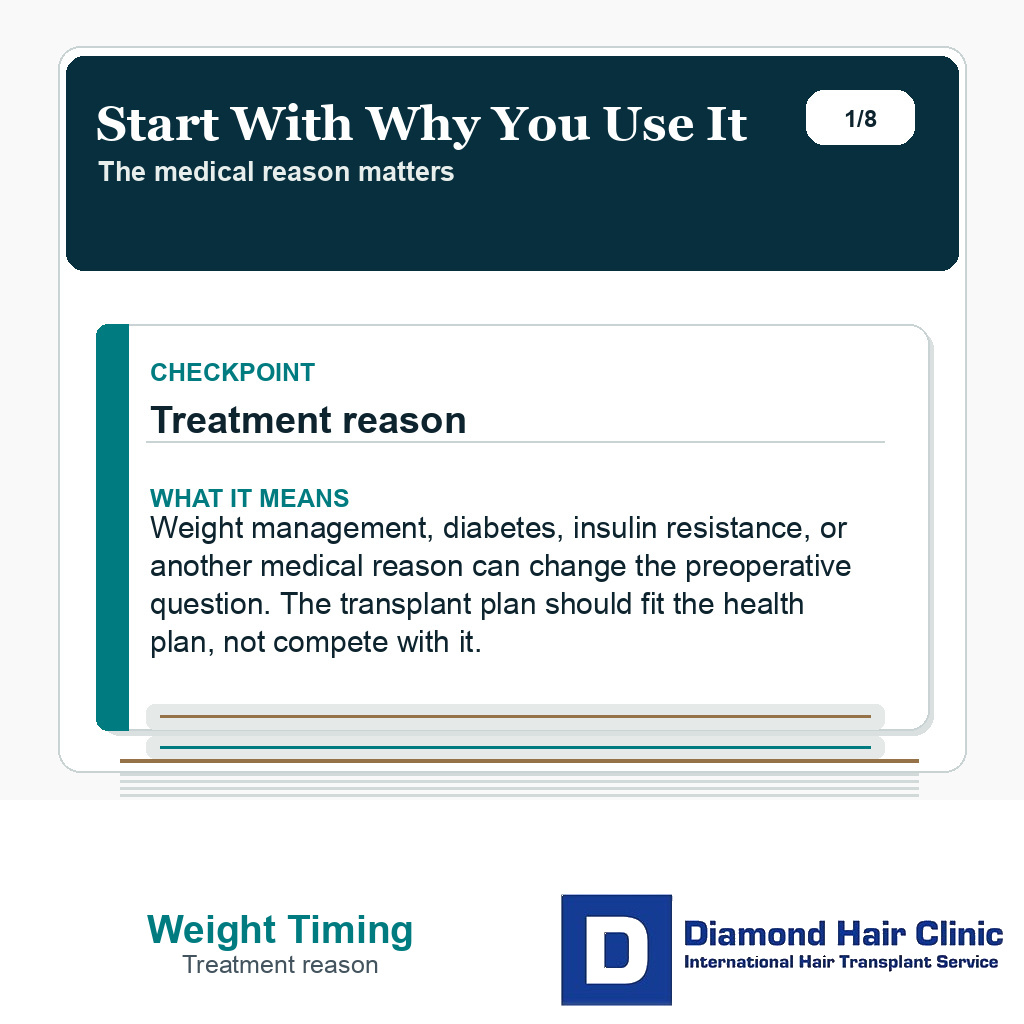
I look at why you take it, whether your weight is still changing quickly, whether you are shedding hair now, whether you can eat enough protein and nutrients, and whether you have nausea, vomiting, dehydration, diabetes, or other medical issues.
If your weight and shedding are stable, surgery may be reasonable after medical review. If the dose is still changing, weight is dropping quickly, or shedding is heavy, I usually prefer waiting until things have been stable for at least 3 to 6 months. Do not stop Ozempic on your own before surgery. The medicine plan should be coordinated with the doctor who prescribed it.
Judging timing while using Ozempic
The brand name is only the start of the discussion. A patient who has been on the same dose for months, eats well, has stable weight, has no severe stomach symptoms, and is not actively shedding is different from someone who has just started the medicine, is increasing the dose, and is losing weight rapidly. Also tell me whether the medicine has changed what you can actually eat during the surgery week, because a stable scale number does not always mean recovery nutrition is stable. Appetite suppression on travel days matters even when the weekly dose has not changed.
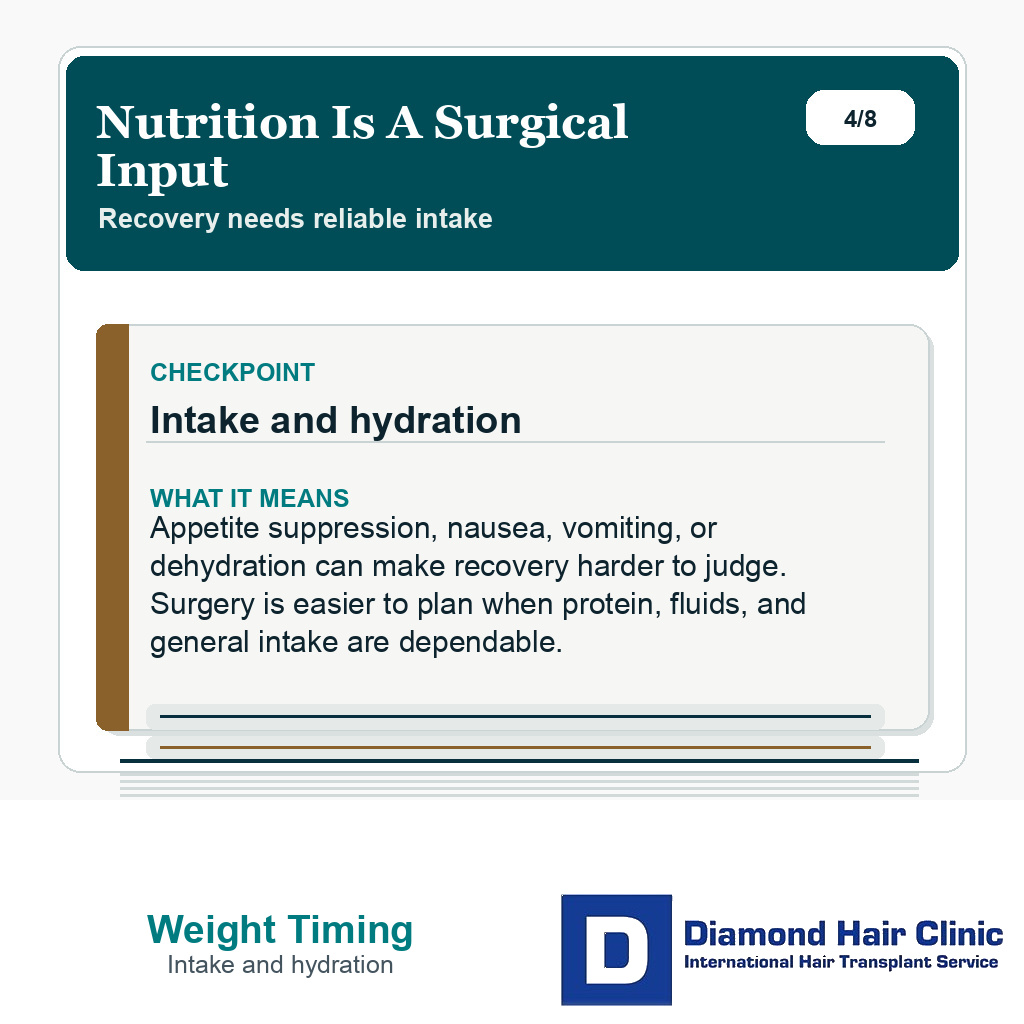
That difference matters because a hair transplant uses a limited donor supply. If the scalp appearance changes every month due to weight loss, calorie restriction, low protein intake, low iron, thyroid changes, stress, or active shedding, the surgical map may not yet be reliable. Appetite suppression from Ozempic can turn a planned deficit into poor recovery nutrition, so I judge dieting during hair transplant recovery by intake, hydration, and shedding stability rather than by the scale alone.
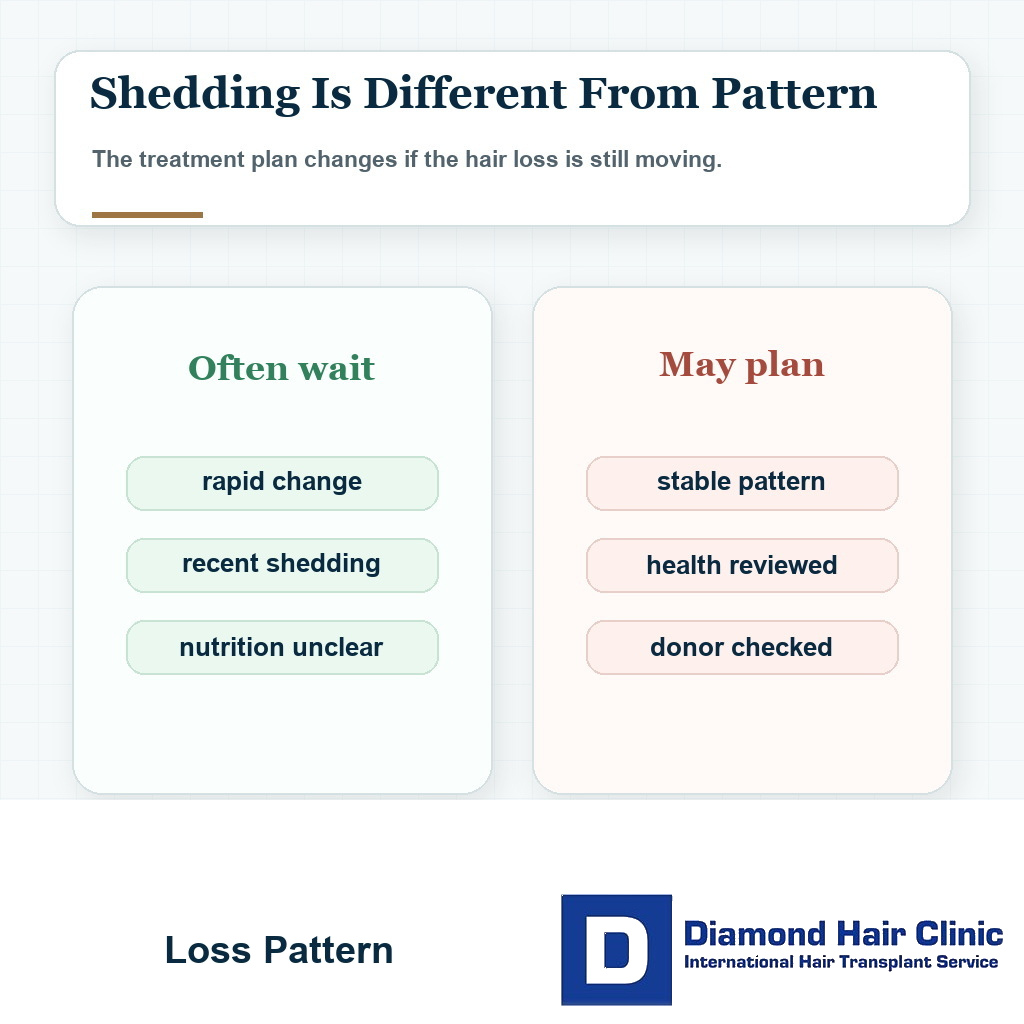
If shedding appears while weight is still changing, I do not treat every thin area as a transplant target. First I separate temporary shedding, nutrition, dose changes, and permanent pattern loss. A surgery date should wait until the hair story is clear enough to protect the donor reserve.
I connect this question with medication before a hair transplant. A prescribed medicine is not necessarily a problem, but it must be understood before surgery. The mistake comes from arriving for surgery without telling the clinic, or changing the dose suddenly because the patient is afraid of cancellation.
When the medicine is helping your health, the hair transplant plan should not interfere with that medical plan. If the medicine is part of a period of rapid body change, the surgery date should respect that timing.
Ozempic, Wegovy, Mounjaro, and Zepbound raise similar timing questions
Many patients say “Ozempic” when they are really referring to a broader group of modern weight loss medicines. Some patients use semaglutide, such as Ozempic or Wegovy. Some patients use tirzepatide, such as Mounjaro or Zepbound. They are not identical medicines, nor are they prescribed for exactly the same reasons, but they raise similar questions in surgical planning.
Newer investigational weight loss medicines raise an extra disclosure question. Retatrutide, for example, is still investigational, so I do not treat an online or compounded product as the same thing as a regulated prescription medicine. If you have used it before FUE, tell the clinic and the prescribing doctor or trial team exactly what you took, when the dose changed, how quickly your weight changed, and whether appetite, nausea, hydration, or shedding has changed.
For surgical planning, the important question is not only the name on the box. The review starts with the reason for treatment and the medicine, dose, timing, weight change, appetite, and stomach symptoms.
This distinction is important because some patients use these medicines for diabetes or metabolic disease, while others use them mainly for weight loss. These are not the same medical situations. A patient with diabetes needs a different level of medical review from a patient who is using the medicine only for weight management.
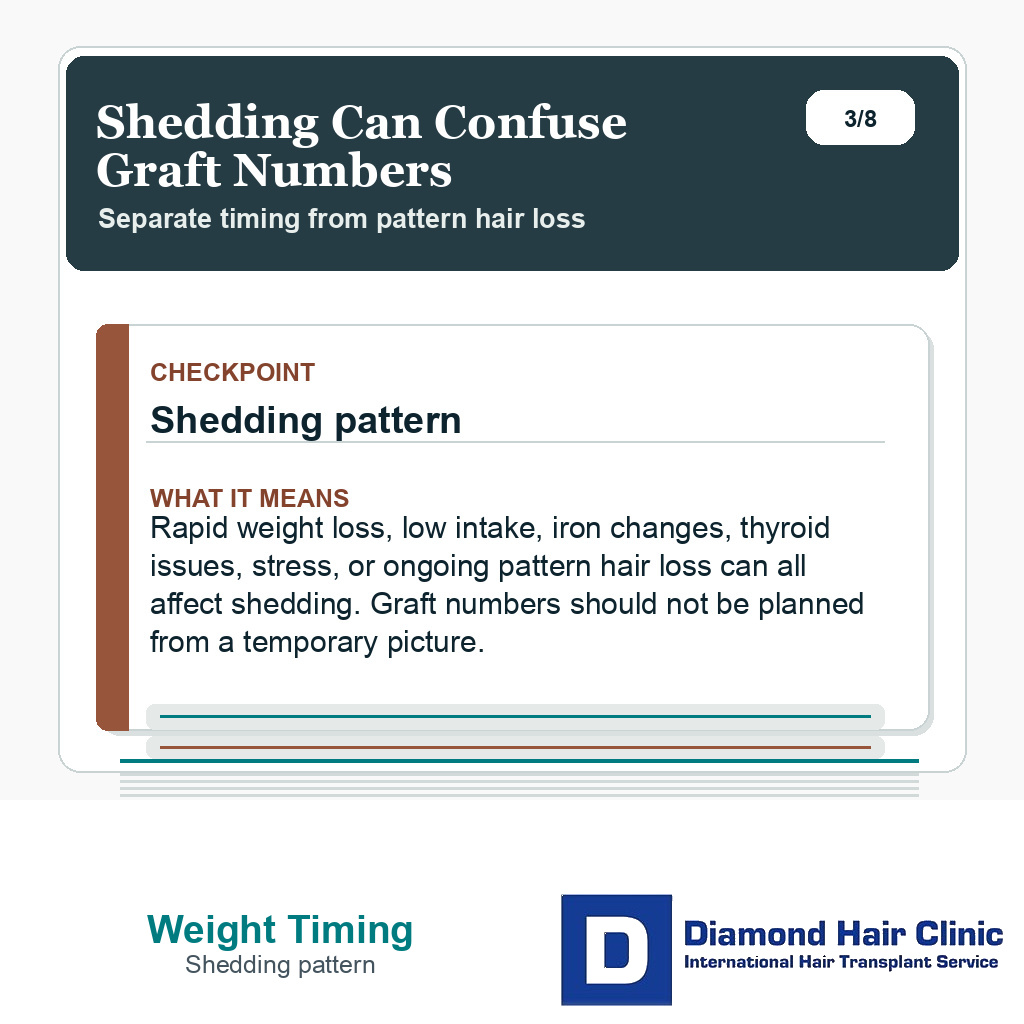
Hair loss can also enter the picture in different ways. I would not assume that the medicine has directly destroyed hair follicles. More often, the concern is that rapid weight loss, low calorie intake, low protein intake, iron deficiency, stress, or metabolic change may push more hair into a shedding phase. In some patients, the timing of the medicine may still be part of the story. For the transplant plan, the decision remains the same. I need the shedding to settle before I plan graft numbers, density, and distribution.
Weight loss shedding can confuse the surgical map
Rapid weight loss can push more hairs into a shedding phase. Patients often notice thinner density, a wider part, more hair in the shower, or a sudden loss of volume. In men who already have male pattern hair loss, this can make the scalp look worse than the stable baseline.
For planning, this can change the map. If I operate while the patient is actively shedding, I may be looking at a temporary situation. The frontal area, mid scalp, or crown may seem to need more grafts than it truly needs before weight, nutrition, and shedding stabilize.
I stay similarly cautious when I think about hair transplant during a minoxidil shed. The cause is different, but the planning problem is similar. When shedding is active, the visible hair map can be misleading.
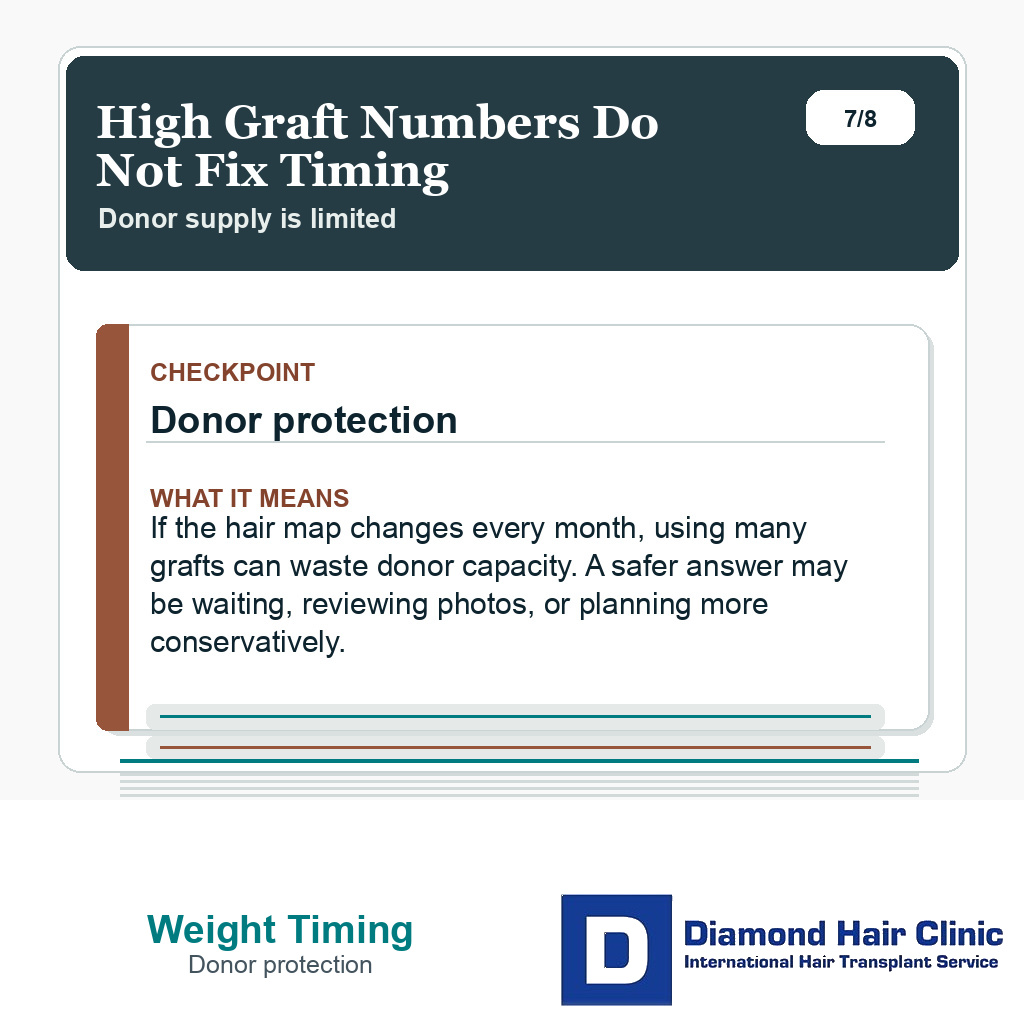
The donor area is not unlimited. If a clinic uses extra grafts because the patient looks thinner during a temporary shedding phase, those grafts cannot be used again later. This belongs among the quiet ways a poorly timed operation can weaken the future plan.
The emotional pressure matters too. Active shedding can make a patient want an immediate fix, and that is exactly when a low hairline, large graft number, or rushed date can start to look tempting. Surgery should not be used as an emergency button while the biology is still moving.
Weight loss shedding usually appears during the active loss phase
This type of shedding does not always appear at the exact moment the patient starts a new medicine. That delay is one reason patients often become confused. A patient may start treatment, lose weight for several weeks, change diet, reduce protein intake, and only later begin to notice more shedding.
Commonly, this type of shedding becomes visible around 2 to 3 months after the trigger, and sometimes the timing is not perfectly neat. The trigger may be rapid weight loss, a major diet change, illness, emotional stress, low protein intake, low iron, a medication change, or several of these factors happening together.
No shedding today does not always settle the timing question. If the rapid weight change happened only recently, I may still want repeated photos, a donor review, and a period of stable eating and weight before travel, because a delayed shedding cycle can appear after the booking already feels fixed.
This delay matters because patients may blame the wrong event. They may say, “I started shedding this week,” but the real trigger may have happened months earlier. If the patient also has male pattern hair loss, the situation becomes even more confusing because temporary shedding and permanent miniaturization can overlap.
I avoid planning a hair transplant from one bad month of photos. If the patient is in the middle of shedding from rapid weight change, the crown may look emptier, the mid scalp may look weaker, and the hairline may seem more exposed. But part of that picture may improve when the body stabilizes.
This timing also affects the emotional side of recovery. If a patient has surgery during or soon after active shedding, normal transplanted hair shedding, temporary native hair shedding, and weight loss related shedding may all be mixed together. This can make the patient think the surgery failed when the timeline is actually more complicated. The same confusion can happen with native hair shock loss after a hair transplant, where the patient needs a clear explanation of what is temporary and what is permanent.
Reasons I would delay surgery instead of operating now
I would delay surgery if the patient has started Ozempic recently, is still in the dose increase period, is losing weight quickly, cannot eat enough, has ongoing nausea or vomiting, feels unwell or dehydrated, or is shedding heavily. I would also delay if blood work suggests a medical cause of shedding that has not been treated yet.
The timing I often look for in this situation is 3 to 6 months of stability. That point does not mean every patient must wait exactly that long. It means there should be enough time to see whether the shedding is calming, whether weight is stabilizing, and whether nutrition is strong enough for surgery and recovery.
When hair loss is active, I may also want a longer observation period, especially in young patients or diffuse thinners. In that setting, when medication can delay a hair transplant is not a negative idea. Waiting can protect the donor area and make the operation smaller, cleaner, and more logical.
Delay is not a punishment. It is sometimes the only way to avoid building an operation on unstable information. A hair transplant is elective surgery. It needs planning when the patient is medically ready and when the hair loss pattern is clear enough to treat responsibly.
Checks before choosing a surgery date
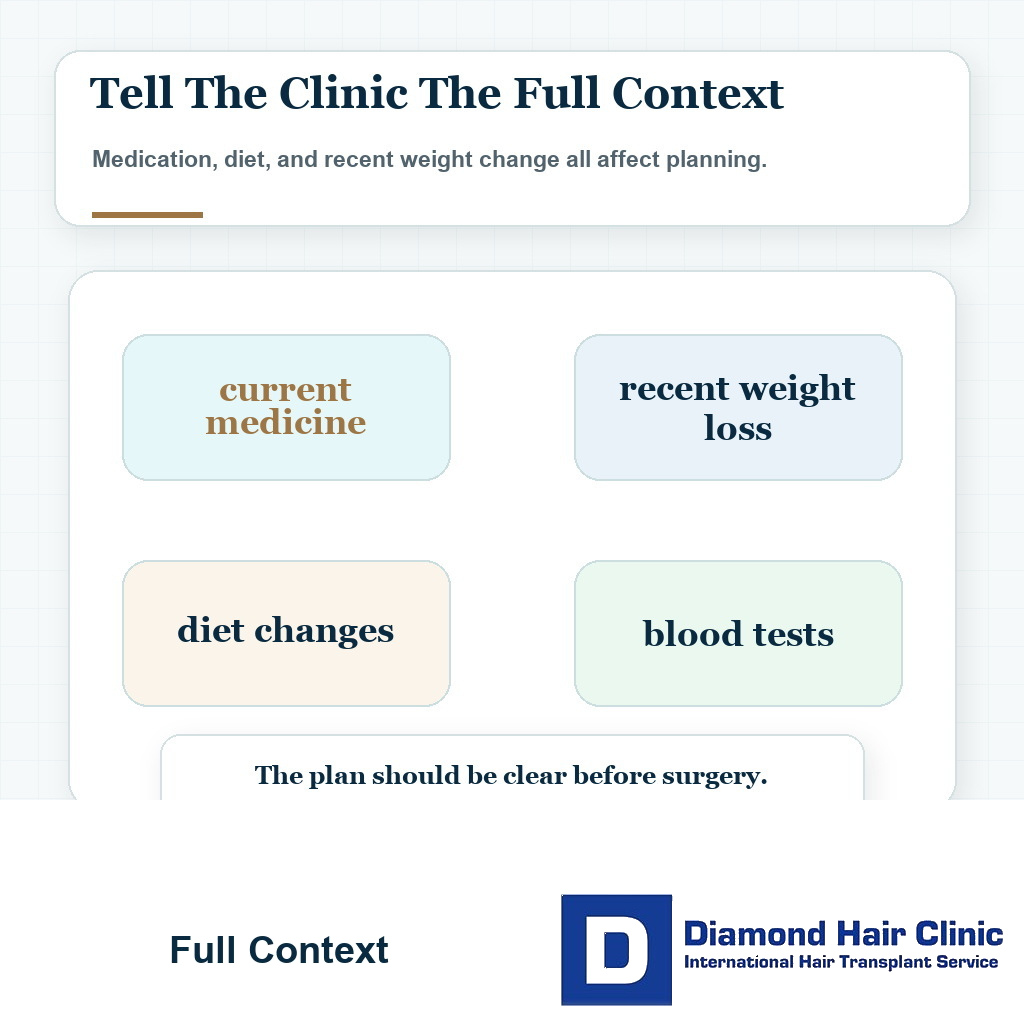
Before choosing a date, I need a clear medication list, dose history, weight change history, blood pressure history, diabetes status if relevant, and any stomach symptoms. I check whether the patient has changed diet dramatically or is struggling to eat protein. I need to know whether you can eat a normal recovery meal, not only whether the last injection was on schedule.
For many patients, blood tests before a hair transplant are useful because they show whether there is anemia, abnormal blood sugar, infection risk, clotting concern, or another issue that should be addressed first. Blood work does not replace surgical judgment, but it helps the judgment become safer.
If the patient is shedding, I pay close attention to iron stores and general health. The discussion about low ferritin or anemia before surgery matters because nutritional or blood related problems can make a surgical plan look weaker than it really is.
The prescribing doctor should be involved when the medicine is being used for diabetes, heart risk, or another medical reason. A hair transplant surgeon should not casually tell a patient to stop a systemic medicine without understanding why it was prescribed.
Share the medicine early instead of worrying that the clinic may refuse surgery. Hiding it creates more risk than the medicine itself. A careful clinic can usually make a safer decision when the facts are clear.
Ozempic can change anesthesia and medical safety review
For most hair transplant patients, the operation is performed under local anesthesia. That means the main safety questions are different from a major operation under general anesthesia or deep sedation, where delayed stomach emptying is a larger concern. Still, the medicine can matter if the patient has severe nausea, vomiting, dehydration, poor food intake, blood sugar problems, or if sedation is planned.
There is no single public rule that every patient must stop or continue the medicine. Some patients can continue normally. Others need coordination with the prescribing doctor, the anesthesia plan, or the clinic’s medical team.
The injection date is only one part of the safety review. Dose escalation, higher doses with symptoms, nausea, vomiting, reflux, constipation, poor intake, dehydration, and diabetes control issues all change the decision. A fixed internet rule to stop for one week can be too rigid, and a fixed rule to continue no matter what can be unsafe. The prescribing doctor and surgical team should make the decision from the actual risk picture.
If a patient has strong stomach symptoms, the surgery date needs more caution. A long surgical day requires the patient to tolerate lying down, sitting still, eating around the procedure, drinking enough, and recovering steadily. If the patient already feels unwell, the hair transplant date should not be forced.
There is also the issue of blood sugar. Some patients use the medicine for weight management, and some use it for diabetes. These are not identical surgical situations. Diabetes control, wound healing, infection risk, and medication timing must all be reviewed carefully.
The medicine is not something to make frightening. It belongs inside proper medical planning.
Recent Ozempic starts or dose increases
The early period of treatment matters. A patient who recently started Ozempic, Mounjaro, Wegovy, or a similar medicine may still be adjusting to appetite change, nausea, reflux, constipation, vomiting, dehydration, or rapid weight loss. The same can happen after a dose increase.
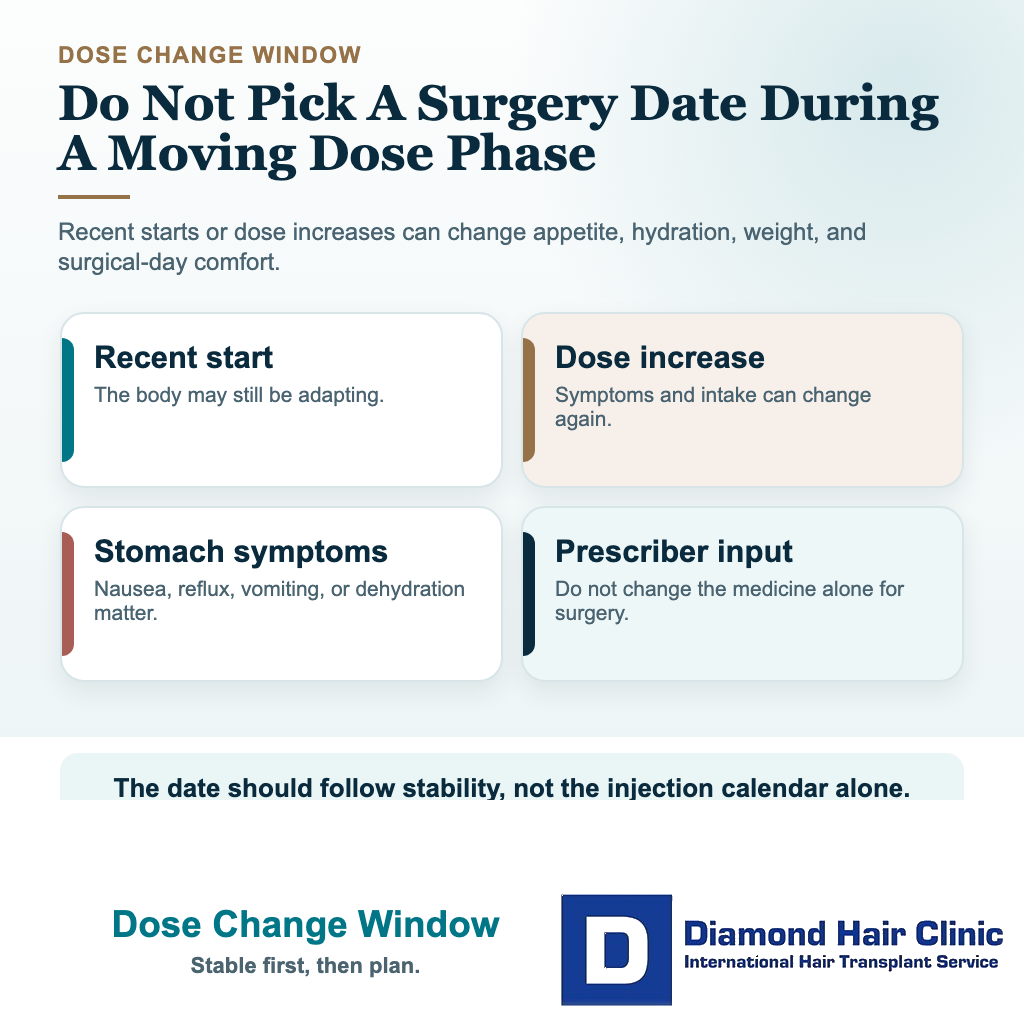
Surgery is not always impossible. The date cannot be chosen as if nothing is changing. If the patient is still struggling to eat, drink, sleep, or keep blood sugar stable, delay is safer than operating during a medically unsettled period.
I also focus on the surgical day itself. Hair transplant surgery is long. Even under local anesthesia, the patient needs enough energy, hydration, comfort, and cooperation to tolerate the procedure. If sedation is being considered, stomach symptoms and delayed gastric emptying become more relevant. A patient who arrives nauseated, weak, dehydrated, or afraid to eat normally is not in the best condition for an elective operation.
The prescribing doctor should guide any medicine change. The clinic can explain the surgical plan, the expected length of the day, and whether sedation is planned. The doctor who prescribed the medicine should help decide whether the current dose, timing, and symptoms are stable enough for surgery.
Diabetes changes the decision
For diabetes prescriptions, I evaluate the case through the diabetes plan first. A patient with controlled diabetes may be a reasonable candidate. A patient with unstable readings, poor healing history, active infection, or unclear medical treatment should slow down before an elective operation.
Hair transplant with diabetes follows the same broader medical logic. The key point is not whether a patient has the diagnosis. The key point is whether the condition is controlled enough for thousands of small donor and recipient area openings to heal safely.
Do not stop or change diabetes medicine without medical supervision. Poor blood sugar control can be more dangerous than the concern that made the patient stop the medicine, so the prescribing doctor has to stay involved.
If the patient is using it only for weight management, I still review health history carefully. Obesity, high blood pressure, reflux, sleep problems, and metabolic issues can all affect the procedure day. The medicine may be only one visible part of a larger medical picture.
Transplant surgery cannot fix active shedding from weight loss
A hair transplant does not fix temporary shedding from rapid body change. Surgery moves donor grafts to areas that need permanent restoration. It does not stop a body wide shedding cycle, and it does not make poor nutrition disappear.
If shedding is temporary, the best surgical decision may be to wait. If the patient also has male pattern hair loss, then surgery may still be useful later, but the plan should be built around the permanent pattern, not the worst month of shedding.
This connects directly with having surgery while hair loss is still active. The unsafe part is not only poor growth. The unsafe part is designing the hairline, density, and graft distribution around a moving target.
Some patients think a transplant will refill every thin area created by shedding related to medicine. That is usually the wrong way to think. If the whole scalp is shedding, chasing it with grafts can waste donor capacity. First understand the cause, support recovery, and then decide which areas truly need surgical restoration.
Starting Ozempic right before surgery adds uncertainty
When the medicine is not urgent, I usually prefer not to start it immediately before a hair transplant. The first weeks on the medicine can bring appetite change, stomach symptoms, weight change, and sometimes shedding from the body adjusting. That is not the cleanest background for surgery planning.
When the prescription is for diabetes, heart risk, or another medical reason, the prescribing doctor’s plan comes first. This does not mean delaying necessary medical treatment for hair. It means that when timing is flexible, separating a new systemic medicine from surgery often makes the recovery easier to understand.
A good plan goes beyond whether the medicine is allowed. The first month after surgery also needs to be predictable. When too many changes happen at once, every concern becomes harder to interpret.
This is also one reason some hair transplant results look thin. Sometimes the difficulty is not that the grafts were placed. The difficulty is that the operation was planned during an unstable biological period, or the native hair kept changing around the transplanted area.
Starting Ozempic soon after surgery can wait when timing is flexible
If a prescribed GLP-1 medicine was paused for surgery, restarting it is a separate decision from beginning treatment for the first time. The surgeon and prescriber should review the dose, reason for the pause, food and fluid intake, nausea, vomiting, diabetes control, and any planned dose increase before the next injection.
This is a question I expect to hear more often. Some patients are not taking Ozempic before surgery, but they want to start it shortly after the operation. I would not say that the medicine automatically damages transplanted grafts. That would be too simplistic. The concern is different. Aggressive weight change, poor appetite, dehydration, vomiting, or very low protein intake during the early recovery period can make healing and shedding harder to interpret.
The first weeks after surgery are not the ideal time to create unnecessary stress for the body. During this period, the focus should be hydration, stable nutrition, enough protein, careful washing, sleep, and steady healing. If you are also planning strict fasting after a hair transplant, settle that timing before the surgery date. I explain the wider recovery logic in my article about hair transplant aftercare.
When the prescribing doctor believes continuation or initiation is medically needed, coordinate that decision medically. Do not ignore diabetes or metabolic treatment because of a hair transplant. But if the medicine is elective and the timing is flexible, avoid adding a major new variable while the scalp is still healing.
Starting a new medicine, increasing the dose, changing diet, adding hair loss medication, and recovering from surgery at the same time can make the next few months confusing. If shedding occurs, the patient may not know whether it is normal shedding after surgery, native shock loss, shedding from weight change, shedding related to medication, or ongoing male pattern hair loss.
Changing fewer variables usually gives a cleaner recovery timeline. If possible, stabilize the treatment plan before surgery, or let the early recovery period settle before making a major new change. The decision is not about fear. It keeps recovery easier to interpret and gives the grafts and native hair a healthier environment.
The 8 slides here connect weight loss pace, nutrition, shedding, medication timing, and donor planning before surgery. Swipe sideways, use the arrows, or choose a number below the image.



Ozempic timing promises that deserve caution
A clinic should not say the medicine does not matter at all without asking why you take it, how long you have taken it, whether you are shedding, and whether your weight is stable. It should also not use fear and tell every patient that surgery is impossible.
The answer depends on the individual case. The consultation should review nutrition, weight trend, diabetes, stomach symptoms, blood work, medications, and the pattern of hair loss. A plan that skips those factors and jumps straight to graft numbers is too thin medically.
Some clinics will use a patient’s fear to push a quick date. They may say that surgery will solve the shedding, or that a high graft number can cover everything. That is not how I plan. A high graft number cannot correct poor timing.
Vitamins after a hair transplant are not a guarantee. They can support recovery when used sensibly, but they do not replace diagnosis, stable nutrition, careful donor management, or an operation timed well.
A careful clinic should leave the patient clearer, not more confused. Before travel, it should be clear when surgery is reasonable, when it is wiser to wait, and what the medicine plan should be.
Planning the operation more safely
Safer planning means looking at medical stability, hair loss stability, nutritional strength, and donor protection together. If one of those parts is unstable, the responsible answer may be to slow the plan down rather than force a surgery date.
If those answers are good, the plan can move forward. If one answer is unclear, I do not always cancel the idea of surgery. I find the unclear part first. Sometimes the solution is blood work. Sometimes it is better protein intake. Sometimes it is a review with the prescribing doctor. Sometimes it is waiting for shedding to settle.
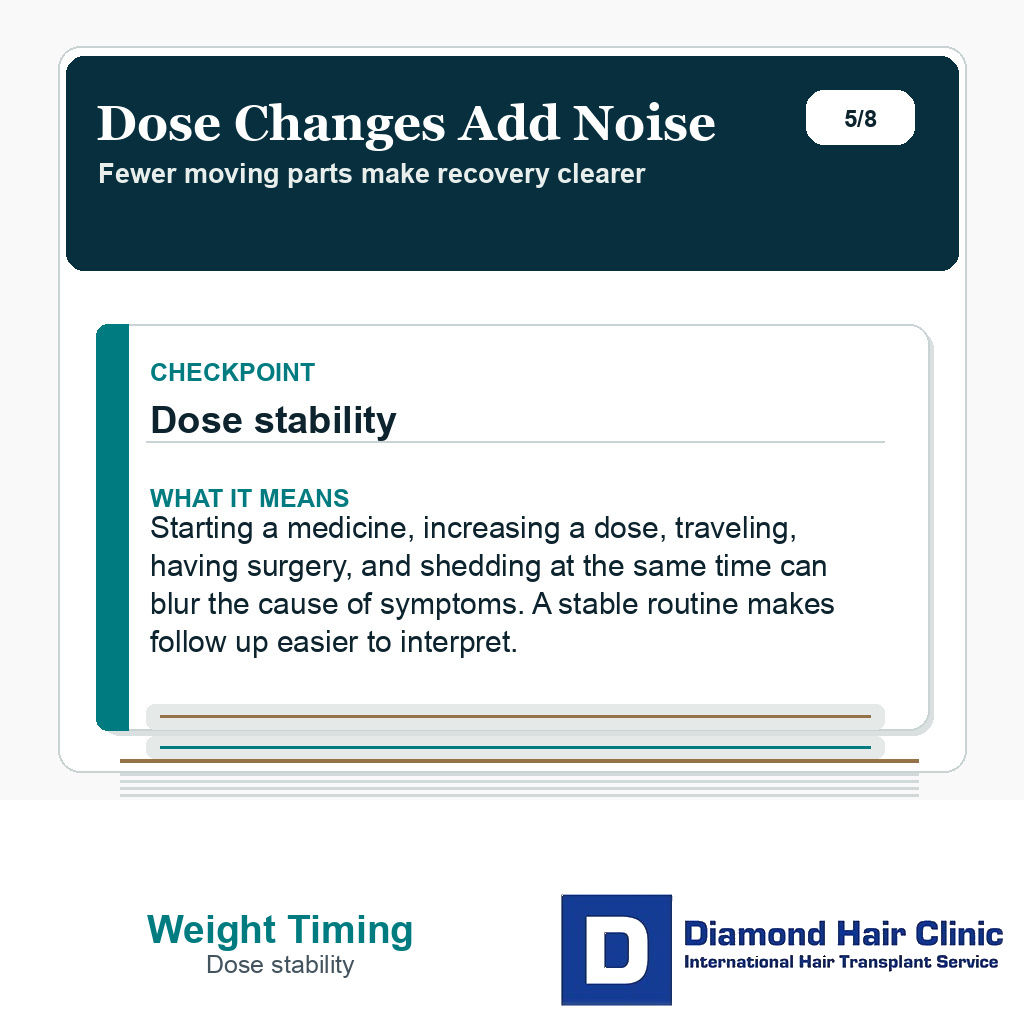
Avoid changing several things at once if you can. Starting the medicine, changing dose, starting oral hair medicine, stopping topical treatment, changing supplements, traveling, and having surgery in the same short window can make recovery very confusing.
I treat oral minoxidil around surgery with the same attention. It can be helpful in carefully chosen patients, but it is another systemic medicine. If the patient starts or changes too many things together, later shedding becomes very hard to interpret.
A steadier plan is usually better. Stabilize the medical background, confirm the scalp pattern, protect the donor area, and choose a conservative design if the future is uncertain. The result is more realistic when the plan respects what the body is doing.
Transplant surgery on Ozempic is more reasonable when health is stable
Surgery while taking the medicine is more reasonable when the patient is on a stable dose, has no severe stomach symptoms, is hydrated, is eating enough, has stable weight, has no heavy active shedding, and has medical conditions under control. It is also more reasonable when the surgical goal is clear and does not depend on temporary hair loss from rapid weight change. A stable dose still needs a stable food pattern, so describe what you can actually eat and drink in a normal surgery week.
You still need to be a true surgical candidate. The question of being a good candidate for a hair transplant depends on donor capacity, age, hair caliber, hair loss pattern, expectations, and the future plan. The medicine does not remove those questions.
If the hairline is clearly receded and stable, surgery may still make sense. If the crown or mid scalp is changing every month, waiting may be wiser. If the patient has diffuse shedding across the whole scalp, I would be careful with treating it as a transplant problem too early.
Do not make the decision from fear. Do not stop a prescribed medicine without your doctor, and do not rush surgery while your body is still changing quickly.
If the medical situation is stable and the hair loss pattern is clear, the medicine does not by itself prevent a careful hair transplant. If the situation is unstable, waiting can be the decision that protects the donor area, the diagnosis, and the final result.

Read this review excerpt
He was very thorough in every little detail and I never felt pressure to do anything I wasn’t sure of.