



Another Hair Transplant May No Longer Be Worth It
If you have already had two, three, or more hair transplants, the question changes. I am not asking only whether another surgery can be done. I am asking whether the visible improvement is worth spending more of a limited donor area. At this stage, I stop recommending surgery when the donor reserve is weak, the gain is small, or the next operation is mainly trying to relieve disappointment rather than solve a clear surgical problem.
Another hair transplant only makes sense when it protects the donor area and improves a specific visible problem. If it cannot do both, I pause the surgery discussion and review styling, scalp micropigmentation, medication, or shaving. This is not a pessimistic answer. It is donor management.
Before another operation, write down the exact visible change that would make the surgery worth the donor cost and recovery burden. If that change cannot be named clearly, the safer review may be stopping, styling differently, or getting a second opinion. Even a small density touch can waste grafts that the donor area may need for a larger future change.
If every new plan depends on growing the donor hair longer to hide extraction marks, the donor area has become part of the result. That is the moment to compare one more surgery with SMP, scar management, a shorter hairstyle, or stopping before more donor is spent.
Another hair transplant needs a clear target
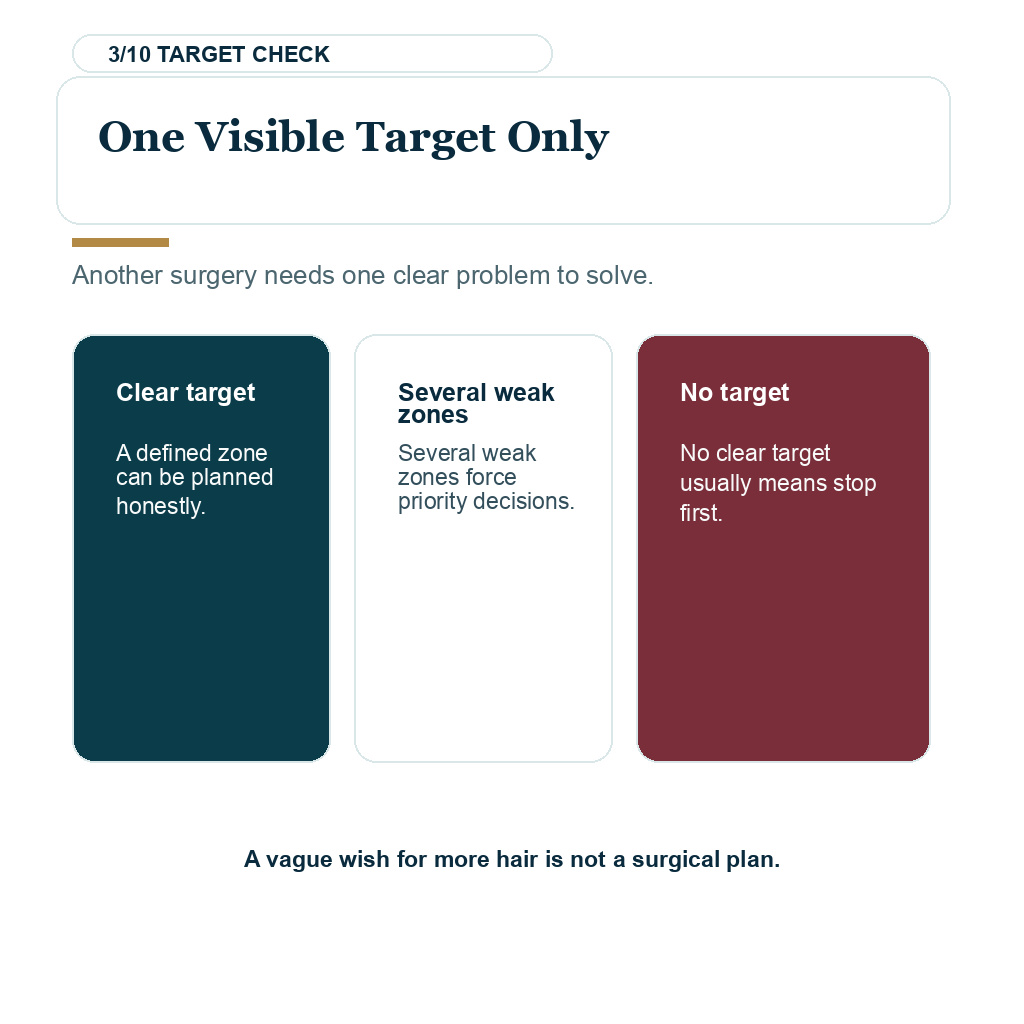
Another operation can be reasonable when the previous work healed well, the donor area still has enough stable hair, and the new goal is limited. A small hairline refinement, a carefully chosen crown improvement, or a repair of sparse areas can sometimes make a meaningful difference. The clearer the target, the safer the conversation becomes. There should be one visible problem, one limited plan, and a clear understanding of what will remain unchanged.
Clear records from earlier procedures, healthy scalp skin, and a modest graft request make a later session safer to consider. If the first operations used the donor area wisely, a later session can still be planned with discipline. Even when a third hair transplant can be safe in selected cases, the decision becomes more personal after every procedure because each session spends more donor reserve.
Proving that one more surgery can be done is not enough. The harder decision is whether it is worth doing.
Repeated surgery becomes harder each time
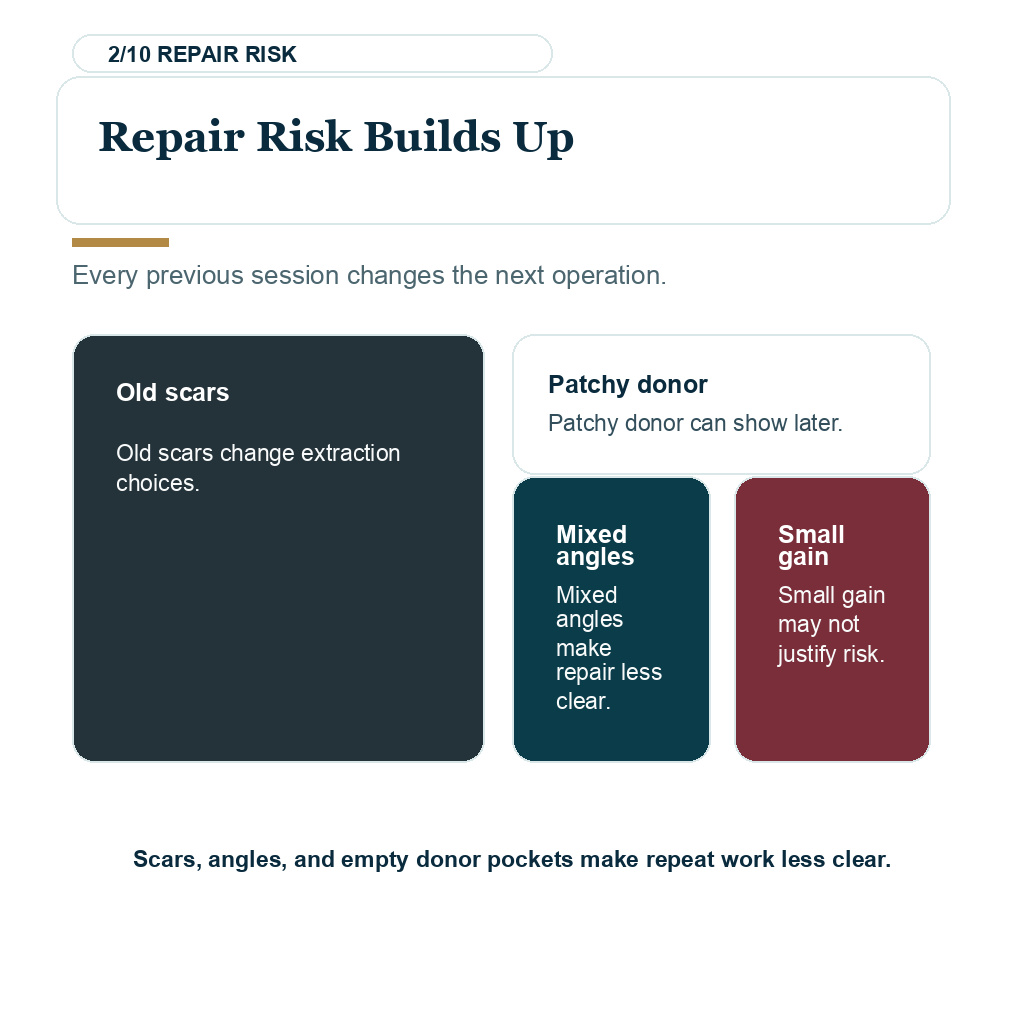
Every transplant changes the scalp. The donor area has fewer untouched follicles. The recipient area may have scar tissue, older graft direction, mixed density, and native hair that continues to thin. The next operation is no longer a clean first plan. It is surgery on top of surgery.
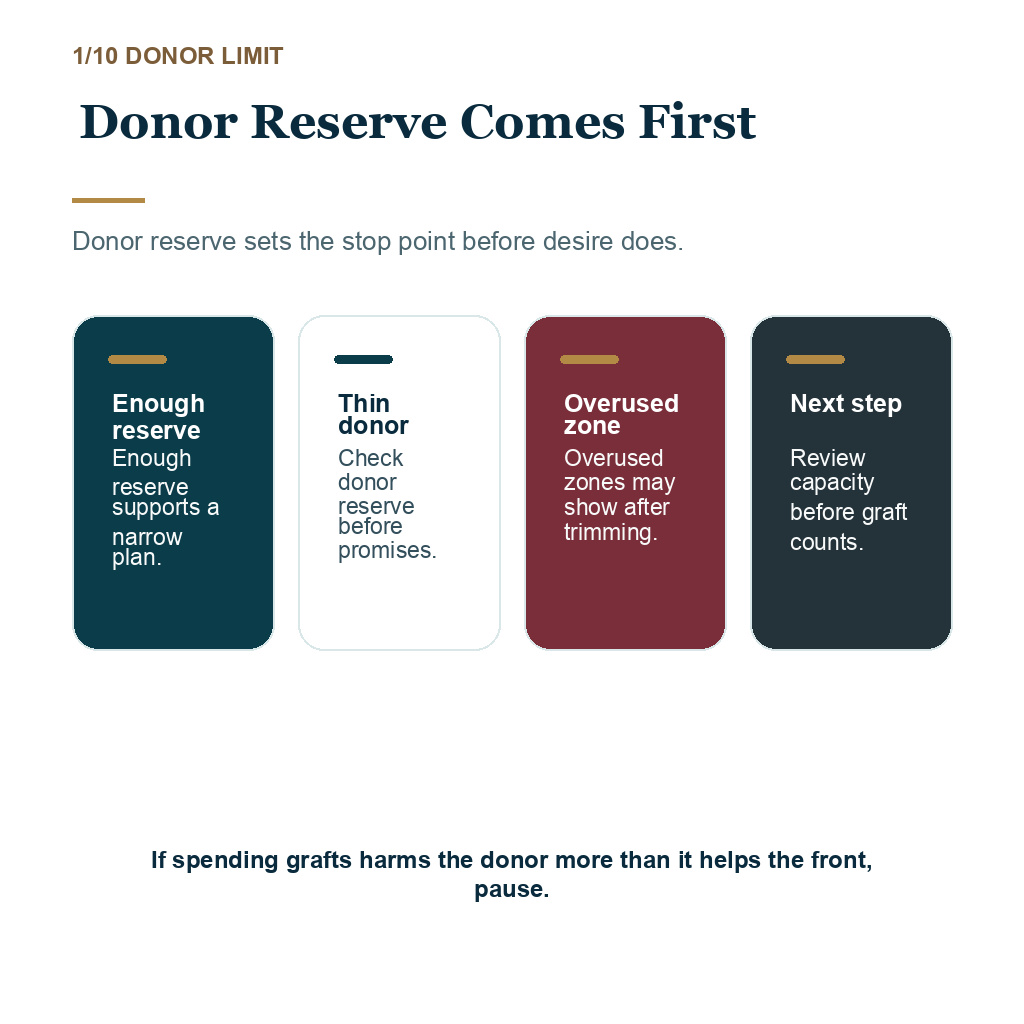
A fourth operation should not be judged by the graft number a clinic says it can extract. A high number can sound encouraging, but too many grafts in the wrong area can weaken survival, damage existing hair, or create a donor problem that becomes more visible with short hair.
More surgery can make the result harder to repair if the donor area is already stretched. You may still have a bald crown, a thin middle scalp, or an unnatural hairline, but the donor reserve may no longer be strong enough to fix everything. That is the moment when clinical judgment matters more than optimism.
Donor details after previous FUE
I examine the donor area under good lighting, with the hair at a realistic length. Patchiness, uneven spacing, visible FUE dot scarring, weak zones above the ears, and poor blending all change the plan. Density alone is not enough. If donor hairs are miniaturizing, those hairs are weak currency for a repair plan. I also ask how short you want to cut the hair in daily life. When possible, I need to see the donor dry, gently lifted, and at or near the shortest haircut you actually expect to wear.
A donor area can look acceptable at medium length and still be too fragile for another large session. That difference is important. If the hair has to stay long to hide extraction changes, the donor is already sending a warning, similar to the warning signs I describe in donor area overharvesting. I also look at the extraction pattern, because scattered, balanced extraction is very different from one zone being visibly emptied.

The remaining donor area decides whether another operation can still help.
I also separate temporary shock loss from true donor depletion. If the donor is still recovering, I wait. If the donor has permanently thin zones, the conversation changes from extraction to camouflage, styling, or repair expectations. An overharvested donor area repair is much more limited than a normal transplant plan.
Crown may be the wrong place to spend more grafts
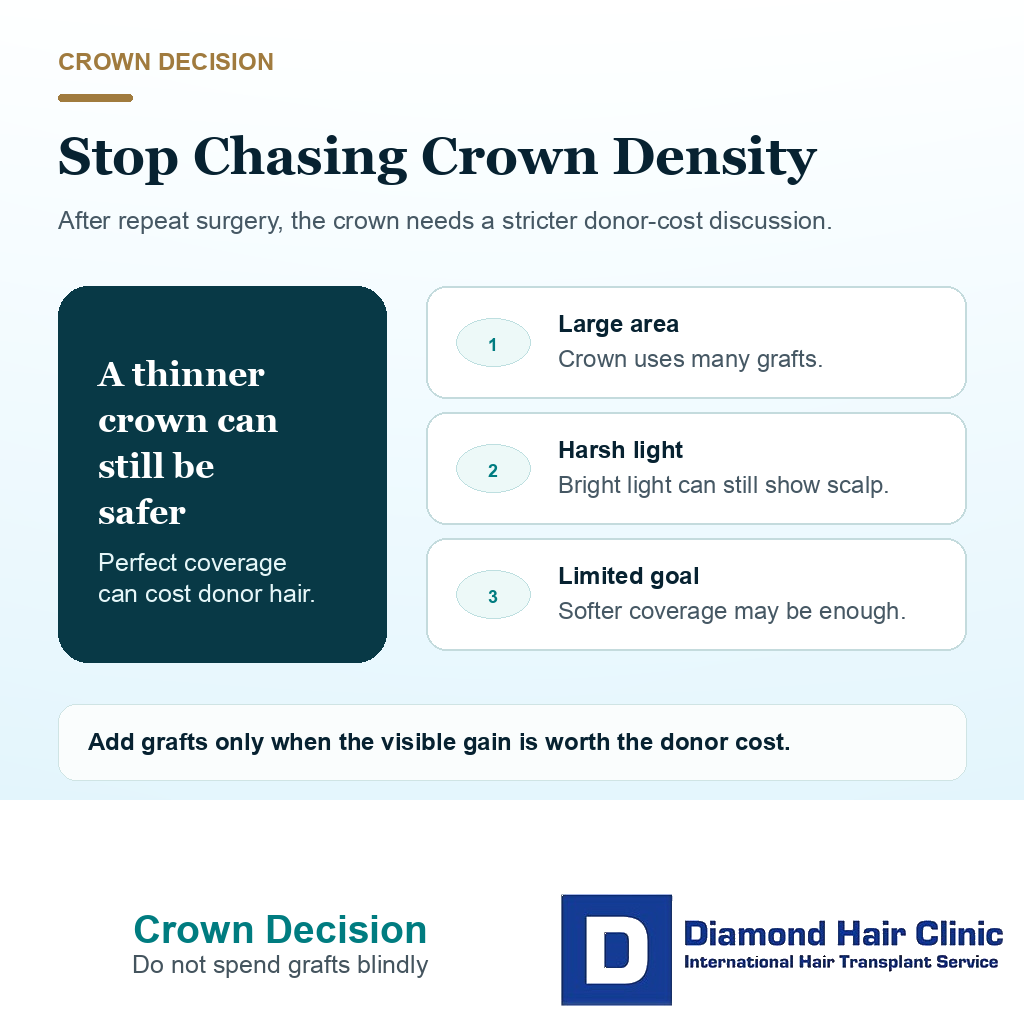
The crown is one of the easiest areas to chase and one of the hardest areas to finish. It has a circular pattern, it consumes many grafts, and it often looks thinner under bright light or when the hair is wet. You may feel that the transplant failed because the crown still looks sparse, even when the hairline and middle scalp improved.
Before I add grafts to the crown, I ask what you expect the crown to do. A crown session meant to soften the area is different from one meant to create full density under every light. The first may help when the donor supports it. The second usually spends grafts and still disappoints.
Advanced hair loss needs a distribution strategy, not reflexively another operation. With Norwood 6 or 7 loss, the conservative plan is often a long term distribution strategy, not one more attempt to fill every area. For Norwood 6 and 7 planning and advanced baldness in one session, caution matters more than chasing another procedure.
SMP can be a better option than more grafts
Scalp micropigmentation can help when contrast is the main concern, not when every possible hair needs to be replaced. It may reduce the contrast between pale scalp and dark hair in a low density area, or make FUE dot scarring less obvious when the donor has already been pushed too far.
But SMP is not a transplant result. It does not create hair length, movement, or true density. It works best as camouflage around a stable haircut and realistic expectations. If the hair is long, wet, or parted, the limitation may still show, which is why scalp micropigmentation with hair transplant results has to be discussed as camouflage, not as new hair.
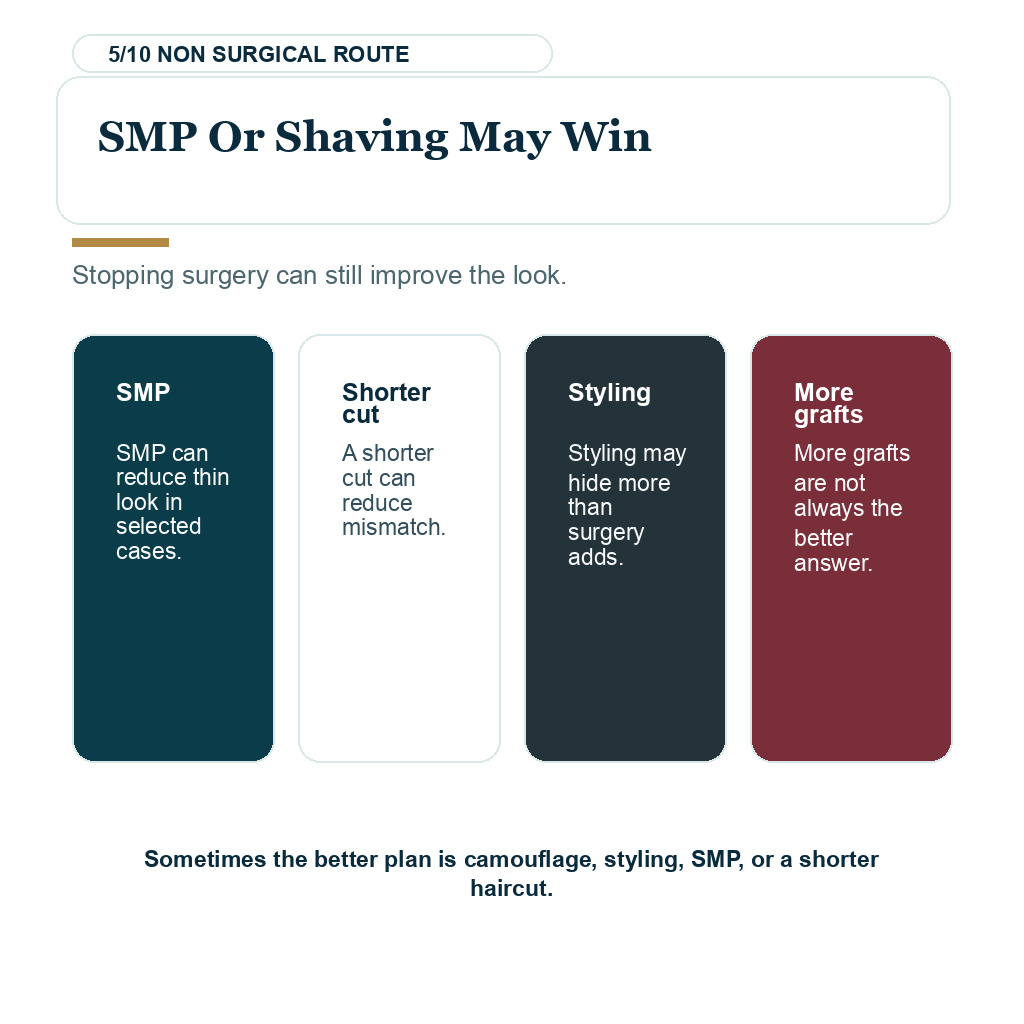
SMP can be useful when the donor cannot safely pay for another large session. I do not use it as a way to hide poor planning. I use it as one option when surgery would take more than it gives.
Shorter haircut can be the better option
Sometimes the better option is not another transplant. It may be a shorter haircut, a different styling routine, SMP, or shaving the head. This can be difficult to hear, especially after years of procedures and money already spent. But continuing surgery only because previous surgery was emotionally expensive is not good medical reasoning.
I look at whether you can wear a shorter haircut without the donor scars becoming too obvious. This is different for each person. Large FUE sessions can limit very short fades, while FUT scars create a different linear issue. If a clean shaved style is part of the fallback plan, shaving your head after a hair transplant has its own limits from donor scarring.
If a patient wants to shave but the donor has visible extraction damage, I discuss camouflage first. If the patient wants to keep medium length hair, I judge whether the remaining density can still look natural at that length. The same operation can be reasonable for one haircut and unreasonable for another.
Records that matter before deciding
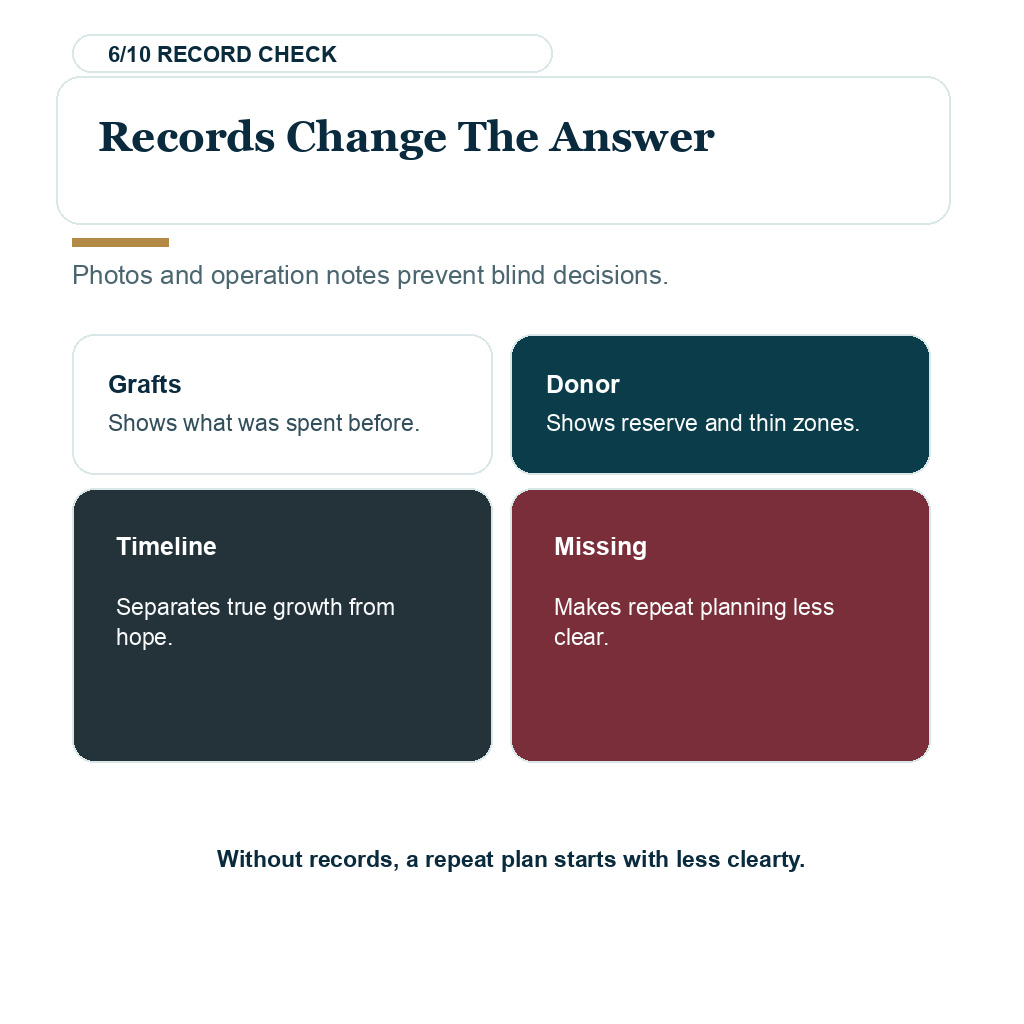
For a repeat case, records matter. I want to know how many grafts were extracted, from which zones, which areas were implanted, whether FUT or FUE was used, whether beard or body hair was used, and how the result changed over time. A total graft number is useful, but the distribution matters more. Two thousand grafts taken carefully from a wide safe area is not the same as two thousand grafts concentrated into an already weak zone.
If possible, I also want an extraction map, operative notes, or at least clear information about which donor zones were already used. Photos under different lighting are more useful than one perfect clinic image, but they should also be comparable, with the same haircut length, dry donor, gently lifted hair, and similar exposure. If beard or body hair is proposed, I treat it as a limited supplement with different texture, growth behavior, and cosmetic limits, not as a full replacement for a weak scalp donor.
If records are missing, I can still examine the scalp, but the uncertainty becomes part of the decision. A missing record does not make surgery impossible. It makes me more cautious, especially when I cannot trust the previous graft numbers. If you only have photos, they can still help with a first assessment, but they do not replace direct donor examination. A hair transplant plan from photos can help with early screening, but it has limits.
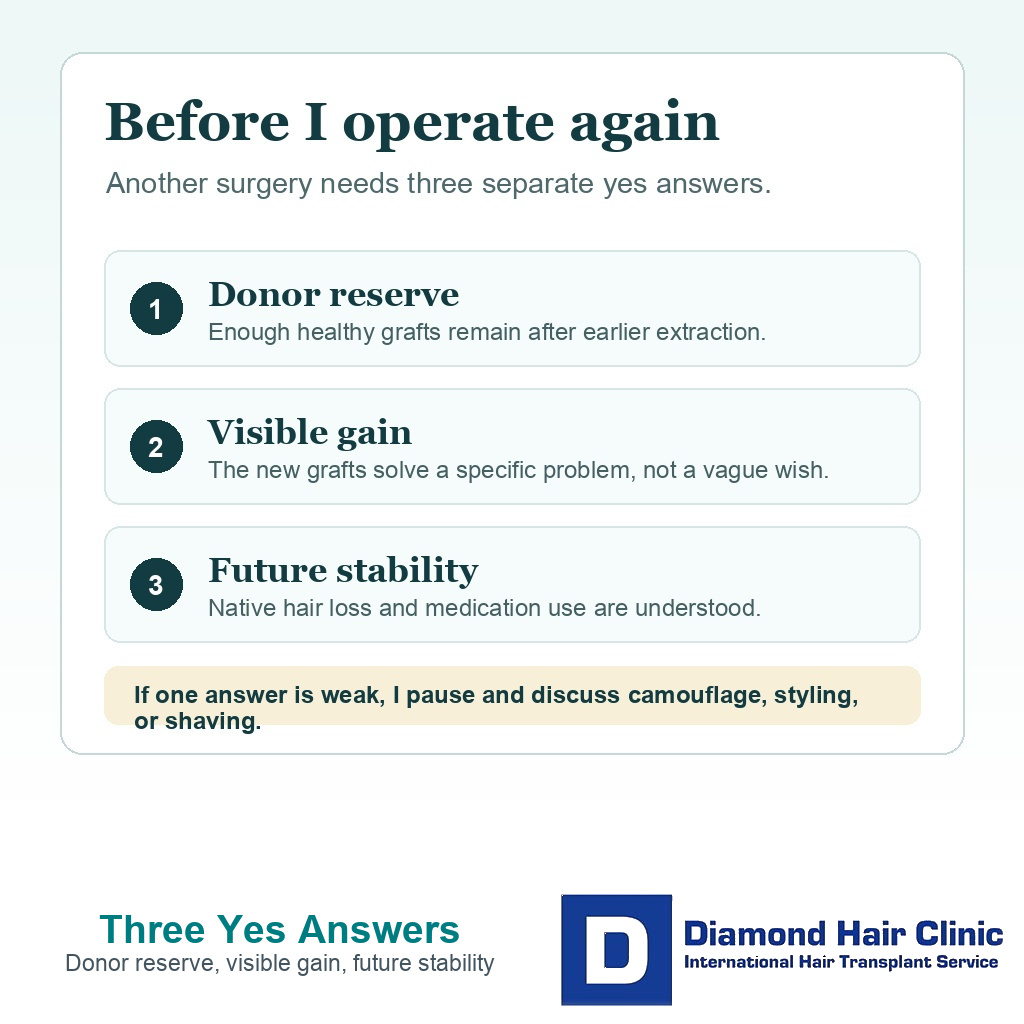
Before another operation, the donor reserve, visible gain, and future stability must all make sense.
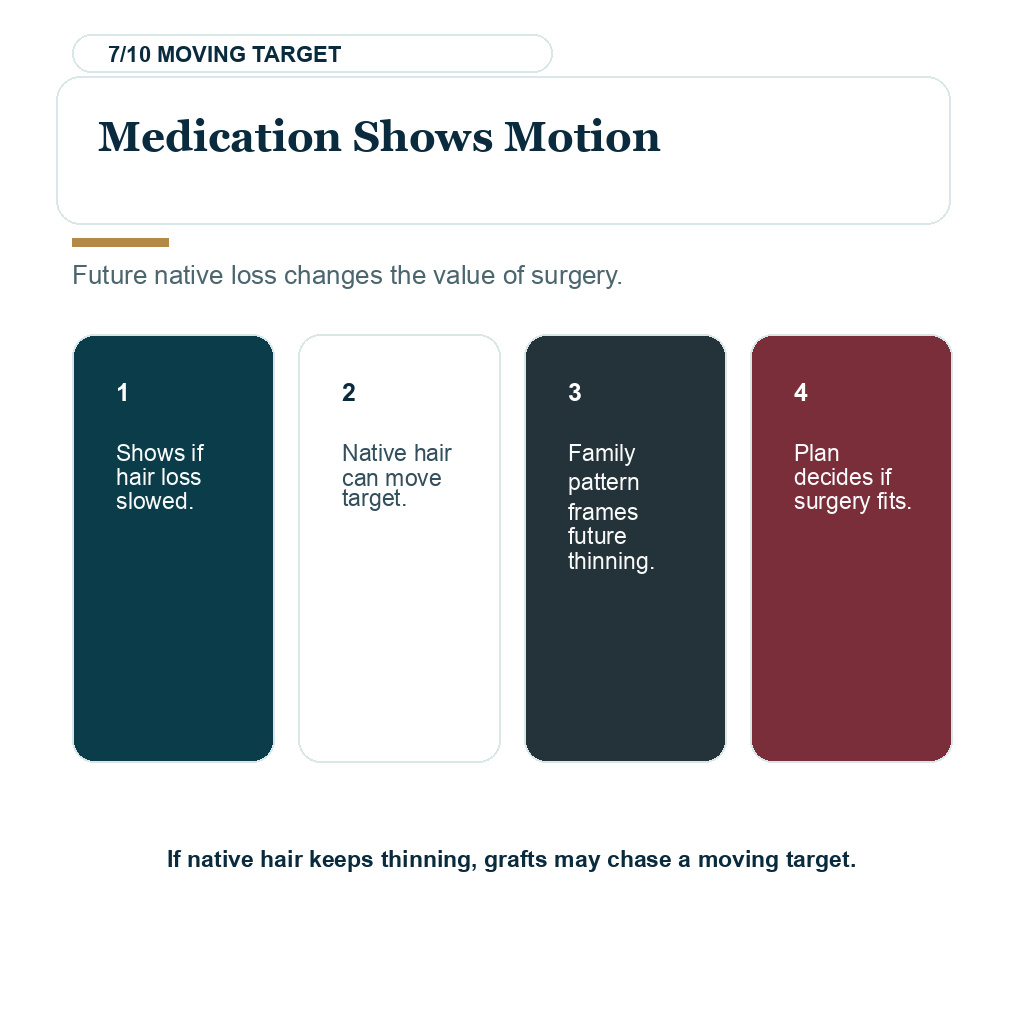
I also ask for the medication history. If the patient stopped finasteride or minoxidil and the native hair continued thinning, another transplant may only chase a moving target. Surgery moves hair. It does not stop future native hair loss.
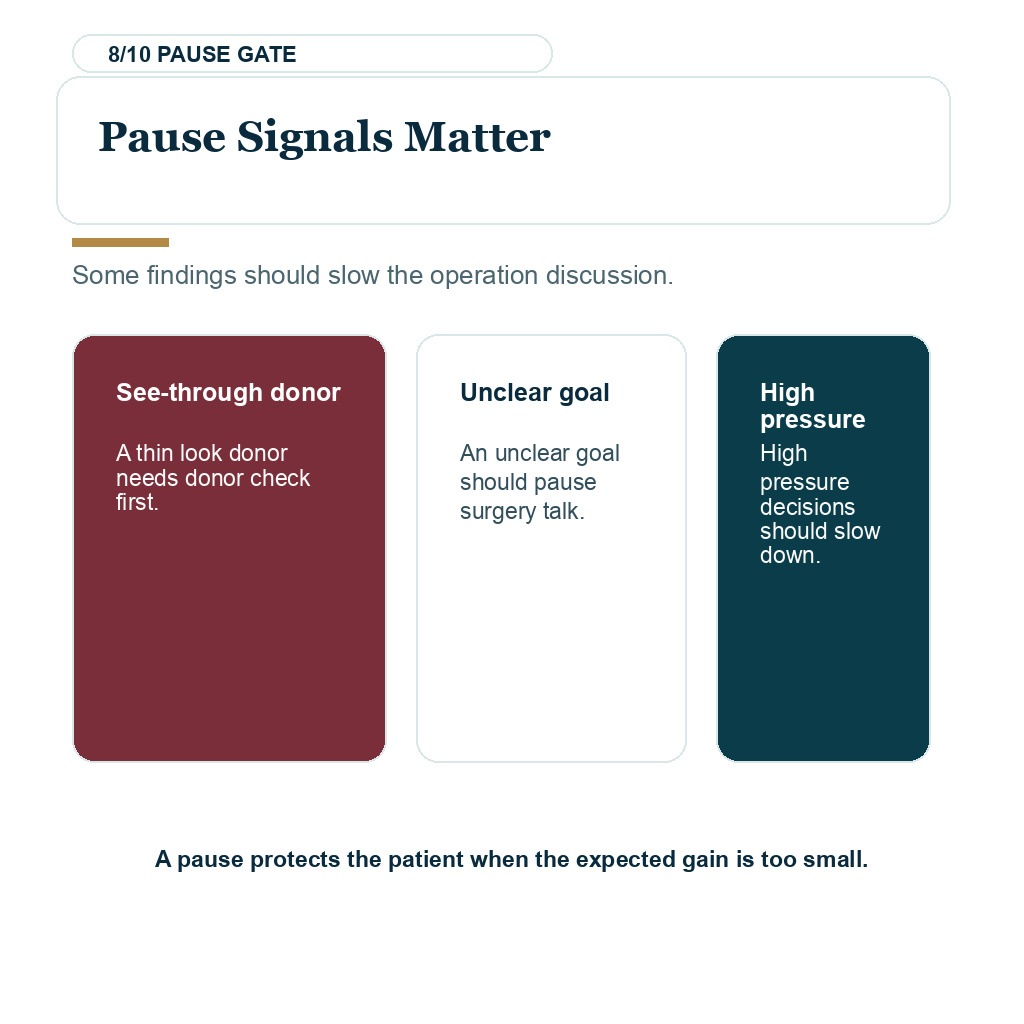
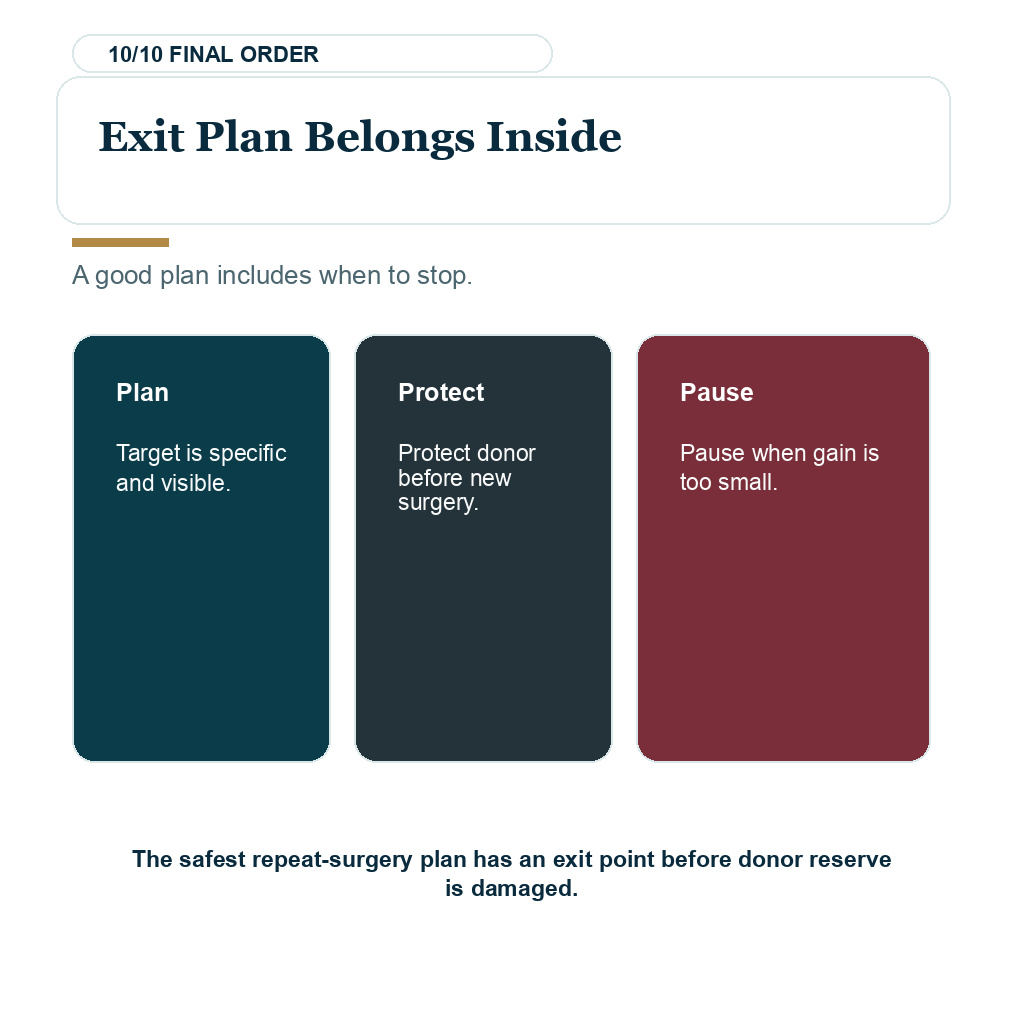
Use the 10 stop boundary slides below to review donor reserve, repair risk, target clarity, crown tradeoffs, SMP or shaving alternatives, records, medication and native loss, pause signals, direct consultation, and the final exit plan. Swipe the carousel, use the arrows one step at a time, or choose a number below the image to jump to that point.


Medication and future hair loss change the decision
Medication does not make every person a surgical candidate, and not everyone can or wants to use it. Still, future native hair loss has to be discussed before another operation. If the native hair is still miniaturizing, the new grafts may look better for a while and then become isolated as the surrounding hair thins. When the donor area itself shows miniaturization, the risk is higher because the supposed reserve may not be as permanent as it appears at first glance.
I ask whether you are using treatment consistently, whether side effects limited the options, and whether the transplant plan assumes stability that does not exist. Surgery without medication can still help some patients, but the surgical goal must be realistic. When a patient considers a hair transplant without finasteride, I keep the surgical goal realistic.
The donor area is finite, but native hair loss can keep moving. I do not use the last strong grafts to chase a small cosmetic improvement while the larger pattern is still changing.
Warning signs that make me pause the operation
I pause when the donor is visibly thin, when a very high graft number is needed for a small visual gain, when the crown expectation is full density, or when the main request is to repair anxiety rather than a clear surgical target. If you cannot define what would count as a meaningful improvement, I slow the process down before any grafts are spent.
Different lighting, one angle, or repeated mirror checking can create a concern that another operation will not solve. If reassurance from photos or consultations disappears after the next mirror check, the problem may be the decision loop, not the hair count. When the hairline is already low, straight, or dense enough that extra grafts could make it less natural, the next step may be low hairline review or pluggy hairline repair, not another density session.
An unnatural result changes the question. A bad angle, pluggy distribution, or overly low hairline may need a repair strategy instead of more density. Repair surgery can be valuable, but it often needs fewer grafts placed with more careful planning rather than another aggressive session. A bad hair transplant repair plan is different from simply adding more hair.
A large number promised elsewhere is not enough reason to operate. Promises do not create donor capacity. Examination does.
The conversation should be direct
I try to make the conversation clear before it becomes emotional. I show what is realistically possible, what cannot be fixed with hair alone, and what you may have to accept. A small repair is different from another large operation. If a small repair is reasonable, the plan should stay limited. If surgery would only create a weaker donor area, stopping is the more protective answer.
For some patients, a limited operation protects the donor. For others, stopping is the stronger decision. That may sound disappointing at first, but it can prevent a worse donor area, an unnatural final look, and another cycle of regret. I also want the fallback options named clearly, including the haircut, styling limit, SMP role, medication plan, or acceptance point if more grafts would not improve the real concern.
One more question belongs in this conversation when finances are shared. Can the household afford another operation without turning the decision into pressure? I am not against a patient wanting more confidence from his hair. But a second or third hair transplant should not use money needed for emergency savings, children, housing, debt, or other plans that both partners depend on. If the budget creates fear or resentment at home, I slow the decision down even when the donor area still looks acceptable.
Your partner’s view matters because that person may live with the recovery, the budget, and the uncertainty, but it does not erase your own decision. A shaved style or scalp micropigmentation can be compared when surgery would take more than it gives, but SMP is camouflage, not new hair. I also do not promise that better hair will improve a career, a relationship, or the way you value yourself. Confidence matters, but another operation still needs a realistic hair goal and a budget that can carry the cost without pressure.
The decision is easier when we separate four questions. Do you have enough donor hair left? Will the new grafts create a visible improvement? Will the result still make sense as native hair changes with time? Can you accept the limits of the remaining donor area without chasing density it cannot safely provide? I want all four answers to be strong before I advise another operation. If one answer is weak, I slow down.
Stop when more grafts will not solve the real problem
Do not decide from one flattering photo, one harsh bathroom light, or one clinic graft quote. Look at the donor area, the recipient area, the haircut you actually wear, the medication situation, and the result you would accept even if it is not perfect. If the answer changes every time the lighting changes, collect standardized photos first and delay the surgical decision. The final operation should have an exit plan before the first graft is removed. You should know what you will do if this is the last safe surgery and the result is only a partial improvement.
My view is direct. Another hair transplant is worthwhile only when it has a clear target, a realistic graft need, and a donor area that can afford the cost. If those conditions are not present, stopping is not failure. It is a way to protect what remains.
The right time to stop is before the next operation creates a problem that no later operation can fully undo. A careful surgeon should be able to say no when no is the better medical answer.

Read this review excerpt
Every single one of my questions was answered and they made sure I had all the details I needed to make an informed decision.