


Braids Need Low Tension While Grafts Heal
Do not restart braids, cornrows, tight twists, extensions, or a heavy protective style while the recipient skin is crusted, tender, swollen, red, or easy to catch. The safer point is not a fixed calendar date. It is when the grafted skin is closed, the crusts are gone, washing is easy, and your surgeon agrees that a low tension style will not pull across the recipient area. The style should protect healing skin, not test tension. Show the exact style before you restart. Describe the added hair, weight, and retwist plan so tension is judged before it touches the recipient area. Loose, clean styling for a short period is very different from a tight style that hurts, lifts the skin, traps sweat, or pulls on the hairline.
I understand why this question matters. For many patients, especially patients with Afro textured or very curly hair, braids, cornrows, twists, loc maintenance, wigs, and head coverings are not only cosmetic. They are part of daily life, privacy, work, culture, and confidence. My answer is not to shame the style. My answer is to separate a healed scalp from a scalp that is still negotiating with new grafts.
Loc maintenance belongs in the healing plan
Loc maintenance, retwisting, palm rolling, interlocking, and added weight can pull differently from a loose style. Planning locs around FUE helps the patient separate identity and presentation from early graft safety.
Start with tension, not the calendar
The first rule is simple. If the style creates pain, stinging, tightness, pulling, or visible lifting at the hairline, it is too much for a healing transplant. That rule applies even if the fabric is soft, the stylist is experienced, or the patient has worn the same style for years before surgery.
Ask the stylist to describe the tension, not only the style name. A loose looking braid can still pull if the first row is tight near the grafted border. Removal should be planned before installation, because a style that is easy to wear can still catch crusts or pull small hairs when it comes out.
Early FUE recovery is a mechanical situation before it is a styling situation. The recipient area needs gentle washing, no catching, no rubbing, and no repeated pressure. The no catching rule behind touching healing grafts applies here. A braid or cornrow can tug a wider area than a fingertip. A wig comb can catch crusts. Extensions can add weight that a healing hairline is not ready to carry.
I avoid giving one universal restart date because healing does not look the same on every scalp. Some scalps are quiet early. Some remain pink, itchy, oily, or prone to pimples longer. Some patients need styling because of work or travel, while others can leave the hair loose. I judge the skin and the tension instead of pretending every patient is the same.
Healing skin cannot negotiate with a tight style
A tight protective style is not protective for grafted skin if it pulls across the recipient zone. During early healing, crusts and small scabs can attach to hair shafts. If a style is installed, removed, tightened, or adjusted roughly, those crusts can be disturbed. For patients who already struggle with touching or picking, the discussion overlaps with scab picking in early FUE healing. The safest style is the one that does not make the patient fight the scalp every hour.
The donor area has its own timing. It may tolerate careful grooming before the recipient area does, but it can still be sore, numb, itchy, or sensitive. Pulling nearby hair into tight sections can irritate the donor zone even if it does not touch grafts. I separate the recipient area, donor area, and untouched hair before I clear any styling choice.
If a patient needs coverage, I usually start with the gentlest pressure option first. A loose satin bonnet or scarf that does not cross the grafts may be safer than a tied style that gives a neater look but adds constant traction. The same pressure logic appears in soft headwear after a hair transplant. Soft fabric can still be risky if it rubs, presses, or traps sweat over healing skin.
Afro textured hair needs planning, not blame
Very curly and Afro textured hair deserves practical planning, not generic warnings. The curl pattern can make sectioning, detangling, dryness control, and daily presentation harder after surgery. It can also make a patient want a style that feels normal again. In Afro and very curly hair in FUE surgery, the planning already starts with follicle curvature and careful placement. After surgery, the same respect has to continue in aftercare.
I do not want a patient to feel forced into neglecting their hair. I also do not want a stylist to treat a transplanted hairline as if it is untouched scalp. The useful middle ground is to keep the grafted zone free from direct tension, avoid heavy added hair, keep the style brief, and ask for loose sections around the hairline and temples.
Products matter too. Oils, gels, edge control, sprays, and adhesive systems can irritate healing skin or make washing harder when used too early. Chemical routines need a separate calm scalp discussion, especially for patients who use relaxers or strong styling products. If the scalp is still burning, tender, flaky, or inflamed, the logic is closer to chemical relaxers before FUE than to a normal salon appointment.
Traction history changes the styling conversation
If traction alopecia was part of the original hair loss, I am more cautious. A transplant can restore hair to stable scarred areas in selected patients, but the new hair is not permission to return to the same tension that caused the problem. The goal of traction alopecia repair is not only to add hair. It is to protect the repaired edge from the old mechanical habit.
A patient may say, “I only want the style for a short time.” That may be reasonable when the scalp is calm and the style is truly loose. But if the previous hair loss came from tight braids, cornrows, extensions, ponytails, wig clips, or repeated edge tension, the threshold for restarting should be higher. New grafts can grow, but the surrounding native hairs can still weaken under repeated pulling.
Watch the symptoms after styling. Pain during installation is not a normal beauty cost. Stinging, bumps, crusting, white flakes fixed to hairs, broken hairs at the edge, or skin that looks pulled upward are warning signs. If any of those appear, remove the tension and contact the clinic instead of tightening the style again.
Protective styles need a low tension test
Before a full style, test the idea in a small, conservative way. Can the hair be parted without tugging the recipient area? Can the stylist keep the first rows away from the new hairline? Can the style be installed without pain? Can it be removed without catching crusts or pulling small hairs? Can the scalp still be cleaned the way the clinic instructed?
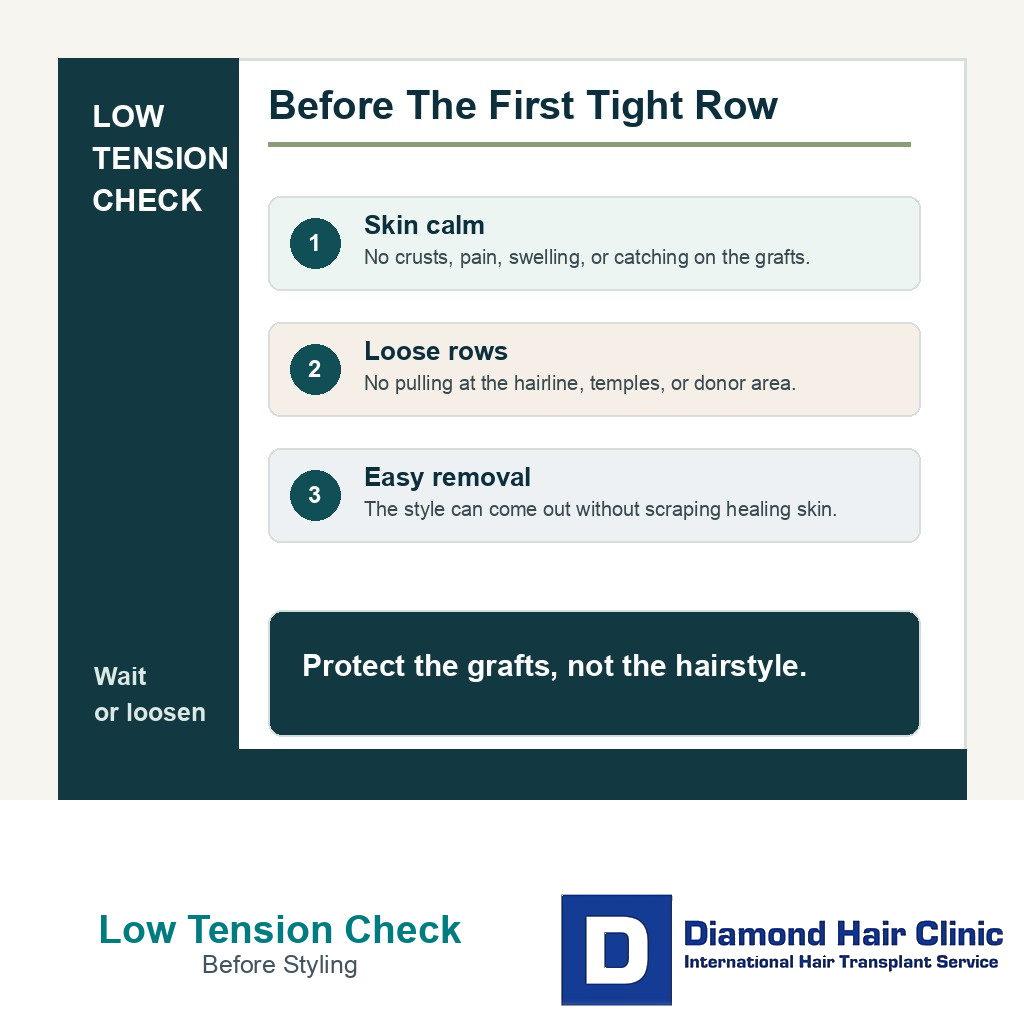
The answer should stay conservative if the transplant is still visually fragile. For example, if the patient is also thinking about first haircut timing, I would not combine that with tight styling, edge work, extensions, and strong products in one visit. Too many changes make it hard to know what caused irritation.
Weight is the part patients often underestimate. Added hair can feel light in the hand but heavy when it pulls through many small sections. A short, loose, clean style with no tension across the recipient zone is different from long, heavy extensions that swing, pull, and require repeated tightening. The safest version is usually lighter, looser, and easier to remove than the style the patient wore before surgery.
Use the route map before the appointment
When I review styling after FUE, I do not only ask what style the patient wants. I ask where the pressure will sit, how long the style will stay in, what products will touch the skin, who will install it, and how it will be removed. That gives the decision a real structure.
Low tension styling route map
Clear the skin, then test the tension
- Skin checkWait if not calm
- Tension checkLoosen the plan
- Texture checkPlan the handling
- Clearance checkAsk before styling
Wait if not calm
Crusts, tenderness, strong redness, swelling, pimples, or catching mean the style should wait.
Next move Keep the area clean and ask for review before adding tension.
Loosen the plan
Pain, lifting skin, tight first rows, heavy extensions, or wig comb pressure are mechanical risks.
Next move Choose lighter, looser styling for less time or leave the front edge free.
Plan the handling
Curly or Afro textured hair may need careful sectioning, moisture, and detangling without pulling the grafted zone.
Next move Tell the stylist which skin is grafted and which hair is untouched.
Ask before styling
If the style needs products, adhesive, tight parting, or long wear, get clinic clearance first.
Next move Use photos and a clear style plan rather than a vague date question.
Patients with a transplanted front edge need special care because the hairline is the first place people notice tension. A style that pulls the hairline backward can change how the result looks in the mirror and can irritate native hairs around the grafts. For women and patients restoring edges, the design discussion often overlaps with female hairline softness, because the result should frame the face without creating a hard, stressed border.
If a stylist is involved, explain that this is not ordinary new growth. Ask for low tension, no hard edge work on grafted skin, no adhesive on the recipient area, no tight first row at the front, no comb pressure that scrapes the scalp, and no heavy added hair until the clinic has cleared it. A good stylist will understand the difference between neat and tight.
Before the appointment, say it plainly. The front edge and any grafted skin must stay loose, clean, and easy to wash. If the style needs force, adhesive, tight edge work, or heavy added hair, it should wait until the grafted and donor areas are calm.
Style around the grafts, not against them
The goal is to style around the transplant while the skin matures. Loose parts, lighter sections, gentle detangling, and easy removal matter more than the name of the style. The recipient area still has to stay clean, visible, and free from pulling.
When patients ask about braids, cornrows, twists, or extensions, I look at tension first. A low tension style may become reasonable after the scalp is calm and the surgeon has cleared it. A painful, tight, heavy, or crust catching style should wait.
The styling slides below focus on tension, weight, washing access, and when a salon appointment should wait.


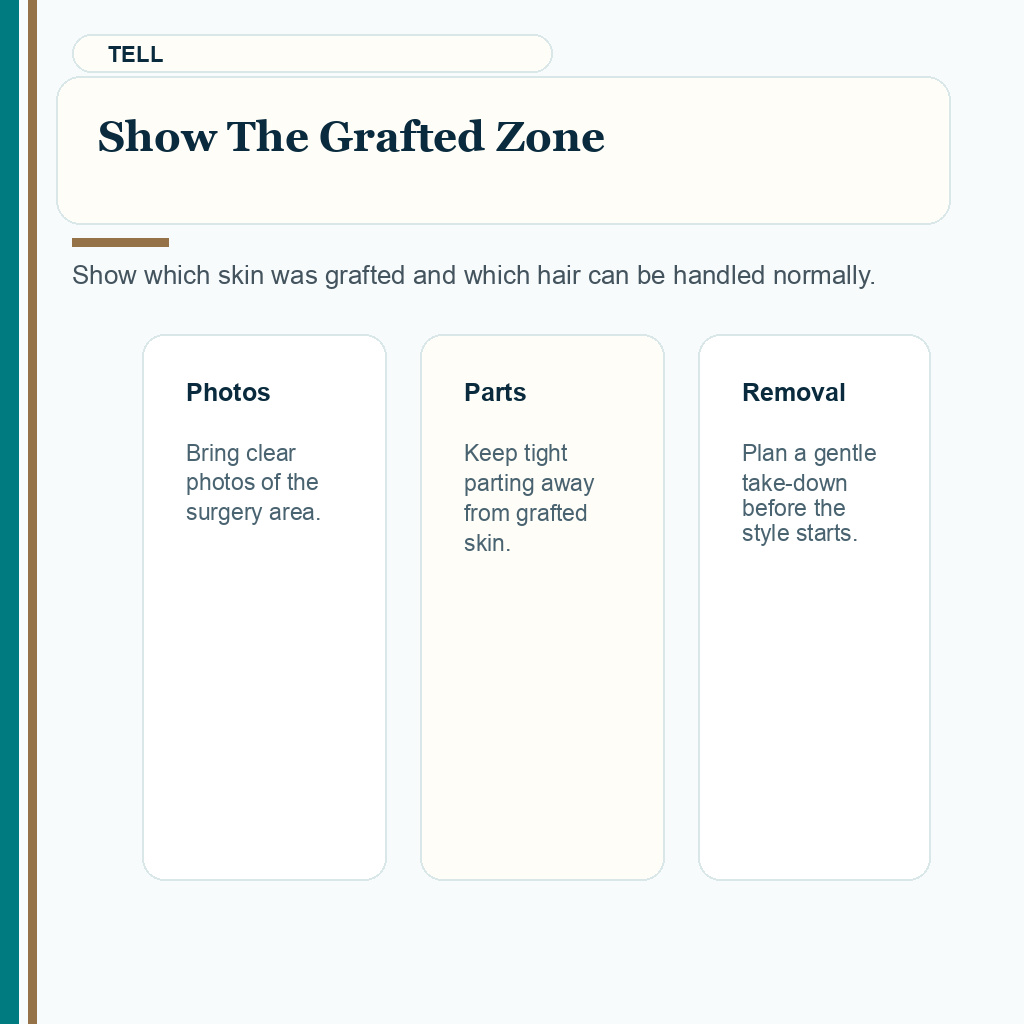

If there is doubt before an appointment, show the intended style, parting pattern, added hair, and first row position to the clinic. A date alone is not enough. The scalp has to tolerate the style without pain, crust catching, or pressure on the new edge.

Read this review excerpt
Upon arriving home, I sent 4 photos (of each side of head) after every washing process to doctor for checking where I was given personal advice for how to take care of my healing head.