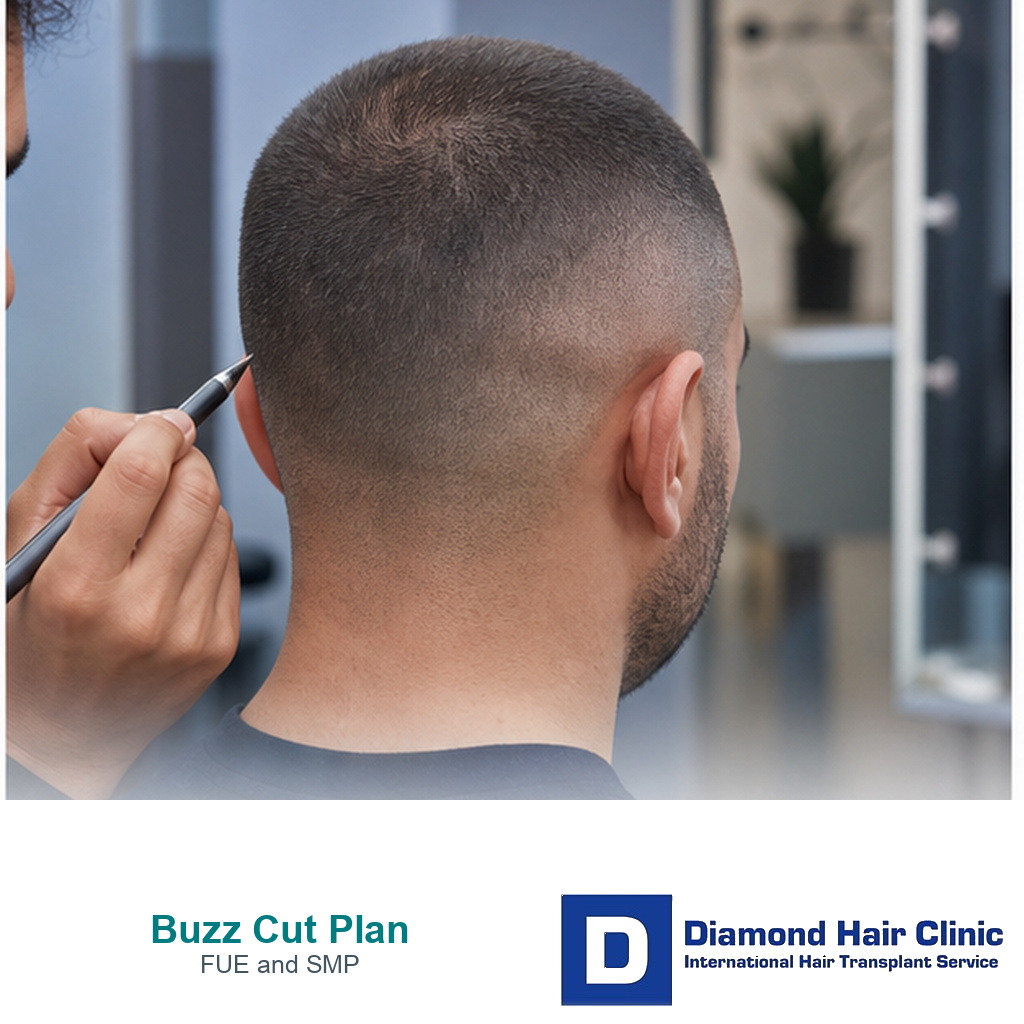
A Buzz Cut Changes the Hair Transplant Plan
A clipper cut with no guard is unforgiving after a hair transplant. It does not hide low density, wide spacing, donor thinning, old scars, or a hairline that was designed only for longer styling. When a patient tells me he wants to keep a buzz cut after a hair transplant, I do not treat that as a small style preference. I treat it as part of the surgical plan. Yes, FUE can sometimes be planned around a buzz cut, but a zero guard or skin shave leaves almost nothing for density, scars, donor thinning, or wrong direction to hide.
This decision is not simply whether FUE can move enough grafts at a very short guard. If you are asking when clippers are safe after surgery, that is a healing question. Here I am asking whether a buzz cut should be part of the original surgical plan. I look at whether the result can reasonably look natural at the guard length the patient actually plans to wear. At that length, contrast between scalp and hair is visible, the donor area is exposed, and any mismatch between transplanted hair, native hair, beard hair, body hair, and SMP can become obvious.
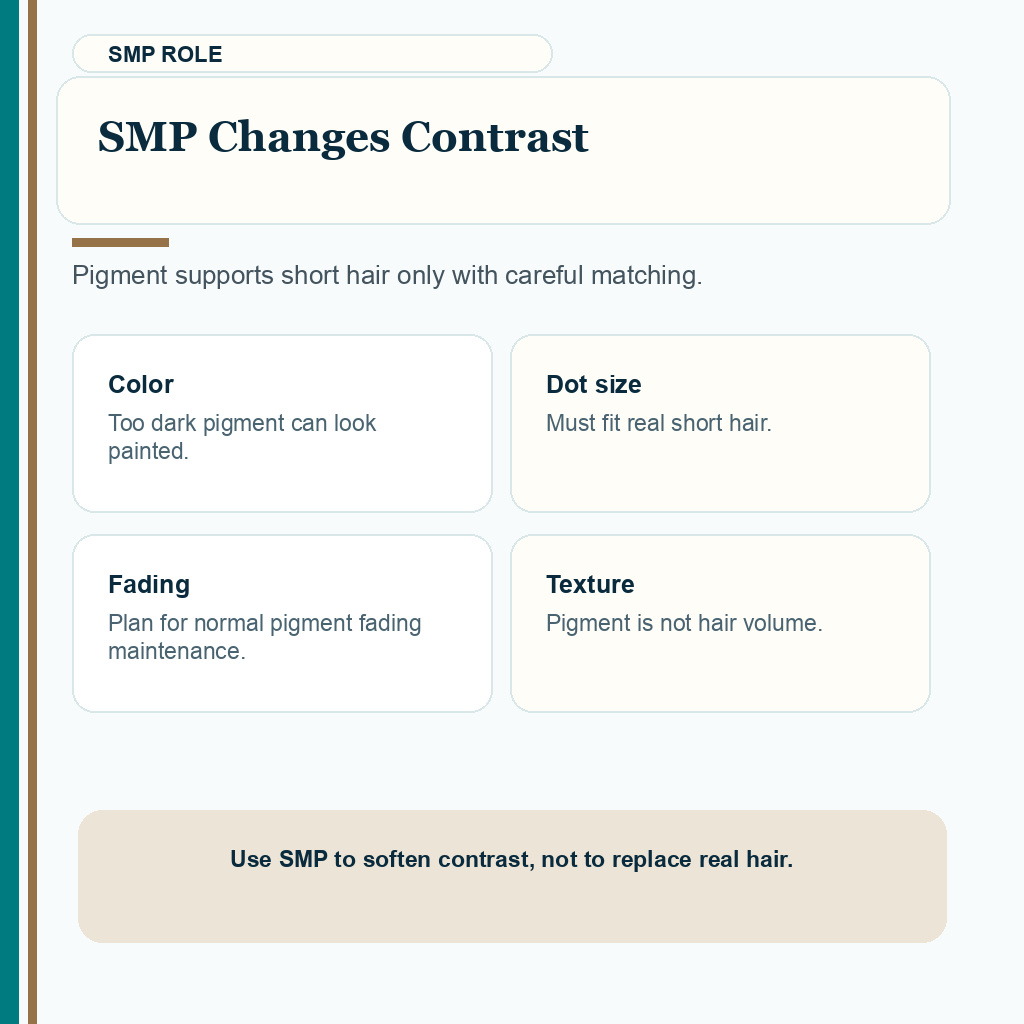
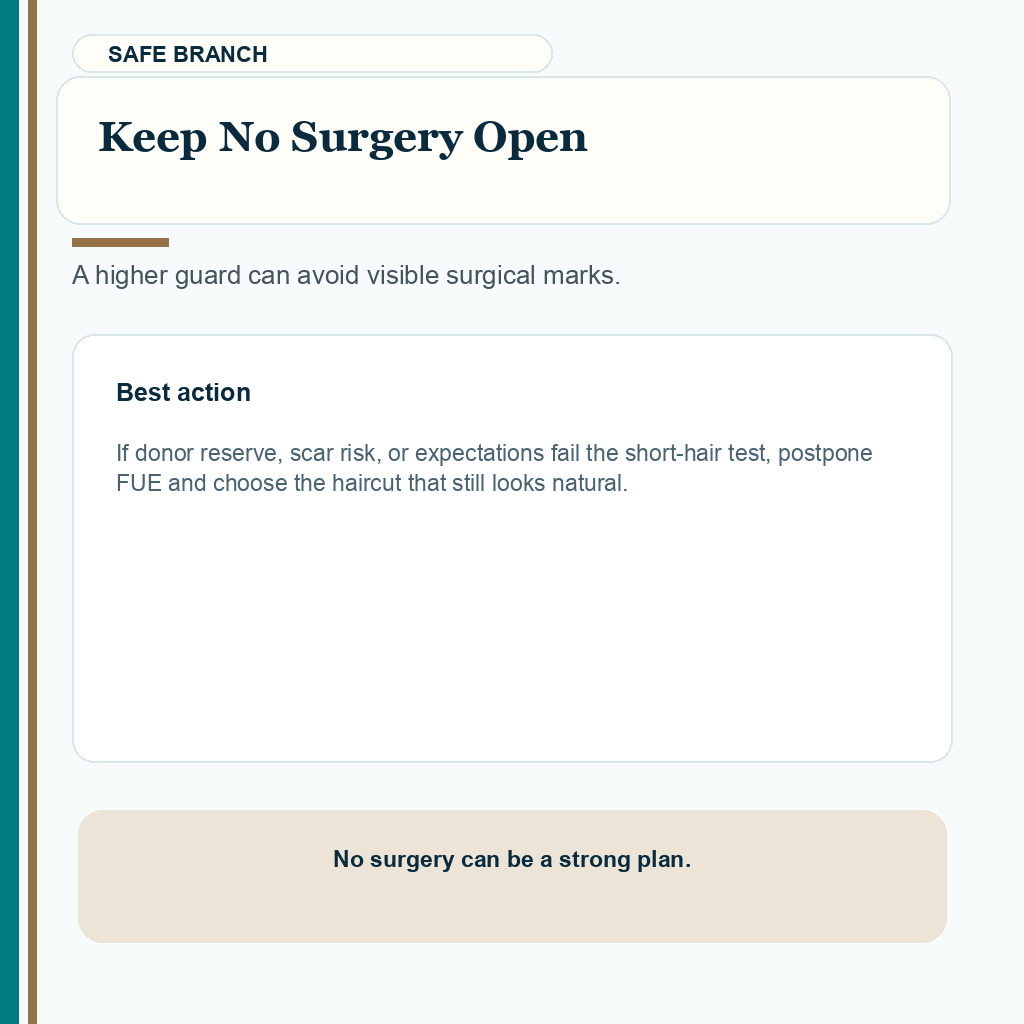
So the safest conversation starts before surgery. If the longer term goal is a regular buzz cut style, the plan may be FUE, FUE with SMP, SMP first, a higher guard length, or no surgery. I decide that from donor quality, hair caliber, skin contrast, hairline position, scar risk, and the haircut the patient truly expects to wear. A zero guard is a different test from a number 2 or 3 guard, and that should be clear before grafts are moved.
Start with the haircut you will actually wear
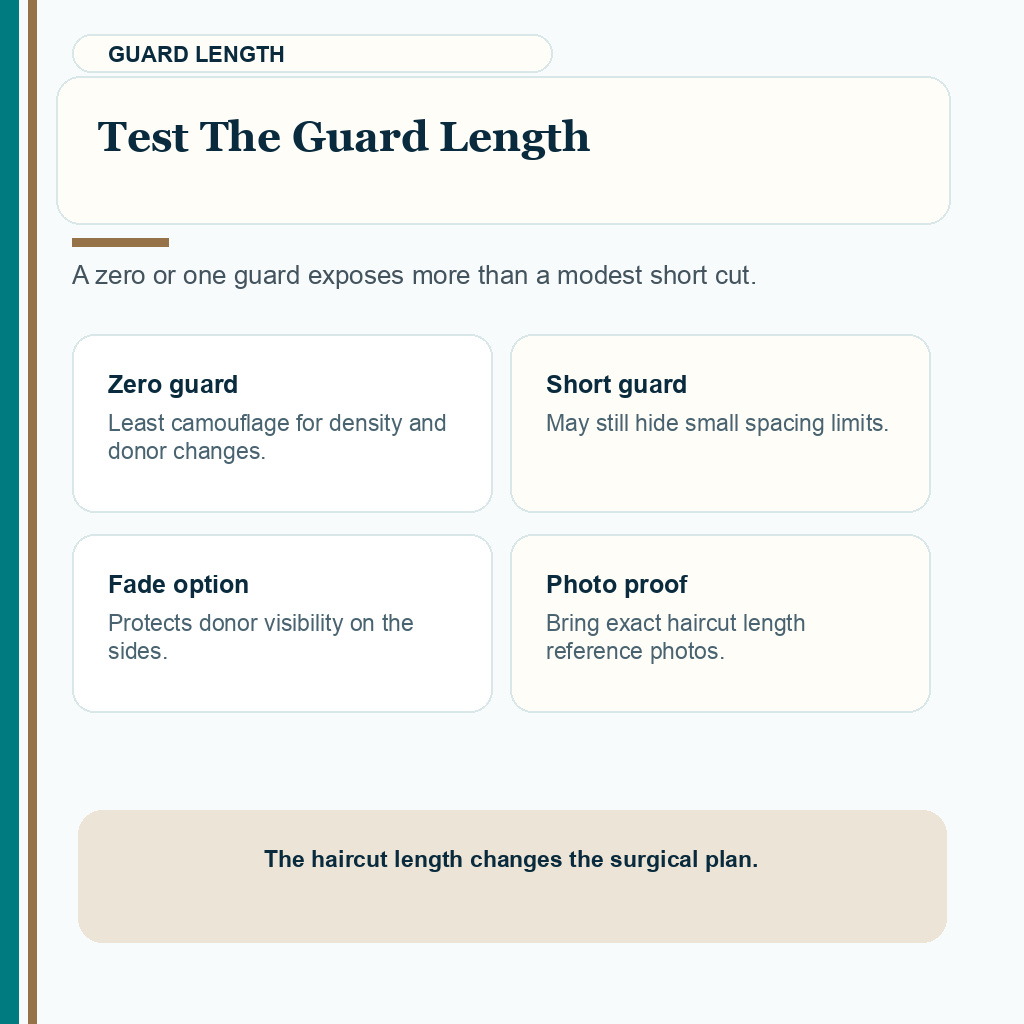
Many patients say “short hair” but mean different things. A number 3 or 4 guard can hide far more than a zero or one guard. A faded back and sides can protect the donor area better than shaving the whole head evenly. A buzz cut with a slightly higher guard can look intentional, while the same transplant at a zero guard may expose every density limit. A result that looks dense when grown out may still look open at a low guard, so the buzz cut goal needs its own proof.
Before surgery, it can be useful to test the actual guard length you think you want. Look at it in daylight, bathroom light, and phone camera light, not only in one flattering photo. If the style already feels too exposed before surgery, moving grafts into the front may not solve the real concern. Use the same guard on the donor area too, because the back and sides are part of the result.
The actual haircut comes first. If you plan to wear longer hair most of the year and only buzz it during recovery, the planning is different from someone who wants a regular military length cut. The recovery timing question is better handled by buzz cut after hair transplant recovery timing. Planning a short haircut as the final style is a different conversation.
Plan for the haircut you will actually keep, not the haircut you use during recovery. A temporary buzz after surgery does not prove that a permanent short style will suit the donor and hairline. Before grafts are spent, test whether the shaved look itself is acceptable, because surgery should not chase a buzz cut the donor cannot support.
There is also an emotional side. Some men ask for a hair transplant because they want to stop worrying and keep shaving everything down. Others later discover that they liked the shaved look more before surgery than after, because a transplanted hairline and donor extraction pattern changed the way the short cut reads. If that fear is already present, compare it with regret after shaving the head after hair transplant before making the plan.
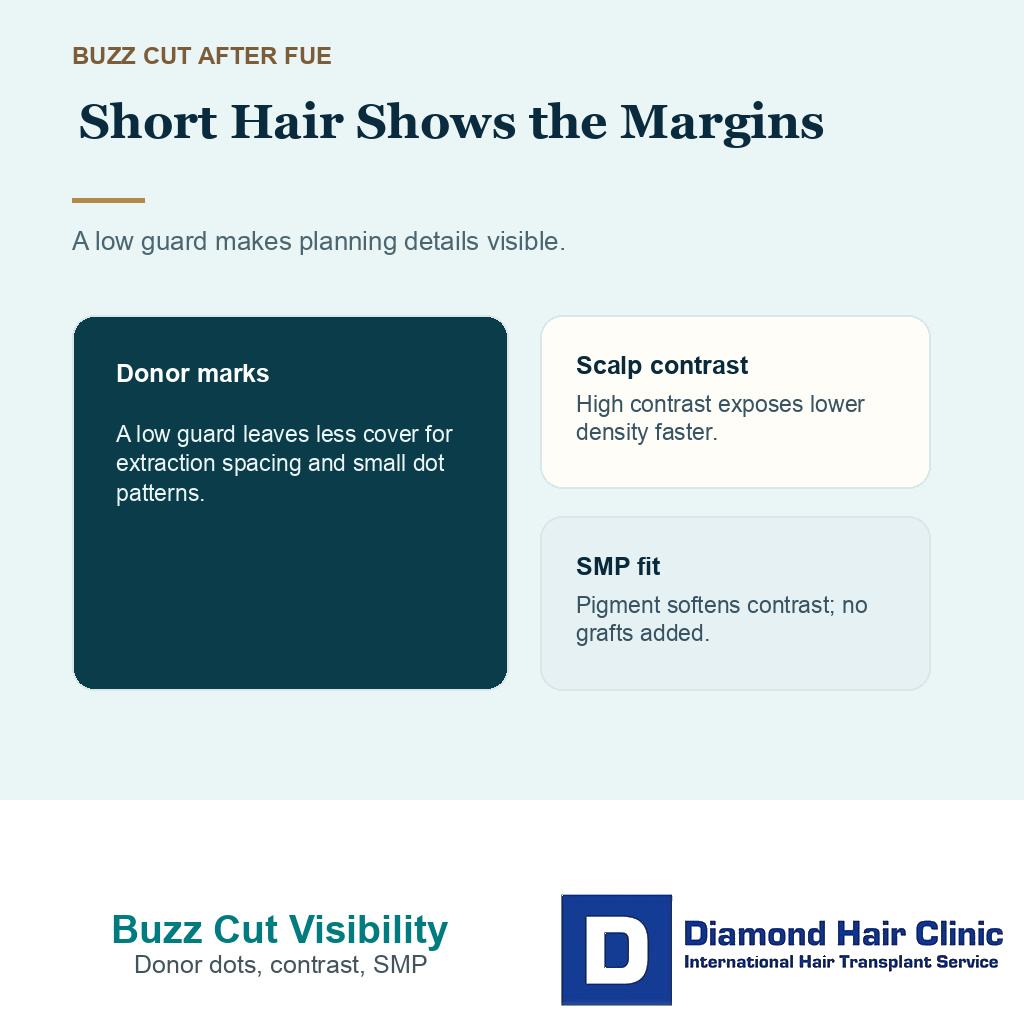
Short hair exposes density gaps and extraction patterns
Longer hair creates cover. It overlaps, casts small shadows, and lets a skilled hairline design soften the transition between scalp and hair. A buzz cut removes most of that help. If the transplanted area has low density, the scalp may still shine through. If grafts are placed in a pattern that looks too regular, the short hair can make that pattern easier to see. At very short length, wrong exit angle and direction are also harder to hide, because styling cannot change the way the graft leaves the scalp.
The donor area matters just as much. FUE removes individual grafts from the donor zone. When extraction is planned carefully, the donor may look acceptable at a modest short guard in the right patient. A zero guard, skin fade, fine dark hair on pale skin, weak donor density, or visible scarring makes that test much stricter. When the donor is overharvested or unevenly harvested, a buzz cut can reveal patchiness. Donor area overharvesting is not only a donor problem. It also limits the hairstyles a patient can wear later.
Before I plan this kind of case, I look at donor density, miniaturization, caliber, safe zones, previous extractions, and future reserve. I am not only asking how many grafts can be removed. I am asking how much can be taken without making the back and sides look damaged when short. That is where donor area capacity becomes practical.

Read this review excerpt
“Because of that, I asked the doctor to mainly focus on restoring the temples and hairline, while leaving areas with strong existing hair untouched. This would preserve more donor hair for potential future procedures and also make it easier to wear my hair short on the sides and back.”
FUE can help only when the target is conservative
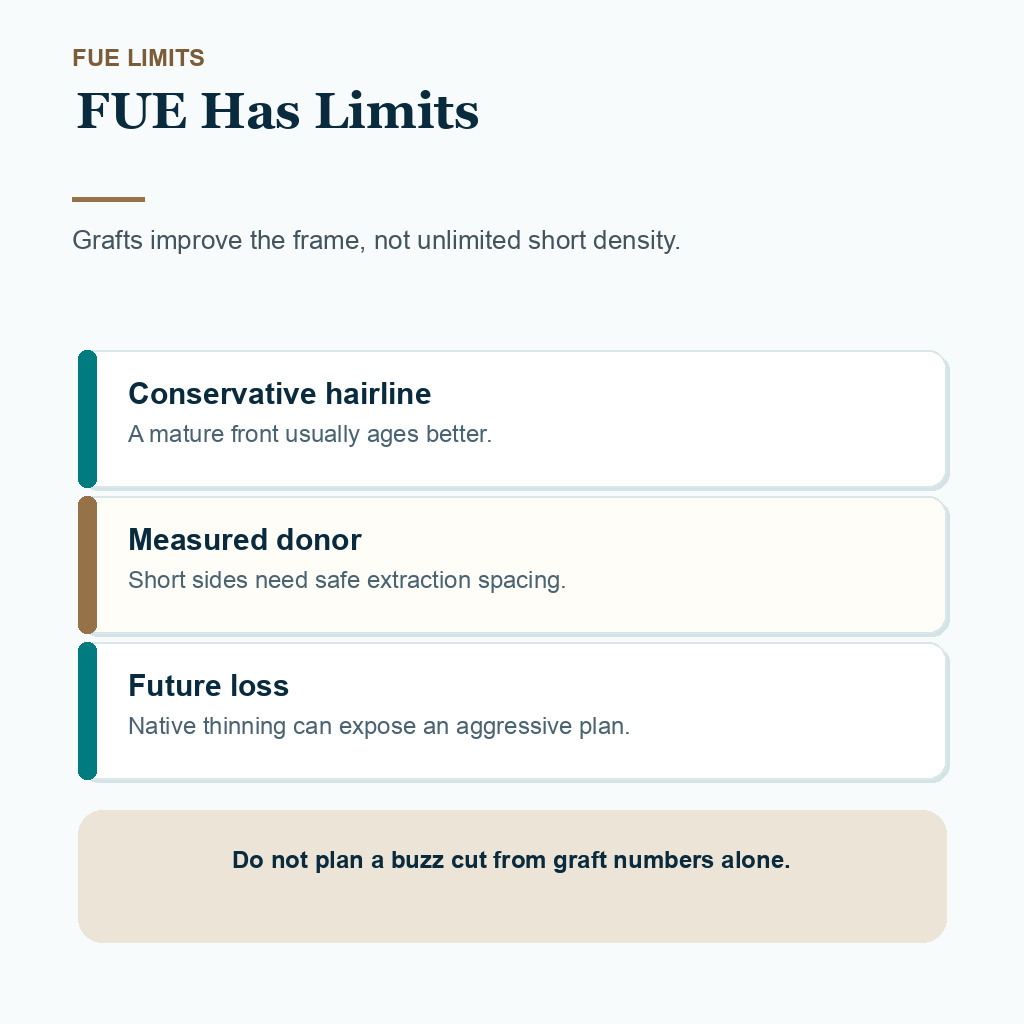
FUE can improve the frame of the face. It can rebuild a hairline, reinforce selected areas, and make a short haircut look more balanced in the right patient. But it cannot turn a very advanced pattern into a dense short hair scalp if the donor supply is limited. A buzz cut usually asks for disciplined planning, not aggressive graft numbers.
The hairline is the first place where unrealistic planning shows. A low, flat, juvenile hairline can look wrong at short length because the density behind it may not support the shape. If the patient also loses more native hair later, the front can look drawn on rather than grown in. For that reason, low straight hairline planning needs extra caution when the final haircut will be very short.
My planning starts with the hairline as part of a long-term pattern. The front should match the donor supply, the likely future loss, and the haircut. A higher or more mature design may disappoint a patient who wants a dramatic change, but it may be the reason the result can still look natural at a buzz cut. The same long-term logic applies to hairline design in any transplant, but short hair makes mistakes less forgiving.
If the patient is young, the loss is still moving, or he does not want long-term medical stabilization when it is appropriate, I become more cautious. Transplanted hair may remain long lasting when donor hair is stable and grafts grow well, but native hair around it can continue to thin. A short haircut makes that separation easier to see.