


PRP for Hair Loss Benefits, Limits, and Best Candidates
PRP is worth discussing when the diagnosis is clear, living miniaturized follicles are still present, and the goal is modest support rather than a new hairline. It cannot rebuild a bald area, replace medical treatment when that treatment is needed, or make a weak surgical plan strong.
In consultation, I first ask what problem we are trying to solve. If the answer is early thinning, weaker hair caliber, or support for existing native hair, PRP may have a role. If the answer is advanced baldness, a depleted donor area, or a poor transplant plan, PRP is the wrong tool.
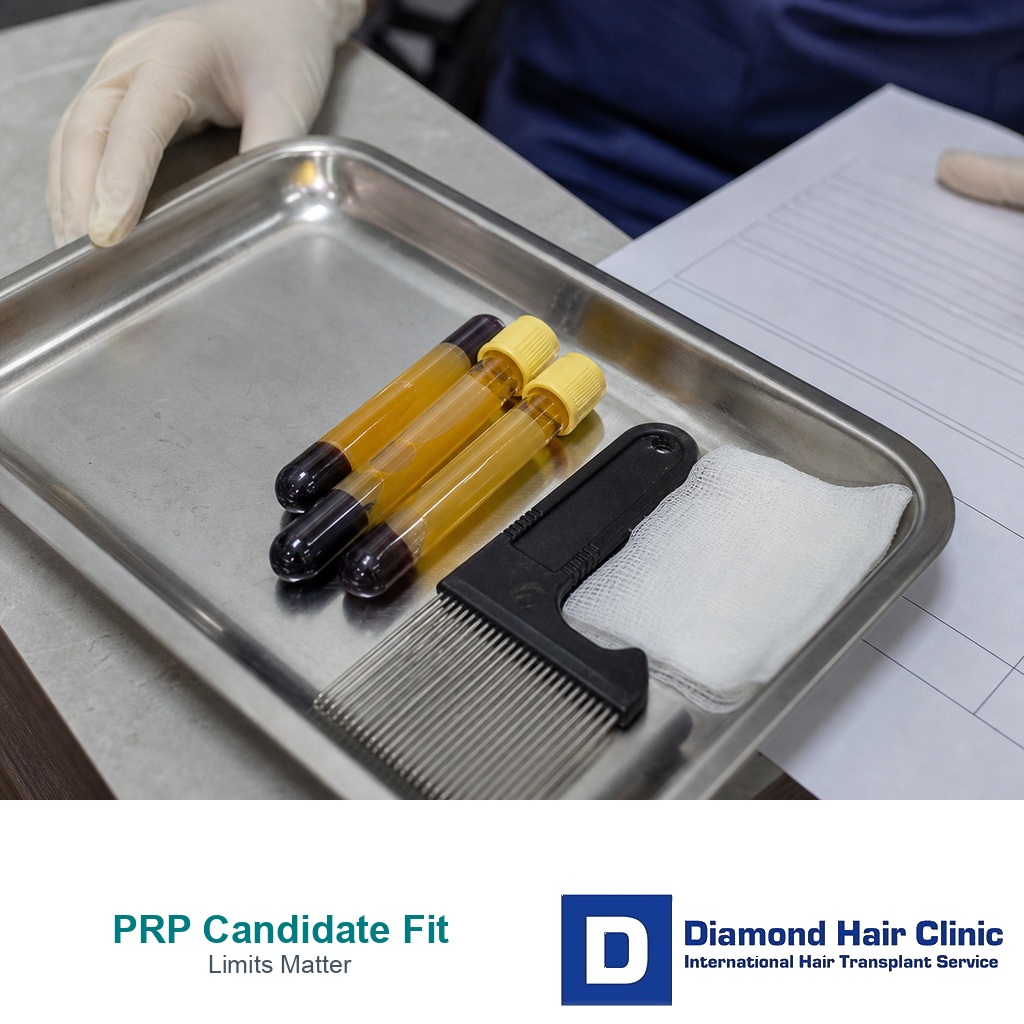
PRP stands for platelet rich plasma. A small amount of blood is taken, processed, and the platelet rich part is injected into the scalp. The appointment may involve short discomfort, small injection points, and temporary tenderness or swelling, but the bigger decision is not the needle. The bigger decision is whether PRP fits the diagnosis and whether the clinic is explaining its limits clearly.
I explain PRP plainly. It is not a cure for baldness. It is not a substitute for proper diagnosis. It is not a replacement for medical treatment when that discussion is appropriate. It cannot create a new donor area, and it cannot compensate for poor surgical planning.
I am more careful with PRP when the scalp diagnosis is still unsettled. PRP is not my way to bypass biopsy findings, active redness, scaling, or a medication plan that has not had time to declare itself. It can be discussed later as support, but it should not make an inflamed or changing scalp look ready for grafts.
In the right case, PRP can be a reasonable support treatment. In the wrong case, or in a clinic built around repeated extra treatments, it can distract from diagnosis, medication planning, donor limits, and the real surgical decision.
The difficult part is that PRP response cannot be promised before treatment or sold as graft insurance. That uncertainty is exactly why the goal, number of sessions, review point, maintenance cost, and stopping point need to be named before money is spent. A measured PRP trial needs a stopping point, so maintenance does not become an open ended expense instead of a reviewed treatment. Name the stopping point as clearly as the reason to continue.
Before surgery, PRP deserves the same test. I discuss a planned course only when it has a clear target, such as miniaturized native hair or a scalp quality issue that could change the plan. A fixed series of sessions does not become necessary just because a transplant date is on the calendar.
What is PRP in plain language?
PRP is prepared from your own blood. The blood is centrifuged to separate the platelet rich layer, which is then injected into the scalp.
PRP does not become hair. It may support the environment around weakened follicles, but it does not manufacture follicles that have already disappeared.
A living miniaturized follicle is different from a shiny bald area where the follicle is gone. That distinction decides whether PRP is even worth discussing. When this is not explained, people hear broad optimistic language and assume PRP can do much more than it can realistically do.
What can PRP realistically improve?
In selected androgenetic alopecia cases, PRP may reduce shedding, improve hair shaft thickness, or make existing miniaturized hair look a little stronger over time. Some men and women with early thinning or diffuse miniaturization notice a visible change in comparable photographs. Others go through the same course and see very little.
I keep the language measured for that reason. PRP has evidence of potential benefit in pattern hair loss, but the quality of evidence, preparation method, platelet concentration, injection technique, treatment interval, and maintenance plan vary between clinics. It should not be presented as a predictable transformation.
The practical goal matters. Less shedding, better caliber, or slower visible decline is a different promise from rebuilding a hairline. If the clinic is speaking as if PRP will reverse significant baldness, the language is already too large for the treatment.
When is PRP worth discussing?
PRP is more reasonable when there are still living miniaturized follicles to support, the diagnosis is clear, and the treatment is not being sold as a replacement for a real hair loss strategy.
I think about PRP differently in someone with early diffuse thinning than in someone with a shiny bald frontal scalp, advanced crown loss, or a weak donor area. These are not the same biological situation.
It is also different from sudden shedding, patchy loss, inflamed scalp disease, scarring alopecia, untreated thyroid or iron problems, or active infection. In those situations, the first step is diagnosis and medical control, not buying PRP immediately.
The decision needs to be practical. We need to know what we are trying to improve, how many sessions are planned, when photos will be reviewed, what maintenance may be needed, and what would make us stop if the response is weak.
Price should not decide this choice by itself. PRP may be cheaper than surgery, but it only makes sense when the remaining follicles can still respond. It cannot fill a bald area just because the surgical option feels expensive.
When PRP is treatment instead of distraction?
Before I recommend PRP, I need the treatment to answer a narrow question. Which diagnosis is being treated? Are there still living miniaturized follicles to support? What will the comparison photos show? What is the stopping point if the response is weak?
PRP becomes concerning when it is used to postpone a diagnosis, avoid a medication discussion, soften a poor transplant plan, or make a weak donor situation sound easier than it is. PRP may support selected follicles. It does not turn a non-surgical problem into a surgical success, and it does not make an unsafe transplant plan safe.
For patients comparing clinics in Turkey, the useful question is not whether PRP appears in the package. The useful question is whether the clinic can explain the exact goal, cost, review timing, and reason the treatment fits that patient’s pattern. One convenient injection during surgery still deserves the same reason and review point as a separate appointment.
Separate the purpose before accepting PRP because native hair support, recovery comfort, and growth timing are different promises.
The limits that PRP cannot cross
This belongs before treatment starts.
PRP cannot create new follicles in a truly bald area, rebuild a severely receded hairline, reverse advanced baldness, save a weak donor area, or correct a badly designed transplant. It also cannot replace a long-term medication discussion when native hair is still actively miniaturizing.

Those are the problems that matter most in hair restoration. If someone has obvious baldness, limited donor reserve, fast ongoing loss, or unrealistic expectations, adding PRP does not solve the main problem. It may only make the consultation sound more active while the real decision is being avoided.
Why does PRP get oversold?
PRP is easy to package, easy to market, and easy to add on top of another service. That makes it vulnerable to selling through pressure.
A common pattern is a very low headline hair transplant package, followed later by extra treatments that are presented as almost necessary. PRP may be one of those extras. The patient is already emotionally committed, worried about growth, and afraid of making the wrong choice, so the added treatment becomes harder to refuse.
PRP itself is not the issue. The message matters. “This may offer limited support in selected cases” is a very different sentence from “you need this or your result may suffer.” The first is medical nuance. The second is fear selling.
This is closely connected with the red flags of Turkish hair mills and cost planning before a hair transplant in Turkey. The full price and the medical reason for every extra treatment need to be written before the patient is under pressure.
Commercial pressure can change the recommendation
A proper hair transplant is not a quick treatment. It requires diagnosis, donor planning, hairline design, recipient area planning, graft handling, aftercare, and follow-up long enough to judge the true result.
Even with good planning and technique, hair transplantation still has biological limits. Growth, healing, donor capacity, and future native hair loss cannot be controlled by a sales script.
Repeated PRP sessions are easier to sell and easier to schedule than complex surgical responsibility. That does not make PRP wrong, but it does mean the recommendation has to be examined carefully. Is the clinic explaining diagnosis, donor limits, medication options, and realistic expectations, or is it mainly selling repeat sessions because they are easier to deliver?
Once a clinic is more interested in easy repeat treatments than in taking responsibility for difficult surgical planning, the patient may no longer be hearing a purely medical recommendation. He may be hearing a business model.
Selling through fear is the warning sign
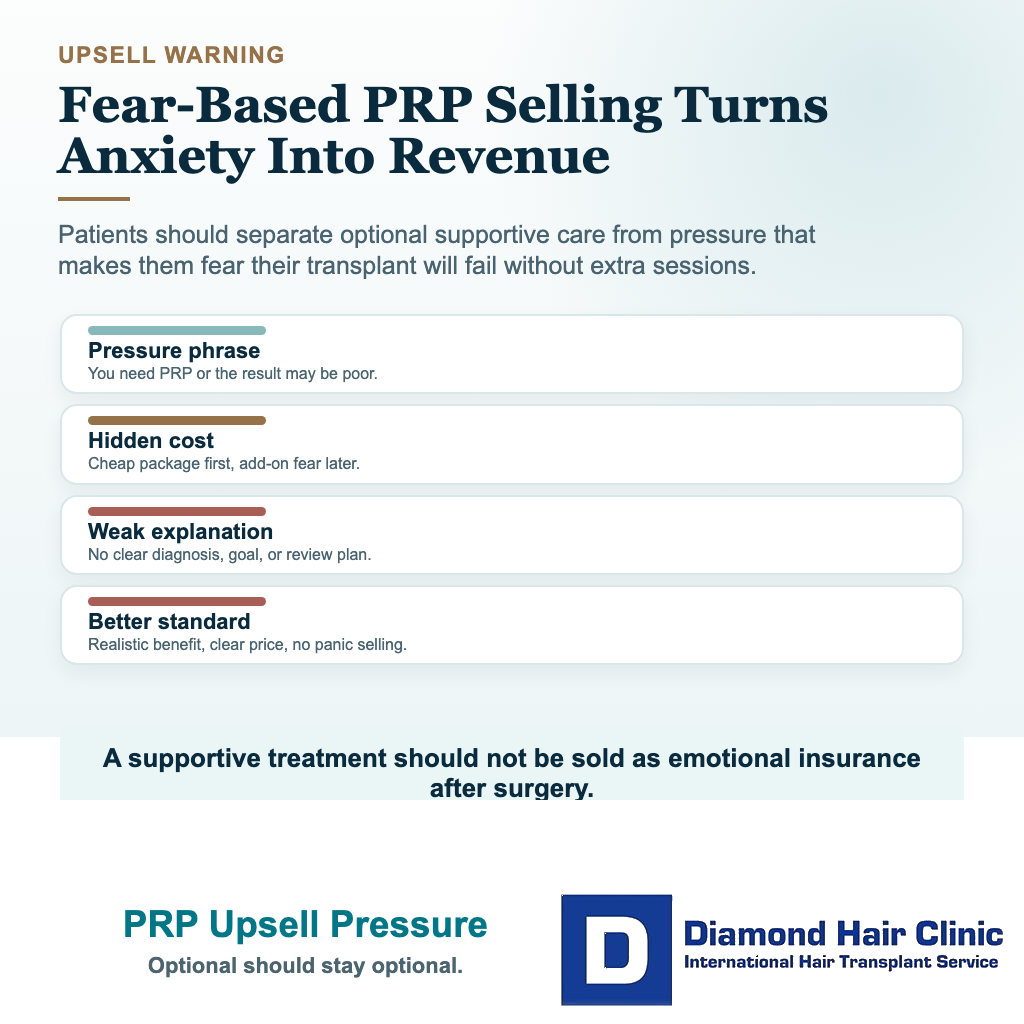
After surgery, people are emotionally vulnerable. They worry about shedding, crusts, graft survival, and every mirror reflection.
If someone says extra PRP is required or the result may fail, many people agree because they are anxious, not because the medical reason is clear. That is not the same as good guidance.
There is a real difference between “PRP may offer optional support in selected cases” and “you need this or your result may not be good.” The first sentence gives a choice. The second creates pressure.
Best candidates still have living miniaturized follicles
PRP makes more sense when follicles are weakened but still alive. Early or moderate thinning is a more reasonable setting than advanced baldness. Some diffuse thinners may also be considered when the diagnosis is clear and the scalp is not inflamed or scarred.
Even then, I see PRP as supportive, not transformative. It may sit inside a broader maintenance strategy for someone who understands the limits and wants to try a modest added treatment. It should not become the central answer to a problem that is bigger than PRP can realistically handle.
Who should be more careful with PRP?
Platelet disorders, a low platelet count, active scalp infection, uncontrolled medical problems, bleeding tendencies, or some blood thinning medicines need careful review before PRP. The doctor should also know about autoimmune disease, cancer history, previous scalp procedures, and any condition that changes healing or infection risk.
PRP uses your own blood, so allergy risk is different from many injected products, but it is still an injection treatment. The patient needs a clear explanation of temporary tenderness, swelling, bruising, bleeding points, and infection risk from poor sterile technique.
Because PRP involves drawing blood, processing it and making multiple scalp injections, I do not treat it as a home procedure. A centrifuge or injector, or help from someone with general clinical training, does not replace a controlled clinical setting, sterile handling, a review of bleeding and infection risks, and a clinician who is qualified to perform the procedure.
I am also cautious when expectations are unrealistic. If advanced baldness is being treated as if a few PRP sessions will significantly fix the situation, biology is not the only issue. The consultation is not clear enough.
Why do results vary between patients and clinics?
Age, diagnosis, degree of miniaturization, inflammation, genetics, hormonal background, and ongoing medical treatment can all change what someone notices. Early thinning with miniaturized living follicles is not the same as long empty areas.
The PRP protocol also matters. Blood processing, platelet concentration, injection depth, session interval, and maintenance plan can vary from clinic to clinic. That is one reason I do not promise response before treatment, even when the examination looks suitable.
The financial side matters too. PRP is rarely a single session decision. A clinic may suggest a short initial series and then maintenance if there is benefit. Before starting, the review point and stopping point need to be agreed. If comparable photos after a fair trial show little change, continuing only because money has already been spent is not good decision making.
How should PRP results be judged?
PRP needs slow, objective judgment, without panic. I avoid conclusions after one session or one anxious week. Hair cycles are slow, shedding fluctuates, lighting changes everything, and mood changes perception.
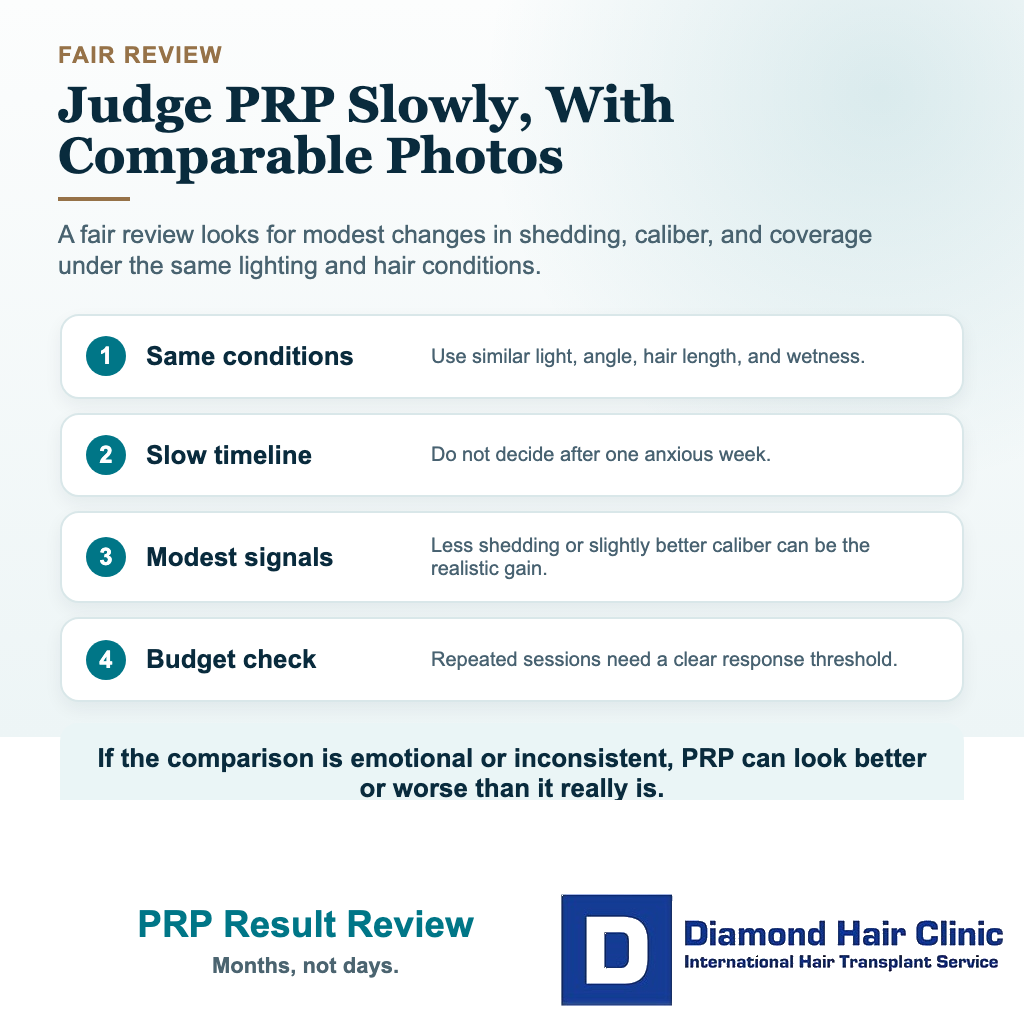
The fairest method is comparable photographs under similar lighting, angle, hair length, and styling. The earliest sensible review is often after several months rather than days. The realistic signs are usually reduced shedding, slightly improved hair caliber, and greater visual fullness, or slower progression than expected.
If the promised result was dramatic regrowth, even a biologically successful PRP response may feel disappointing. The goal has to be realistic before treatment begins.
After a transplant, PRP is optional support, not insurance
PRP can be used after a transplant in selected circumstances, but the language has to stay balanced.
A properly planned and properly performed hair transplant should not depend on aggressive post-operative upselling to justify its quality. Good graft handling, good surgical judgment, recipient area planning, and aftercare matter much more.
If PRP is offered as optional support with realistic language, that is one thing. That balance also applies to PRP and exosomes after a hair transplant. If PRP is pushed in a way that makes someone feel the transplant will be poor without it, that is something else.
PRP has to earn its place
I do not reject PRP blindly, and I do not sell it as a cure. The diagnosis comes first. Androgenetic thinning, female pattern loss, diffuse shedding, inflammation, and scarring disease do not all deserve the same treatment.
If living follicles remain and PRP may help, the plan should name the goal, session count, review point, maintenance expectation, cost, and stop point. Without those details, it becomes marketing instead of medicine.
PRP can support selected patients. It should not sound bigger than diagnosis, donor reserve, surgical design, or ongoing hair loss control.