



The Real Cost of a Cheap Hair Transplant Abroad
Traveling abroad for a cheaper hair transplant can be a good decision only when the saving does not weaken medical responsibility. A lower price is not the problem. The weak point is choosing a clinic where the hotel, transfer, and package are clear, but the surgeon’s responsibility, donor plan, and follow up are vague.
For Turkey, this needs a careful comparison. The usual hair transplant cost in Turkey range is $5,000 to $10,000, and reputable surgeon led clinics in Istanbul are usually in the $7,000 to $10,000 range. A price can sit below many Western countries and still be far from the cheapest offer in the market.
Compare the whole structure, not only the invoice. A protected plan needs to show who evaluates you, who designs the hairline, who decides the graft number, who creates the recipient area, who protects the donor, and who remains responsible after you fly home. If the price is tied to a rushed deposit, read about hair transplant booking pressure and payment clarity before a hair transplant in Turkey before treating the saving as medical value. That is the core of Turkey hair transplant without the sales lens, because a saving only helps when the surgeon role, donor reserve, and follow-up still hold.
Travel abroad can be reasonable in selected cases
Traveling abroad can make sense when the surgeon, clinic structure, donor planning, and aftercare are strong enough to justify the decision. A lower price can reflect local operating costs and an efficient international patient system. It becomes risky when the saving comes from rushed assessment, unclear surgeon responsibility, weak donor planning, or follow up that becomes vague once the patient leaves the country.
Turkey should not be rejected only because some clinics behave badly. Turkey has experienced surgeons and a strong medical tourism structure. It also should not be chosen only because it is known for lower prices. Both extremes are too simplistic.
A useful test is whether you would still trust the same clinic if the price difference were smaller. When the answer is no, the decision may be driven by savings rather than medical trust.
If the saving only feels safe because the price is low, pause before paying. The clinic should still earn trust through donor planning, medical records, and follow up after you return home.
Price is only one part of value
The true cost of a hair transplant includes more than the operation. It includes flights, hotel, time off work, medication, aftercare, possible local medical visits, written medical records, and the cost of repair if the first plan damages the donor area or creates an unnatural hairline.
When insurance excludes elective surgery abroad, the aftercare plan becomes even more important because swelling, infection concern, or flight disruption may need a named route after you leave.
A cheap operation can become very expensive if it leaves the patient with an overharvested donor area, poor hairline design, visible scarring, or a result that needs repair. The first invoice may look attractive, but the real cost can continue for years if the donor area has been spent carelessly.
A more expensive clinic is not always better either. Price alone does not prove quality. The detail that matters is whether the patient can see medical responsibility behind the price. A good value decision is not the lowest price. It is the strongest medical plan at a fair and transparent price.
Real total cost after travel and recovery
The real total cost includes the clinic fee, flights, accommodation, food, transport, time away from work, medication, supplies, and possible local medical attention after returning home. If the patient travels with a companion, that cost also matters. For tightly curly hair, I also check whether the curl aware travel budget leaves enough room for surgeon review and follow up.
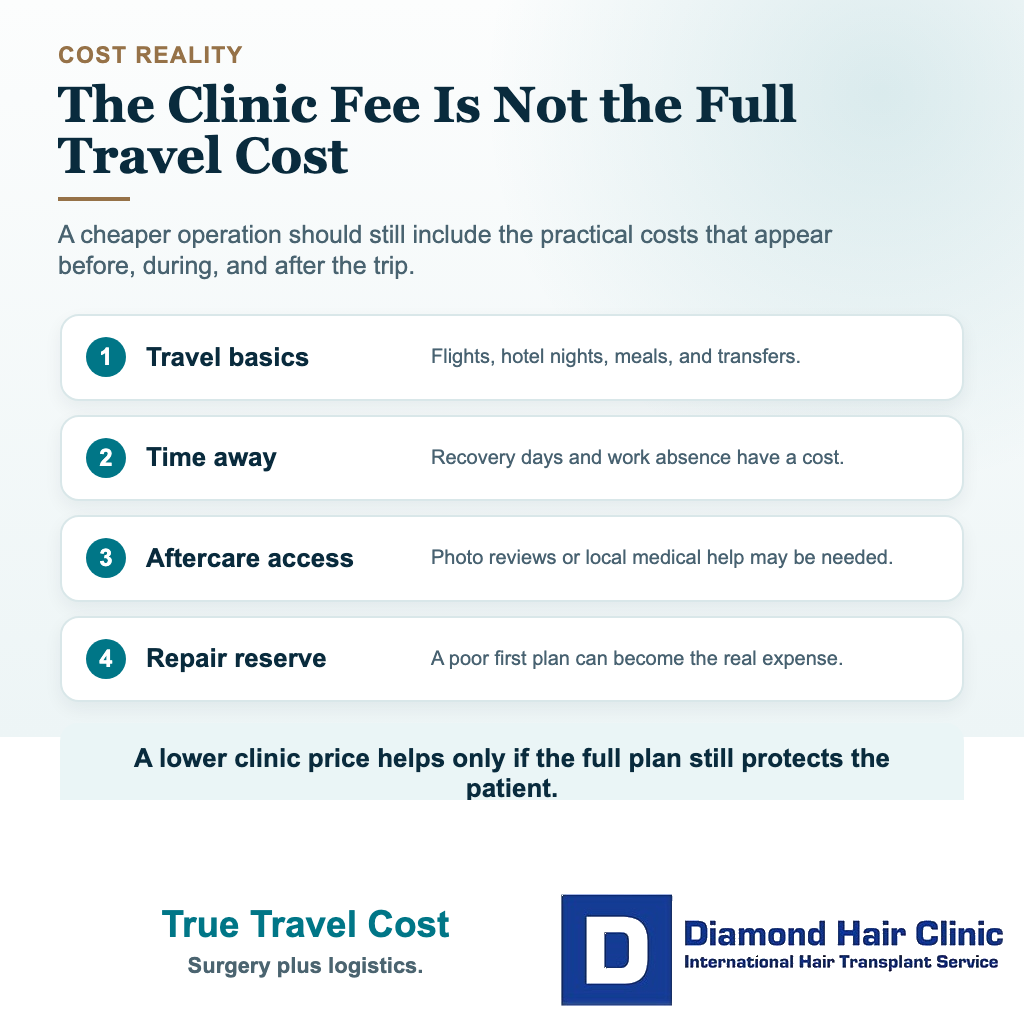
A correction offer can look generous while the patient still carries the real cost of time away, anxiety, and another procedure on a limited donor area. Build that possibility into the first travel decision, not only after a problem appears.
Build the cost of uncertainty into the calculation. If the clinic does not answer questions clearly after the patient returns home, local doctor visits, extra medication, or repeated opinions may be needed just to understand whether healing is normal. That emotional cost is real, even when it does not appear on the invoice.
Planning time off work after a hair transplant is part of the same calculation. The cheapest surgery may not be truly cheaper if the recovery plan is rushed, the patient returns to work too soon, or the result creates anxiety that could have been prevented with better planning.
Turkey as a destination for hair transplant patients
Turkey is attractive because it has a large hair transplant market, experienced teams, strong international patient systems, and costs that are often lower than the United States, Canada, the United Kingdom, and many parts of Europe. For many patients, that difference makes treatment possible.
Turkey also has clinics that work with international patients every day. They understand travel timing, hotel coordination, airport transfers, photo assessment, language support, and recovery instructions for patients returning home. These systems can make the experience easier.
But the size of the market is both an advantage and a risk. A large market includes excellent clinics, average clinics, and poor clinics. The country alone does not decide the result. The clinic model and the surgeon’s real involvement decide much more.
Separating quality from marketing
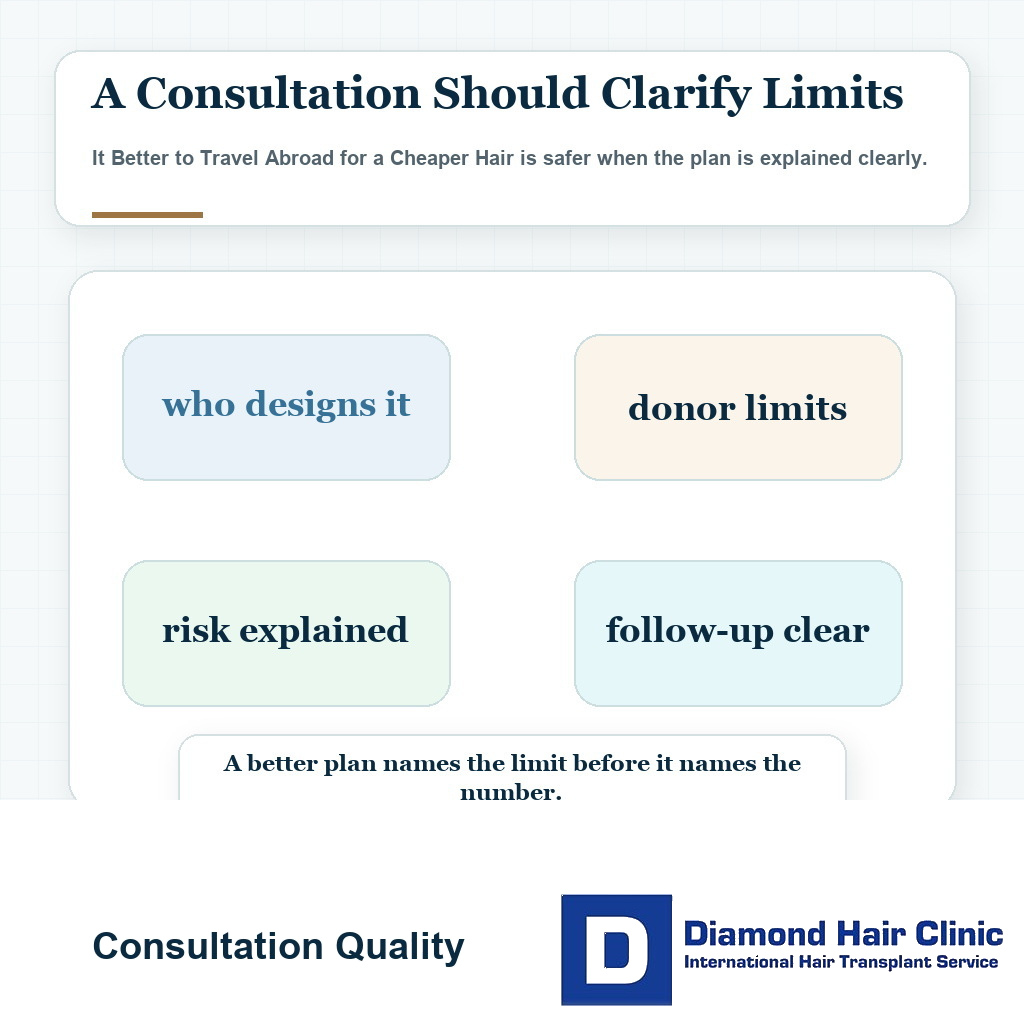
Quality is separated from marketing by looking at responsibility that can be verified. Before payment, the plan needs to make clear how you are evaluated, how the hairline is designed, how donor capacity is measured, who performs the critical steps, and what limits are explained.
A clinic can have polished videos, hotel arrangements, many reviews, and a confident coordinator, but none of that proves the surgical plan is safe. Marketing can show attention, but it cannot replace medical judgment.
The central question remains who performs your hair transplant. A transfer, a hotel, and a friendly coordinator do not replace the doctor who is medically responsible for the operation.
Before paying a deposit abroad
Before paying a deposit abroad, know who will assess the donor area, who will design the hairline, who will decide whether the case is appropriate, who will create the recipient area, and who will be responsible if the plan needs to change on surgery day.
Know what is included in the price and what is not. Some packages include hotel and transfers but give very little clarity about surgeon involvement, written records, medication, washing support, or follow up after travel. Other clinics charge more but give a more serious medical evaluation. The package must not distract from the surgical question.
Before paying, the operative record, graft distribution, medication instructions, and photo review route after travel should already be clear. A package is not complete if the answers disappear once you fly home.
For medical tourism, the travel decision is stronger when it still works if the operation becomes smaller after examination. Before the trip, the clinic should explain what would lower the graft range, who makes that call, and how follow up will handle questions once the patient is home.
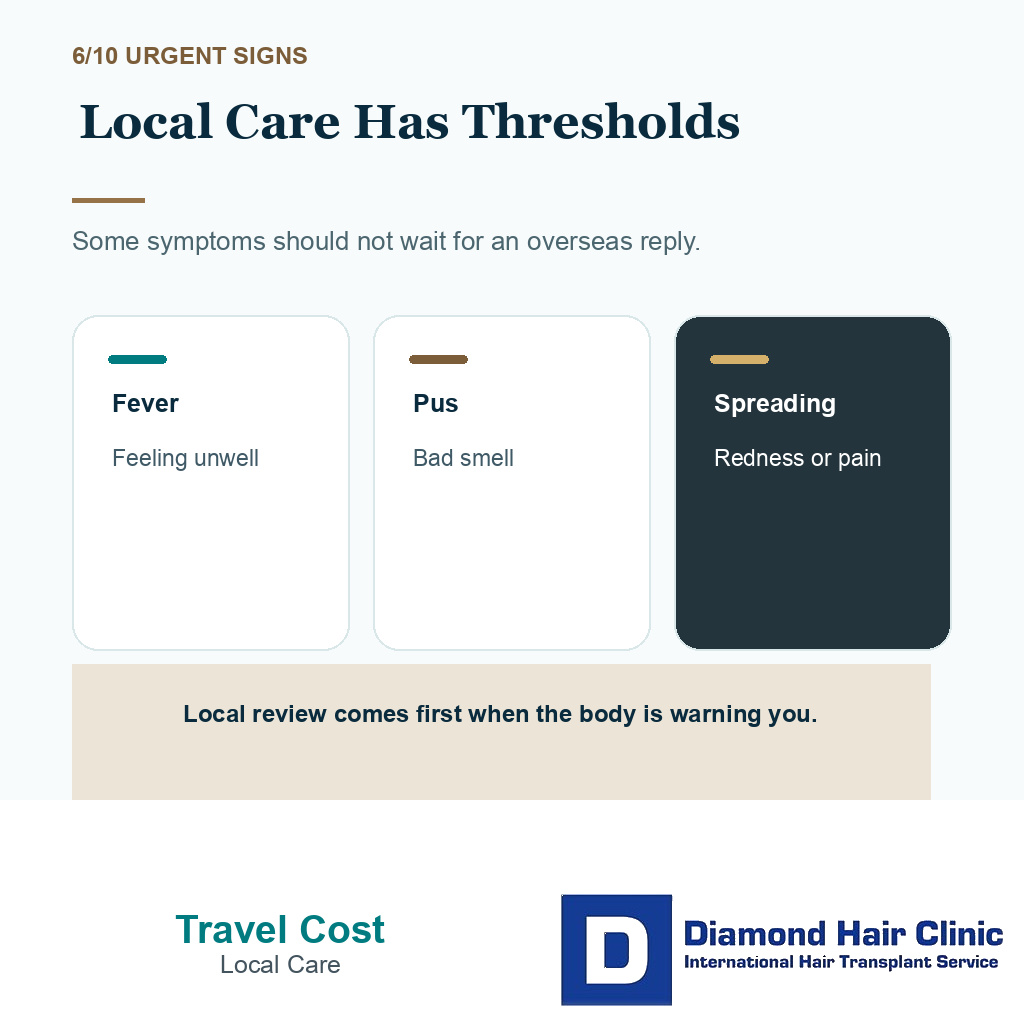
The complication route should be just as clear as the transfer route. If pain worsens, redness spreads, discharge appears, the skin opens, or the donor area looks infected after you return home, local medical care may need to come before waiting for a remote cosmetic answer.
Also ask how many patients are operated on in the same day, whether the surgeon is present throughout the critical parts of the case, and whether the clinic ever refuses patients who are poor candidates. A clinic that says yes to everyone is not protecting everyone.

Medical tourism risk check
For international patients, the risk is not travel itself. The risk is travelling after seeing a doctor’s name in marketing, then discovering that the real surgical responsibility is unclear.

Travel can still be reasonable. The test is whether distance has been planned medically, not only logistically.
Clinic must be able to say no
The clinic should be willing to say no to a patient who is too young, has unstable hair loss, has unrealistic density expectations, has a weak donor area, or wants a hairline that may not age naturally. Saying no is not poor service. In surgery, it can be protection.
Concern increases when a clinic approves the case immediately, gives a large graft number quickly, and moves straight to payment. Some patients are not ready for surgery. Some should try medication first. Some need a smaller plan. Some should wait until the hair loss pattern becomes clearer.
Candidacy matters as much as price. Being a good candidate for a hair transplant should come before the booking decision. A safe clinic protects the patient from the wrong operation, even if that means losing a booking.
Surgeon involvement matters more than country
The country matters less than who carries the medical responsibility. A safe hair transplant depends on case selection, donor calculation, hairline design, recipient area creation, graft handling, incision distribution, and postoperative judgment. These are medical decisions, not travel services.
When surgeon involvement is weak, the patient may not know who truly owns the plan. A technician team may be experienced, but medical responsibility still needs to be clear. If the surgeon’s role is limited to a name on the website, treat that as a serious warning.
Travel makes accountability more serious. If something feels wrong after surgery, distance does not make responsibility smaller. Before flying, know who you can contact, who reviews your photos, and whether that person actually understands the case.
Donor protection matters more than package price
Your limited lifetime graft supply is what makes future hair restoration possible. If too many grafts are taken, or if extraction is concentrated badly, the back and sides may look thin, patchy, or scarred. This can limit future repair options.
A package that promises a very large graft number can sound attractive before surgery. But the patient lives with the donor area after surgery. If the donor is harmed, the saving does not feel like a saving anymore.
The patient needs to know the donor area before choosing a clinic. The safe question is not how many grafts can be taken today. The safe question is how many grafts can be taken without damaging the patient’s future.
Red flags in a cheap package
A cheap package becomes worrying when it focuses on unlimited grafts, guaranteed density, celebrity photos, very large numbers, or pressure to book quickly. It is even more concerning when the patient cannot speak directly with the doctor responsible for the plan.
Another weak point is when every patient seems to receive the same graft number. Real planning should respond to donor density, hair caliber, recipient area size, age, medication status, future hair loss, and expectations. It should not sound like a fixed menu.
Red flags of Turkish hair transplant clinics help patients avoid systems where volume replaces judgment. The purpose is not to frighten patients away from Turkey. It is to help them separate a serious surgical model from a weak one.
Follow up is harder after travel
Follow up is harder after travel because the patient is not near the clinic when many questions appear. Swelling, redness, pimples, shedding, shock loss, itching, numbness, scabs, and anxiety often happen after the patient has already returned home.
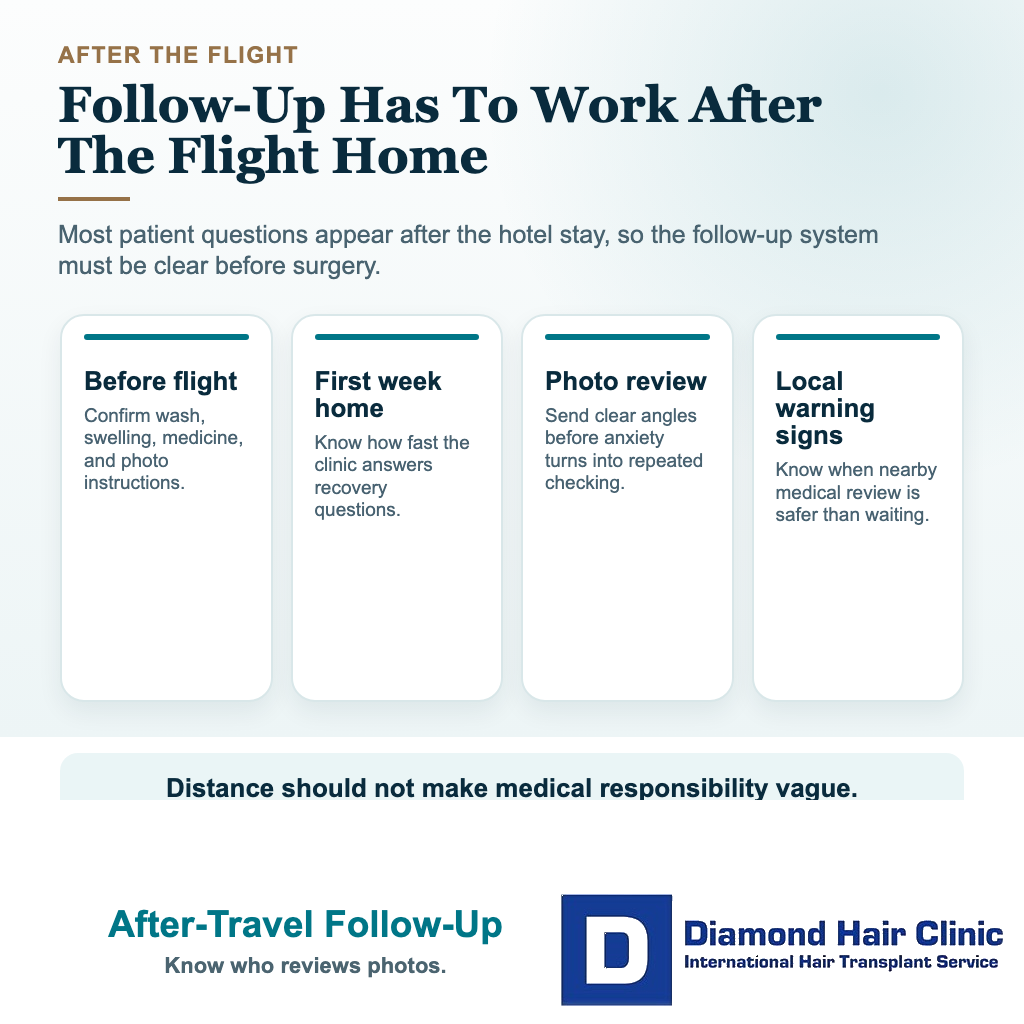
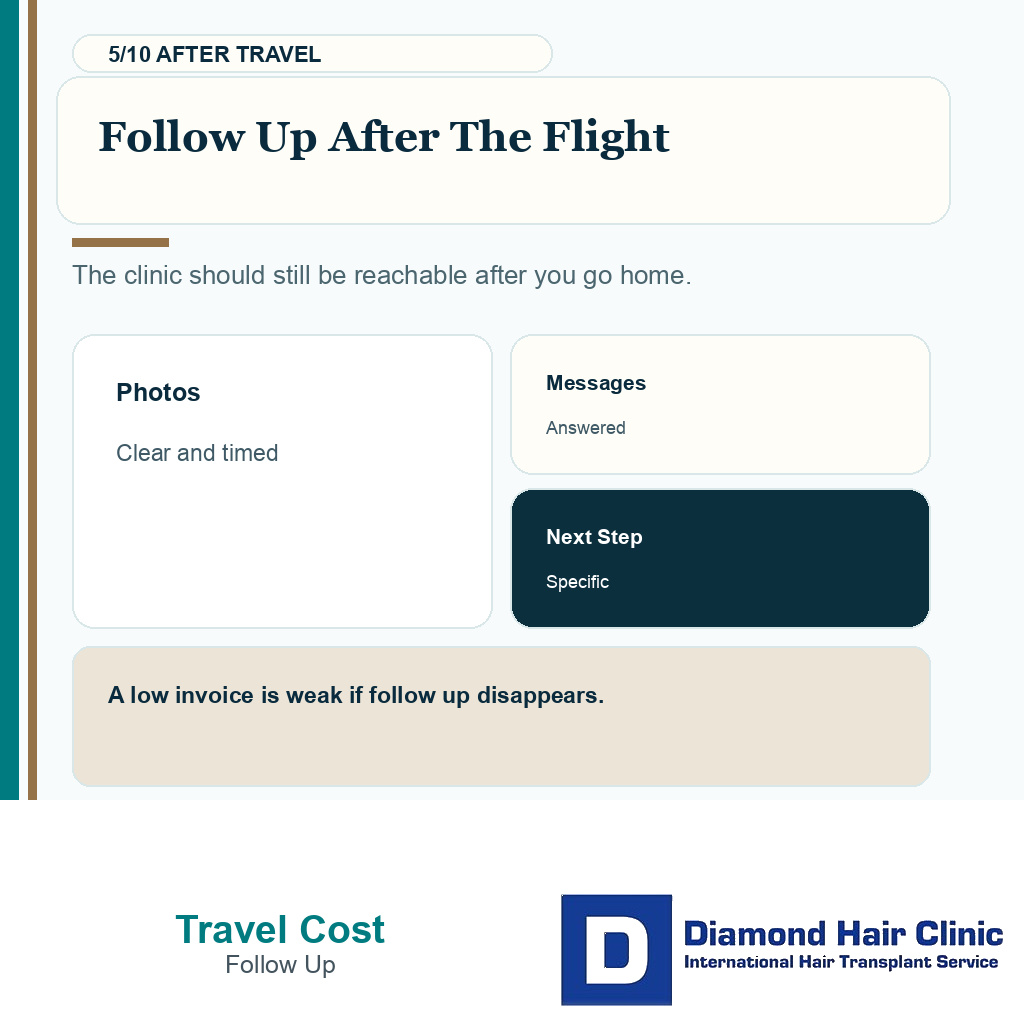
A careful clinic needs to explain how the patient can send photos, who reviews those photos, how quickly questions are answered, and which warning signs require local medical attention. These details need review before surgery, not after the patient is worried.
Good hair transplant aftercare protects a well planned operation. Poor communication after travel can make a normal recovery feel frightening and can also delay help when a real problem appears.
Recovery time after travel
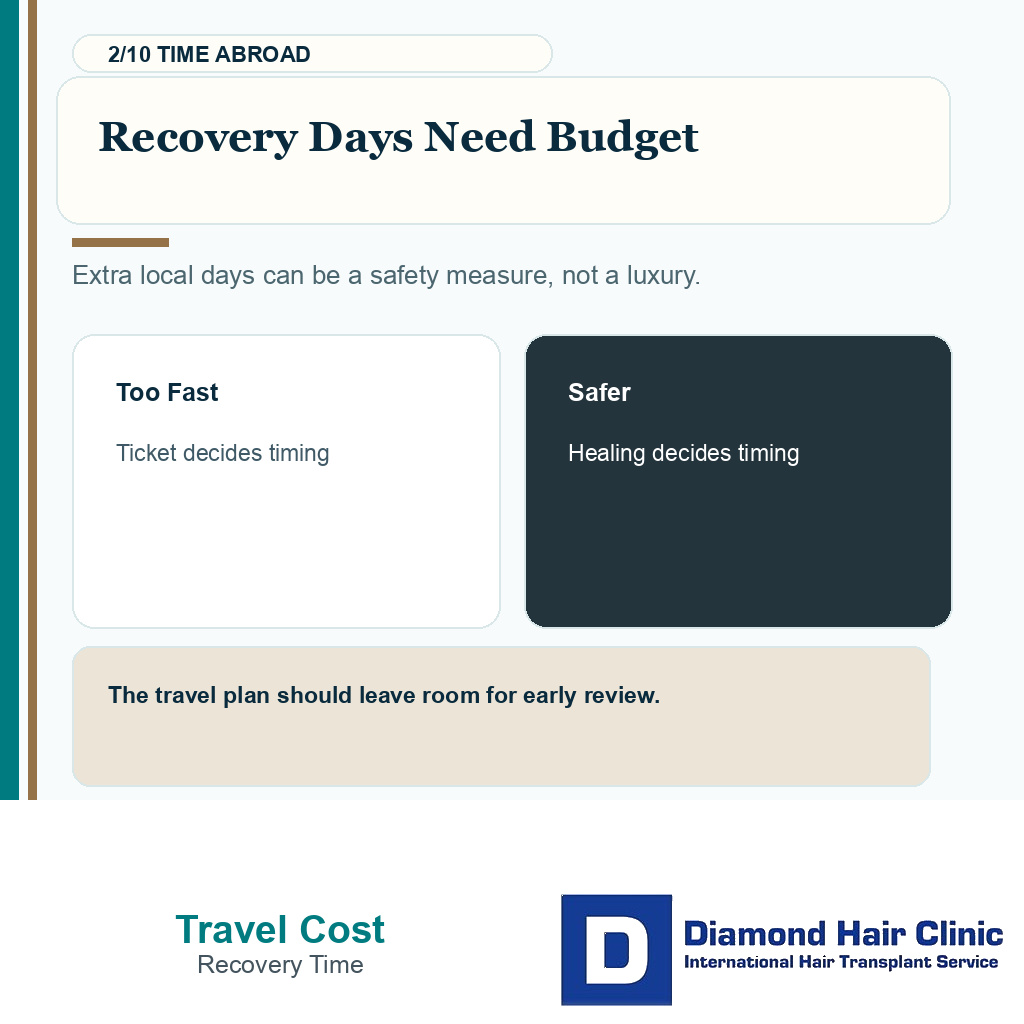
Before flights are booked, the recovery plan needs to be realistic. In the first days, the plan should account for swelling risk, first washing, donor area comfort, sleeping position, scab management, and whether the patient understands what is normal before leaving the clinic.
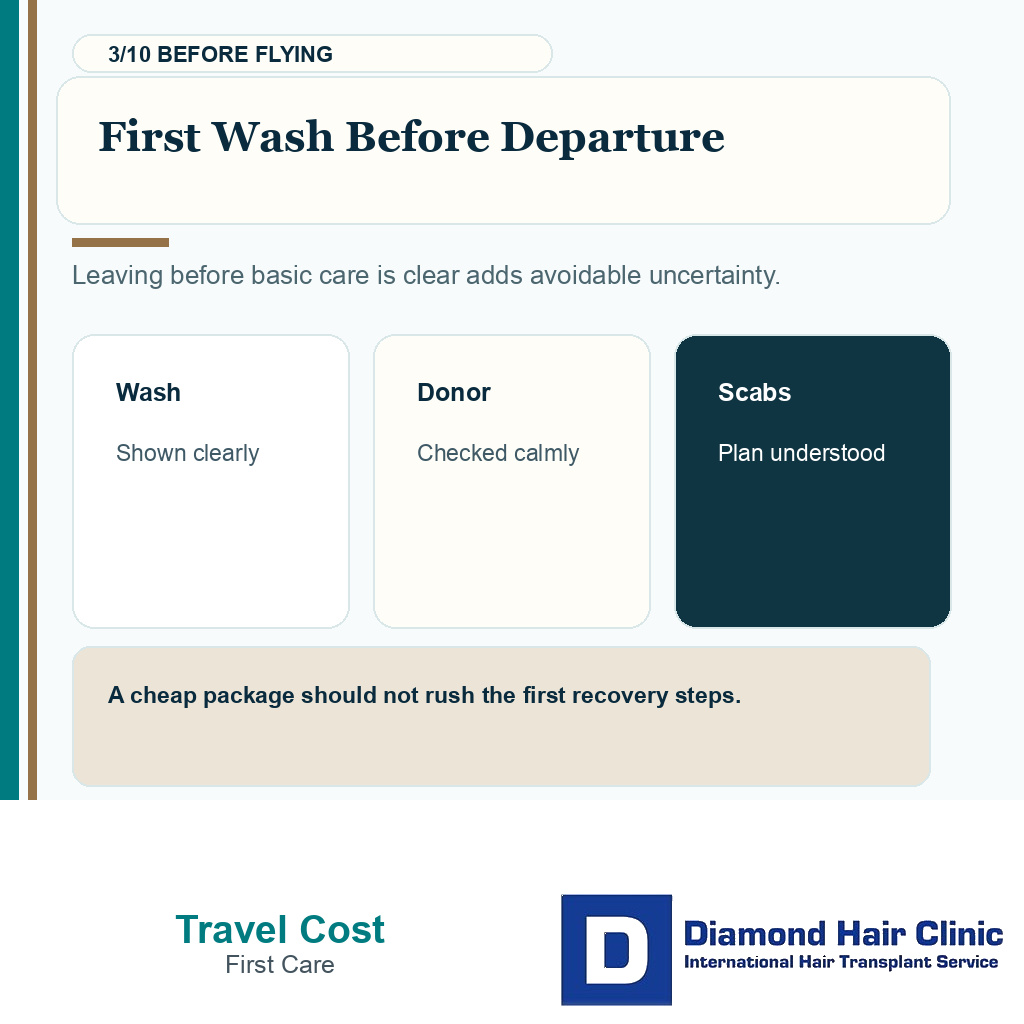
Some patients can travel home safely soon after surgery, but the plan needs to be clear before departure. That means first wash instructions, donor area review, photo follow up after travel, written operative details, and the symptoms that need urgent local medical attention. If the patient has medical risk factors or a long flight, travel timing belongs in the medical plan instead of being treated as only a ticket booking.
A travel plan that ignores recovery is not a complete plan. Hair transplantation is not finished when the grafts are placed. The result still depends on careful healing, clear instructions, and a patient who understands how to protect the scalp during the first weeks.
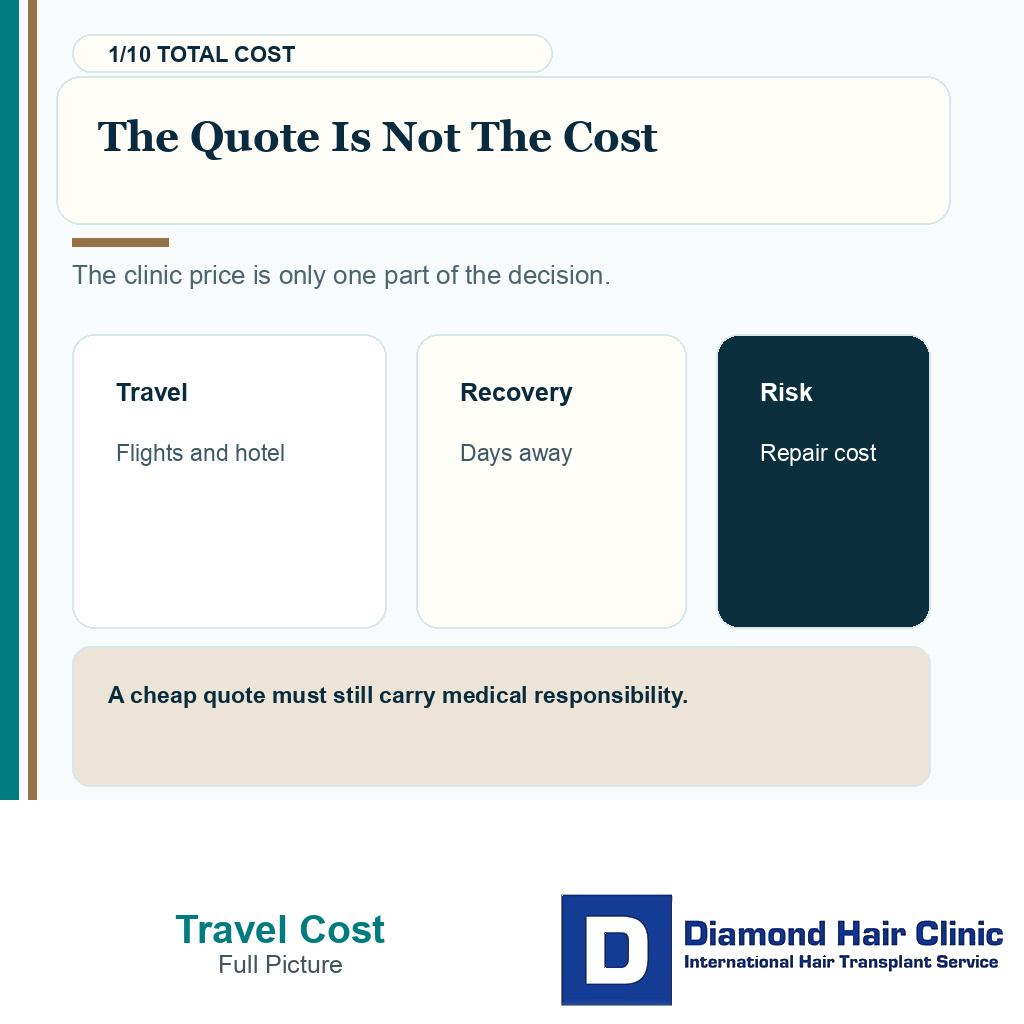
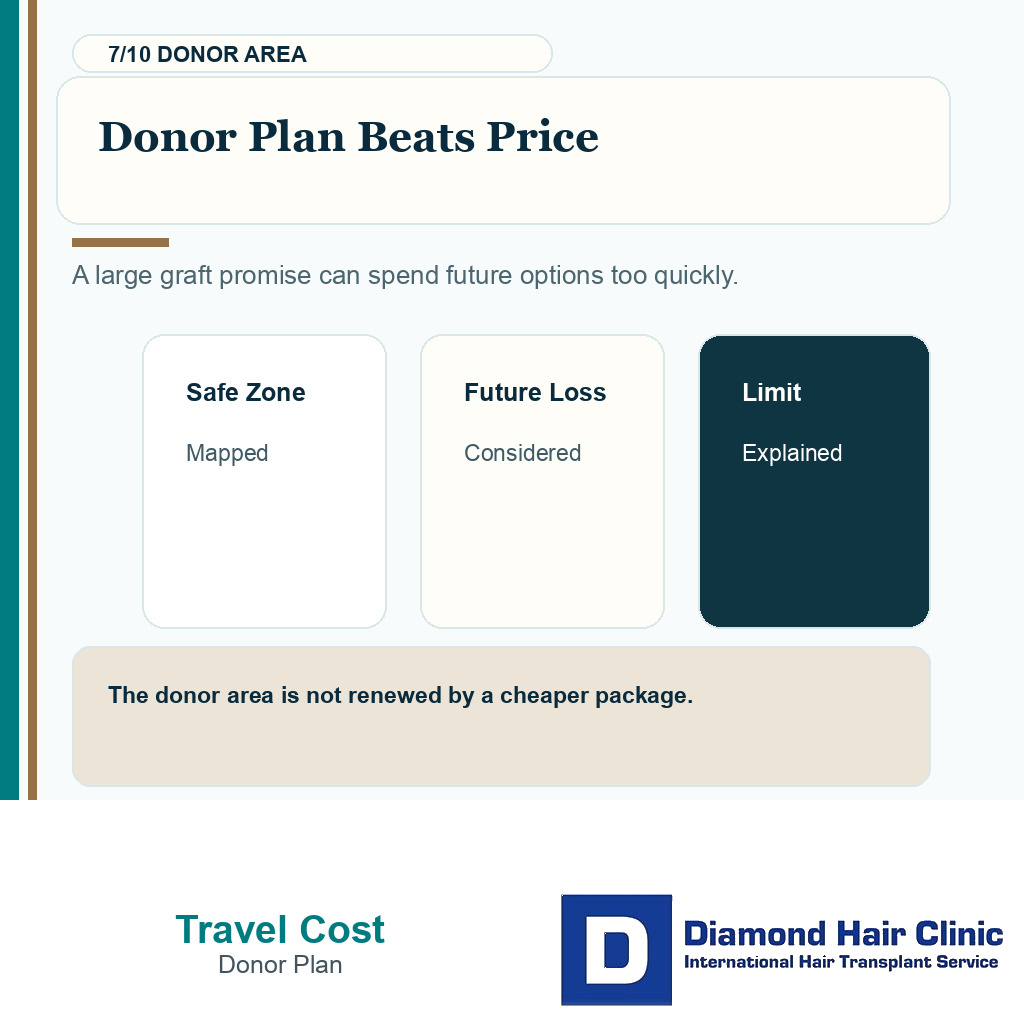
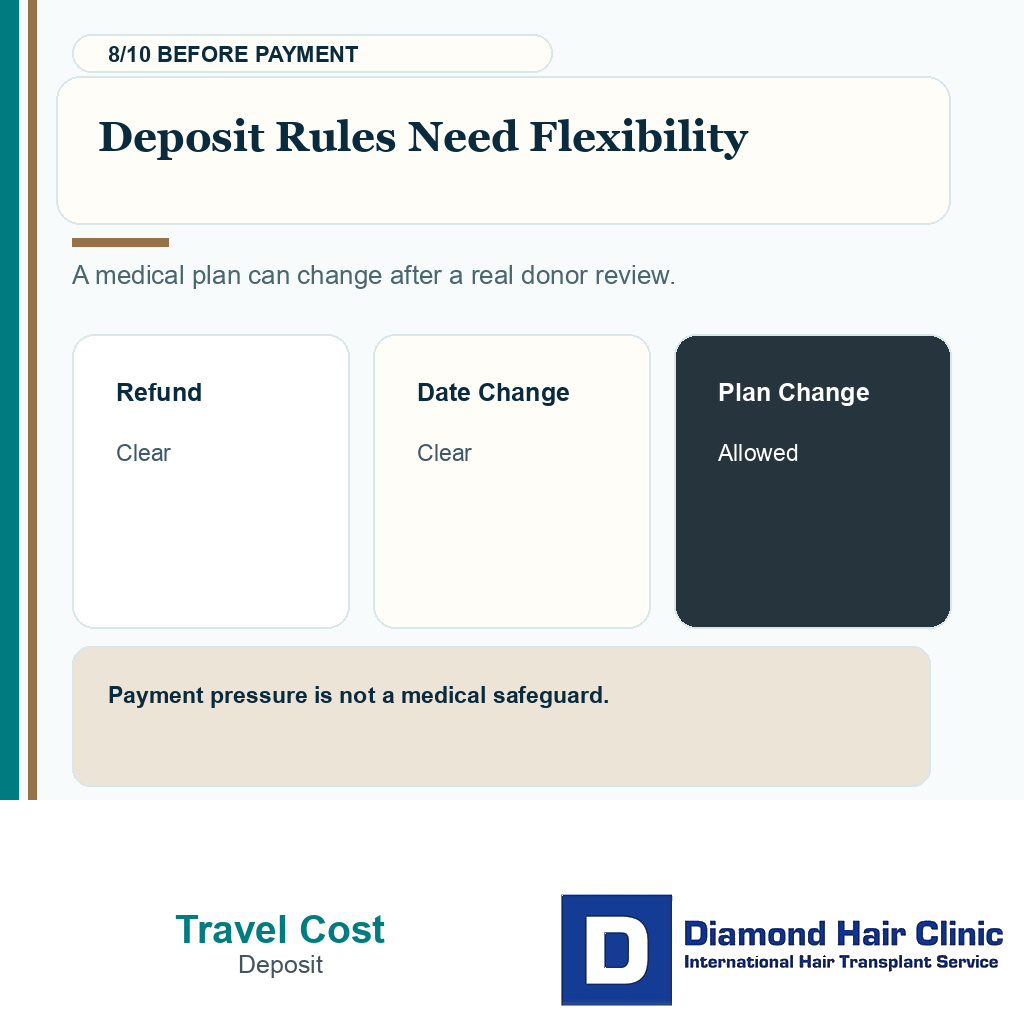
Use the 10 travel cost and recovery planning slides below to compare a cheap quote with the medical safeguards that still need to be clear. Swipe the carousel, use the arrows for one step at a time, or choose a number below the image to jump to that point.



Staying local may be better
Staying local may be better if the overseas plan is vague, the patient has complex medical needs, the surgeon is not clearly involved, or the patient cannot stay long enough for early review. In a complicated case, convenience can have real medical value.
A patient with significant medical history, unstable medication use, bleeding risk, uncontrolled blood pressure, diabetes concerns, or severe anxiety may need closer coordination than a short medical tourism trip can provide. Travel can still be possible in some cases, but the planning must be stronger.
Staying local may also be better if the patient feels pressured or uncertain. A hair transplant should not feel like a countdown to a flight that cannot be changed. If the plan is not clear before travel, waiting is safer than treating the flight date as fixed.
Travel abroad makes sense only with safeguards
Traveling abroad can make sense when the patient chooses a qualified surgeon, receives a conservative plan, understands donor limits, has realistic expectations, and can communicate directly with the clinic before and after surgery.
It can also make sense when the patient has researched carefully, compared similar cases, asked about surgical responsibility, and accepted the recovery logistics. A good travel candidate wants a responsible medical plan, not only a lower price.
How to get a hair transplant in Turkey explains the practical travel side. Travel planning is useful only when it supports a responsible surgical plan.
Cheap results still need photo context
A low price may be shown beside excellent before and after photos. I still ask what the photo is actually proving. Hair length, lighting, styling product, camera angle, donor appearance, wet or dry hair, medication use, and the month of follow up can change how dense a result looks.
One result also does not show the limits of your own case. The photographed patient may have thicker hair, stronger donor supply, a smaller bald area, a different hairline, or a plan that left the crown thin on purpose.
Before a cheap offer feels convincing, ask what was not promised in the case. Ask why that graft number was chosen, what would have made surgery unsafe, and whether the donor area after surgery is shown well enough to judge.
Comparing clinic reviews
Reviews can help, but they should not be treated as proof. A review may describe one patient with one hair type, one donor area, one pattern of hair loss, and one expectation. Your case may be different.
Look for patterns rather than single emotional posts. Mature results at 12 months or later, visible donor areas, soft hairlines, clear doctor involvement, and repeated themes in negative reviews tell more than one dramatic comment.
Hair transplant reviews in Turkey goes deeper into this. Reviews are clues. They are not a substitute for a medical consultation and a clear surgical plan.
Comparing countries
Patients often compare Turkey with Mexico, Europe, the United States, or other destinations. That comparison can be useful, but it should not become only a price table. Each country has strong clinics and weak clinics. Each patient needs a clinic that matches their medical situation.
The real comparison is not Turkey against another country. It is one clinic model against another clinic model. Look at who evaluates the patient, who designs the plan, how many patients are treated daily, how the clinic handles a limited donor, and what happens if the result needs follow up.
The pros and cons of hair transplant in Turkey are worth understanding because Turkey can be a very good choice for the right patient in the right clinic. It can also be a poor choice if the patient treats the country name as a guarantee.
Lower price can still mean high quality in some cases
A lower price can still be associated with high quality when the clinic structure is medically strong. Turkey can offer a better cost structure than many Western countries because of local operating costs, medical tourism infrastructure, and experience with international patients.
But lower price and extremely low price are not the same thing. A fair price can reflect efficiency and location. An unrealistically low price may reflect rushed work, unclear surgeon involvement, too many daily cases, weak aftercare, or pressure to use a very large graft number as a sales tool.
Balance matters. A lower price does not prove danger. A higher price does not prove excellence. The structure behind the price matters more than the price label.
Question that protects the patient most
The question that protects the patient most is whether you would still choose the same clinic if the price difference disappeared. When the answer is no, you may be choosing a discount rather than a surgeon.
Another useful question is whether the clinic explained any reason you might not be a good candidate. A careful clinic can say no. It can also recommend waiting, medication, a smaller session, or a more conservative hairline when that protects the donor area better.
Choosing a hair transplant clinic in Turkey should depend on the medical plan, surgeon involvement, donor management, and follow up, not the loudest promise or easiest booking process.
Repair risk belongs in the decision
Repair risk belongs in the cost calculation. A poor first surgery can create an unnatural hairline, weak density, wrong direction, scarring, or donor depletion. Repair may then require more time, more money, and more emotional energy than the original decision.
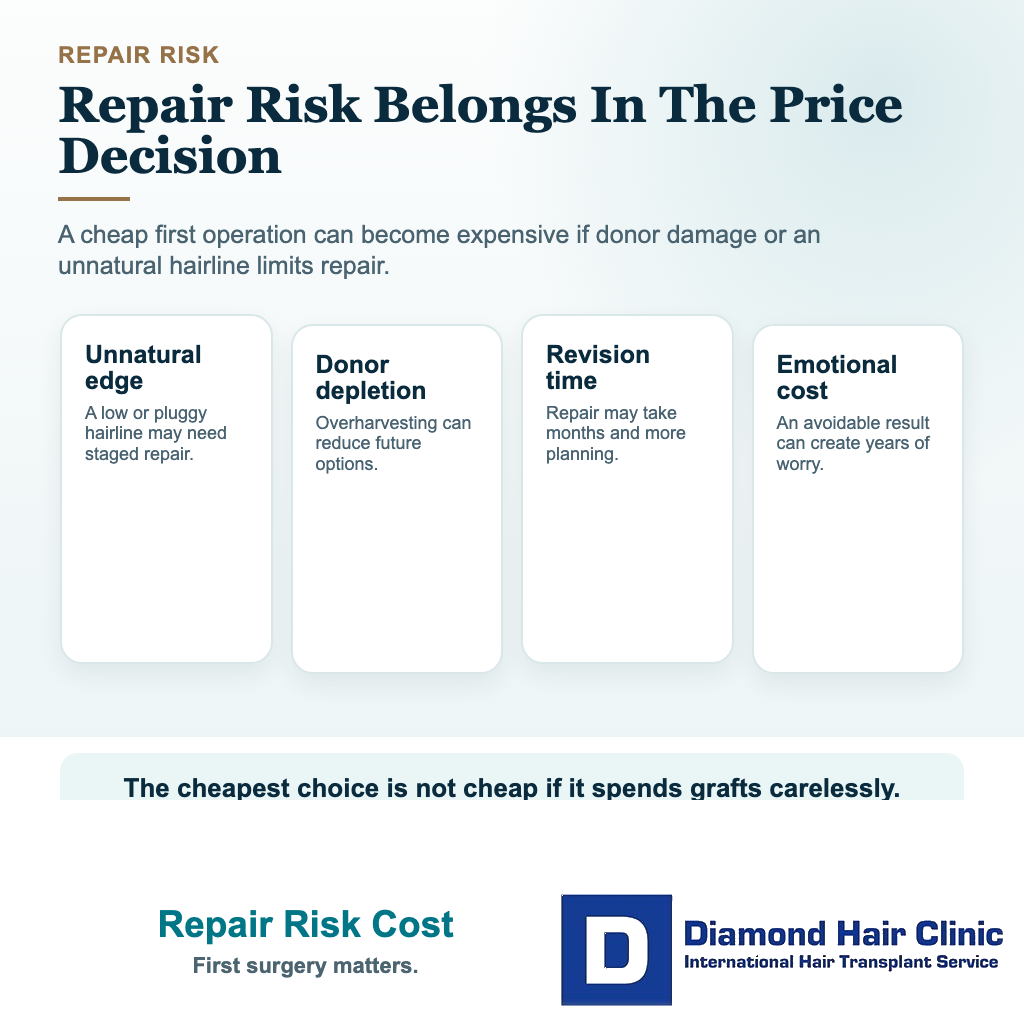
Some problems can be repaired well. Some can only be improved. Some donor damage cannot be fully reversed. The first choice matters because the cheapest plan is not cheap if it spends the donor area carelessly.
This is not meant to frighten patients away from travel. It is meant to make the real risk visible before surgery. A travel decision should protect the patient’s future, not only reduce the first payment.
Cheap surgery needs proof
Cheap surgery needs to prove the same things as expensive surgery. That means clear medical responsibility, natural design, safe donor use, clean technique, realistic graft planning, written case information, and real follow up. Price does not remove those requirements.
If those standards are present, traveling abroad may be reasonable. If they are absent, the cheaper choice can become the most expensive one.
Choose the clinic you trust medically first. Then decide whether the price and travel plan make sense. Do not choose the clinic only because it makes surgery possible next week at the lowest price. Hair transplantation is permanent enough to deserve more patience than that.