


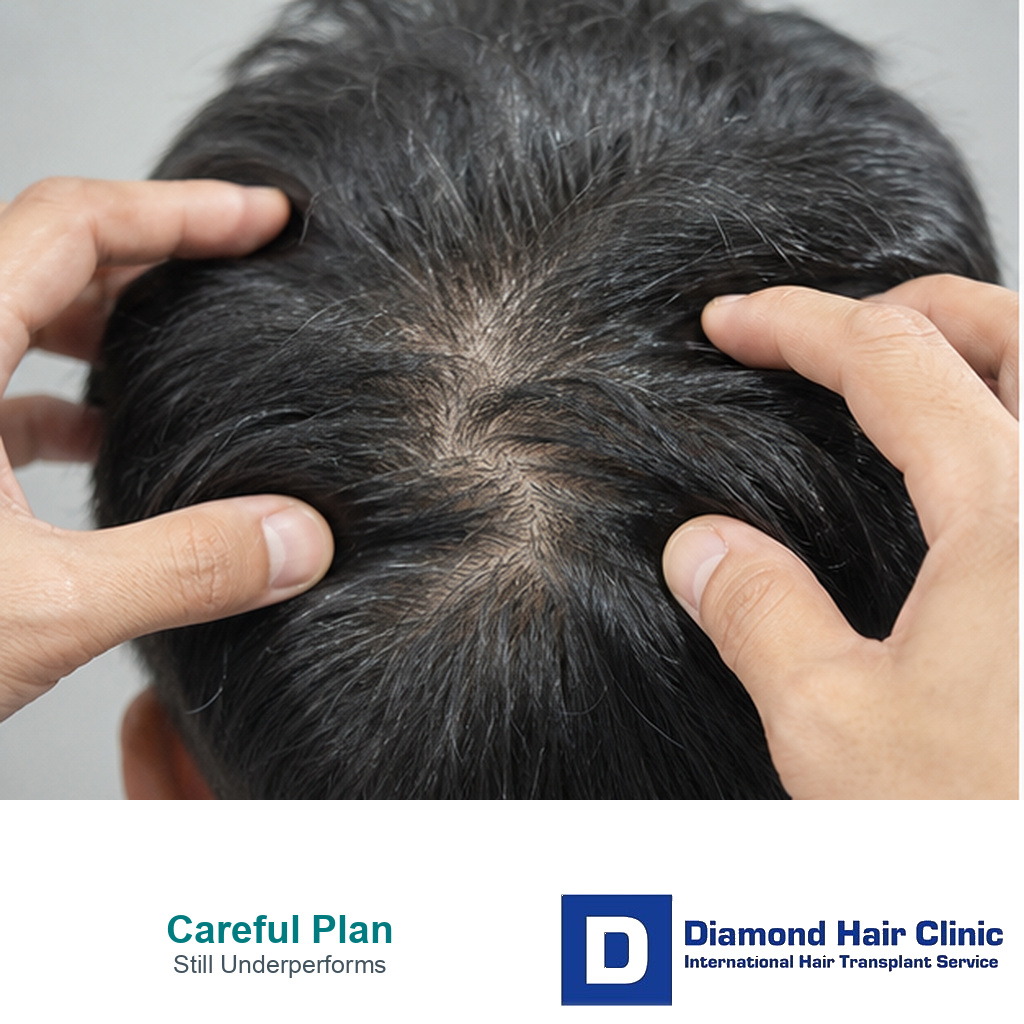
A Carefully Planned Hair Transplant Can Still Underperform
Even with good planning and careful surgery, transplanted hair still has to survive, heal, cycle, and grow. A result that looks weaker than expected does not prove poor surgery by itself, and it does not mean the patient did something wrong.
Hair transplantation is living tissue surgery. Good planning, careful extraction, protected graft handling, and correct placement lower preventable risk. They do not let anyone control every step of growth, healing, donor behavior, native hair loss, scalp biology, or genetics.
Before blame, panic, or a second operation, start by organizing the evidence. A strong donor, a suitable age, a healthy scalp exam, realistic density planning, and a careful surgical team can all be present, and the visible result may still be weaker than expected. No surgical team can guarantee final growth from living tissue. Blame rarely helps before the evidence is organized. First, I want to know what evidence explains the gap.
Even careful planning can end in a disappointing result. The review should separate planning quality, growth, hair caliber, styling, and future loss before judging what failed.
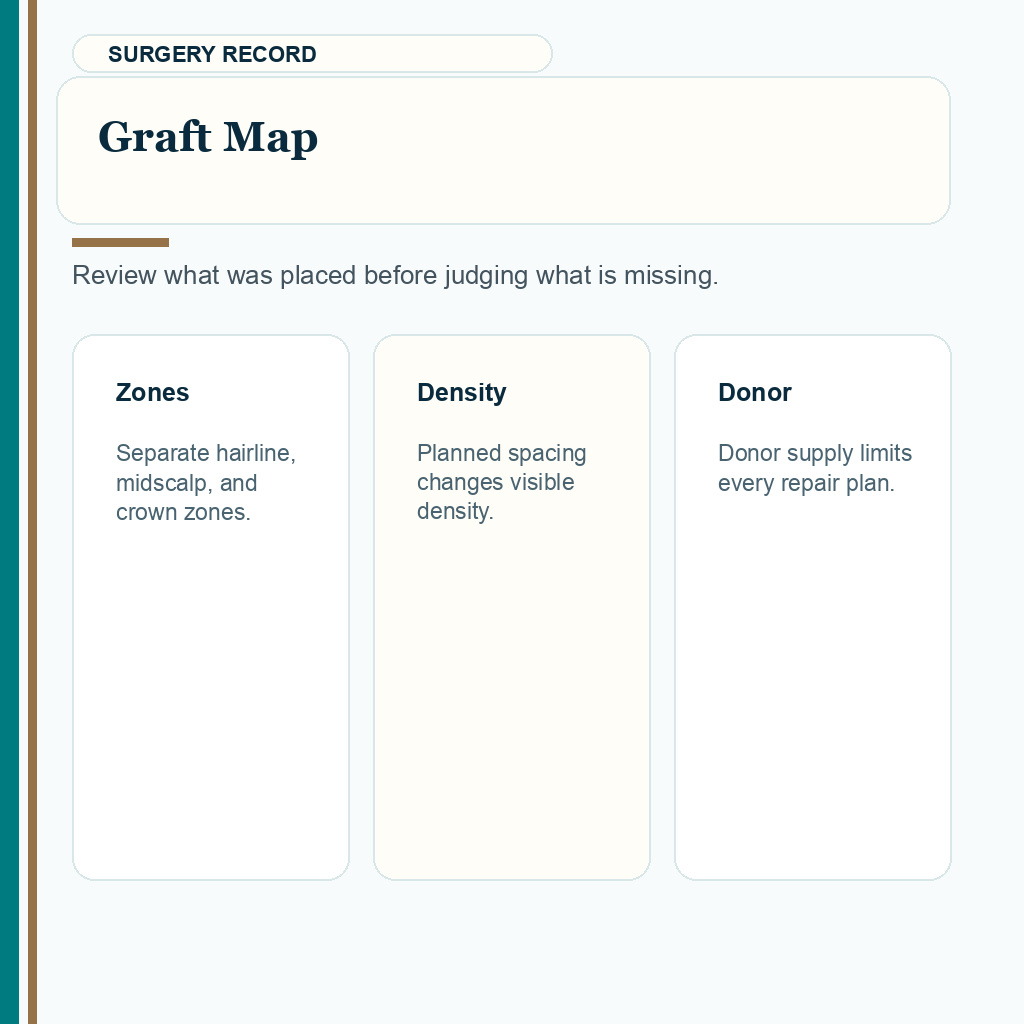
Bring the original plan into the review, not only the disappointing photo. Hairline drawing, graft map, donor notes, and later medication or health changes can show whether planning, growth, or new loss needs attention.
Good surgery lowers risk, but it cannot control biology
A quality operation controls the things surgery should control. The donor should be evaluated carefully. The plan should match the available graft supply. Grafts should be extracted with respect for the donor area, protected while they are outside the body, and placed at an angle and density that match the case. Those choices matter, and poor choices can absolutely cause poor results.
But a good plan is not the same as a promise. A hair transplant guarantee should not be treated as if it can promise every follicle, every cosmetic density point, and every future hair loss variable. Surgery places the grafts. The body still has to heal them, feed them, cycle them, and grow them.
Recipient blood supply, graft survival biology, inflammation, scalp condition, hair caliber, contrast between hair and skin, donor miniaturization, future native hair loss, medication response, illness, smoking, systemic stress, and genetics can all change the final appearance. Some factors are visible before surgery. Some are estimated. Some only become clear with time.
If weakness comes with persistent or spreading redness, scale, burning, itching, pain, pustules, discharge, or patchy loss, I do not treat it as a simple density complaint. The scalp should be examined before anyone plans repair.
Probability is different from blame
A weak result after a careful surgeon-led clinic does not by itself mean careless surgery, just as a good result from a weak clinic system does not prove that the system is safe. Both exceptions can happen. They should not be the basis for judging your own case.
I use probability because it keeps the review fair. A careful surgical system lowers avoidable risks such as poor case selection, excessive graft use, rushed hairline design, weak donor control, rough graft handling, and unclear follow-up. It still cannot promise that every graft will grow with the same strength or that native hair will stay unchanged.
Can a reputable surgeon still have bad results?
Yes. A reputable surgeon can still see a result that grows less strongly than expected or looks thinner than planned. The important difference is whether the case was selected carefully, limits were explained before surgery, records were kept, and the follow-up review looks for the real cause instead of offering a simple excuse.
First define what underperforming means
Before deciding that a transplant failed, define what is weak. Is there little growth in the transplanted area? Is the hair growing but too fine to give coverage? Did the surrounding native hair thin, making the same grafts look less impressive? Is one side behind the other? Are the photos harsher than the mirror?
I separate a true failed hair transplant from a result that is still too early to judge before I decide what kind of problem we are looking at. A result can be immature, visually thin, affected by native hair loss, limited by donor supply, or genuinely poor in growth. Those are different problems.
I also separate disappointment from evidence. Disappointment is real, but it is not enough for diagnosis. Evidence means pre-op photos, surgery report, graft distribution, comparable current photos, donor review, medication history, scalp symptoms, and the pattern of change over time.
If the surgery report is missing, gather what can still be verified from the time of treatment. The original hairline drawing, consent or treatment plan, clinic messages, discharge instructions, dated photos, and any graft distribution given to you can help a reviewing surgeon separate what was recorded at the time from memory or attempts to count grafts from photographs. These records do not replace an operative report, but they may help clarify the original plan and which details remain uncertain.
Use the first year review as a rounded checkpoint
A month number alone should not decide the whole result. In the middle and later parts of the first year, I compare the trend, caliber, photos, and original plan before calling the case final. Some hairs are growing, some are maturing, and some are still changing texture. A harsh light photo can make that period feel final before it really is.
Use one year after FUE as the cleaner review point, not as a magic day when biology obeys the calendar. Rounded language matters because false precision creates bad decisions. Toward the final review, the question becomes more serious if growth is flat, the density gap is stable, and the evidence is comparable.
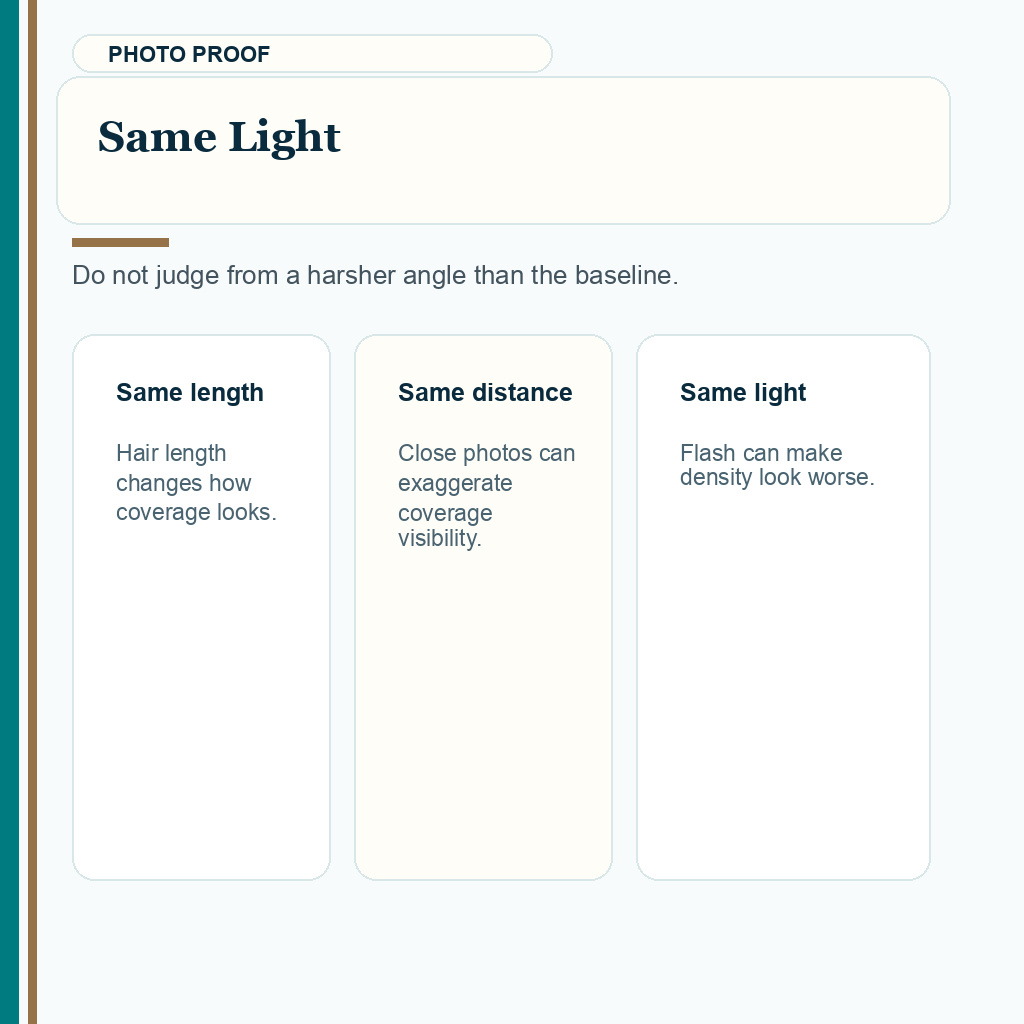
If a clinic reviews the result, send the same angles, same lighting, same hair length, similar camera distance, wet and dry if useful, and the original plan. Without that, one close photo can overstate or understate the problem.
Thin can come from survival, hair caliber, or contrast
A transplant that looks thin does not always mean no grafts grew. Sometimes the hairs are present but too fine, too straight, too light against the skin, or too spaced for the coverage the patient expected. Sometimes the original donor could not safely support the density the patient imagined. Sometimes a crown or midscalp area simply needs more hair to look dense than a frontal framing zone.
Why some hair transplant results look thin is a separate concept from total graft failure. The surgeon has to compare growth evidence with visual coverage. Hair count and cosmetic density are related, but they are not identical.
Hair character matters as well. Coarse, wavy, low contrast hair gives more coverage per graft than fine, straight, high contrast hair. A patient comparing photos online should compare hair transplant results with hair like yours instead of judging only the graft number or clinic name.
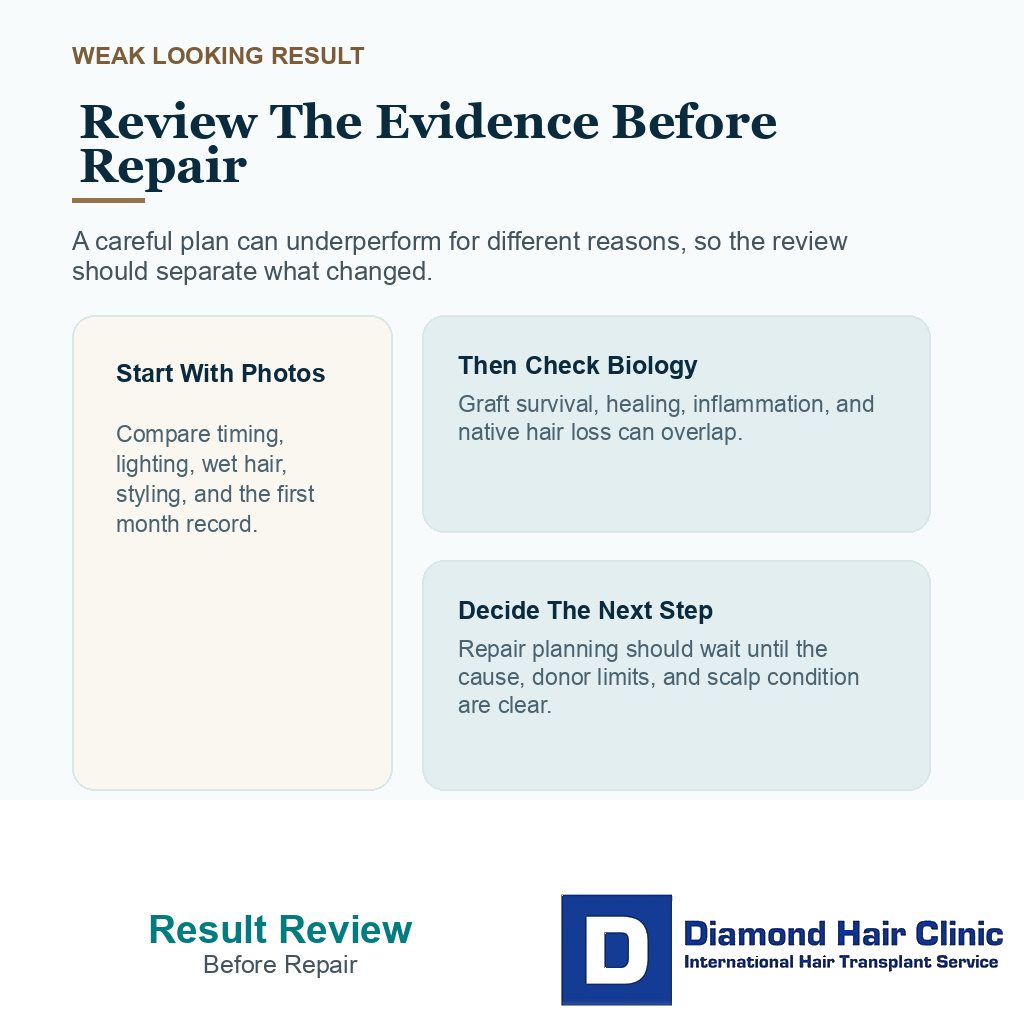
Native hair can change around the transplanted hair
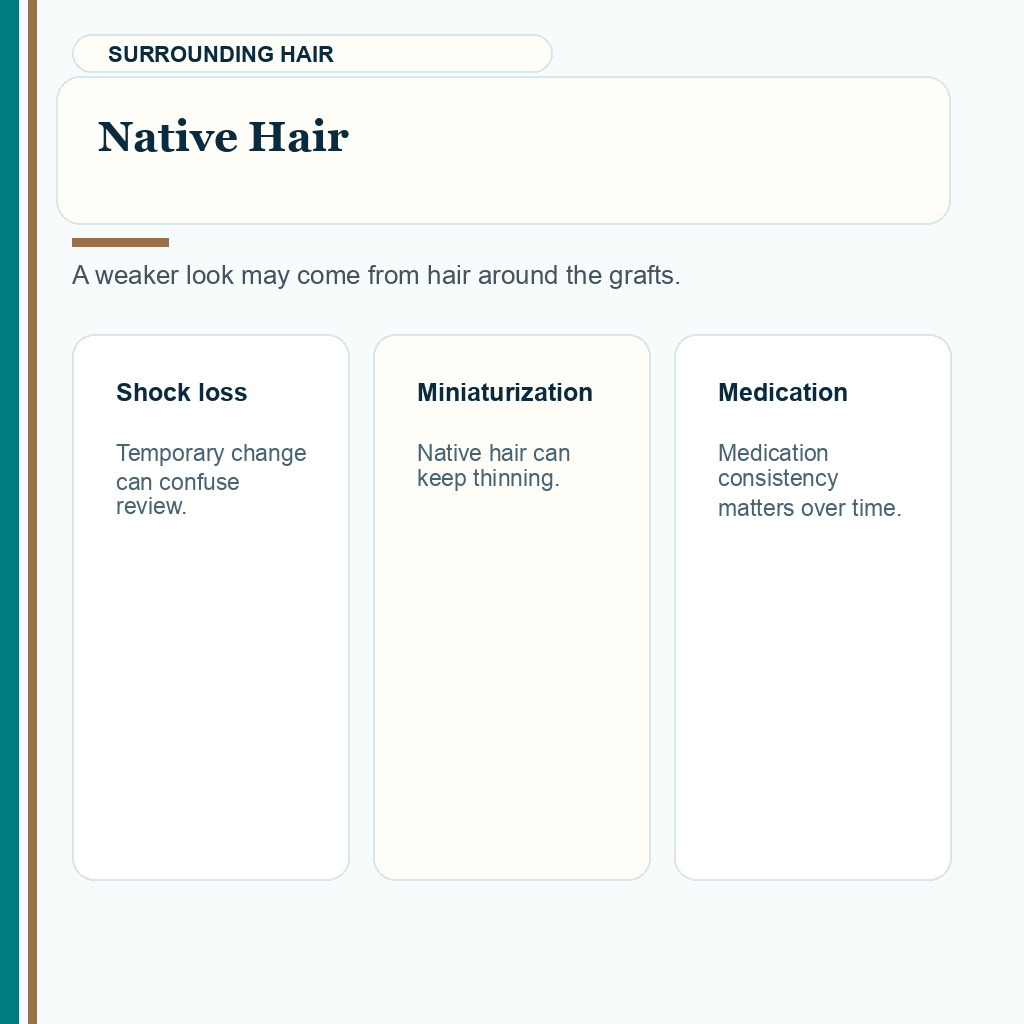
Transplanted grafts and native hairs do not always move together. A patient can gain transplanted hair and still look weaker because native hair behind or between grafts has miniaturized. Shock loss is often temporary, but I still separate it from progressive native miniaturization. If the surrounding hairs were already weak, some native loss may not fully return, so the review should not assume every weak area is graft failure.
I review native hair shock loss after FUE and longer term native thinning separately from graft growth. The same transplanted hairs can look strong in one surrounding environment and weak in another.
Donor behavior also matters. If the donor contains miniaturizing hairs, those hairs may not behave like permanent strong donor hair. Checking donor miniaturization before a hair transplant keeps the donor in the future risk review, not only the hair supply estimate. A stable donor lowers risk, but it is not a lifetime certificate.
Use the outcome gap proof check
Use this proof check as a conversation guide before deciding that the operation failed or before planning a repair. If the pattern points to timing, photos, or native hair change, the outcome review is usually better evidence and review, not surgery. If it points to scalp symptoms, donor weakness, or clear poor growth after maturity, the review should become more diagnostic.
Outcome Gap Proof Check
Sort the weak result by evidence
A result that looks weak does not have one automatic explanation. Choose the pattern that best matches the evidence before deciding how to respond.
Use a rounded first year review
If the case is still in the middle or later part of the first year, growth, texture, and caliber may still be changing. Compare photos and clinic records before calling it final.
- Keep the timing rounded.
- Use same lighting photos.
- Check whether growth is still improving.
Separate growth from visible density
The grafts may be growing but still look weak because hair caliber, curl, contrast, spacing, or styling exposes scalp. The review should inspect hair count and visual coverage separately.
- Check hair caliber.
- Compare wet and dry appearance.
- Review the design density.
Review native hair around the transplant
Progressive native loss can make a transplanted area look weaker even when some grafts survived. Medication consistency and donor stability belong in the same review.
- Map native miniaturization.
- Review medication consistency.
- Check donor stability.
Look for biology that surgery cannot promise away
Inflammation, scarring disease, poor recipient blood supply, healing variation, and graft survival biology can limit a result even after careful surgery.
- Ask for scalp examination.
- Report symptoms clearly.
- Do not rush into repair.
Fix the evidence before judging the outcome
A harsh flash, different hair length, wet hair, strong overhead light, or a new angle can exaggerate a weak result. Evidence must be comparable before the conclusion is strong.
- Same length.
- Same light.
- Same angle and distance.
A second surgery should not be the reflex
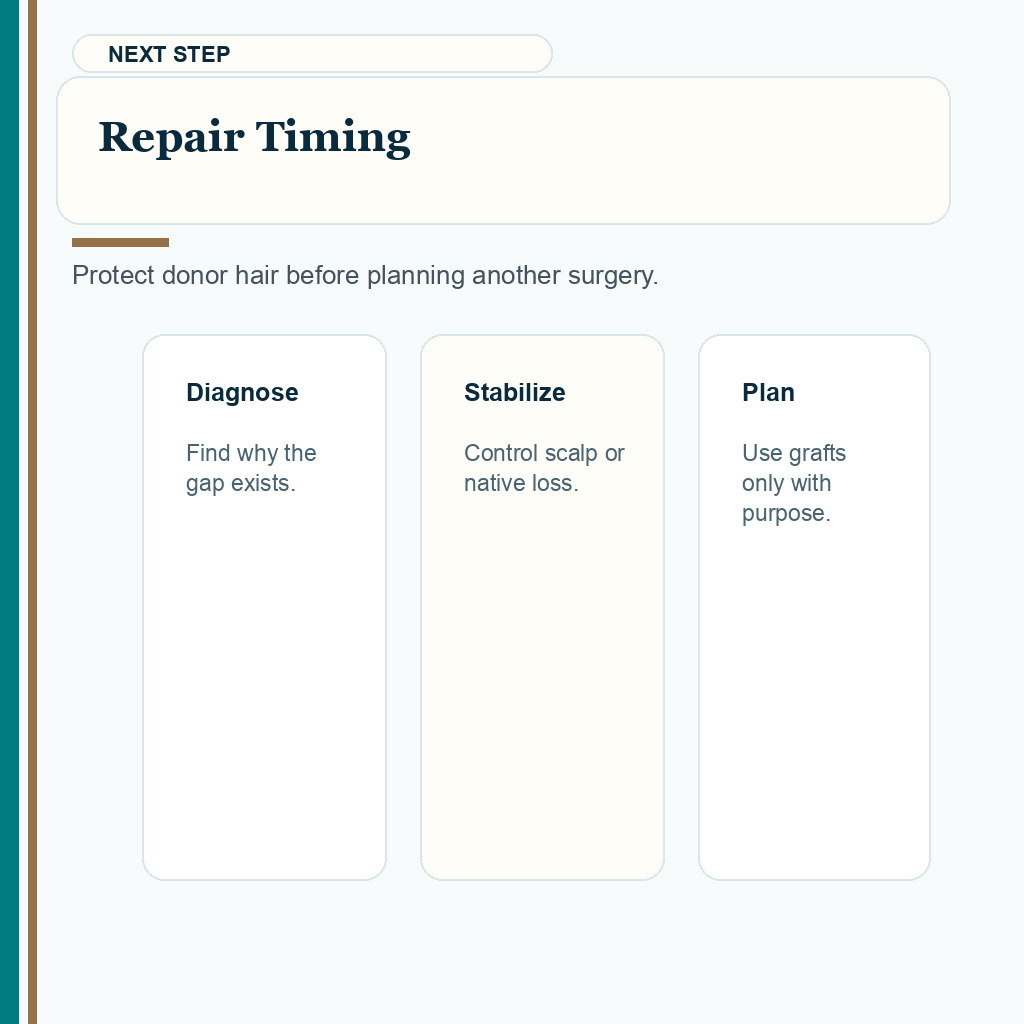
If a result is truly weak, a second hair transplant may become part of the conversation. But another operation should not be the first reflex. The surgeon should know whether the weak result comes from poor growth, low visual density, native hair progression, scalp disease, donor limitation, or evidence mismatch. Repairing without that diagnosis can spend grafts without fixing the reason the result disappointed.
Scalp diagnosis is especially important. Active inflammatory or scarring alopecia can make repair unsafe or inappropriate until the scalp has been diagnosed and quiet for a sustained period. The principles behind scarring alopecia and hair transplant planning apply whenever redness, scale, burning, itching, pain, pustules, discharge, or patchy loss raises a diagnostic question. If the examination suggests it, dermoscopy, biopsy, or dermatology management may be needed before any graft plan.
Asymmetry should also be reviewed carefully. One side may appear slower or thinner for reasons that are not obvious from one photo. If that is the pattern, compare it with one side growing slower after a hair transplant before deciding that the whole case has failed.
Before a repair conversation, review the evidence in this order so grafts are not spent before the cause is clear.
The outcome review when a strong case disappoints
The outcome review is not a repair promise. It is a structured review. I review the original diagnosis, donor quality, graft numbers, placement map, comparable photos, medication consistency, scalp symptoms, and the current donor condition. More than one factor may be involved, so the plan should not be built around one photo or one assumption.
A hair transplant is powerful, but it is still living tissue surgery. Good surgery, candidacy, and aftercare matter. Yet graft survival, healing, hair caliber, native hair, donor stability, and genetics still have their own biology, so the review has to stay practical rather than emotional.
If your result looks weaker than expected after a substantial recovery window, do not reduce the answer to one angry photo or one comforting excuse. The final review should end with a practical route. That may mean waiting and comparing again, reviewing medication consistency, treating native hair or scalp inflammation, requesting missing records, or planning a narrow repair only if the donor reserve and target zone justify it. That is how I protect the donor instead of letting disappointment spend more grafts too early.
Read this review excerpt
First wash completed and visual instructions given to my daughter.