If a Clinic Says to Stop Finasteride or Minoxidil Before Surgery
Clinic advice to stop finasteride or minoxidil before surgery can be reasonable, but it has to be specific. A short topical minoxidil pause for scalp handling is different from telling a patient to stop finasteride, dismiss medication, or accept surgery because medication supposedly makes graft planning harder. Before grafts are spent, I want to know what the medicine was doing, which hairs are native, whether the donor is safe, and who owns any stop or restart decision.
I do not want a patient to secretly continue, stop, or restart medicine after reading an article. I want the instruction to be brought back to the operating surgeon and, when a medicine is prescribed by another clinician, to that prescriber as well. The question is not whether the clinic can have rules. The question is whether the rule explains your actual hair loss pattern, scalp condition, native hair, donor reserve, and timing.
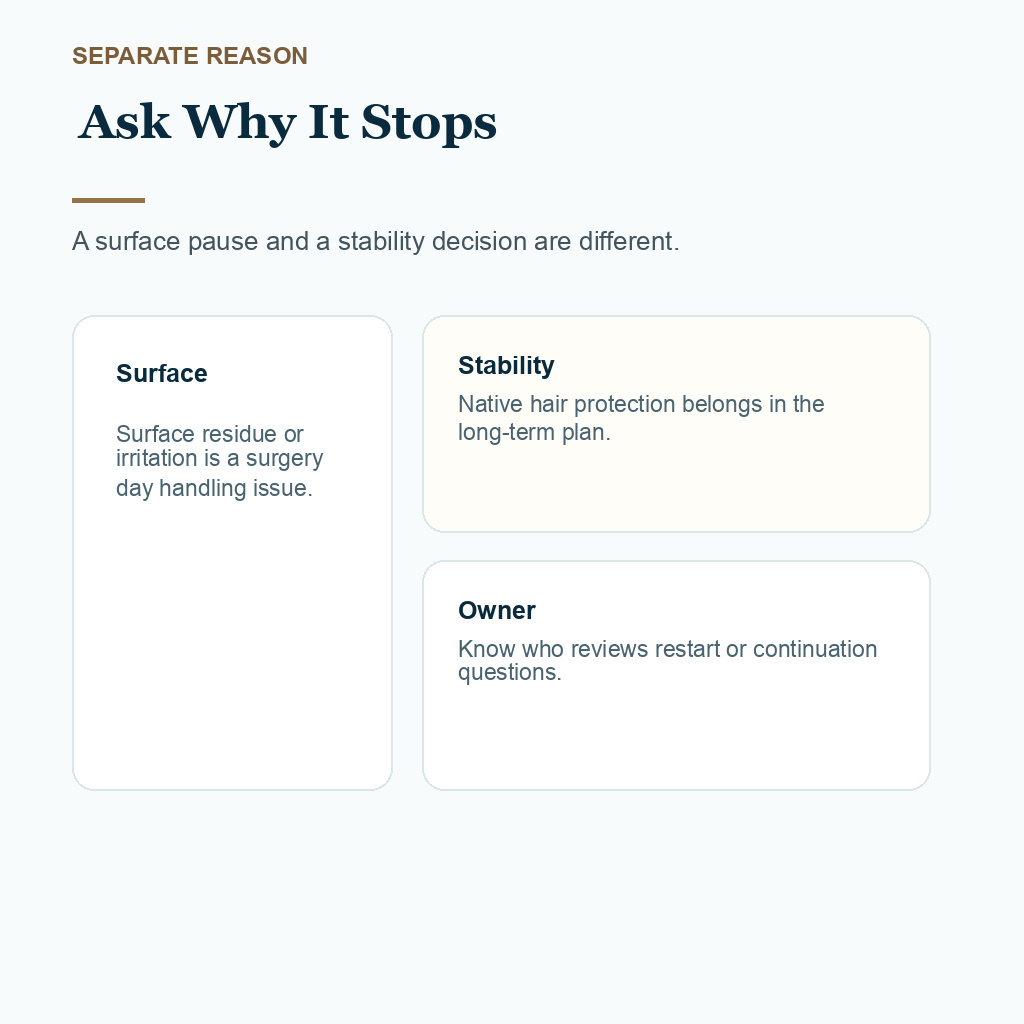
First Separate a Surface Pause From Stability
Topical minoxidil sits on the scalp. It can leave residue, irritate skin in some people, and change how clean the recipient area feels on the day of surgery. When that is the concern, a short topical minoxidil pause can be a practical surgery day instruction. It should sound like a scalp preparation rule, not like a verdict that treatment was useless.
Finasteride is a different discussion. In selected men, finasteride and native hair protection are about the vulnerable hair that remains around and behind the transplanted zone. That decision involves diagnosis, tolerance, side effects, future loss risk, and the patient's goals. It is not the same as wiping topical solution from the scalp before implantation.
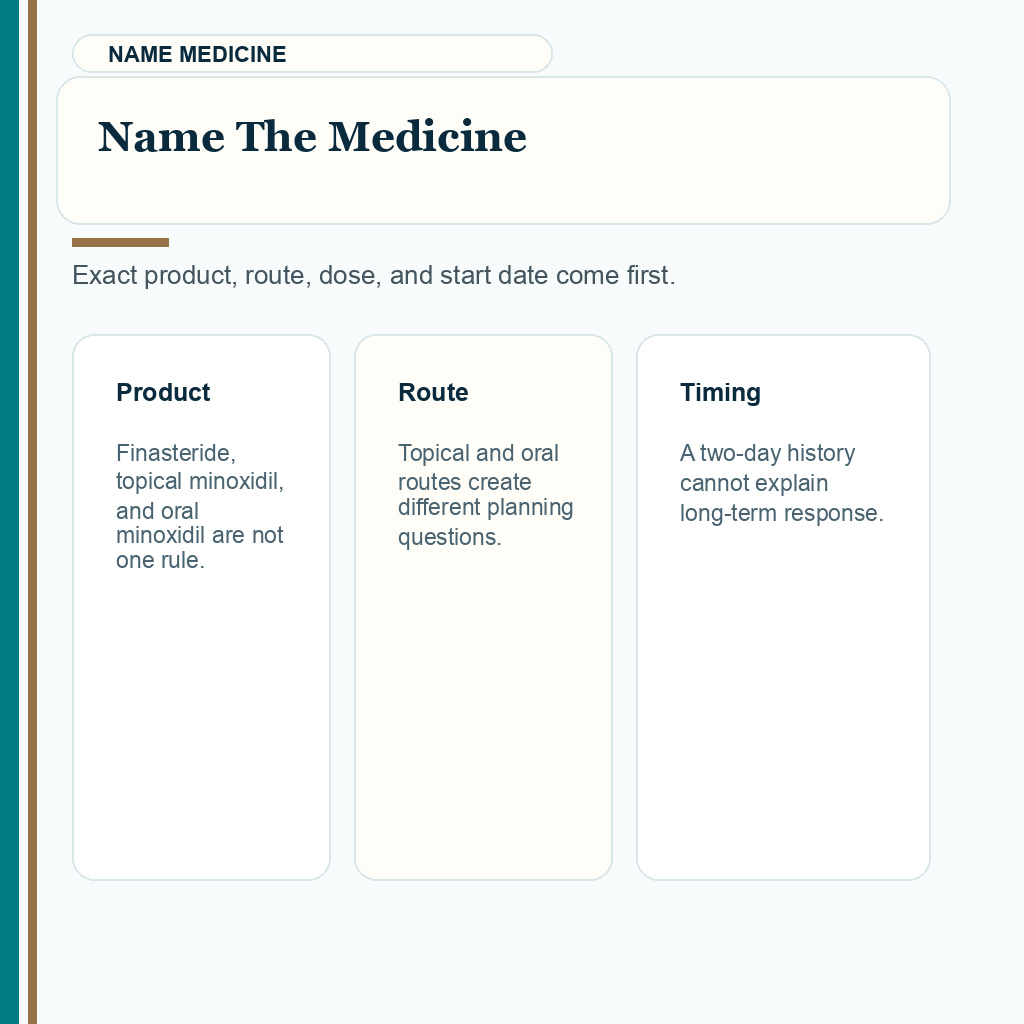
This distinction matters because patients often hear one sentence to stop the medication. A safer conversation asks which medicine, which route, and which reason before it accepts any change in the graft plan. If the answer is only that medication makes surgery harder, the explanation is not finished.
Graft Planning Needs More Than One Sentence
A transplant plan should not be built on a slogan. Medication can change the surgical plan because it helps me interpret current density, recent shedding, scalp irritation, side effect history, and how stable the native hair may be. That does not mean medication should hide the truth from the surgeon. It means the history must be included.
If a clinic says medication makes placement harder, my next question is what that means in practice. Does the scalp need to be cleaner for surgery day? Is the skin irritated? Is the clinic trying to see whether weak native hairs shed after stopping? Is the graft number changing because density is uncertain? Each answer leads to a different decision.
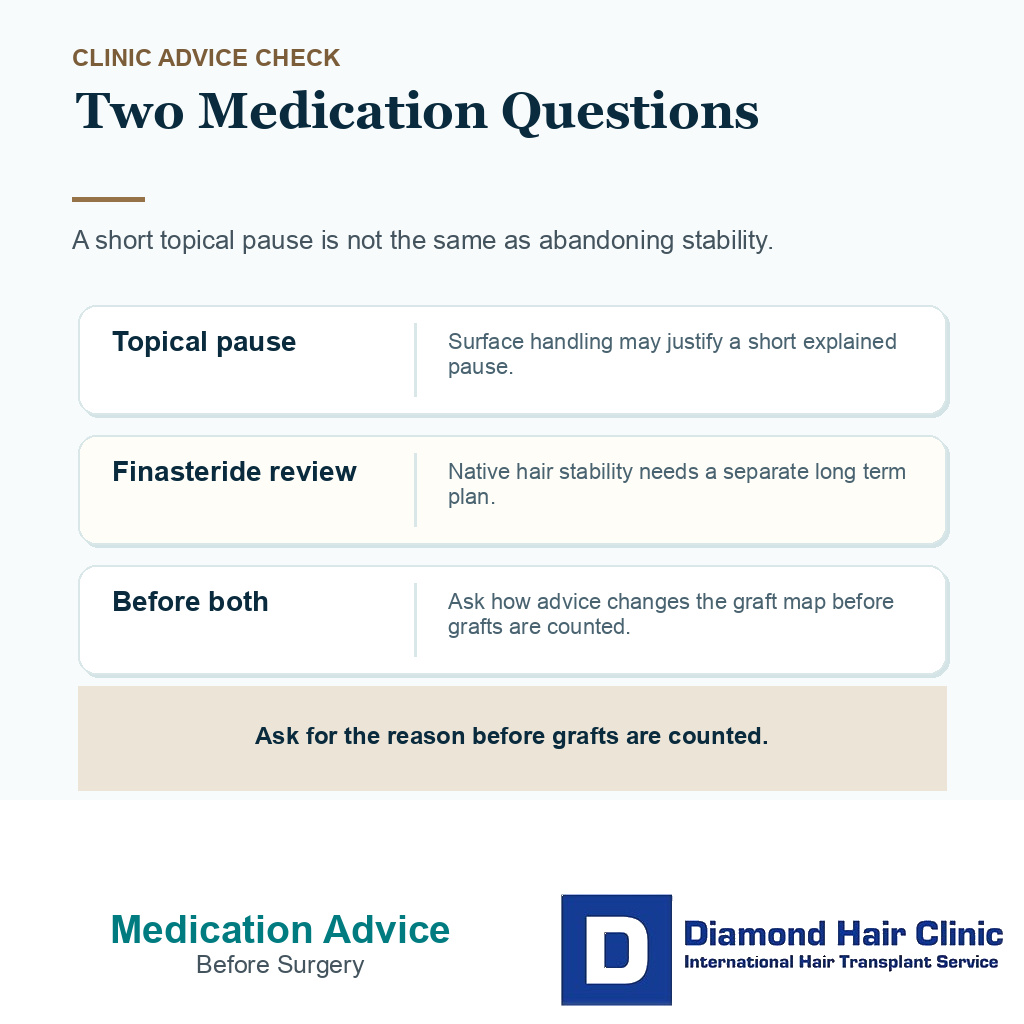
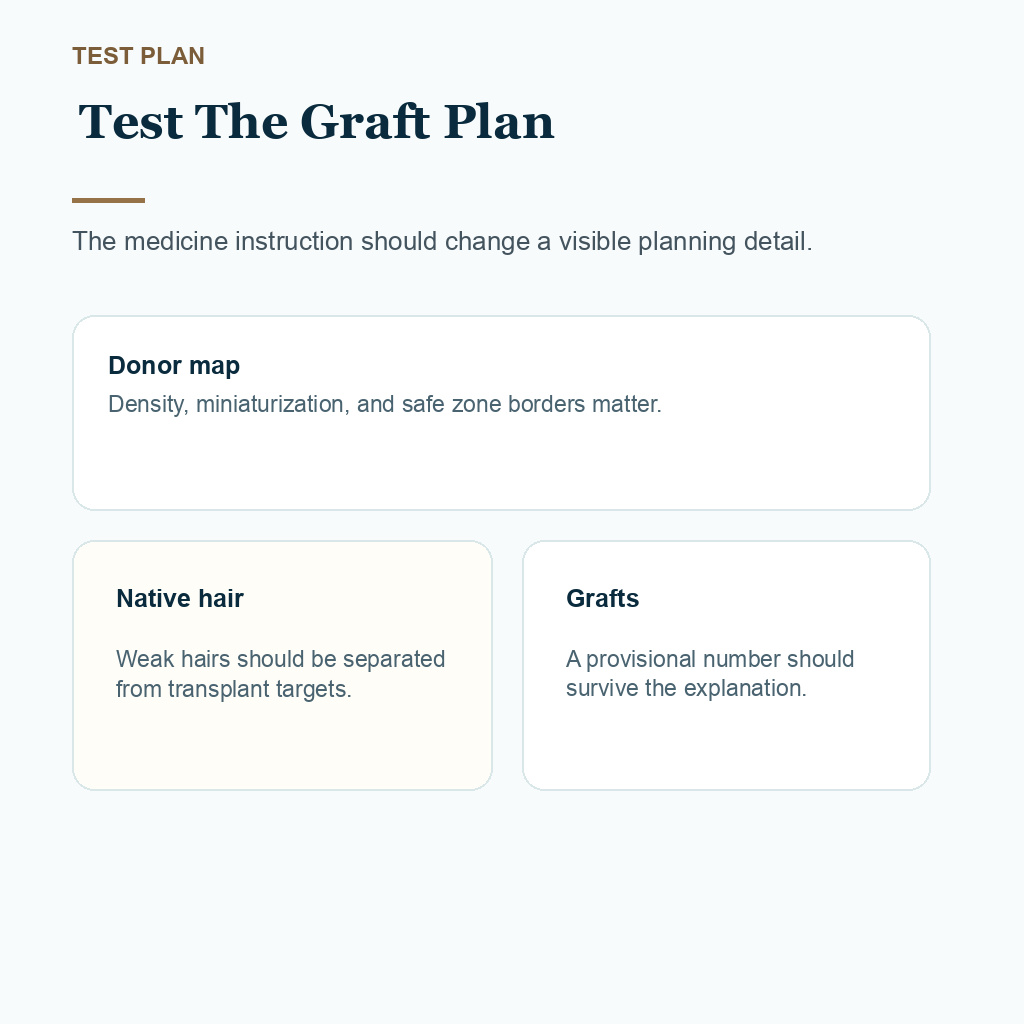
The donor review belongs in the same conversation. A graft number should stay provisional until donor density, safe zone borders, hair caliber, miniaturization, and future loss risk are reviewed together. Medication advice that pushes the patient toward a fixed number before that review is too thin.
Native Hair Must Be Mapped Before Grafts Are Counted
When I design a recipient plan, I separate transplanted hair, strong native hair, and weak miniaturizing native hair. That native hair map tells me where grafts can be placed safely, where shock loss risk must be respected, and where future thinning may expose a poor distribution.
If the patient has diffuse thinning, the same conversation becomes more serious. A diffuse thinning stability check can change whether surgery should happen now, which zones need priority, and how conservative the hairline should be. Medication history does not replace this examination, but ignoring it removes useful context.
Clinic medication advice review board
Match the clinic claim to the review it needs
- Topical minoxidil pauseAsk if this is a surface rule
- Finasteride stop adviceAsk what native hair evidence changed
- Stop both indefinitelyAsk who owns the review plan
- Surgery only claimAsk how graft demand was measured
- Medication hides the planAsk what the clinic needs to see
Ask if this is a surface rule
A short topical pause may be about residue, irritation, or clean surgery day handling. That is different from saying medication has no planning value.
Next question Ask what issue on the day of surgery the pause solves and how restart questions are handled.
Ask what native hair evidence changed
Finasteride belongs to native hair stability, tolerance, and future loss review in selected men. It is not judged from a brief new trial.
Next question Ask whether the plan reviewed miniaturization, side effects, and long term native hair risk.
Ask who owns the review plan
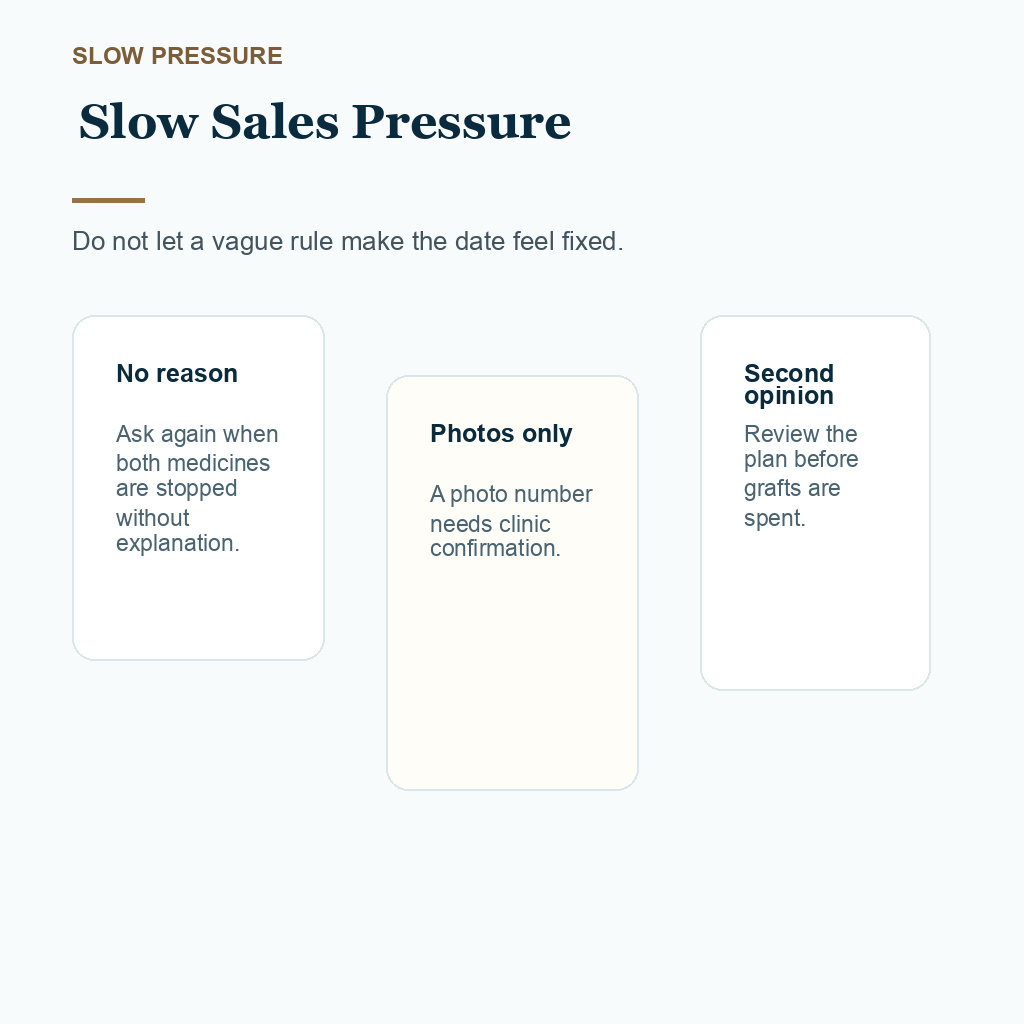
Stopping both medicines without a reason specific to each medicine can hide whether the advice is surgical handling, safety caution, or sales pressure.
Next question Ask who told you to stop, why, and who will review the next step with your prescriber when needed.
Ask how graft demand was measured
A transplant can move donor hair into thinning areas, but it does not stop ongoing androgenetic alopecia in native hair.
Next question Ask how donor reserve, current density, future loss, and realistic coverage were measured.
Ask what the clinic needs to see
If medication history makes assessment harder, the plan should name the missing evidence instead of turning uncertainty into a fixed graft number.
Next question Ask which finding would change timing, hairline design, donor use, or the decision to wait.
The most dangerous version of the advice is not a short topical pause. It is a surgery only answer that treats every weak native hair as a graft problem. A transplant moves donor hair. It does not switch off androgenetic alopecia in the native hair around it. If the plan does not show that difference, the patient may spend grafts in the wrong sequence.
Advanced AGA Changes the Realism of the Answer
Advanced androgenetic alopecia does not mean surgery is impossible. It does mean the plan has less room for vague promises. If the frontal area, midscalp, and crown are all involved, advanced baldness often needs staged planning. The first operation should protect donor reserve for the result the patient can maintain over time.
In that setting, a few days of medication use cannot prove that treatment failed. It also cannot prove that surgery should wait forever. The practical question is what can still be saved, what is already gone, where transplanted grafts can create visible value, and how much donor hair must be held back for later loss.
I am also careful not to use medication as a shield against surgical judgment. Some patients cannot tolerate finasteride. Some have medical reasons to avoid it. Some have used minoxidil poorly or only briefly. These facts do not make them bad candidates by themselves. They make the donor plan, hairline design, and expectation setting more important.
A Medication Pause Needs a Specific Reason
A medication pause can be reasonable when it is specific to the medicine and connected to a real purpose. Scalp residue, dermatitis, irritation, bleeding concerns from another medicine, side effect history, or a prescriber instruction are all different reasons. They should not be compressed into one unexplained rule.
Topical and oral routes also need separation. Oral minoxidil is a systemic medication, so I do not discuss it as if it were simply liquid on the scalp. The prescribing doctor's reason, dose, blood pressure context, and side effect history matter. A transplant article should not turn that into a private stop or restart command.
The same is true for side effects. Finasteride side effects before transplant planning deserve to be taken seriously. If a patient had sexual, mood, breast, fertility, allergy, or other warning symptoms, that history belongs in the medical review. A reason to avoid finasteride can exist. It should not be used as a shortcut to avoid donor and native hair planning.
Use these 4 medication advice slides to keep the booking decision structured.