


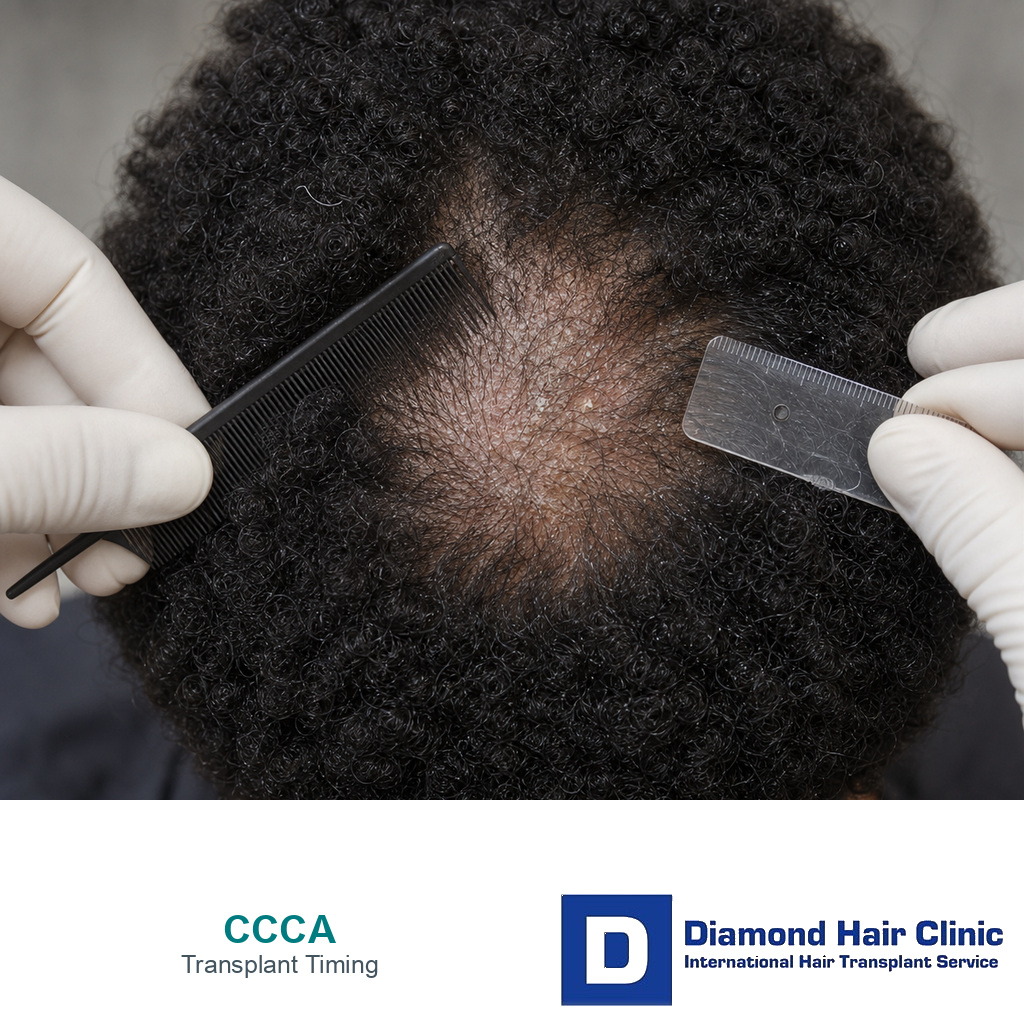
CCCA and Hair Transplant Planning
With central centrifugal cicatricial alopecia, surgery belongs later in the conversation, after the scalp disease is quiet and donor reserve is safe. CCCA is not ordinary female pattern thinning, because this is not only a density issue. It is an inflammatory scarring process that can destroy follicles.
If someone with CCCA wants grafts in the crown, the first decision is whether the scalp is stable, not a graft number. The diagnosis, flare history, treatment record, and clear photos should show whether the center of the scalp is stable. The history of styling matters too, especially tight styles, relaxers, heat, tenderness, itching, or breakage around the central scalp. Active CCCA is a reason to wait, not a reason to rush surgery.
CCCA changes the first question
CCCA usually affects the center or crown of the scalp first. It is seen more often in Black women, but the surgical issue is not ethnicity alone. The issue is scarring inflammation. Once follicles have been replaced by scar tissue, medicine and surgery both become more limited.
CCCA is separate from the usual conversation about female hair transplant candidacy. A woman with stable pattern thinning and strong donor hair is a different surgical situation from a woman with central scarring, tenderness, scale, burning, or a history of scalp injections and dermatology treatment.
It also differs from a pure hairline request. Female hairline transplant planning is about shape, direction, and facial balance. CCCA is usually about whether the crown skin is safe enough to receive grafts at all.
The diagnosis must be clear before graft planning
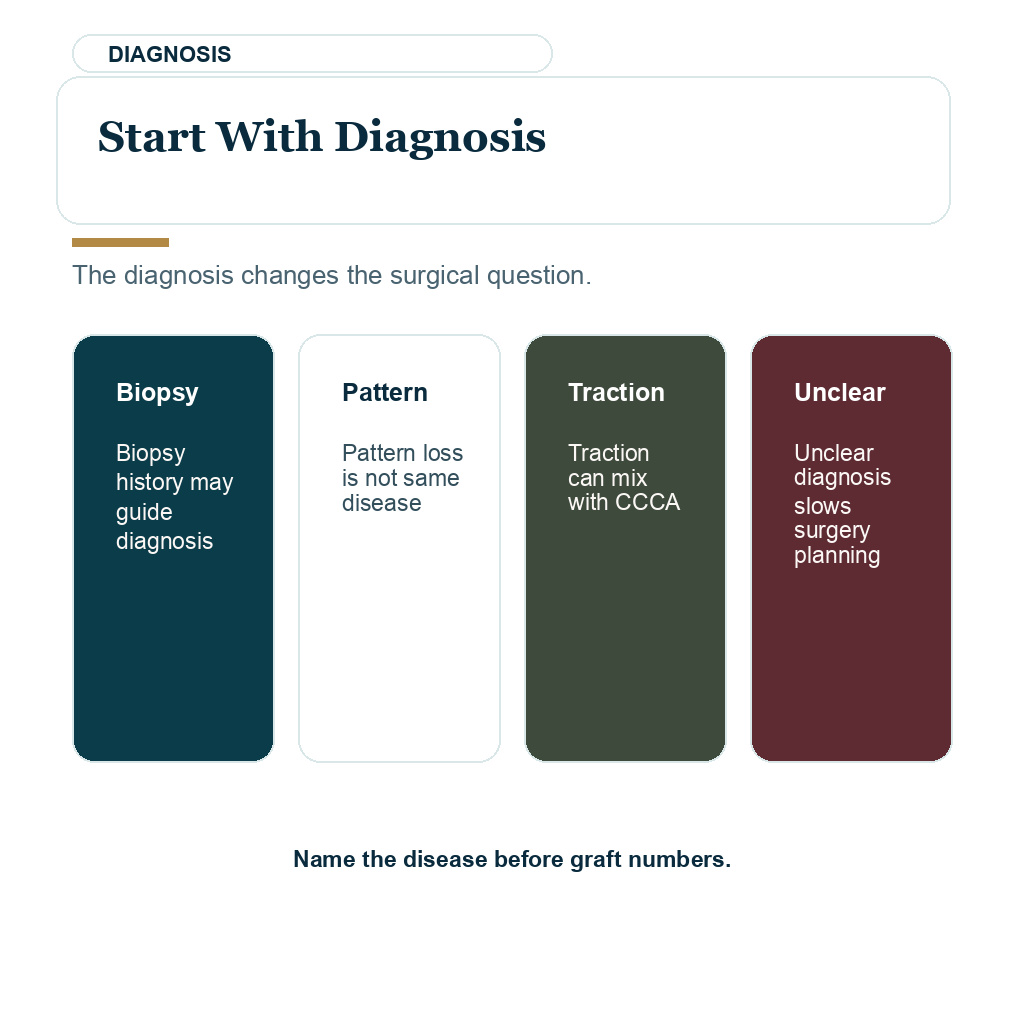
The first consultation should clarify whether a dermatologist has confirmed CCCA, whether a biopsy was done, and what other diagnoses were considered. Traction alopecia, female pattern loss, seborrheic dermatitis, telogen shedding, and other scarring alopecias can overlap in a real patient. A crown that looks thin from breakage or traction is not the same surgical problem as a scarred central patch with lost follicular openings.
The diagnosis changes the surgical question. In traction alopecia hair transplant planning, the main issue is often whether the pulling has stopped and whether the hairline skin is healthy enough. In CCCA, I am usually looking at central scalp scarring, treatment stability, and whether inflammation has truly stopped moving.
The disease should not be treated as the patient’s fault. Hair practices can contribute to irritation in some people, but many patients have done everything carefully and still develop CCCA. The surgical plan should stay respectful and evidence based.
Loc history belongs in the diagnosis review
Locs do not diagnose CCCA, but maintenance pressure, tenderness, scale, breakage, products, and styling changes can help explain what the scalp has been through. Locs and dreadlocks transplant planning separates the style question from the medical stability question.
That respect matters in consultation. If a patient has been told for years that styling explains everything, she may arrive feeling dismissed before the scalp is even examined. The history should include braids, relaxers, wigs, heat, and tight styles because they can affect irritation and traction. Those answers are not there to shame the patient. They help show whether avoidable scalp stress should be reduced before surgery is even considered. For that part of planning, see chemical relaxers and hair transplant timing.

CCCA planning starts with diagnosis and stability before any graft number is discussed.
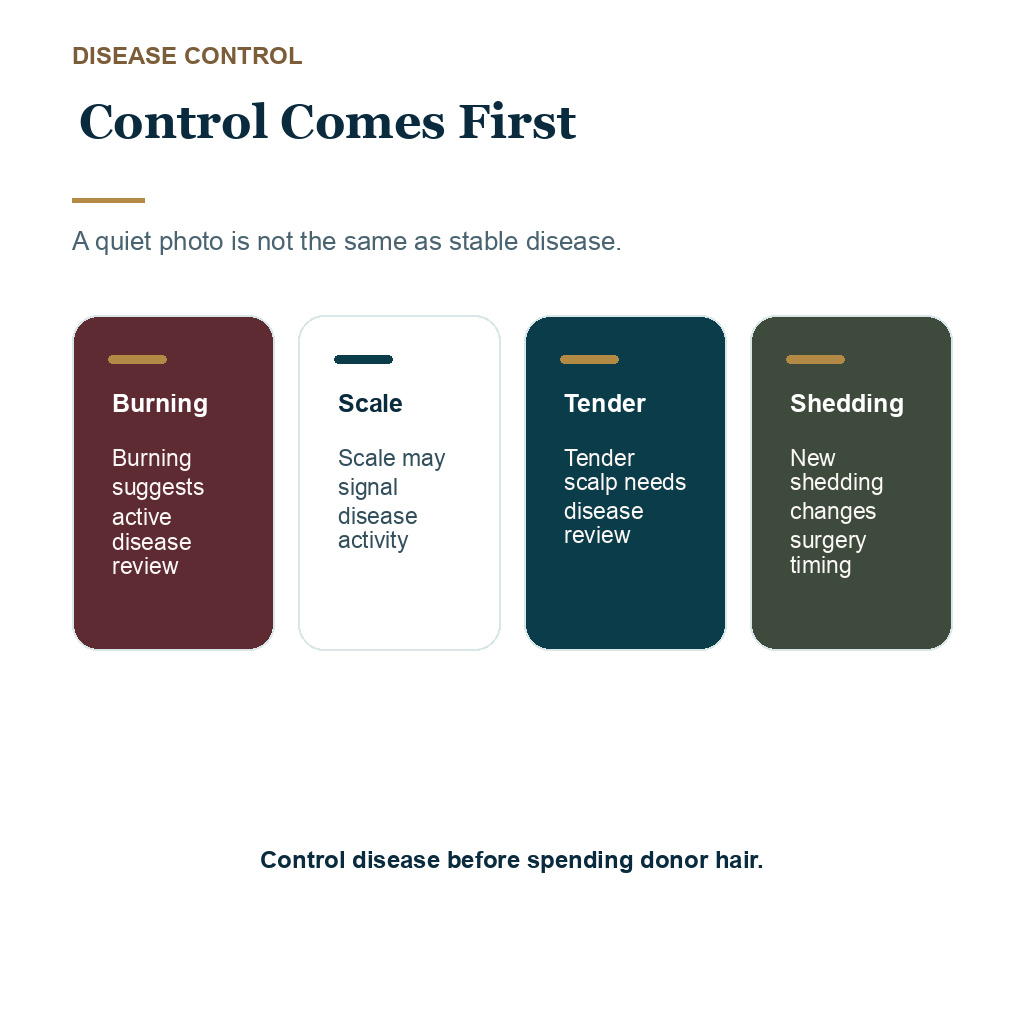
A quiet photo is not the same as stable disease
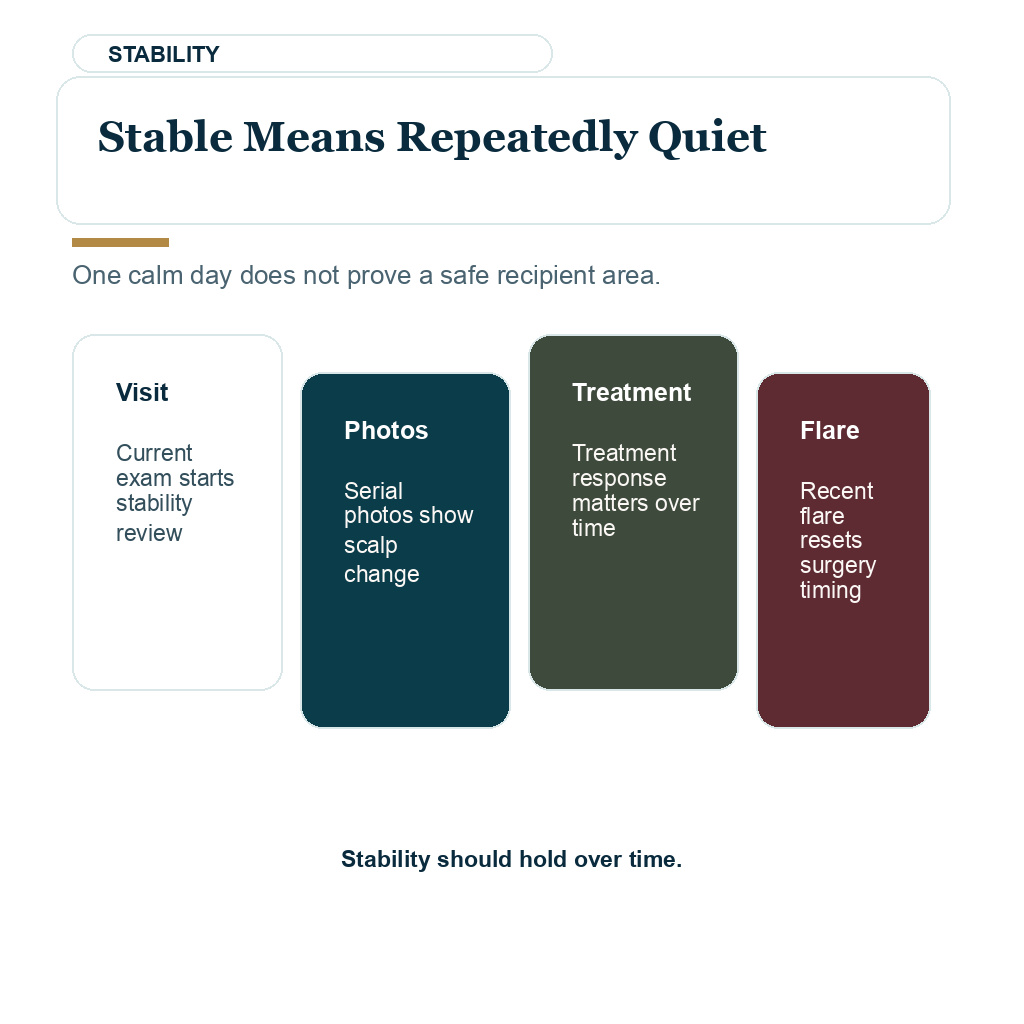
One quiet day can be misleading. A scalp can look quiet in a photo and still flare again after treatment changes, stress, illness, styling pressure, or no obvious trigger at all. The trend matters more than one image.
In many scarring alopecia discussions, a year of stability is treated as a serious benchmark. That is not a magic certificate, but long stability is much safer than recent improvement. A few quiet weeks after stronger medication are not enough proof for a surgical plan. I also separate a scalp that is quiet only while treatment has just been intensified from a scalp that stays predictable after the plan has settled.
This limit also appears in scarring alopecia and lichen planopilaris. Different diagnoses can still lead to one surgical boundary. Active inflammation should be controlled before donor hair is spent.
Medication timing also needs to be clear. If the dermatologist has just changed treatment, the scalp may look temporarily quieter while the true trend is still unknown. Surgery should not be scheduled simply because the most recent photo looks better. The treatment plan, symptoms, and scalp surface should all stay predictable before surgery enters the discussion.
Donor hair should not be wasted on unstable skin
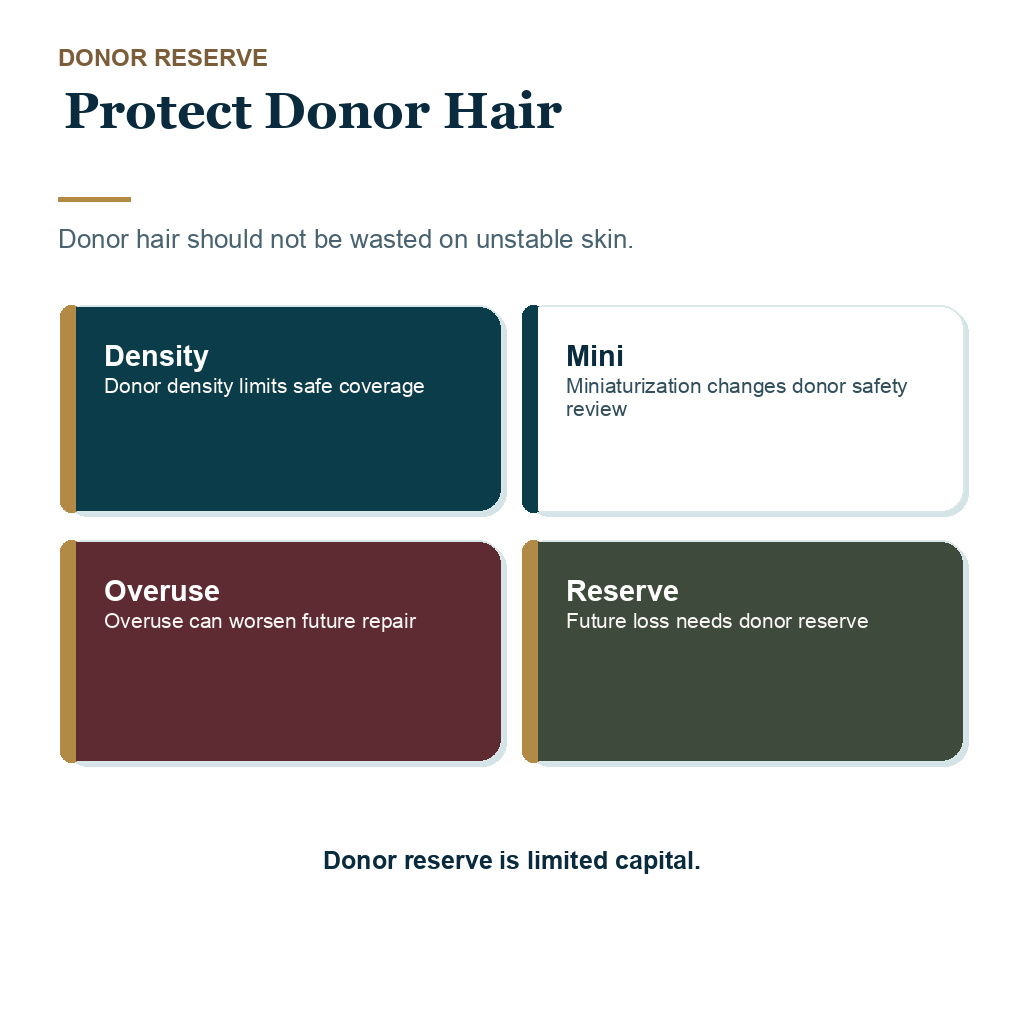
Every graft taken from donor reserve is a limited resource. If the recipient scalp is still inflamed or scarred in a way that cannot support growth, the patient can lose precious donor reserve without gaining a useful cosmetic improvement.
I examine the donor area carefully before saying yes. I look at hair caliber, density, miniaturization, scalp health, prior extraction scars, and the amount of reserve that must be protected for the future.
If the donor is already weak, CCCA makes the decision stricter. A patient with a weak donor area cannot afford an optimistic experiment in poor recipient scalp. Medical control, camouflage, or no surgery may be the right recommendation for now.
This donor conversation can be difficult because the crown is the area the patient sees and feels every day. Still, donor reserve is what makes any future repair or second stage possible. If the first plan spends too many grafts chasing a scarred crown, there may be little left for a more useful correction later.
Graft survival may be lower in scarred scalp
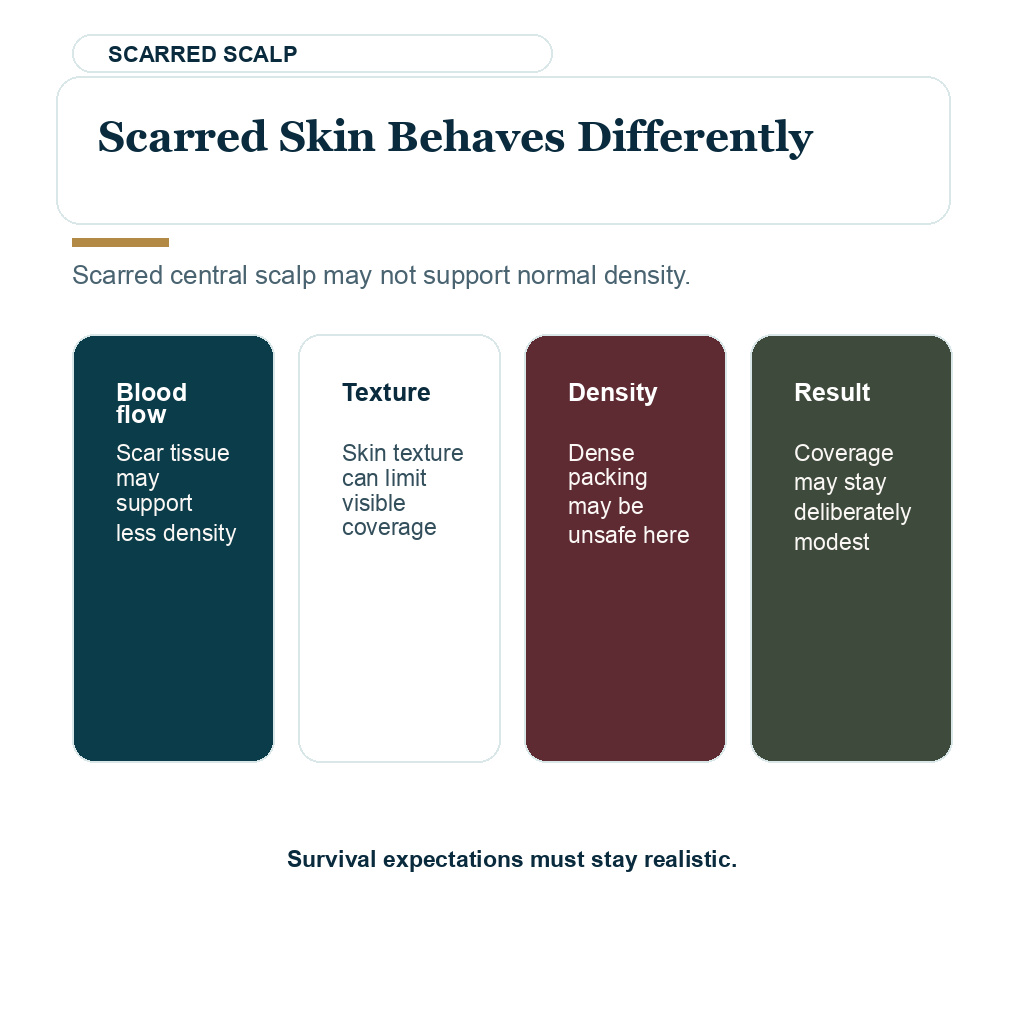
Scarred scalp is not the same as normal crown skin. Blood supply, tissue stiffness, inflammation history, and loss of follicular openings can all affect how grafts behave. Normal survival or normal density should not be promised in a scarred CCCA area.
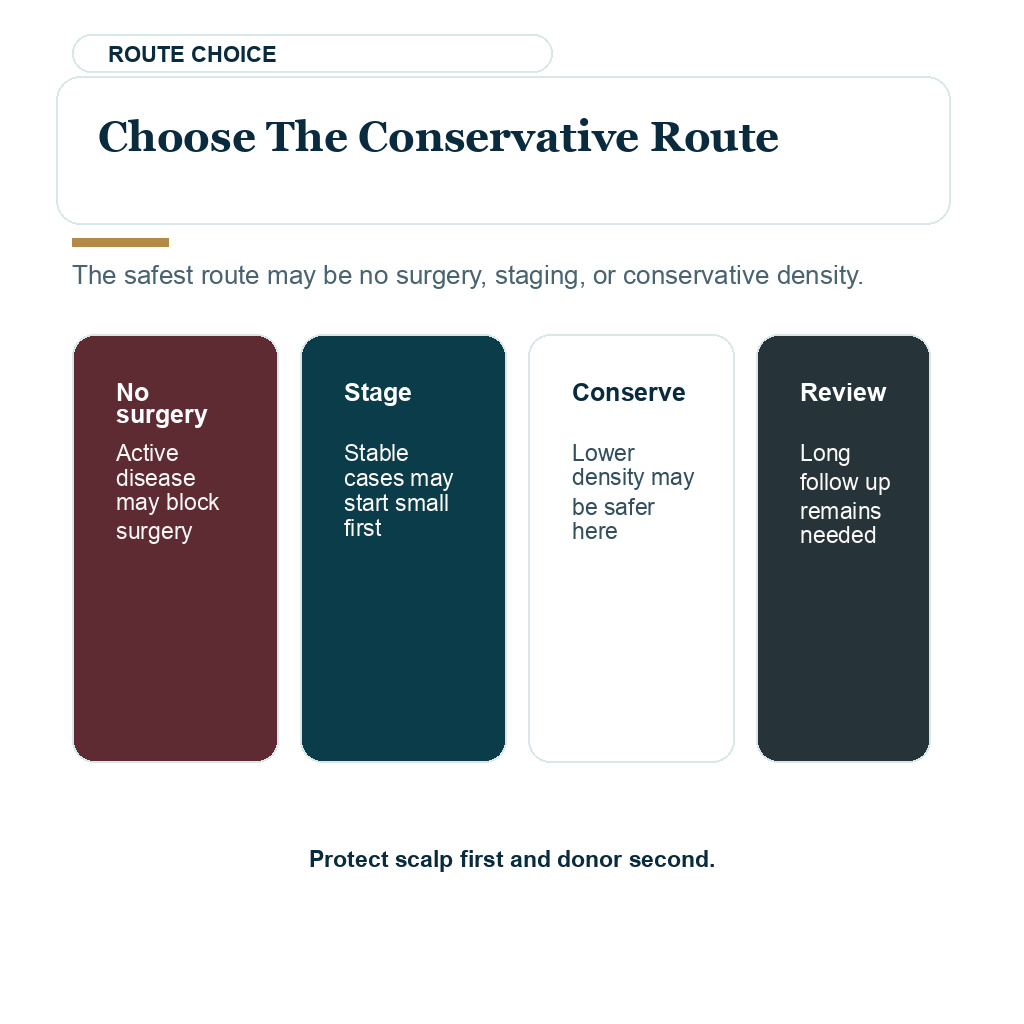
When surgery is reasonable, the plan may be smaller and use lower density than the patient expects. The first goal may be a modest softening of the visible patch, not complete coverage. How surgeons calculate graft numbers explains normal graft planning, but CCCA adds disease stability to that calculation.
Lower density may protect the skin and donor area. Trying to force thick coverage into tissue that cannot support it can waste grafts.
I explain this before surgery because disappointment often comes from a mismatch between hope and tissue biology. If the patient expects normal crown density, a cautious plan can feel too small. If she understands that the first aim is safe improvement in scarred skin, the same plan may feel more reasonable.
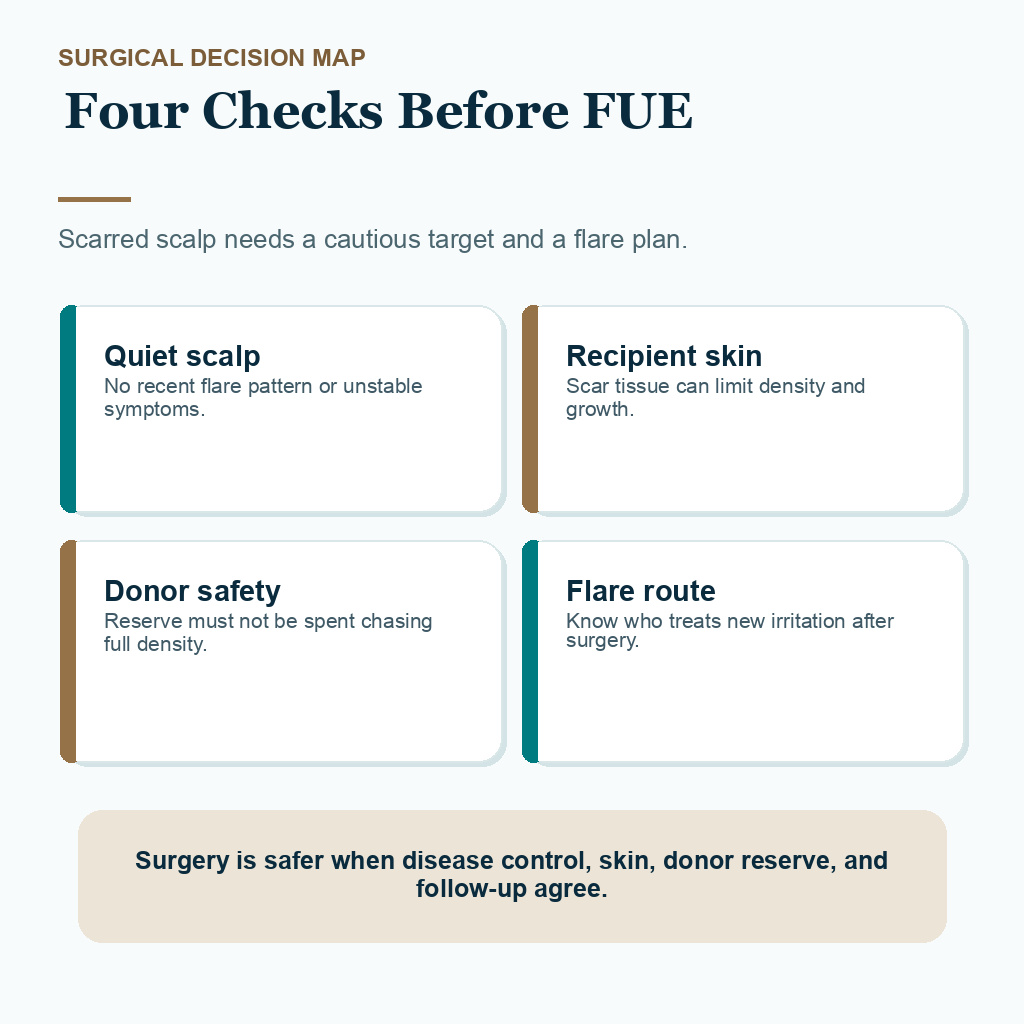
The safer decision checks disease control, scarred skin, donor reserve, and the flare plan together.
A staged decision sequence
When a patient might be a candidate, I use a staged decision. The order protects the patient from turning a chronic scalp disease into a failed transplant story.
The sequence starts with disease control rather than graft numbers. I want a confirmed diagnosis, a quiet scalp, dermatologist involvement, enough donor reserve, and a modest target area before I treat FUE as an option. If the disease is still active, if the goal depends on dense crown coverage, or if the patient is not prepared for lower graft survival in scarred skin, waiting or not operating is safer than forcing surgery.

Afro textured hair can help and complicate planning
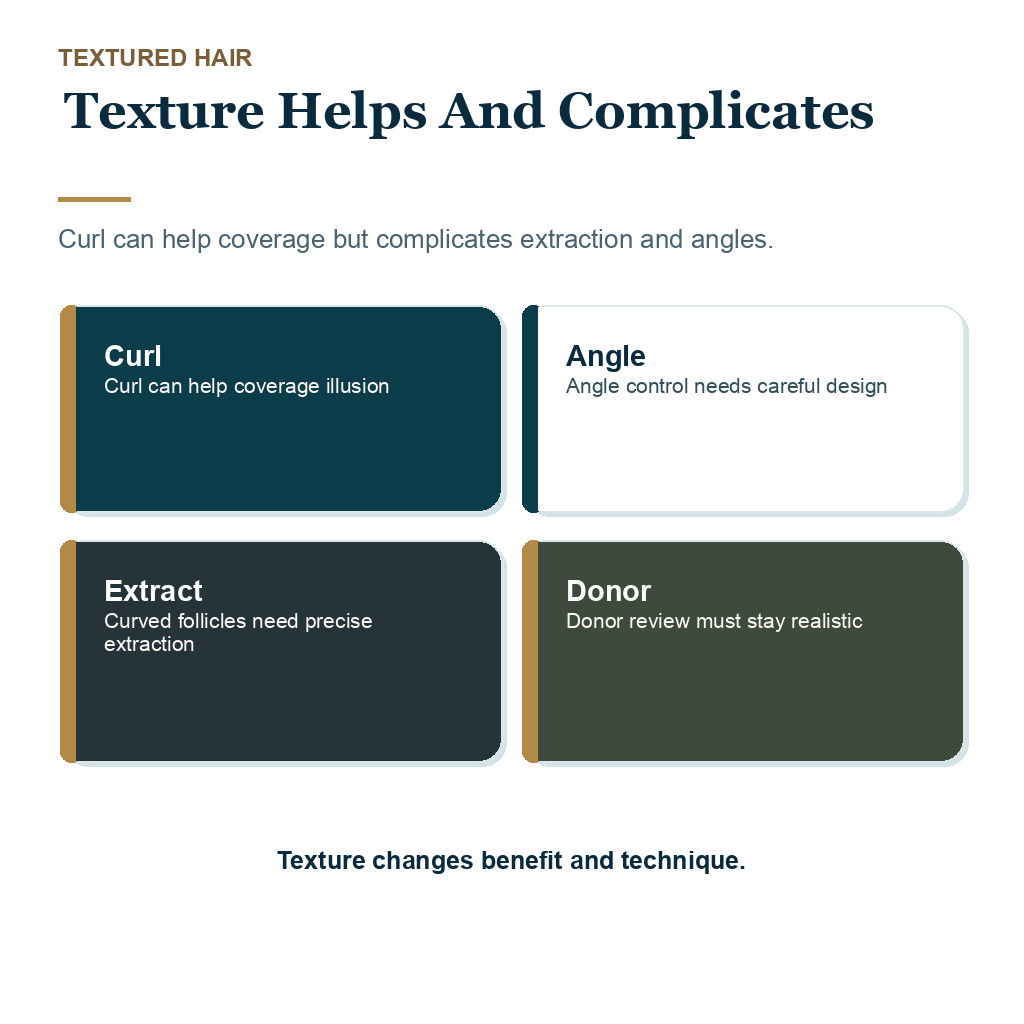
Curly or Afro textured hair can sometimes create stronger visual coverage with fewer grafts, because curl and caliber can help camouflage the scalp. That can be helpful when density must stay cautious.
CCCA photo evidence needs more caution than ordinary density photos. A useful case should show that the diagnosis was stable, the treated zone was scarred rather than only thin, the curl pattern was respected, and follow up was long enough to judge survival in quiet skin. Photos should also show the crown, part line, donor area, and any tender or treated zones, because CCCA planning is a stability check before it is a density discussion.
The same hair characteristics also demand careful angle control, extraction planning, and realistic donor assessment. Afro curly hair transplant planning explains why curl pattern and donor extraction are technical decisions, not small cosmetic details.
With CCCA, the covering power of textured hair should not be used as an excuse to ignore disease activity. Hair texture can improve camouflage, but it cannot make unstable scarred skin safe.
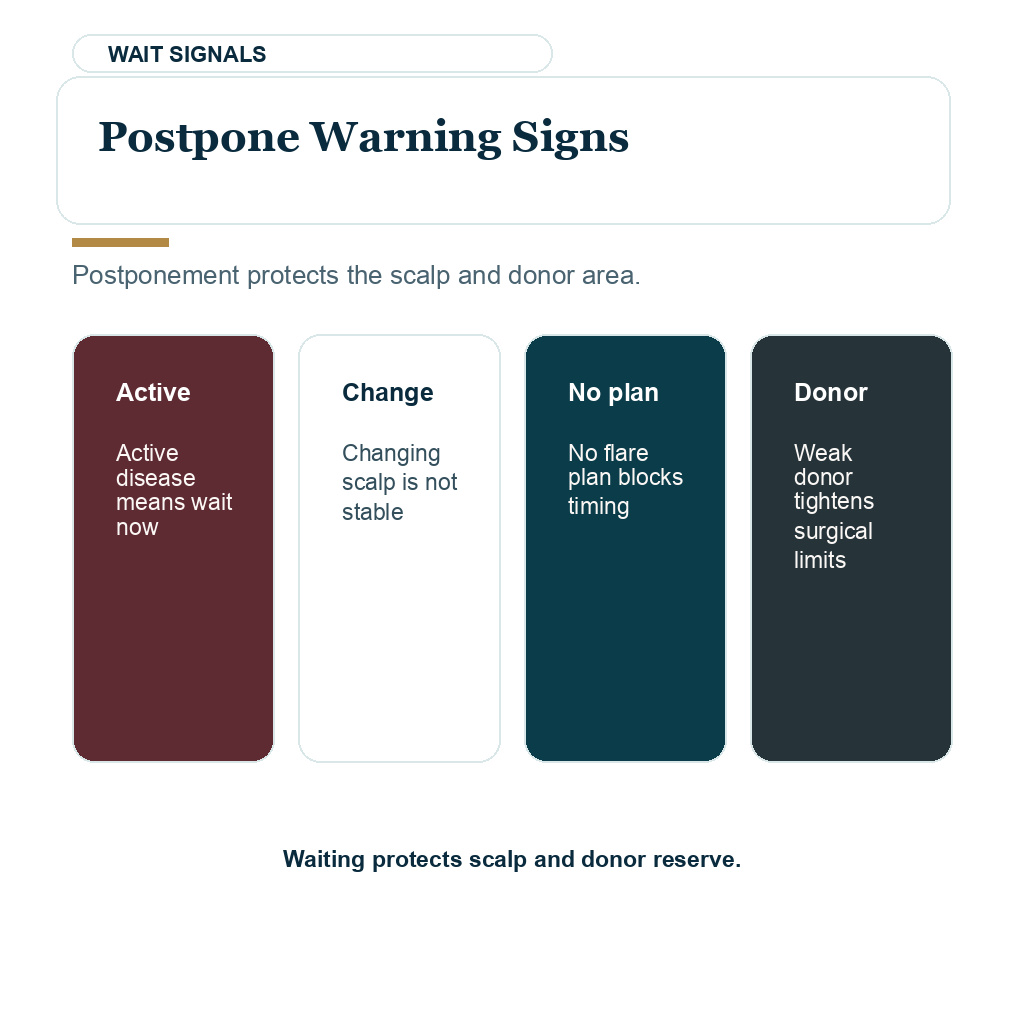
Reasons to postpone surgery
Surgery should be postponed if there is burning, pain, tenderness, worsening scale, active shedding from the central patch, new pustules, crusting, drainage, or recent treatment escalation. It should also wait when the patient has no clear diagnosis or no dermatologist following the disease.
Postponement is not rejection. It is often the decision that protects the patient from spending donor hair too early. This is similar to my approach in hair transplant into scar tissue and hair transplant after scalp radiation, where skin quality and blood supply matter as much as desire for coverage.
If the scalp keeps changing, the operation should wait. A moving target is not a stable recipient area.
What should the first consultation include?
A useful first message includes photos of the crown in natural light, photos with the hair parted, donor photos, a list of treatments, biopsy or dermatology notes if available, and a timeline of the last flare. I also want to know what the patient hopes surgery can actually achieve.
If wigs, braids, relaxers, heat, or tight styles are used to cover CCCA, name the gentler routine you can realistically follow after surgery. New grafts need a calm central scalp, not a return to pressure that keeps the area irritated.
Styled photos are less useful than clear photos. Wet hair can exaggerate thinning, but hiding the central patch makes planning harder. The aim is not to judge the patient. The aim is to avoid a false yes.
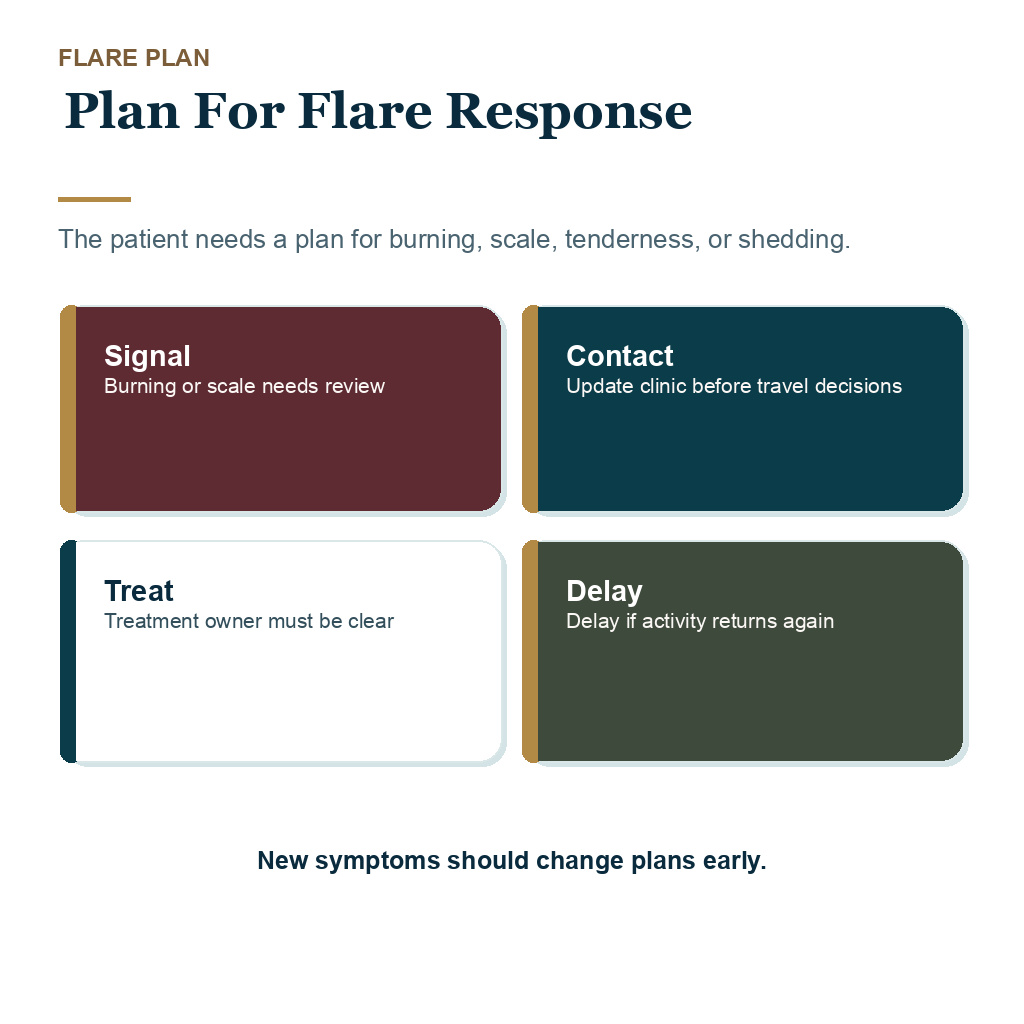
If surgery is eventually accepted, the follow-up route must be clear before the operation. The general principles in hair transplant aftercare still apply, but CCCA also needs a plan for new burning, tenderness, scale, or shedding. I want the follow-up route agreed before surgery, not after a new symptom appears.
What has to be stable before I discuss surgery?
For CCCA, I need more than a quiet photograph. I want the diagnosis established, symptoms quiet, the treatment plan stable, the edge of the affected area not expanding, and the donor supply suitable enough to justify spending grafts.
Burning, tenderness, scaling, pustules, new central shedding, recent medication escalation, or no dermatologist following the condition all move the case away from surgery. A transplant should not be used to test whether the disease is still active.
When the disease has been quiet long enough and the cosmetic target is limited, I may discuss a small or staged plan. When the stability proof is weak, the more useful answer is medical control first, not a higher graft number.
CCCA needs a quiet scalp before grafts are considered
The first question is not how quickly the central scalp can be filled. The first question is whether the scarring process has been quiet enough for surgery to have a fair chance.
A limited transplant or test area may be possible only when symptoms, dermatology review, scalp examination, and donor planning point in the same direction. Burning, tenderness, scaling, spreading loss, or uncertain diagnosis changes the timing.
The scalp has to be protected before donor hair is spent. When CCCA is still active, waiting is part of treatment judgment. When it is stable, the plan can stay smaller, slower, and clear about what grafts can and cannot change.

Read this review excerpt
Every single one of my questions was answered and they made sure I had all the details I needed to make an informed decision.