


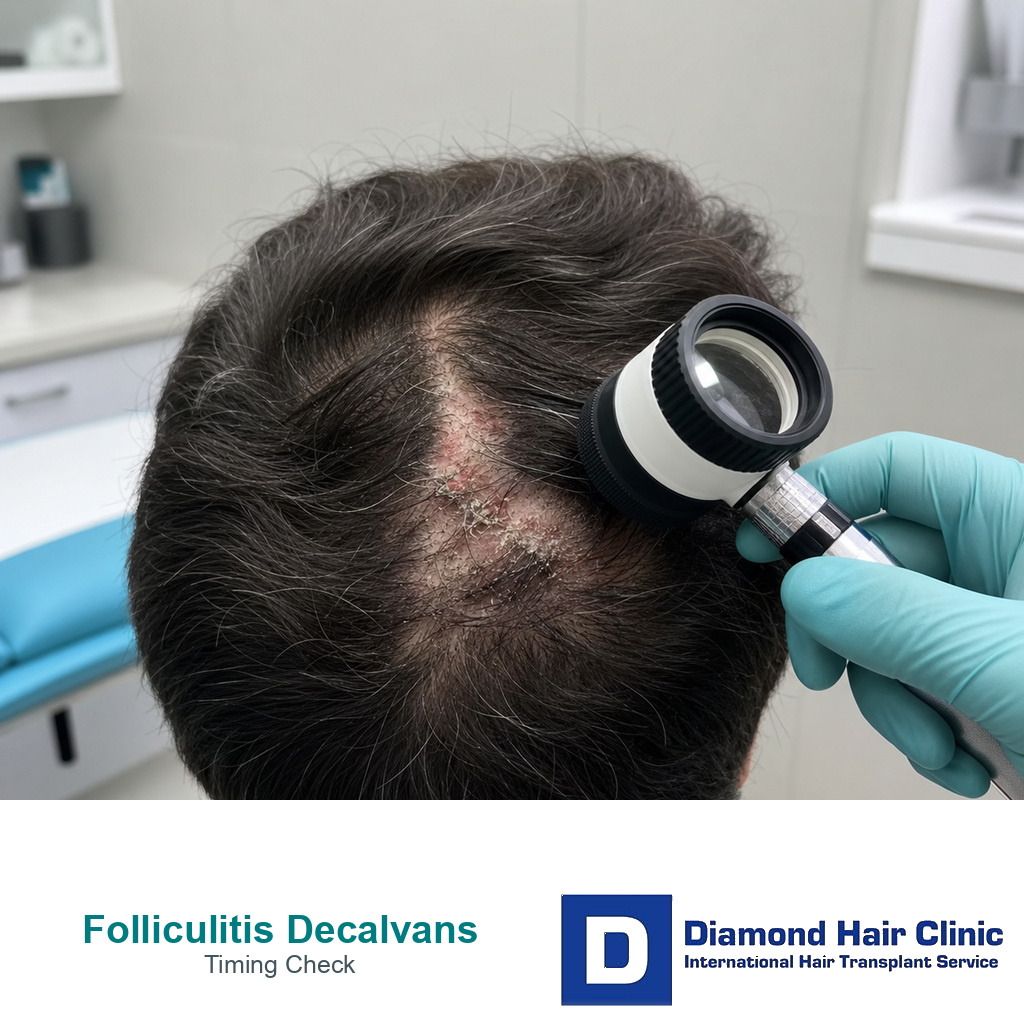
Folliculitis Decalvans Needs a Quiet Scalp Before Surgery
The timing depends less on the name of the diagnosis and more on whether the scalp has stayed calm under dermatology control. I first need a clear diagnosis, a quiet scalp over a meaningful period, dermatology control, usable donor hair, and a realistic goal.
Pustules, wet crusting, drainage, spreading redness, increasing pain, or a recent flare make surgery inappropriate at that moment. A transplant can move hair into skin, but it cannot switch off a chronic scarring scalp disease. Treatment history matters even when the patch looks calm in one photo. Active disease is a stop signal until the scalp has been reviewed and controlled by the right medical team.
Active inflammation changes the whole plan
Ordinary postoperative folliculitis is usually a short term irritation around follicles after surgery. Folliculitis decalvans is different. It is a chronic scarring condition where pustules, crust, tenderness, tufted hairs, and expanding bald patches can return in the same area again and again.
That difference changes the surgical risk. In an inflamed recipient area, graft survival may be weaker because the skin is still part of the disease process. In an inflamed or scarred donor area, extraction may create more damage than benefit. Common bumps and pimples after a transplant belong to the ordinary folliculitis after a hair transplant discussion. The situation here is a diagnosed or strongly suspected scarring scalp disease before surgery is planned.
The first answer is often not surgery. It is to pause, document the disease, treat it, and reassess after the scalp proves stability. Delaying an operation protects the patient more than planting grafts into skin that is still sending warning signals.
What does quiet disease need to mean?
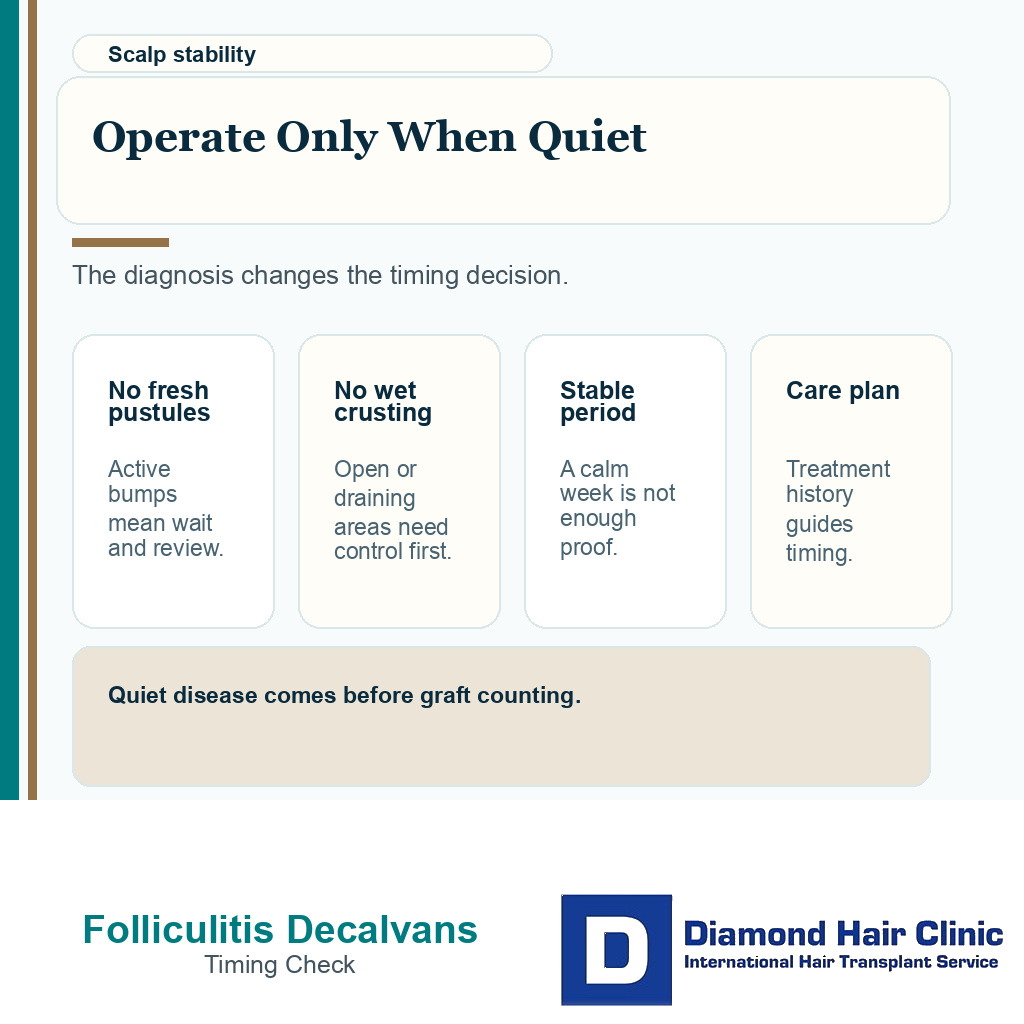
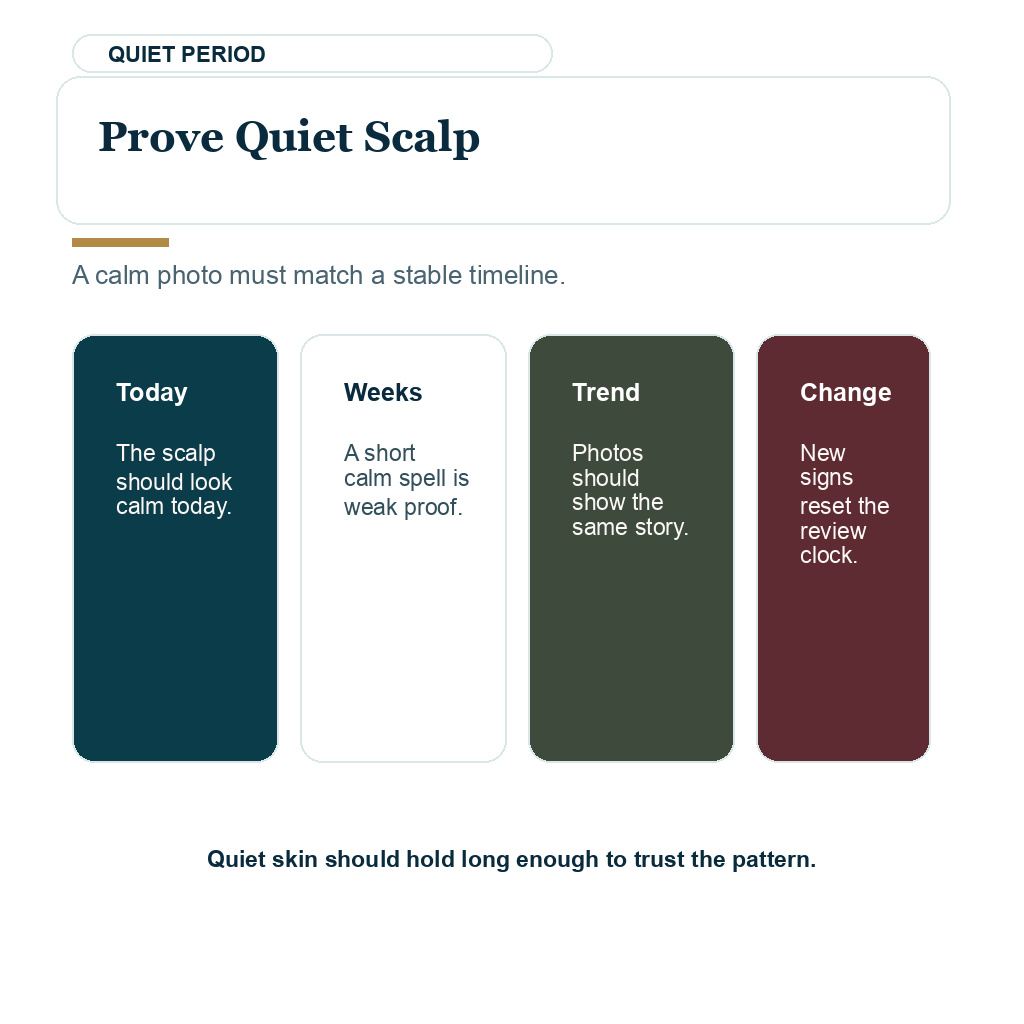
Patients sometimes hear the word quiet and assume that means cleared for surgery. I use a stricter meaning. Quiet means no fresh pustules, no wet crusting, no drainage, no spreading redness, no increasing pain, and no recent flare pattern that suggests the disease is still moving.
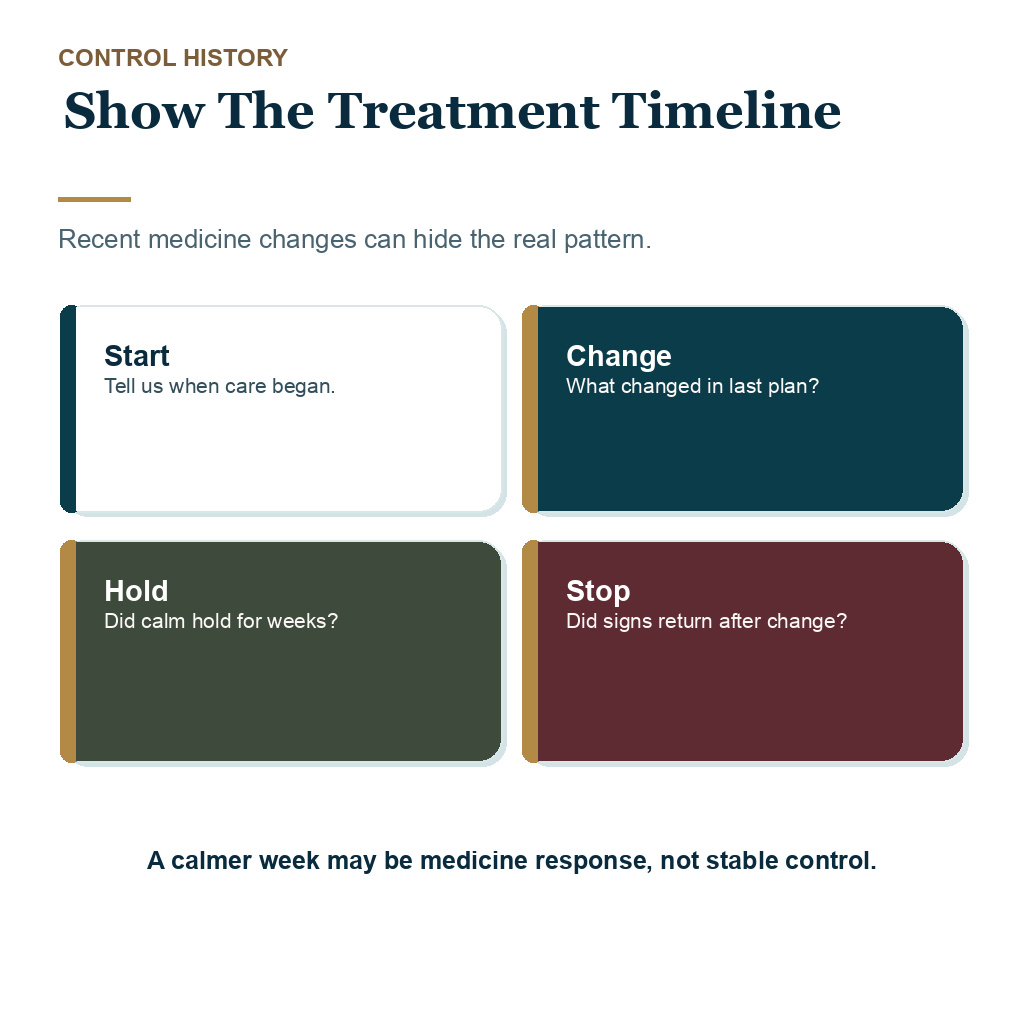
I also need to know how long the scalp has stayed quiet. One good photograph or one settled week is not enough. Surgery is fair to discuss only after a long, documented quiet period. In some patients, that can mean many months to years of inactivity. If antibiotics, isotretinoin, steroid treatment, biologic treatment, or other dermatology care was only just started, stopped, or changed, the surface may look better before the deeper pattern is proven.
I treat folliculitis decalvans closer to other scarring alopecias than to simple scalp irritation. Scarring alopecia and lichen planopilaris also require stability before density planning.
The history I need before surgery
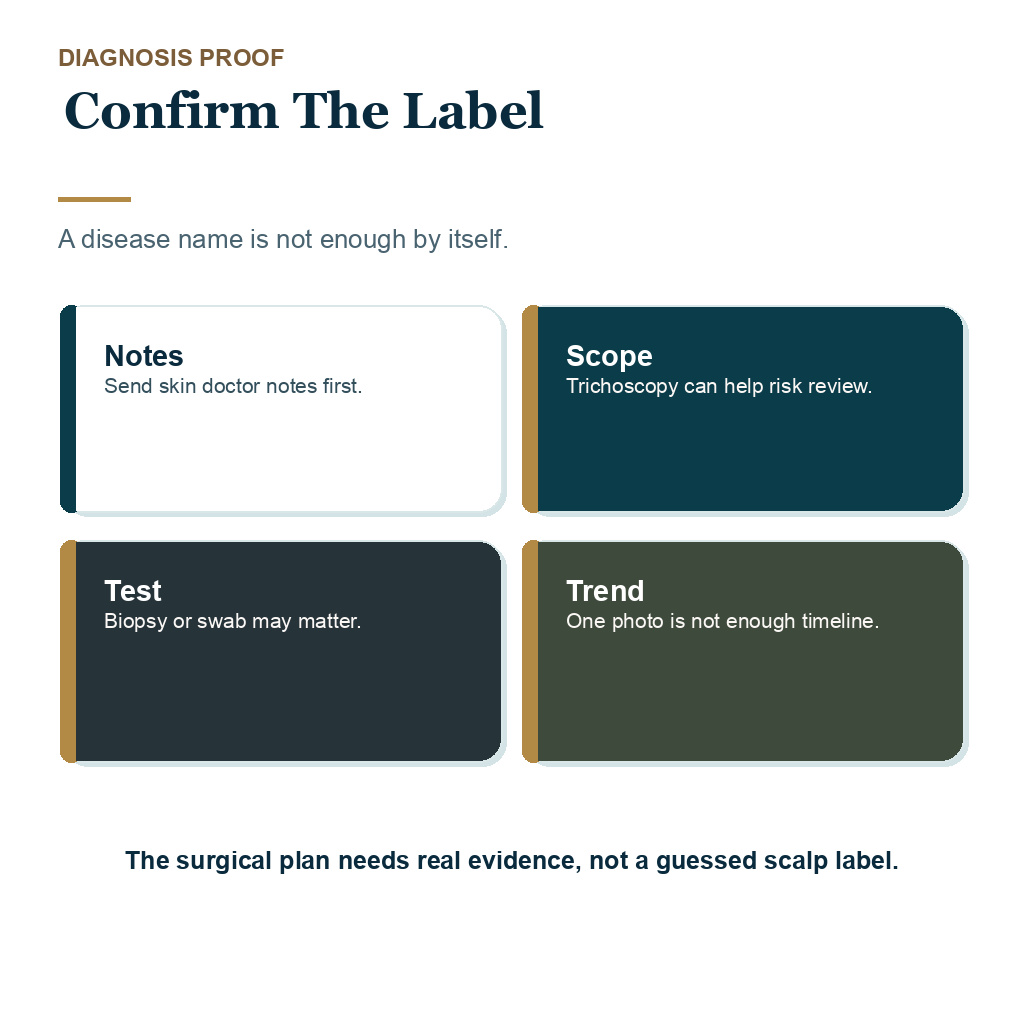
Before I discuss a hairline, crown, or graft count, I need a clear disease history. I ask when the first patch appeared, where flares happen, what treatments have been used, how recently pustules returned, whether a swab or biopsy was done, and whether a dermatologist is still actively treating the scalp. When the diagnosis is unclear, a scalp biopsy before hair transplant may be more useful than another graft estimate.
Photos are useful, but they are not enough by themselves. I need to know the trend. A single quiet photo can hide repeated flares. A single angry photo can look worse than the current condition. The pattern over time is what protects the patient from a rushed decision.
If the patient has another immune or inflammatory diagnosis, I also connect this with the broader medical picture. In that setting, my guide to autoimmune disease and hair transplant planning can be relevant even when the exact diagnosis is different. The operation should fit the patient, not just the bald patch.
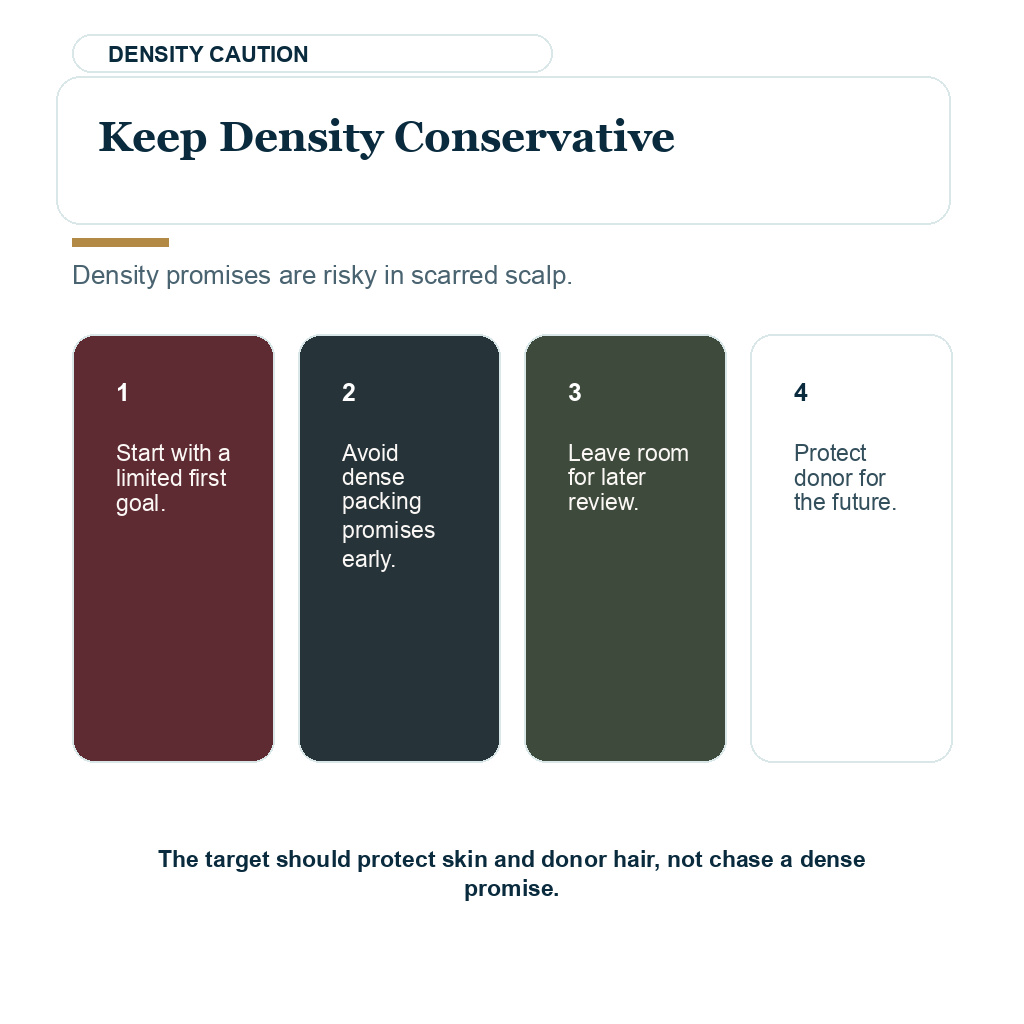
Density promises are risky in scarred scalp
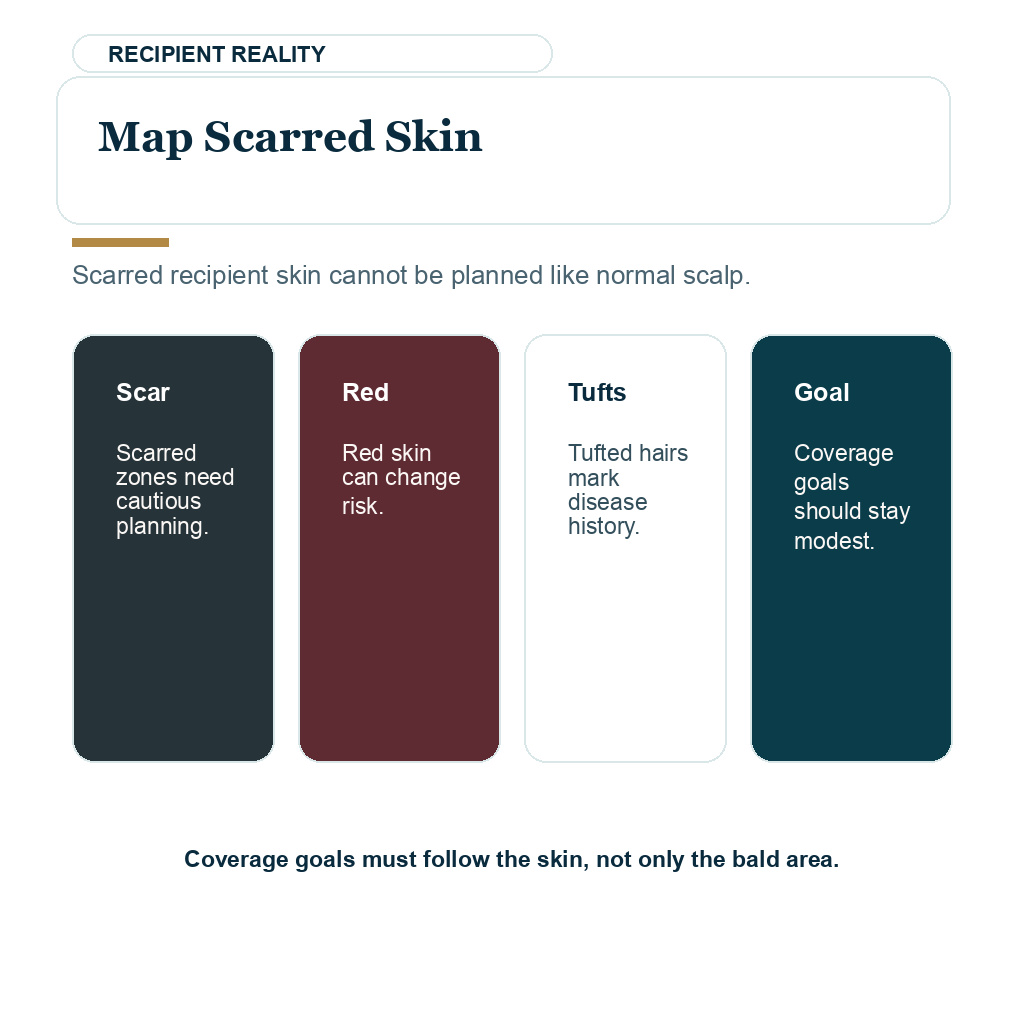
Scarred scalp behaves differently from healthy recipient area. Blood supply, skin thickness, inflammation history, and tissue stiffness can all affect how many grafts the area can safely accept. I do not promise normal density in a scarred or previously inflamed patch.
In some patients, the realistic plan is a small improvement. In others, a test area may be wiser before treating a larger patch. In some, surgery is not sensible because the disease is not stable enough or the donor area cannot afford the risk. The target is safer improvement, not forcing a full coverage promise into poor skin.
That is also why graft numbers cannot be copied from a standard hairline case. Normal graft number planning starts with donor supply, surface area, hair characteristics, and the goal of the operation. With folliculitis decalvans, the skin diagnosis becomes part of the calculation.
I check the donor area just as carefully
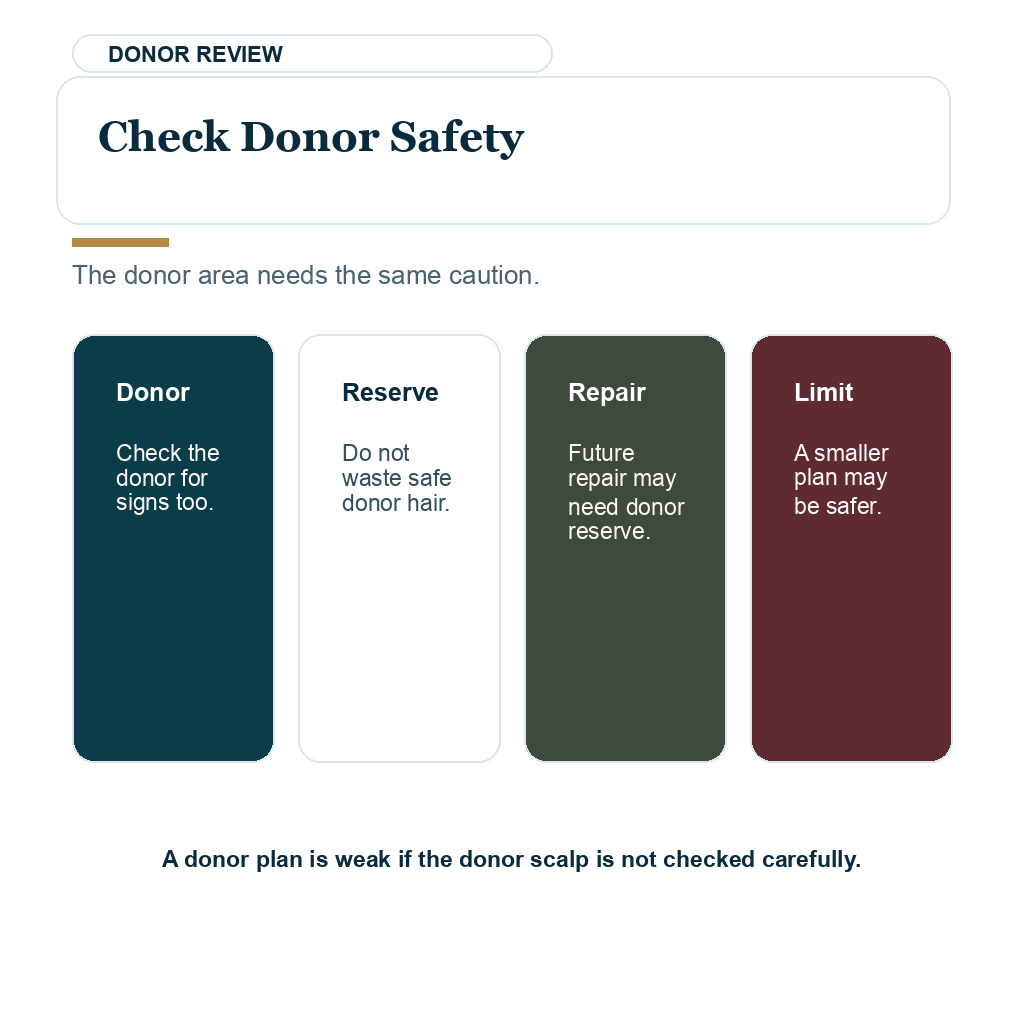
Many patients focus only on the bald scarred area. I also study the donor zone carefully. If there are pustules, crusts, keloid tendencies, old extraction damage, or active inflammation in the donor area, FUE may create new problems while trying to solve the old one.
This is similar to the caution I use for acne keloidalis nuchae and FUE planning. The diagnosis is different, but the donor safety question is familiar. We must not treat the back of the scalp as an unlimited bank when the skin itself may react badly.
Donor reserve is especially important if the patient already had surgery elsewhere or has weak hair characteristics. Donor area strength and weak donor area planning matter because folliculitis decalvans can make an already limited plan even tighter.
Flare planning comes before surgery
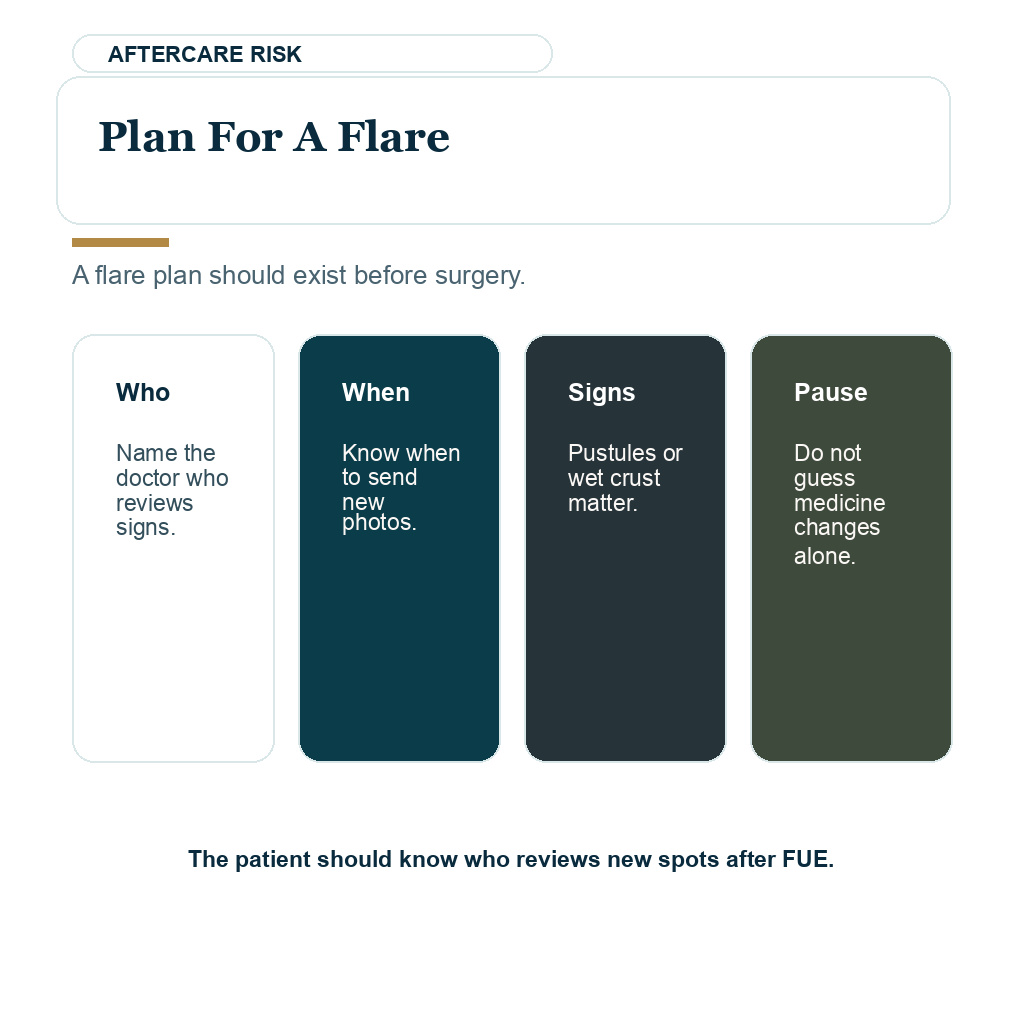
A flare after surgery can threaten both comfort and result. Inflammation can confuse the healing picture, create pain or crusting, and make patients worry that every shed hair is a failed graft. The more important issue is that a flare may continue the same disease process that caused scarring before surgery.
This does not mean every patient with a past diagnosis is impossible to treat. It means the flare plan has to exist before surgery. The dermatologist and the surgical team need a clear route if pustules or crusting returns, which medicines can be used around the procedure, which close photos in good light should be sent, and when local urgent care is needed.
Keep the dermatologist route active after you travel home. If pustules, crusting, or drainage return, the first reply should not be guesswork between a transplant chat and an unfamiliar local clinic.
If crown pimples appear after FUE
A few scattered pimples after a transplant can be simple postoperative folliculitis, especially when new hairs are starting to come through. A crown that stays red at 10 to 12 weeks, keeps forming pustules or yellow crusts, feels sore, or flares each time it seems to settle should not be treated as a wait and see problem.
The crown matters because folliculitis decalvans often involves the vertex, but postoperative crown irritation has several possible causes. It may be ordinary folliculitis, dermatitis, infection, product irritation, or a flare of a scarring condition. The right step is clinic review and, when the signs persist, a dermatologist review with examination and testing if needed.
Minoxidil after a hair transplant also needs caution while the scalp is actively inflamed. Topical minoxidil can irritate a red, itchy, or abraded scalp, so restarting is a medical timing decision. Do not use a delayed restart as proof that the grafts have failed, and do not restart just to calm anxiety if the skin is still inflamed.
A transplant is not a treatment for the disease. It is a reconstructive step considered only after the disease is controlled. If that distinction is unclear, the operation is being discussed too early.
A cautious case has a sequence
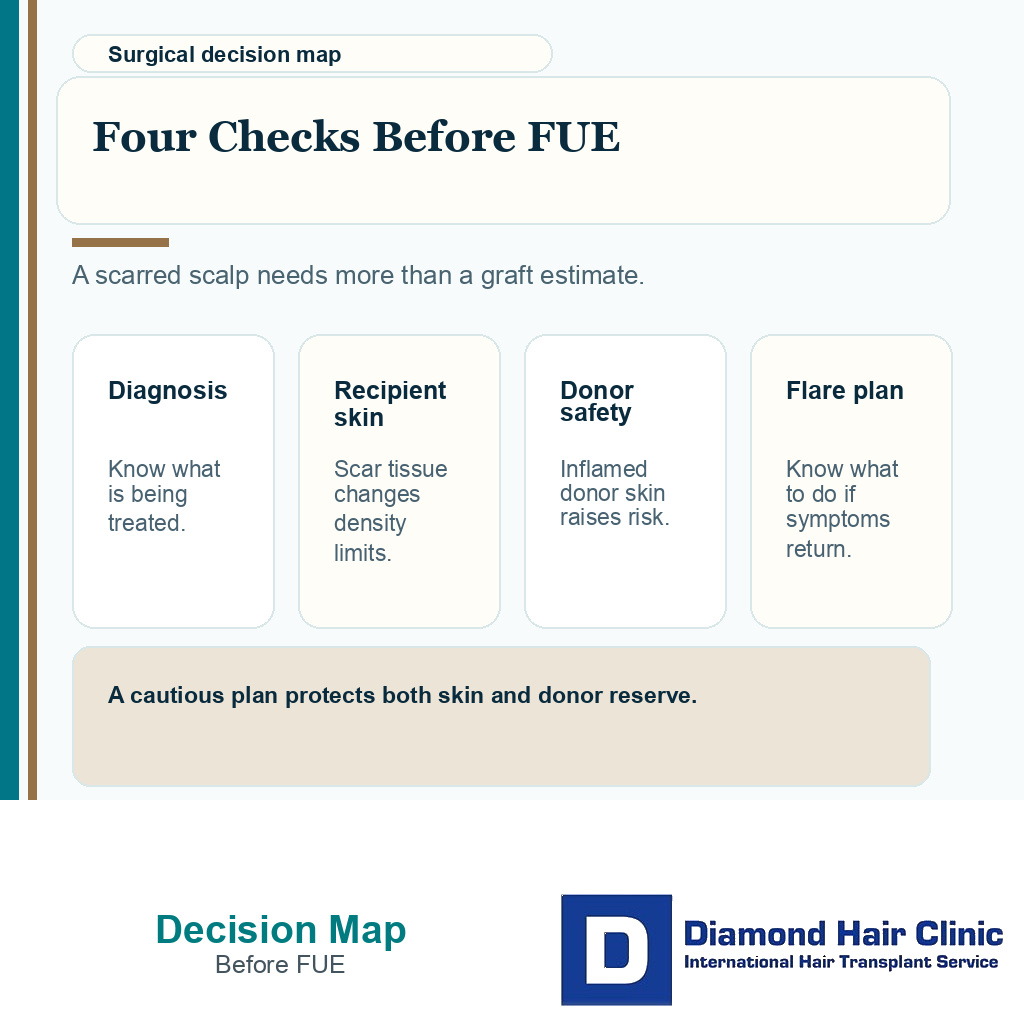
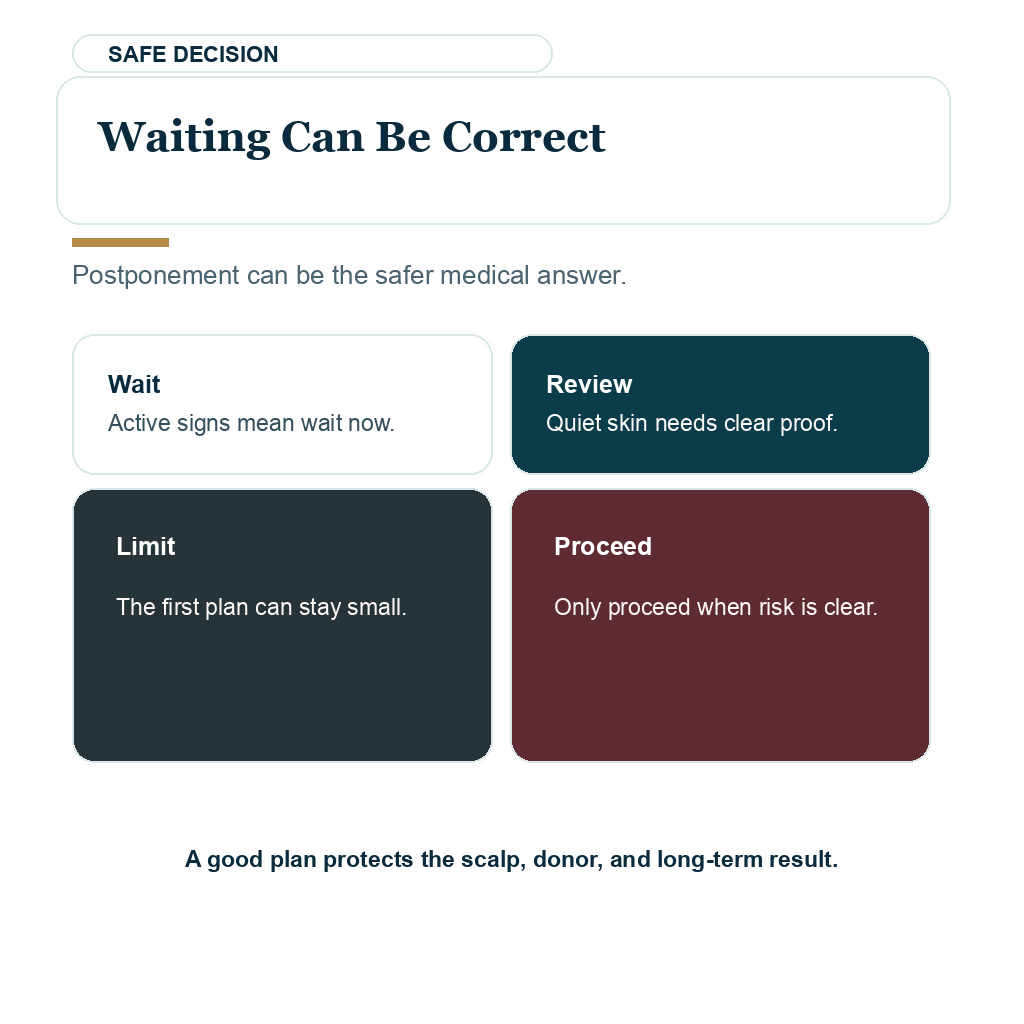
When surgery might be reasonable, I use the sequence in the visual below to keep the decision clinically grounded. It is not a checklist exercise. If diagnosis, stability, donor safety, density, or flare planning is weak, the later steps do not rescue the plan. A small test area may be more responsible than covering the whole scarred patch.
When do I postpone surgery?
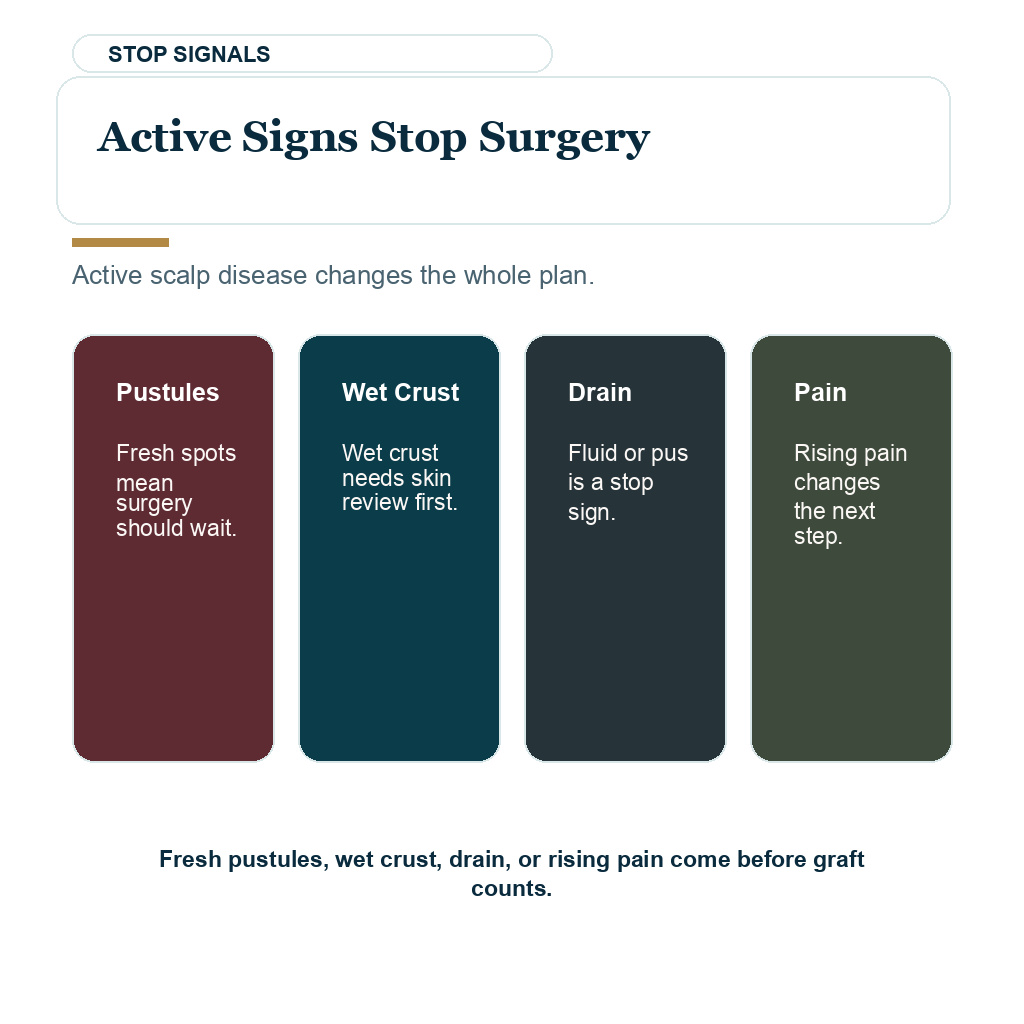
I postpone surgery when there are fresh pustules, wet crusts, drainage, spreading redness, increasing tenderness, fever, or a recent flare. I also pause when dermatology treatment is changing, the diagnosis is not clear, or the scalp cannot show a stable period after the last flare.
High density requests are risky when the target is a scarred patch. Donor concerns become stricter when the donor zone shows miniaturization, old overharvesting, thick scars, or active bumps. A weak plan becomes weaker when the skin diagnosis is ignored.
Patients sometimes feel that postponement means rejection. It does not. Postponement is often protective planning. It gives the skin time to prove whether it can heal predictably enough for surgery.
Psoriasis and seborrheic dermatitis are different
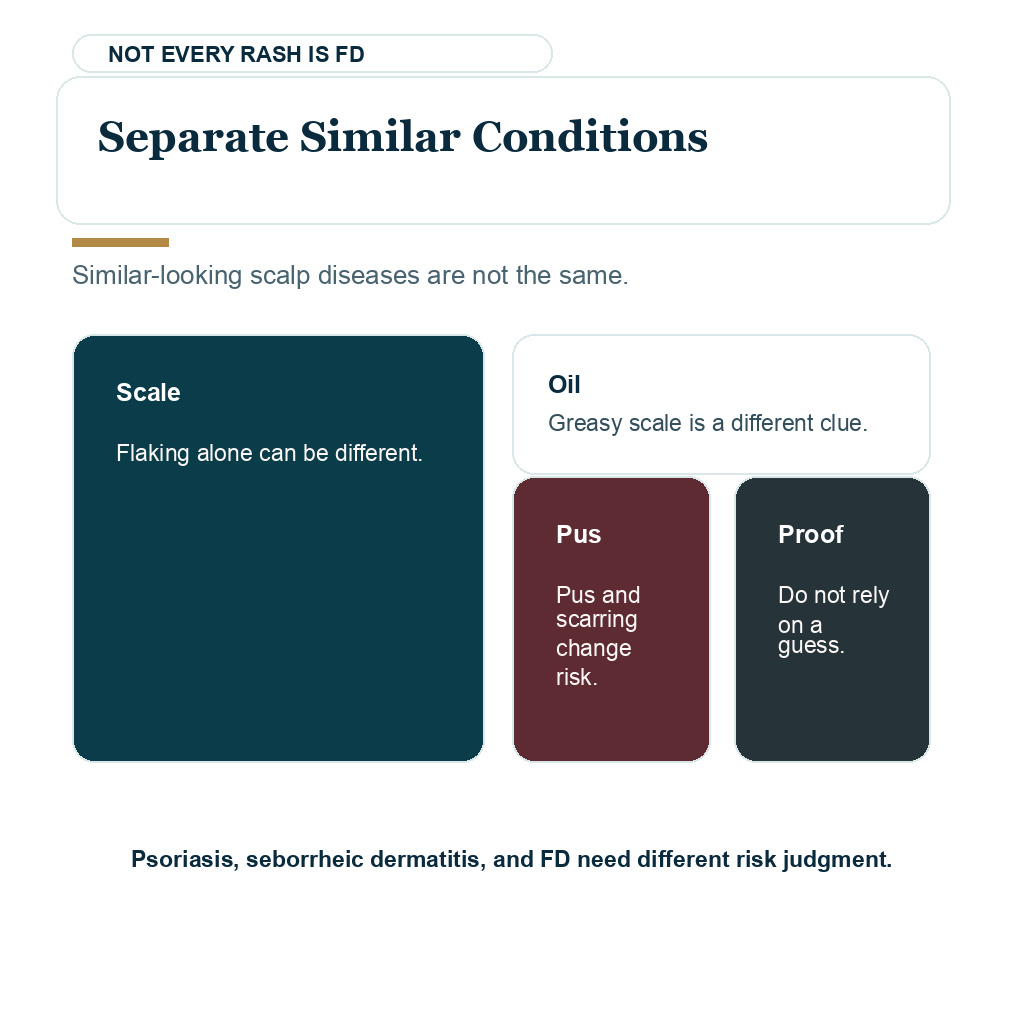
Several scalp conditions can create flakes, redness, itch, and anxiety before a hair transplant. The details matter. Psoriasis and seborrheic dermatitis can be active and irritating, but they do not always destroy follicles in the same scarring pattern as folliculitis decalvans.
Diagnosis matters before planning. When the main problem is flakes, I first ask whether the pattern fits scalp psoriasis and hair transplant or seborrheic dermatitis and hair transplant rather than folliculitis decalvans. A patient with pustules, crusting, tufted hairs, and permanent patchy loss needs a different level of caution.
The visible scalp can look similar to a worried patient. The surgical risk can be very different. A few flakes are not the same as follicle destruction, and a scarring disease should not be treated like ordinary dandruff.
Repair patients need extra caution
Some patients ask about folliculitis decalvans after a disappointing earlier transplant. This is difficult because the visible problem may include scarred disease, poor graft growth, pluggy design, depleted donor reserve, and emotional fatigue from a bad experience.
For repair patients, I separate disease control from repair design. My bad hair transplant repair guide explains why a plan must preserve donor reserve and avoid chasing every visible problem at once. With folliculitis decalvans, that donor reserve limit becomes more important because active disease can make every graft decision less forgiving.
A second operation into unstable skin can make the story more complicated. If surgery is possible, the plan usually needs to be smaller, better documented, and easier to stop if the scalp sends warning signs.
A quiet scalp is the first threshold
Folliculitis decalvans does not close the door to every future surgical plan, but it raises the standard for saying yes. I need a clear diagnosis, a quiet scalp, donor safety, realistic density, and a flare plan before I discuss graft numbers.
For some patients, that careful process leads to surgery. For others, it leads to medical treatment only, camouflage, scalp micropigmentation discussion, or simply more time before another decision. A cautious no for now is better than an enthusiastic yes that the scalp was never ready to support.
If you have this diagnosis, bring the full story rather than only the bald patch. Photos, treatment history, dermatology notes, flare timing, and donor photographs all matter. Adding hair is only one part of the decision. My question is whether the scalp can support even a limited improvement without making a chronic disease worse.

Read this review excerpt
Upon arriving home, I sent 4 photos (of each side of head) after every washing process to doctor for checking where I was given personal advice for how to take care of my healing head.