


Hair Transplant Planning in Your 40s or 50s
A hair transplant in your 40s or 50s can be a good decision when the donor area, health, hair loss pattern, and coverage goal all fit the plan. Age alone does not decide it because health, donor reserve, and coverage goals still have to fit. I have seen men in their 40s and 50s who were better candidates than much younger men because the pattern was clearer and the goal was more realistic. I have also seen men this age who needed a smaller plan, medical clearance first, or no surgery because the donor area, crown size, health history, or requested coverage did not fit safely.
Compared with a hair transplant in your 30s, this age group often gives me a clearer pattern, but it does not remove future loss planning. Donor hair is still limited and medical review still matters. I am checking whether your donor, health, and expectations can carry the result.
For patients in their 40s or 50s, health logistics sit beside design. Blood pressure control, regular medicines, sleep apnea, blood thinners, and the trip home all affect how conservative I need to be. Bring the names and doses, not just the condition names, because clearance depends on the actual routine.
This matters especially if you are travelling to Istanbul from abroad. I am not trying to recreate the hairline you had at 22. I am trying to create a natural improvement that still makes sense under harsh light, in unstyled photos, after donor area review, and years later if another surgery is never wise.
Age alone does not decide candidacy
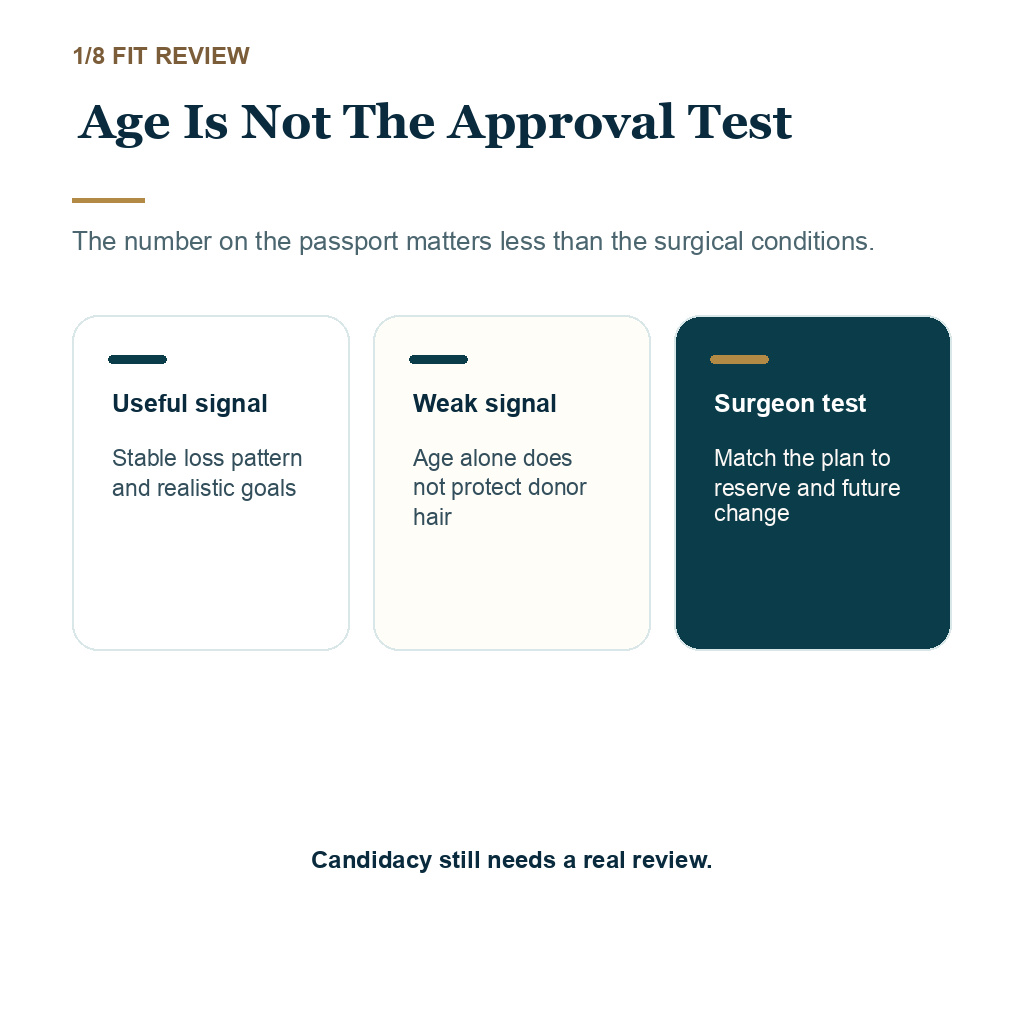
For many people, 40 or 50 is not too old. A person with stable frontal thinning, healthy donor hair, and a realistic coverage goal may be easier to plan than a younger man whose future hair loss is still uncertain. If you are asking whether you are a good candidate for a hair transplant, age is only one part of the answer.
What matters more is whether the donor area is strong, whether the recipient area can be covered without exhausting future grafts, and whether your health allows a safe elective procedure. A 48 year old with good donor hair and controlled medical conditions may be a stronger candidate than a 24 year old with aggressive miniaturization and unrealistic density expectations. I also check whether miniaturization is limited to the recipient area or already visible inside the donor margins.
The comparison with younger patients is useful, but the risk is different. In a younger patient, the main danger is often future loss. In an older patient, the main danger is often asking the donor area to solve too much surface area. I separate these two problems before discussing graft numbers.
Planning can be clearer after 40
After 40, the hairline, temples, middle scalp, crown, and donor area often tell a more complete story. That does not make surgery free of risk, but it can make the plan more realistic. There is usually less uncertainty than in someone who is still very young, where being too young for a hair transplant can create a lifetime planning problem. Same angle photos over several years are more useful than one current selfie when I am judging whether the pattern is stable or still moving quickly.
Many men in this age group also know what kind of improvement they can live with. They may want a cleaner frame to the face, a softer frontal line, or better styling coverage rather than teenage density. That helps because the donor area can be used for a realistic goal instead of a promise of full restoration everywhere.
Planning becomes clearer only after the details are examined. A blurry photo, a graft number, or a promise of full coverage is not enough. I need donor density, hair caliber, miniaturization, crown size, scalp health, previous surgery history, current treatment use, and medication history before deciding how much surgery is sensible.
Strong candidate signs after 40
A strong candidate has stable or slowly progressing hair loss, a healthy donor area, enough hair caliber to create visible coverage, and expectations that match the available graft supply. The best sign is a donor area that can be harvested inside a safe zone without creating a thin, depleted, or overharvested look later, not just hair at the back of the head. The donor plan also has to match the haircut and length you expect to wear after healing.
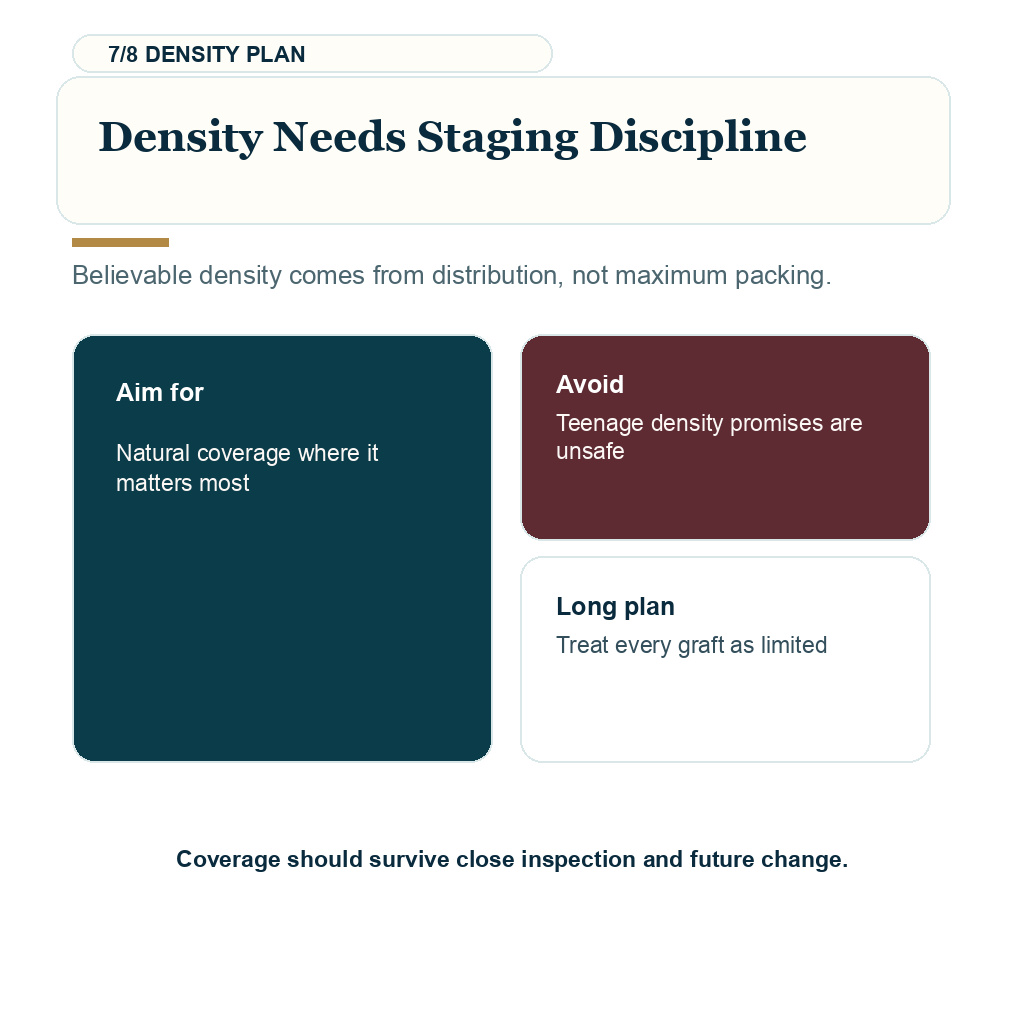
Expectation is just as important as donor density. If you want a natural hairline, accept that the crown may need partial coverage, and understand that transplanted hair redistributes donor hair rather than creating unlimited new hair, the plan becomes stronger. If the goal is a very low hairline and a full crown from a limited donor area, the plan becomes weaker even if the surgery is technically possible.
I also need to know whether the plan is realistic long term. A transplant can improve bald or thinning zones, but native hair can still thin. Medication may or may not be suitable, but the background hair loss must be part of the discussion.
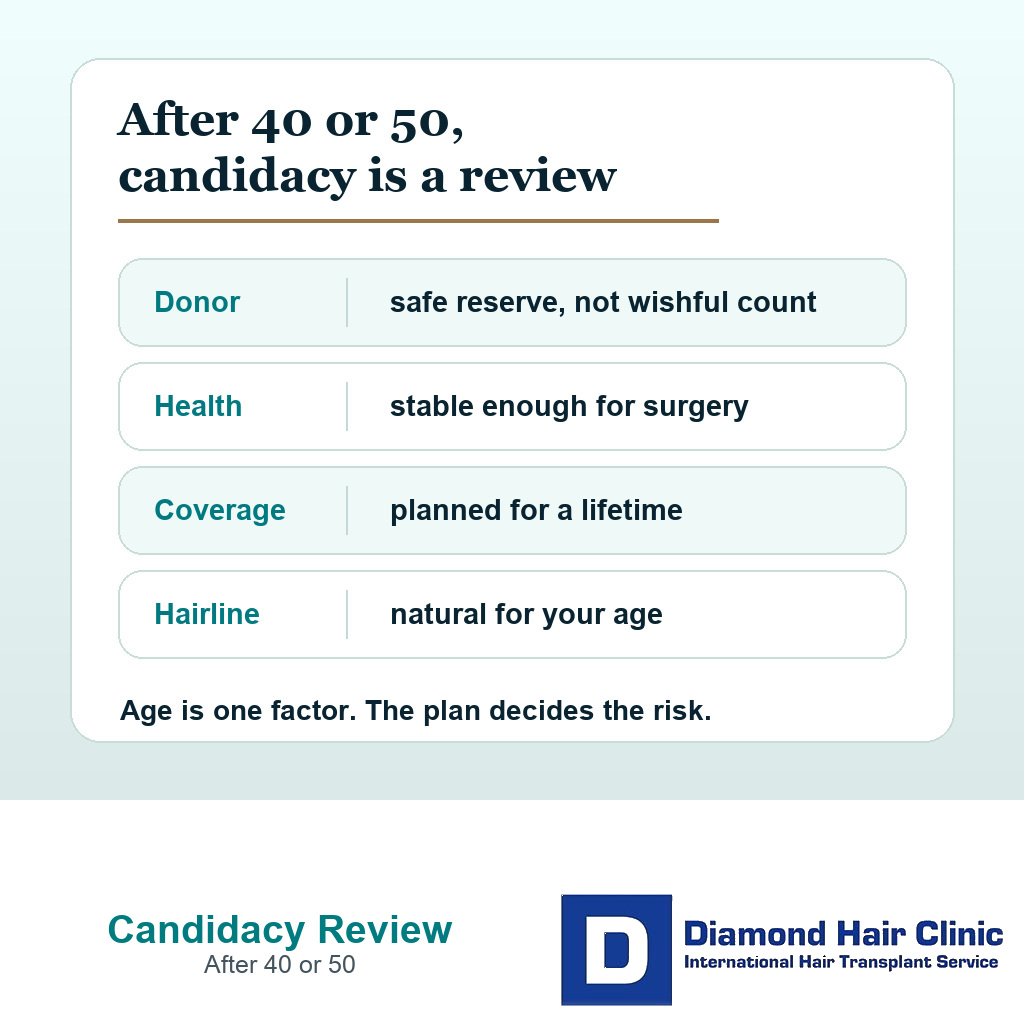
In your 40s or 50s, candidacy depends on the donor reserve, health stability, coverage target, and whether the hairline design will still look natural with age.
Cases where surgery is less suitable after 40 or 50
The most common problem is not age itself. It is a mismatch between the size of the bald area and the strength of the donor. Advanced crown loss, weak sides, retrograde thinning, diffuse donor miniaturization, scarring, active scalp inflammation, or a depleted donor area can leave too few safe grafts for the result you want. A larger operation can look like progress in one area while permanently weakening the donor area.
Previous surgery also changes the calculation. If grafts were already used in the past, the second plan must account for what remains. Lifetime hair transplant grafts are a limited resource, especially when frontal density, crown coverage, and future safety are all being discussed at the same time.
Medical instability can also pause or block surgery. Uncontrolled blood pressure, unstable heart disease, poorly controlled diabetes, active scalp disease, unresolved blood thinning decisions, untreated infection, or a recent major health event can make an elective procedure inappropriate until the medical picture is clearer. You may still become suitable later, but the timing must respect health first.
Donor reserve needs careful judgment
Donor reserve is not a guess from one photo. It needs direct assessment of density, hair shaft thickness, color contrast, miniaturization, previous extraction patterns, and the lower edges of the donor zone. A donor area that looks full when the hair is long may still be unsafe if miniaturization is present or if extraction would need to move outside the safe zone. I need to know what the donor will look like after extraction, not only how full it looks before surgery.
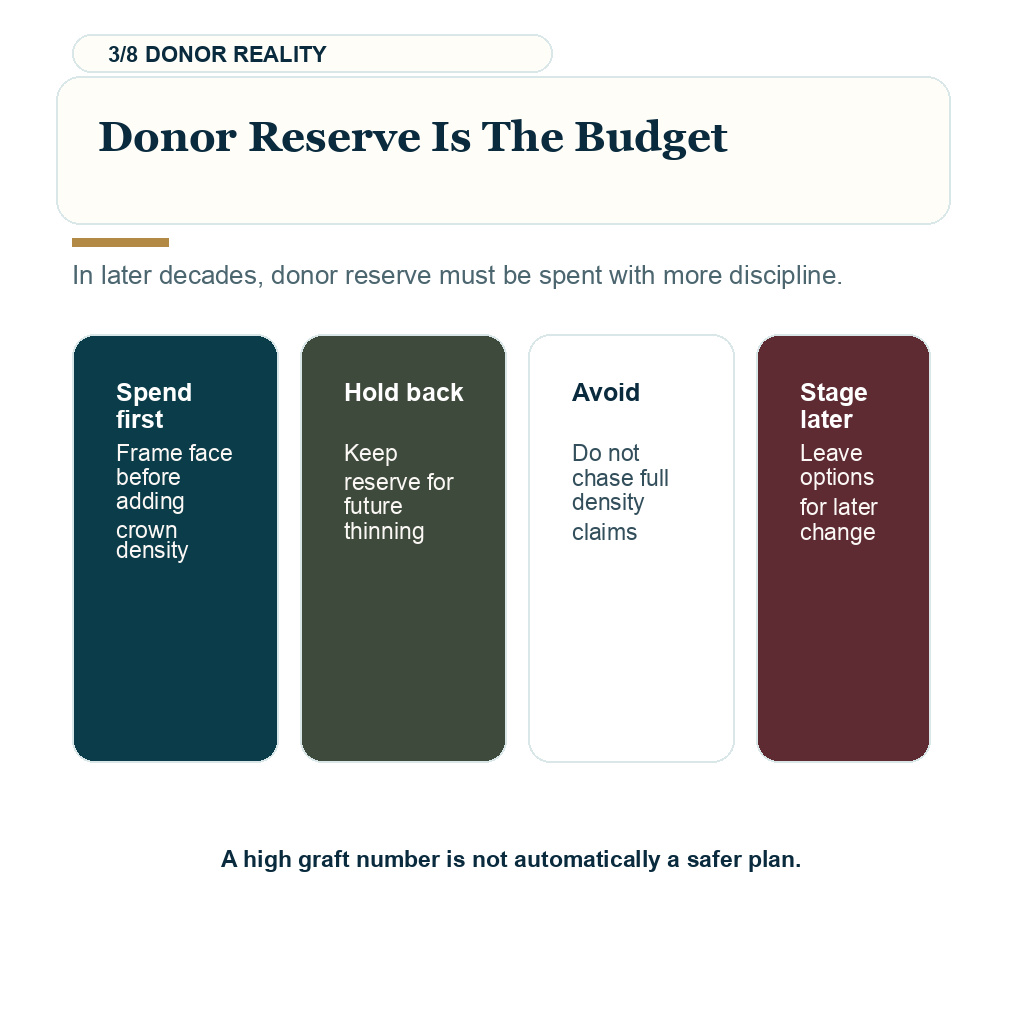
In older patients, I pay close attention to the sides and lower occipital area. If the donor area is narrowing or showing retrograde thinning, the plan must become smaller and more selective. A weak donor area does not always block surgery, but it changes the size, density, and priority of the procedure. A high graft count is not a success if it steals from unstable margins or leaves the donor visibly patchy.
Advanced Norwood patterns need disciplined planning. With Norwood 6 or 7 hair transplant planning, the goal may be a framed face and strategic coverage, not full restoration. A good plan protects the donor even when you want more coverage.
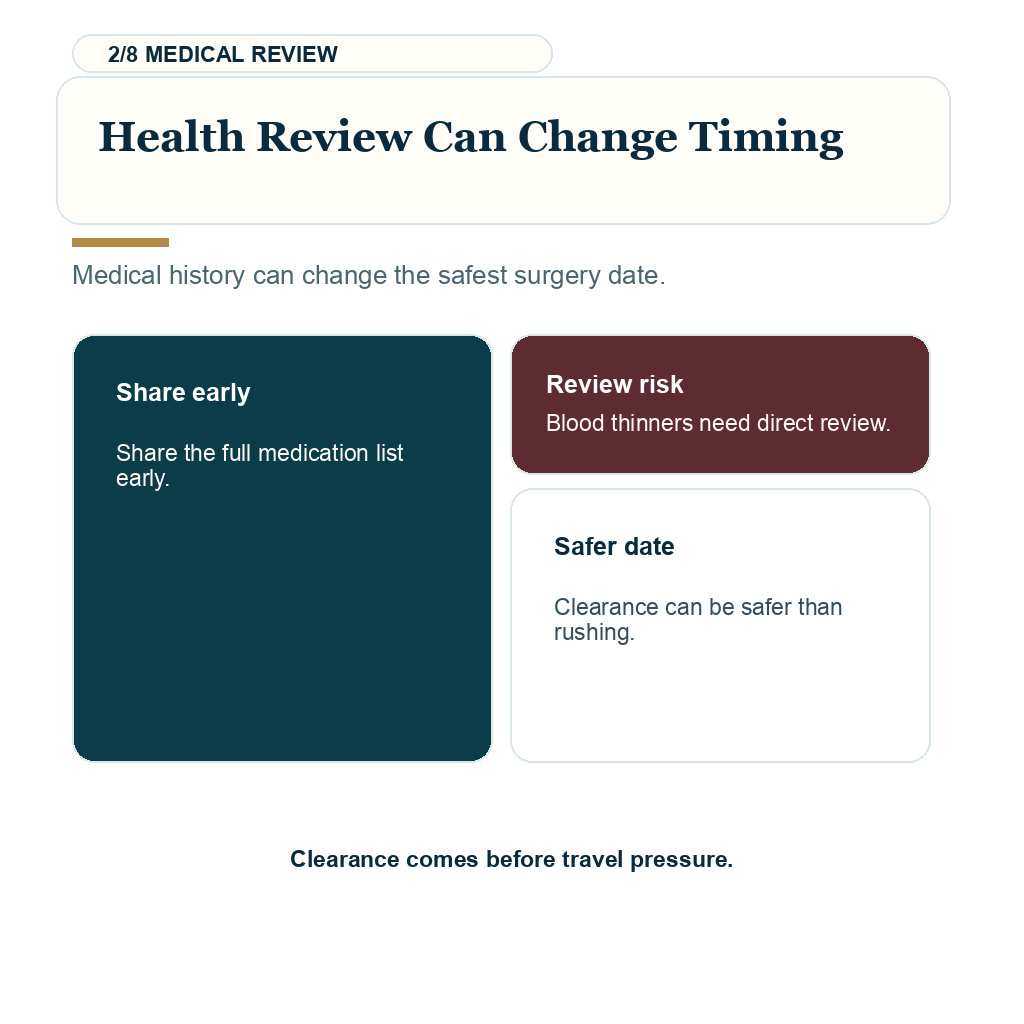
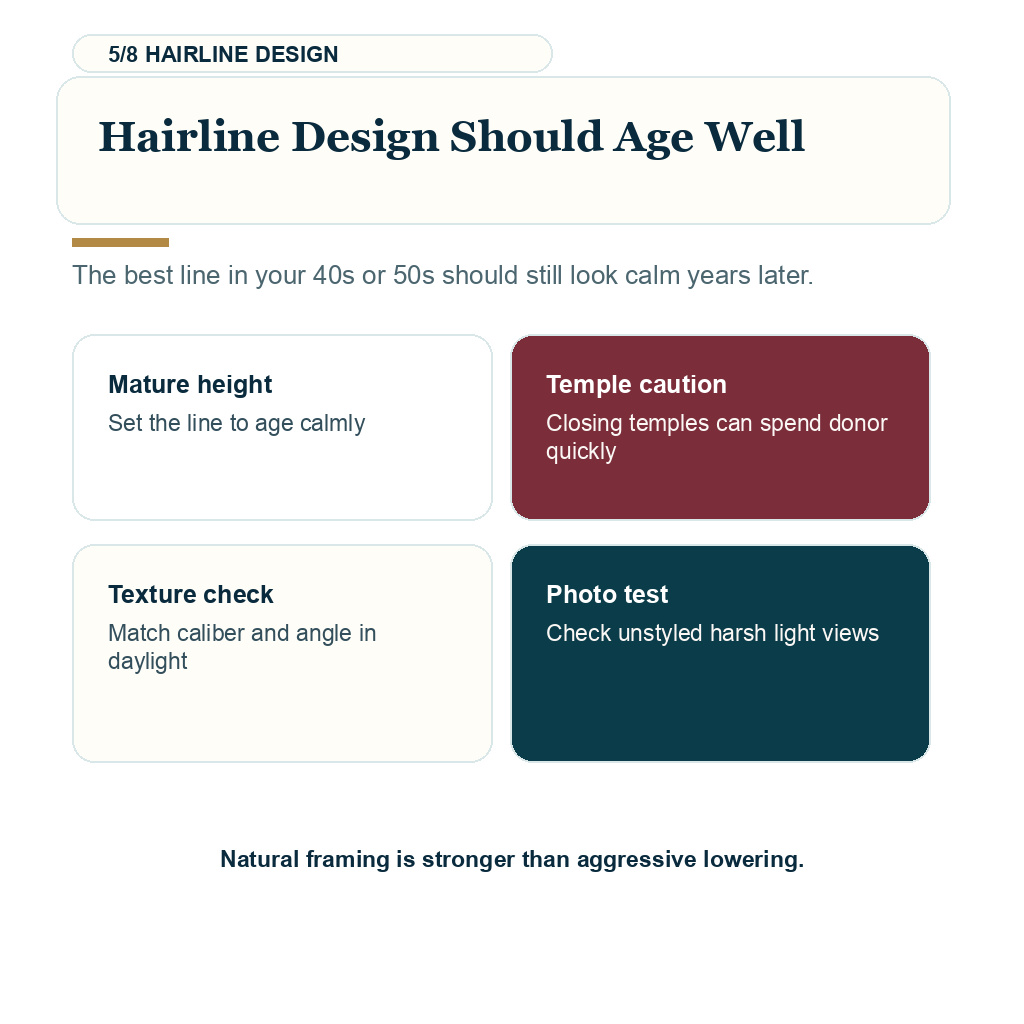
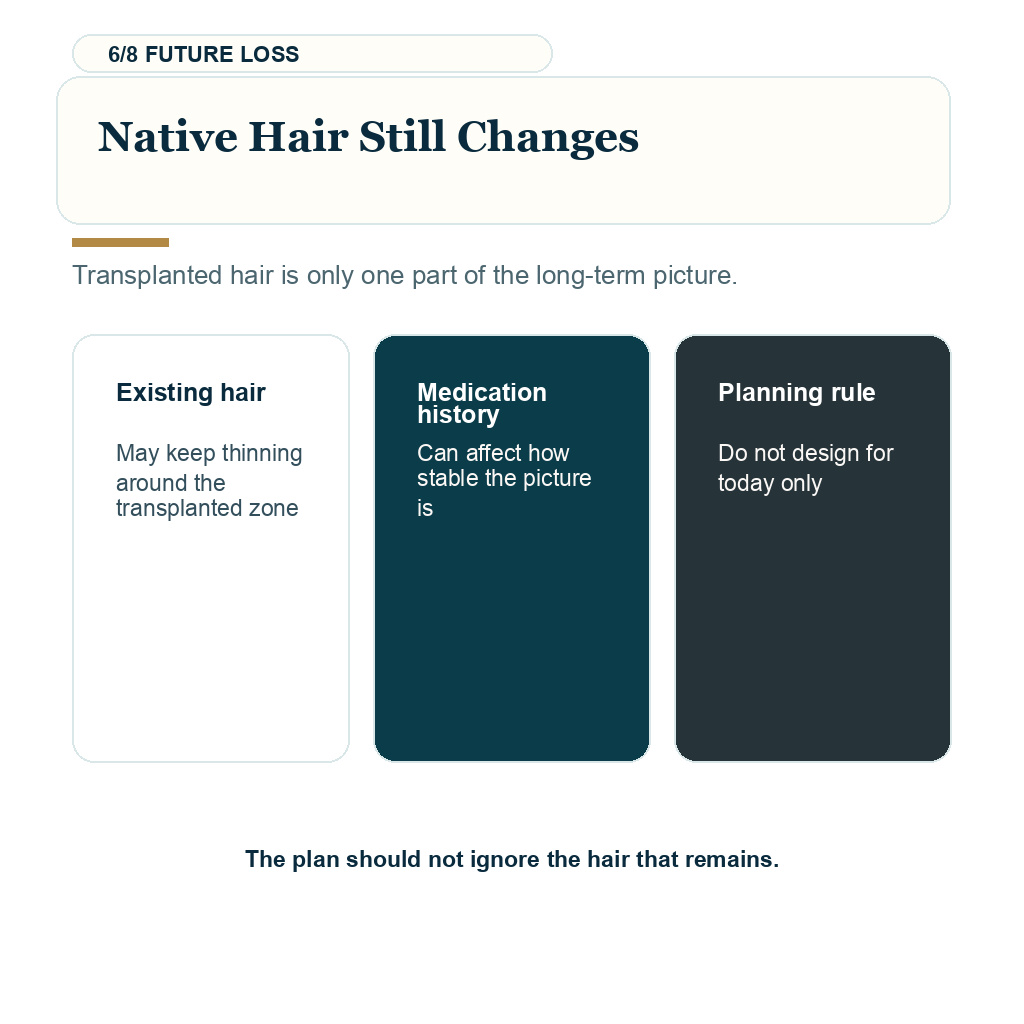
These 8 planning slides explain how age, health review, donor reserve, crown priority, hairline design, native hair changes, density, and photos shape the plan. Swipe sideways, use the arrows one slide at a time, or choose a number below the image.

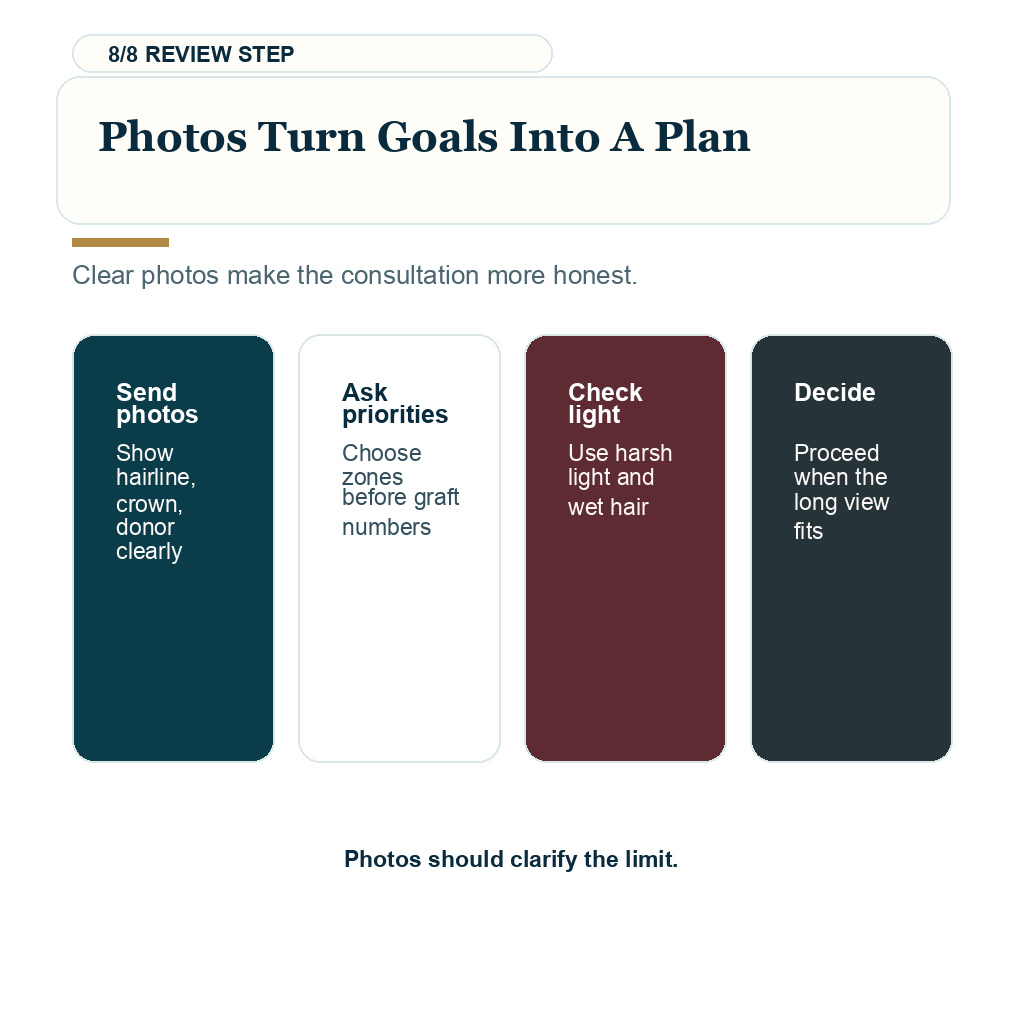
Hairline planning at 45 or 55
A hairline at 45 or 55 should not simply copy a young adult hairline. The design has to match the face, temple recession, future hair loss risk, and available donor reserve. A slightly higher, softer, irregularly natural hairline often ages better than a low dense line that consumes too many grafts.
Temple points follow the same planning principle. Rebuilding aggressive temple closure can use many grafts and may look unnatural if the rest of the scalp continues to thin. A natural design should frame the face without pretending that age has no effect on the hair pattern.
I think about how the result will look in photographs, in bright light, with shorter hair, and as you get older. The design has to help the hair transplant look natural as you get older, not only on the first styled result day. A result that looks reasonable at 50 should still look natural at 60.
Crown priority in later planning
The crown often creates the hardest choices in older patients. It can cover a large surface, the whorl spreads hair in several directions, and the scalp often shows through more easily under light. A crown result may improve styling confidence, but it can also consume many grafts without creating the visual impact of frontal restoration. I do not let the crown spend grafts that may be needed later to keep the frontal frame natural.
For some people, treating the frontal third first gives the most visible benefit. For others, the crown can be treated if donor reserve is strong and the frontal area is stable. I judge a crown hair transplant by the whole lifetime plan, not by the wish to fill the largest empty area first. A staged crown plan is often safer than one large session that tries to close every bright spot at once.
If the crown is broad and the donor is limited, partial coverage or a lighter density plan may be more sensible than chasing complete closure. This is the part many people misunderstand. A crown that looks better for styling is different from a crown that is fully closed under harsh light. The crown should not consume grafts needed for future facial framing.
Health issues that need stability first
Hair transplantation is elective surgery. Health stability comes before density. Blood pressure, heart history, diabetes, blood thinning or antiplatelet medication, previous clotting problems, allergies, smoking, sleep apnea, and prescription medicines, pharmacy medicines, supplements, or herbal products all need direct review. If you have high blood pressure before a hair transplant, the issue is control and safety, not cosmetic urgency. The right time to clarify this is before flights and deposits create pressure on the medical decision.
Heart disease or a stent needs medical coordination before travel and surgery. The timing of antiplatelet or anticoagulant medication is not something to improvise, and aspirin, blood thinners, blood pressure medicine, diabetes medicine, or heart medication should not be stopped without the prescribing doctor and surgical team agreeing on the plan. If you are reading about hair transplant after heart disease or stent placement, understand that cardiology clearance can be part of the decision. A cosmetic plan cannot override the reason those medicines were prescribed.
Blood tests, medication review, and medical history help protect you and the clinic team. Blood tests before a hair transplant do not replace medical judgment, doctor clearance, or a proper medication plan, but they support them. In diabetes and hair transplant planning, glucose control and wound healing risk deserve careful attention.
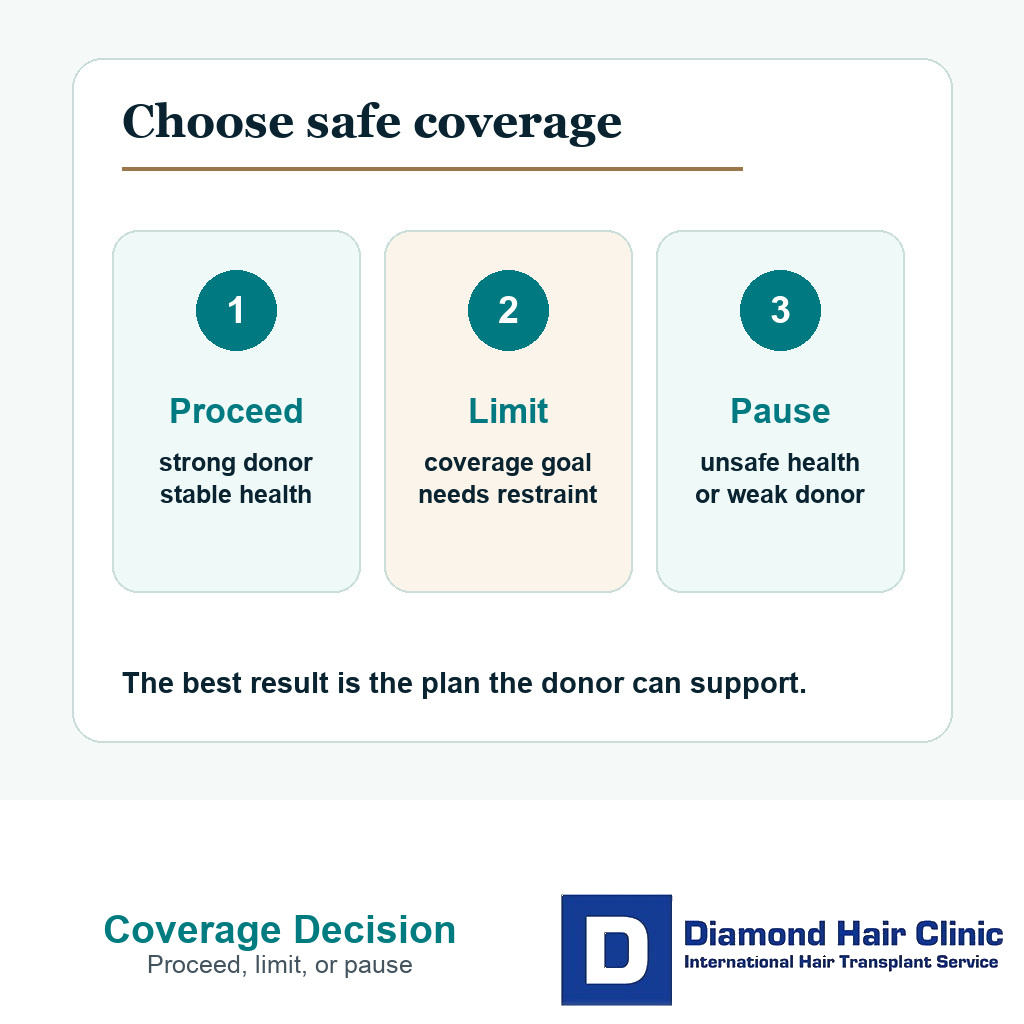
A responsible plan may proceed, limit the coverage goal, or pause surgery depending on donor strength, health stability, and realistic coverage.
Medications still matter in your 40s or 50s
They can. Medication decisions are not identical for every patient, and age does not remove the need to assess native hair. If there is active miniaturization behind the transplanted area, the result can look thinner later even if the grafts grow well. The transplant adds coverage. It does not freeze the rest of the scalp.
Some patients are already using finasteride, dutasteride, minoxidil, or other treatments. Some cannot use them or do not want to. The important point is to include medication history in the plan, not hide it. Finasteride before and after a hair transplant may be relevant when native hair preservation is part of the long term strategy. If medical treatment is not suitable for you, the operation should not depend on medication magically protecting the surrounding native hair.
If medication is not suitable, the surgical plan should usually become more selective. The hairline may need to sit higher, the crown may need less ambition, and donor reserve must be protected. Surgery and medical stabilization are separate tools, not substitutes for each other.
At 50, refusing long term hair loss medicine does not close the door on surgery by itself. The design becomes more conservative, with a mature hairline, measured crown priority, and enough donor reserve for native hair that may still change.
Results worth comparing with
Do not compare only graft numbers. A 3,000 graft result in thick, dark, low contrast hair is not the same as 3,000 grafts in fine hair with high scalp contrast. Age also changes the comparison because older patients often have larger crown areas, more native thinning, previous surgeries, or different styling goals. The result must match donor strength and surface area, not only a number that sounds impressive.
The useful comparison is with patients who share your starting pattern, donor quality, hair caliber, color contrast, and coverage goal. Hair transplant results from hair like yours are more helpful than random before and after photos selected for drama.
Comb through videos, harsh light photos, and donor area photos matter more than a single styled final image. A useful comparison asks how the result behaves when the hair is wet, parted, or cut shorter. It should also show what the donor looks like after extraction. That tells more truth than a perfect angle.
If you cannot find results from men in their late 50s or 60s
Do not read that gap as proof surgery is impossible. Some older patients are less visible online, some prefer privacy, and some choose shaving, scalp micropigmentation, or no surgery because the donor area or crown goal does not fit safely. The medical question is still whether your donor reserve, health history, hair caliber, scalp contrast, and coverage target can carry the plan.
If there is no close age match, compare the details that change the surgical decision. Look for a similar Norwood pattern, crown size, donor rim, hair thickness, color contrast, healed donor photos, and a clear explanation of what was left thinner. For an advanced pattern, I connect this age discussion with Norwood 6 or 7 hair transplant planning before deciding whether a result example is useful.
Age matched examples are useful only when the details are close enough. A patient in the same decade but with thicker hair, lower contrast, or a smaller crown may still be a poor comparison for your plan.
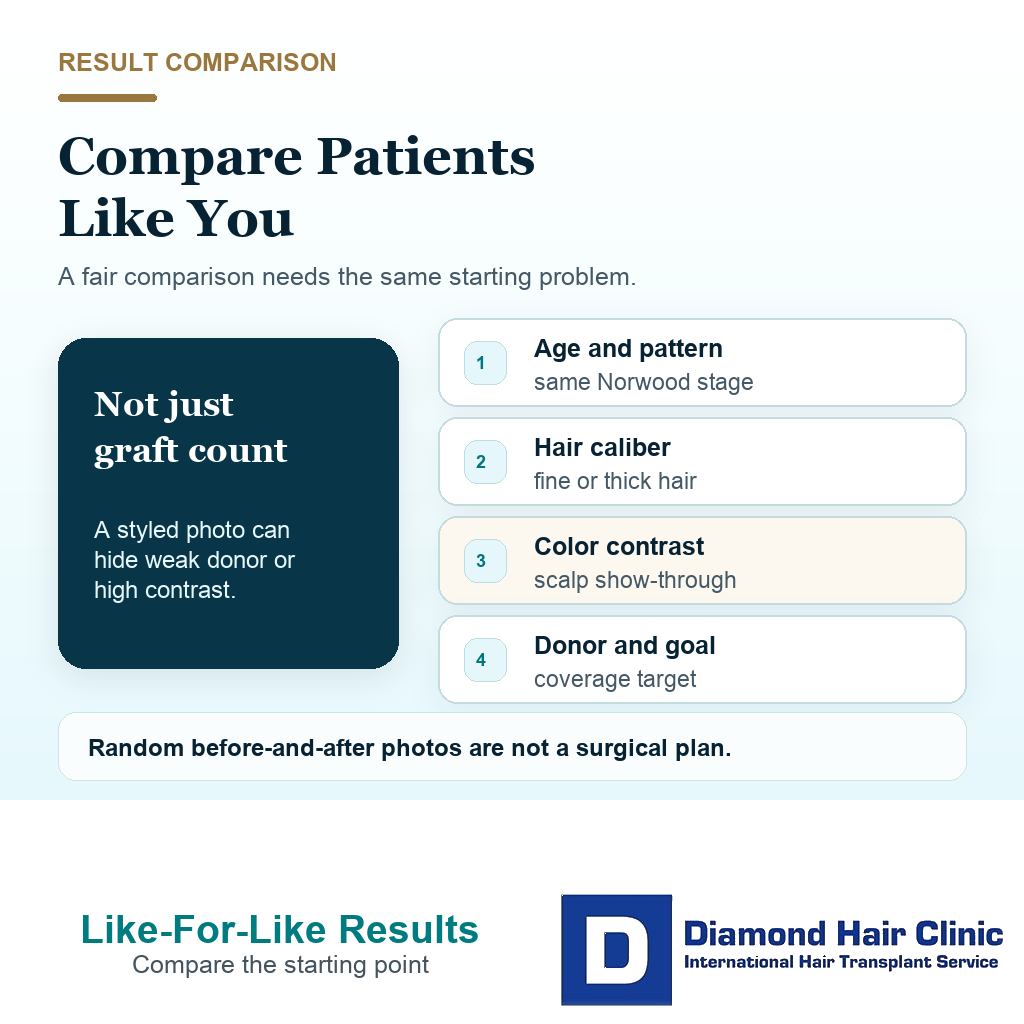
Patients in their 40s or 50s should compare results by starting pattern, hair quality, contrast, donor strength, and coverage goal.
Shaving, SMP, or no surgery as wiser choices
Sometimes the better medical decision is not another procedure. If the donor area is weak, the bald area is very large, you want full density everywhere, or health is not stable, shaving, scalp micropigmentation, or doing nothing can be wiser than a transplant that overpromises. A transplant should improve the situation, not trap you into a donor problem.
Scalp micropigmentation with hair transplant results can be useful in selected cases, especially when the goal is the look of density or a short hair appearance. It does not replace hair, but it can reduce contrast and help some patients avoid chasing unsafe graft numbers.
Some people are better served by accepting a shaved style. If you are considering whether to shave your head after a hair transplant, the decision should include donor scarring risk, FUE extraction visibility, head shape, and how much surgery has already been done. No surgery is better than surgery that spends donor hair without a durable plan.
In your 40s or 50s, the untreated areas matter
For an overseas patient, the useful preoperative record is not one flattering selfie. I need to understand the hairline, temples, middle scalp, crown, donor back and sides, any scar, and any area that still looks unstable under normal light.
The medical record matters just as much. Age alone rarely blocks surgery, but blood pressure treatment, blood thinners, diabetes medicines, sleep apnea, previous operations, and hair loss treatments can change the size or timing of the procedure. Include prescriptions, pharmacy products, supplements, herbal products, and topical or oral hair loss medication.
The recommendation should be specific about restraint. In some patients the recommendation may be a normal procedure. In others, it may be a smaller design, medical clearance first, or no surgery. What I refuse to treat is as important as what I agree to treat, because the donor area has to serve the patient for the rest of life.
Read this review excerpt
He was very thorough in every little detail and I never felt pressure to do anything I wasn’t sure of.