


The Hair Transplant Operation Report Should Be More Than a Graft Number
If you leave surgery with only a graft number, a later review begins with a gap. A useful hair transplant operation report should show what was agreed before surgery, what was actually done, where the grafts were used, who performed the key steps, and which follow-up instructions changed your care. It helps later review, but it does not prove final graft survival by itself.
I look at this record as the clinical memory of the operation. It is most useful while the details are still fresh at the clinic or in the first days after surgery, before photos, messages, and memory become scattered. It should be clear enough that another serious hair transplant surgeon can understand the starting point without guessing from one number or a few swollen postoperative photos.
Detailed photos can support the record, but they should not replace the dated surgical record. If a later question appears, the written report is what explains the treated zones, graft handling, plan changes, and follow-up instructions without rebuilding the story from images. Screenshots of clinic messages can help, but the report should put the treated zones and changes in one dated place. If the result later looks thin, the report should help show whether the top was intentionally left lighter or whether the placed area underperformed. Copies of the clinic’s standardized preoperative and immediate postoperative photographs should be in your file before departure. They give later follow-up and any second opinion a baseline that phone pictures may not reproduce.
First separate the plan from what actually happened
The record has to separate three moments that are often blurred together. There is the plan you agreed to before surgery, the surgery that was actually performed, and the follow-up advice you were given after leaving the clinic. If those are mixed into one vague note, later review becomes much weaker.
For example, the plan may have said frontal hairline and mid scalp reinforcement. The operation may have placed fewer grafts in one area because donor conditions changed during extraction. The follow-up advice may have added a warning about swelling, bleeding, or medication timing. Those facts are related, but they are not the same fact.
The record also connects back to the purpose of preoperative documents and the final plan review before consent. A consent form helps record what was discussed and agreed before the operation. An operation report should show what happened during and immediately after it.
Keep the consent and report together. Your copy needs the final consent you signed, any surgery day revision, and an operation report describing the plan actually carried out. Changes to the graft range, treated area, fee, or surgical roles belong in both records. A later clinician should not have to reconstruct them from messages.
The report does not need to be long. It needs to be specific, dated, and practical. A simple request is enough. “Could you please send me my operation report with the graft count breakdown, treated areas, donor notes, surgical roles, medication notes if relevant, photos, and follow-up instructions?” That is not an accusation. It is a normal medical record request.
A clear preoperative record makes the report stronger. If the in person examination changes the graft number, hairline, crown priority, or donor limit, the reason should appear later in the file so another surgeon is not forced to guess what changed.
A graft number only helps when I know what was counted
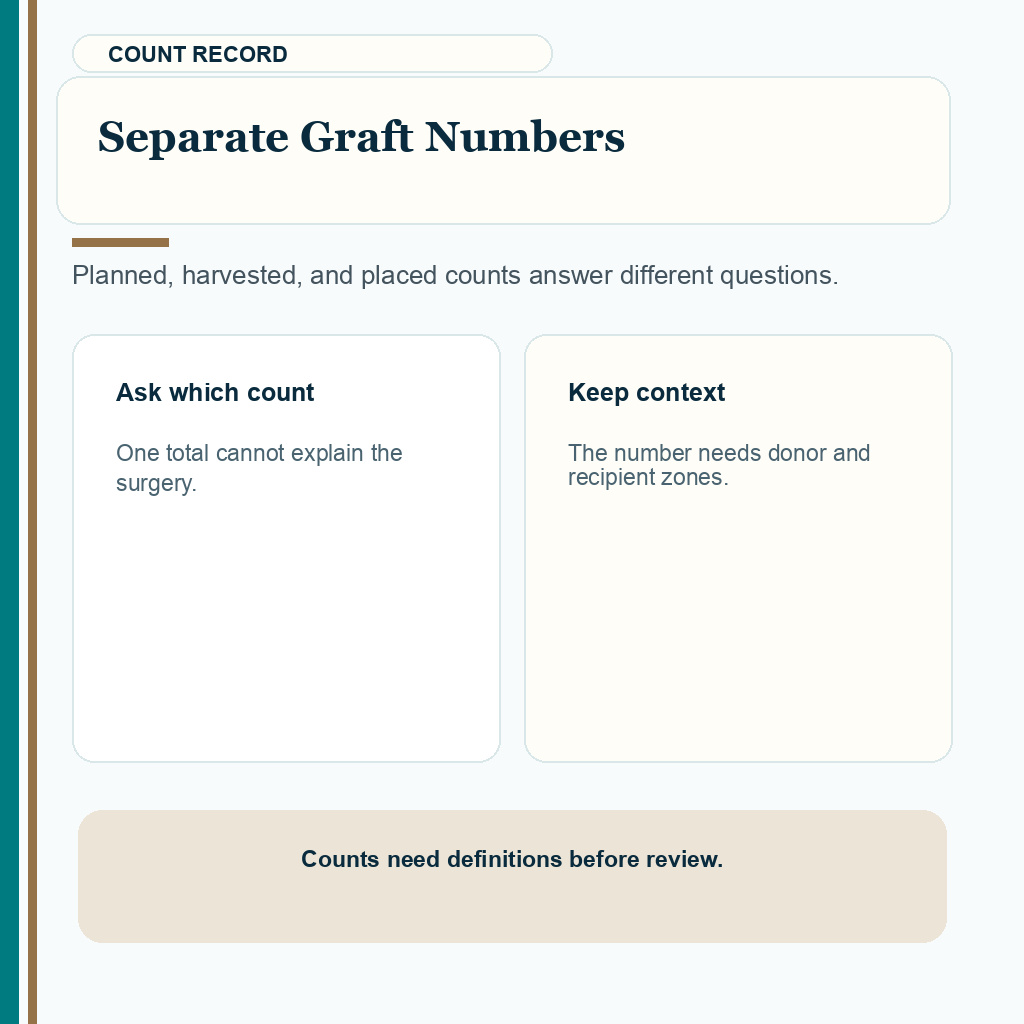
A single graft number is rarely enough. Patients often tell me, “They said I received 4,000 grafts.” My next question is usually what that number means. Was it the planned number, the harvested number, the prepared number, or the placed number?
A total needs a definition before it becomes useful. A planned number is a target. A harvested number describes what came out of the donor area. A prepared number may be affected by graft quality and trimming. A placed number describes what entered the recipient area. When possible, the record should also separate single-hair grafts from double- and triple-hair grafts by zone, because a graft count is not the same as a hair count. In a clean report, these numbers do not need to be hidden behind one impressive total.
When the clinic has measured the recipient area, keep the area size and intended graft density for each zone with the placed counts. This helps a later review distinguish a small dense target from lighter coverage spread across a wider area.
If you try to count grafts from photos, treat the count as a question for the record, not as a replacement for it. A useful report should make the photo estimate easier to check or correct. The record should clarify harvested, prepared, and placed grafts before anxiety becomes the only version of the story.
In a donor area photo, extraction sites may seem to outnumber the placed graft total. Do not turn that impression into a diagnosis or an exact count. Check whether the report separates successful graft harvests from total punch insertions or punch attempts. Those figures can differ, and the record should explain what happened between donor excision and recipient placement.
If harvested, prepared, and placed totals do not match, the report should show how many grafts were not implanted and the recorded reason. Transection, damage, poor quality, or another documented finding should not disappear inside one final number. That reconciliation helps a later surgeon review donor use without reconstructing the operation from photographs alone.

A useful operation report separates the plan, what left the donor area, what entered each recipient area, and what the record cannot prove by itself.
This is also where patients should avoid false certainty. A written number can support later review, but it cannot prove final growth, density, or survival. Healing, shedding, growth cycles, placement angle, graft handling, donor quality, and time all affect what the result eventually looks like.
If the number is important to you, read it alongside how graft numbers can be verified and why graft numbers can differ. A stronger record answers what was counted, where it was placed, and why that distribution made clinical sense.
Donor and recipient details make the record useful later
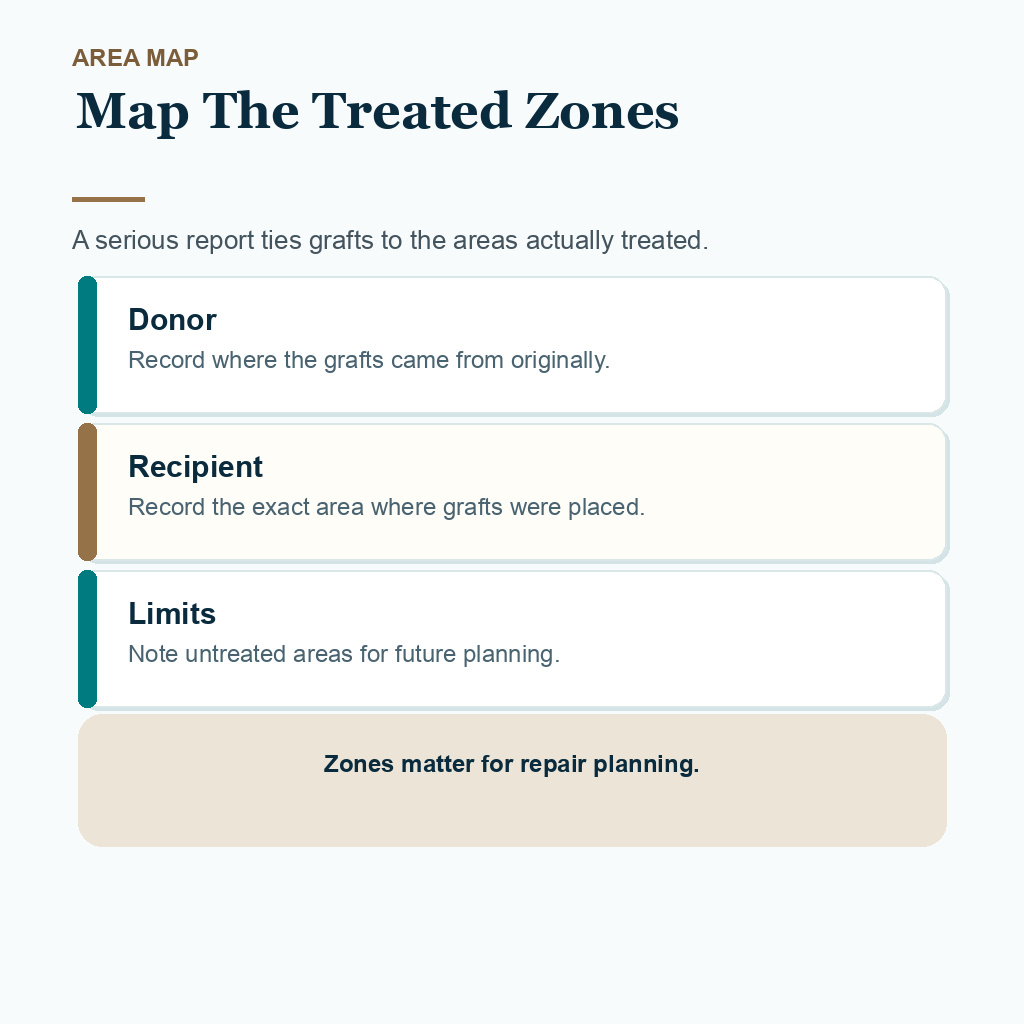
A later surgeon needs to know where the grafts came from and where they went. “FUE, 3,800 grafts” is not enough when the patient returns with donor thinning, an unnatural hairline, a crown that still looks weak, or a repair question.
During a later repair review, every plan change needs its reason. Fewer grafts in one zone or a reduced crown target can be a donor protection choice rather than a mistake.
The report should name the donor zone used, any donor warnings observed during surgery, and any contribution from beard or body hair. It should describe the recipient areas in practical language, such as frontal hairline, temples, mid scalp, crown, scar, beard graft contribution, or another specific area. If a section was intentionally left untreated, that should be easy to understand too. For FUT, I also want the length and width of the donor strip, the closure method, and dated donor wound photos before bandaging when available. Those details let a later surgeon compare the original donor procedure with the healed scar instead of estimating the strip from a current photo.
If your position changed during the operation, the report should record that too. It should note when you were face down, on your side, reclined, or seated, and which donor zones could be reached in each position. It should also record whether the extraction map or treated area changed after you were repositioned. When an operation runs over more than one day, keep that sequence separate for each day. Your position by itself does not judge the technique. Recording it simply helps a later surgeon reconstruct the workflow without guessing from photographs.
Good documentation also helps protect donor planning. If a patient later considers another procedure, the surgeon should not have to guess whether the first operation stayed within the donor zone selected as safest for that patient, went beyond it, or mixed donor sources without a clear reason. A donor record before another surgery can become more important than the old marketing promise.
If the report includes an estimate of remaining donor capacity, keep the date and basis of that assessment with it. It is a planning estimate, not a guaranteed balance of grafts available for another operation.
Photos can help here, but the written record should still carry the surgical meaning. A photo may show the scalp. It may not show why a density choice was made, how many grafts were placed in a zone, or whether donor limitations changed the plan during surgery.
Surgical roles are clinical information, not gossip
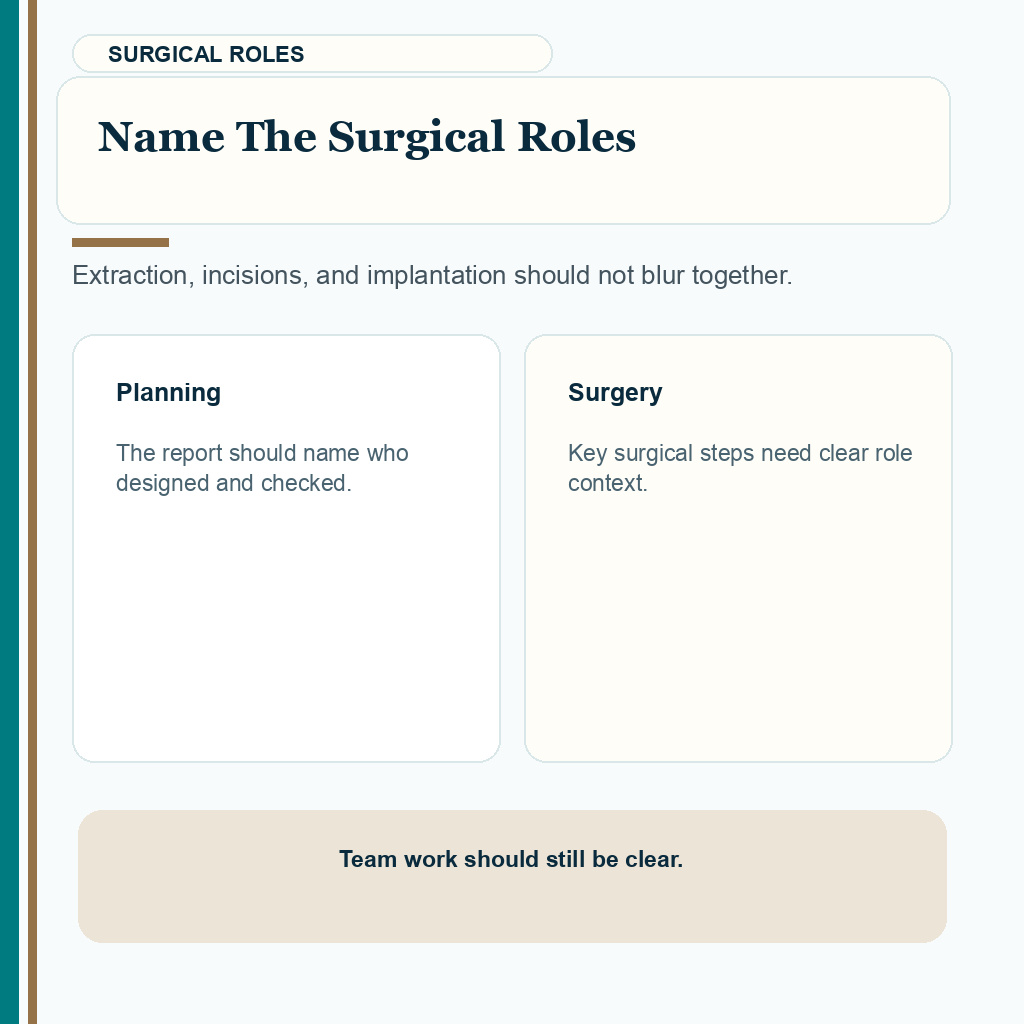
Hair transplantation is teamwork, but the record should not blur the key surgical roles. Planning, hairline design, extraction, creating the recipient area incisions, implantation, anesthesia monitoring, and final checks are not interchangeable tasks.
I do not ask who did each step to blame someone. I ask because each step affects a different part of the result. A low hairline is a planning question. A donor area that looks depleted is an extraction question. Wrong graft direction can involve recipient area planning and implantation control.
The record check applies when you review surgeon involvement in the surgical plan or ask who performs each surgical step. A record that says only “team performed procedure” leaves too much clinical meaning outside the file.
Clear roles do not need to become an accusation against another clinic. They simply make later review more precise. A role record shows responsibility on paper. It helps clinical review, but it does not prove by itself that every technical decision was correct.
If the surgical plan changes after the operation has started, the report should explain the reason, the corrected area, any extra grafts used, who approved the change, and whether follow-up instructions changed. Without that record, a later review has to guess whether the concern is design, placement, healing, or communication. A crown or temple change should not disappear inside one total number.
Medication, anesthesia, and reaction notes belong in the file
Most hair transplant patients focus on grafts and photos, but medication and anesthesia notes can matter later. The record should preserve relevant local anesthesia or sedation details, medication timing, dose and route when documented, monitoring notes, known allergies, unusual bleeding, faintness, nausea, strong swelling, or any reaction that changed follow-up advice.
This does not mean you should interpret the medication record yourself. Medication decisions still belong with the doctor who is reviewing you. The point is that the doctor should not have to work from memory alone. If a patient felt unwell during surgery, had a reaction after medication, or was told to avoid a drug after leaving, that belongs in the file.
The safest record is useful to another doctor, not only reassuring to the patient. Time, dose, route, response, and follow-up advice can matter when a later symptom needs interpretation. They can also prevent a repeated mistake if the patient needs another procedure.
If you are worried about pain, swelling, dizziness, bleeding, allergy symptoms, or medication side effects, you should contact the treating clinic or a qualified doctor. The operation report helps that conversation, but it does not replace medical assessment.
Photos help only when timing and angles are clear
Photos are valuable when they are tied to timing and position. Design photos before surgery, immediate recipient photos, donor area photos, and early follow-up photos can help a later surgeon understand the starting point. They are much weaker if the light, angle, hair length, or timing is unclear.
A good photo set does not need to be artistic. It needs to be consistent. Keep photos dated and comparable, with the same room or similar light when possible, the same distance, similar hair length, and clear front, top, crown, side, donor, and hairline views when relevant. Identifiable photos, operation reports, and medication details should be shared privately with the treating clinic or doctor, not posted publicly for crowd judgment.
Before you leave the clinic, keep these record details together.
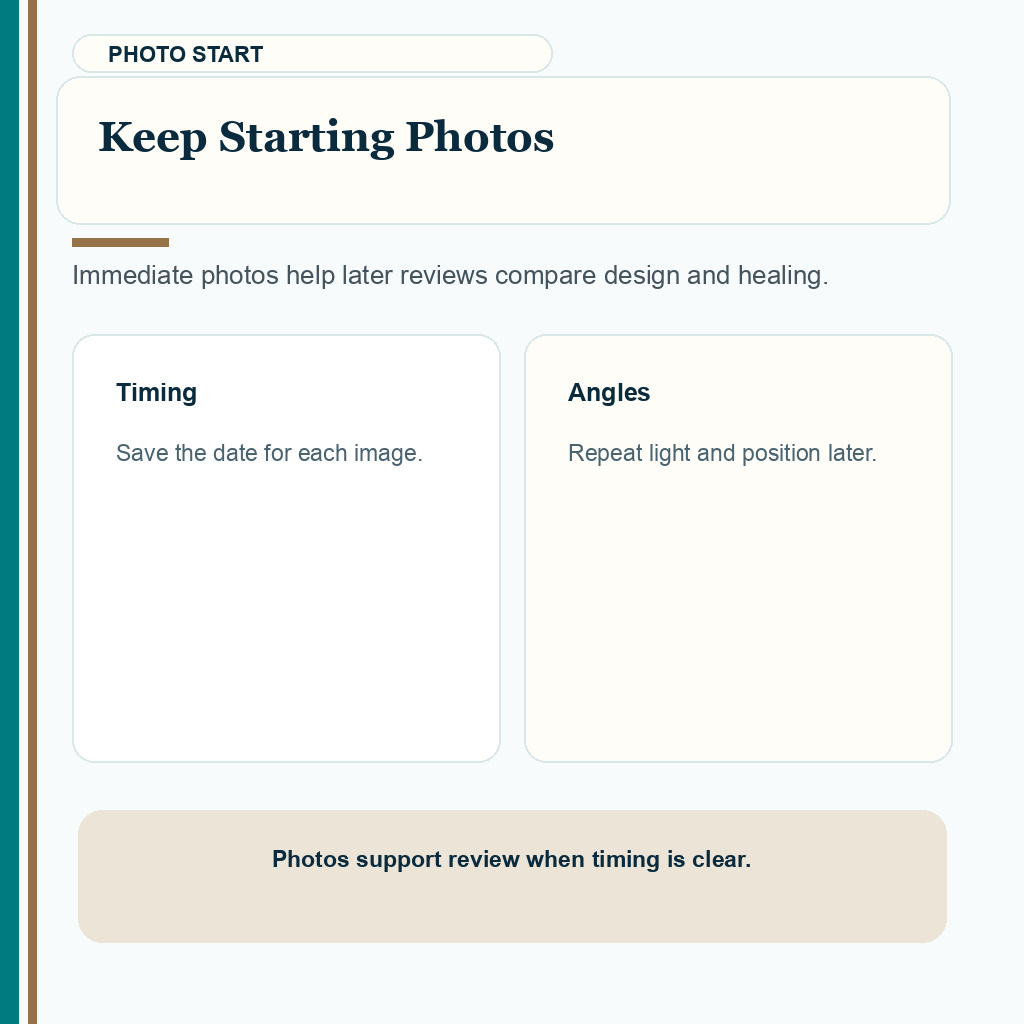
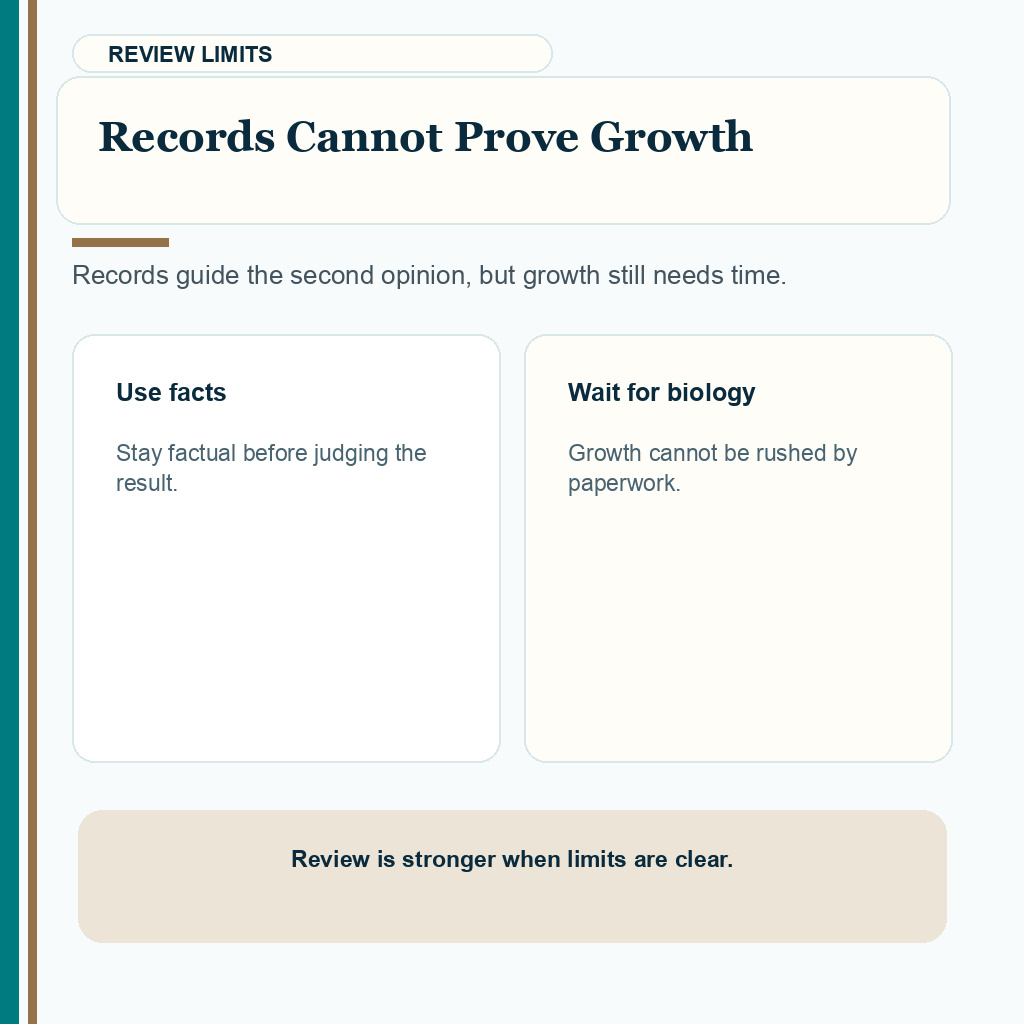
Still, photos have limits. They cannot count every graft with certainty. They cannot show microscopic graft handling. They cannot prove final growth before enough time has passed. They are evidence, not the whole case.
The report and photos should travel together. The written record explains the surgical facts. The photos show the visual starting point. When those two pieces agree, second opinion review becomes more grounded. When they conflict, the contradiction itself becomes something to clarify.
If the report is written in another language, keep the original version with any translation. A later surgeon needs the clinic’s own wording, not only a summary rewritten for travel, insurance, or online advice.
An unreadable handwritten operation report needs a typed transcription kept beside the original. A later message with a different graft total also needs a dated explanation of what each number represents and which figure is correct. Keeping that clarification with the earlier report lets another surgeon follow the record without losing its history.
If the report is missing, rebuild the evidence before judging
A missing report does not make a second opinion useless. It means I have to rely more on current scalp examination, dated photos, prescriptions, messages, and your plain timeline. I can still assess the donor area and hairline, but I should be clear about what I cannot know from memory alone.
Your record changes the strength of a second opinion
Choose the situation closest to yours. Each one changes how much weight the report carries before a second opinion.
Complete report
The report gives a second opinion surgeon a clear starting point, especially when photos and follow-up notes match the written facts.
Count only
A total alone does not show whether the number was planned, harvested, prepared, or placed.
Photos only
Images can show design and healing, but they cannot replace the written surgical facts.
No report
The second opinion may rely more heavily on current donor examination, photos, prescriptions, and dated messages.
Contradictory details
A contradiction may be a documentation error, a misunderstanding, or a true surgical mismatch.
A complete report gives the strongest context when a second opinion is needed because the surgeon can compare the record with the current scalp. A graft count alone is weaker but still useful if it can be clarified. Photos without a written report need timing notes. A missing report means the later surgeon must lean more on examination and reconstruction. Contradictory details should be clarified in writing before anyone makes a repair decision.
Documentation changes the quality of the review, not the biology of growth. Weak records leave more uncertainty. Strong records do not guarantee a perfect outcome.
Ask for the record before memories fade
The best time to get the report is soon after surgery, before follow-up messages become scattered. A useful record includes the graft breakdown, treated areas, donor notes, key roles, medication or anesthesia notes when relevant, immediate photos, and follow-up instructions, not only one total number.
Then keep the record in one place. Save the PDF or document, dated photos, prescriptions, washing instructions, and any follow-up messages that changed your care. If you travel home after surgery, do not leave the record spread across photos, WhatsApp messages, and memory.
The report should help you think clearly, not make you suspicious of every detail. Incomplete details are best clarified in writing. If a symptom worries you, talk to a qualified doctor. If a result later needs review, bring the record, current photos, and a plain timeline instead of filling gaps with guesses.
A hair transplant operation report is not only paperwork. It is the bridge between what was planned, what was done, and what another surgeon can responsibly understand later. Hair transplant follow-up after surgery also works better when the clinical record is specific from the beginning. When something is missing, say it is missing. That clarity protects the next decision.

Read this review excerpt
told me the quality of my donor hair and what he could take out and advised me what will the be best outcome with what donor hair I had.