


Mirror Checking Can Make Normal Recovery Feel Worse
After a hair transplant, the mirror can become a second clinic. You wake up, check the hairline, open the bathroom light, look again under a stronger light, take a phone photo, zoom in, compare it with yesterday, and then feel worse. I understand why this happens. You invested money, time, travel, pain, and hope. You want proof that the grafts are safe and that growth is moving in the right direction.
Daily mirror checking often creates the wrong kind of signal. It magnifies swelling, redness, scabs, shedding, uneven lighting, wet hair, short hair length, and normal early asymmetry. It can turn a normal recovery phase into a new fear every morning. A mirror is useful for safety checks, not for judging final density. The better method is a structured photo routine, clear warning signs, and review by milestone.
I am not asking you to ignore your scalp. I am asking you to separate useful observation from checking that feeds anxiety. There is a difference between noticing a change that needs medical review and checking so often that the same scalp looks different five times in one day.
Mirror checking feels worse after surgery
Mirror checking feels worse after surgery because the scalp is changing faster than your brain can interpret it. In the first days, swelling moves. Scabs darken. Redness changes with heat and washing. The hairline looks sharp one hour and uneven the next because crusts, hairs, and skin tension do not sit the same way all day. Later, transplanted hairs shed, native hairs can look thinner, and the ugly duckling phase can make the operation look worse before it looks better.
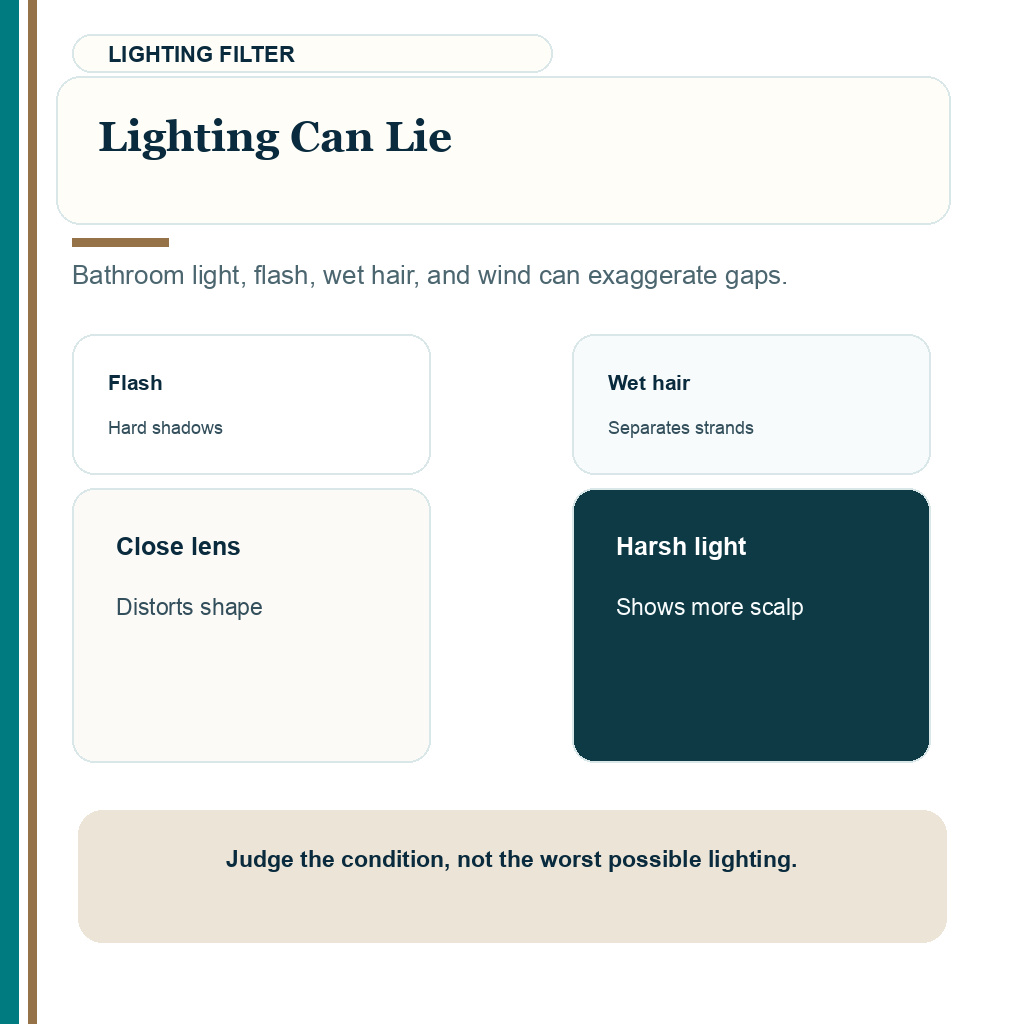
Phone cameras add another layer. A selfie lens distorts distance. A bathroom spotlight shows scalp through short hair. A wet hair photo separates strands and exaggerates see through areas. A flash photo can make the recipient area look harsher than it appears in normal life. If you judge recovery from these changing conditions, you are not judging the transplant. You are judging the lighting, hair length, camera distance, and your anxiety at that moment.
That pattern overlaps with the emotional side of recovery. The emotional crash after hair transplant recovery is the heavier version of that mood swing, when normal uncertainty starts to affect sleep, mood, and daily function. Here I am focusing on the checking routine itself, so you know what to look for, when to take photos, and when to stop looking.
What to check in the first two weeks?
During the first two weeks, the mirror is mainly for healing and safety. You are not judging density. You are checking whether the grafted area is staying clean, whether swelling is moving as expected, whether scabs are softening, and whether any symptom looks outside the normal healing range given by your clinic.
Useful checks are brief. Look at the recipient area, donor area, and forehead once or twice a day under normal room light. Looking is different from touching. Do not rub, lift scabs, part the grafts repeatedly, or pull at hairs to prove they are secure. If that is the worry, the safer question is about touching grafts after a hair transplant, not density. Ask yourself whether there is active bleeding, spreading redness, increasing pain, thick discharge, fever, a bad smell, or swelling that is getting worse instead of moving down. When those signs are absent, extra checking adds stress rather than knowledge.
Early photographs can help if they are taken calmly. Day one hair transplant photos are useful as a record of placement, but they can mislead if you treat them as proof of final density. The first look after surgery is a healing record, not the final result.
Safer photo schedule
For most patients, daily progress photos are too frequent. They create a large pile of images with very little real change between them. Then you start searching for tiny differences. One side looks darker, one corner seems thinner, one scab fell earlier, or one angle looks worse. The emotional cost becomes higher than the clinical value.
Take recovery photos on a schedule. In the first two weeks, your clinic may ask for specific check photos. Follow that instruction. Photos requested by the clinic are different from daily density photos taken for reassurance. After the initial healing period, once or twice a week is enough unless a symptom appears. From month two onward, monthly comparison photographs are often more useful than daily pictures because hair growth changes slowly. After the planned set is taken, close the camera. If there is no new warning sign, extra photos usually add emotion rather than information.
Use the same place, same camera, same distance, same hair condition, and same lighting. Take front, left, right, top, donor, and crown views if the crown was involved. Use the same lens when possible and avoid changing between a close selfie lens and a farther rear camera view. Label the date or month instead of relying on memory. Do not mix wet hair one day and dry styled hair the next, then panic about the difference. Turn off beauty filters, portrait blur, sharpening, and automatic color changes if your phone allows it. A controlled set of photos is a medical record. A random set of anxious screenshots is often a stress loop.
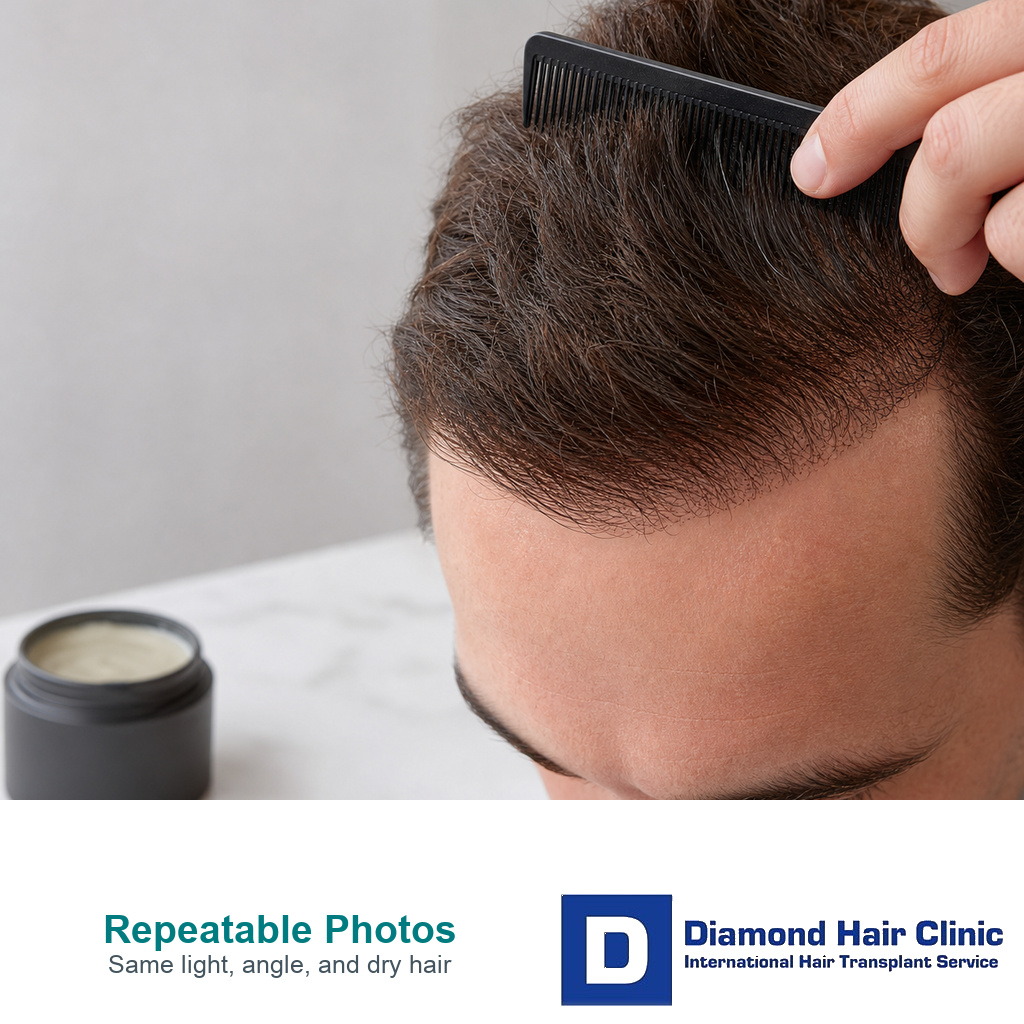
Useful recovery photos keep the same lighting, camera distance, and hair condition so small changes are easier to interpret.
Photos that help a surgeon review recovery
The most helpful photos are boring. They do not use dramatic lighting, filters, extreme zoom, wet styling, hairline measuring apps, or unusual angles. They show the scalp clearly and repeat the same conditions over time. A surgeon reviewing recovery needs a consistent pattern, not the harshest possible image.
For the hairline, stand straight, keep the camera level, and show the face and forehead rather than only a cropped close up of grafts. A front view and a top view can answer different questions. The front view shows how the hairline frames the face, brow level, and temple corners. The top view can help show distribution and hair direction, but it should not be used alone to decide whether one side is truly lower. If the views do not match, repeat the set before making it a verdict. For the top view, keep the camera above the head without tilting it so much that one side stretches. For the donor area, use normal light and enough hair separation to show whether healing is even. For the crown, use the same hair length and dry condition when possible. If the worry is specifically one side of the hairline, the next question is whether you are judging design or growth timing. Compare the pattern with uneven hairline after a hair transplant and what month three FUE growth can and cannot show instead of measuring the same corner all day. If that exact mismatch keeps triggering anxiety, a front versus top view hairline check can separate design, timing, and camera distortion before the mirror starts driving the decision.
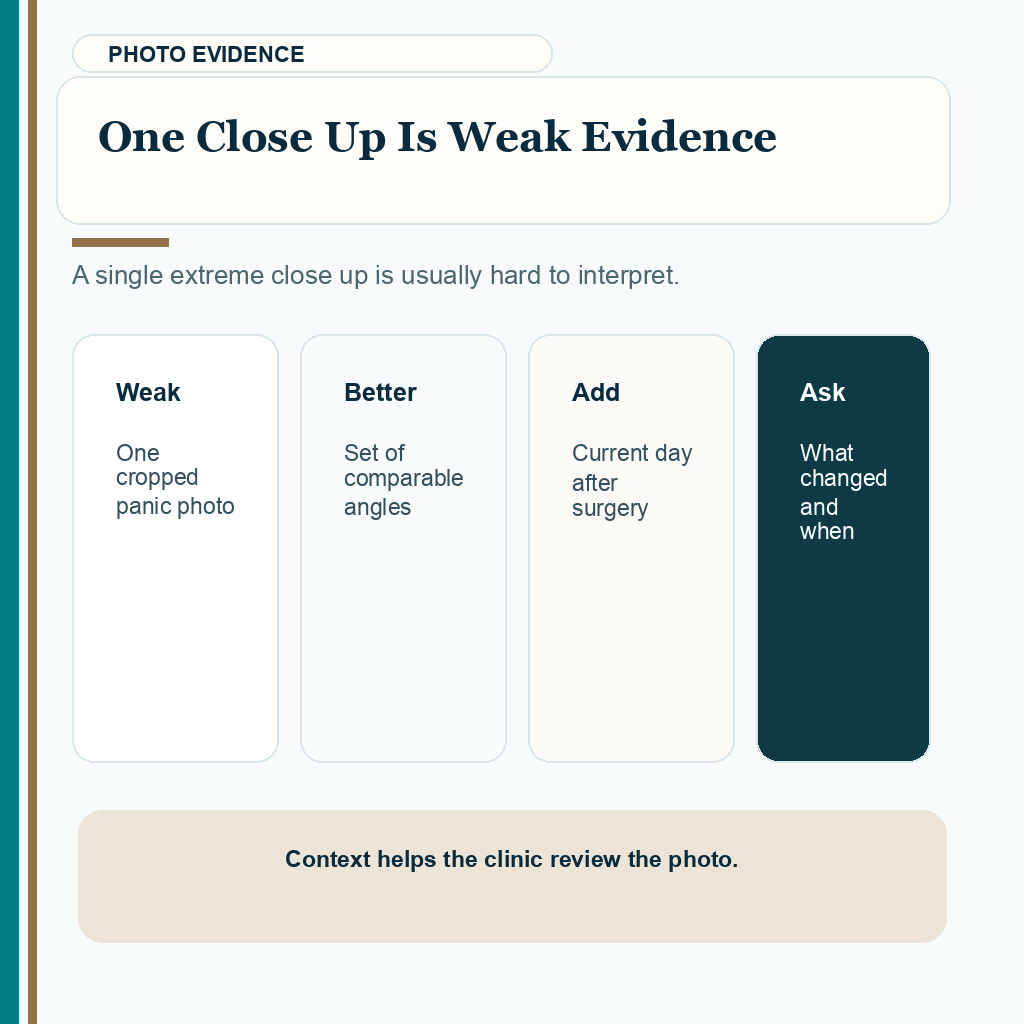
If you are sending photos because something worries you, include one close photo and one wider photo. The close photo shows the detail. The wider photo gives context. A zoomed image without context can exaggerate a harmless detail. This matters before surgery too, when a clinic tries to create a full hair transplant plan from photos. Images can guide the discussion, but they do not replace clinical judgment.
Lighting can make early recovery look worse
Lighting can make a recovery look worse at almost every stage. Bright overhead bathroom light exposes the scalp between short hairs. A flash bounces off oil and redness. Wet hair separates into lines and shows more scalp. Wind lifts hair in a way that reveals direction and gaps. Very short hair after shedding can make the recipient area look empty even when the follicles are resting under the skin.
These images may feel truthful because they are sharp, but sharp does not always mean clinically fair. What matters is whether the lighting reflects how people normally see you and whether it matches your previous comparison photos. If every check is done under the harshest condition you can find, the mirror becomes a test you are designed to fail.
There is still value in seeing the hair under difficult conditions after growth has matured. A natural result should not only look good in one flattering photograph. Early recovery and harsh light, wind, and wet hair after hair transplant are different discussions.
Changes that matter more than daily density
Daily density is the least reliable early measure. During the first months, I look at different signals. Is the recipient area healing without spreading redness or discharge? Is the donor area closing and becoming less tender? Are scabs clearing without aggressive picking? Is swelling reducing? Is pain improving? Are pimples, crusting, or odor staying within the guidance your clinic gave you?
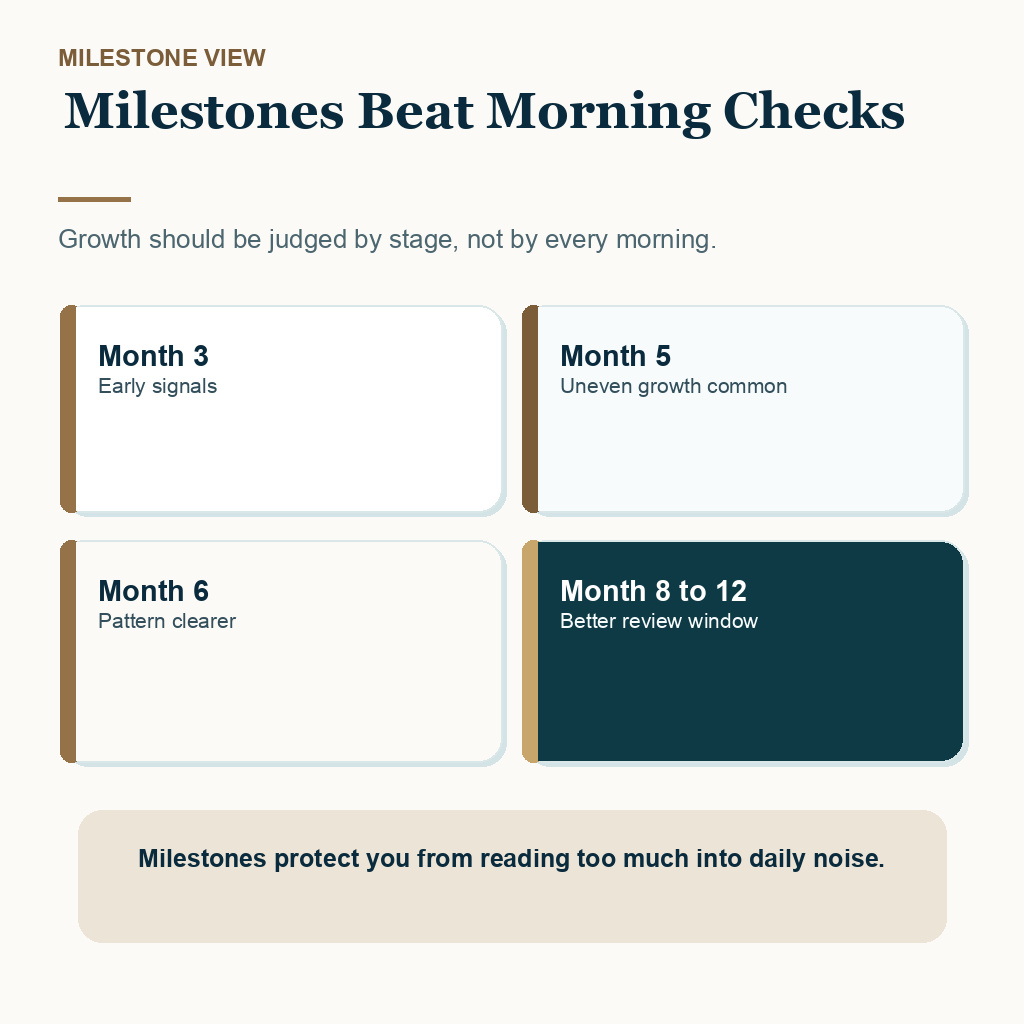
After shedding, the key signal is pattern over time. At month three, early hairs may start. At month five, there may be visible growth but unevenness is common. At six months, pattern becomes more meaningful, but it is still not final. At eight months, hairline direction, density lag, and design concerns can be judged more clearly. Around one year, the result is much closer to final review.
Those milestones are more useful than daily mirror checks. If you are in the middle phase, compare with the month five growth check, the six month density check, the month eight hairline check, and one year after FUE. Milestones protect you from reading too much into daily noise. Once your planned follow-up is complete and comparable photos document a mature result you are satisfied with, routine progress tracking can end. Keep the final standardized set as a baseline instead of searching for a new verdict every day. Reopen the comparison only if a change persists across repeated photos taken the same way, or if a new symptom needs review.
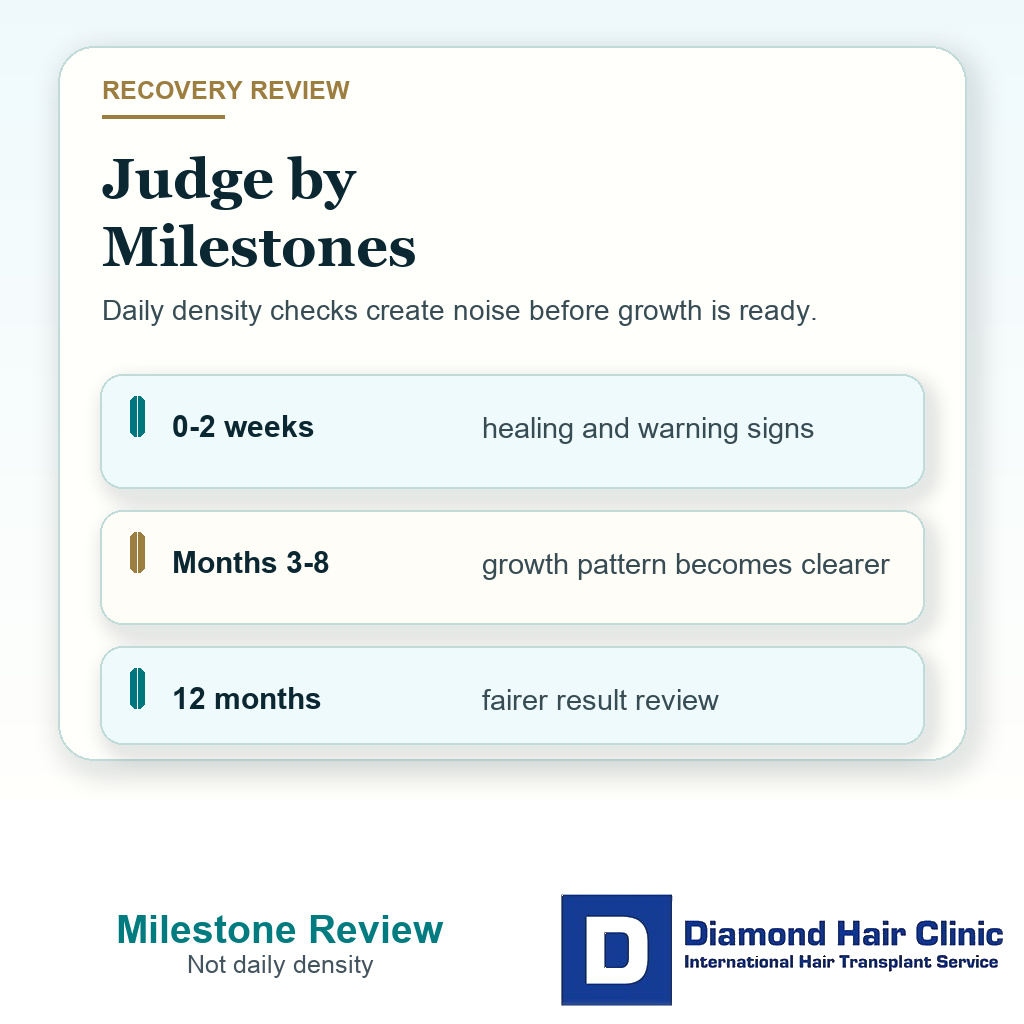
Milestone comparison is more useful than daily density checking because healing, shedding, and early growth change slowly.
Use these slides to separate safety checks, photo routine, lighting distortion, warning signs, milestone review, and when to step away.
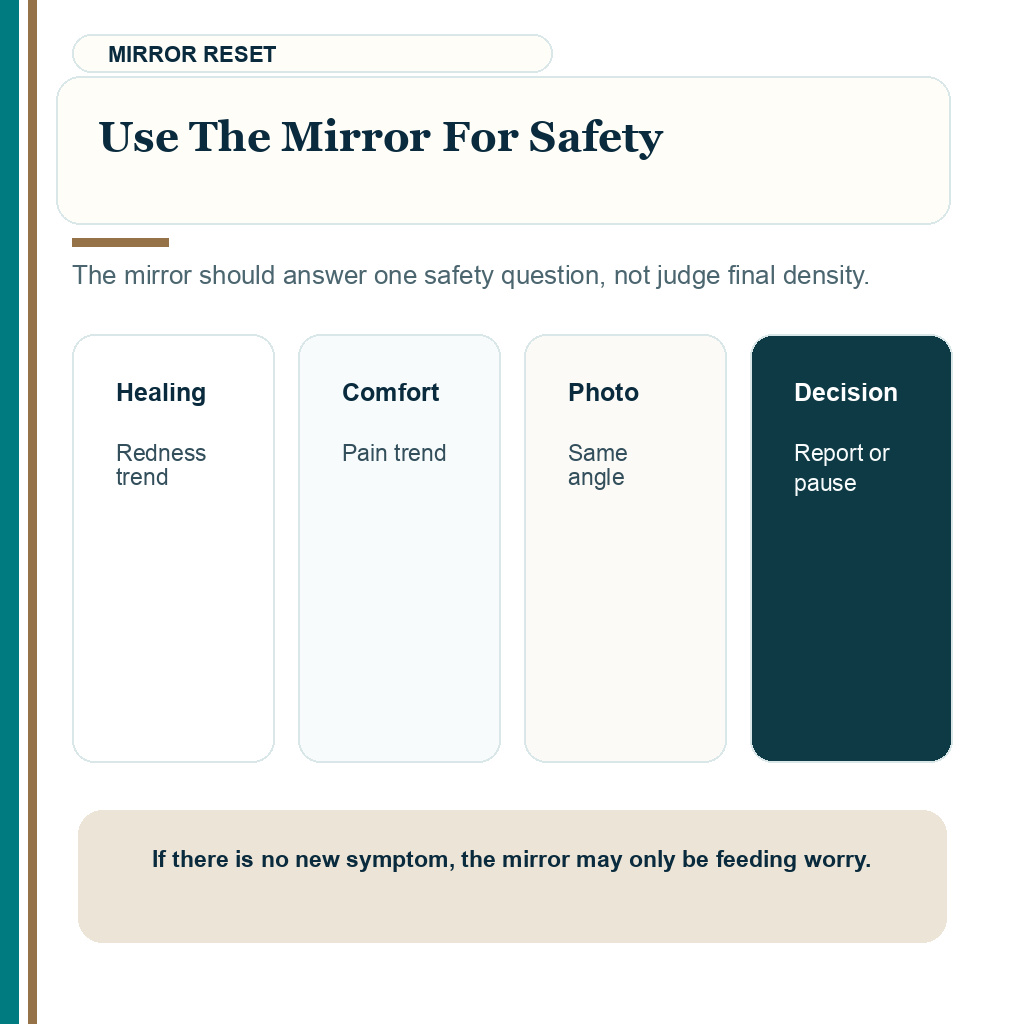


Message the clinic instead of checking again
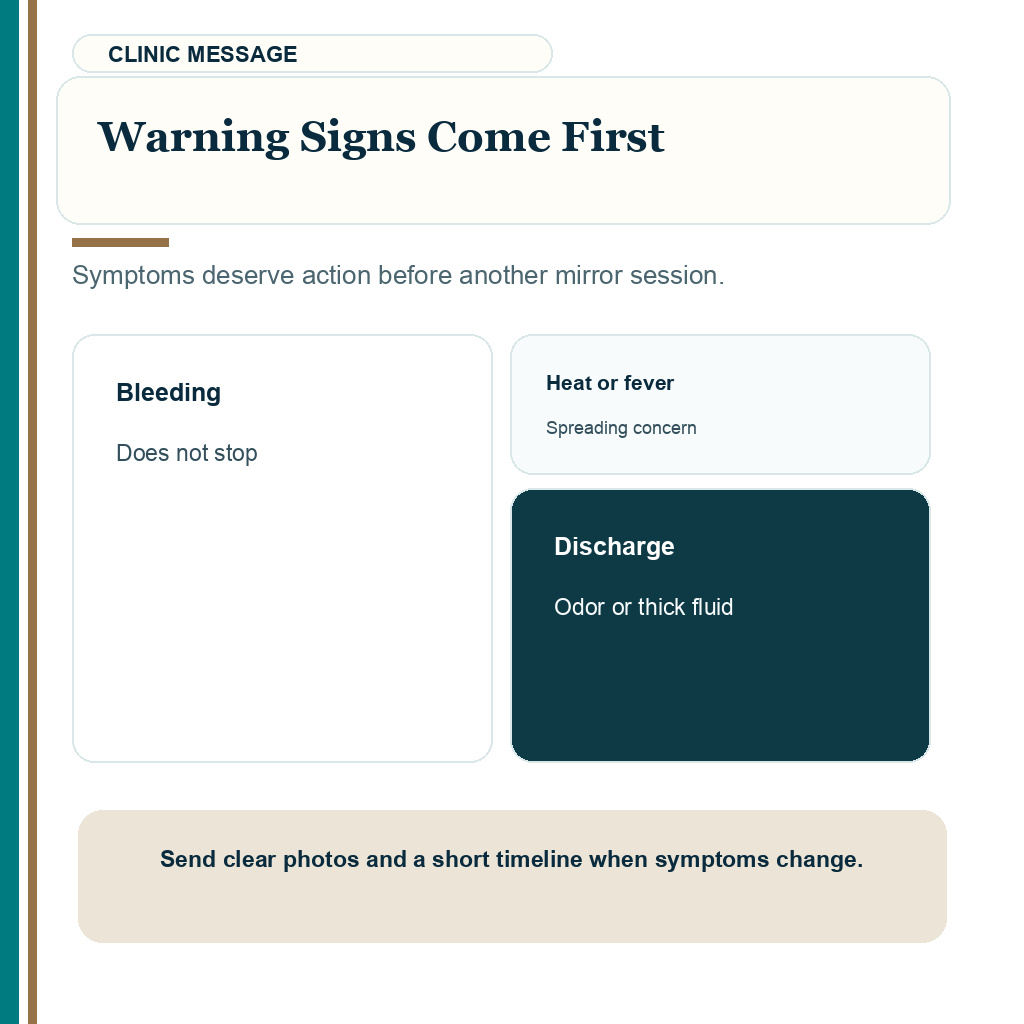
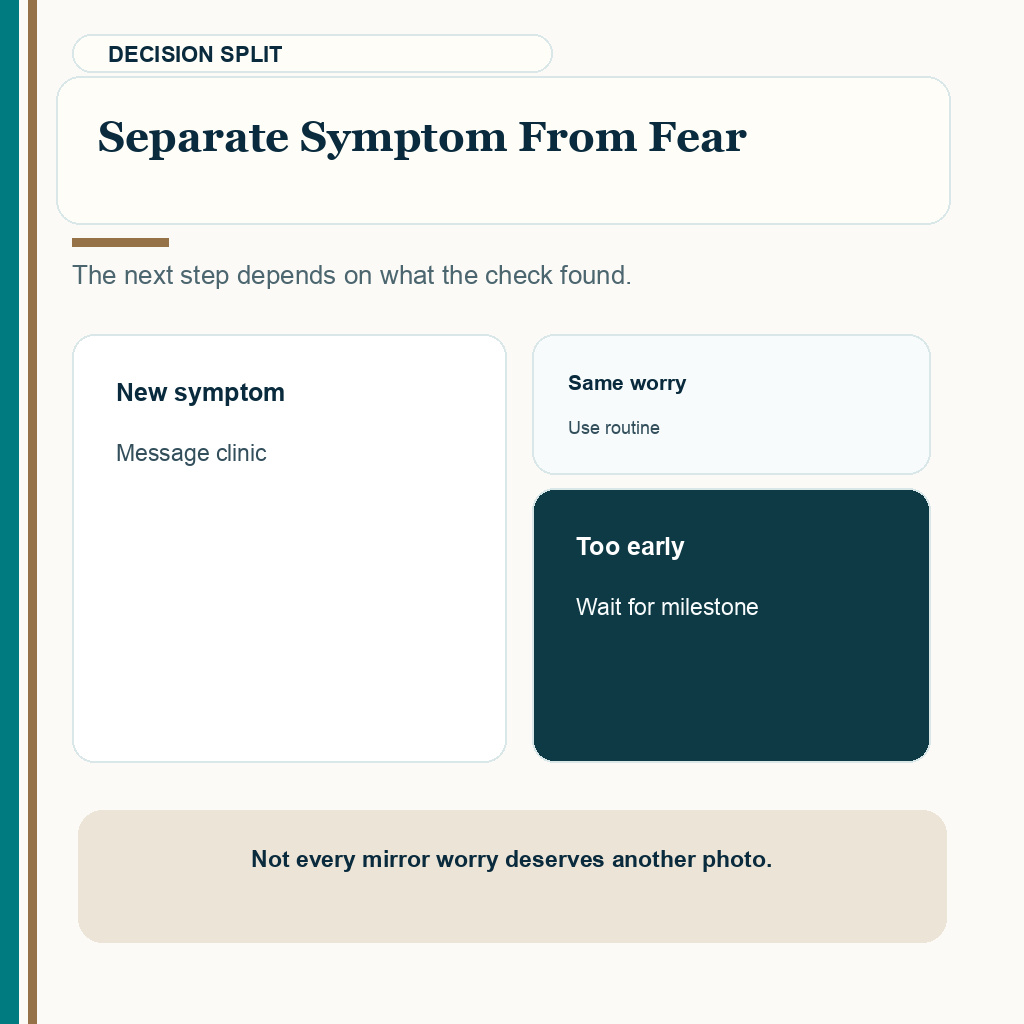
Message the clinic when a new symptom needs a medical answer. Concerns about hairline shape or density that persist in comparable photographs also deserve a planned review, not repeated mirror checking. Contact is appropriate if you see active bleeding that does not stop with the clinic’s instructions, worsening pain, fever, spreading heat or redness, thick yellow discharge, a strong odor, sudden swelling that is increasing, trauma to the grafts, or a donor area change that looks sharply different from the surrounding skin.
Send clear photos with a short timeline that includes the surgery date, current day after surgery, medication taken, washing status, symptom start time, pain level, and whether fever is present. That timeline helps the clinic evaluate the photos. A message that says “Does this look bad?” with one extreme close up is harder to interpret.
If you notice fluid, odor, fever, or unusual swelling, do not spend the day comparing old pictures. Read the relevant safety guidance and contact your clinic. Examples include yellow scalp fluid after FUE, scalp odor during FUE recovery, and after FUE fever. Symptoms deserve action. Review density and design concerns with your surgical team at the right stage.
Handling anxiety during the ugly duckling stage
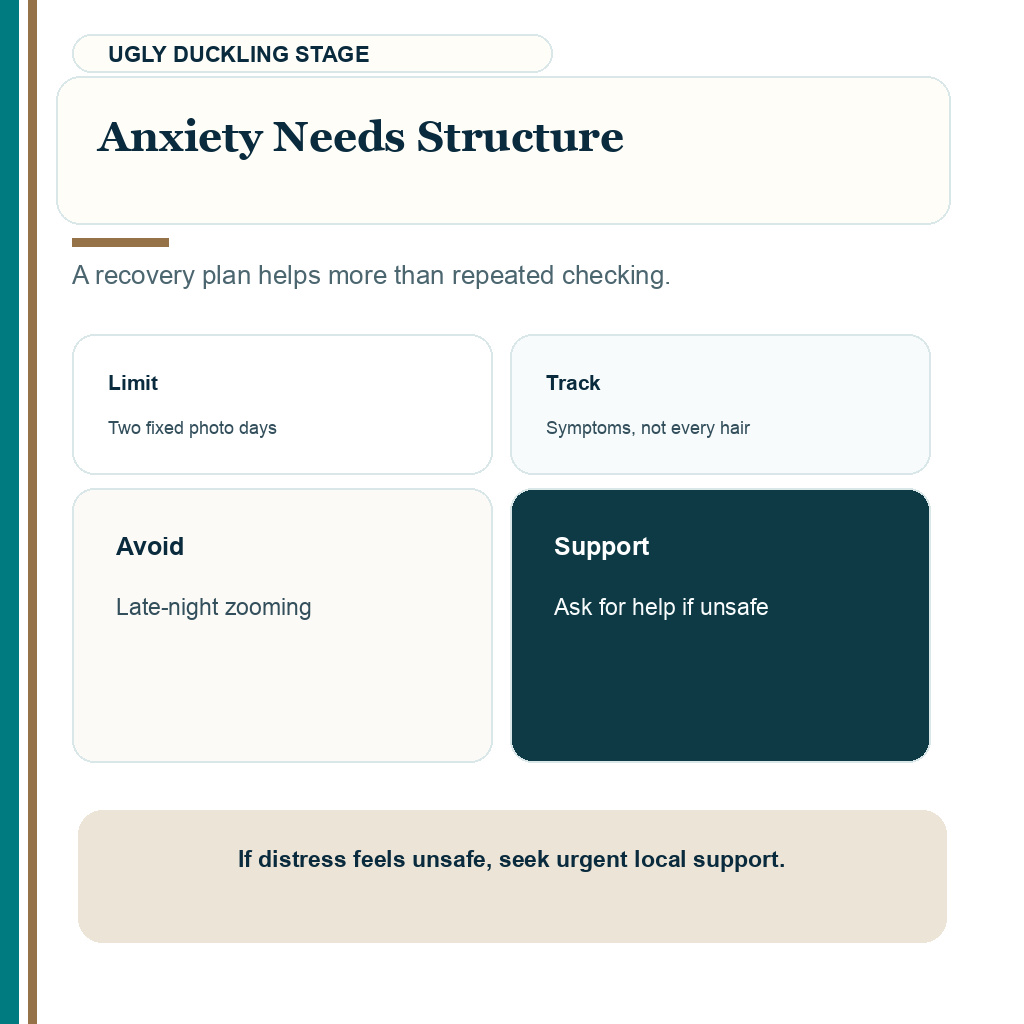
The ugly duckling stage is difficult because you have already done the surgery but cannot yet see the benefit. Transplanted hairs shed. Native hair may look temporarily weaker. The recipient area can look pink, thin, or uneven. Social confidence may drop just when you expected relief.
A recovery plan helps more than repeated checking. Set two fixed photo days each week, then stop taking extra photos unless a symptom appears. Keep a short note with dates rather than writing long emotional interpretations. Do not retake the same angle until you find the worst version of it. Between photo days, separate a new symptom from a comparable photo or a true review milestone. If none of those is present, wait for the next planned review. Compare month to month, not hour to hour. Avoid asking five different online groups to judge one cropped image, because the replies may be confident but not medically responsible.
If anxiety is strong, reduce the triggers you can control. Avoid harsh bathroom light inspections. Do not check the hairline every time you pass a reflective surface. Do not open old before surgery photos at midnight and start measuring pixels. Choose one planned review window instead of letting the mirror interrupt the whole day. If you keep retaking the same angle, ask one trusted person to take the scheduled photos and stop there. Structure is kinder than constant reassurance seeking. It gives you a way to observe without turning every glance into a test.
Mirror checking as a deeper problem
Mirror checking becomes more concerning when it is hard to stop, takes significant time each day, interferes with work or relationships, disrupts sleep, or pushes you toward repeated procedures despite reasonable clinical advice. It is also concerning when a clinic reply calms you only briefly and then you need another mirror check, another photo, or another graft opinion for the same unchanged finding. Hair transplant anxiety and body image distress are not the same for everyone, but repeated checking can become part of a larger cycle.
Some patients do not only worry about growth. They feel unable to accept any visible imperfection. They search for flaws that other people cannot see. They ask for repeated revisions, then quickly shift attention to another area. When that pattern appears, another graft discussion may not be the first priority. The first priority may be to pause and look at the mental pattern around the mirror.
Body dysmorphia and hair transplant decisions become relevant when the main problem is compulsive checking and distress rather than a surgically correctable pattern. If checking feels uncontrollable, frightening, or starts to affect sleep, work, relationships, or basic daily function, involve a qualified mental health professional as well as the surgical team. If distress turns into thoughts of self harm or feeling unsafe, seek urgent local emergency or crisis support. Do not wait for a routine clinic reply.
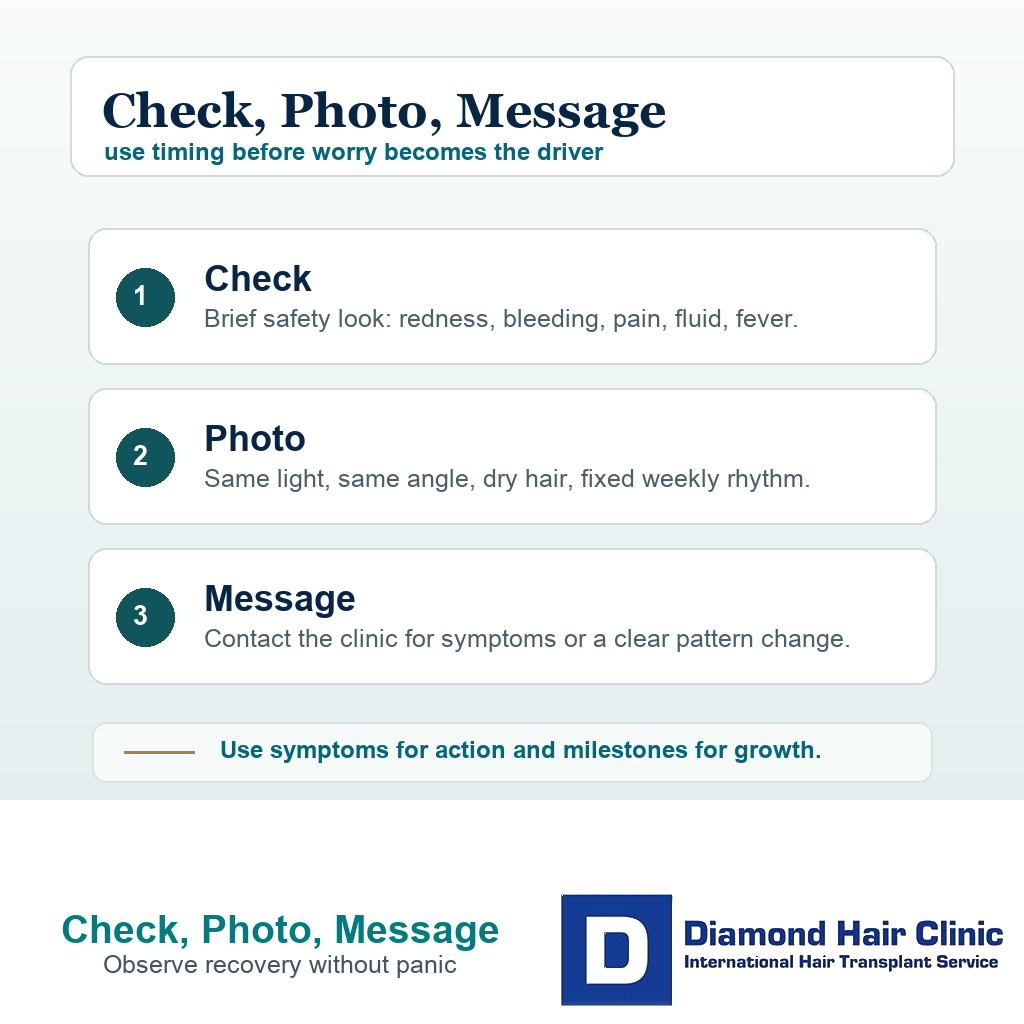
A structured routine separates normal observation from symptoms that need medical review.
Judging progress without letting the mirror take over
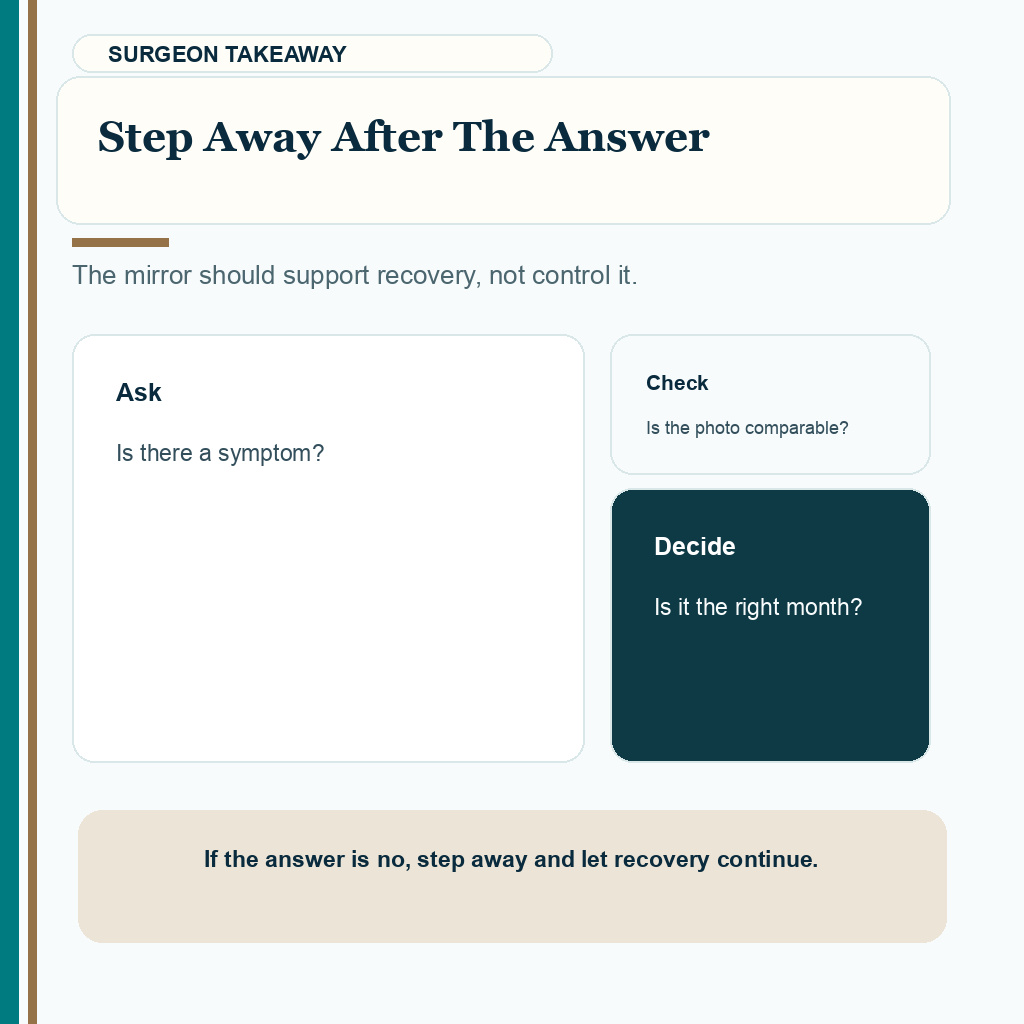
Judge progress in a simple order. Early on, start with scalp safety. Then check whether the photo can be compared with earlier photos and whether the timing is late enough to judge the concern. If those checks do not pass, the mirror is not giving you a decision. It is only giving you another image.
A steady routine will not make recovery fully predictable, because waiting is part of the process. It still helps by reducing false alarms from lighting, wet hair, swelling, shedding, and extreme close ups. When review is needed, the photos are clearer and less emotional.
If you are early in recovery, protect the grafts, wash as instructed, and send photos when your clinic asks for them. If you are in the shedding phase, expect the mirror to feel unfair for a while. If you are several months out, compare by milestone rather than by day. The mirror should answer one question at a time. Is there a symptom to report? Is this photo comparable? Is this the right month to judge? If not, step away and let the recovery keep moving. The mirror should support recovery, not control it.

Read this review excerpt
Upon arriving home, I sent 4 photos (of each side of head) after every washing process to doctor for checking where I was given personal advice for how to take care of my healing head.