



Can Neck Beard Hair Be Used for a Beard Transplant?
Neck beard hair can sometimes be used for a beard transplant, especially for a small cheek, jawline, goatee, or facial hair gap where facial texture matters. I do not treat it as hair that can be removed without consequence.
The area under the chin and on the neck is still visible skin. If too much is removed, the patient may trade one patchy area for another. It can look thinner or patchy after extraction if the plan treats the area under the chin as hidden spare hair. Before graft numbers are discussed, I map texture, direction, donor density, scarring risk, shaving habits, and whether the recipient area truly needs surgery. If the same neck hair is being considered for laser hair removal, the future donor question should be answered first in the laser hair removal donor planning guide.
This is not only about, “Why use scalp hair if I already shave dense hair from my neck?” That is a reasonable concern, but a photograph cannot decide it. I need to know whether the neck hair is stable, dense enough, similar enough, and safe enough to remove without leaving visible thinning, dots, or texture change when the patient trims or shaves later.
Neck beard hair can match facial hair better in selected cases
A beard transplant is judged from close distance. The cheek, jawline, mustache, and goatee are seen when the patient speaks, smiles, trims, or shaves. Hair texture matters. Scalp hair may grow longer and softer than native beard hair. Neck beard hair may have a closer facial hair character, which is why some patients ask about moving it upward into sparse cheek or jawline areas.
That possible match is useful only when it fits the specific beard design. Thick, dark, curved neck hair may blend well in one patient and look too heavy in another. Fine neck hair may not give enough visual weight. A donor option that sounds logical in theory still needs to be compared with the recipient area, not with a generic beard transplant promise.
The first decision is match, not harvest, because short stubble can expose every mismatch in angle, caliber, and direction. I look at the beard at the length the patient actually wears it. A plan that looks good with a full grown beard can look wrong as short stubble, where each coarse or misdirected graft is easier to see.
The neck is still a visible donor area
Many patients think of neck hair as unwanted hair. They shave it anyway, so they assume it has no cosmetic value. That can be true for some patients, but the surgical donor area still matters. FUE extraction can leave tiny marks, texture change, or visible thinning if too many follicles are taken from one area. Those changes may be subtle in one patient and obvious in another, especially with short shaving, strong contrast between hair and skin color, or skin that scars or pigments easily. The neck can be exposed every time the patient shaves, trims the neckline, or turns the head.
I connect neck beard harvest with broader donor area thinking, not only with beard filling. FUE punch size and donor scarring explains why small extractions are still extractions. The face and neck are less forgiving than an area hidden by longer scalp hair. For a usually clean shaven neck, extraction visibility has to be judged there, not only under grown stubble.
A patient who keeps a full natural beard may tolerate a small reduction under the chin differently from a patient who keeps a clean neckline. A patient with very dense neck hair may have more room than a patient with thin scattered hair. A good plan asks how both areas will look after surgery, not only whether the sparse cheek can be filled.
Mark the neckline you actually keep before surgery. Hair taken from below a daily shave line has a different cosmetic cost than hair taken from an area you sometimes leave visible. Check the donor plan with the neck freshly shaved if that is how you usually wear it.
Cheek, jawline, mustache, and goatee areas change the plan
Facial hair does not grow in one simple direction. Cheek hair, jawline hair, chin hair, and upper lip hair can have different angles and density. A few grafts placed in the wrong direction may be more visible than the original empty spot. For that reason, beard transplant for acne scars and small patch repairs need careful angle planning, not only coverage. If scarred skin or skin with acne is raised, painful, inflamed, or unstable, I want the skin quiet before placing grafts, and uncertain scar beds may need a staged plan.
The mustache is even less forgiving. In a mustache hair transplant, the border, direction, and trimming behavior are seen very close. Neck beard donor hair might match facial texture, but it still has to behave correctly in the upper lip area. A coarse graft in the wrong direction can look like a bristle, not a natural mustache hair.
For cheek and jawline work, I also ask whether the target should be full density or soft camouflage. A small sparse area can often be softened without creating a dense artificial patch. When a patient wants a dramatic beard line, I become more cautious because a sharp line can age badly and make any direction mistake easier to see.
Some neck beard areas are unsafe to harvest
The safest looking donor area is not always the area the patient dislikes most. Hair low on the neck can be different from hair under the chin. Some neck border hairs may be finer, less dense, or less reliable. Some skin may be prone to irritation, ingrown hairs, shaving bumps, acne keloidalis nuchae, or raised scarring. If the donor skin is not calm, harvesting from it can create a problem that is harder to hide.
I also look for the pattern of the beard. If the area under the chin is dense but the lower neck is sparse, extraction should not be spread carelessly just because the patient calls all of it neck beard. A small, scattered harvest under the chin is different from hollowing a visible band along the neckline. If there is a strong neckline that the patient likes, removing hair from the wrong band can change the shape of the beard after trimming.
A neck beard donor plan should include the donor area after harvest in the planning stage. The surgeon should be able to explain where hair would be taken from, how concentrated the harvest would be, and the likely visible change when shaving or trimming.
Compare neck beard, scalp donor, and body hair by behavior
Neck beard hair is one possible donor option, not a universal answer. Scalp hair is still common in many facial hair plans, especially when its caliber and color blend well and the scalp donor area can be harvested safely. Beard hair may be coarser or thicker and closer in character to native facial hair. Chest or other body hair may have different growth length, curl, and predictability. Beard and chest hair as donor options is a broader scalp restoration topic, but the same donor matching principle applies here. Donor hair has behavior, not only numbers.
For the hairline of the scalp, I am much more cautious with coarse reserve hairs because the first rows need softness. For that reason, beard or body hair in the hairline is a different decision from beard filling. In a facial hair transplant, the donor and recipient may both be beard zones, but the close viewing distance keeps the standard high.
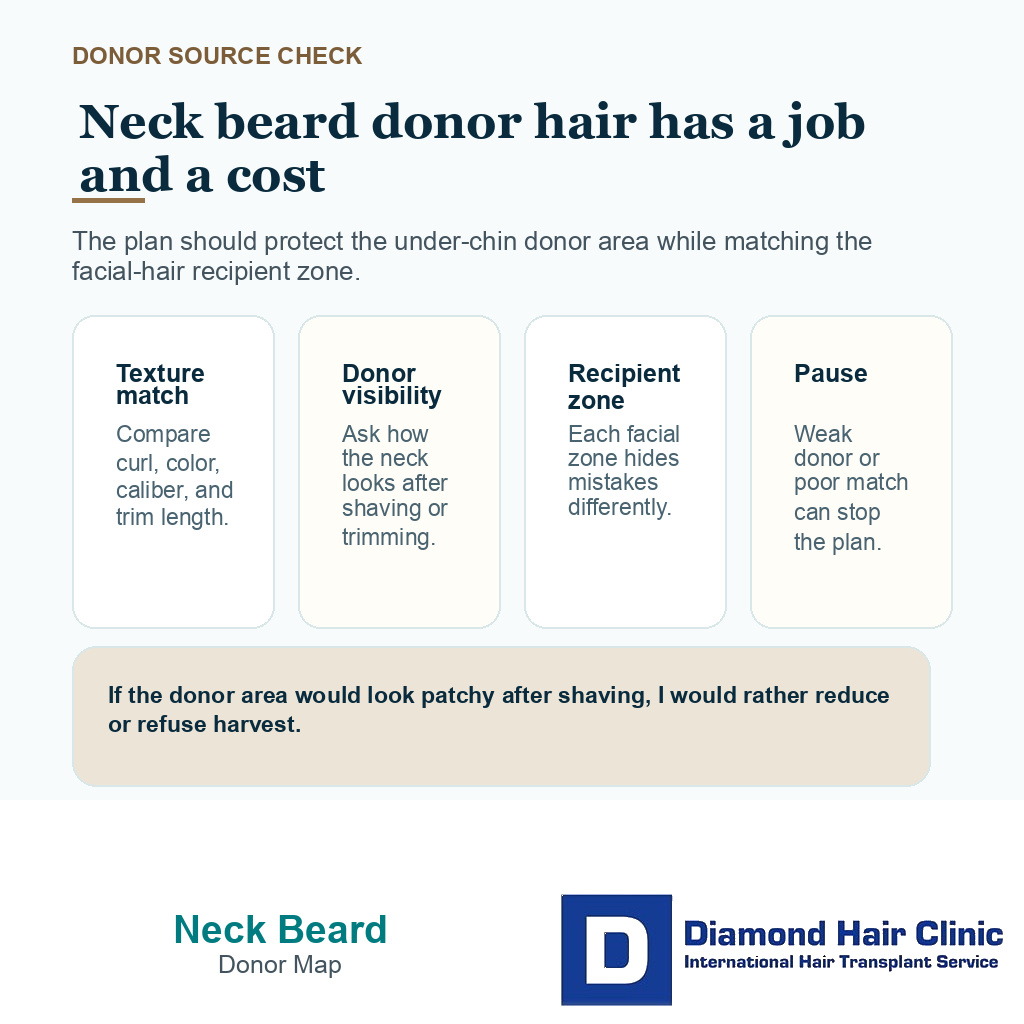
Neck beard donor planning should protect the donor area while checking whether the hair matches the beard area being filled. If beard or neck hair might also be considered for scalp coverage later, that future use belongs in the same donor plan before grafts are taken for a beard goal.
If the only reason to use neck beard hair is that the patient dislikes shaving it, the plan is not strong enough. If the reason is that the hair is dense, matches the target area, can be removed safely, and is unlikely to leave unacceptable visible thinning, dots, or texture change, then it becomes a real surgical discussion.
The neck beard donor match map shows the pressure points
This map is not a diagnosis. It shows the four pressure points I want settled before neck beard hair is treated as a donor option.
The four planning signals
Choose the pressure point that matters most. The right answer changes when texture, donor visibility, recipient zone, or the stopping point is the main issue.
The four states are Texture Match, Donor Visibility, Recipient Zone, and Pause Harvest.
Texture match. Neck beard hair may blend better with facial hair than scalp hair, but only if caliber, curl, color, and trimming behavior fit the target beard area.
Donor visibility. The neck and area under the chin are still visible skin, especially when the patient shaves clean or trims a sharp neckline.
Recipient zone. Cheek, jaw, mustache, and goatee areas do not hide mistakes equally. Direction and angle matter more as the area becomes more visible.
Pause harvest. If the donor area is weak, the skin scars easily, or the patient will dislike a thinner neck beard, the donor decision may be no harvest.
The most important part is not the technical possibility of moving the hair. Many hairs can be moved. The question is whether moving them improves the beard without making the donor area, recipient direction, or future trimming worse.
Shaving and trimming come before graft counts
A beard transplant is not judged only when the beard is grown out for clinic photos. I ask patients to imagine the shortest beard they realistically wear, not the longest clinic photo. It is judged on ordinary days, with a short trim, clean neckline, uneven stubble, bright bathroom light, and close conversation. Neck donor thinning that is hidden by a longer beard may become visible when the patient shaves. Recipient graft direction that looks acceptable at length may look stiff as stubble.
When I look at beard transplant cases that used neck hair, I want to see the neck as well as the filled area, at a similar trim length. Scalp transplant results alone do not show how the neck looked after harvesting or how transferred beard hair blended at close range. The case details should say where the donor hair came from, rather than leaving the patient to infer it from the final beard photograph.
I also ask about laser hair removal. If a patient is planning laser hair removal before hair transplant donor options have been mapped, neck beard hair may be permanently reduced before anyone decides whether it had useful surgical value. Laser can be reasonable, and it may not remove every hair, but the sequence matters when facial hair restoration is still possible.
Before graft counts, answer three questions. How short do you usually trim? Do you care if the neck looks thinner or dotted when shaved? Do you want a soft natural fill or a strong drawn beard line? Those answers can reduce the graft number or stop the plan entirely.
Reasons I would slow down or say no
I slow down when the patient wants a full beard but has only a small safe neck donor area. Active irritation, painful bumps, infection signs, or a history of raised scarring also make me cautious. If new bumps or ingrown hairs persist after a previous neck beard harvest, I examine the donor skin before taking more follicles from the same area. Their appearance alone does not prove the exact cause, and I do not plan another harvest until the skin is calm and the problem has been assessed. The same is true when the target beard shape is too sharp, too dense, or too dependent on one donor option. A small facial correction can be reasonable, but a large cosmetic promise can create regret.
Beard transplant regret and repair limits matter because the face is difficult to hide. If grafts are placed at a poor angle, if the surface becomes bumpy, or if the donor neck looks patchy, repair is not simple. The beard plan may be a smaller session, a staged test area, or no surgery.
There are also patients who should wait. Younger patients may still develop more facial hair. Patients with active acne or inflamed skin should treat the skin first. Patients who are unsure about beard style should not use surgery to create a fashion line they may not want later. A beard transplant should solve a stable problem, not freeze a temporary preference.
The neckline is the real donor test


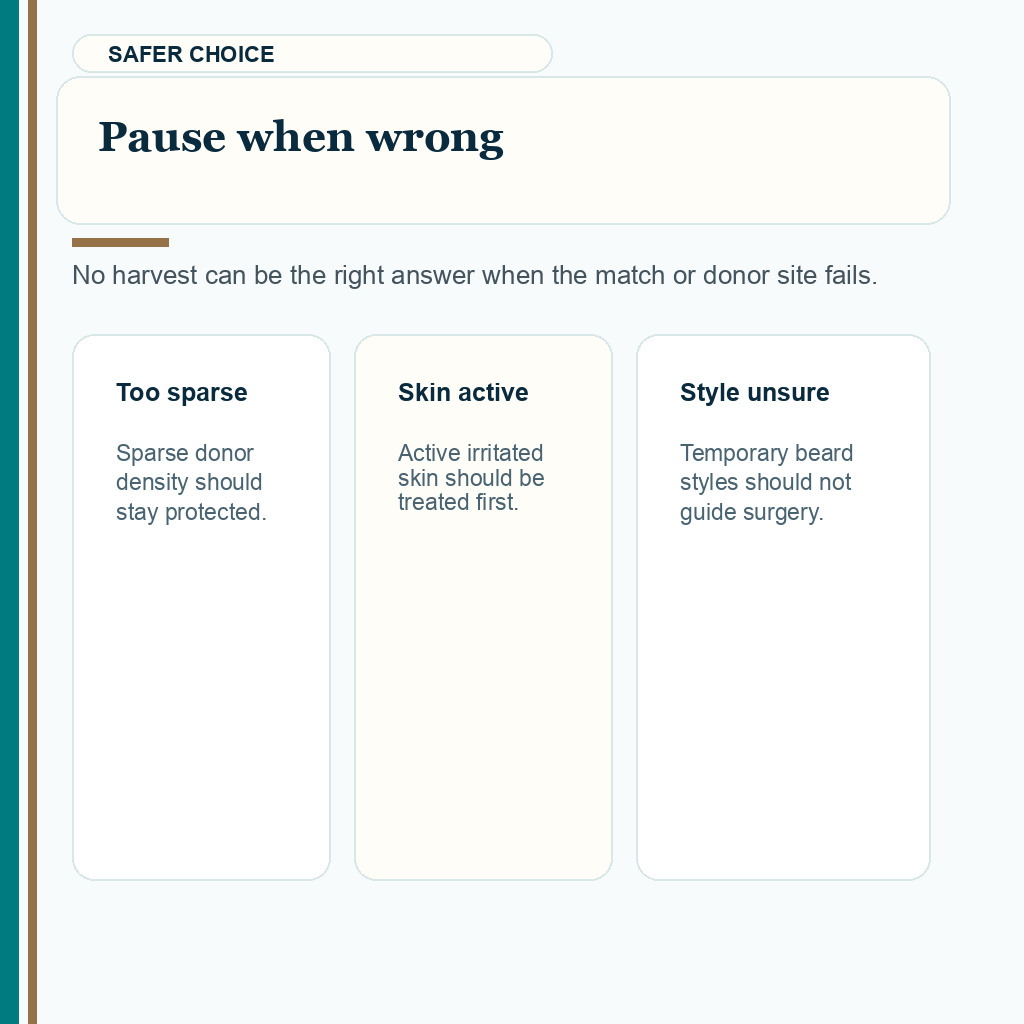
Neck beard hair is only a useful donor source when the hair removed will not make everyday grooming look worse. I look at the usual neckline, the contrast between neck and cheek beard, the curl or coarseness of the hair, and whether shaving bumps or ingrown hairs are already a problem.
Before I think in graft numbers, I want to see the beard at the length the patient actually wears it and where the neck is normally shaved. A clean area below the chin that is never visible creates a different tradeoff from a low neckline that sometimes forms part of the beard.
If harvesting would leave a visible patch, change the beard outline, or use hair that does not match the recipient area, a smaller beard transplant goal is the cleaner choice than borrowing from the wrong place. The donor area has to look acceptable after surgery, not only the beard gap.
Read this review excerpt
We also had a levelled conversation about my hairline and results I could expect based on my donor density area.