


Hair Transplant Photos Need Careful Reading
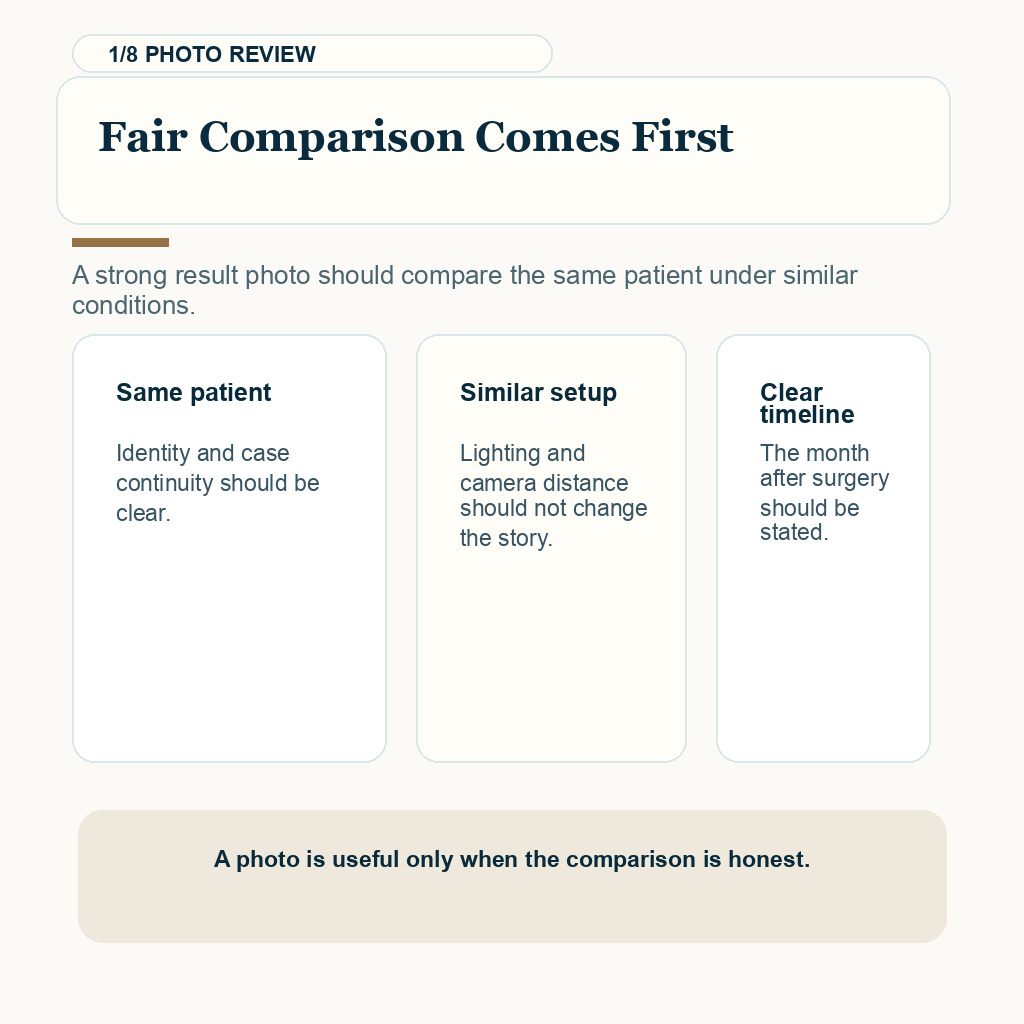
You can trust hair transplant before and after photos only when the comparison is fair. I want to see the same patient, enough time after surgery, similar lighting, similar hair length, clear hairline views, crown views when the crown was treated, and healed donor area photos. I also want to know the graft number, hair type, donor strength, medication context, and who was medically responsible for the surgery.
A strong photo can begin your research, but it should not finish it. I judge the image by the context around it, including whether the case, donor, timeline, and plan are close enough to make a similar approach safe and realistic for you.
Before and after images can be useful. They can also hide weak density, donor damage, poor angles, harsh light thinning, styling tricks, or a result that suits one person but would be wrong for another. I treat photos as evidence to examine, not proof to accept immediately.
A safer starting point for checking result photos
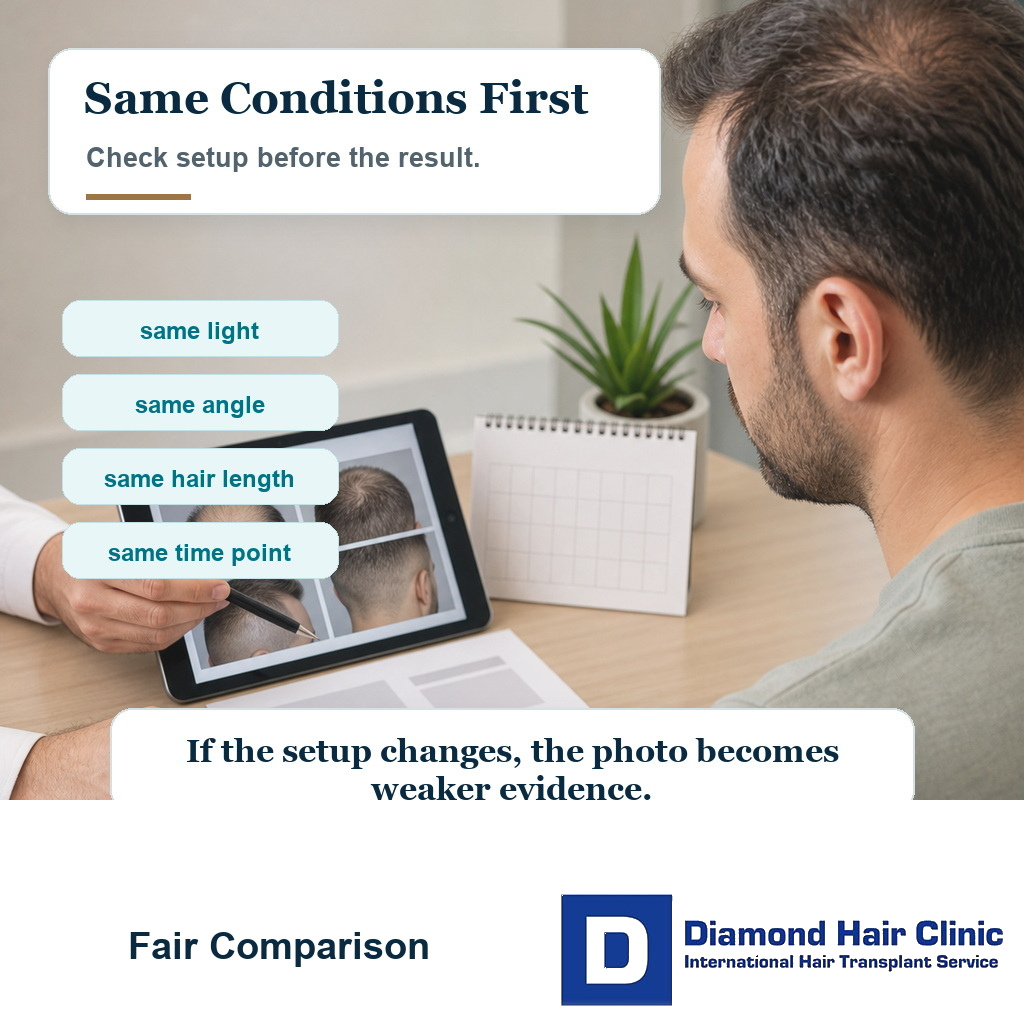
Start with the basics. Is the before photo taken under the same conditions as the after photo? Is the hair wet in one image and dry in the other? Is the after photo longer, styled forward, darker, or taken in softer light? Is the camera angle the same, or has the head position changed enough to make the hairline look stronger?
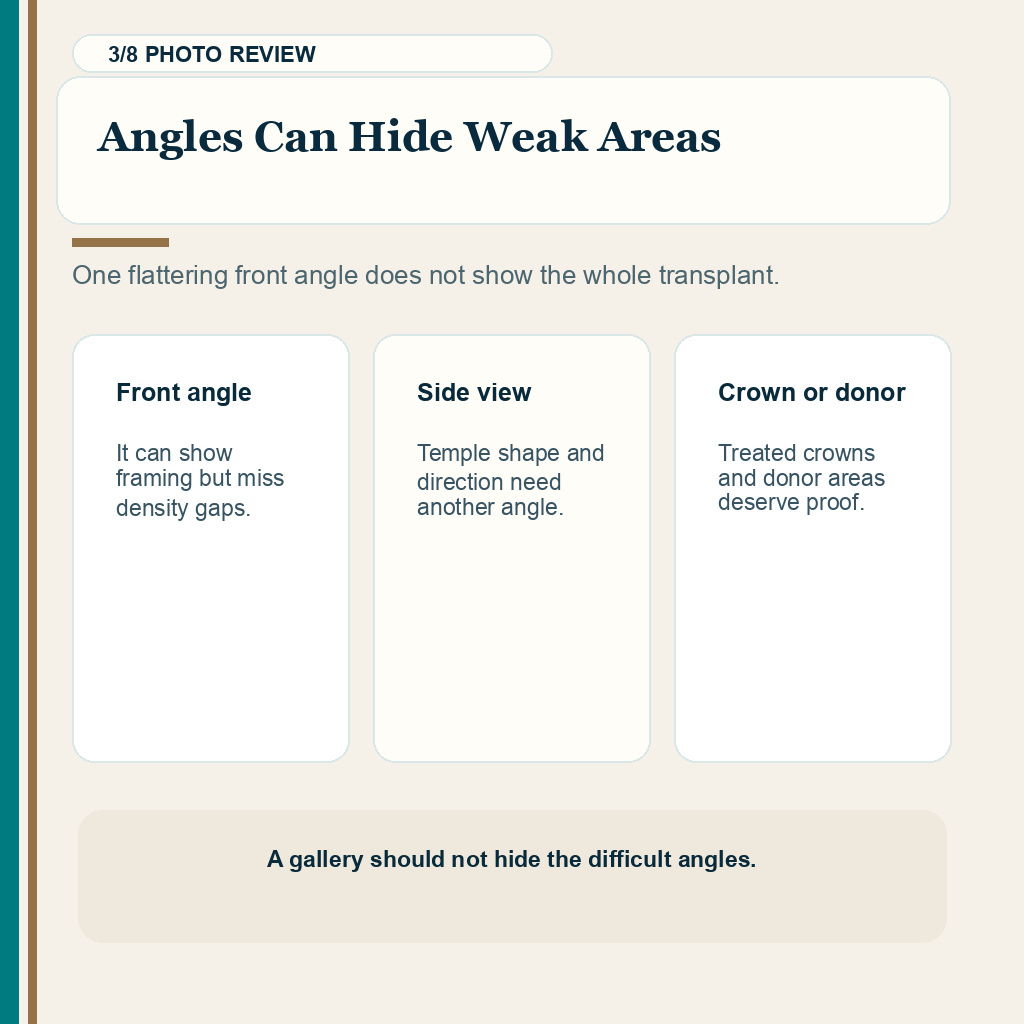
If the treated area was the hairline, I want to see the front and both temples clearly. If the crown was treated, I want overhead and angled views, not only one flattering top photo. If a large graft number was used, I want to see the donor area healed, because the back and sides are part of the result.
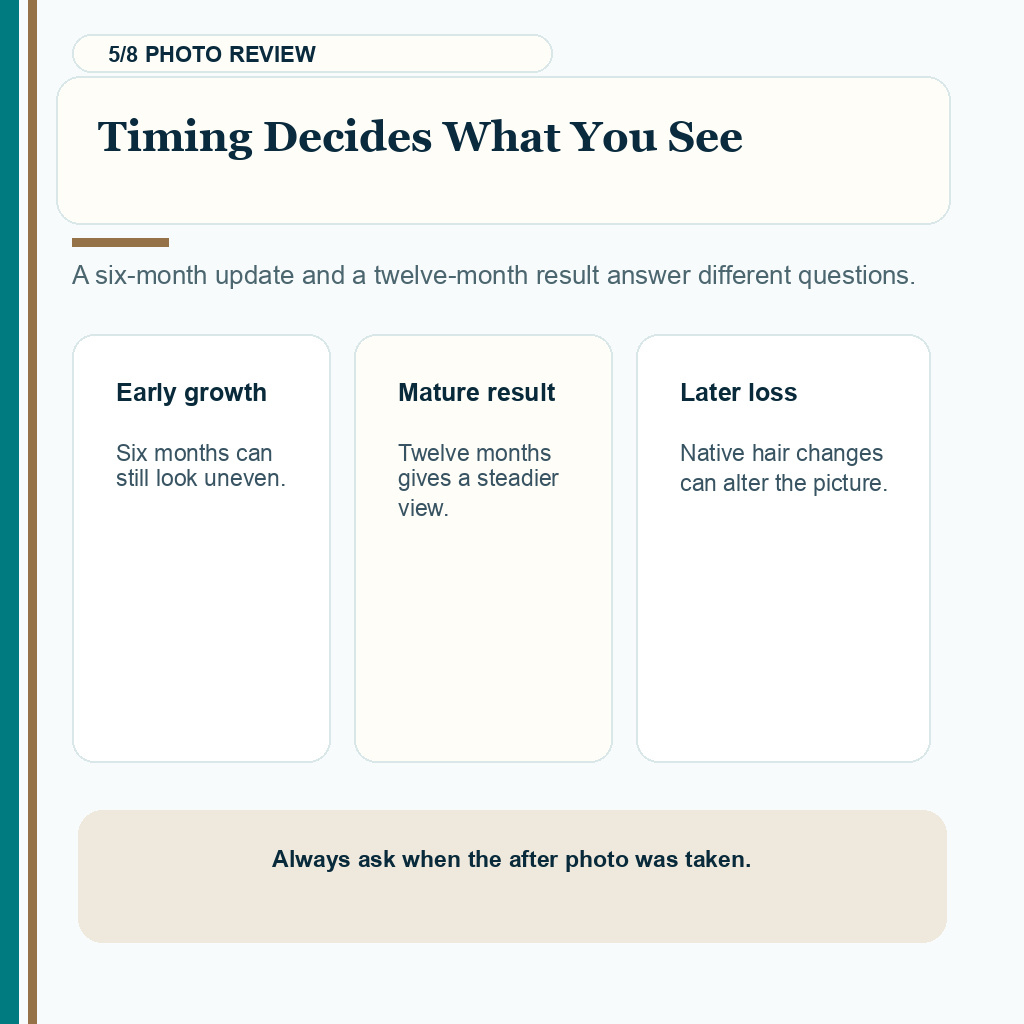
The time point matters. A 4 month photo, 8 month photo, 12 month photo, and 18 month photo do not mean the same thing. A mature result is usually judged around 12 months, and crown cases or slower growers may need longer. For that reason, day one hair transplant photos should never be treated as final density proof.
A good photo can still mislead you
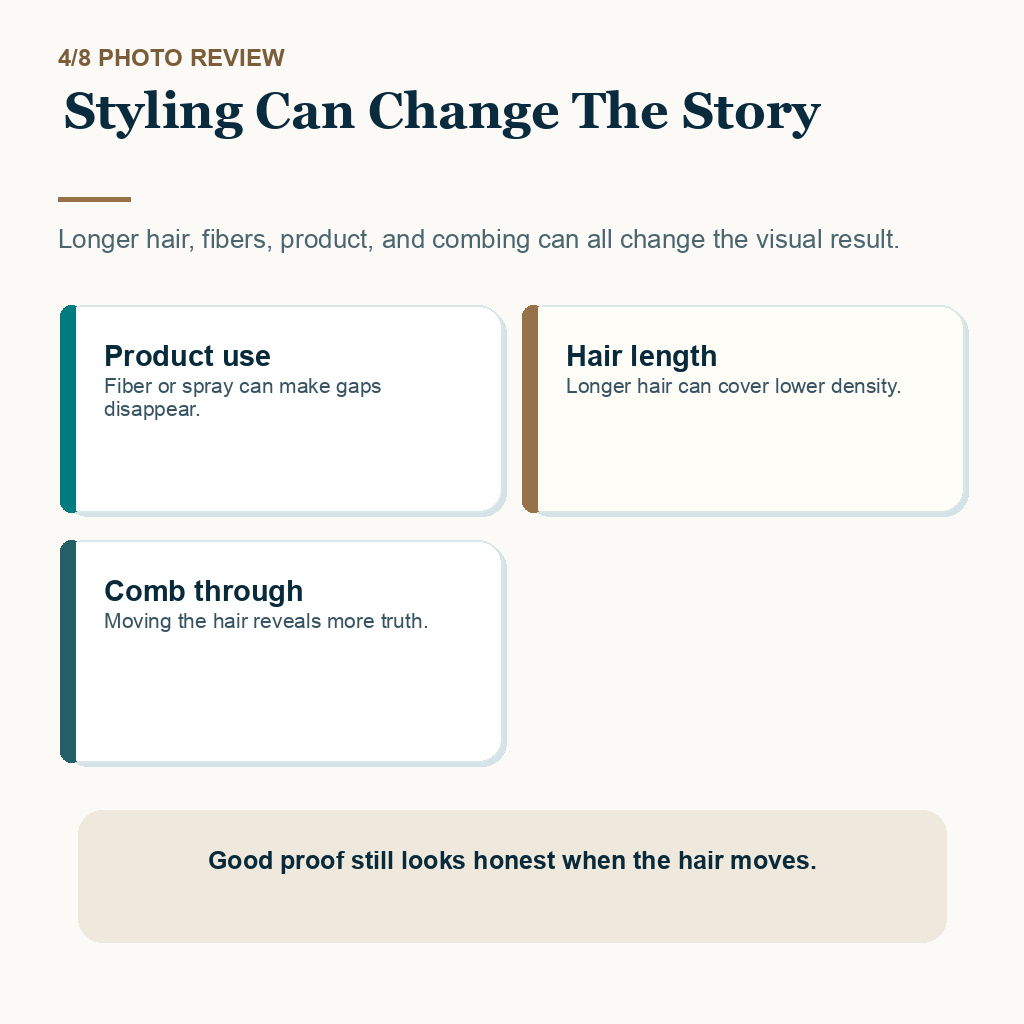
A photograph freezes one moment. Real life does not. Hair moves, separates, gets wet, catches overhead light, and changes with styling. A hairline that looks dense in one still image may look thinner when the hair is lifted or combed through. A crown can look improved from one overhead angle and still feel light in bright bathroom light.
Look for the view that hides the least. A gallery can still be useful, but it is too weak for risk judgment if every image avoids the hairline, crown, donor, or harsh light. Include ordinary patients too, not only the clinic’s strongest transformations.
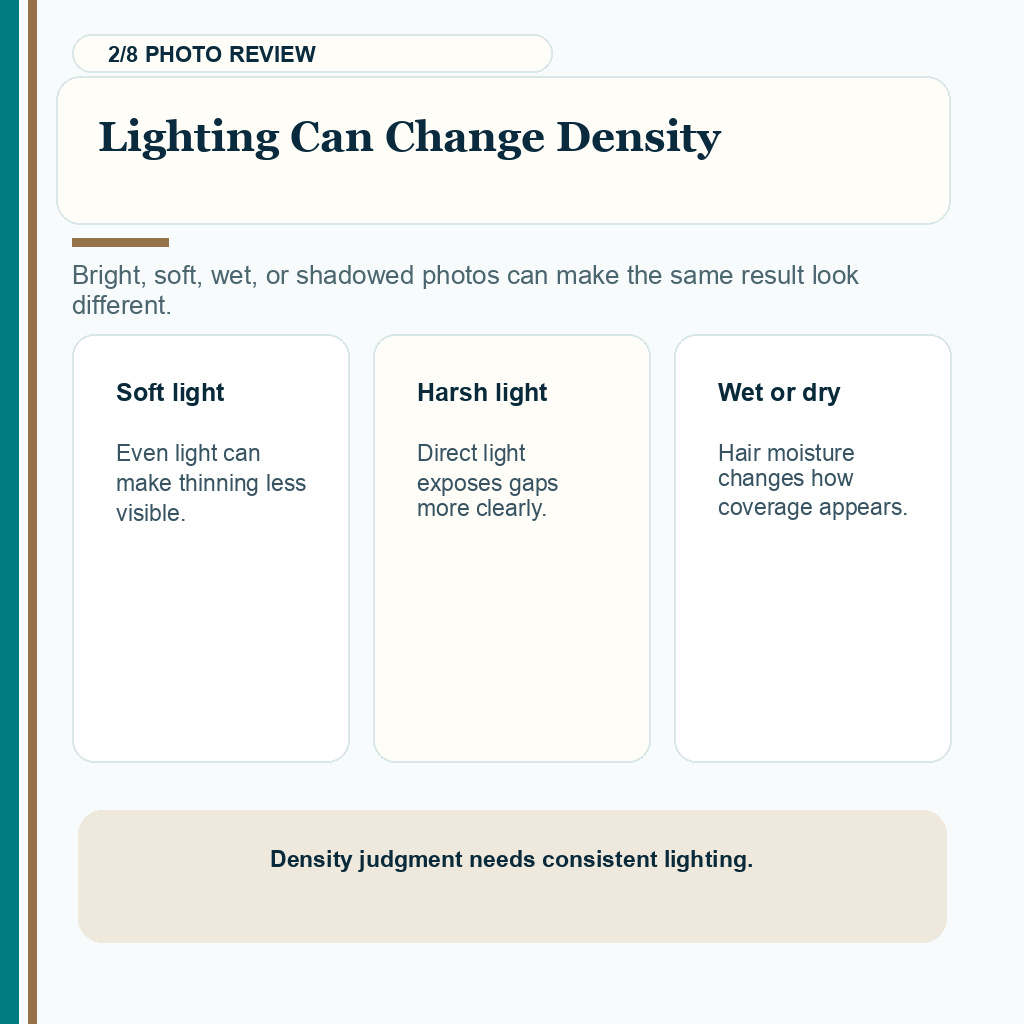
Lighting is one of the biggest problems. Soft indoor light can make almost any result look thicker. Direct sun, wet hair, short hair, and strong scalp contrast can reveal limits that a gallery image does not show. When you compare photos, also check harsh light and wet hair after a transplant, because those are the conditions many patients notice at home but galleries often avoid.
Styling also changes the impression. Longer hair, fibers, product, darker background, lower camera angle, and combing forward can all improve a photo without changing the actual density. None of these details automatically prove misleading intent, but they do mean the image needs context.
Details that make a photo set more trustworthy
A fair photo set does not need to make the result look worse. It needs to show enough of the truth. The useful set shows the front, both sides, temples, top, crown if treated, and donor area. It should include normal distance photos together with closer detail, because close photos can exaggerate small problems and distant photos can hide real ones. Fair comparison uses similar light, hair length, camera distance, and styling on both sides.
A trustworthy set usually includes the graft number, the treated zones, the time after surgery, and whether the person used medication. It also helps to know whether the person had thick or fine hair, straight or curly hair, high or low scalp contrast, and mild or advanced hair loss. The most useful comparison is not the most dramatic result. It is a result from hair like yours.
Continuity matters too. The gallery should show the same patient, the same treatment zone, the same clinic, and a named medical responsibility. A polished after photo or referral name leaves a weak decision trail when those links are missing.
If a gallery mixes surgery day, shedding, month five, and current photos, put the images back in chronological order before judging the result. A strong final image is less useful when you cannot see what each stage represents or whether the same area is being compared.
When a gallery shows several recovery stages, read it as a chronological growth record, not as a row of separate promises. After surgery, use tracking hair transplant growth without panicking as the standard for reading those images. Keep the light, angles, hair condition, and treated zone consistent before comparing stages.
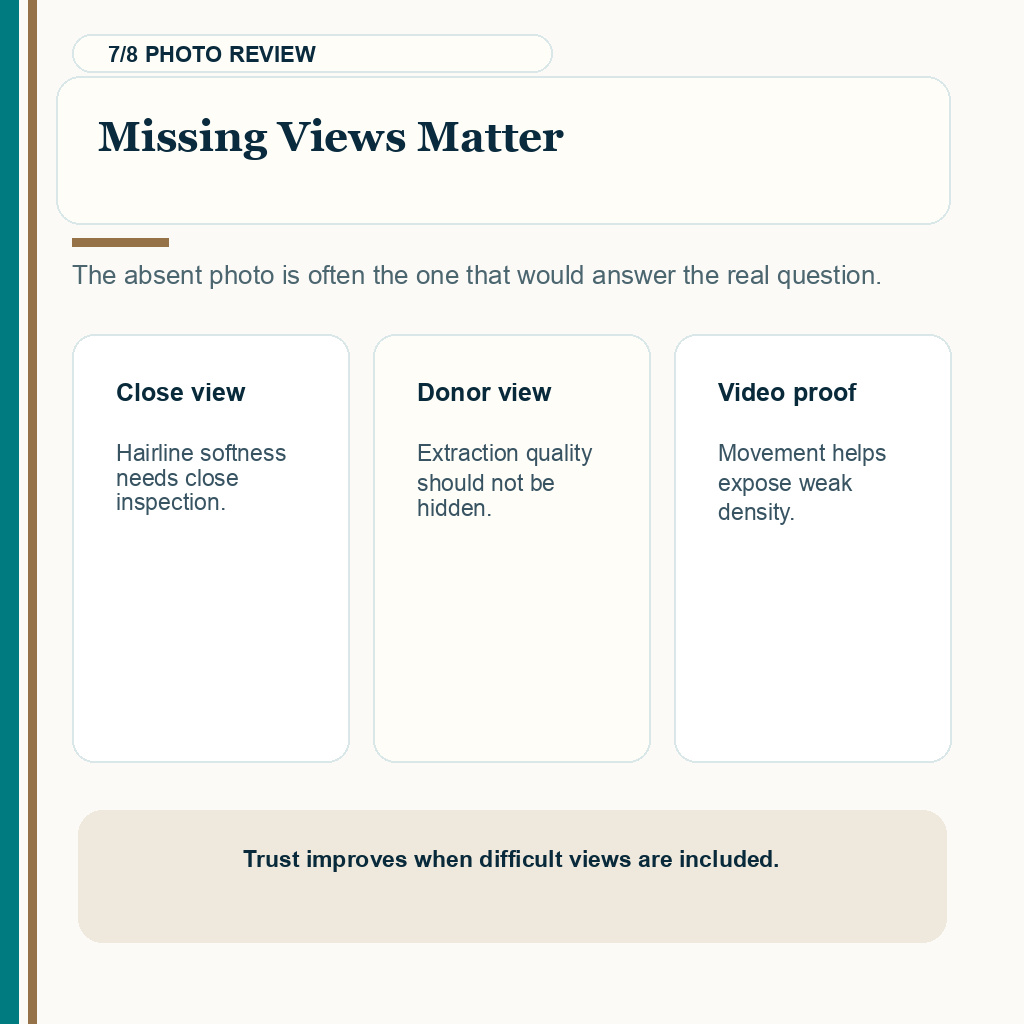
Video can help when it is simple and unedited. A comb through video can show movement, direction, and density better than one still image. It is still not perfect, but it makes it harder to hide the weak angles.

Missing views that matter most
The healed donor is often the missing view. A beautiful front photo can distract from overused donor hair, patchiness, or extraction patterns that limit future options. If thousands of grafts were used and the healed donor area is never shown, I become cautious. The donor area belongs to the result too. For donor views, an early photo can show extraction spacing before longer hair hides the pattern.
The hairline detail is another important view. A low hairline can look exciting in a front photo, especially when hair is styled forward. But a natural hairline needs correct height, irregularity, angle, careful single hair graft selection, and planning that still makes sense over time. Hairline design should still make sense years later, not only in the first attractive gallery image.
Crown photos need special caution. The crown has a spiral pattern and often needs many grafts for moderate visual change. One overhead photo does not tell you whether the density is realistic, whether future loss was considered, or whether the frontal area should have been prioritized first.
Photos cannot prove that the same result is possible for every patient
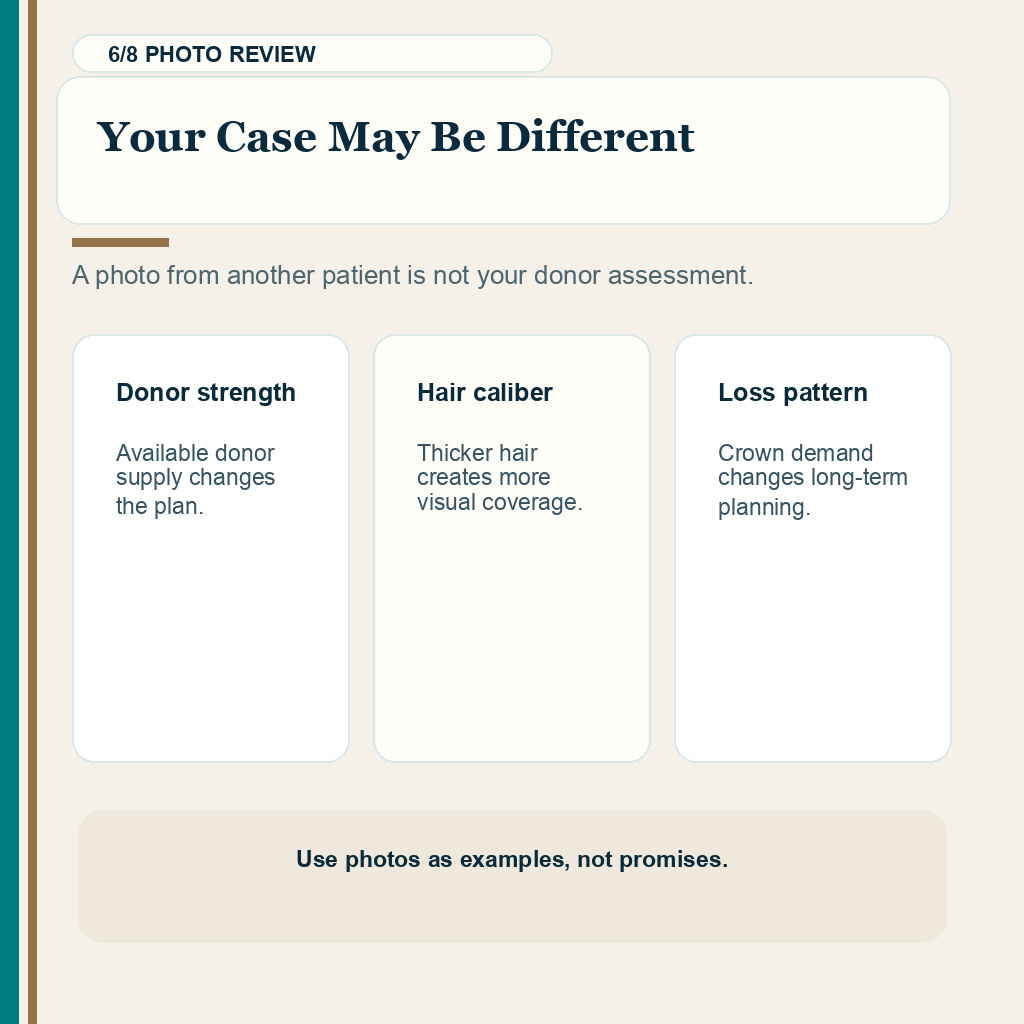
No. Photos show possibility, not your personal surgical limit. They cannot measure your donor density, hair caliber, miniaturization, scalp contrast, future hair loss, medical history, or the amount of donor hair that should be kept in reserve.
A plan made from images alone should stay provisional. A hair transplant plan made from photos can start the discussion, but I still treat it as provisional. The donor area, recipient area, hairline, scalp, and long-term pattern need proper assessment before surgery.
If a photo makes you excited, slow the decision down and look for the missing context. The loss pattern, hair thickness, donor strength, medication history, photo timing, crown coverage, and styling can all change what the image really proves.

Gallery signs that should make you cautious
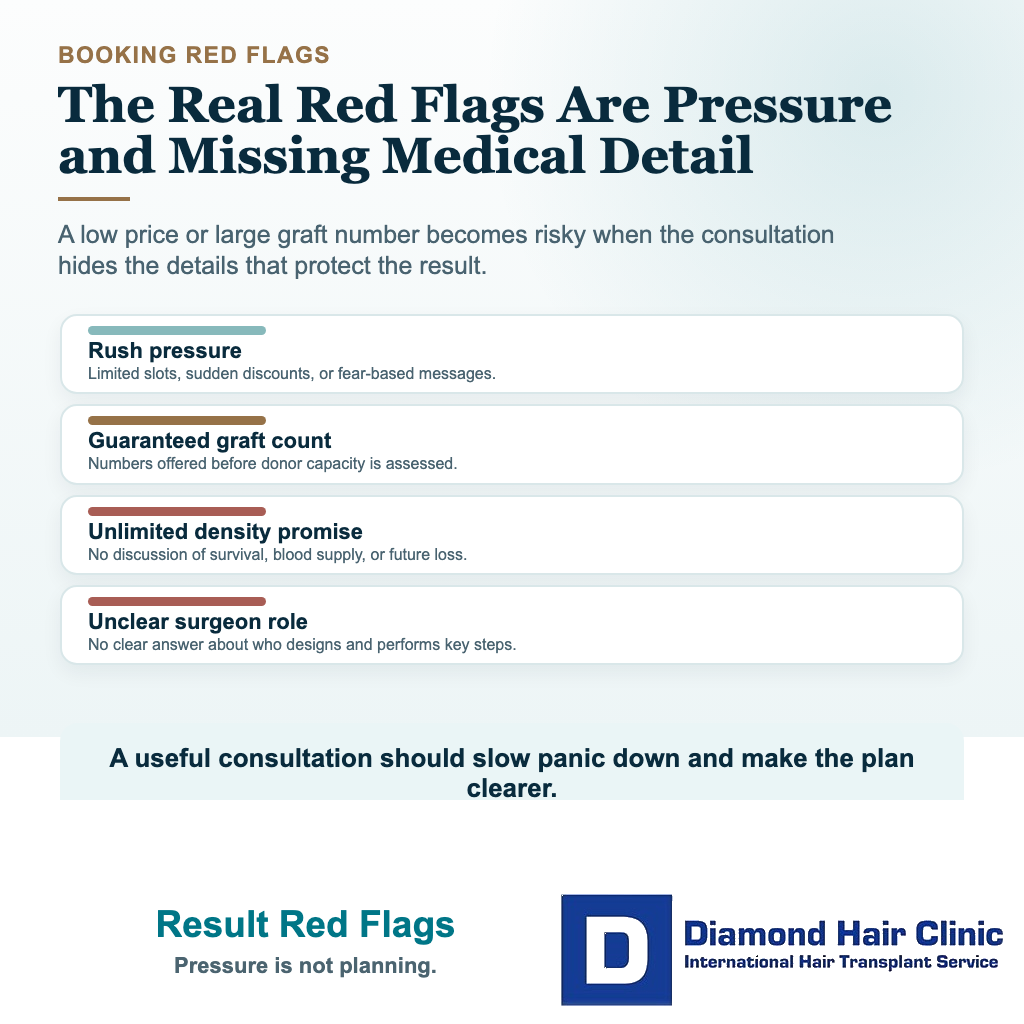
Be careful when every after photo is perfect, but the before photos are harsh, wet, short, or badly lit. Be careful when the healed donor is never shown. Be careful when the clinic shows dramatic transformations but gives no graft numbers, no timeline, no surgeon responsibility, and no explanation of case difficulty.
Another red flag is pressure. Photos should help you understand a result, not push you into a rushed booking. If a gallery is followed by short deadline discounts, sudden package pressure, or urgency before your questions are answered, separate the excitement from the medical decision. Hair transplant booking pressure should not decide a permanent surgery.
High graft numbers also need caution. More grafts can sound reassuring, but too many grafts in the wrong plan can damage the donor area, reduce survival, or leave fewer options for future hair loss. A gallery photo that hides donor cost is incomplete.
Result stories are not enough to judge a clinic
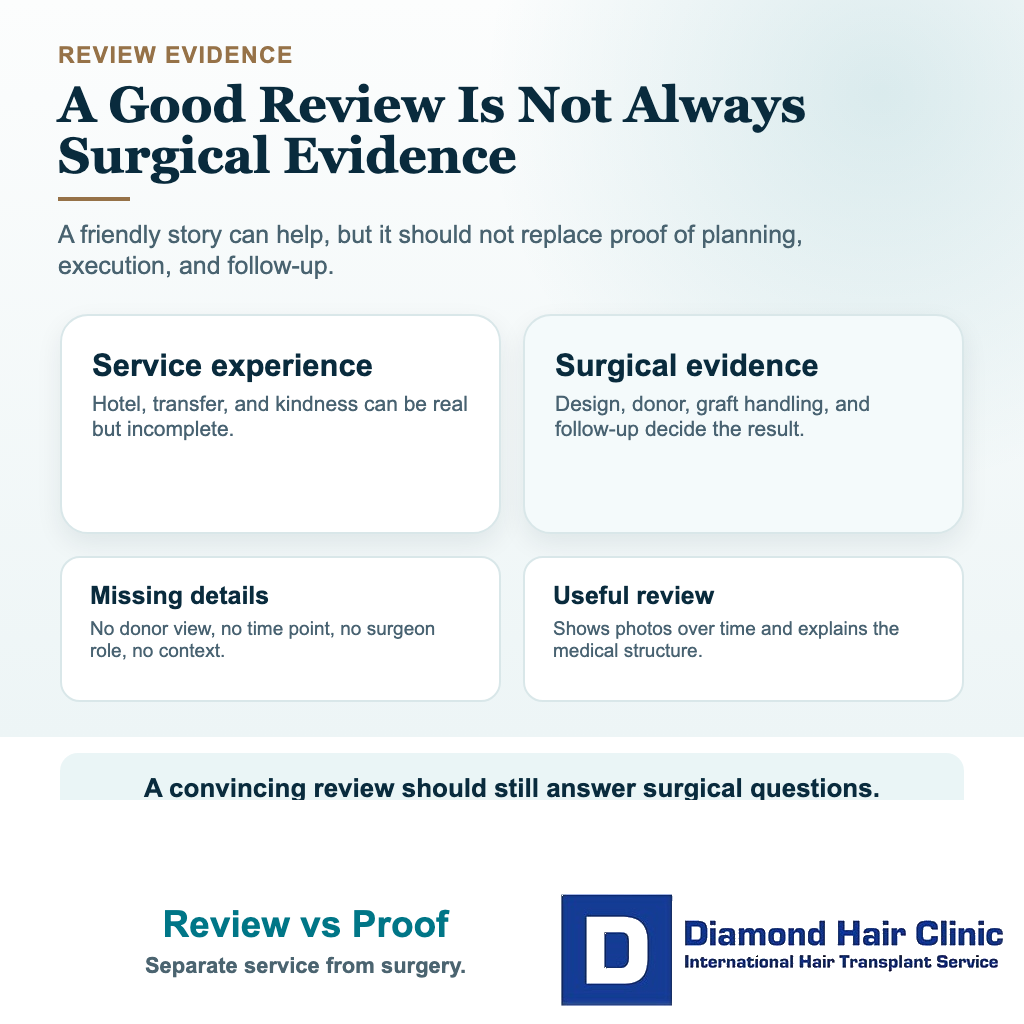
A detailed result story can be helpful when it explains the consultation, graft number, surgical plan, recovery, donor area, and result over time. But a story that only talks about the hotel, transfer, friendliness, and price does not tell you enough about the surgery.
Comfort matters, but it is not the operation. A friendly coordinator does not tell you who designed the hairline, created the recipient area, handled grafts, or stayed medically responsible. Service quality is not surgical quality. Before trusting a result story, you need to know who performed the medically important steps.
This is also why clinic comparison in Turkey needs more than gallery browsing. Istanbul has excellent medical talent, but high-volume systems can make a delicate surgery feel like a production line when the priorities are wrong. The red flags of Turkish hair mills are not about rejecting Turkey. They are about protecting the medical responsibility behind the result.
Hairline, crown, and density photos need different judgment
Hairline photos are emotionally powerful because the hairline changes the face. But the same power can mislead. A low, dense, straight hairline can look impressive in one image and still be wrong for age, face shape, donor reserve, and future hair loss.
Crown photos need different judgment. The crown can take many grafts and still look lighter than the front because of its spiral direction and the way light hits the scalp. A crown result needs realistic coverage expectations, not comparison with frontal hairline density.
Density claims need the most careful language. A thick looking after photo is not enough by itself. The useful context is where the grafts were placed, what was left for the future, whether the donor area still looks healthy, and whether the result would still look natural as hair loss progresses.
When strong photos should still make the patient pause?
Even a real result can be the wrong guide for another patient. I pause when the patient is younger, still losing hair quickly, has diffuse thinning, has weak donor reserve, wants a much lower hairline, or expects the crown to match the frontal density in one operation.
I also pause when the photo set hides the part of the case that would change the plan. A front view without healed donor views, a crown result without lighting context, or a repair result without the previous damage can make the surgery look easier than it was.
For repair cases, I want the photo set to show the defect before repair and the limits after repair. Donor views, immediate placement, short hair or wet hair views, and longer follow up matter more than one polished final image. A repair result without the original damage can make the case look simpler than it was.
A photo should sharpen the consultation. It should not replace candidacy review, donor assessment, hairline design, graft number logic, or a clear candidate decision.
Questions to ask before booking from photos
Cases that resemble you matter. Similar age, loss pattern, hair caliber, curl, skin and hair contrast, donor strength, and crown involvement change the comparison. If you have fine hair, diffuse thinning, previous surgery, weak donor capacity, or crown dominant loss, a result that looks strong in a different type of case may not help your decision.
The missing context matters more than the strongest angle. Graft number, result age, medication history, hairline planning, recipient area work, healed donor appearance, and case limitations all help decide whether the photo is useful evidence or only a persuasive image.
Older patients with advanced hair loss need examples that show the donor after extraction and the area deliberately kept thinner. A photo set that looks impressive at the front but hides the donor or crown can mislead a patient who actually needs Norwood 6 or 7 hair transplant planning or hair transplant planning in the 40s or 50s.
When the answer still feels unclear, a second opinion before hair transplant can be more valuable than more scrolling. More impressive images will not answer the safety question. A real review should tell you whether the plan is safe for your scalp.

Photos affect emotional readiness
Photos can make the decision feel simple. You see a weak before image and a strong after image, and the difficult months in between disappear. That missing middle is important. Swelling, redness, scabs, shedding, uneven early growth, and the awkward shedding stage are part of the real experience.
If you expect the gallery photo too early, recovery can feel like failure. The same problem can happen after surgery when you measure your own healing against online hair transplant photos during recovery. That does not mean every worry is emotional. It means the timeline should be explained before surgery. A good result can improve confidence, but it should not be sold as a cure for every insecurity.
Before surgery, define success in a way that can survive normal life. Not perfect density under every light. Not a hairline copied from another face. A natural, age appropriate improvement that protects donor reserve and makes daily styling easier is a safer target.
Follow-up proves whether the photo matches the plan
A result photo becomes more trustworthy when the follow-up record matches the story. I want to know when the photo was taken, whether the donor healed well, whether the patient had ongoing native hair loss, and whether the clinic reviewed the result after the early growth anxiety passed.
Without follow-up, a photo can show only the best angle of one day. With follow-up, the patient can see whether the plan stayed stable, whether the donor reserve was respected, and whether the clinic remained responsible after the attractive gallery image was made.
Before and after photos are worth trusting only with enough context
They are worth trusting when the clinic shows enough context for the result to be judged fairly. The photos should be consistent, mature, clear, and open about the donor area. The case details should make sense. The plan should protect future options. The clinic should explain limitations before asking for trust.
Be cautious when the whole decision depends on the most dramatic transformation. Look for clarity instead. Look for donor preservation, natural hairline design, realistic density, surgeon involvement, and results that still make sense when the lighting is not perfect.
Cost can be part of the decision, but it should not replace this assessment. Hair transplant cost in Turkey only makes sense when it is weighed together with medical responsibility.
A photograph can show possibility. It cannot examine your donor area, design your hairline, or protect your future graft supply. I would treat it as one piece of evidence, not as permission to book. The plan still needs a donor assessment, realistic hairline design, careful graft use, and a surgeon who remains responsible after the photo is taken.