


Payment terms come after the medical plan
Money is often easier to discuss than donor capacity, graft survival, hairline design, and future hair loss. A clean invoice, a quick answer, or a hotel package can make the process feel organized before the surgery has been explained well. That can give false comfort.
That sequence puts the patient in the wrong place. Payment clarity is useful only after the medical plan is understandable. Before payment, ask about the likely graft range, donor reasoning, hairline design responsibility, surgical roles, and what may change during the examination at the clinic.
If the surgical answer is vague but the payment answer is fast, slow down. The payment conversation belongs inside the medical plan, not beside it as a sales step.

Once payment questions are written down, test whether the tone still protects medical judgment. The next sorter is useful because refund or rescheduling wording should leave room for a surgeon to reduce grafts, delay surgery, or change the plan when safety requires it.
A payment answer should never be faster than the surgical answer. Read the next check as a pressure test for whether the booking terms still respect donor safety and the surgeon’s final judgment.
Deposit terms can create pressure
Some clinics ask for a deposit before they reserve a date. Some ask for a larger advance payment close to surgery. Some say the payment is only to protect the schedule. The word deposit is not the issue by itself. The risk begins when the payment makes you accept surgery before the case has been reviewed properly.
After money is paid, the flight, hotel, and clinic slot can start to feel too costly to lose. That pressure can make a person accept a graft number, hairline, or surgery date that still needs more medical review.
A deposit should never become stronger than donor safety or a medically sensible delay. If a clinic asks for money before the donor area, hair loss pattern, age, medication history, and realistic goal have been reviewed, the financial step is ahead of the medical step. If the deposit terms are unclear, they should say what the payment reserves and what happens if the plan is changed, reduced, delayed, or refused for medical reasons.
When terms are unclear, do not rely on a friendly chat promise after payment. Save the written rule first, then decide whether the medical review and travel plan still make sense.
Cancellation terms need real dates
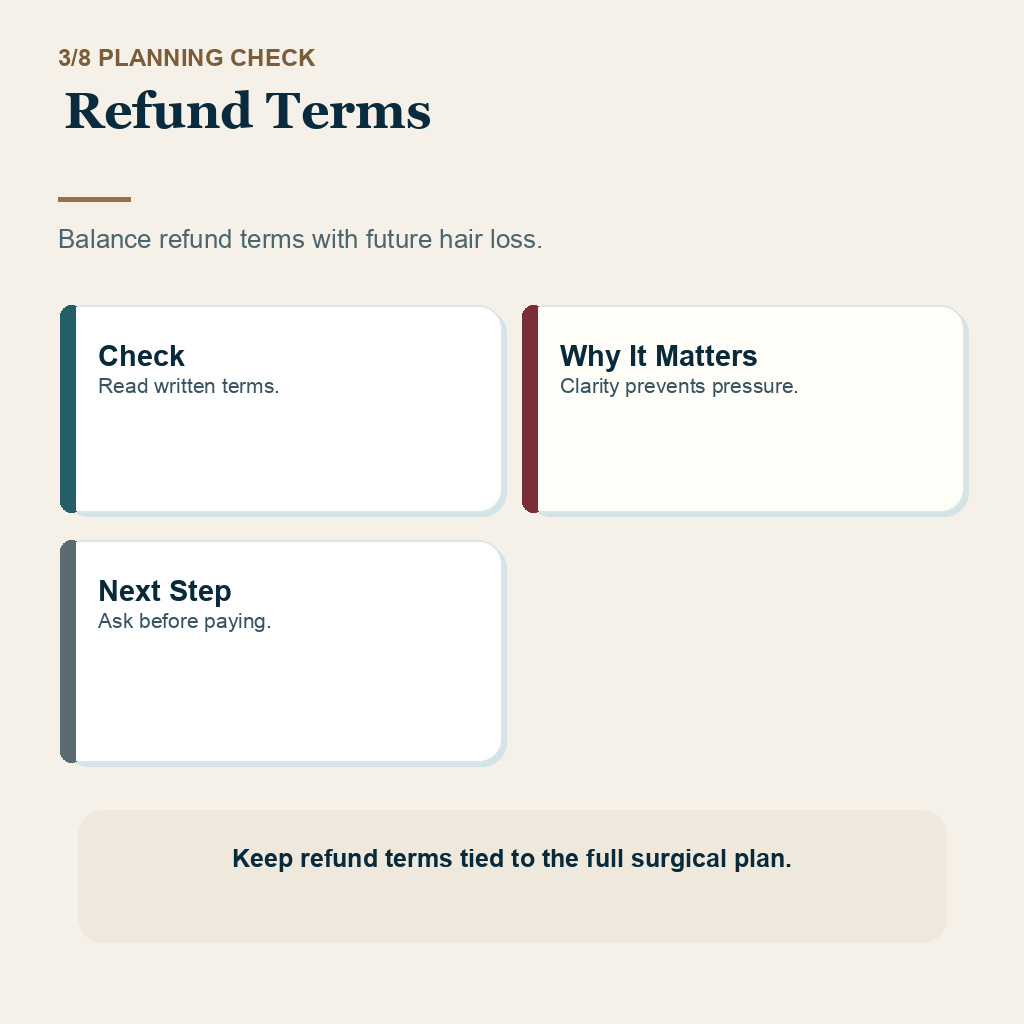
Cancellation terms should not rely on a friendly message. The written answer should cover how many days before surgery a date can be cancelled, what part of the payment may be kept, whether hotel, transfer, or testing costs are separate, and whether a medical reason changes the answer.
For a medical cancellation, the written terms should identify the evidence accepted, the treatment of the deposit, the expiry date of any credit, and whether that credit can be moved to a later date.
International travel adds more moving parts. A visa delay, flight cancellation, illness, family emergency, work issue, or uncovered cost can appear after the date is chosen. Travel insurance for hair transplant abroad should also be checked before you assume flight changes, extra hotel nights, or medical costs are covered.
Cancellation also needs a medical boundary. If you develop fever, an infection, uncontrolled blood pressure, a new medicine issue, or another health change close to surgery, the question is not only whether money is lost. The question is whether operating is medically sensible. When health changes after booking, medical review before the planned hair transplant date matters more than the amount already spent.
Rescheduling is different from disappearing
Rescheduling means you contact the clinic early, explain the reason, and agree on a new date in a way that protects the medical plan. Disappearing means the clinic loses the date and trust is damaged. These are different situations, and the written terms should not treat them as the same.
Rescheduling terms should state whether one date change is allowed, whether a time limit applies, whether a new medical review is needed, and whether the plan will be repeated if many months pass. Hair loss can progress. Medication can change. The donor area can look different. A date change is not only a calendar change.
For international patients, rescheduling also affects flights, hotel nights, first wash timing, recovery time away from work, and the return trip. The practical schedule should fit the medical plan. It should not force surgery into the cheapest or most convenient travel window.
Rescheduling should be written before payment
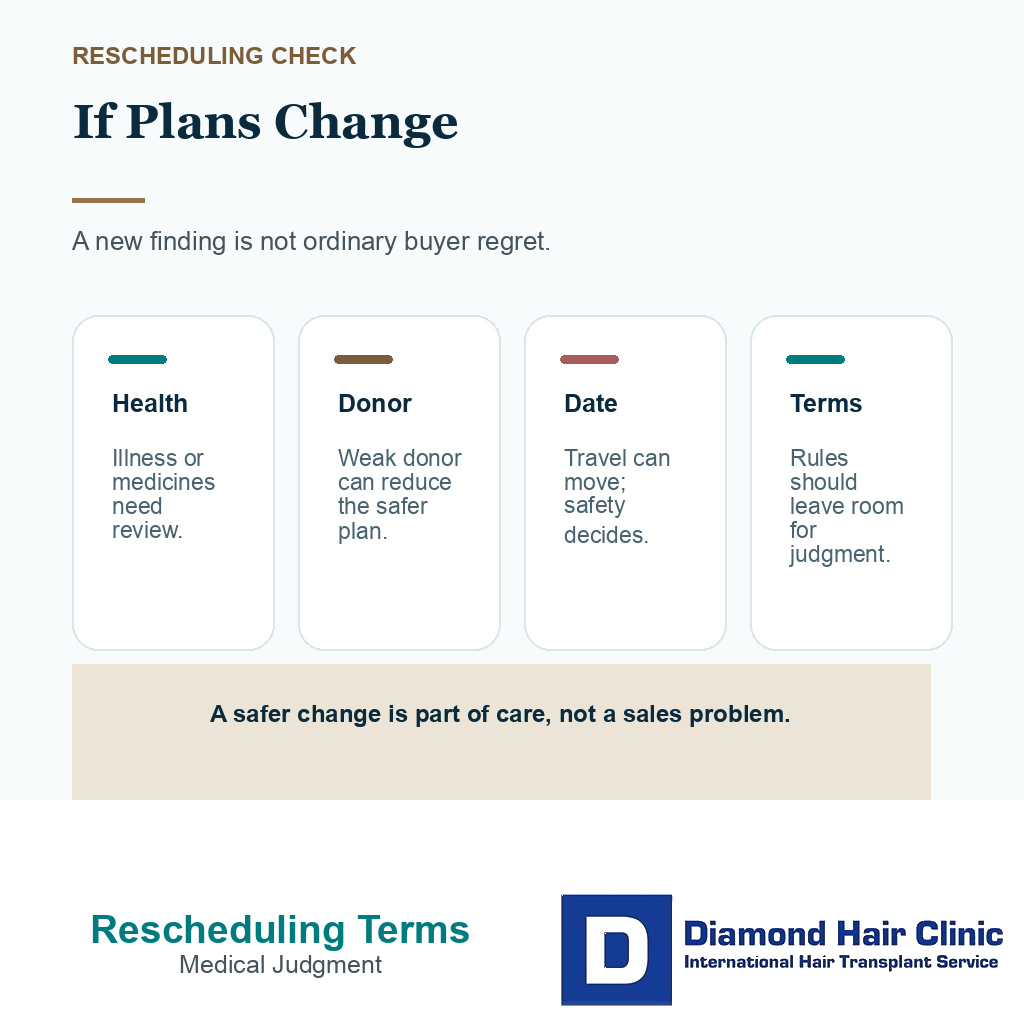
Rescheduling is not only a calendar issue. Sometimes it is the medical decision that protects the donor, the healing conditions, and the patient’s ability to understand a changed plan.
Before paying, confirm how the clinic handles new health information, an abnormal blood test, a medicine change, a weaker donor finding, or a direct examination that changes the graft number, hairline, or crown plan. These are not the same as simply changing your mind.
Different clinics can write different commercial terms. The written terms should leave room for a medical delay before surgery starts, even when travel and hotel dates have already been arranged.
Before paying a deposit, separate a medical postponement from a casual cancellation in writing. The rule should say what happens if the surgeon changes the graft plan or decides surgery should wait.
Put the deposit rule beside the medical change rule. You should know whether the same money rule applies when surgery is delayed for health, when the graft target changes, or when the surgeon refuses the plan.
If the quote changes after the examination, refund and rescheduling terms are easier to apply when the revised scope is clear. A quote change before surgery should name the changed finding before the patient accepts a new price.
A changed medical plan is not buyer regret
A key question is what happens if the examination at the clinic changes the plan. A clinic may estimate a graft number from photos, then see a weaker donor area, finer hair, more miniaturization, active scalp inflammation, or a larger area than expected when you arrive.
That is not ordinary buyer regret. It is new medical information. If fewer grafts are safer, if the hairline should be higher, if the crown should wait, or if surgery should be postponed, the plan should be allowed to change. A clinic that treats every change as a payment problem is not separating medicine from sales.
Written terms need room for medical judgment. Before travel, confirm what happens if the surgeon reduces the graft number, changes the design, delays surgery, or decides that surgery is not suitable on that date. That clause shows whether the clinic is protecting the medical decision or only protecting the booking. The written terms should say who makes that medical call, not only how much money is kept.
A refund promise cannot repair a donor area
Some people focus on refund language because they are afraid of being trapped after a poor result. I understand that fear. A poor hair transplant can affect appearance, confidence, donor reserve, and future repair options. But a refund discussion and a repair plan are not the same decision.
A refund promise does not put overharvested donor hair back. It does not soften a low hairline, change bad graft angles, or make a weak surgical plan safe. If the result is already poor, repair planning starts with medical review of records, photos, timeline, donor condition, growth maturity, and repair possibility.
I keep poor hair transplant result review before refund or repair separate from payment language. Money can be part of a dispute. Surgery is still a medical decision, and the donor area cannot be treated like a product return.
Written terms should match the person speaking to you
When you travel from another country, information may come through coordinators, translators, messages, PDF files, and calls. That can work well when the written terms match the spoken explanation. It becomes risky when one person says something casually and the written document says something narrower.
Before paying, save the written plan, the quote, the payment method, the date, the included services, and the answer about date changes. Coordinator promises about flexibility should be written. If a package includes hotel or transfer support, the terms should explain whether those costs follow the same rules as surgery or are handled separately.
Language matters here. You may think you understood the answer when the wording was actually unclear. If translation is involved, ask for simple written wording rather than a fast verbal reassurance.
Compare clinic terms by decision order
When I compare clinic terms, I do not start with the most generous promise. I start with the order of the decision. The clinic should first decide whether surgery is suitable, then explain the plan, then explain the booking and payment structure. If the payment step comes first, you are being asked to trust the clinic before the clinical reasoning is clear.
Patient friendly terms should make room for reality. Flights can change. Illness can happen. The donor area can be weaker than photos suggested. Someone may need a smaller plan. A clinic can discover that the requested hairline is not safe for the future. Written terms that ignore those possibilities are not patient friendly, even if the price looks attractive.
The best comparison is not which clinic writes the most comforting promise. It is which clinic gives you enough clarity to decide before you travel. Payment terms belong in the same decision as choosing a hair transplant clinic in Turkey. The financial rules matter, but they are only one part of clinic safety.
Clarity before payment
Before paying any clinic, separate three questions. Is the surgical plan medically reasonable? Are the payment and booking terms written clearly? Do the terms explain what happens if the clinic cannot answer, the surgeon changes, the address is unclear, or the examination changes the plan?
Start with the medical question. Weak surgical reasoning is not rescued by clear payment terms. When the plan is solid but the written terms are vague, ask again before sending money. When both are clear, the financial step belongs inside an organized plan instead of becoming a pressure point.
For someone travelling internationally, the safest feeling before travel is not excitement about a discount. It is knowing that the donor area has been reviewed seriously, the graft plan has been explained clearly, travel support has been separated from medical responsibility, and the booking terms are written in language you can understand later.

Read this review excerpt
Probably my only concern of the whole trip was when my transport pulled up to a different hotel than I had been told but this was solved instantly and was only due to the Covid situation.