



Spironolactone and FUE Planning
Some women can have FUE while taking spironolactone. The medicine name alone does not decide the surgery. I first look at whether the hair loss pattern is stable, whether the donor area is safe, whether the dose is tolerated, and whether pregnancy plans, side effects, blood pressure symptoms, or potassium concerns change the timing.
If you take spironolactone for female pattern hair loss, PCOS related thinning, acne, or hormonal symptoms, I need the full medication story before I design the recipient area. That includes the dose, start date, prescriber, response, recent dose changes, other medicines, and any recent potassium or creatinine tests if they were checked.
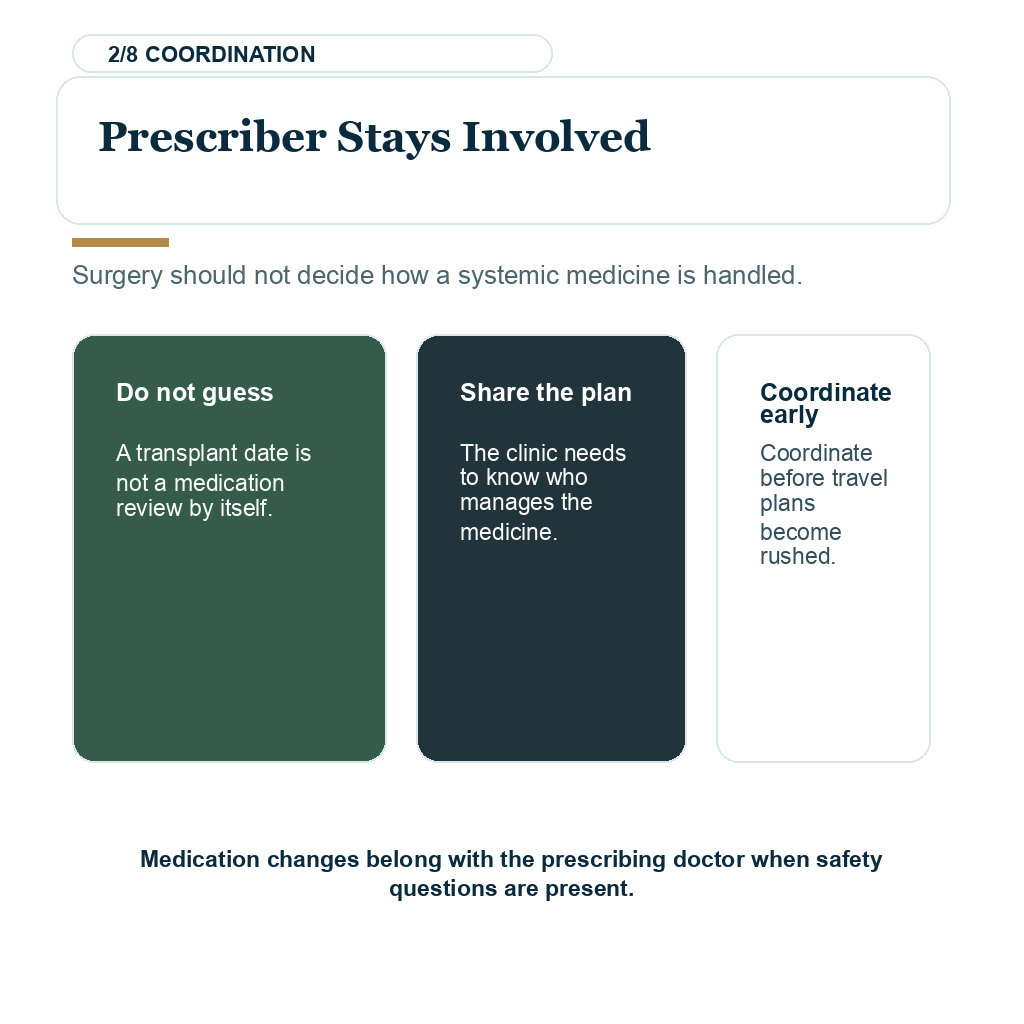
Dose changes should be visible in the plan, not hidden behind a fixed graft number. The prescribing doctor and the clinic need the same timeline before surgery is treated as settled. Recent dose changes need more than a date. Bring the reason for the change too, so the surgical plan can judge whether the shedding pattern is settling or still moving.
Pregnancy or IVF plans belong in the same early conversation. So do dizziness, fainting, kidney history, potassium history, dehydration, vomiting, diarrhea, or a recent illness before travel. These details may still allow FUE, but they can change whether surgery should happen now or wait.
A transplant cannot stabilize active hair loss. It can move donor hair into a selected area, but it cannot make ongoing shedding, diffuse miniaturization, or a changing hormonal plan disappear.
The role of spironolactone before FUE
Spironolactone is often discussed in women with androgen driven hair thinning because it can reduce the androgen signal that contributes to miniaturization. In hair loss treatment planning it is medical support, not proof that the scalp is ready for grafts. The medication history helps me judge whether the diagnosis, response, and surgical target make sense together.
Spironolactone planning has to answer a candidacy question, just like female hair transplant candidacy. Diagnosis comes before grafts. If the thinning is localized, the donor area is strong, and the pattern has become steady, surgery may be useful. If the whole top is miniaturizing, shedding is active, or the donor also looks weak, a transplant can spend grafts too early.
When spironolactone is part of the plan, I check whether it has slowed the loss, changed the density, and made the surgical target more predictable. Those details belong together, but they answer different parts of the plan.
Medication planning sorter
Which spironolactone planning issue is active?
Use this before treating the prescription itself as clearance for FUE.
This can support planning, but it is still not automatic clearance. I still check diagnosis, donor strength, and whether the surgical target is defined enough.
The useful split is medication response, recent dose change, side effect safety, fertility timing, diagnosis overlap, and whether the surgical target is narrow enough.
Spironolactone does not prove the hair loss is stable
Spironolactone can make surgery more sensible when it slows the pattern, but the tablet itself is not a surgical guarantee. A woman can take it and still have active shedding from iron deficiency, thyroid instability, recent stress, postpartum change, traction, scarring alopecia, or a mixed diagnosis. A prescription does not replace scalp examination, donor assessment, or blood work when the history points that way.
In PCOS, the distinction is especially important. PCOS and hair transplant planning depends on whether the hair loss has become steady enough and whether there is a defined area that can benefit from grafts. Hormonal treatment may improve skin symptoms or cycles while the scalp still needs more observation.
The medication question is not only, “Am I taking the right medicine for surgery?” The more useful question is whether the medicine has made the hair transplant plan more reliable. The medication supports the diagnosis. It does not replace it.
Observing the response before surgery
A few hopeful weeks are not enough to judge spironolactone. Hair responds slowly, and the first months can be confusing if minoxidil, supplements, contraception, weight changes, stress, or shedding triggers are changing at the same time. Several months at a stable dose gives more useful information than a new medicine started right before travel. The same timing problem is covered directly in birth control changes before FUE, especially when several hormonal variables move together.
This is also how I think about oral minoxidil before or after hair transplant surgery. Continuing a familiar, tolerated medication is different from starting a new systemic medicine in the final weeks before FUE. A dose increase just before surgery is also a new variable, even if you have taken the medicine before.
If spironolactone has recently been started, stopped, increased, or reduced, I want to know why. Side effects, menstrual changes, dizziness, fatigue, breast tenderness, low blood pressure symptoms, potassium concerns, acne treatment, or fertility planning can all change the timing. Travel dehydration, vomiting, diarrhea, fasting, or poor fluid intake around surgery can also make dizziness and blood pressure harder to interpret. Dose decisions belong with the prescriber, not with a surgery calendar.
The safety details also matter. I ask about kidney disease or adrenal disease, previous high potassium, fainting or near fainting, palpitations, muscle weakness, dehydration, vomiting, diarrhea, and medicines or products that can affect potassium or blood pressure.
That includes potassium supplements, potassium containing salt substitutes, electrolyte powders, ACE inhibitors, ARBs, eplerenone, trimethoprim containing antibiotics, blood pressure medicines, and regular anti inflammatory painkiller use. These details may not cancel FUE, but they make the plan for the day of surgery more precise.
Trying medication before using donor grafts
Medication is worth considering before surgery when it may change the surgical decision. Active, diffuse, or unclear thinning often needs treatment and observation before donor hair is used. A stable frontal shape, a high forehead, or a localized area with strong donor hair may not need the same long medication delay.
I frame the issue through medication before a hair transplant because medication and surgery do different jobs. Medication tries to support hair that is still alive. Surgery moves donor hair into an area where coverage is permanently weak or cosmetically insufficient.
A graft number should not lead the consultation. The pattern needs to be stable enough, the donor needs to be reliable, and the expected improvement needs to justify using finite grafts. Stability comes before graft placement.
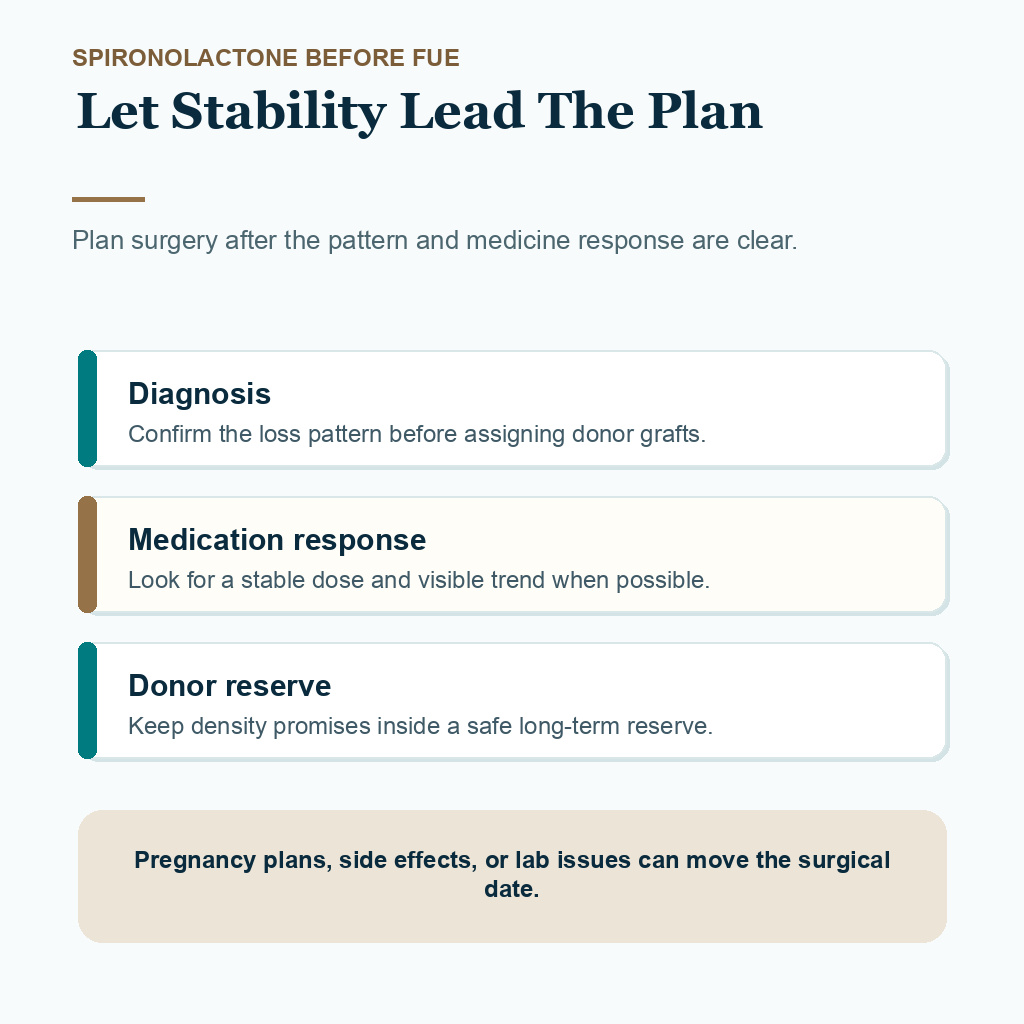
Before grafts are used, the diagnosis, response, donor area, and timing need to be clear.
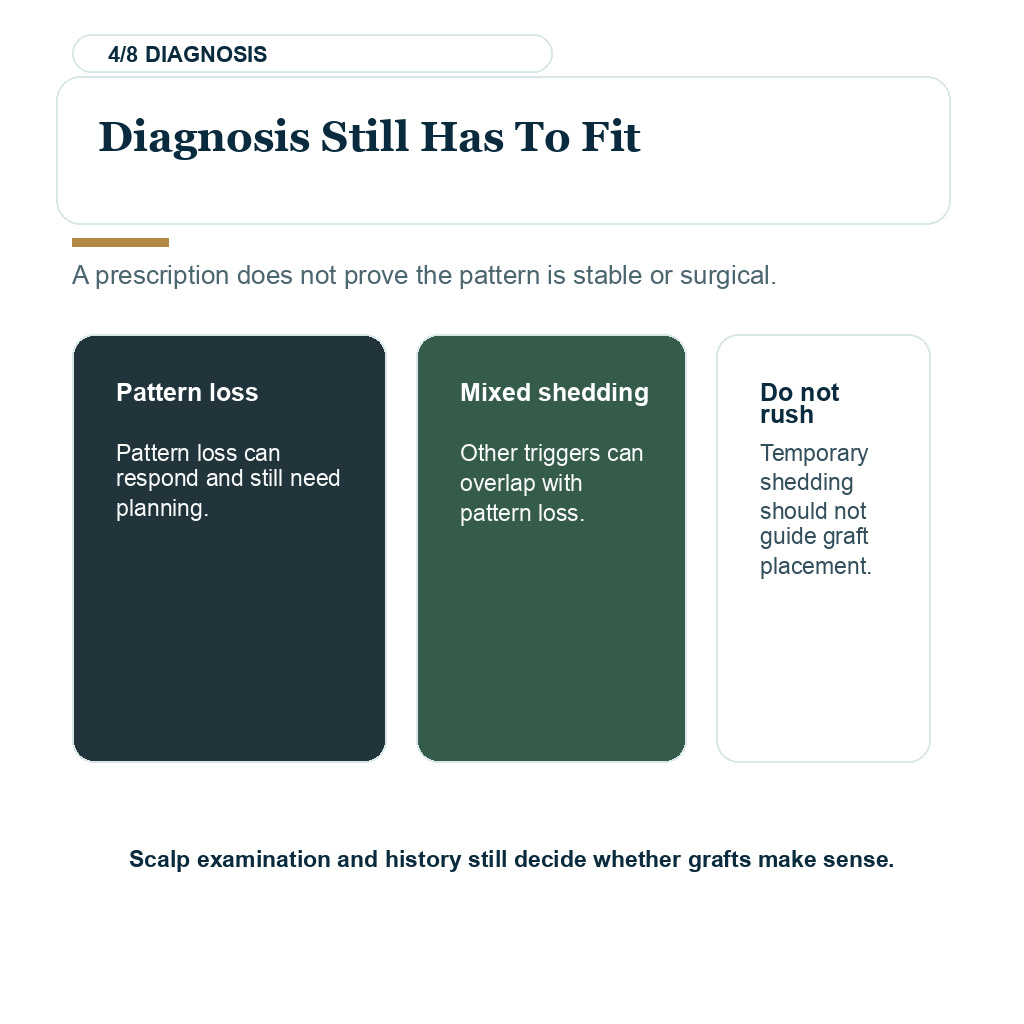
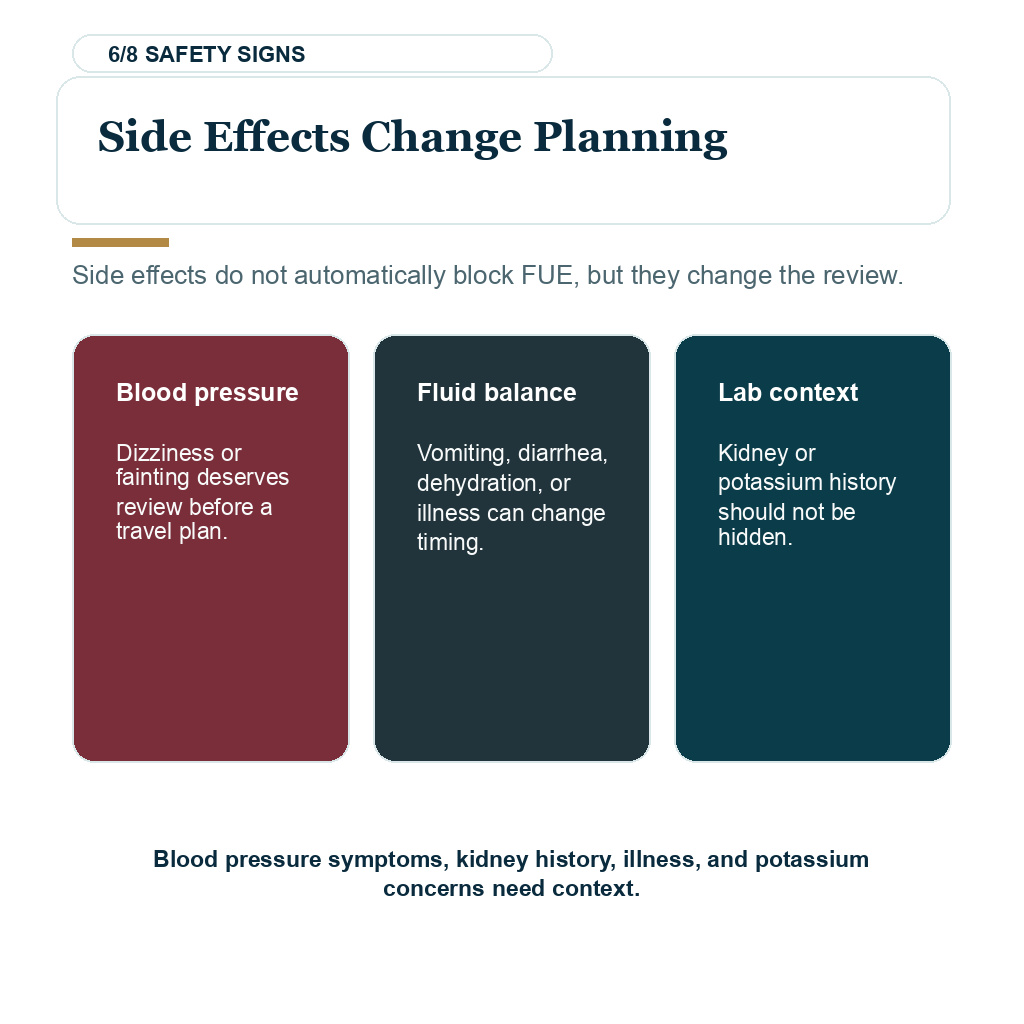
Use the 8 spironolactone and FUE planning slides below to separate disclosure, prescriber coordination, fertility timing, diagnosis, response timing, side effect context, donor checks, and surgical target choice. Swipe the carousel, use the arrows one step at a time, or choose a number below the image to jump to that point.



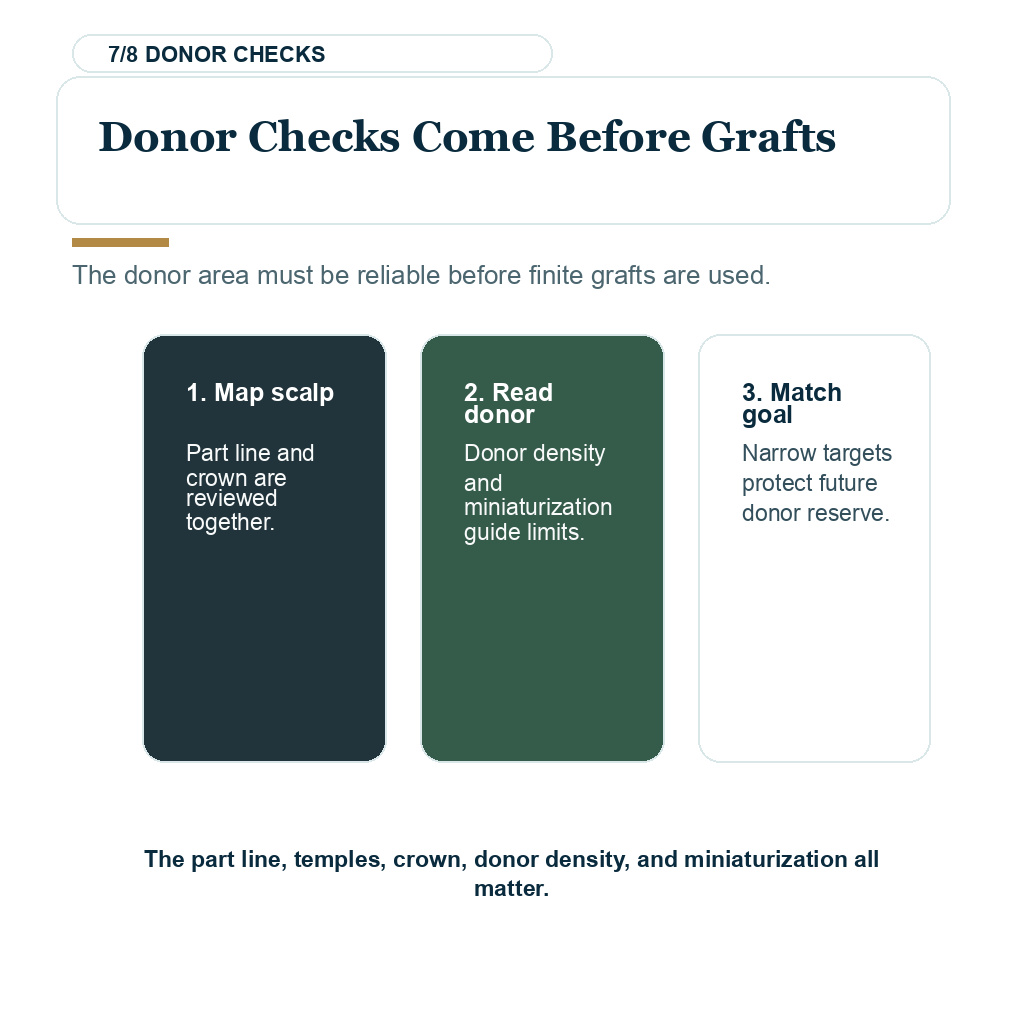

Checks before donor grafts are used
I check the part line, frontal density, temples, crown, donor density, miniaturization, shedding history, medicine timeline, blood tests when relevant, scalp symptoms, and family history. I also ask what you want from surgery, such as a softer hairline, better part line coverage, temple support, or a fuller frame when tying the hair back.
Spironolactone is only one part of that map. A good response can support the plan. A poor response can also teach us something. If the medicine has not helped, we need to know whether the diagnosis is wrong, the dose is not tolerated, the timeline is too short, or another trigger is driving the shedding.
In women, I am careful with diffuse thinning because native hairs are often still present between the planned grafts. Dense placement in a moving area can create shock loss, poor visual payoff, and disappointment. If you are still losing hair on medication before a hair transplant, I separate the speed of loss from visible thickening and surgical predictability.
Pregnancy or IVF can move the surgery date
Pregnancy plans can change the timing quickly. Spironolactone is an androgen blocking medication, so pregnancy, trying to conceive, IVF preparation, and breastfeeding need direct review before an elective surgery date is chosen. This is not a cosmetic detail. It can change the medication plan, contraception plan, and the safe surgical calendar.
I review pregnancy, IVF, and hair transplant timing before an elective operation is placed on the calendar. If embryo transfer is near, a pregnancy test is pending, postpartum shedding is active, or breastfeeding limits medication choices, surgery can wait.
A fertility calendar should not compete with a recovery calendar. A transplant can be discussed later, but I do not want a medication change, fertility cycle, surgery trip, and uncertain shedding pattern all moving at the same time. Any decision to stop, pause, or restart spironolactone should sit with the prescribing doctor and the fertility or obstetric doctor when relevant.
Shedding patterns that change the plan
A spironolactone prescription does not prove that the diagnosis is simple androgenetic hair loss. Some women have telogen effluvium, low ferritin, thyroid imbalance, nutritional deficiency, medication related shedding, inflammatory scalp disease, traction damage, or more than one process at once. If the diagnosis is mixed, surgery has to wait until the permanent part is separated from the temporary part.
When the shedding looks like telogen effluvium and hair transplant timing is still unclear, I slow the surgical decision down. The scalp can look surgically urgent while the true baseline is still unreadable. In that phase, grafts may be used in the wrong place or at the wrong density.
Iron status can create a similar problem. If low ferritin or anemia is part of the history, I review low ferritin and hair transplant planning before treating the case as stable pattern loss. Surgery can move grafts, but it cannot correct an untreated medical trigger for shedding.
PCOS, menopause, and female patterns need separate planning
Female hair loss is not one pattern. A woman with PCOS at 28, a woman in menopause at 54, and a woman with traction damage around the temples can all ask about spironolactone and hair transplant surgery, but they are not the same surgical case.
In menopause related hair loss and hair transplant planning, I review hormones, medicine history, iron, thyroid, donor quality, and pattern stability before grafts are discussed. Menopause can reveal female pattern hair loss, but it can also overlap with shedding from sleep change, weight change, stress, or medication changes.
In a woman whose concern is mainly the front frame, the discussion can be closer to female hairline transplant design. A naturally high forehead with strong donor hair is very different from diffuse androgenetic thinning across the top and sides.
Details to bring to the consultation
Bring the exact spironolactone dose, the start date, the prescriber, any dose changes, side effects, blood pressure symptoms, potassium or kidney concerns, and recent potassium or creatinine results if they were monitored. If the medicine was stopped, bring the reason, the date, and who advised the stop.
Potassium or kidney results need dates as well as numbers, because old monitoring may not answer a new surgery timing decision.
Also bring pregnancy or IVF plans, contraception changes, minoxidil use, supplements, blood tests, dermatology notes, and photos over time. Too much context is safer than a donor plan built from an edited version of the medical story.
Photos matter because female hair loss can look different under different light, hair length, styling, and camera distance. A timeline is more useful than one close image taken on a bad day. A widening part, temple change, reduced ponytail volume, or stable high forehead do not all mean the same surgical plan.
Do not hide dose changes or side effects. The consultation becomes safer when the medical background is visible rather than edited to protect the surgery date. Tell the clinic if you have morning dizziness, fainting, unusual weakness, palpitations, severe nausea, diarrhea, dehydration, or a recent illness before travel.

The dose, timing, side effects, blood test history, and pregnancy plans should be visible before surgery is planned.
Situations where FUE still makes sense
FUE can still make sense for the right woman on spironolactone. The strongest cases have a clear diagnosis, a stable pattern, a donor area that remains stronger than the recipient area, realistic density goals, and a surgical target that is narrow enough to protect donor reserve.
That target may be temple softening, a naturally high hairline, frontal frame improvement, or selected density where the surrounding hair is stable enough. It is weaker when the whole scalp is moving, when the donor is miniaturizing, when shedding is recent, or when medication and pregnancy plans are still changing.
I also discuss what surgery will not do. It will not remove the need for diagnosis, it will not guarantee that native hair stays forever, and it will not make a poorly tolerated medicine suddenly irrelevant. The plan must be built around the real limits of the donor and the real behavior of the hair loss.

FUE is strongest when the diagnosis, medication response, donor area, and surgical target are stable enough to justify graft use.
The medication response must settle before grafts are used
My view is straightforward. Spironolactone can be part of a responsible female hair loss plan, but it is not a surgery passport. If it supports a stable pattern and the donor is safe, it may help the timing of a future FUE decision. If the pattern remains active, the dose is changing, side effects are present, or pregnancy plans are close, surgery should slow down.
The consultation should not stop at how many grafts can be placed. It needs to ask why the hair is thinning, whether the medicine is helping, whether the timing is safe, and what the result will look like if native hair continues to change.
The best FUE plan is the one that still makes sense after the medication story is understood. That means the diagnosis is clear, the donor is protected, the timing is medically sensible, and surgery is solving a defined cosmetic problem rather than chasing a moving target.

Read this review excerpt
Every single one of my questions was answered and they made sure I had all the details I needed to make an informed decision.