



Viagra Cialis and Blood Pressure Before FUE
Many men who use Viagra, Cialis, sildenafil, or tadalafil can still be considered for FUE, but the clinic needs the exact product, dose, reason for use, and last tablet before surgery. In most elective cases, do not take sildenafil, tadalafil, Viagra, Cialis, or a similar tablet on surgery day unless the prescribing doctor and surgical team have already agreed on it. Tadalafil can stay active longer than sildenafil, so a tablet taken yesterday or in the previous few days may still matter.
This does not mean every use of these medicines makes FUE unsafe. It means the medicine belongs in the medical history, not in a private corner of the hotel room. An occasional prescribed tablet for erections is different from daily tadalafil for urinary symptoms, and both are different from a hidden tablet, an online performance capsule, or a pill taken because anxiety rises before the procedure.
Medication clearance gate
Which tablet detail changes the surgery plan?
Use this before guessing a pause window from outside advice.
Tell the clinic the medicine name, dose, and last tablet time. Sildenafil in the previous 24 hours and tadalafil in the previous 48 to 72 hours need review, but the answer depends on the whole medical picture.
Hiding a tablet makes the plan less safe. Product, dose, timing, reason, and heart or blood pressure history all have to be visible before the surgery day is treated as simple.
This medicine matters before a hair transplant
Sildenafil and tadalafil are PDE5 inhibitors. They relax blood vessels and can lower blood pressure. The same effect that helps erections, and sometimes other prescribed conditions, is the reason I ask about them before a long procedure under local anesthesia.
During FUE, I am not only thinking about whether you feel fine at home. I am thinking about the whole setting, including local anesthetic with adrenaline, a long procedure, hydration, anxiety, sleep, coffee, heart history, blood pressure medicine, alpha blockers for prostate or blood pressure symptoms, and whether another medication may be needed during the day. A tablet that seems routine in normal life can become more important when it sits inside that full surgical picture.
I avoid framing Viagra or Cialis as “good” or “bad.” I look at whether the medicine changes blood pressure, field visibility during graft work, monitoring, consent, or the decision to pause. Missing this detail can make an otherwise stable plan unsafe. Do not add a tablet because an online post says it may help circulation. A planned dose and an experimental dose are different safety stories.
Sildenafil or tadalafil needs discussion before surgery
For erectile dysfunction use, share that with the clinic and avoid dosing yourself close to the procedure. Sildenafil taken within the previous 24 hours should be disclosed. Tadalafil taken within the previous 48 to 72 hours matters more because it can remain active longer, and daily tadalafil creates a different exposure pattern again. These time windows are not automatic cancellation rules. They are the reason the surgical team must know whether the medicine may still be active in your body.
Sildenafil usually has a shorter active window than tadalafil. Tadalafil can affect erectile response for up to 36 hours and can be taken daily in low dose. That longer profile is why “I took Cialis yesterday” is not the same message as “I used sildenafil several days ago.” Dose, timing, reason for use, alcohol, blood pressure medicine, alpha blockers, and heart symptoms all change the answer.
Once a surgery date is booked, use the clinic’s medication instructions rather than guessing a pause window from outside advice. Send the medicine name, exact dose, frequency, and the time of the last dose. Include the prescribing doctor’s advice when available. Any answer must account for heart history, blood pressure medicine, alpha blockers, nitrate use, and chest symptoms.
Daily tadalafil needs a separate plan
Daily tadalafil needs a different conversation from occasional sildenafil. One tablet now and then for erections can often be paused more simply than tadalafil taken every day for erectile function, urinary symptoms, or another medical reason.
A regular prescription should not be changed suddenly without telling the prescribing doctor. Daily medication may be tied to urinary symptoms, blood pressure treatment, heart assessment, or pulmonary arterial hypertension. The indication matters as much as the brand name. Even a low daily dose creates continuous tadalafil exposure, so its interaction risk differs from a single tablet taken weeks ago.
Daily tadalafil review depends on why it was prescribed, what a pause would mean, and which other medicines could interact with it during surgery. The plan can be short, but it must be specific to the patient.
BPH or pulmonary hypertension changes the decision
Some men use tadalafil for benign prostate symptoms. A smaller group of patients may use a PDE5 inhibitor for pulmonary arterial hypertension under a specialist. Those situations are not the same as occasional ED use.
If tadalafil or sildenafil is part of a specialist managed condition, the transplant schedule does not override the medical condition. Delaying FUE is better than stopping a medicine that is stabilizing a more important health problem. A cosmetic operation must not create a cardiac, pulmonary, or urinary problem because the medication history was treated casually.
This is also why a preoperative form needs more than a one word medication box. A useful form asks for medicine name, dose, timing, diagnosis, prescribing doctor, and recent symptoms. If the clinic does not ask, the patient still needs to disclose it.
Nitrates and poppers as a hard warning
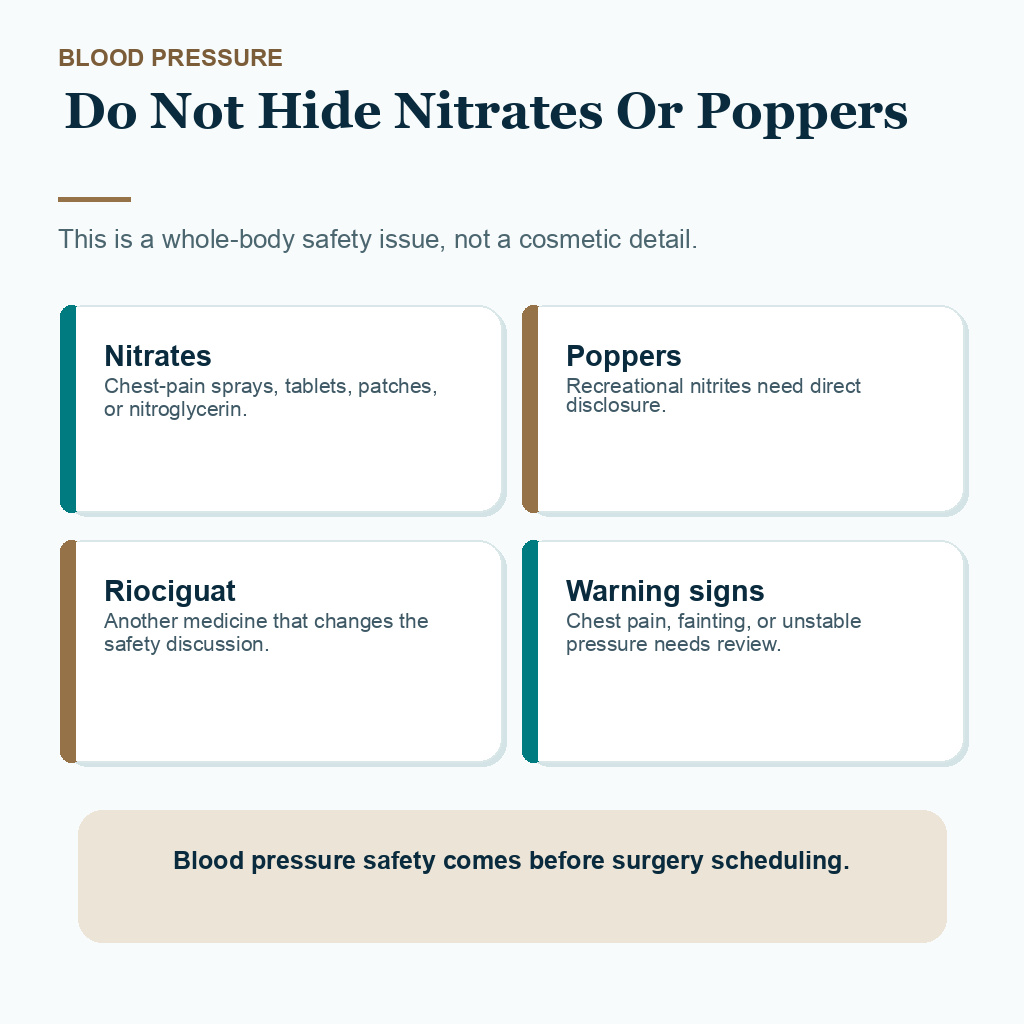
Nitrates are used for chest pain and some heart conditions. Recreational nitrites, often called poppers, can act in the same dangerous direction. Combining nitrates or nitrites with sildenafil or tadalafil can drop blood pressure to an unsafe level. Riociguat is another hard warning because it also interacts with PDE5 inhibitors. This is not a hair only issue. It is a whole body safety issue.
If you use nitroglycerin, nitrate sprays, nitrate tablets, nitrate patches, riociguat, or poppers, do not hide that from the clinic. The answer may be postponement, cardiology review, or a strict medicine plan. It should never be a silent experiment before a long procedure. If chest pain occurs after sildenafil or tadalafil, emergency clinicians need to know the exact last dose before nitrate treatment is considered.
Chest pain, fainting, recent heart symptoms, unstable blood pressure, or a recent stent also changes the conversation. A history of heart disease, stents, and hair transplant safety is more relevant than any cosmetic schedule. The same applies when heart racing around hair transplant surgery is new, persistent, or joined by dizziness or chest pressure.
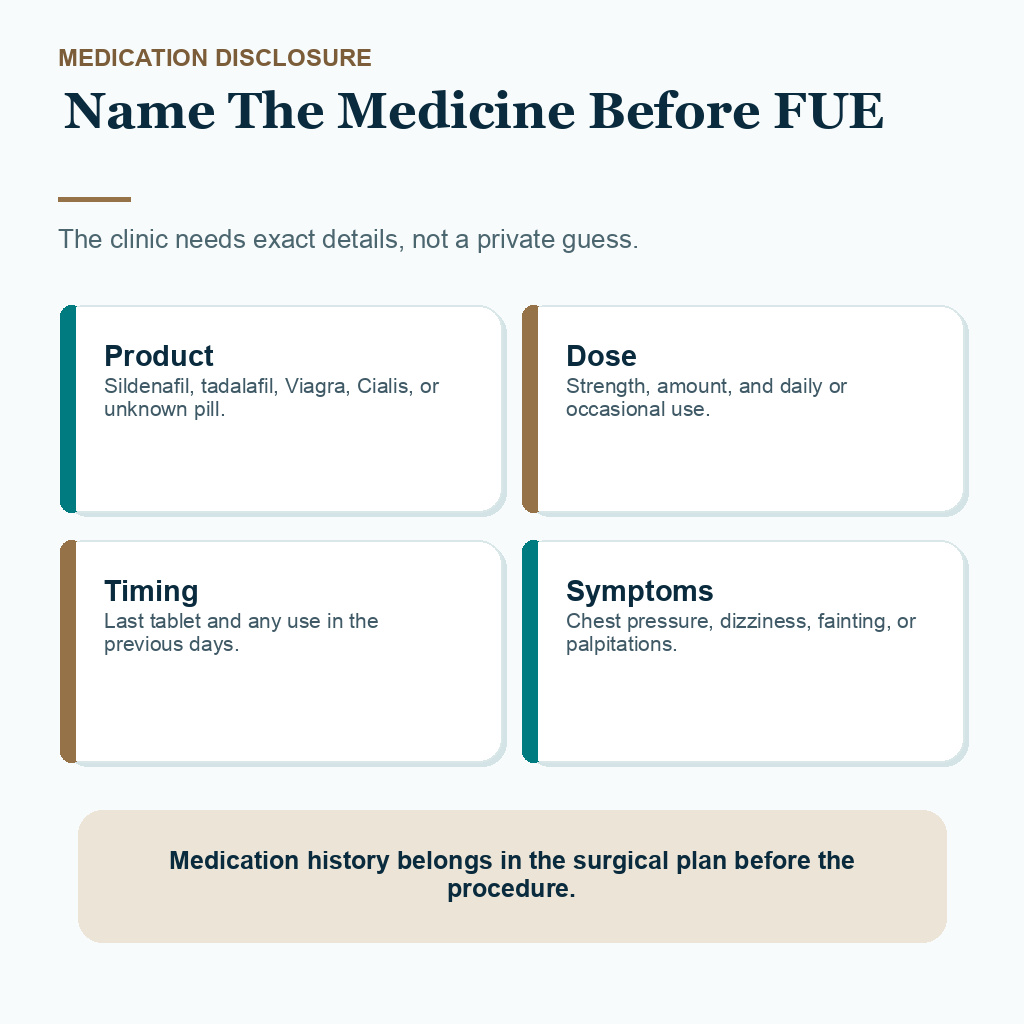
For FUE planning, the medicine name is not enough. Dose, timing, heart medicine, and hidden sexual performance pills change the safety review.
An occasional performance tablet still belongs with heart medicine, blood pressure medicine, nitrate, alpha blocker, riociguat, and symptom history in the safety review before surgery.
Viagra or Cialis and bleeding during graft work
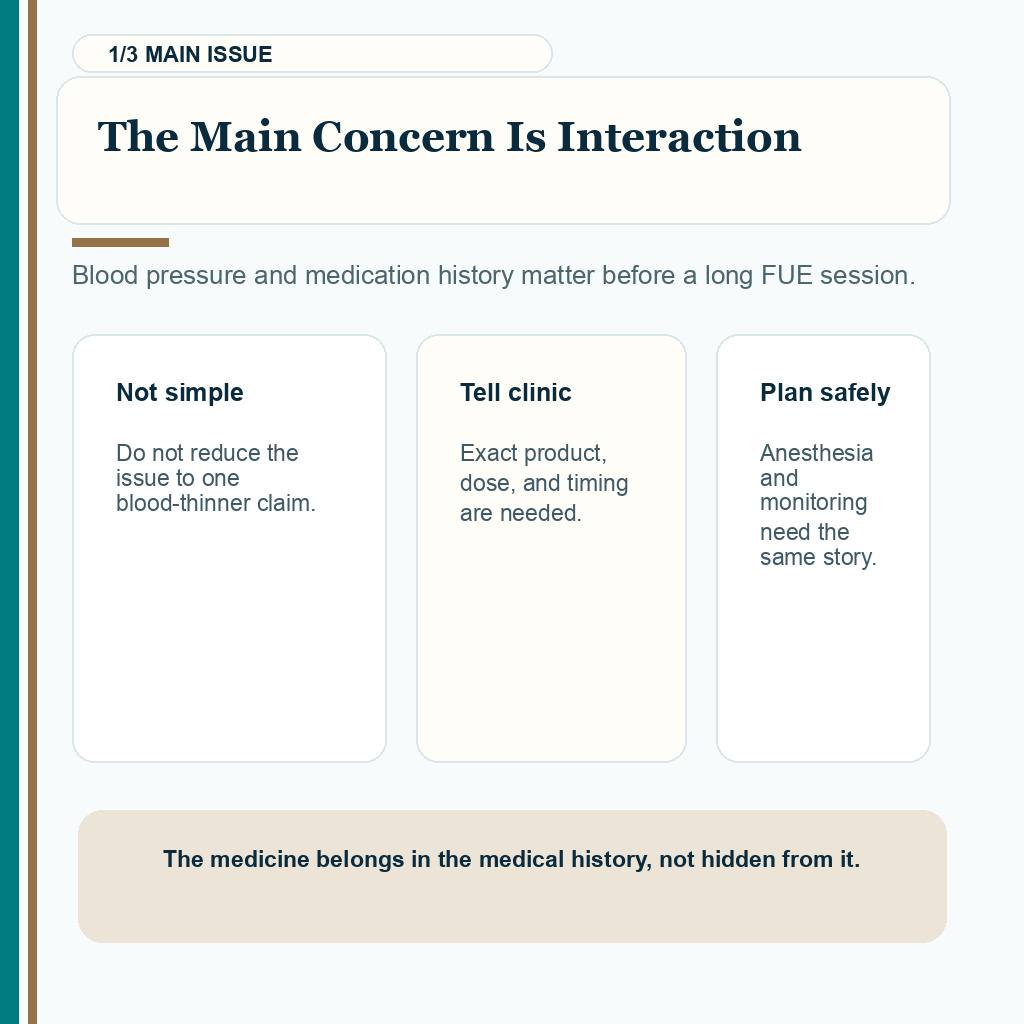
The main established concern is blood pressure and medication interaction, not a simple statement that every ED tablet acts like a blood thinner. Still, scalp surgery is performed in a field where visibility matters. More oozing, flushing, unstable readings, dizziness, or medication stacking can make a long graft procedure harder to control.
Another patient’s protocol cannot decide this for you. I need to know how the tablet fits your heart history, blood pressure, other medicines, and anesthesia plan.
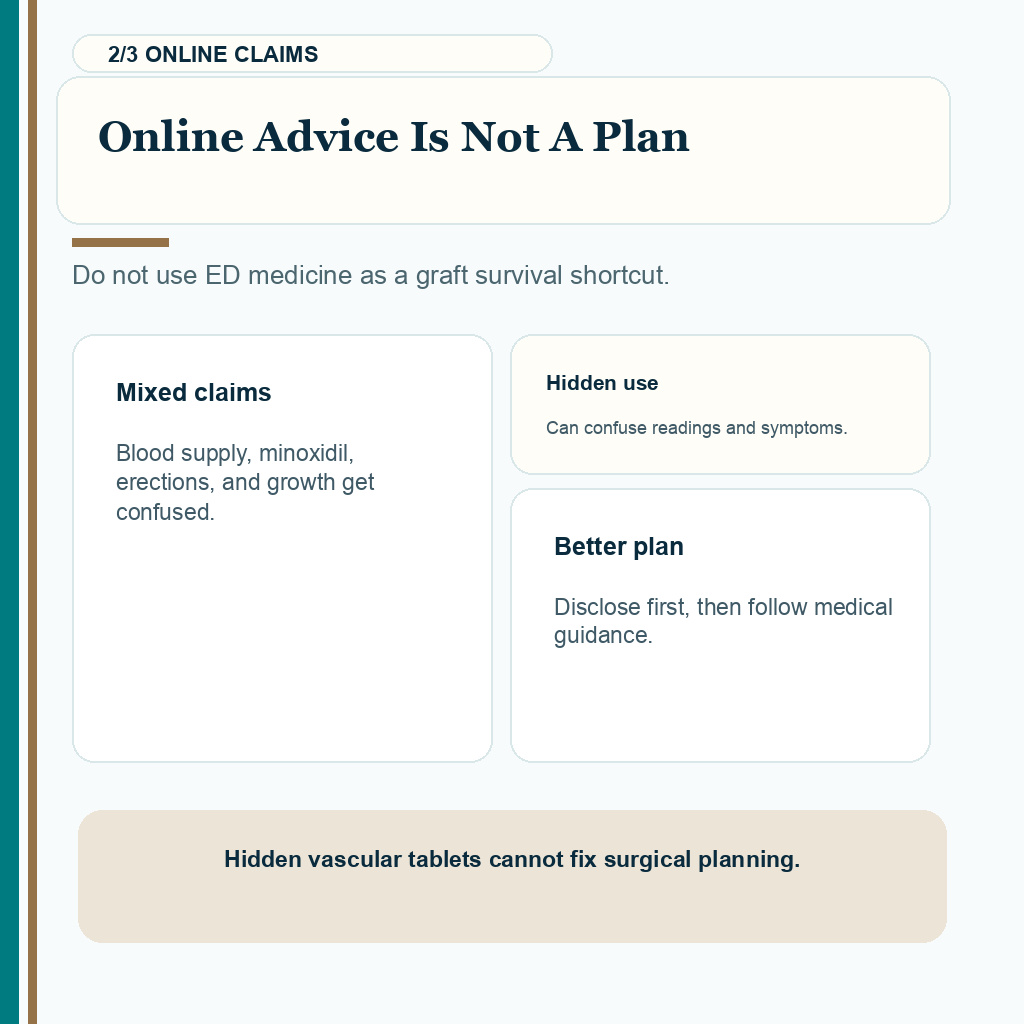
Do not use sildenafil or tadalafil as a graft survival shortcut. The idea appears online because people mix up blood supply, minoxidil, erections, and graft growth. A transplanted graft needs careful handling, clean recipient area work, stable tissue contact, and protection from trauma. A hidden vascular tablet cannot repair poor extraction, rushed placement, infection, aggressive density, or weak donor planning.
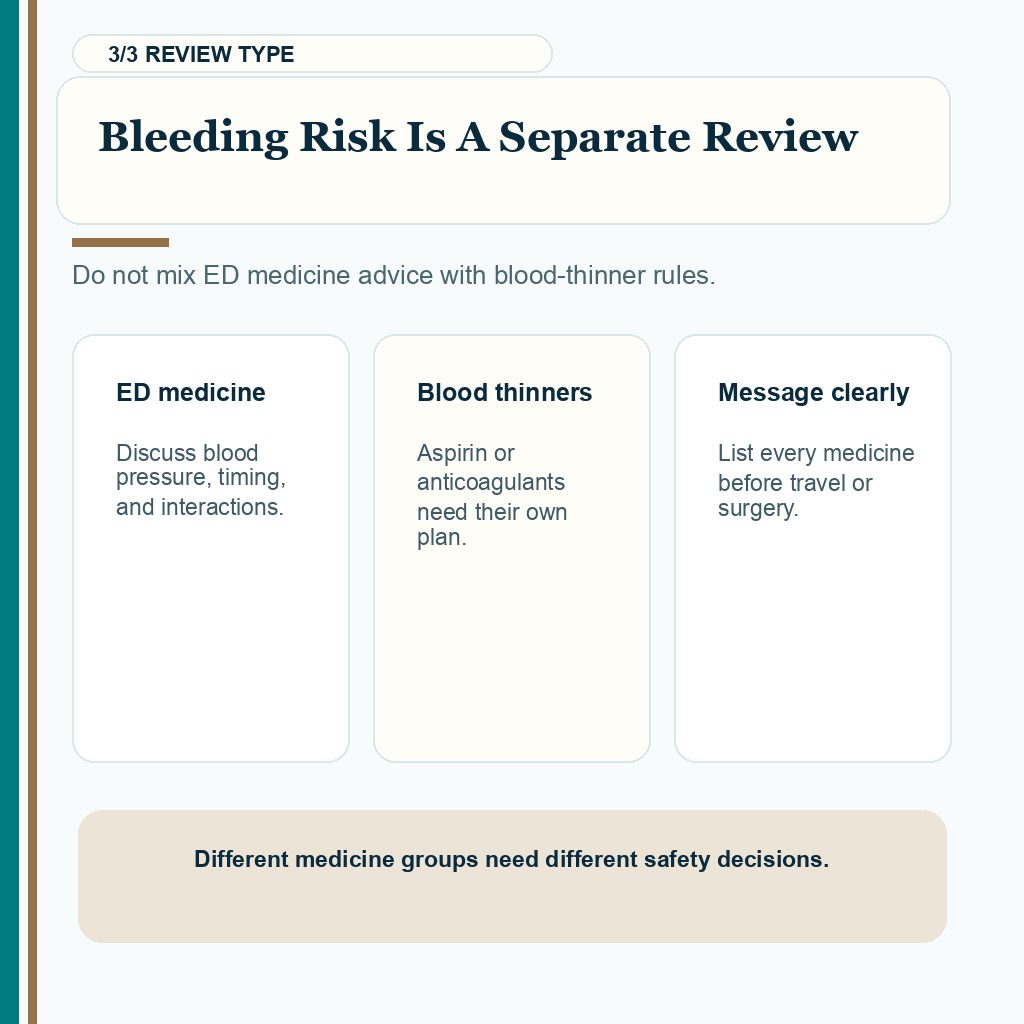
If bleeding risk is the real concern, the stronger pages to review are blood thinners and hair transplant surgery and aspirin around hair transplant surgery. Those medicines have their own rules and should not be mixed into the same casual advice as ED medication.
With Viagra or Cialis, these 3 slides keep erection medicine, blood pressure, and anesthesia planning in the same conversation. Swipe sideways, use the arrows, or choose a number below the image.
Tablet taken without telling the clinic
Say this before the procedure starts, ideally before travel or check in. The medicine name, dose, and timing determine whether the procedure can continue as planned. If the tablet was sildenafil several days ago and there are no heart symptoms, the clinic may only need to record the timing. If it was tadalafil in the last few days, a high dose tablet, a daily dose, an unknown capsule, or a tablet mixed with alcohol or poppers, the decision changes.
The mistake is not only taking the tablet. The bigger mistake is hiding it until the procedure is already underway. A surgeon can work with accurate timing. Working with missing information is much more difficult, especially after local anesthesia, adrenaline, sedatives, or other medication decisions have already started.
If you also took a sedative because you felt nervous, that is a second disclosure. Self medication with Xanax or Valium before a hair transplant can affect consent, monitoring, and travel safety. If alcohol was involved, the timing belongs in the same message. Drinking before a hair transplant has its own pause rules.
Medication message details
Write the message in plain detail. Do not write only “I took Cialis, is it okay?” That forces the clinic to guess.
A useful message includes the exact name on the package, whether it is sildenafil, tadalafil, vardenafil, avanafil, or an unknown sexual performance product. Include the dose, the last time you took it, whether you take it daily or occasionally, and why you take it.
Also include whether you use nitrates, chest pain medicine, riociguat, alpha blockers such as tamsulosin, alfuzosin, doxazosin, or prazosin, blood pressure medicine, or heart medicine. Add any dizziness, fainting, chest pressure, palpitations, unusual shortness of breath, severe headache, vision change, or erection lasting more than four hours. That symptom list is also why ECG or chest imaging before FUE is a case by case safety decision, not a routine paperwork ritual.
This is the same reason I review medication before a hair transplant as part of surgical planning, not as a separate administrative task. A new medicine, new symptom, or new diagnosis after booking can require a medical changes after booking review before travel.
Before surgery, the safest medication message is specific. Include product, dose, last tablet, reason for use, and heart or blood pressure medicine.
Online or natural performance pills can be riskier
Unregulated sexual performance pills are a different problem. Some products sold as natural boosters have been found to contain hidden sildenafil, tadalafil, or related drug ingredients. You may believe you took a harmless supplement, while the body is actually exposed to a prescription strength drug interaction risk.
This matters before FUE because the clinic cannot safely judge a hidden ingredient. A pill bought online, in a shop, at a gym, or from a friend may have unclear dose, mixed ingredients, stimulant effects, or undeclared PDE5 medicine. A photo of the label may not prove what is actually inside. If nitrate medication, blood pressure medicine, alcohol, or recreational nitrites are also involved, the uncertainty becomes more serious.
This is not something to be ashamed of. I am much more concerned when someone stays silent because the topic feels embarrassing.
Sex after surgery is a separate decision
Before surgery, I am deciding whether the medicine is active during the procedure. After surgery, the decision shifts to sex, exertion, blood pressure swings, sweating, and when medication restart becomes reasonable.
Those are connected, but they are not identical. You may be safe to have surgery after an appropriate medication pause and still need to wait before restarting sex or ED tablets after the operation. Viagra or Cialis after a hair transplant needs its own recovery review, especially when blood pressure, sexual activity, regular PDE5 use, dizziness, bleeding concern, or extra postoperative medication needs an individual plan.
For most patients, sex itself is more relevant after surgery than before it. Before surgery, I am mainly concerned with the medication history, the interaction risk, and whether the patient arrives medically stable.
Situations where I would delay the procedure
I delay the procedure if the ED medicine use points to a bigger safety problem, such as chest pain, recent heart event, nitrate or riociguat use, unstable high or low blood pressure, fainting, severe dizziness, unexplained palpitations, unclear pills, heavy alcohol use, or a person who cannot tell us what they took.
I also pause if a patient is using tadalafil or sildenafil for a specialist managed condition and no doctor has advised how to handle the medicine around surgery. Hair transplant timing should bend around medical safety, not the other way around.
If the issue is anxiety about the procedure, do not solve it with hidden tablets. Routine or self directed sedation during hair transplant can create more risk than comfort. The better answer is a clear preoperative conversation, not a private stack of medicines. If chest pain, fainting, severe shortness of breath, or a prolonged erection occurs, urgent medical help comes before any hair transplant decision.
The medication detail controls the surgery day
At Diamond Hair Clinic, sildenafil, tadalafil, Viagra, Cialis, and similar tablets are handled as medical information, not embarrassment. The key details are the exact product, last dose, reason for use, blood pressure history, heart symptoms, nitrate or riociguat use, alpha blockers, and other heart or blood pressure medicines.
If those details are straightforward, the plan may stay simple. If they raise risk, the operation can wait before the first anesthetic injection. That is a medical pause, not a judgment about the patient.

Read this review excerpt
Every single one of my questions was answered and they made sure I had all the details I needed to make an informed decision.