


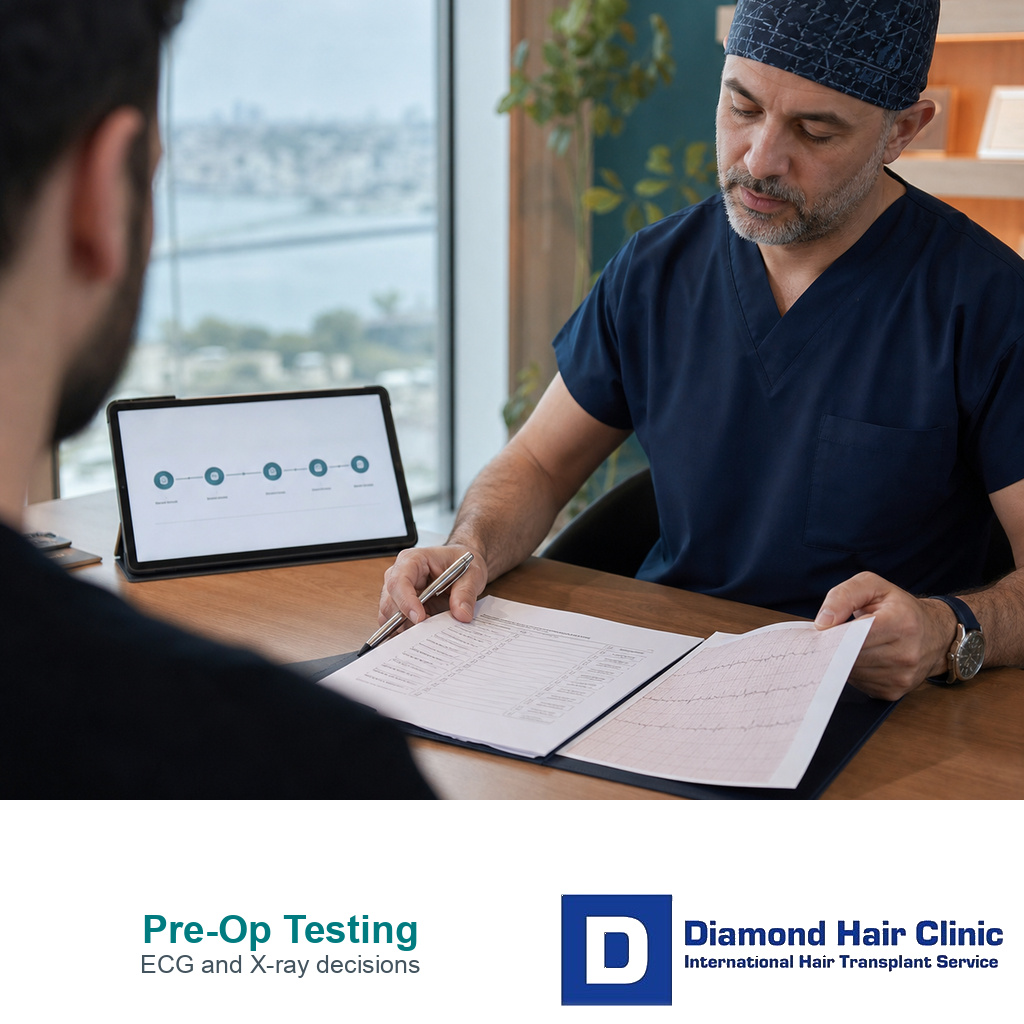
ECG and Chest Imaging Before FUE Need Medical Context
A healthy patient with no heart, lung, fainting, or medication concern usually does not need routine testing before a straightforward FUE plan. I use these tests when the result could change timing, medication planning, cardiology or chest review, sedation choice, or whether an elective operation should wait.
If you have chest symptoms, fainting, a stent, unstable blood pressure, breathing problems, relevant medication, planned sedation, or an old abnormal result, the same tests may become important. The question is not whether a clinic can collect more paperwork. The question is whether the result changes the surgical plan.
A test should answer a specific safety question, not just make the package look more medical. If the answer would not change FUE, the test may only create delay or anxiety. If the answer could change the timing of surgery, medication instructions, specialist review, anesthesia approach, or decision to delay, then I want it reviewed before the travel date becomes the pressure.
Testing should start from the medical story
A clinic may request ECG or chest imaging because its local protocol asks for it in certain age groups or risk groups. Some teams request it because sedation may be involved. Others ask because the patient is travelling from another country, and a preventable cancellation after arrival is stressful.
Those reasons are not identical. A clinic protocol is not the same as a clinical concern. A clinical concern means something in the symptoms, examination, medical history, medication list, previous reports, or planned anesthesia could affect the operation.
For FUE, the usual setting is local anesthesia, often with adrenaline in the local anesthetic, and a long period sitting or lying while the scalp is treated. The surgical field is the scalp, but the patient still has to tolerate the day safely. Heart rhythm issues, unstable blood pressure, breathing symptoms, recent infection, fainting or dizziness around surgery, and significant lung disease all matter.
A form collects facts, but it does not decide whether the risk is acceptable. I still have to connect those facts to the planned hair transplant, the donor area, the expected graft number, the length of the procedure, and the patient’s general condition.
Routine tests may add little for healthy patients
If you are healthy, active, have no heart or lung symptoms, take no relevant medication, and are having a low risk plan under local anesthesia, routine ECG or chest imaging may add very little. A normal result can feel reassuring, but it is not a guarantee.
A normal ECG is not a promise that surgery has no risk. It is only one piece of information. It does not replace blood pressure measurement, medication review, bleeding risk review, allergy history, or a clear explanation of what will happen during the day.
Routine chest imaging can also create confusion when there are no respiratory symptoms and no relevant history. An incidental finding may be real and still unrelated to a scalp procedure. It may need extra review, but that review can delay surgery without improving the FUE plan.
Other checks should answer a surgical question. A proper blood test review before a hair transplant is useful when it answers a surgical question, such as anemia, platelet level, infection markers, kidney function, diabetes control, or medication safety. Testing works best when the question is clear.
An ECG becomes useful when heart history matters
I look at an ECG differently when the heart history makes the result clinically relevant. I pay more attention when a patient has chest pain, shortness of breath with exertion, fainting, unexplained palpitations, previous heart attack, arrhythmia, heart failure, valve disease, a pacemaker, a stent, or poor exercise tolerance.
It can also help when age and risk factors are combined, especially with uncontrolled hypertension, diabetes, kidney disease, or medication that affects heart rate, rhythm, or blood pressure. The ECG does not decide everything, but it can show whether another doctor should review the case before an elective procedure.
If you have a known stent or serious heart history, a quick ECG screenshot is not enough. I need the timing of the stent, current symptoms, cardiology letters, blood thinner plan, and functional capacity. These details shape hair transplant planning with heart disease or a stent more than one test image does.
Blood pressure is another common reason for caution. One high reading on surgery day may be anxiety. Repeated high readings, symptoms, or poor medication control need review, and high blood pressure before hair transplant surgery then becomes part of the planning conversation.
Chest imaging becomes useful when lung history matters
I think about chest imaging when there is a lung reason to look. Recent pneumonia, unexplained breathlessness, persistent cough, fever, low oxygen readings, active tuberculosis concern, significant COPD, poorly controlled asthma, or a previous abnormal chest image can make a report relevant before surgery.
It may also matter if sedation is likely, breathing during sleep is a concern, or a respiratory condition could affect monitoring. FUE is not chest surgery, but breathing comfort still matters during a long procedure.
A chest image cannot compensate for a weak medical history. If the patient has cough, fever, or active infection, medical review and timing judgment come before forcing an elective date. I use the same cautious logic with cold or flu symptoms before a hair transplant.
For known breathing problems, I need the name of the condition, current treatment, recent attacks or hospital visits, baseline oxygen information if available, and previous reports. A single image report cannot carry that whole decision alone.
Abnormal results create questions, not automatic cancellation
An abnormal ECG or chest imaging report does not cancel FUE by itself. It creates a question to answer. An old, reviewed, stable finding is different from a new result that appears with symptoms or has no explanation.

If the abnormality is new, unexplained, or linked with symptoms, the hair transplant date is not the priority. The priority is proper medical review. FUE is elective and can be delayed. A missed cardiac or respiratory problem can create a far bigger consequence than postponing surgery.
A postponed operation can be the safest outcome of screening. The test did its job when it finds a medical question early enough to review it before an elective FUE day.
Sometimes the result changes medication planning. If you use warfarin, clopidogrel, apixaban, rivaroxaban, aspirin, or similar medication, the prescription reason matters as much as scalp bleeding risk. Hair transplant planning with blood thinners and aspirin before hair transplant surgery both depend on why the medication was prescribed, not only on the tablet name.
Sometimes the result changes anesthesia planning. A long FUE day with local anesthetic and adrenaline is different from a short office visit. If heart rhythm, blood pressure, or breathing status is unstable, the plan may need modification, specialist review, or postponement.
How do age, sedation, and adrenaline change the threshold?
Age alone is not the whole story, but it changes the probability of hidden medical issues. A fit patient in the late fifties with stable blood pressure and good exercise tolerance is different from a younger patient with chest pain, fainting, or untreated sleep apnea. The number on the passport is only one part of the risk picture.
Sedation also changes the threshold for review. If sedation is planned, I need to understand airway history, breathing conditions, previous anesthesia reactions, snoring or sleep apnea, and current medication. For comfort concerns, sedation during a hair transplant is a medical choice, not just a comfort upgrade.
Local anesthetic with adrenaline can reduce bleeding and improve surgical control, but it deserves respect with heart rhythm problems, severe anxiety with palpitations, unstable blood pressure, or certain medication profiles. In those cases, local anesthesia and adrenaline during hair transplant surgery belongs in the preoperative decision.
This is the practical distinction patients often miss. A routine ECG in a healthy person may add little. The same ECG in someone with palpitations, a stent, poor exercise tolerance, or new chest symptoms may be very useful. Context decides the value.
Records to send before travelling to Istanbul
Send medical records before you travel, not on the morning of surgery. If you have a heart or lung diagnosis, previous abnormal ECG, chest imaging report, cardiology note, blood thinner prescription, fainting history, shortness of breath, or recent hospital visit, send those records early.

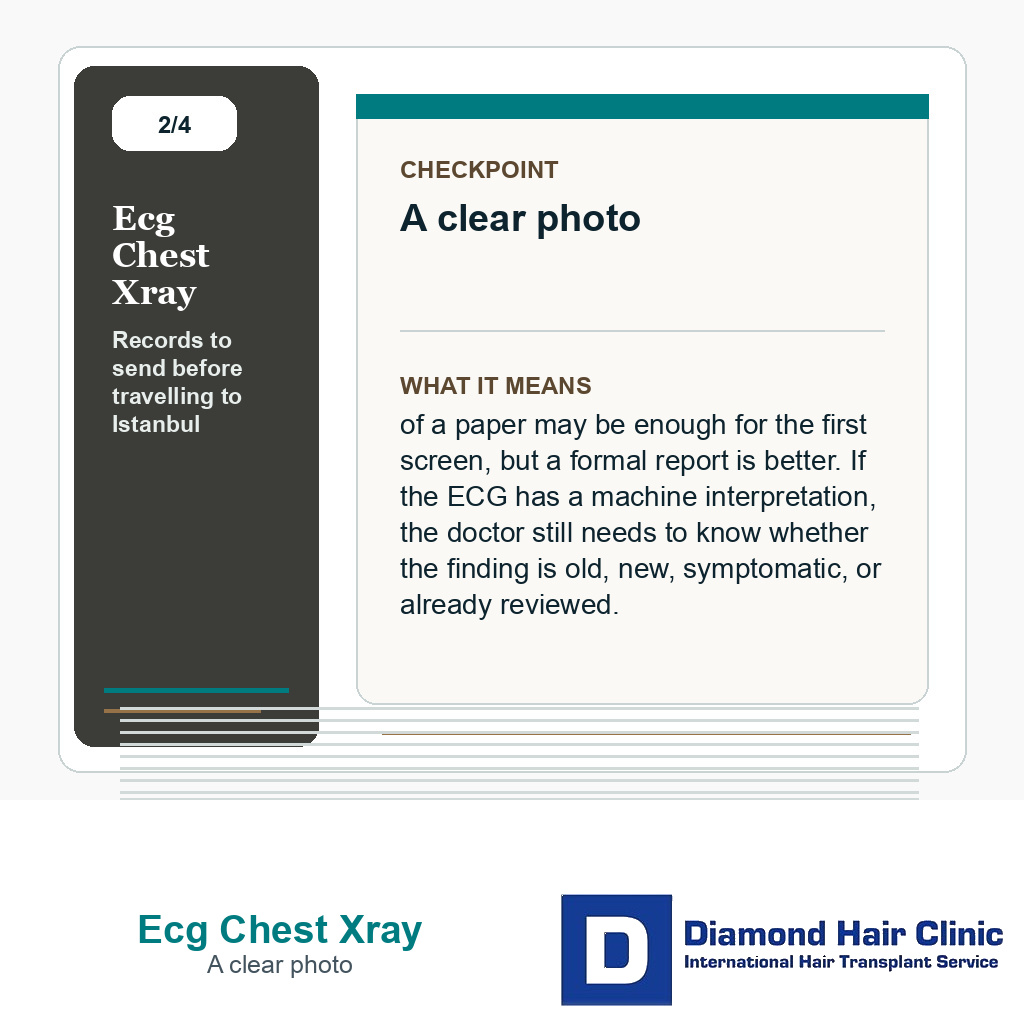
Send the actual report, not only a message saying normal or abnormal. A clear photo of a paper may be enough for the first screen, but a formal report is better. If the ECG has a machine interpretation, the doctor still needs to know whether the finding is old, new, symptomatic, or already reviewed.
When a report is in another language, send the original dated report and any doctor explanation together. A machine label that says normal is less useful than a record showing when the test was done, why it was ordered, and whether a doctor reviewed the finding.
Medication lists should include prescription drugs, supplements, topical medications, blood pressure tablets, diabetes medication, and any drug started by another doctor. Even a detail such as biotin taken before FUE blood tests can matter if a lab result or medical review depends on it.
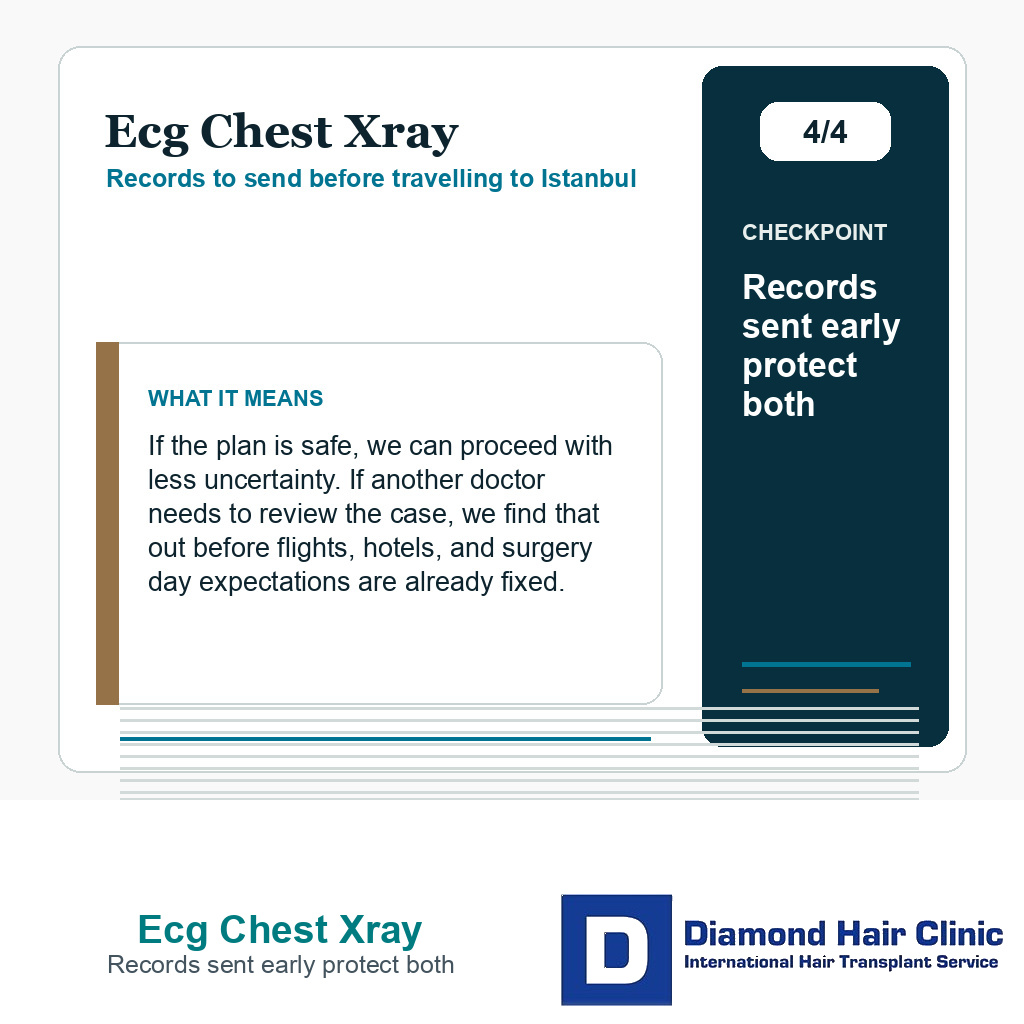
Records sent early protect both sides. If the plan is safe, we can proceed with less uncertainty. If another doctor needs to review the case, we find that out before flights, hotels, and surgery day expectations are already fixed.
These four slides keep the record request practical. They show which records help, what kind of report helps, why medication details matter, and why early review protects the travel plan.


Why do avoidable delays usually happen?
The best way to avoid delays is to share the health story early and clearly. Do not wait until the room before surgery to mention a stent, recent chest pain, fainting, pneumonia, blood thinner, or previous anesthesia problem. That kind of surprise can force a delay because the team has to protect the patient.
Do not stop heart, blood pressure, diabetes, or blood thinner medication on your own to make surgery feel easier. Some medicines need pausing. Some need continuation. Some need the prescriber involved. The wrong change can be more dangerous than the original issue.
Do not chase random tests without asking what question they answer. A test ordered too late can create confusion. A test ordered for the right reason, sent early, and interpreted by the right doctor can make the plan clearer.
Broader safety fears need a focused conversation. If you have read frightening stories about rare complications, more paperwork may feel like the way to remove all risk. It will not. The useful conversation is about serious hair transplant safety risks, the surgical setting, and your medical profile.
How do I use preoperative testing at Diamond Hair Clinic?
At Diamond Hair Clinic, I use preoperative testing as a targeted safety tool, not as a paperwork ritual. I start with the consultation, medical history, medication list, photographs, donor assessment, planned graft number, and expected length of surgery. Then I decide whether existing records are enough or whether extra review is needed.
If the patient is healthy, has no symptoms, and has no relevant history, the focus may stay on surgical planning, donor management, blood test review, consent, and postoperative instructions. If the history contains a heart or lung concern, I slow down and ask for the records that answer that concern.
This approach protects against two opposite mistakes. One mistake is ignoring a real medical issue because the patient looks well. The other is creating delay through testing that does not change the surgical plan.
FUE planning is already complex. Hairline design, donor protection, graft number, medication tolerance, anesthesia, recovery, and future hair loss all need attention. Medical screening should support that plan, not distract from it.
What does clearance really mean?
Clearance is a decision process, not a stamp. A doctor does not make an elective operation safe by writing one word on a form. Safety comes from identifying the relevant risks, optimizing what can be optimized, and choosing the correct timing.
For some patients, an ECG or chest imaging report is a sensible part of that process. For others, it is only a routine request with little value. The difference is found in the history, symptoms, medication, anesthesia plan, and what the result would change.
If you are planning FUE and already have ECG or chest imaging reports, share them early. If you do not have them, ask before arranging tests. Do not order tests just to feel safer, and do not avoid tests just to protect a travel date.
A careful hair transplant plan is never only about grafts. It also includes the patient sitting safely through the day, the donor area that must be protected, and the medical details that can make the procedure more predictable. I do not want the largest stack of tests. I want the right risks known early enough to make the FUE day more predictable.

Read this review excerpt
Every single one of my questions was answered and they made sure I had all the details I needed to make an informed decision.