



Shedding at Months 6 to 8 Needs a Growth Review
Shedding around month 6, 7, or 8 after FUE is not automatic proof that the transplant has failed. At this stage I first separate four possibilities. It may be a normal cycle shift in growing hairs, shedding related to medication, native hair loss around the transplant, or scalp inflammation that needs review. A few hairs after washing is different from the same area becoming thinner over repeated comparable photos with the same light and length.
Some patients hear this called anagen desynchronization. I treat that as a description of a possible growth cycle shift rather than a diagnosis from photos. The review still has to separate a temporary cycle change from native hair loss, medication changes, scalp inflammation, illness, nutrition, and repeated matched photo changes. If shed hairs are not increasing in the sink, pillow, or hands, I do not label the problem as shedding just because coverage looks weak. I review growth direction, density, scalp health, and the original graft map before calling it a shedding episode.
What does anagen desynchronization mean?
In plain patient language, anagen desynchronization means transplanted hairs that began growing at similar times may later stop behaving like one synchronized group. Some hairs keep growing while others enter a resting and shedding phase, so the result can look less even for a period. I still do not use the term as a single diagnosis. The review has to separate stable change over comparable photos from diffuse shedding, medication effects, scalp problems, native hair loss, or growth that is truly lagging.
The useful reading starts with the trend, not with hair counting. I look at whether the same area is progressively thinner in comparable photos, whether the fallen hairs are short new transplanted hairs or longer native hairs, and whether medication, illness, stress, nutrition, or scalp irritation changed before the shedding became obvious. Earlier in recovery, that same distinction belongs to native hair shock loss after FUE.
When the transplant was mainly in the hairline, shedding through the mid scalp points to a different question than short transplanted hairs cycling at the front. The map of the shedding matters as much as the amount seen after washing.
A handful of hairs after a shower is only part of the picture. If density is steady while shedding rises, the review is different from a clear widening gap in the same area.
If the scalp looks healthy and photos remain broadly stable, late shedding can often be watched with structured follow up. If density drops quickly, the loss is patchy, or the scalp is painful, red, scaly, oozing, or smelly, I want to review it instead of giving automatic reassurance.
First checks when shedding starts around month 6 to 8
Month 6 to 8 shedding after FUE can be harmless, but it deserves a more careful reading than the early shedding phase. In the first weeks after surgery, many transplanted shafts fall while the follicles remain under the skin. The earlier 2.5 month shedding and graft loss fear has a different timing and usually a different meaning. Month 6 to 8 is different because new growth has usually started, so you expect forward movement rather than another shed.
The hairs in the sink are only one clue. A few shed hairs, even longer hairs, can appear while follicles move through normal cycles. Longer hair also looks more dramatic in the sink than short early growth, so the visual amount can feel larger than the true density change. One heavy shower is not the same as a visible density collapse in the same region over several weeks. Late shedding is not immediate graft loss, but it is late enough that photos, medication history, and scalp symptoms matter.
Shedding can happen after early growth
Hair does not grow in one synchronized block forever. Transplanted hairs can begin growing at different times, thicken at different speeds, and later enter resting and shedding phases at different moments. Around month 6 to 8, the scalp may show a mixture of newer soft hairs, maturing shafts, and native hairs cycling in the same area. A shaft can shed while the follicle remains in the skin and later produces again. The question is whether the area as a whole is improving, stable, or genuinely thinning.
There are also non surgical triggers. A recent fever, crash diet, major stress, low nutrition, medication change, or strong seasonal shed can push hairs into a shedding phase. When this looks more like a wider telogen effluvium pattern than a change limited to the transplanted zone, the trigger and timeline matter. That does not prove the grafts were damaged. It means the result has to be read together with the whole body context.
For these triggers, I look back two to three months, not only at the week the shedding became visible. Hair cycle changes can appear with a delay, so the timeline should include illness, dieting, medication interruption, and stress from the previous few months.
The opposite direction can worry patients too. Some people barely shed early and then worry that the result behaved strangely. The opposite pattern, little or no shedding after hair transplant, also has its own timing logic. Shedding timing varies. What matters clinically is whether the result is still progressing, stable, or clearly moving backward.
Late shedding differs from the first shedding phase
The first shedding phase usually happens in the first weeks or early months after surgery. The graft has already been placed into the skin, and the visible shaft can fall while the follicle rests. The transplanted area may look worse before it improves, which can be emotionally difficult even when the surgery is progressing as expected.
Month 6 to 8 is a different checkpoint. By then, many grafts should be showing activity, but the hair may still be soft, short, uneven, and visually thin. The checkpoints for six month density after hair transplant and thin appearance at 7 months both use pattern reading rather than final judgment. Late shedding should be read the same way, with attention to new hairs still appearing, hair caliber improving, crown involvement, and native hair thinning at the same time.
Longer fallen hairs need context before graft failure is assumed
Longer hairs falling out can look alarming because it feels as if a full growing graft has been pulled out. Most shed hairs are shafts, not entire living follicles. A true graft loss event is more likely early, usually with bleeding or tissue attached. It is much less likely months later without trauma, infection, or an open wound.
At month 6 to 8, root appearance, region, and trend matter more than the length of one strand. A small pale or white bulb at the end of a shed hair is often a normal club hair, not proof that a transplanted follicle has come out. That is different from an early graft loss event with bleeding, tissue, or a fresh wound. If the fallen hairs are long and scattered, and photos taken in the same light do not show a major density drop, the strand alone is not proof of failure. If the same region visibly thins over repeated weeks, especially with inflammation, pain, or crusting, I take it more seriously.
Do not pull, scratch, or test transplanted hair to see if it is secure. That only adds irritation and anxiety. Use comparable photos and a clinic review instead of mechanical testing.
Medication changes can affect shedding at this stage
Medication history can completely change the interpretation. Starting, stopping, switching brands, missing doses, or changing the form of minoxidil, finasteride, or dutasteride can create a shed that overlaps with the transplant timeline. It is easy to blame the transplant when the real issue is a medication cycle change, unstable native hair, or both. If shedding appears from month 6 through month 8, note any medication change before assuming the transplant has gone backward.
When one area looks weaker after earlier progress, compare that same zone before and after any illness, medicine change, or major stress period.
Minoxidil deserves special attention because starting or restarting it can temporarily increase shedding before the visible pattern becomes clear, while stopping it after it has been supporting hair can create another delayed loss pattern. Routine minoxidil after a hair transplant is one question. A shed that began after starting, stopping, or changing minoxidil has to be read with minoxidil shed and hair transplant timing before blaming the grafts. Finasteride or dutasteride changes can also reveal whether native hair is still dependent on medical stabilization.
Do not stop, restart, double, or stack hair loss medication only because you saw hair in the sink. A rushed medication change can create another shedding variable and make the review less clear. Write down the exact dates, dose changes, missed weeks, side effects, and brand changes, then send that timeline with your photos. A surgeon can interpret the shedding much better when the medication record is not guessed afterward.
Native hair loss can mimic a transplant problem
Transplanted hairs and native hairs around them do not always behave the same way. A good transplant can grow while untreated native hair behind, between, or around it continues to thin. This can feel like transplant failure even when the surgical grafts may be growing.
This distinction matters in diffuse thinning, crown thinning, younger cases, and cases where medication was avoided or not tolerated. Sometimes the visible change is continued native hair loss after hair transplant, not graft failure. When the loss involves existing native hairs near the work zone, native hair shock loss after hair transplant becomes another possible explanation.
At a month 6 to 8 review, border changes matter. A stable transplanted line with thinning behind it, a crown that is opening wider, donor area shedding, or a patchy pattern can point away from the grafts themselves and toward native hair biology.
Month 6 to 8 shedding that needs surgeon review
A review is useful if the shedding is persistent, increasing, localized to one suspicious area, or paired with visible scalp change. I take it more seriously when there is pain, warmth, spreading redness, pimples, discharge, crusting, odor, fever, or a patch that looks worse each week. Redness, scabs, and pimples after hair transplant and scalp odor after FUE recovery are warning sign patterns, not cosmetic details, when they appear with late shedding.
Review also matters after a high density plan, crown work, weak donor hair, active diffuse thinning, recent medication interruption, poor nutrition, or sudden illness. If shedding is diffuse across transplanted hair and hair that was not transplanted, I also want to know about thyroid disease, iron or ferritin issues, rapid weight loss, new medication, and recent infection so the right medical review is not missed. These details do not prove a bad result, but they change how carefully the pattern needs to be interpreted.
A healthy scalp with stable comparable photos is more reassuring than a single handful of shed hairs. A changing scalp, worsening photos, or a clear medical trigger deserves a structured review.
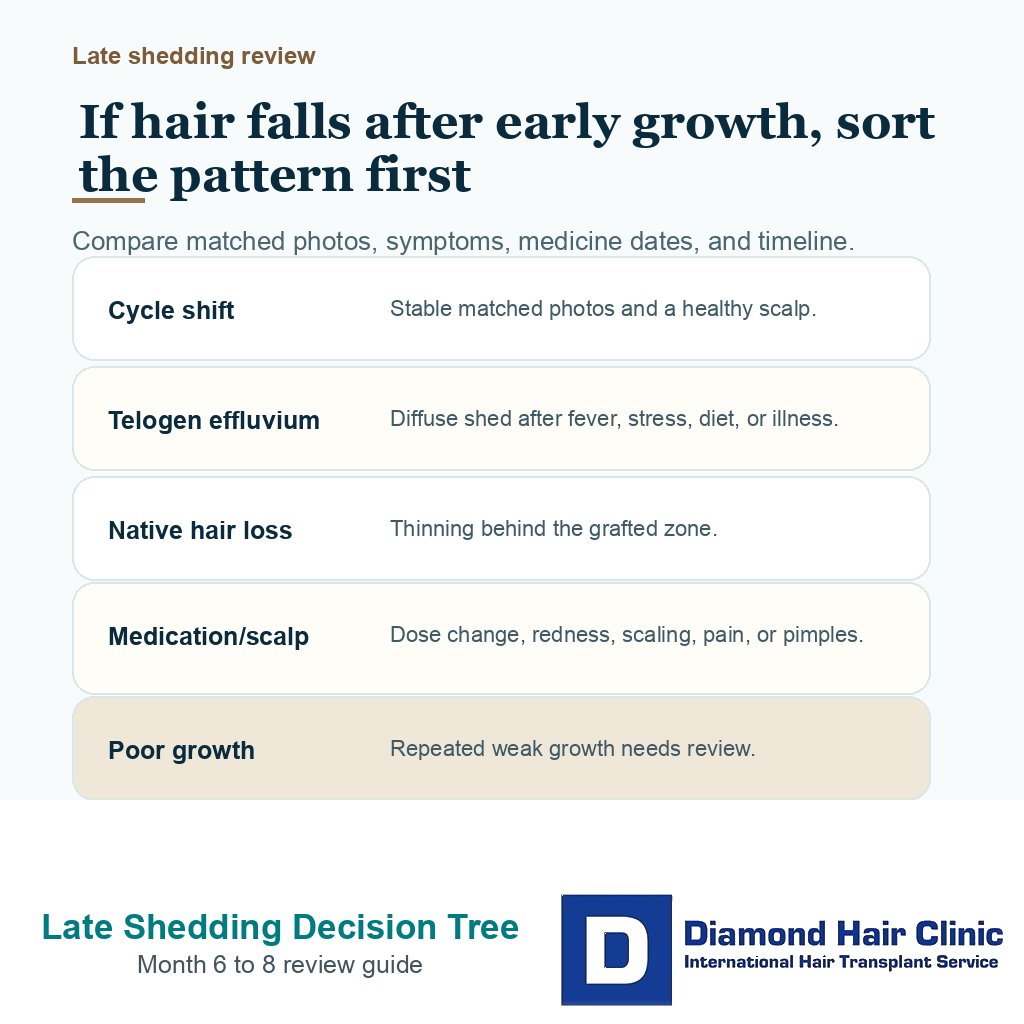
A late shedding review should sort the pattern before assuming graft failure.
Late shedding at this stage should be reviewed with trend photos, medication or health changes, native hair progression, scalp warning signs, photo sets, and the next review window. Swipe sideways, use the arrows, or choose a number below the image.
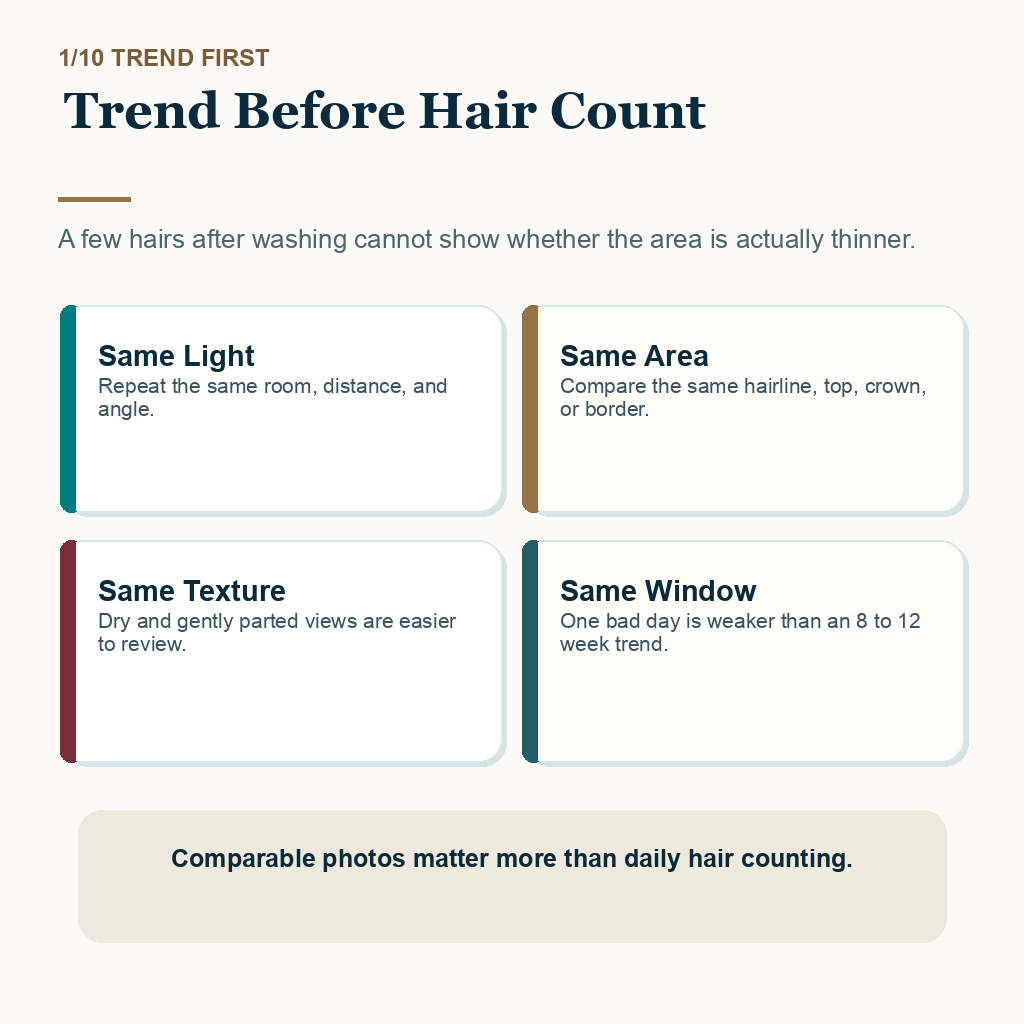





Photos and details that help the clinic review it
Send photos that show the pattern, not only the most frightening close up. A useful set includes the front hairline, both temples, top, crown, donor area, and any area that seems to be shedding. Use the same lighting, similar distance, similar hair length, and both dry and gently parted views if possible. A single macro photo of shed hairs cannot show whether the scalp pattern is improving or declining.
Send the medication timeline with the photos. Include minoxidil, finasteride, dutasteride, supplements, recent illness, fever, weight loss dieting, surgery, antibiotics, stress, and any product that irritated the scalp. If the clinic only receives a photo of hairs in your hand, it cannot judge the pattern well.
If anxiety is making you check constantly, tracking hair transplant growth without panicking can help set a calmer photo rhythm. If you cannot get a clear answer from your clinic, hair transplant follow up after surgery becomes part of the medical quality of the case, not a courtesy afterthought.
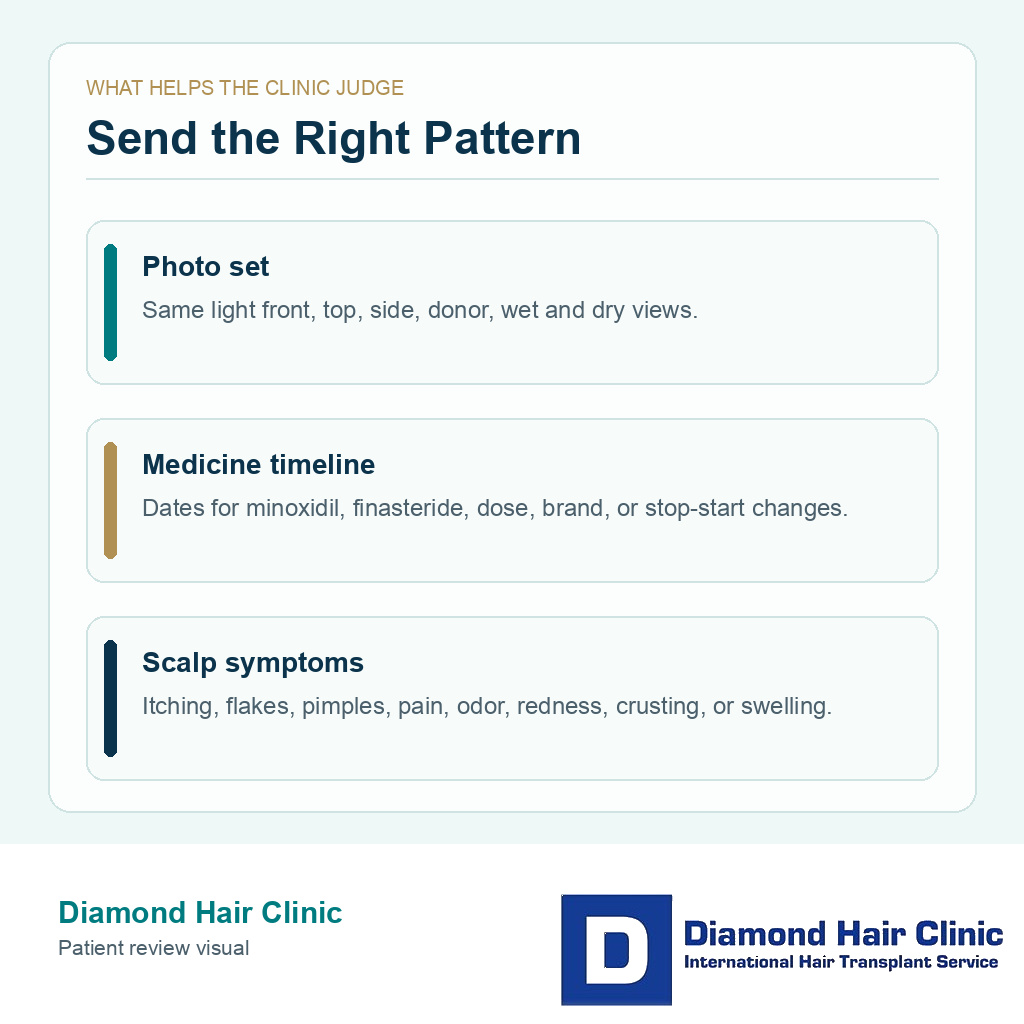
Useful review depends on comparable photos, medication timing, and scalp symptoms.
Habits to avoid while the pattern is unclear
Avoid turning one shedding episode into a chain of new experiments. Do not add multiple products, harsh shampoos, scalp scrubs, oils, microneedling, laser devices, or aggressive massage at the same time. If the scalp is irritated, adding more variables makes the review harder and may make symptoms worse.
Avoid comparing your month 7 result to clinic marketing photos or to another case with different hair caliber, donor quality, graft count, crown involvement, lighting, and medication history. Texture, angle, and maturing hairs can still change later, especially around the hairline, so a month eight hairline review after FUE should stay focused on comparable photos rather than marketing comparisons.
While the pattern is being reviewed, keep haircut length, products, and photo conditions steady so a real trend is easier to see.
Most importantly, do not hide the medication or product timeline because you feel embarrassed. A useful review depends on accurate details. If you stopped minoxidil for three weeks, changed finasteride, used a dandruff shampoo that irritated the scalp, or had fever, say it plainly.
Judging the next two to three months
Use a structured comparison window. If there are no warning signs, I usually want comparable photos over 8 to 12 weeks rather than daily panic photos, daily hair counting, or collecting shed hairs in a bag. Hair cycles do not answer overnight. A real improvement trend may show as better coverage, darker shaft caliber, less visible scalp, and more consistent styling under the same light.
If the area keeps getting thinner, the scalp looks unhealthy, or the shedding connects clearly with medication loss or active native progression, the plan may need adjustment. That does not always mean repair surgery. It may mean treating inflammation, stabilizing native hair, waiting longer before judging density, or planning a future session only after the pattern is clear.
The final result is still usually judged closer to 12 months, sometimes longer for crown work or slower maturation. But month 6 to 8 is not meaningless. It is a useful checkpoint for pattern, scalp health, medication stability, and whether the result is moving in the right direction.
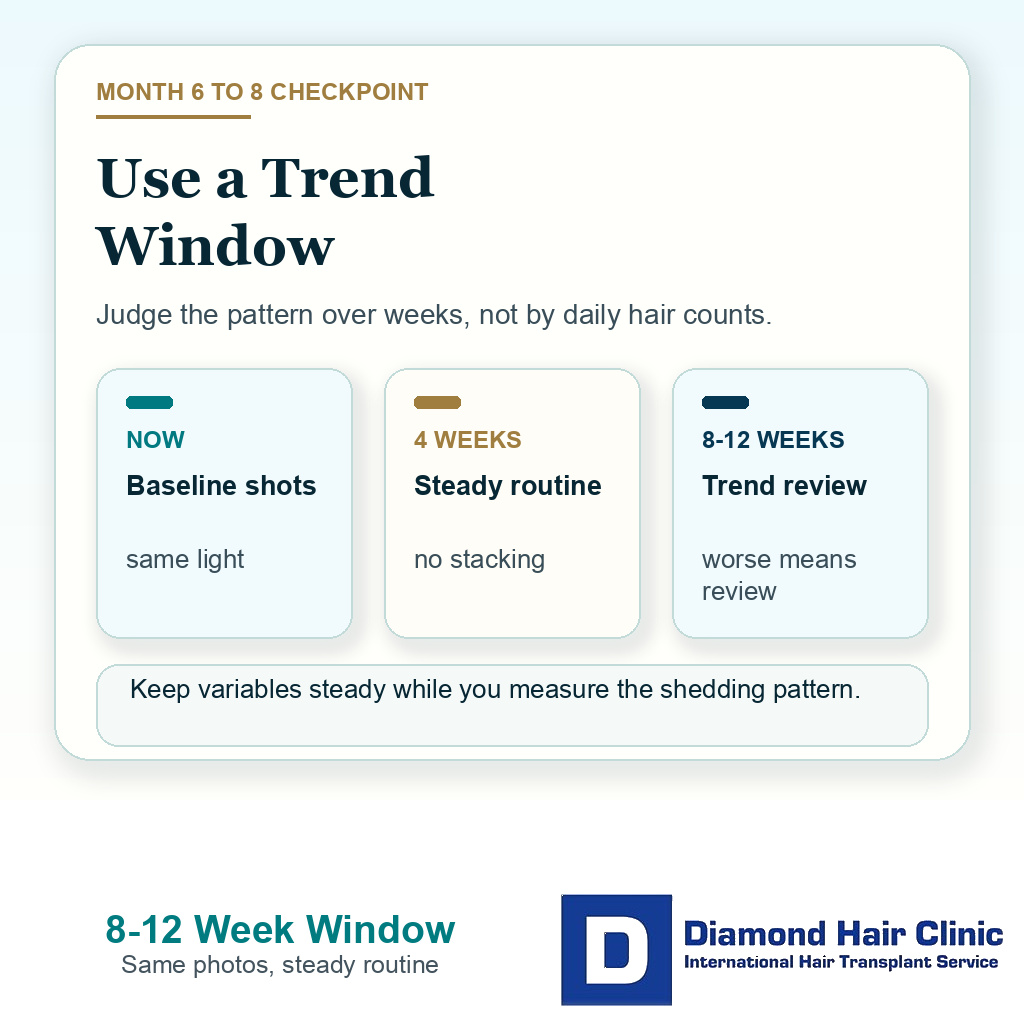
At month 6 to 8, the trend over comparable photos is more useful than daily hair counting.
At months 6 to 8, visible change matters more than shed hairs
Late shedding after FUE is frightening because it arrives when confidence was supposed to improve. I understand that reaction. But a few shed hairs at month 6 to 8 do not prove the grafts are gone. The decision comes from scalp health, stable photos, the medication timeline, and whether the visible pattern is moving in the wrong direction.
If you see sudden visible thinning, patchy loss, worsening scalp symptoms, or a clear change after stopping or changing medication, share structured photos and details with the clinic. If the photos are stable and the scalp is calm, give the hair cycle enough time to declare itself. At this stage, the decision should come from visible pattern change, scalp health, and medication history rather than shed hairs alone.
Read this review excerpt
I asked two questions at all the clinics: how many patients will you take in a day and how much of the work will be done by the doctor.