



Afro Hair Transplant Repair Starts With Curl and Donor Review
A patient with tightly curled hair often comes to me with one urgent request after a weak result. They want it to look fuller, softer, or less damaged. I understand why that request comes first. Still, I do not want the next conversation to begin with another graft number. In an Afro textured repair, the first answer is that repair may include adding grafts, but it may also mean camouflage, selective removal, a smaller staged step, skin treatment, or no surgery if the donor is already too fragile.
Complete photo sets matter more than one flattering or worrying angle. The most useful repair photo set shows the front, both temples, any top or crown concern, and the donor from the back and both sides, in the same light and distance, with dry hair at the haircut length that reveals the problem. I also ask for the previous graft count or surgical record if available, and a plain explanation of what bothers you most. A density gap, a pluggy front edge, a low or straight design, a curl direction problem, visible donor depletion, and reactive skin do not all lead to the same plan.
Before repair planning, send photos at the haircut length that exposes the problem, not only the style that hides it best. Curl can give coverage, but repair decisions need to see the edge, donor texture, and any patchy areas clearly.
Show the curl pattern at the length you normally wear, not only pulled straight for the camera. Repair planning can change when the concern is curl direction, density, or the way short curls group together.
Normal loc styling matters in repair photos
For repair planning, locs should be shown at the length and shape the patient actually wears, not only pulled apart or hidden under one flattering view. Locs and dreadlocks hair transplant planning asks for normal style, parted views, donor views, and tension history before a repair promise is made.
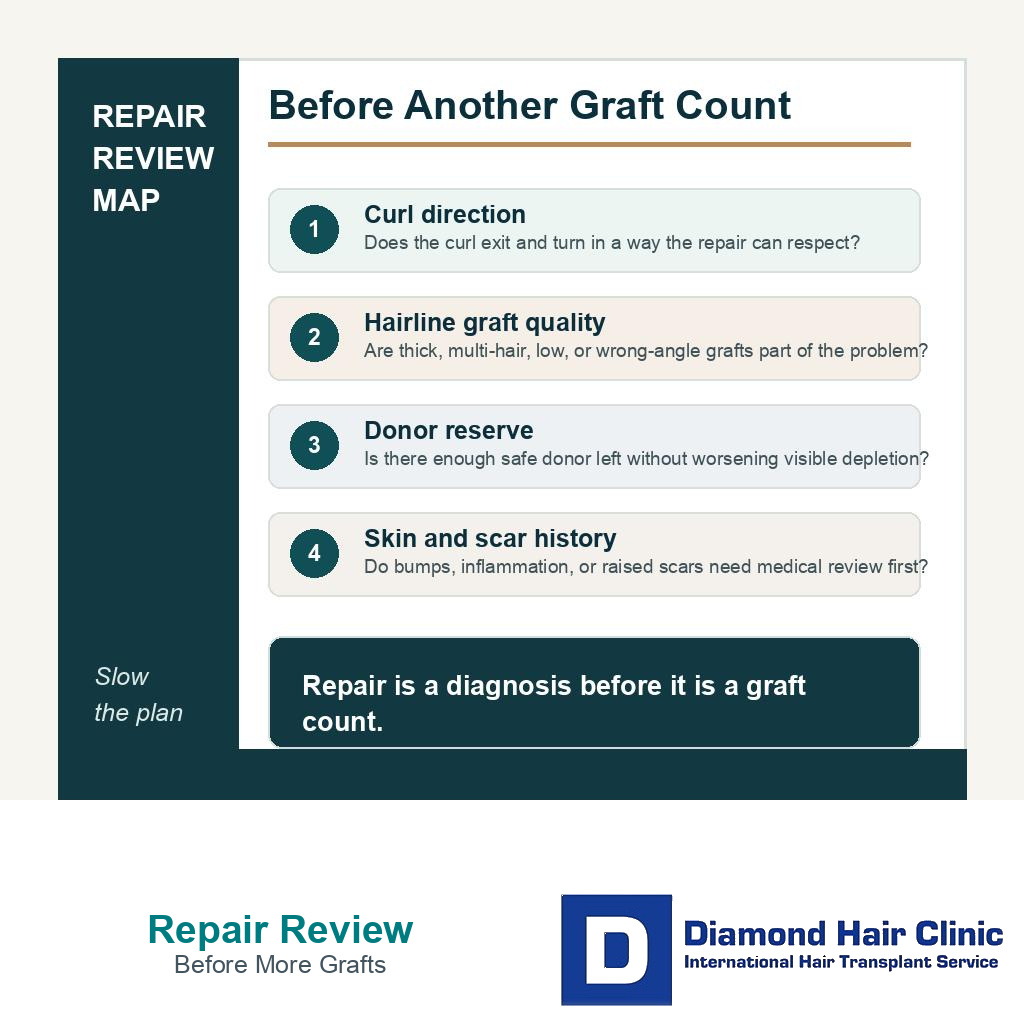
In my consultation, I slow this discussion down. Afro textured hair can give strong visual coverage when planned well, but the curl pattern can hide technical details until the hair is cut short, parted, or viewed from more than one angle. Repair means improving what can be safely improved, not returning the scalp to an untouched starting point. Before I accept a second surgical plan, I want to understand the curl direction, the hairline graft quality, the donor reserve, and the skin or scar history. Only then can we decide whether adding grafts is reasonable, whether the plan should be staged, or whether surgery should pause.
The first repair question is not how many grafts
A patient often comes to repair with one number in mind. How many grafts are needed to fix this? That number matters later, but in Afro textured repair it is not the first safe question. If the first surgery placed thick grafts too far forward, another density pass may make the border look heavier. If the donor area was already overharvested, another extraction may create a visible cost that cannot be hidden easily with short hair.
I still treat bad hair transplant repair as diagnosis before surgery, not as a quick graft count. The repair plan should explain what is being corrected, what should be left alone, what the donor can still support, and what may not be repairable without creating a new problem. A fast second quote can feel reassuring, but it can also skip the part that protects the last good options.
I also take the emotional pressure seriously. A weak or harsh result can make a patient want the fastest visible change, especially when the donor looks patchy or the hairline feels embarrassing. That pressure is one reason I slow the plan down. The remaining donor has to solve the right problem, not every frustration at once.
Timing matters too. If the first result is still early, contact is useful for documentation and safety, but serious cosmetic repair planning usually needs a mature result. Many repair decisions are clearer around 12 months, and sometimes between 12 and 18 months. Waiting for a mature result is different from ignoring active skin, infection concern, trauma, worsening donor symptoms, or clearly misplaced grafts. Those concerns deserve earlier medical review before any routine cosmetic repair plan. If you are not sure whether a result has failed or is still too early, separate that timing question from repair pressure before another surgery is planned.
In an Afro textured repair, I also want to know how the patient wears the hair. A result that looks acceptable at one length can show donor thinning, dotting, or a harsh front edge when the hair is cut shorter. That styling reality changes the repair target. I am looking for a plan that still behaves naturally in the way the patient actually lives with the hair, not only a dense photo on one day.
Curl direction changes the repair review
Afro textured and very curly hair needs a texture specific review because the curl does not only sit above the skin. The follicle and hair shaft can curve beneath the surface, and that changes how extraction, placement, and direction are judged. This does not mean every Afro hair transplant is high risk. It means the review has to be slower and more specific.
The starting principles are the same as in Afro and very curly hair in FUE surgery, but repair adds a harder question. What did the previous surgery do to the natural curl direction? If the hair exits at a poor angle or turns against the surrounding curl pattern, adding more grafts can make the problem more obvious. The repair may need camouflage, selective removal, a smaller density plan, or waiting rather than a routine fill.
In selected cases, a limited first step can be more useful than a large promise. If grafts release poorly, break during extraction, or the donor skin reacts badly, the plan should slow down, shrink, change technique, or stop before more donor hair is spent.
When a second plan promises many grafts, the surgeon’s measurement has to cover more than the headline number. Curved graft difficulty, remaining donor density, and the short hair view after the first surgery all decide whether another operation is realistic.
The previous clinic’s role map also helps the repair review. I want the operative record to separate who extracted grafts, who created recipient sites, who placed grafts, and what the package tier actually changed medically. Without that record, a repair quote can repeat the same blind spot that made the first result difficult to judge.
A free repeat procedure still needs a documented repair plan. The operative record, a current donor review, and a written account of what the next procedure would change should be available before another graft is placed. The second procedure should not be the first attempt to work out what went wrong.
The hairline has to be diagnosed before it is filled
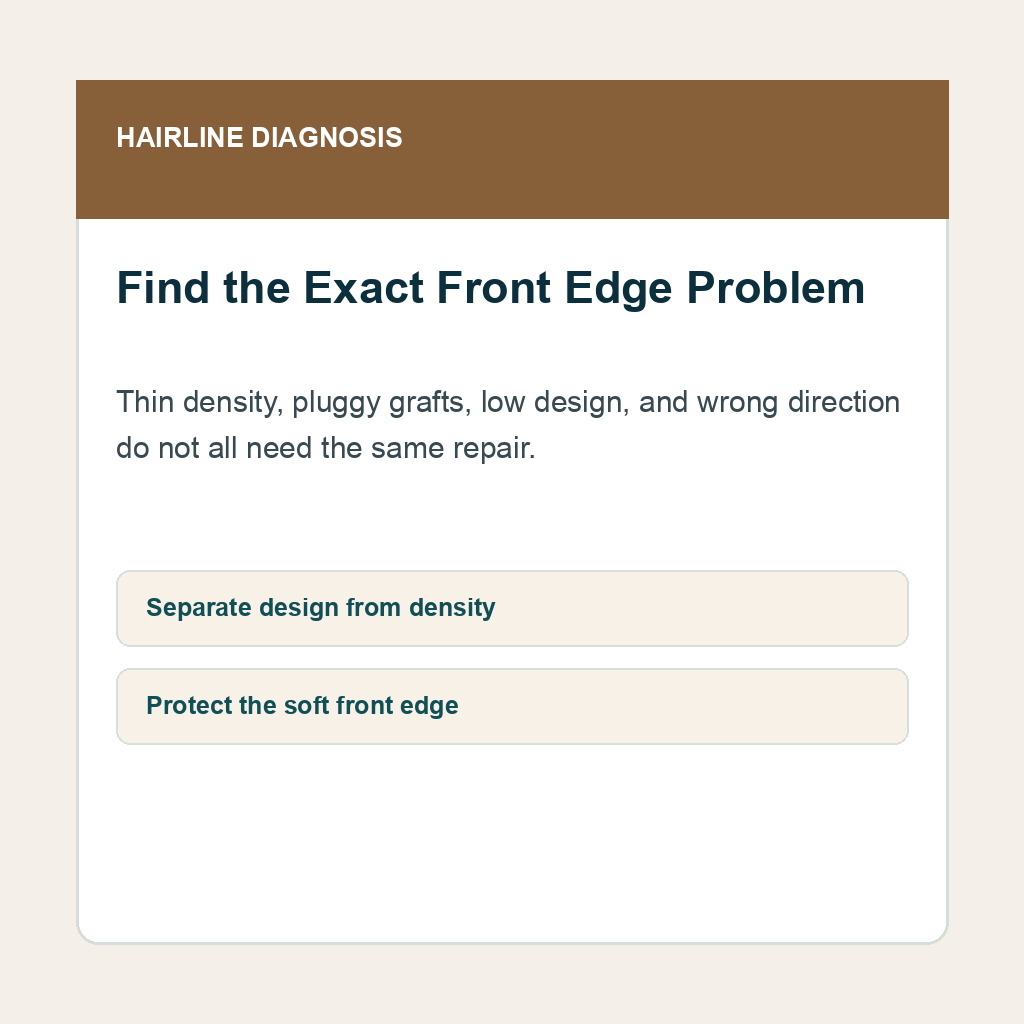
A weak Afro textured hairline can look thin for several reasons. Sometimes the density is genuinely low. Sometimes the front edge has too many thick grafts, too many grafts that contain multiple hairs, a straight border, or direction that does not blend with the natural curl. These problems can sit together, so the repair should not assume that every thin looking area needs more grafts.
When the front edge looks pluggy, I first separate design, graft size, and direction. This is the same reason pluggy hairline repair starts with diagnosis before more density. Thick grafts in the first row need the softness problem handled directly, because grafts with multiple hairs in the hairline can make an Afro repair look harsher even when density improves. For this repair decision, the key point is narrower. Density, graft size, hairline position, and direction should be separated before deciding whether more grafts help.
The repair path changes with density, direction, design, donor damage, or reactive skin. I use these signals to decide whether the repair route is adding, removing, camouflaging, treating skin first, waiting, or stopping. Choose the signal before accepting another graft count.
Density gap
The hairline shape and curl direction may be acceptable, but the result still looks thin in harsh light.
Adding grafts without a donor map can spend reserve on an area that may need a smaller staged plan.
Check donor reserve, hair caliber, and whether native hair loss is still moving before choosing density.
Repair starts with the cause of the visible problem. A graft count comes after that diagnosis, not before it.
A damaged donor area can change every option
The donor area is not separate from the hairline repair. It is the limited reserve that makes repair possible. If the previous extraction left patchiness, visible dotting, weak reserve, or a pattern that becomes obvious with short hair, the next plan has to shrink. In some patients, donor camouflage and styling become a more useful discussion than a large new extraction. For tightly curled hair, the short haircut view can matter as much as the long hair view when donor depletion is being judged.
Temple repair and donor repair are separate problems. A softer front still has to leave the remaining donor wearable at the haircut you actually choose.
I review the donor in more than one condition. Longer hair can hide depletion. Wet hair, bright light, and short hair photos can reveal whether the extraction was evenly spread or concentrated in a way that limits the next surgery. A serious donor map also looks at visible dotting, patchiness at the haircut the patient actually wears, hair caliber, remaining safe reserve, and whether native hair loss is still moving. If the donor is already fragile, even a technically clean extraction may be the wrong choice because the remaining reserve has to support the lifetime plan, not only the next repair session.
An overharvested donor area repair discussion matters here. I do not want to make the donor look worse in order to soften the front. I also want the patient to bring the previous record when possible. A donor record before a second transplant can help us understand what was removed, where it was removed from, and whether the new request fits the remaining reserve.



Skin and scar history must be part of the plan
Afro textured repair planning should also ask about the skin. A history of raised scars, hypertrophic scarring, keloids, acne keloidalis nuchae, active bumps, draining areas, or inflammatory scalp disease can change timing and candidacy. I would not diagnose these issues from a description or a photo, and neither should a clinic quote. Before I judge repair candidacy, I also want to know about raised scars elsewhere on the body, recurring nape bumps, draining areas, current skin treatment, and any dermatologist notes.
This point matters because scar and inflammation risk can be quiet on a casual photo review. If the skin is active, the careful repair choice may be dermatology input, treatment, observation, or a smaller test of surgical behavior rather than immediate cosmetic repair. Delaying a repair is better than operating through a problem that has not been understood.
If a patient has a keloid scar history, I treat the next incision pattern as a medical decision before a cosmetic one. Active bumps or scarring in the lower donor or nape area can mean acne keloidalis nuchae and FUE donor safety has to be addressed before that area is counted as simple reserve. In some cases, medical review comes before cosmetic repair planning.
The repair plan may be staged or smaller
A careful repair can still include surgery, but it may not be the surgery the patient expected at first. Sometimes the responsible repair is a small softening step, not a full density pass. Sometimes the first repair decision is to wait until the result is stable enough to judge. Sometimes the priority is skin quietness, donor mapping, or removal of a few badly placed grafts before any new grafts are added.
A staged plan needs a clear meaning. It is not a way to sell more procedures. It is a way to avoid spending donor hair before the response to the first repair step is visible. If the donor reserve is limited, the staged plan may become very conservative. If the hairline design is the main issue, the repair may focus on shape and softness before density. If the donor area is already visibly damaged, surgery may need to be smaller or avoided.
Repair should protect the last good options
The most important repair principle is simple. Do not let the wish for a fast correction spend the options that remain. Afro textured hair can be very rewarding to plan when the curl, donor, skin, and hairline design are respected, but it can also be unforgiving when repair is reduced to a number on a quote.
A careful green light should name the main defect, the safe donor limit, the skin or scar concern, what will be protected, and what would make me stop. If a clinic cannot name those points clearly, the right repair path may be waiting, a narrower plan, medical review first, or no surgery. That is what keeps the plan surgeon-led, careful with donor reserve, and clear about what repair can and cannot safely do.

Read this review excerpt
told me the quality of my donor hair and what he could take out and advised me what will the be best outcome with what donor hair I had.