- Written by Dr.Mehmet Demircioglu
- Estimated Reading Time 12 Minutes
Sapphire FUE: Why I Use It and How I Believe Patients Should Understand It?
When patients hear the phrase Sapphire FUE, they usually react in one of two ways.
Some assume it must be better because it sounds newer, more advanced, or more premium. Others dismiss it immediately, saying it is just another marketing phrase used by clinics to make a standard FUE procedure sound more impressive.
In my opinion, both reactions are too simple.
Sapphire FUE is not a miracle, but it is not meaningless either. It is still FUE hair transplantation. The grafts are still extracted one by one from the donor area and transplanted into the thinning or bald area. The difference is not in the basic logic of the surgery, but in how the recipient area is prepared.
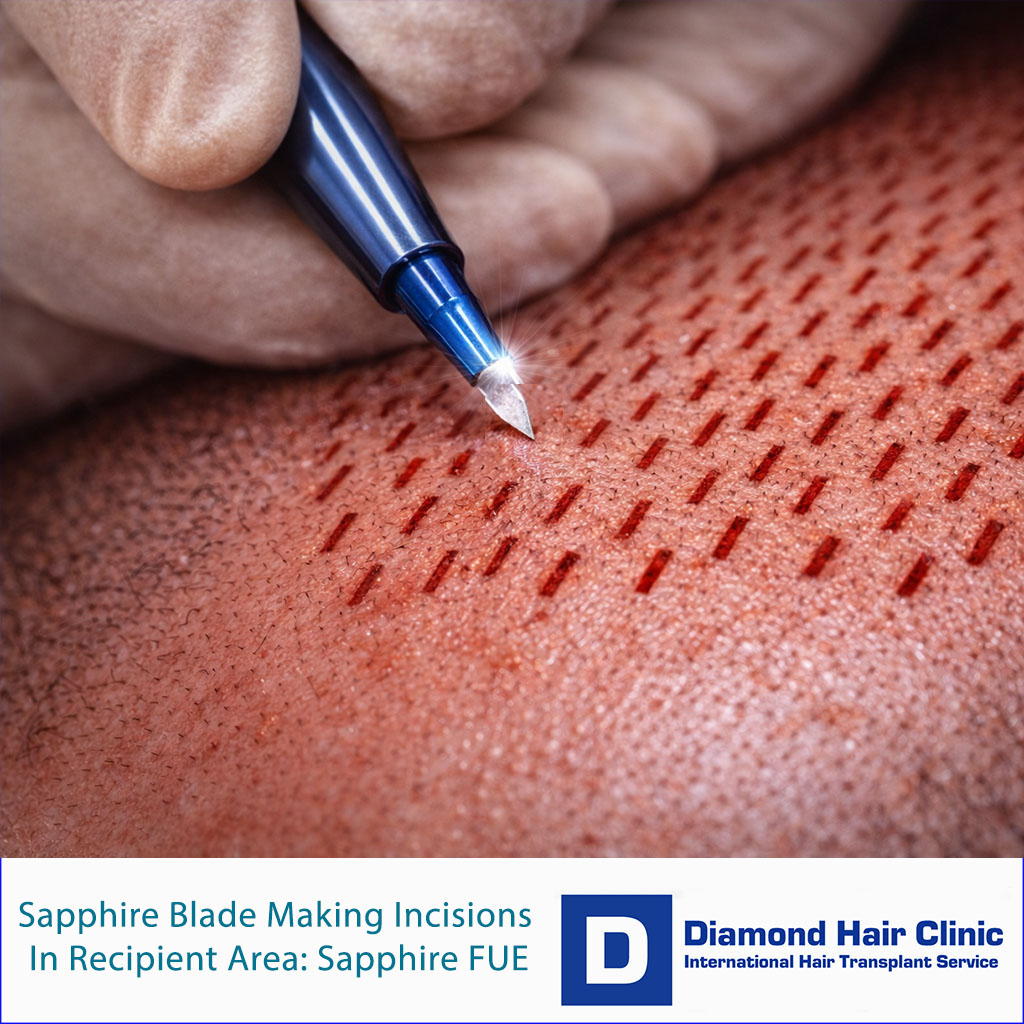
In Sapphire FUE, sapphire blades are used instead of traditional steel blades during the stage of making incisions in the recipient area.
At first, that may sound like a small technical detail. But in hair transplantation, small technical details can affect both the aesthetic quality of the result and the way the scalp tolerates the procedure.
That is why I do not like the discussion when it becomes too exaggerated in either direction.
As Dr. Mehmet Demircioglu, I do not think sapphire should be treated as magic or a miracle, nor should it be dismissed as empty branding. I think it should be understood properly.
What FUE Really Means, and Why the Recipient Area Matters So Much?
FUE, or follicular unit extraction, means removing naturally occurring follicular units individually from the donor area and transplanting them into the area where hair has become thin or absent.
These follicular units usually contain between one and four hairs, and sometimes even more than four hairs.
In patients, the donor area is the back and sides of the scalp because the hair in these regions is usually more resistant to the hormonal influence that drives common male pattern hair loss. Once these grafts are transplanted, they generally preserve that resistant characteristic. This is one of the reasons hair transplantation can offer a long-term solution, although age, progression of hair loss, medical treatment, and long-term planning still matter greatly.
Many patients understandably focus first on the donor area. They want to know how many grafts can be extracted, whether the donor area will remain natural, and whether they will still be able to wear short hair after surgery. These are important questions.
But the final naturalness of a hair transplant is not decided by extraction alone.
The recipient area is where the visual character of the transplant begins to take shape. That is where the angle is determined, where the direction is controlled, where the spacing is planned, and where density begins to become visible. It is also where the softness or harshness of a hairline is created.
This is why I never see the recipient area as a simple mechanical stage. It is one of the most judgment-dependent parts of the entire operation.
A case can have acceptable graft extraction and still look unnatural if the work in the recipient area is weak. On the other hand, when the recipient area is prepared with control, restraint, and aesthetic understanding, the result is much more likely to look natural and age well.
That is the context in which sapphire becomes important.
Why I Adopted Sapphire Early?
My belief in sapphire does not come from trend or branding.
I have been creating the recipient area with sapphire blades since 2016. In that sense, I consider myself one of the earlier adopters of this instrument in Turkey, and in my opinion, also one of the earlier adopters in Europe. Even today, many clinics, including some major names in the hair transplant industry, still use traditional steel blades rather than adapting their hands to sapphire.
I say that not to criticize others for the sake of criticism, but to make one point clear: sapphire is not something I began using after it became fashionable to advertise. I began using it because, in my own surgical work, I came to believe it offered real practical advantages.
That distinction matters to me.
If a surgeon adopts a technique because it sounds attractive on a website, that is one thing.
If a surgeon adopts it early, keeps using it for years, and continues to trust it because of what he has personally observed in the operating room, that is something very different.

Why I Believe Sapphire Offers a Real Advantage?
In my own experience, sapphire blades allow narrower, cleaner, and more refined work in the recipient area than traditional steel blades.
One practical reason is that sapphire tends to preserve sharpness better during use. When an instrument becomes less sharp, the work can become rougher, precision can decrease, and tissue may be handled less delicately. Once that happens, the quality of the work in the recipient area may suffer, and the scalp may also respond less favorably.
That is why I value sapphire. It helps me maintain a more controlled, refined approach when preparing the recipient area.
Cleaner work matters because cleaner work can mean less unnecessary tissue injury. Less unnecessary tissue injury can mean less trauma for the scalp. And less trauma can contribute to a smoother postoperative course.
This does not mean the blade alone creates a good result. No blade can replace judgment, planning, or experience. But a useful instrument can help the surgeon express those things more precisely, and that is exactly how I see sapphire.
What I Have Observed in My Own Practice?
Over the years, I have observed that when the recipient area is carefully prepared with sapphire blades, the tissue often tolerates the procedure better.
By that, I mean several things.
I mean a cleaner preparation of the recipient area while making incisions.
I mean more precise control of angle and direction.
I mean more delicate tissue handling.
I mean grafts that often sit more appropriately within the tissue.
And I also mean a postoperative course that, in my own experience, is often smoother.
In my practice, I believe this has contributed to fewer postoperative problems such as excessive bleeding in the recipient area, unnecessary hematoma formation, and circulation-related tissue stress. I also believe that careful, non-aggressive work of this kind can help reduce the risk of severe complications such as tissue compromise that may progress toward necrosis.
Of course, I say that carefully.
No serious surgeon should claim that any single instrument makes complications impossible. Surgery does not work that way. Tissue behavior still depends on many factors, including vascularity, smoking, scalp quality, density planning, previous surgeries, postoperative care, and the overall discipline of the operation.
But I also do not think it would be honest to ignore long-term clinical experience. My own experience is that sapphire has been a meaningful and useful instrument, not only for the quality of the work itself, but also for the way the scalp often behaves afterward.
I have also observed that when the recipient area is prepared more precisely, the grafts usually sit more securely within the tissue. That matters not only for angle and direction, but also for graft stability in the early postoperative period. More refined work can help reduce the chance of unwanted movement, positional change, or partial dislodgement.
The healing phase is influenced by this as well. Cleaner and narrower work in the recipient area is often associated with less tissue injury, less roughness during healing, and in many cases, less scab formation than cruder or less refined work.
These are not flashy marketing points. They are practical surgical observations. Practical observations matter far more than impressive slogans.
In Which Cases Sapphire Matters More?
I also think it is important to speak realistically.
Sapphire does not carry the same weight in every patient.
In some cases, I believe its value becomes more meaningful.
For example, when I want especially refined work in the frontal zone, softer hairline transitions, delicate angle control, or very careful handling of the recipient area, the advantages of sapphire become more important in my hands.
This can be especially relevant for patients with finer hair, those seeking a more detailed hairline design, or in cases where subtlety matters greatly. In such patients, the quality of the work in the recipient area becomes even more important.
In other cases, broader surgical judgment matters much more than the blade itself. If a patient has limited donor capacity, unstable hair loss, diffuse thinning, unrealistic expectations, or a case that is not well indicated for surgery, then the choice of blade will never be the decisive issue.
That is exactly why I do not present sapphire as if it were equally important in every case. Sometimes it matters more. Sometimes it matters less. The surgeon’s judgment remains more important than the instrument.
Where Hair Transplant Clinics Misuse Sapphire?
One reason some patients have become skeptical of Sapphire FUE is that many clinics misuse the term.
The most common example is density.
Patients naturally want good density. That is completely understandable. But some clinics use Sapphire FUE as if it were a license to promise extreme density in the recipient area, sometimes speaking in unrealistic terms such as 70 or 80 follicular units per square centimetre.
I do not consider that kind of language serious.
Neither sapphire nor steel changes the biological and aesthetic limits of hair transplantation. Hair still has to be placed at the proper angle, in the proper direction, with proper spacing, and with respect for tissue conditions and blood supply. If density is pushed too aggressively, the result may begin to look unnatural, harsh, or pluggy.
This is where I think skeptical patients are partly right. Many clinics do turn sapphire into a marketing device. They speak about it as if the blade itself creates the artistry, the healing, the density, and the naturalness. That kind of language naturally creates distrust, and I understand why.
But it would also be wrong to conclude from that that sapphire means nothing.
A sapphire blade is a real surgical instrument. In my own practice, I believe it has real value. What becomes a gimmick is not the blade itself, but the way some clinics advertise it.
That is an important distinction.
Why a Good Blade Still Cannot Rescue Bad Surgery?
No patient should choose a clinic simply because it says Sapphire FUE.
A clinic can use sapphire and still overharvest the donor area. It can still create an unnatural hairline. It can still push density too aggressively. It can still have weak angle control. It can still work in a technician-driven, high-volume, hair mill model.
The instrument can support quality, but it cannot create quality by itself.
That is why I do not treat sapphire as a standalone selling point.
I do not build surgery around a blade alone.
I build it around diagnosis, surgical planning, donor management, recipient area discipline, naturalness, restraint, and long-term thinking.
If those things are weak, the blade will not save the case.
Sapphire FUE and DHI Should Not Be Confused
Patients also often confuse Sapphire FUE and DHI, as if they are simply two trendy labels competing against each other.
That is not the right way to understand them.
Sapphire FUE primarily refers to the use of sapphire blades during incisions in the recipient area. DHI is a different discussion, more related to implantation logic and instrumentation.
So when patients compare these terms, they should not compare them like brand names on a shelf. They should ask a more serious question, what exactly is changing in the surgical process, and why?
That is the more intelligent way to think about technique.
What Patients Should Ask Instead?
If a patient is researching Sapphire FUE, I think the healthiest approach is very simple. Do not dismiss it automatically, but do not be impressed by it automatically either.
Ask better questions.
Who designs the hairline?
Who creates the recipient area?
Who performs the extraction?
How is the donor area protected?
How is density planned?
How many patients are treated per day?
Are the results truly natural, or only flashy?
Is the clinic thinking long term, or mainly in terms of graft count and sales?
These questions matter far more than whether the word “sapphire” appears on the homepage.
A serious clinic should be able to explain sapphire in a measured and realistic way.
A serious surgeon should be able to describe the advantages without turning it into mythology.
That is the level of honesty patients deserve.
Final Thoughts
When I speak about Sapphire FUE, I prefer not to speak in extremes.
It is not a miracle.
It is not nonsense.
It is still FUE, but it is a meaningful technical refinement in how the recipient area is prepared.
In my own hands, I have observed that sapphire blades can support more refined work, cleaner and narrower preparation of the recipient area, more precise control of angle and direction, better graft stability, less unnecessary tissue injury, less scab formation in many cases, and a smoother postoperative course with fewer complications.
That does not mean the blade is everything.
It means the blade is one useful part of a much larger surgical discipline.
So if a patient asks me whether Sapphire FUE matters, my answer is straightforward.
Yes, I believe it can matter.
But not because it sounds impressive.
Over many years, I have seen that, in the right hands, it can make a real difference.
Sapphire FUE Incison (Narrower) vs. Classic FUE Incision (Wider)

The Main difference between Sapphire FUE and Classic FUE lies in incisions quality.