



Hair Transplant Deposit Before Booking
Diamond Hair Clinic does not require a deposit or advance payment to reserve a surgery day on Dr. Mehmet Demircioglu’s schedule. After the plan is accepted, purchased flight ticket details are enough for us to reserve the surgery date.
I still want patients to understand deposit pressure, because many people comparing clinics in Turkey are asked to pay before donor capacity, graft range, hairline design, surgeon role, and refund or rescheduling terms are clear. A payment request should not lock you into a graft number, technique, or hairline that has not survived medical review.
Before paying anything, save the quoted graft range, refund terms, rescheduling rules, and who can change the plan if the donor area looks different in person. The written terms should also say how cancellation for a medical reason is handled and how quickly the clinic will respond after a cancellation request. A small deposit can still create pressure when those answers are vague or only verbal.
An approved refund is not complete until the repayment route and target date are confirmed in writing. The record should state whether the money returns to the original card or account, which identity checks are required, and who pays any transfer fee. Keep that confirmation until the funds arrive.
Practical guide
Plan the trip around
the medical decision
International patients need more than a surgery date. Use the route that matches the practical question you are trying to settle before travelling, paying, or returning home.
Medical thinking behind deposit timing
A hair transplant is not a hotel booking with a medical label attached. The deposit may look like a small administrative step, but it can quietly change the psychology of the decision. Once money is paid, some people stop asking hard questions because they do not want to lose the payment or the date.
That is the wrong order. The money should follow the medical decision. Before a deposit, the clinic needs to understand your hair loss pattern, donor area, age, expectations, medical history, medication use, previous surgery, and the result you are trying to achieve. A quote given before these details are reviewed is not a surgical plan. If paperwork is requested at this stage, hair transplant documents need a clear purpose too, not just a booking excuse.
I connect deposit timing with booking pressure before a hair transplant because a rushed person may accept a discount or a last available slot before the plan has been properly tested. That pressure can also appear when a clinic uses a best hair transplant clinic in Turkey claim to make payment feel urgent.
Clear points before payment
Before paying, clarify whether the deposit reserves a date with a specific surgeon or only a package managed by a coordinator. The written receipt should also state whether medical review, surgeon review, hotel, transfer, blood tests, medication, follow up after surgery, or only the operation day is included. It should name the clinic, the patient, the date or service being reserved, the amount paid, the remaining balance, and whether the booking is tied to a named surgeon or only to a clinic date.
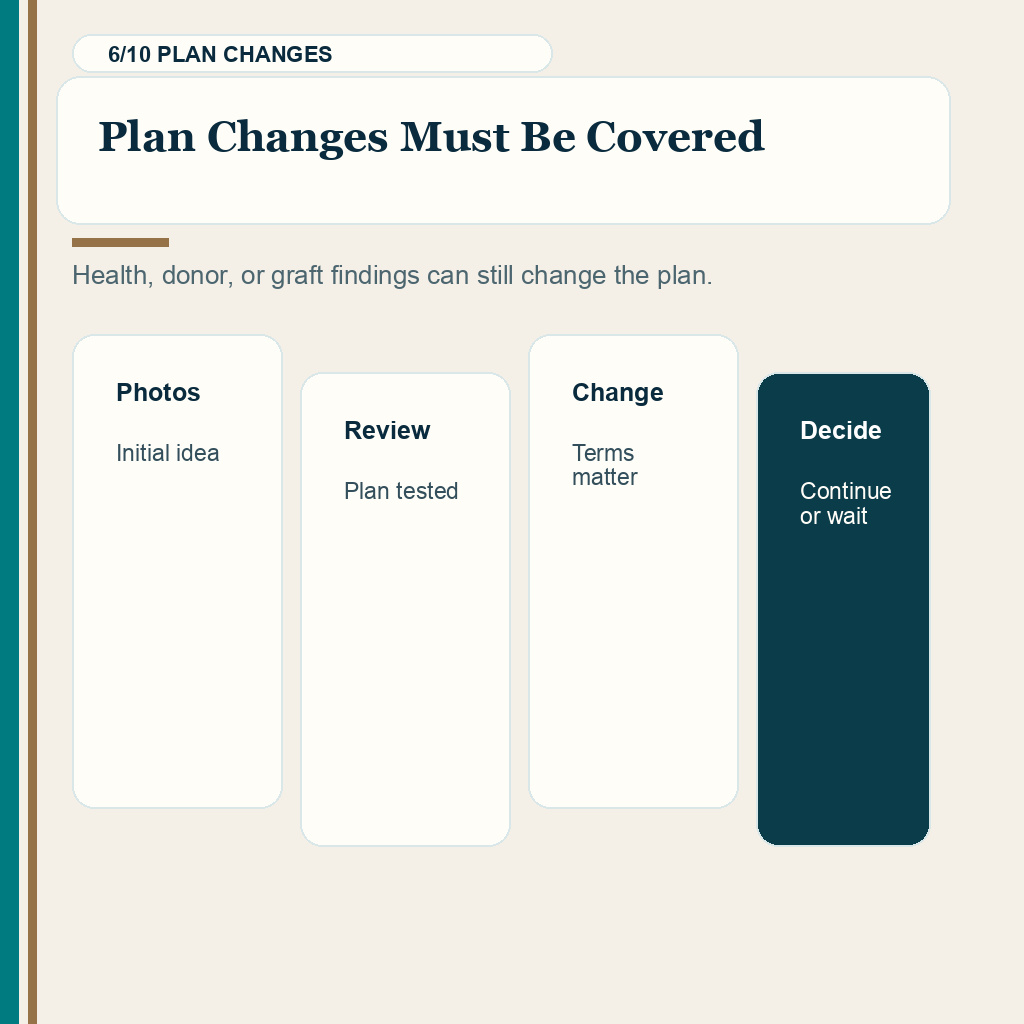
The proposed graft range, donor area limits, main technique, hairline approach, surgeon role, and conditions for postponing, reducing, or refusing surgery belong in the written plan before payment. A deposit is safer when the clinic can explain what would make the plan change. The same terms should cover a lower or higher graft count after direct examination, including whether the patient can accept the revised plan, postpone, or decline before surgery starts.
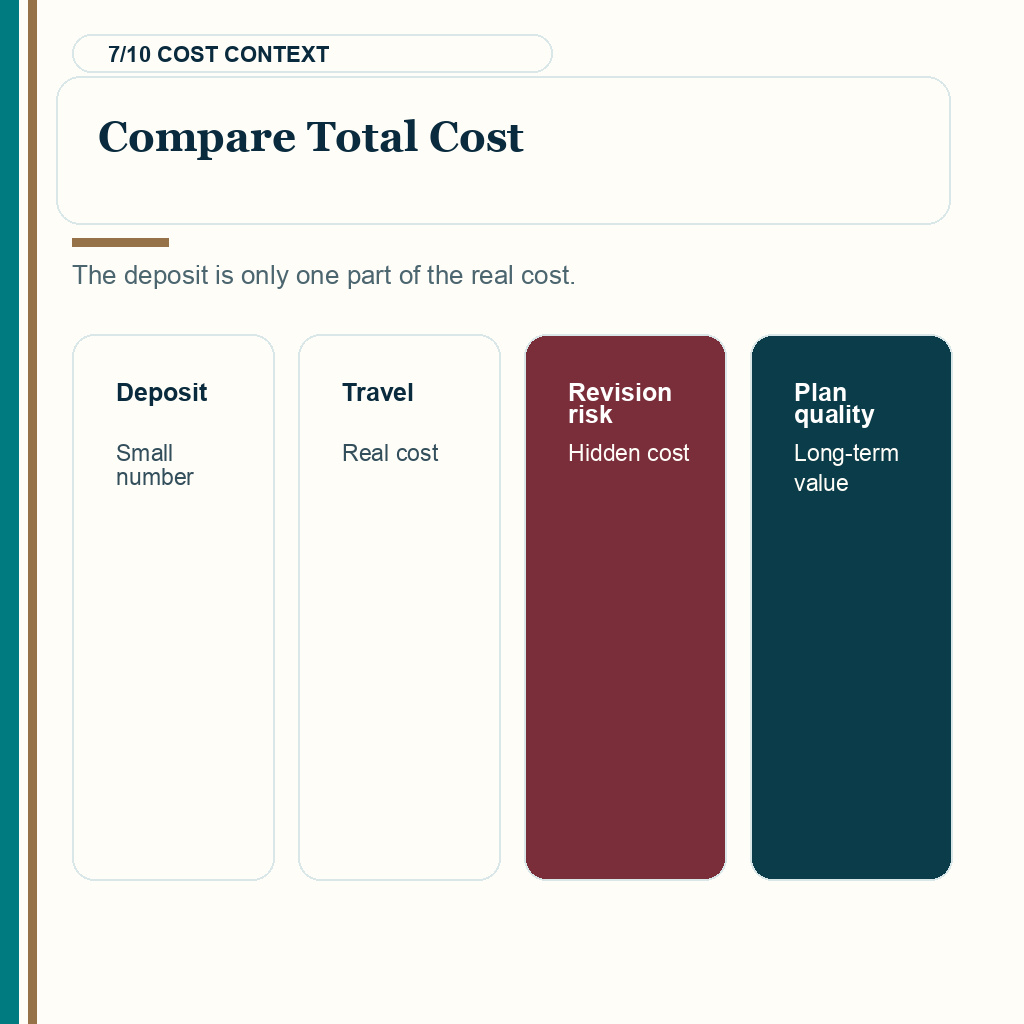
Price is part of the discussion, but it is not the whole decision. The broader hair transplant cost in Turkey matters, and financial planning for hair transplant cost in Turkey should include travel, hotel, missed work, medication, follow-up, and possible repair before a deposit makes the choice feel locked. If you are comparing cash, card, transfer, receipts, or currency, review paying for a hair transplant in Turkey before the route feels urgent. Before travel is fixed, the same conversation should include travel insurance for hair transplant abroad and what the policy does not cover. Do not let a small deposit push you into nonrefundable flights or hotel costs before the medical and cancellation terms are clear.
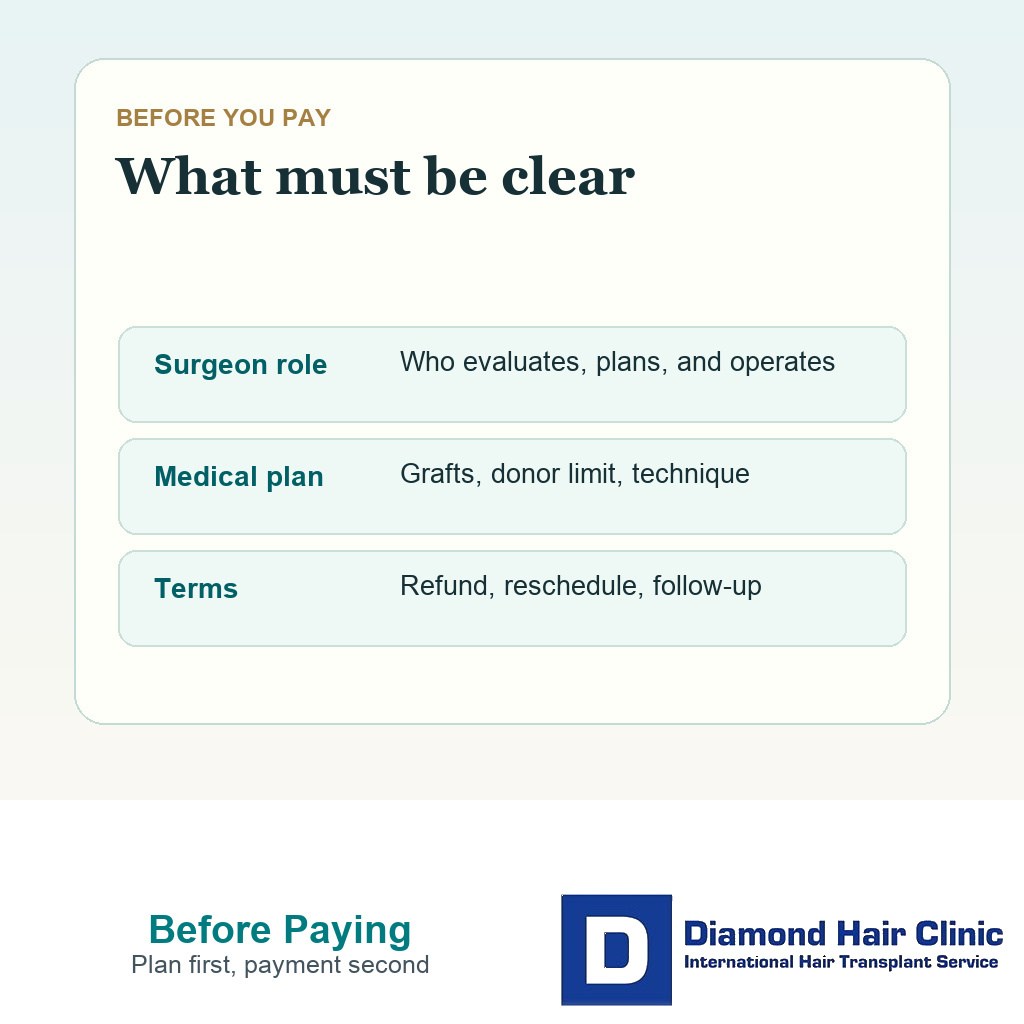
The deposit is safer when it follows the medical plan, not when it is used to rush the plan.
Questions before money changes hands
Before paying a deposit, ask questions that would still matter if the discount disappeared. These are the answers that protect the donor area, not only the booking date.

A deposit should confirm a clear medical process. It should not make the patient feel locked in before the clinical limits are understood.
Real consultation before payment
A deposit before a real medical review worries me. A short message, a few photos, or a fast sales call can begin the conversation, but it should not replace a real consultation. Photos can miss diffuse thinning, scalp disease, weak donor density, unrealistic hairline goals, medication issues, and repair complexity.
Remote review can be useful when it is structured. For that review, I need clear photos, medical history, medication history, expectations, and a direct discussion of limitations. A vague promise from photos is different from the more careful process described in planning a hair transplant from photos.
A clinic that takes a deposit first and delays the real plan until arrival should still explain how payment terms handle a medical change. The written policy should cover fewer grafts, a different hairline, a smaller session, postponement, or no surgery.
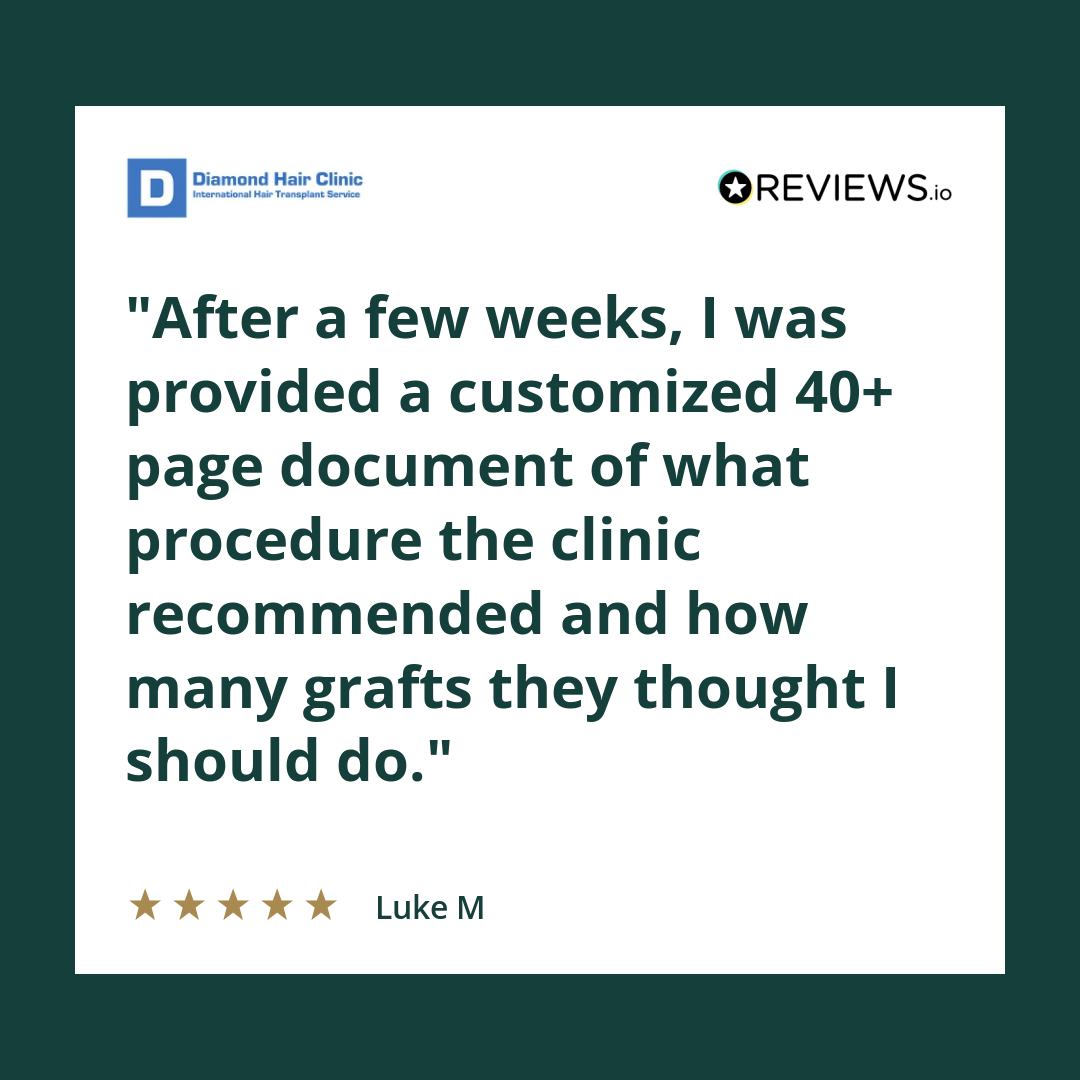
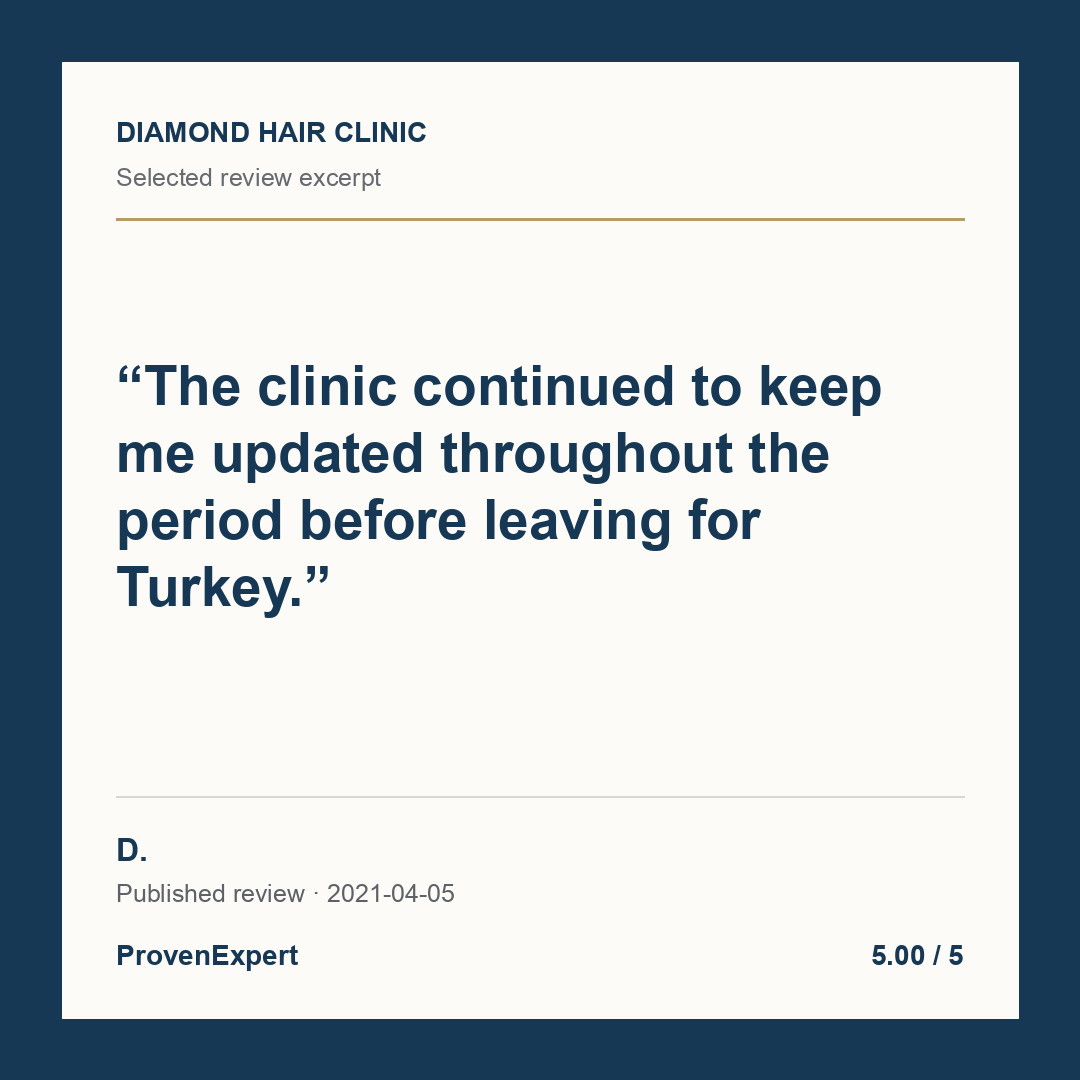
The price figures in that reply were my assessment in that discussion, not a current cutoff for judging a clinic. A quote above those figures still needs the same surgeon and aftercare details before you pay a deposit.
Surgeon confirmation before payment
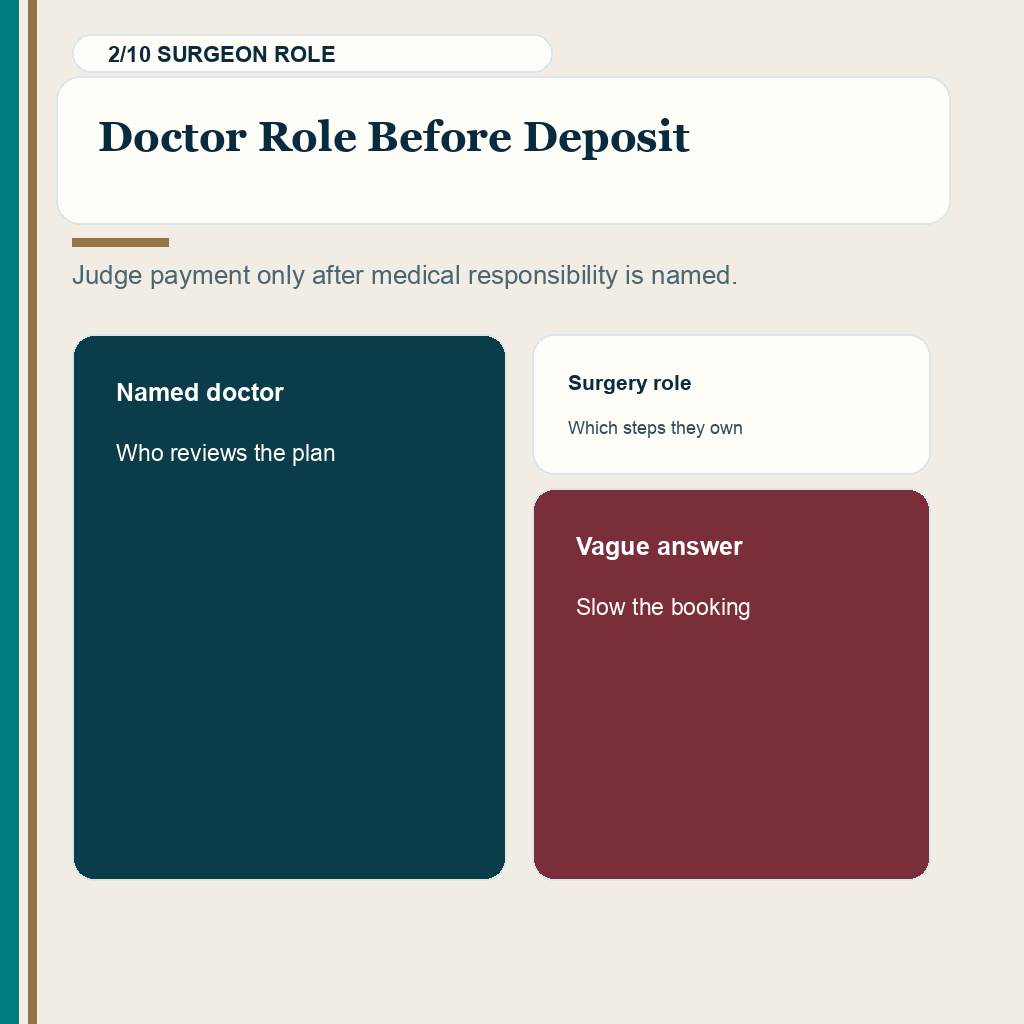
The coordinator can help with logistics, dates, photos, travel, and communication. That does not make the coordinator the surgeon. A quote prepared by a coordinator may be efficient, but the surgical plan still needs medical responsibility.
Before paying, candidacy review, hairline design, graft number decisions, recipient area openings, extraction, and graft placement supervision should all be explicit. These details overlap with the limits of a surgical plan controlled by a coordinator and with surgeon involvement in hair transplant surgery. If you want to understand what surgeon review should cover before travel, use case review before travel as the clinical benchmark.
A clinic that cannot answer these questions clearly before payment is asking you to trust a process you cannot see. That may be convenient for the clinic, but it is not a strong way to protect your donor area.
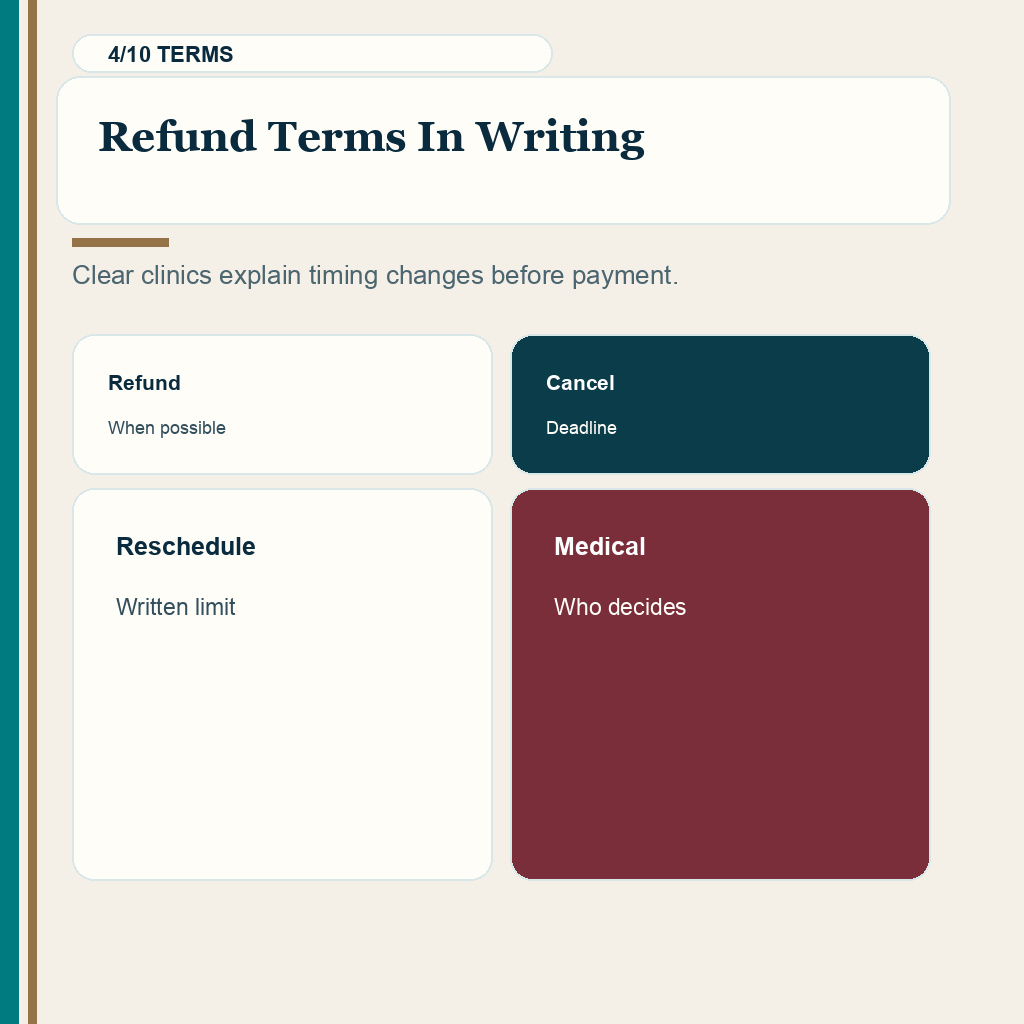
Refund and rescheduling terms belong in writing
Refund terms do not need to be hostile, but they do need to be clear. Some deposits are partly nonrefundable because the clinic blocks time, staff, a room, or travel logistics. That can be understandable. A nonrefundable deposit is not always the concern. Unclear terms after payment are the real concern.
The written policy should separate ordinary cancellation from medical unsuitability, surgeon unavailability, clinic date changes, graft number changes, and donor safety refusal after in person examination. It should also say whether the same terms apply if the clinic changes the named surgeon, changes the technique, or refuses surgery because donor safety is not acceptable.
Refund policy belongs before payment, not inside a surprise confirmation message. An organized clinic can put the terms in writing without turning the discussion into a conflict.
Package pricing can hide the medical decision
A package that includes hotel, transfer, and scheduling can be useful because it simplifies travel. It can also hide the medical issue that matters most, which is how much of the price pays for medical judgment, surgeon time, safe donor management, and follow up.
A package may include airport transfer, hotel, translation, PRP, shampoo, or medication. These extras do not prove that the surgical plan is strong. When the package is sold faster than the consultation, it becomes easy to compare hotels and discounts while missing surgeon responsibility, donor limits, and long term planning.
I explain this separately in hair transplant packages in Turkey. The package itself may be acceptable. It becomes risky when the package is the reason to pay before the medical questions are answered.
Discounts and limited slots should not control the decision
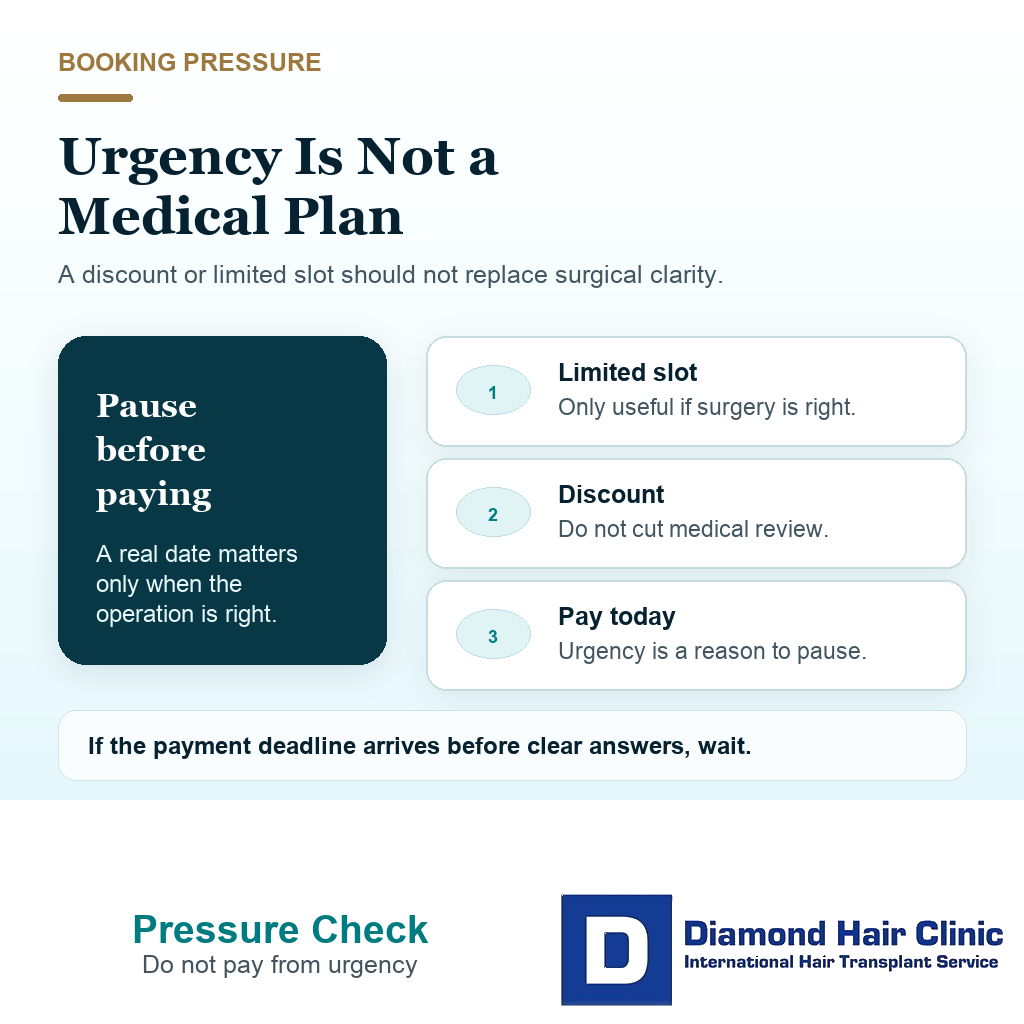
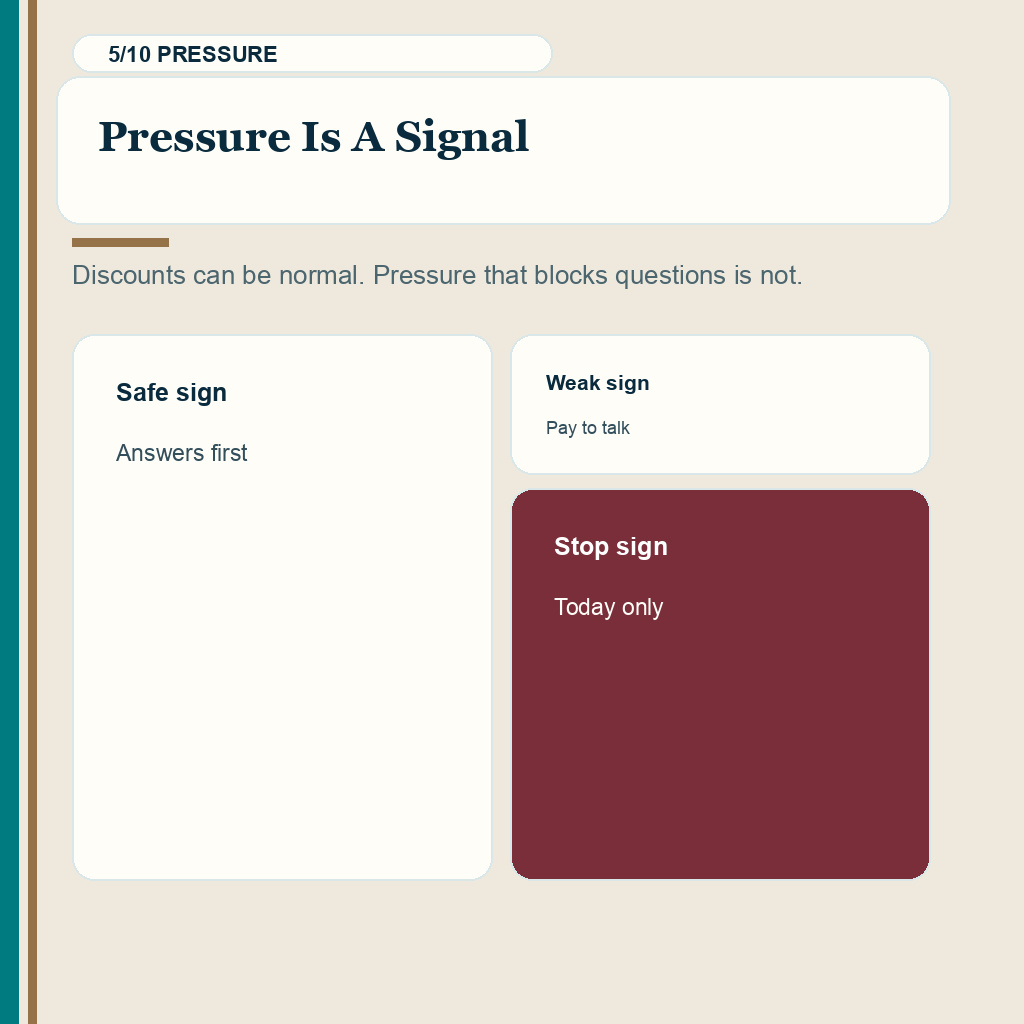
A limited slot can be real. A surgeon’s schedule can be full. A clinic may have cancellation dates. The concern begins when urgency becomes the main force behind the decision. Someone who is already anxious about hair loss, or who has just had a frightening shaved head reaction, can be pushed into paying before the plan is clear.
Timing and safety need to stay separate. A date is useful only if the operation on that date is the right operation. A discount is useful only if the saving does not weaken the medical review, the surgeon’s role, or the follow up path.
If the message sounds like “pay today or lose the chance,” slow down and use how to choose a hair transplant clinic in Turkey as the comparison frame. High volume systems often rely on speed, package language, and confidence before medical detail.
Documents and messages to save before payment
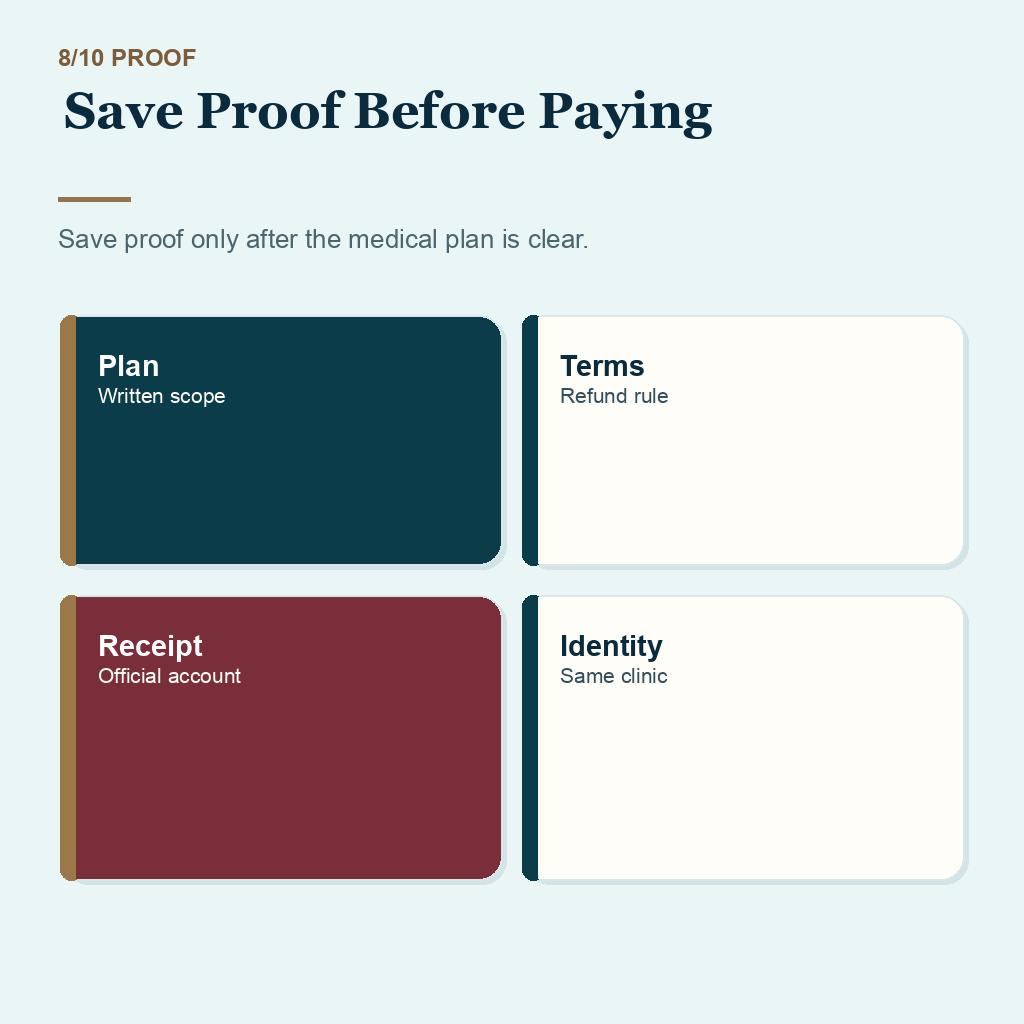
Save the written quote, deposit amount, payment method, cancellation terms, rescheduling terms, proposed graft range, technique, surgeon name, who performs each surgical step, hotel or transfer details, medicine instructions, and follow up promise. Keep screenshots or PDFs of the terms as they were shown before payment.
The payment request also needs to match the clinic’s official identity. Before any transfer, keep the clinic name, written confirmation, receipt or invoice, payment reference, and the exact date or service the deposit reserves. Use a traceable official clinic payment route when possible. A personal account, changing payment name, cryptocurrency request, friends and family transfer, or vague message such as “send now and we will explain later” deserves caution. If payment details change between messages, verify the change through a separate official channel before sending money. A clinic name that feels familiar does not make unclear payment terms safer. The written medical plan, receipt, refund rule, and official payment route should still match each other before the patient pays.
This is not because you should approach the clinic with suspicion. It is because memory becomes unreliable when travel, surgery, money, and anxiety are mixed together. Clear written terms protect both sides.
Result promises need exact wording. Read the guarantee language carefully because a deposit cannot remove biological uncertainty.
What must be written before money feels final?
Before a deposit feels final, the patient needs a written clinical frame, not only a receipt. That frame should include the diagnosis, treated areas, likely graft range, donor limit, hairline priority, crown priority, surgeon role, aftercare contact, and the reasons surgery could become smaller or stop.
The important part is the exit route. If direct examination shows weak donor supply, diffuse thinning, active scalp disease, unstable health, or a request that would spend too much donor reserve, the written plan must allow the medical decision to change.
A deposit becomes dangerous when it makes the patient accept the old promise after new information appears. Money can reserve time. It cannot make an unsafe plan safe.
Medical findings that can change the plan after a deposit
Many real findings can change a hair transplant plan. The donor area may be weaker than the photos suggested. The hair loss may be diffuse. The scalp may show inflammation. Blood pressure, blood tests, medication, smoking, recent illness, or a medical condition may make the timing less suitable. A serious deposit policy should allow the plan to reduce, pause, or stop when better medical information changes the risk.
You may also arrive wanting a very low hairline, dense crown coverage, or a high graft number that is not responsible for the donor area. If the clinic has already taken money and built the whole conversation around a large session, it may be harder to accept a smaller, safer plan when the medical review points that way.
The deposit policy should leave room for medical reality. A clinic that never changes the plan after better information is not necessarily efficient. It may simply be ignoring the information.
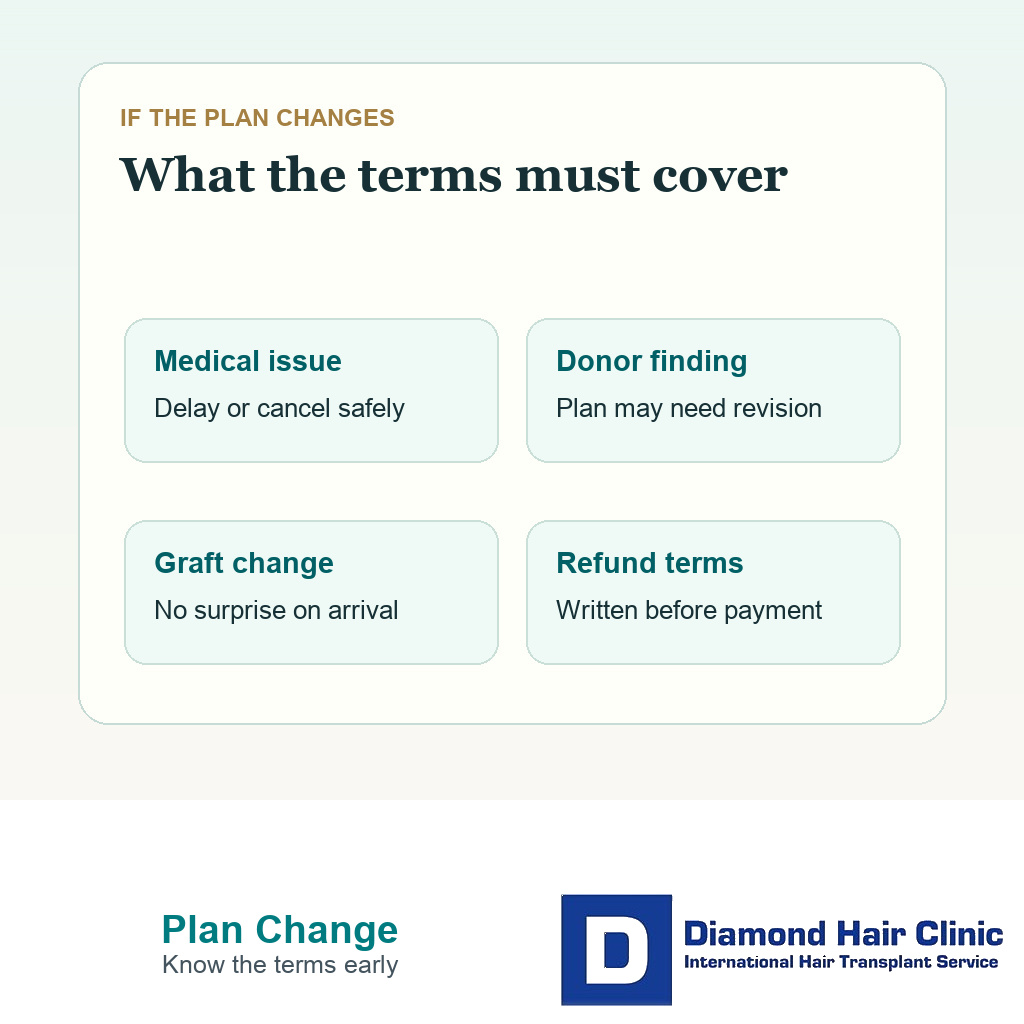
Deposit terms must leave room for medical reality.
Do not let a deposit replace the medical plan
Losing a deposit can be cheaper than accepting a plan that still feels medically unclear. Payment should follow a defensible donor and hairline plan, not replace it.
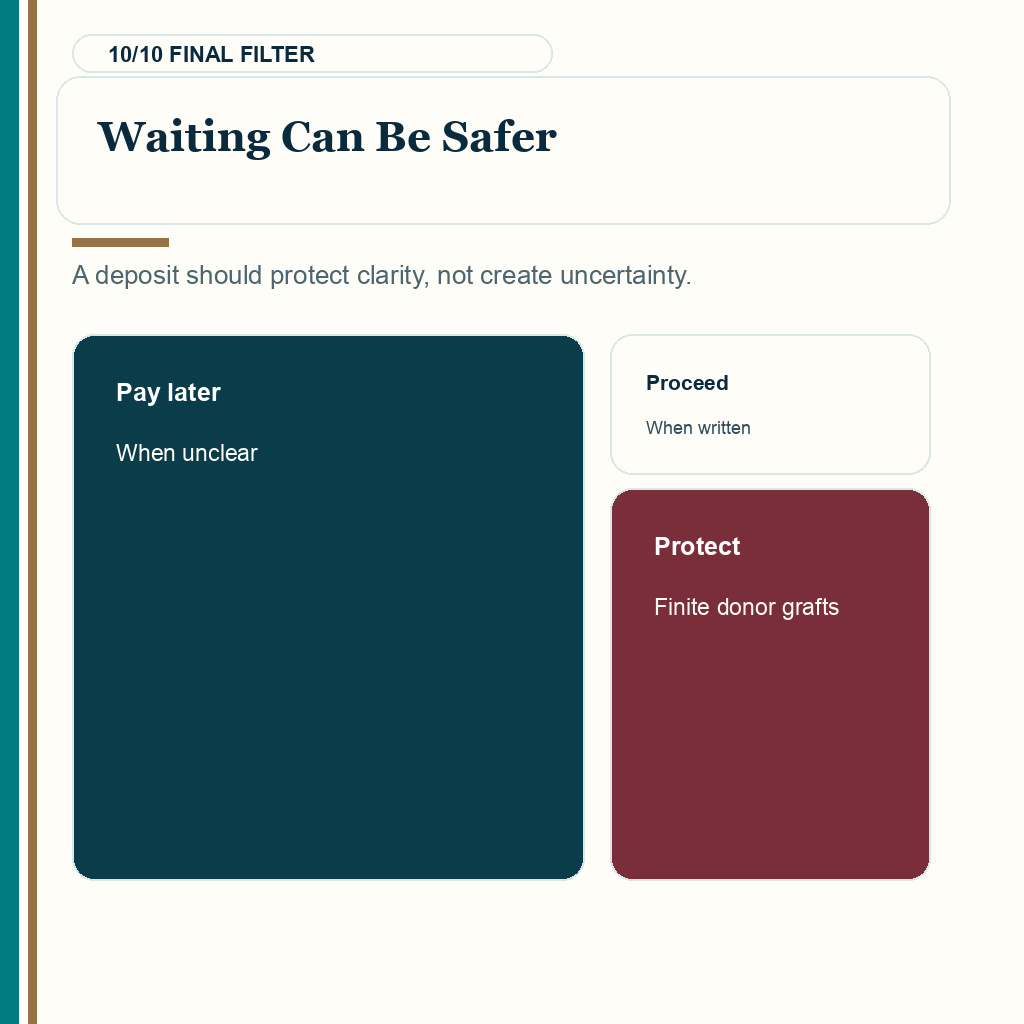
I know that is frustrating. But hair transplant repair is often more expensive, more emotionally difficult, and limited by the donor area that remains. Money already paid should not force you into surgery that no longer feels medically right. Keep the distinction clear. A deposit is money. Donor grafts are a limited medical resource.
Before walking away, ask for clarification in writing. If the answers become clear and the plan is medically sound, the deposit may still serve its purpose. If the answers stay vague, consider a second opinion before a hair transplant before you commit more money or donor grafts.
Comparing clinics before paying
Compare clinics by responsibility first. The surgeon, daily patient volume, surgeon’s personal role, donor area assessment, candidacy limits, and follow up after travel home should be clear before payment.
Then compare price. A cheaper deposit is not useful if it buys a vague process. A higher price is not enough either if the surgeon’s role is still unclear. When you compare a hair transplant in Turkey, the important question is whether the clinic can explain the operation in a way that protects your donor supply over the years and still aims for a natural result.
During a review of who performs hair transplant surgery, look beyond the brand name on the message. Payment should follow clarity about the people doing the work.
Waiting for a surgeon can be a good sign when the waiting time reflects real personal involvement. A deposit for a specific surgeon’s limited date is different from a generic deposit into a high volume system where the actual surgical responsibility is unclear.
For a named surgeon, the deposit terms should say whether the payment holds that surgeon’s involvement or only a clinic date. A surgeon change should also have a written path for rescheduling, refund, or cancellation.
A hair transplant surgeon waitlist needs patience. A real wait can be inconvenient, but a rushed deposit with no named medical responsibility can create a much bigger problem.
Postoperative communication should be planned before payment. Photo review, weekend and travel day coverage, and warning signs needing faster review matter because recovery questions often begin after the patient leaves the clinic.
A deposit should reserve more than the day of surgery. It should cover preparation, operation, and follow up. Fast payment messages followed by vague medical answers are a warning sign.
A clear hair transplant follow up after surgery plan matters because early concerns are not only emotional. Swelling, bleeding, infection signs, medication questions, and washing uncertainty all need a real response path.
The 10 deposit decision slides below split the payment question into one proof point at a time. Swipe sideways, use the arrows for one slide at a time, or choose a number below the image.



A deposit should follow written clarity
A deposit should come after the clinical and financial record is clear. You should know who reviewed the case, what the graft range means, what can change after shaving, where the official payment goes, and what happens if the date or plan has to move.
Keep the quote, deposit receipt, refund rule, and medical conditions in one written record. Scattered voice notes and changing payment instructions are harder to challenge if the plan changes.
If the clinic changes the price or scope later, a quote change before surgery should be handled as a written consent issue, not as a rushed message.
This standard also belongs in booking messages and the surgical plan. Payment should confirm a plan you already understand. It should not become the way the real discussion starts.
Read this review excerpt
I asked two questions at all the clinics: how many patients will you take in a day and how much of the work will be done by the doctor.

Read this review excerpt
The administrator was very professional and patient with all of my questions. After accepting their terms, I booked my flight which permitted them to schedule my operation. I stayed in contact with the administrator up until the day of the operation.