Online Hair Loss Topicals Before FUE
A bottle bought through an online clinic, pharmacy, or vendor can change how I read the scalp before surgery. It may be stabilizing your native hair, irritating your scalp, or causing side effects that are easy to miss if I only see photos. Bring the full list to the consultation, including the product name, strength, ingredients, start date, last use, application area, and any reaction you noticed. A spray or research chemical can seem small at home, but it may change how I read your donor area, hairline, crown, and timing. When the online product is a pill instead of a topical, online hair loss pills before graft planning explains the prescription and pharmacy proof I ask for before I trust the baseline.
I am not shaming anyone for trying treatment. I often see topical finasteride, topical dutasteride, RU58841, pyrilutamide products, minoxidil mixtures, tretinoin blends, caffeine or peptide serums, and compounded formulas from online clinics. I need to separate a useful treatment response from unstable shedding, irritation, unknown dosing, or side effects. The product list matters because it changes the baseline I am judging. If you are asking about the postoperative side of the same issue, my research topicals after FUE restart plan covers the recipient area timing decision.
The most useful label is the one that tells us exactly what touched the scalp. A brand name, screenshot, or bottle photo can matter when the formula has more than minoxidil.
Save the current formula before the subscription changes. A screenshot of the ingredients, concentration, instructions, and side effects is more useful than a brand name remembered from memory.
Online topicals can change FUE planning
FUE planning depends on the pattern I can see today and the pattern I expect tomorrow. If your native hair is still miniaturizing quickly, a transplant can improve the visible frame but it cannot freeze the future. I already check medication before a hair transplant closely when the loss is active, diffuse, crown heavy, or related to younger age.
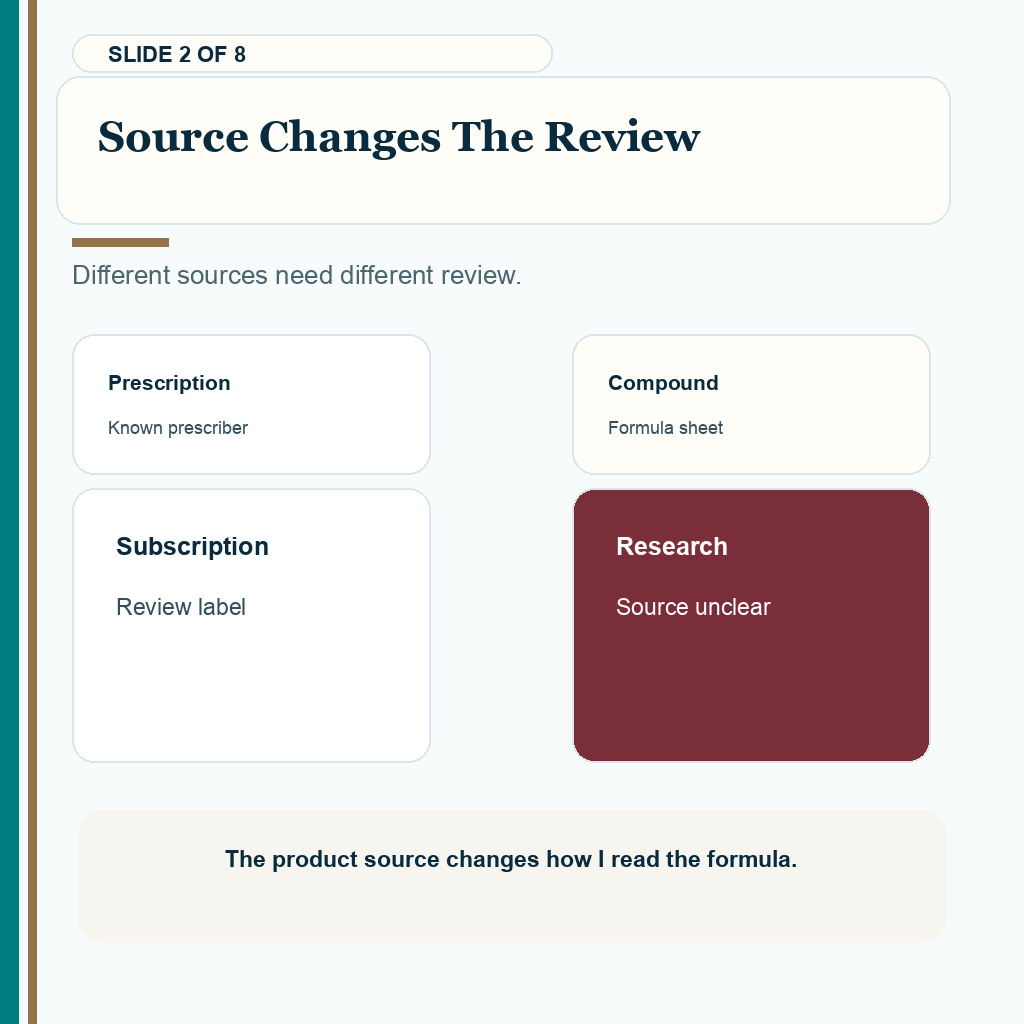
Online topicals add another layer. Some are standard medications in topical form. Some are compounded mixtures. Some are research chemicals sold without the same clarity as a licensed prescription product. A subscription brand, doctor reviewed website, or professional looking label is not enough by itself. I separate a formula prescribed by a physician and filled by a licensed pharmacy from a subscription or telehealth formula, a vendor bottle with unclear sourcing, or a self mixed product. Each can change dosing, storage, batch clarity, expiry, medical oversight, and how much confidence I can place in the treatment history. If the label says 0.25% finasteride, 8% minoxidil, tretinoin, and something else, that is a different situation from plain 5% minoxidil from a pharmacy.
The marketing page is not the part I rely on. I look at what the product has done to your scalp and your hair loss pattern. Did shedding start after the product? Did redness or burning appear? Did libido, mood, breast tenderness, chest symptoms, dizziness, palpitations, or headaches appear? Did you switch formulas every few weeks? These details decide whether the surgical plan is clear enough.
Products that belong on the list
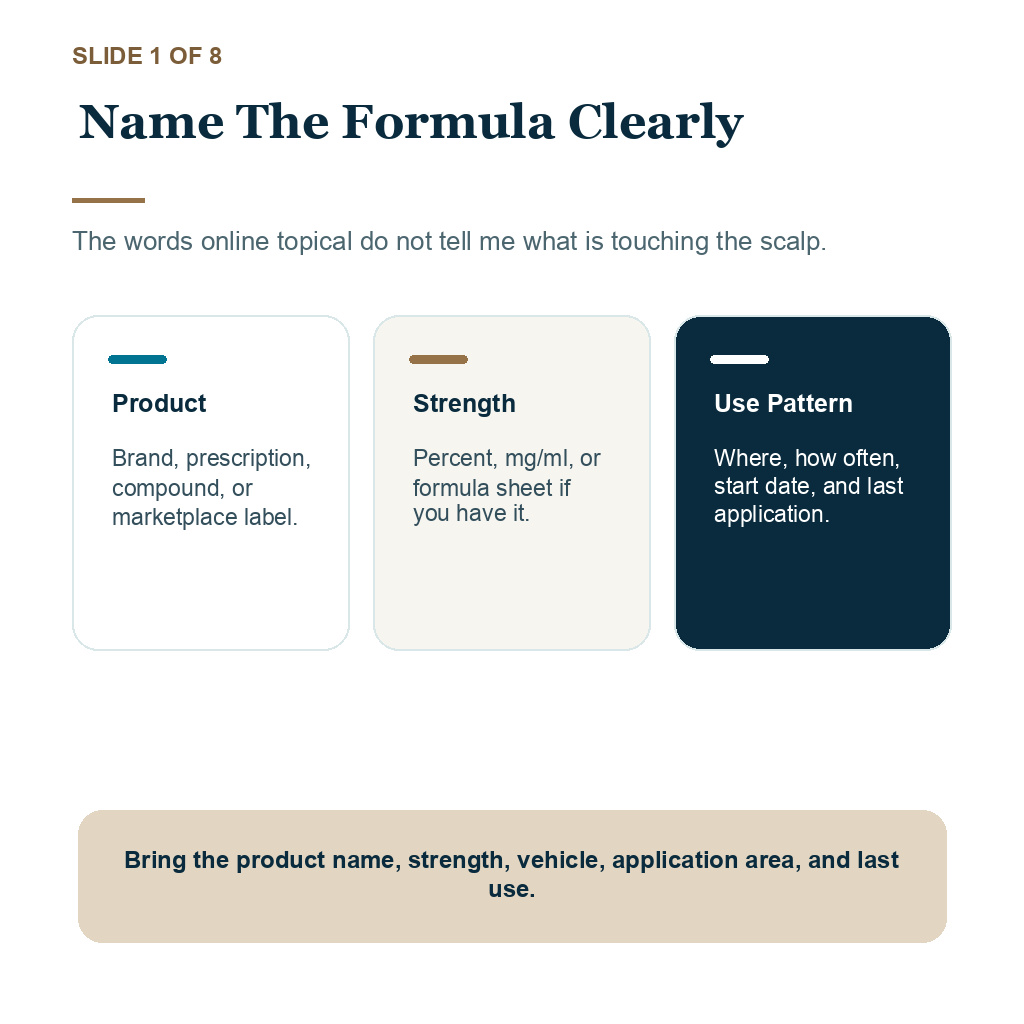
Bring every topical product, even if you are not sure whether it counts as medication. I need the brand name, active ingredients, percentage or mg/ml strength, how many sprays or drops you use, where you apply it, how often you apply it, the pharmacy or vendor name, the prescriber if there is one, and the lot or expiry detail if the bottle shows it. If you mix your own powder, dilute a concentrate, add tablets into a bottle, or buy from a research chemical vendor, say that clearly.
The list should include topical finasteride, topical dutasteride, minoxidil solution or foam, high strength minoxidil, tretinoin blends, azelaic acid mixtures, RU58841, pyrilutamide products sometimes listed as KX 826, stemoxydine, caffeine formulas, copper peptide or growth factor serums, ketoconazole scalp products, steroid lotions, anti inflammatory scalp treatments, and anything used with microneedling. It should also include oral medication used at the same time, especially oral minoxidil around hair transplant surgery, spironolactone before FUE, finasteride, dutasteride, testosterone, anabolic agents, thyroid medication, or acne medication.
For retinoid blends in that list, I treat topical tretinoin after FUE as a separate scalp irritation decision, not only a hair growth ingredient.
Do not hide a topical because it came from the internet or seems minor. The more unusual the product is, the more I need the exact details. A vague answer such as “I use a hair spray” is not enough when that spray may contain a 5 alpha reductase inhibitor, a high minoxidil strength, a retinoid, or an androgen receptor blocker.
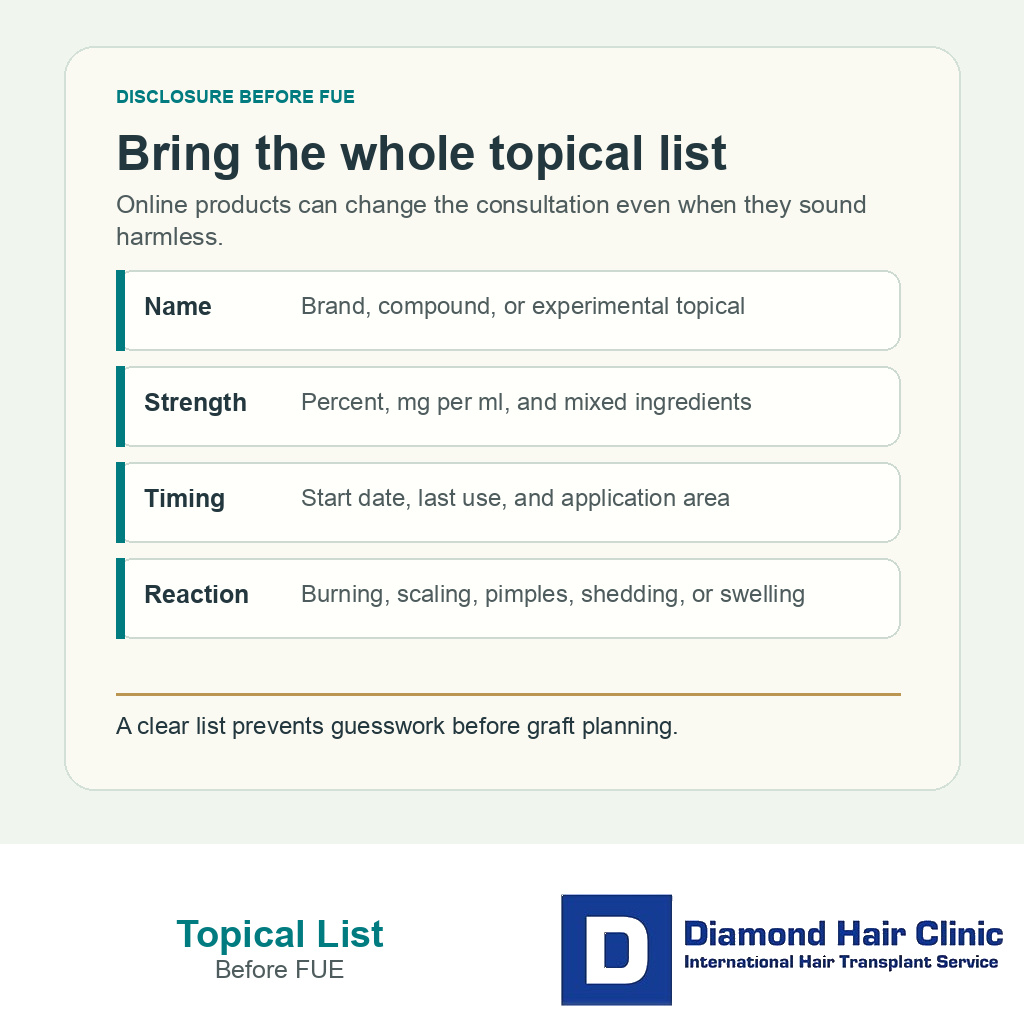
Bring the exact product name, strength, source, timing, and reaction history before graft planning.
Topical finasteride and dutasteride need safety context
Topical finasteride is often presented as a local treatment, but local does not mean whole body effects are impossible. It may reduce exposure for some people compared with tablets, but the formula, dose, treated surface area, scalp condition, and frequency still matter. If you have had sexual, mood, breast, fertility, or PSA related concerns with finasteride, I treat that as part of surgical planning, not as a side note. The dose and timing of topical finasteride before or after hair transplant surgery matter, and previous finasteride side effects can change the transplant plan.
Topical dutasteride needs the same clarity. Some patients choose it because they hope for less systemic exposure. Others use it because oral finasteride was not tolerated, or because topical finasteride seemed weak. I still need to know the formula, frequency, application area, and whether it is prescribed, compounded, or bought online. If you are moving between medicines, dutasteride versus finasteride after a hair transplant is only one part of the decision. Your personal safety history still comes first.
If fertility or pregnancy planning is part of your life, tell me before the hairline design is fixed. This is especially important when finasteride or dutasteride is involved, including topical versions. Early discussion of fatherhood planning with finasteride or dutasteride is safer than discovering the concern after we have already built the surgical plan around medication assumptions.
If a partner is pregnant, trying to become pregnant, or could touch the treated scalp, I ask about the home handling of the product. Finasteride and dutasteride discussions are not only about your own tolerance. Treated scalp residue can move to hands, pillows, hats, or shared towels, so hand washing, drying time, and separate towels matter. The prescribing doctor should guide pregnancy exposure safety, and I should know who may be exposed before I build the plan around that medication.
Research chemical topicals need source and dose clarity
RU58841 and pyrilutamide products come up often because people want a topical approach that feels more targeted than oral medication. I understand the attraction. Someone may have tried finasteride, disliked the side effects, and then searched for a product that promises local androgen blocking without the same fear. The surgical issue is not whether the promise sounds attractive. The issue is whether the product history is clear enough to trust when I am planning donor grafts.
For RU58841, I want to know whether it was premixed or powder, the seller source, the batch or certificate of analysis if one exists, how it was stored, how fresh it was, how many mg you used, how you calculated the final concentration, and whether it was applied after microneedling or onto inflamed skin. If you used a tiny scale, solvent, drops, or ml measurements, bring the math. If you cannot reconstruct it, I treat the dose as uncertain. If there were chest symptoms, shortness of breath, dizziness, sexual symptoms, mood changes, or other systemic symptoms, that belongs in the consultation record. I am not using the transplant visit to validate a research chemical. I am using the history to decide whether your scalp and native hair trend are reliable enough for surgery.
For pyrilutamide products, I need the product source, country, concentration, timing, and whether it is part of a formal product line or an online mixture. Clinical development news does not make every bottle on a bathroom shelf equivalent. If you changed to a pyrilutamide product recently and then saw shedding, thickening, irritation, or no change, time and photos are safer before deciding that the transplant design needs adjustment.
Minoxidil mixtures or high strength formulas and timing
Standard topical minoxidil is familiar, but many online formulas are not standard. A bottle may contain 6%, 8%, 10%, or 15% minoxidil, plus finasteride, dutasteride, tretinoin, azelaic acid, caffeine, or other additives. Stronger is not always cleaner for surgery. Higher strength mixtures can irritate the skin, increase dryness or flaking, and confuse the timeline if they trigger shedding close to the operation. High strength minoxidil also deserves separate attention when dizziness, fast heartbeat, ankle swelling, facial hair growth, or chest symptoms appear.
If you are already using minoxidil, do not stop it abruptly just because surgery is scheduled unless your surgical team tells you to. Stopping can cause shedding that looks like worsening hair loss. I separate those two decisions. Stopping minoxidil before a hair transplant is not the same problem as minoxidil shed and hair transplant timing.
What I need before FUE is a stable story. Minoxidil used for years on a scalp that tolerates it is different from a new high strength mixture started three weeks before travel. Do not test a new online topical in the final weeks before FUE just to boost growth. It creates a moving target when I need a settled scalp and a readable baseline. If the hair is shedding from a recent product change, I may not be able to tell whether the crown or mid scalp truly needs grafts today.
A weak result from an online topical still belongs in the record. I need to know whether the problem was no visible change, irritation, inconsistent use, a formula switch, or an area that was already too empty for a topical to change.
If the formula contains topical minoxidil and cats or dogs live in the home, I also need a minoxidil pet safety plan. Residue control, bedding, spills, closed storage, and pet access become part of the medication history, not a separate household detail.
Reasons the plan may slow down
If the scalp is irritated, I slow the transplant plan down. Active redness, burning, scaling, painful pimples, crusting, open spots, or a rash in the recipient area all matter. Grafts need a settled recipient surface. A scalp that is red, inflamed, infected, painful, or actively peeling is not a clean recipient canvas. A topical product that inflames the skin can turn a clear plan into a waiting plan.
I also slow down when the treatment history is changing too quickly. If you started topical dutasteride last month, added RU58841 two weeks later, increased minoxidil strength, and began microneedling, the hair loss pattern is not easy to read. I cannot tell which change caused shedding, irritation, thickening, or symptoms. Surgery may still be possible later, but the baseline should be cleaner before spending donor grafts.
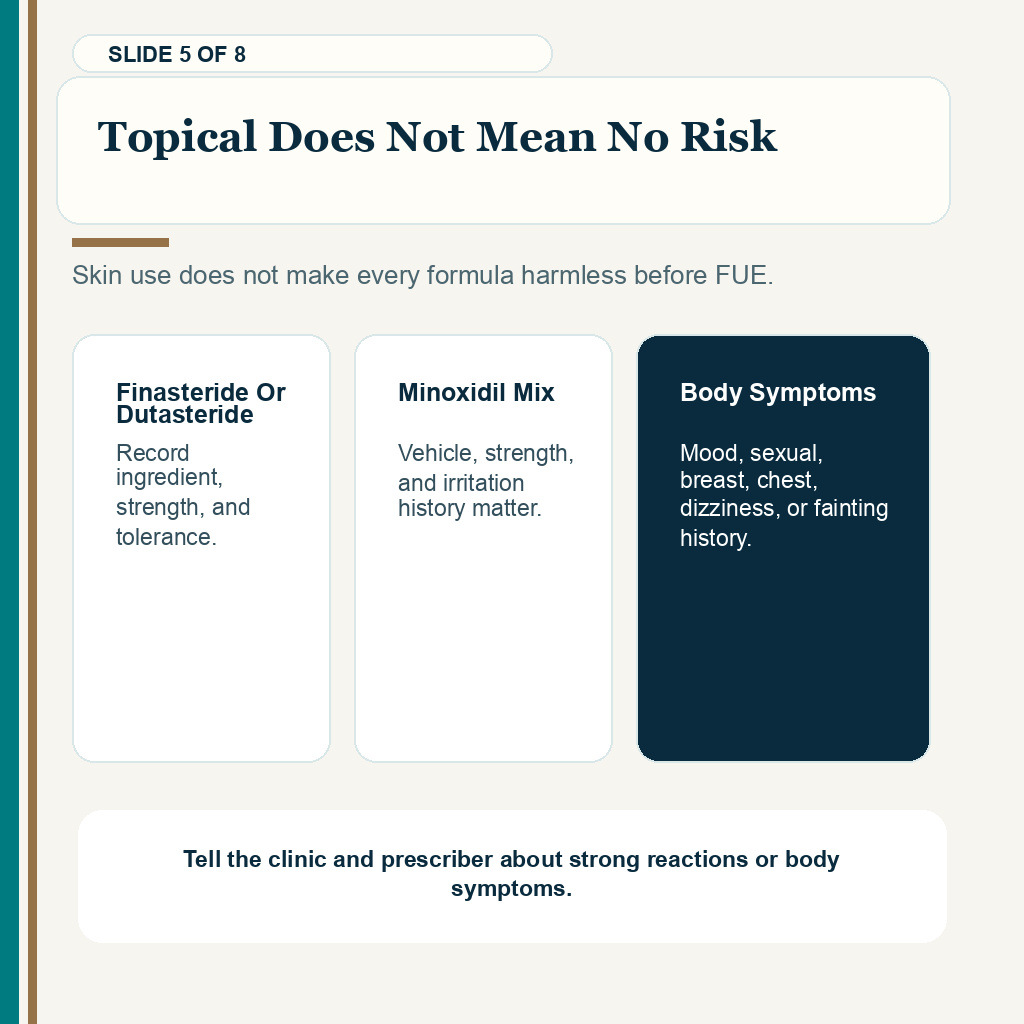
Side effect history also matters. If a topical product caused sexual symptoms, breast tenderness, chest discomfort, palpitations, dizziness, mood change, or severe skin reaction, do not frame it as “only topical.” Tell the clinic and the prescribing doctor. A transplant plan should not be built on a medication routine you cannot tolerate. Medication tolerance also shapes whether I plan a hair transplant without finasteride.
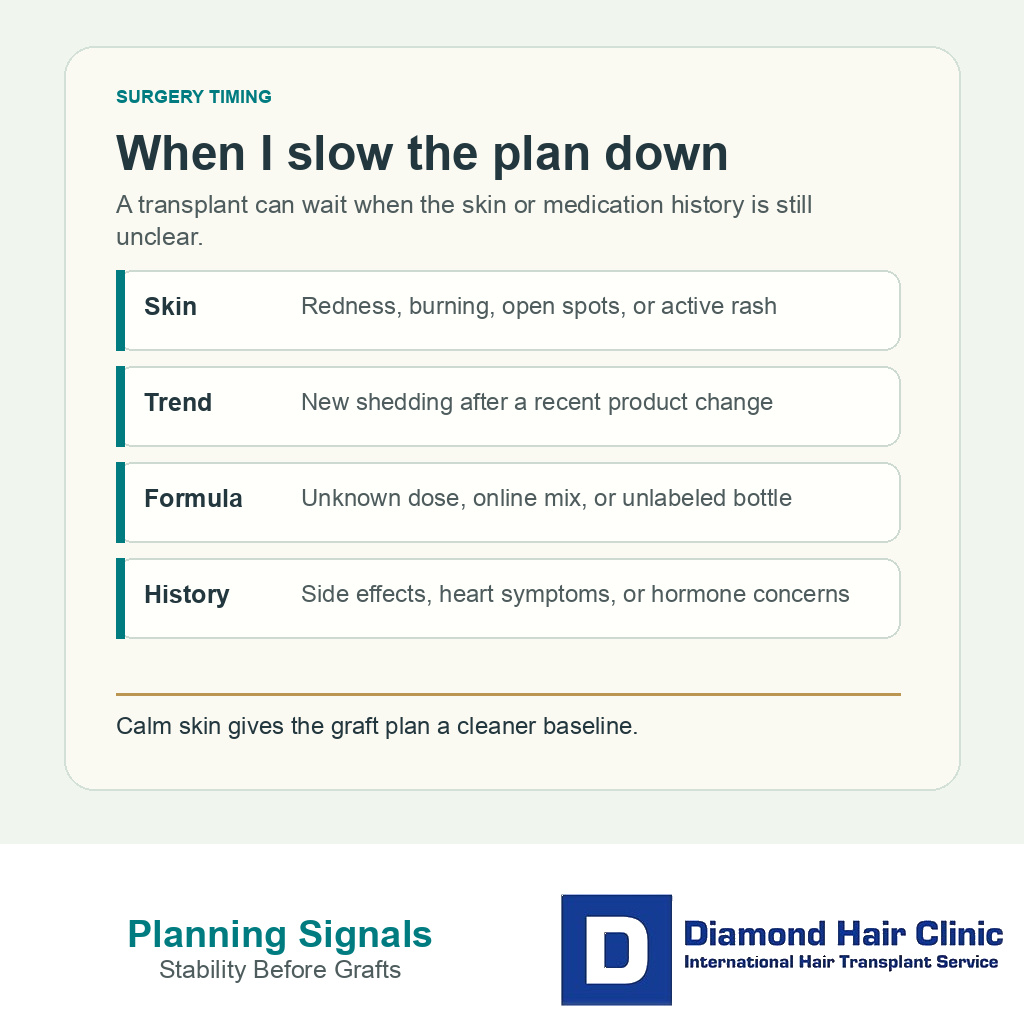
Skin irritation, unclear formulas, new shedding, or side effects can make timing more important than speed.
Topicals and graft planning
It can. Treatment response changes what I try to restore surgically. If a topical routine thickens weak native hair around the crown, I may be more conservative with grafts there. If the front is clearly gone but the mid scalp is still changing, I may design a hairline that protects future donor reserves rather than chasing temporary density in unstable areas.
The opposite can also happen. If a patient is still losing hair on medication before a hair transplant, I need to decide whether the loss is too active for the proposed design. More grafts are not always the mature answer. Sometimes I choose a smaller first session, a more conservative hairline, or a delayed crown.
I need the medication record as it actually happened, not cleaned up for the consultation. If you had a good response for six months and then lost ground after changing formula, that is important. If you stopped because of irritation and then shed, that is important. If you are on TRT or performance enhancing drugs while trying topical androgen blockers, TRT and hair transplant surgery becomes part of the planning picture.

Read this review excerpt
Diamond Hair was the only clinic asking for medications, treatments I've done before, and other type of questions that make me feel confident on the professionalism that they practice with their clients.
Stopping online topicals before surgery
There is no single stop date for every product. A prescribed topical finasteride plan, standard minoxidil, a high strength compounded spray, and an unverified research chemical are different situations. I decide from scalp condition, side effects, bleeding or irritation risk, how close surgery is, whether stopping would trigger avoidable shedding, and whether the product leaves an oily, alcohol heavy, or powdery residue that affects marking and preparation.
Unless I specifically tell you otherwise, do not arrive on surgery morning with a fresh layer of an unknown topical, oily vehicle, powder residue, or irritating solution on the scalp. The donor area and recipient area should be clean for examination, marking, and antiseptic preparation. If a prescribed product should be continued close to surgery, I give that timing separately.
If a topical causes burning, rash, swelling, chest symptoms, shortness of breath, severe dizziness, fainting, or strong palpitations, stop guessing online and speak with a physician or urgent medical service. A transplant consultation is not the place to manage an acute reaction. If the product was prescribed, involve the prescriber. If it was bought without medical supervision, tell the surgical team exactly what it is and when you last used it. Pausing the plan is safer than operating through uncertainty that could have been clarified.
A written treatment timeline is usually more useful than memory alone. It should record the start date, dose changes, missed periods, side effects, shedding episodes, and photos under consistent lighting. Stable treatment history makes graft planning cleaner. It helps me see whether surgery is solving a fixed cosmetic problem or chasing a moving target.
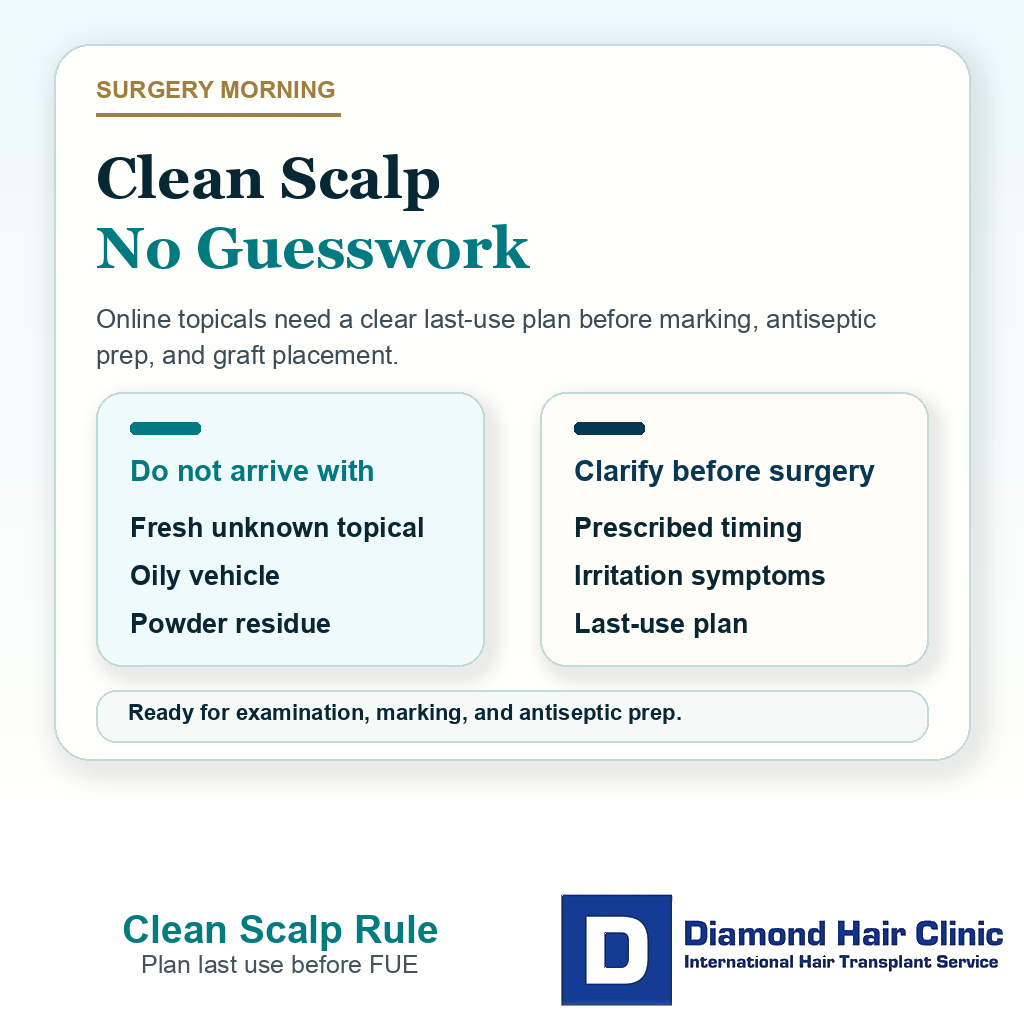
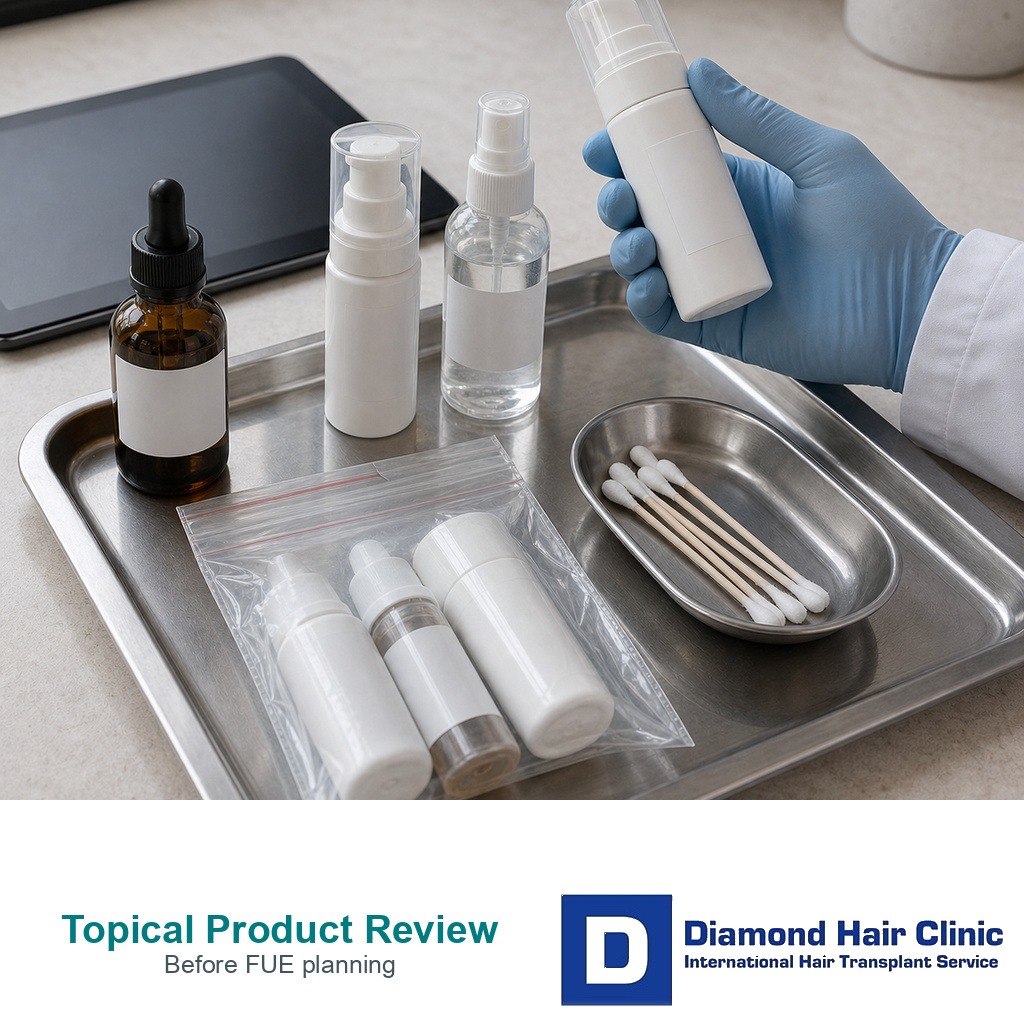
Before FUE, the topical plan should be clear so the scalp is clean for examination, marking, and antiseptic preparation.
These 8 topical review slides separate product formula, source, dose dates, scalp irritation, symptom history, shed photos, clean scalp review, and the record I need before FUE. Swipe sideways, use the arrows one slide at a time, or choose a number below the image.