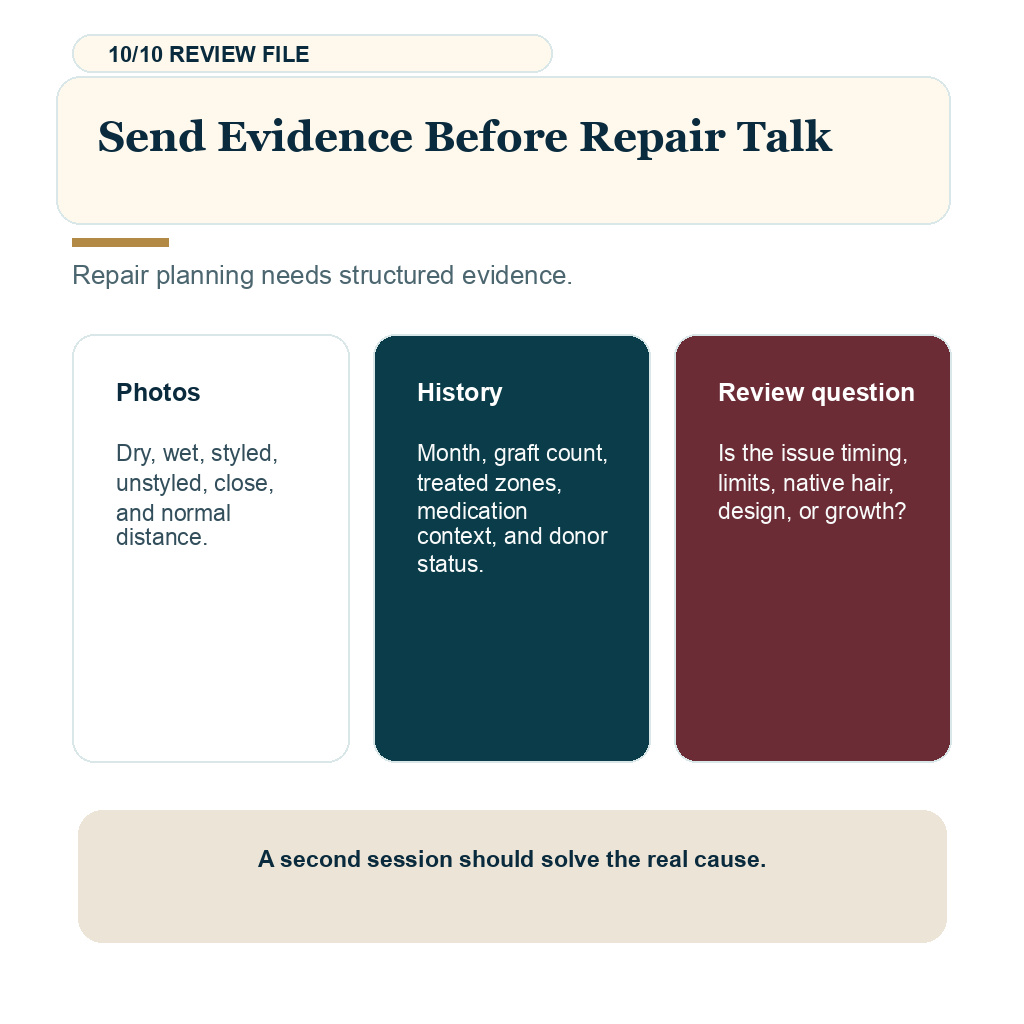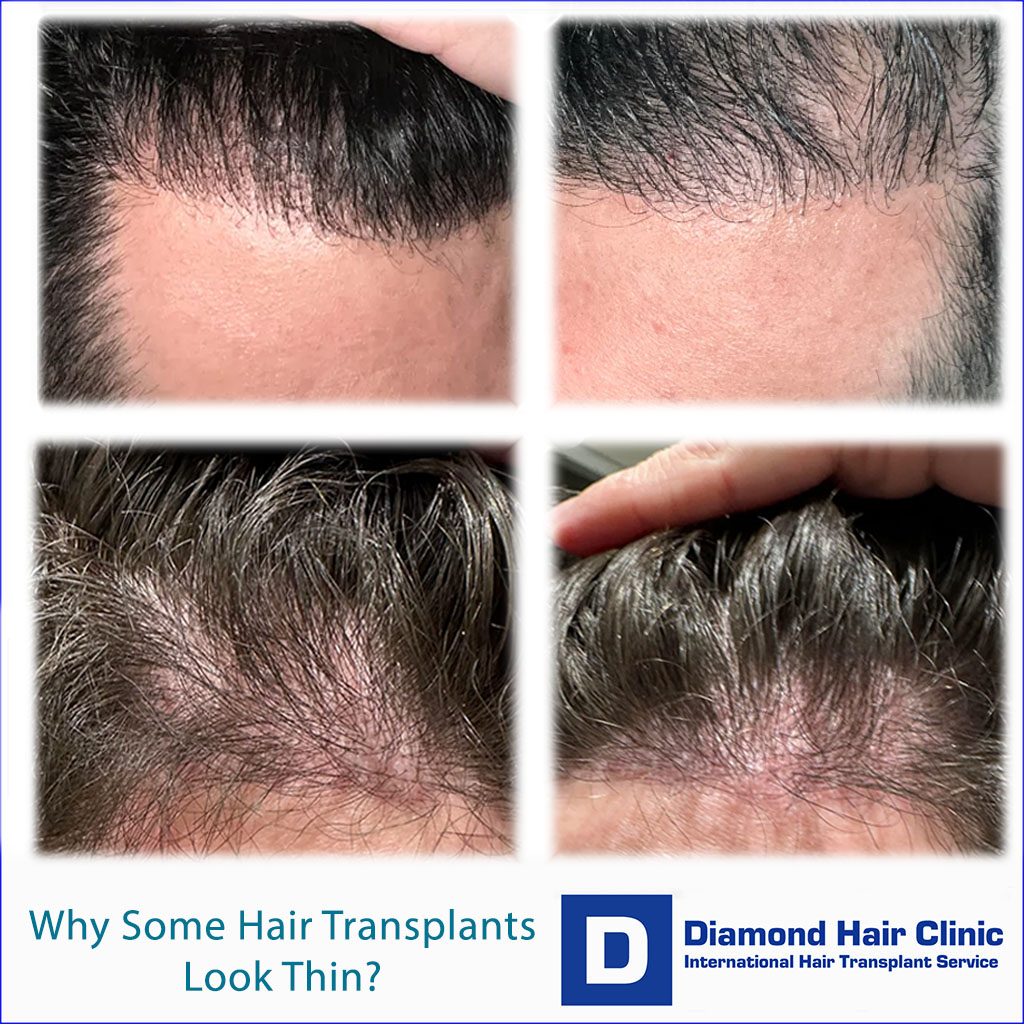
Why Some Hair Transplant Results Look Thin?

I keep seeing the same confusion again and again!

A man starts researching hair transplantation seriously. 

He studies before and after photos more carefully than ever, zooming in on hairlines, noticing scalp visibility, and comparing one clinic’s results to another’s while spending significant time on clinic Instagram profiles, hair transplant forums, and Reddit.

And after some time, he starts asking himself a very specific question: Am I becoming too aware of hairlines, or do hair transplants really look thin?

In my opinion, both things can be true at the same time.

Yes, once a person starts paying close attention, he begins seeing details he never noticed before. But yes, some hair transplants also truly do look thinner than they should.

The important part is understanding why.

Because not every visible scalp means a poor result.

And not every transplanted hairline that looks “full” in one clinic photo is actually a well-planned or natural result, either.

After more than 10 years of performing hair transplant surgery, I can say that many patients think they are asking a simple density question, when in reality they are asking a much broader question about naturalness, visual density, donor limitations, hairline design, lighting, timing, native hair loss, and whether the surgery was planned with real long-term judgment.

That is why this subject deserves a more careful explanation.

Why Do Patients Start Seeing Thinness Everywhere?

Because once a person begins researching hair transplantation seriously, he stops looking at hair the way ordinary people look at hair.

Before that point, most men simply notice whether someone looks bald, thinning, or normal. But once they enter the world of hair transplant research, they start studying details much more closely.

They look at the first few millimeters of the hairline.

They focus on scalp visibility under bright light.

They compare how one clinic places grafts versus another.

They begin noticing things like softness, direction, spacing, transitions, and how much of the scalp shows through at certain angles.

That kind of attention changes perception.

So yes, some patients do become more critical than before.

But that does not mean the concern is imaginary. 

Sometimes they really are noticing a genuine weakness. The problem is that they often do not yet know how to distinguish among the many different situations that can create the impression of “thinness.”

As a hair transplant surgeon, in my experience, what they are seeing usually falls into several different situations.

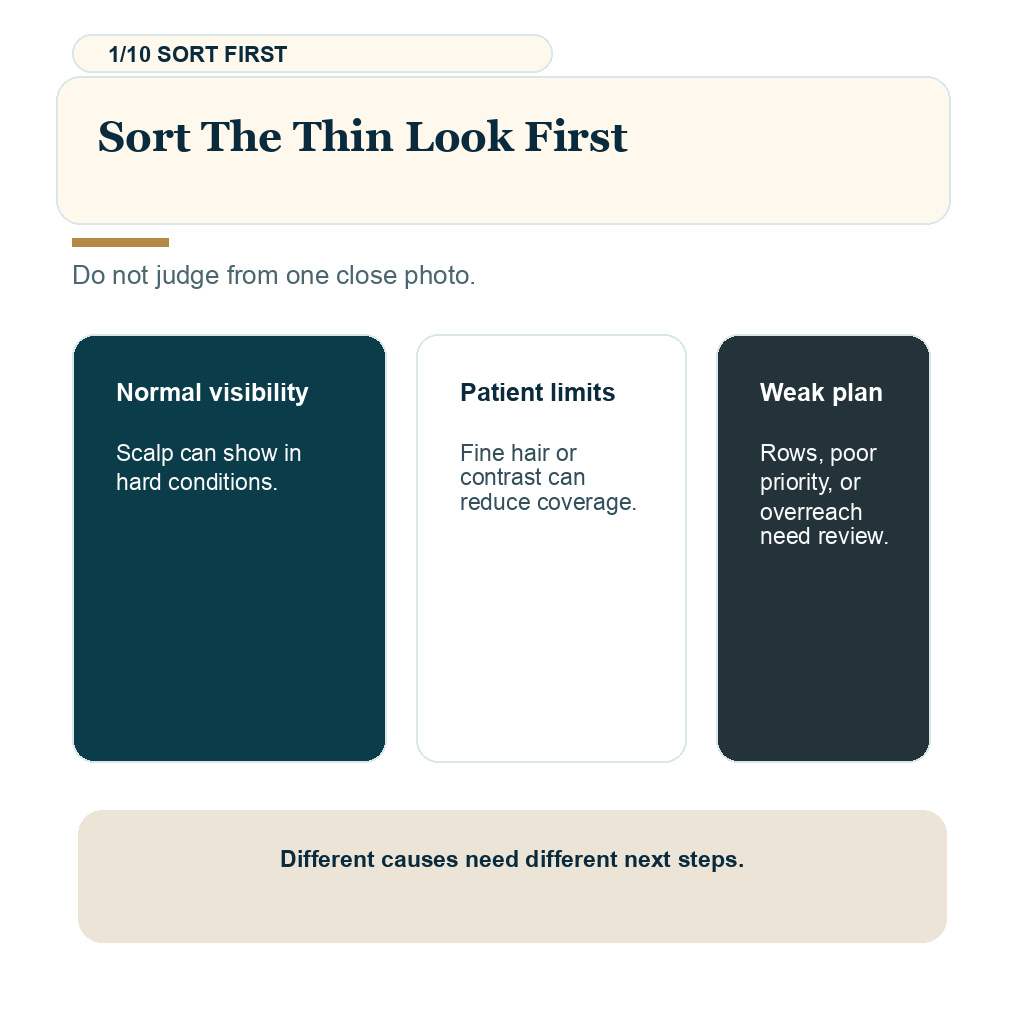
The first is a result that is actually good, but can look a little airy under certain lighting, angles, or styling conditions.

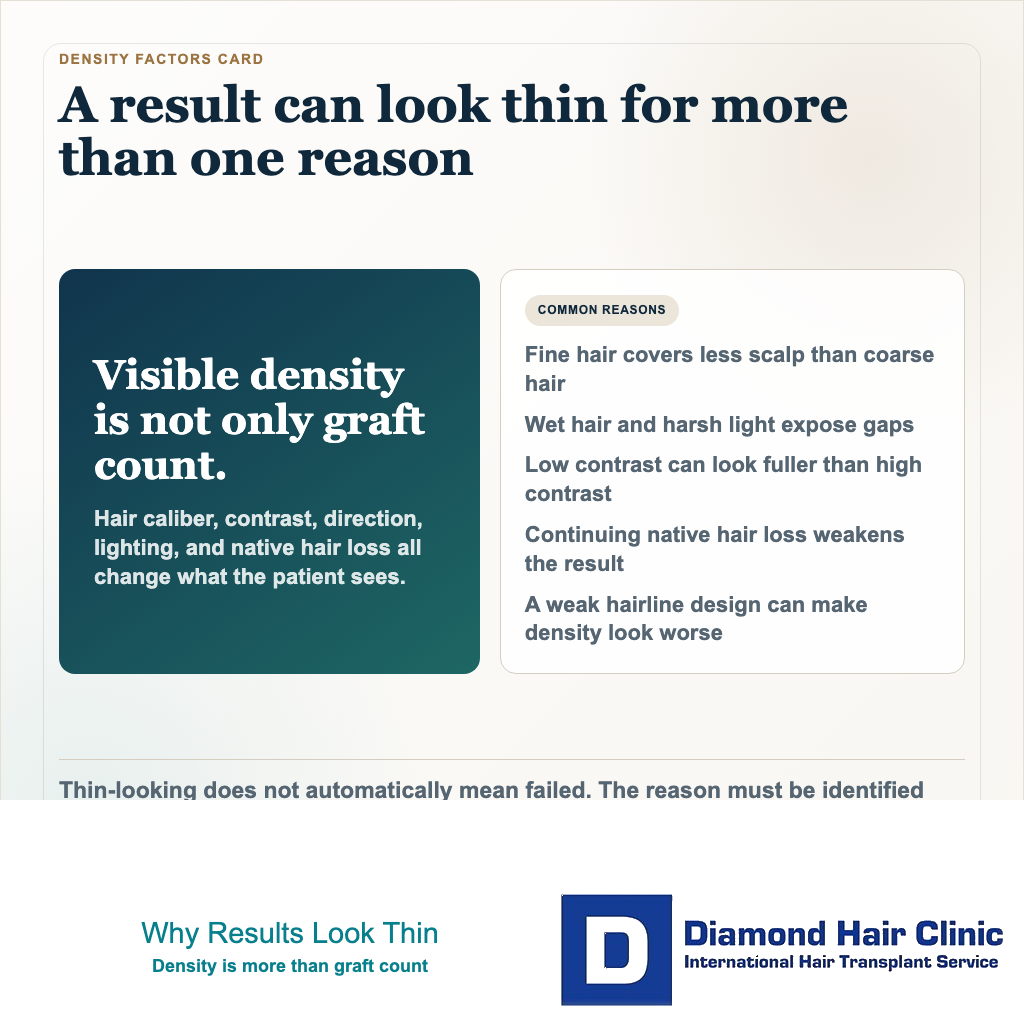
The second is a result that appears lighter, mainly due to the patient’s hair characteristics. Fine hair, very straight hair, strong scalp contrast, or a wide balding area can all reduce the impression of fullness, even when the surgery itself was planned honestly.

The third is a result that is limited by donor reality. Sometimes the donor is simply not strong enough to create very high visual density across every area the patient wants treated, especially when the balding pattern is broad.

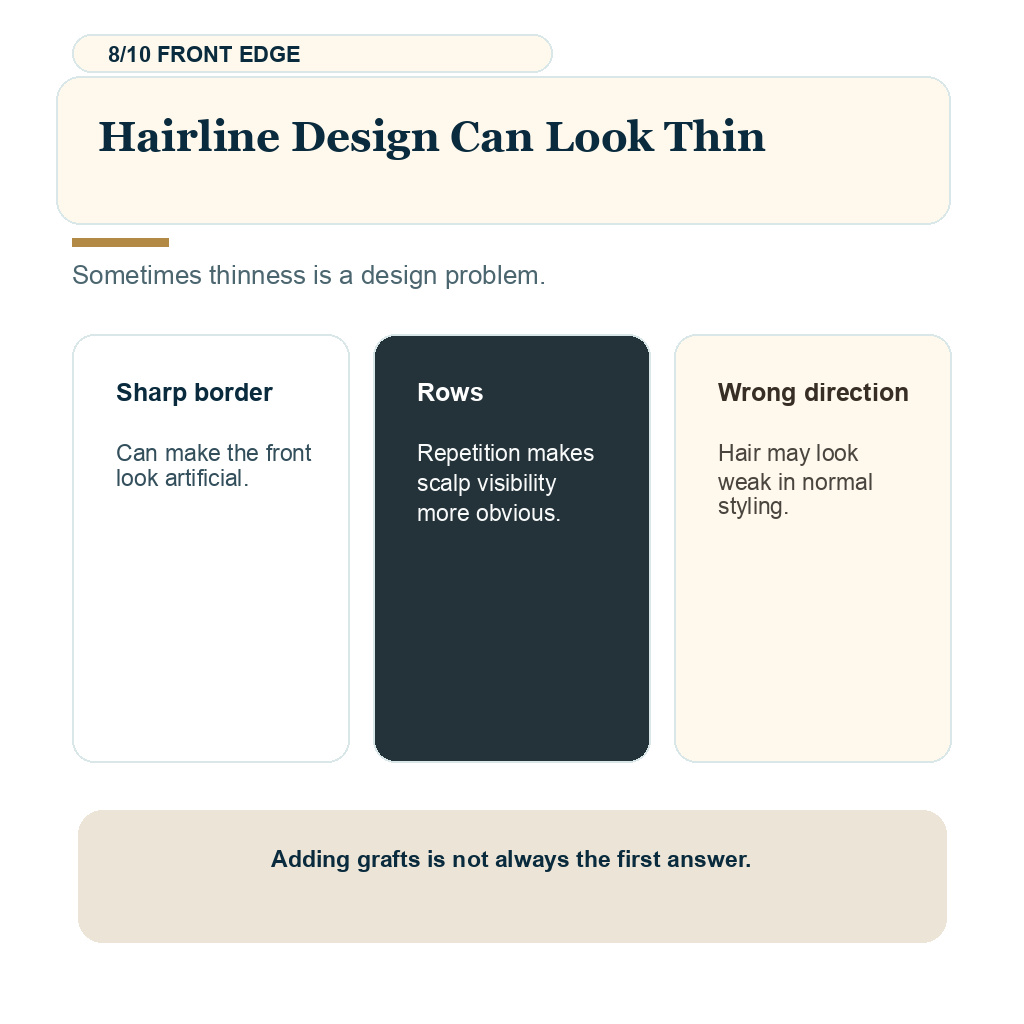
The fourth is not mainly a density problem at all, but rather a design problem. Sometimes patients describe a hairline as thin when what is really bothering them is that it looks too straight, too sharp, too artificial, too repetitive, or too row-like.

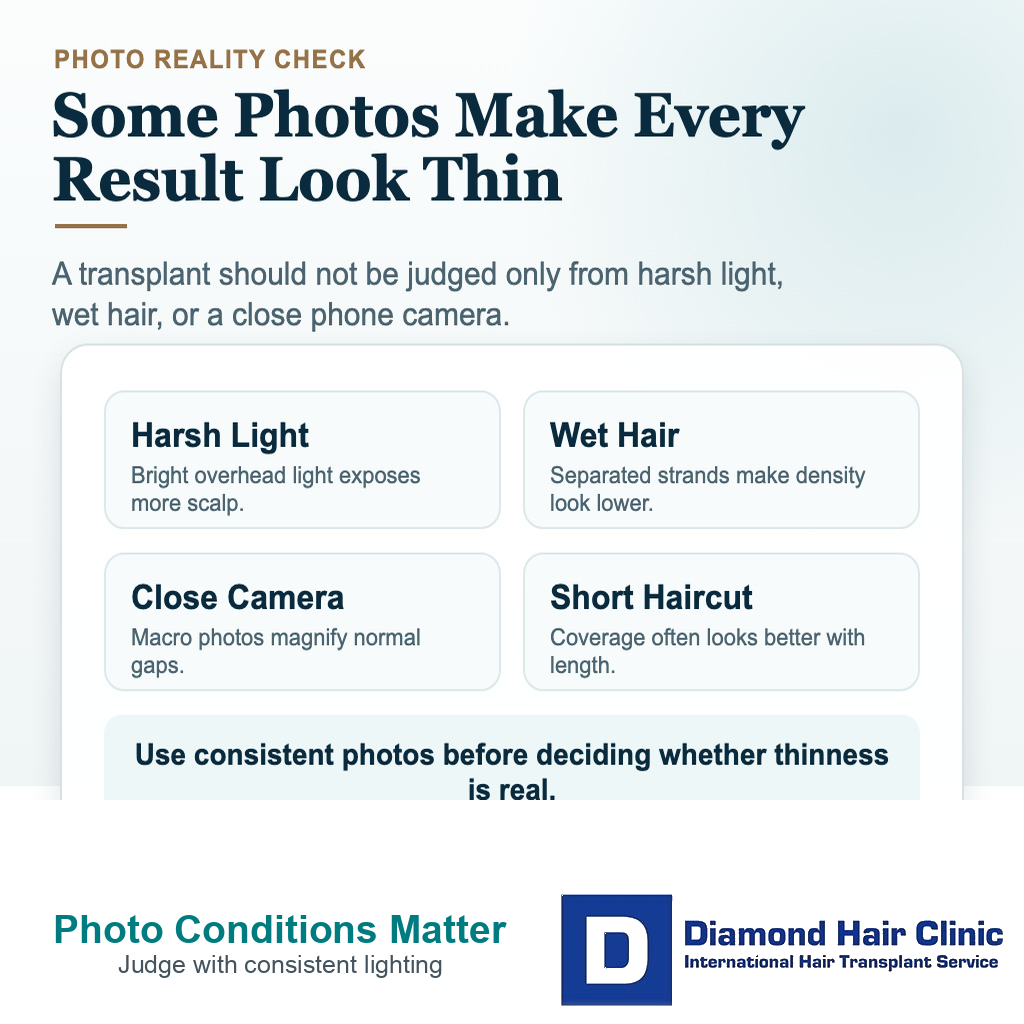
The fifth is a result that appears worse in photos, close-ups, or harsh lighting than it does in normal daily life. This is extremely common, especially when the hair is wet, flattened, parted, or photographed too closely.

The sixth is a result that appears weaker because the patient still has ongoing native hair miniaturization in the area behind or around the transplanted zone. In that situation, the transplant itself may not be the main problem. The surrounding hair may still be thinning, which changes the overall visual impression.

The seventh is a result that genuinely looks weak because the planning was poor, the grafts were distributed badly, the donor was used without a real strategy, or the execution itself was not strong enough.

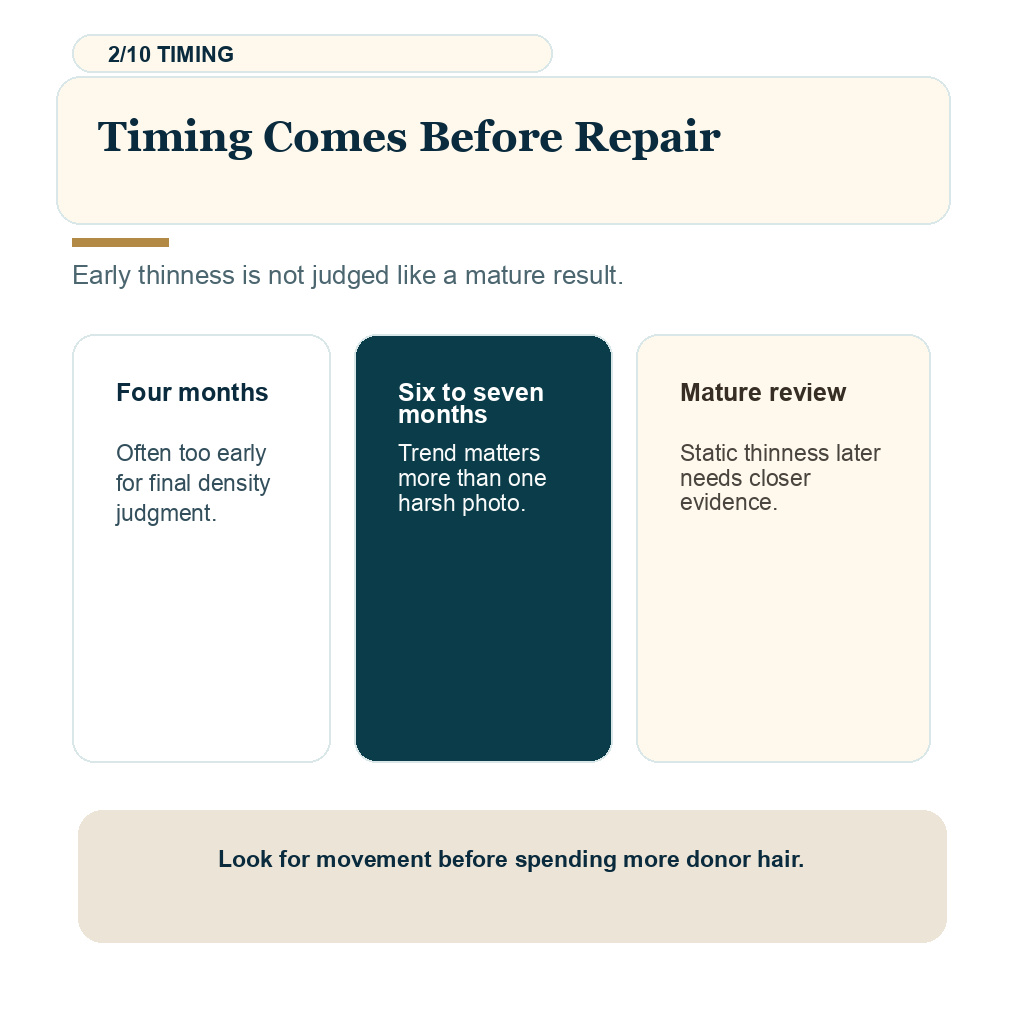
There is also one more point that patients often overlook. Sometimes they judge a result too early. A transplant that is still in an immature growth stage can easily look lighter than the final outcome will look later, usually within 18-24 months. If a person judges the surgery before the hair has had enough time to grow and mature, he may interpret normal progression as a density problem.

If a patient cannot separate these realities, he will misread much of what he sees online. He may unfairly criticize an honest result, misunderstand a design issue as a density issue, mistake ongoing native hair loss for transplant weakness, or fail to recognize a poorly planned transplant when it appears right in front of him.

That is where the confusion usually begins.

Does Seeing Some Scalp Automatically Mean Failure?

No, it does not.

This is the first point I would want every patient to understand clearly. 

If you look closely enough at almost any head of hair under strong light, from the wrong angle, with the hair flattened, parted, or slightly wet, you may see some scalp. That is not unique to transplanted hair. It can happen even in men who have never had a hair transplant in their lives.

So the mere existence of scalp show-through does not prove a bad result.

What matters is the overall visual impression. Does the hair frame the face properly? 

Does the front look soft and natural? 

Does the result suit the patient’s age and pattern of hair loss?

 Does it look right in daily life, not just in a harsh close-up taken under unforgiving lighting?

This is where many patients become too severe in their judgment. They begin studying hair as if it were a flat material meant to hide the scalp perfectly from every angle. Hair does not behave that way. It reacts to light, angle, length, moisture, texture, and styling.

Sometimes, what a patient thinks is “thinness” is simply the normal behavior of hair being judged too harshly.

But once that point is clear, the more important question appears.

If a visible scalp alone does not automatically mean failure, then what actually creates the feeling of fullness in the first place?

What Actually Creates The Feeling Of Density?

This is one of the most misunderstood parts of the whole subject.

Many patients think density is only about graft numbers

They hear a number and assume that number alone will decide how full the final result will look. 

In reality, what the eye reads is much more complex than that.

There is true density, which is the actual amount of hair present in a certain area.

There is visual density, which is how full that area appears in real life.

And there is also the illusion of density, which is shaped by characteristics that can make the same number of hairs look either fuller or lighter.

That distinction matters enormously.

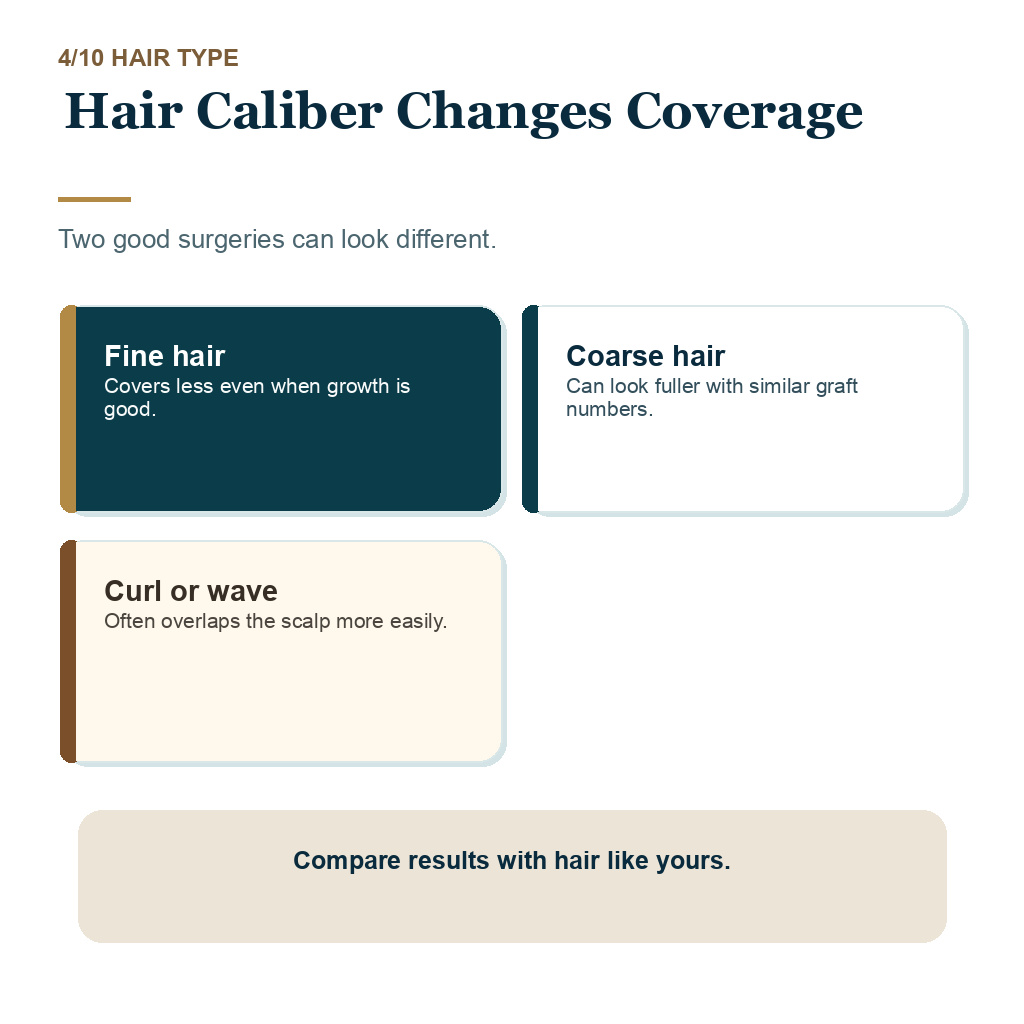
Hair caliber matters. Thick hair creates more bulk than fine hair.

Hair texture matters. Wavy or curly hair often gives more visual fullness than very straight hair.

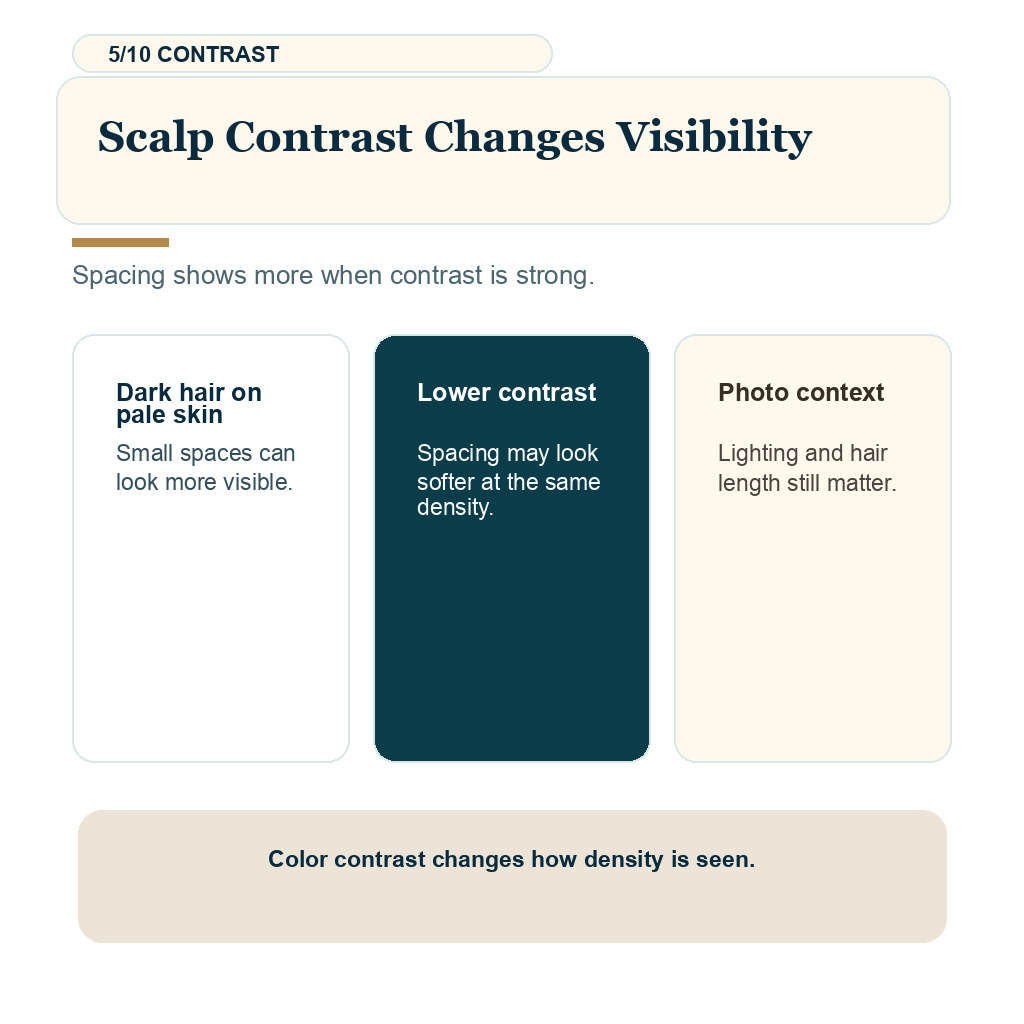
Scalp contrast matters. When the scalp and hair color contrast strongly, the scalp becomes easier to notice.

Direction and angulation matter. Hair placed correctly can create softness, depth, and fullness. Hair placed poorly can make an area look flatter, harsher, and lighter than it actually is.

Distribution matters. Where the grafts are placed often matters more than patients realize. Even when the graft count sounds acceptable, poor distribution can still create a weak visual result. If the grafts are placed in obvious row-like patterns, the scalp can appear more see-through and the hairline can lose the soft, natural irregularity that makes a transplant look convincing. 

In my opinion, failing to pay close attention to graft distribution and creating a row pattern is almost always a sign of poor hair transplant quality. This is most commonly seen in hair mill clinics or in the work of careless surgeons. A row pattern mainly saves time during the recipient-site incision stage of the surgery, but that convenience comes at the cost of naturalness. 

And the question patients should ask is simple: Who feels the need to rush such a critical step of the procedure? Usually, it is clinics taking on high volumes of patients at lower prices, hair mills. You would not normally expect to see this kind of rushed pattern in a surgeon-led clinic that treats only one patient per day.

This is why two patients can receive similar numbers of grafts and still look very different in the end. A man with coarse, dark, slightly wavy hair may look quite full with fewer grafts. A man with fine, straight hair and a stronger scalp contrast may still look lighter even with more grafts.

That is not a theory. That is the everyday clinical reality.

In my experience, this is one of the biggest mistakes patients make when they compare results online. They compare one result to another as if every patient starts with the same donor, the same hair characteristics, and the same biological potential.

That is never true.

Can Hair Characteristics Alone Make A Good Result Look Lighter?

Yes, very often.

This point deserves much more emphasis, because many patients underestimate how powerful hair characteristics really are in hair transplantation.

A patient with fine, straight hair and strong scalp contrast may never look as visually full as a patient with coarse, wavy hair and lower contrast, even if both surgeries were planned competently and both patients received an honest, technically sound procedure.

That does not automatically mean the first result is poor.

It may simply mean the visual advantages are different from the beginning.

This is one of the biggest reasons why patients misjudge results online. They compare one patient to another as if the surgery alone explains everything. In reality, the surgeon is not working with the same raw material in every case. He is working with varying hair shaft thicknesses, textures, contrasts, donor qualities, and surface areas to cover.

And those differences matter enormously.

A thicker hair shaft creates more visual bulk than a thinner one. Hair that has some natural wave or curl tends to overlap and cover the scalp more effectively than very straight hair. Hair with lower contrast against the scalp usually hides show-through more easily. Even the way hair grows, bends, and sits on the scalp can affect how dense the result appears in daily life.

So when patients say, “This person looks much fuller than that person,” they often assume they are looking only at surgical quality.

Very often, they are not.

They are also looking at the biology that the surgeon started with.

I have seen this many times in practice. 

A patient with relatively favorable hair characteristics may achieve a strong-looking result with a more moderate graft count, while another patient with much finer hair may still look lighter even after a carefully planned surgery. The first case may appear denser in a photo, but that does not automatically mean the surgeon performed better in that case. Sometimes it simply means the patient’s hair had more natural visual advantages.

This is also why I do not like simplistic online comparisons between clinic cases.

One patient may have coarse donor hair, mild wave, and a relatively smaller area of loss, such as Norwood 1 or 2.

Another may have fine hair, a flatter texture, stronger scalp contrast, and a much broader area to cover, such as Norwood 4, 5, or 6.

Those two patients should never be judged as if they started from the same position, because they did not.

Even within the same patient, hair characteristics can influence how different zones are perceived. A frontal area may look reasonably full when styled properly, while the same level of density in another patient may still appear lighter because the scalp shows through more easily. In some men, hair can separate more quickly under bright light or when slightly wet, making the scalp more visible, even though graft survival may still be acceptable.

I even remember operating on identical twin brothers from the United States in 2023. Their degree of baldness was very similar. The number of implanted grafts was very similar. Their hair-to-scalp contrast, donor graft quality, and even habits such as not smoking were almost identical. I operated on them on two consecutive days, Saturday and Sunday. Both improved significantly after surgery, but one still achieved noticeably better visual fullness than the other.

That is a very important example, because if even identical twins with very similar starting points can show a difference in final visual impact, patients should understand how unrealistic it is to compare unrelated clinic cases online as if the surgery alone explains everything.

This is why I believe patients should be very careful when they judge a result too simplistically.

A fair judgment should include the patient’s hair caliber, texture, curl or straightness, scalp contrast, donor quality, and the size of the bald area being treated. Without that context, many comparisons become misleading from the beginning.

As a hair transplant surgeon, I can say that two equally well-planned surgeries can still produce two very different visual impressions simply because the biological starting point was not exactly the same.

That is not an excuse for poor surgery.

It is simply a clinical reality.

Can A Good Hair Transplant Still Look Light Because Of Donor Limits?

Yes, absolutely.

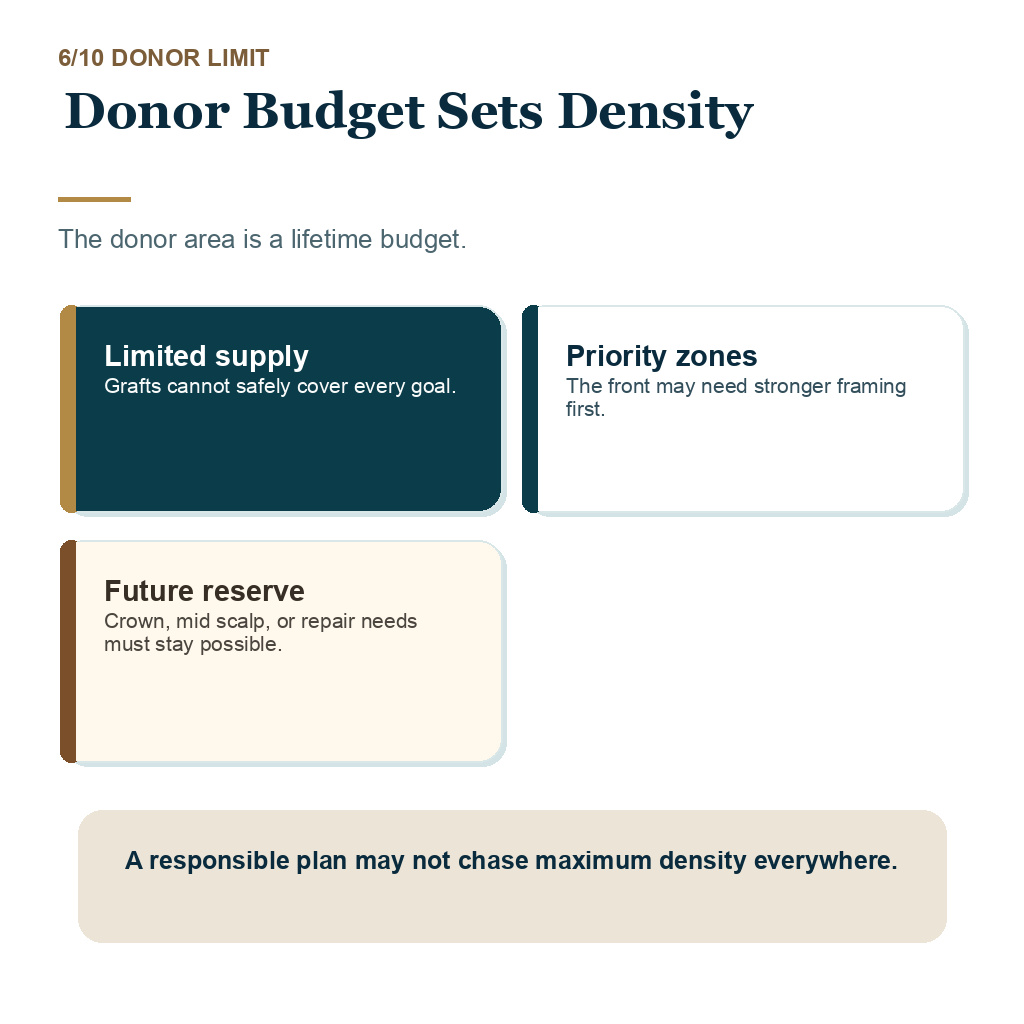
A hair transplant does not create new hair out of nowhere. It redistributes a limited supply of existing donor hair. 

That is why I always say the donor area is the patient’s long-term hair bank. Once grafts are removed from that bank, they are permanently removed from that area.

That means every case has a ceiling.

A patient may emotionally want the same density he had at 17 years old, but the surgeon is not working with that original teenage situation. He is working with the donor the patient still has today, the amount of loss already present, the likelihood of future progression, and the need to keep the donor looking natural as well.

This is where many patients misunderstand the subject. They assume that if a surgeon is good enough, the surgeon should simply be able to “make it dense.” But the donor is not unlimited. It is not an endless resource that can be spent freely without consequences. Every graft taken from the donor has a cost, and that cost must be judged not only by what is gained in the front but also by what is left behind at the back.

This is where honest surgical planning matters.

Sometimes, the most responsible result is not the densest-looking result imaginable. Sometimes the most responsible result is the one that clearly improves the patient, properly frames the face, preserves the donor, and still leaves room for the future.

That is especially true in patients with broader patterns of loss. (Norwood 4,5, or 6 cases) 

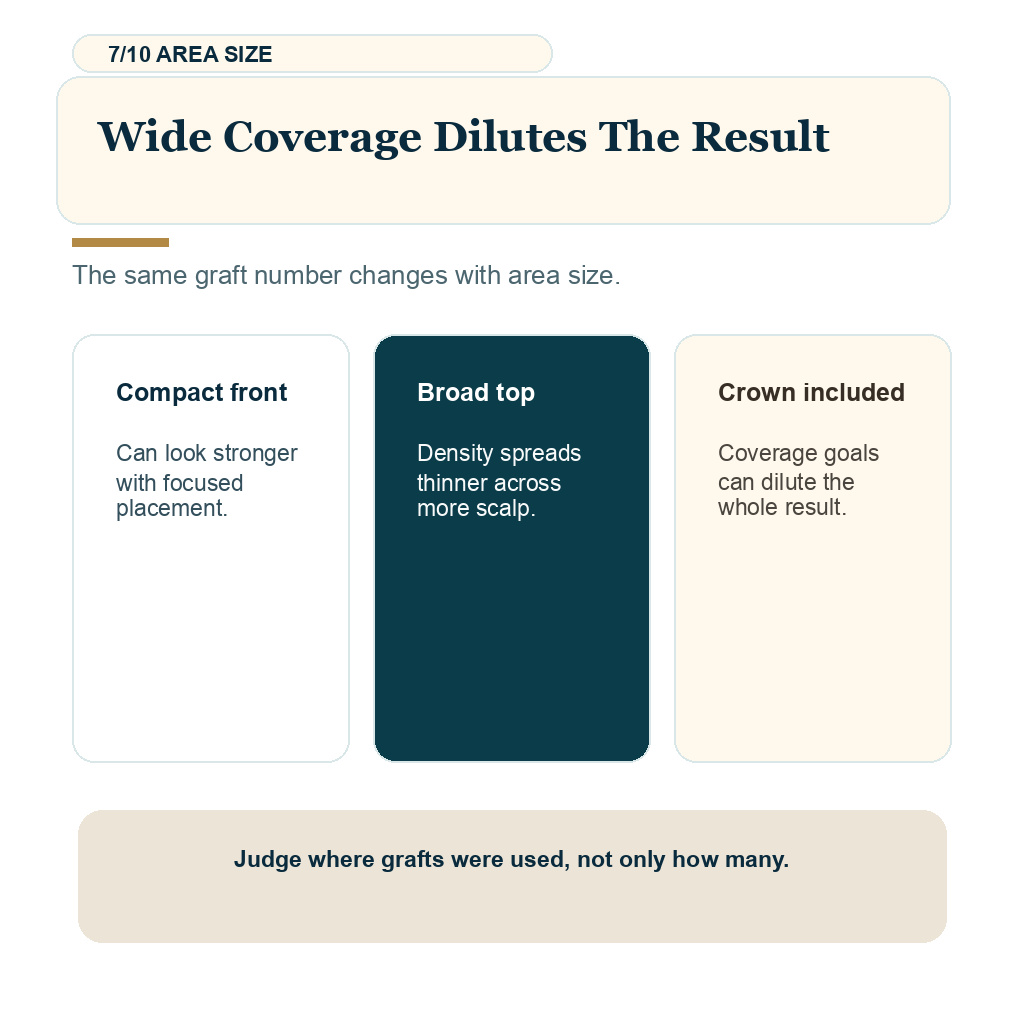
A man with a relatively small area to restore may achieve a stronger visual effect with the same donor than a man whose thinning extends across the hairline, midscalp, and crown. In the second situation, the donor may simply not be strong enough to create very high density everywhere without becoming overused.

This is exactly why I do not believe in promising fantasy density across a large balding area.

A surgeon can always spread grafts wider.

That is easy.

What is much harder is creating real visual impact while still protecting the donor and ensuring the result remains sustainable if hair loss continues in the future.

I have seen patients misread this many times. A man with a broad balding pattern may receive a well-planned transplant and still not look as dense as he emotionally hoped, because the donor simply could not support that fantasy honestly. In that situation, the lighter appearance is not always a sign of poor surgical technique. Sometimes it is the result of responsible restraint.

And in my opinion, responsible restraint is often one of the clearest signs of a thoughtful, ethical surgeon.

Because the alternative is very dangerous.

The alternative is to chase a dramatic short-term look by pushing the donor too far, extracting grafts too aggressively and causing overharvesting, or trying to cover too much territory at once. That approach may sound attractive during the consultation, but it can easily create two problems instead of one: a front that still does not look as dense as the patient imagined, and a donor area that no longer looks natural because it has been overharvested.

As a hair transplant surgeon who has been performing hair transplant surgery for more than a decade, I can say very clearly that some results look lighter not because the surgeon did too little, but because the surgeon refused to do something irresponsible and unethical. 

That is not weak surgery.

Very often, it is the opposite.

It is a sign that the surgeon respected the biology of the case, respected the limitations of the donor, and chose a plan that made more long-term sense than an emotionally attractive but unrealistic promise.

Can A Hairline Look Weak Even When The Real Problem Is Design?

Yes, absolutely, and in my opinion, this is one of the most important distinctions in the whole subject.

Many patients say a transplant looks thin when what they are actually reacting to is poor design

The human eye does not judge only how much hair is present. It judges the front edge first. If that front edge looks wrong, the entire result can feel disappointing even before we start talking about deeper density behind it.

A hairline may look weak because it is too straight, too sharp, too even, or too artificial in the way it transitions into the forehead. In that situation, even if the graft count is not especially low, the result can still feel wrong. The problem is not always that there are too few hairs. Sometimes the problem is that the hairs have been arranged in a way that does not look natural.

This is why hairline design matters so much.

A natural hairline should not look like a drawn border. It should have softness, slight macro and micro-irregularities, and a proper transition zone. It should not feel like a hard wall placed across the forehead. If that soft transition is missing, the eye immediately notices the artificiality.

This becomes even worse when the grafts are placed in obvious row-like patterns. Even when the graft count appears acceptable, poor distribution at the hairline can still create a weaker, more see-through appearance. 

A row pattern removes the subtle irregularity that makes a hairline look natural. Instead of creating a natural front edge, it creates repetition. And repetition is exactly what the human eye picks up. 

In my opinion, this is one of the clearest signs of poor-quality hair transplantation. 

This is why I do not judge a hairline only by how “dense” it looks in a close-up. I also assess whether it looks soft, age-appropriate, irregular in a natural way, and properly integrated into the patient’s face. 

If the density is reasonable but the design is artificial, the result can still appear weak. 

On the other hand, if the design is natural and the frontal framing is strong, even a result that is not ultra-dense can still look very good in real life.

This is one of the main reasons I believe patients often mislabel unnaturalness as thinness. What they are reacting to is real, but they are often using the wrong word for it.

Do Photos And Close-Ups Make Results Look Worse Than They Really Are?

Yes, very often.

This is one of the most overlooked reasons patients misjudge hair transplant results.

Most patients evaluate hair transplantation through static, zoomed-in clinic photos. But real life is not like that. In real life, hair is seen in motion, from normal social distance, with ordinary styling, and as part of the whole face. 

In photographs, especially online, the patient is often studying one frozen angle under one specific light source, sometimes with the hair wet, flattened, separated, or photographed much too closely.

That changes perception dramatically.

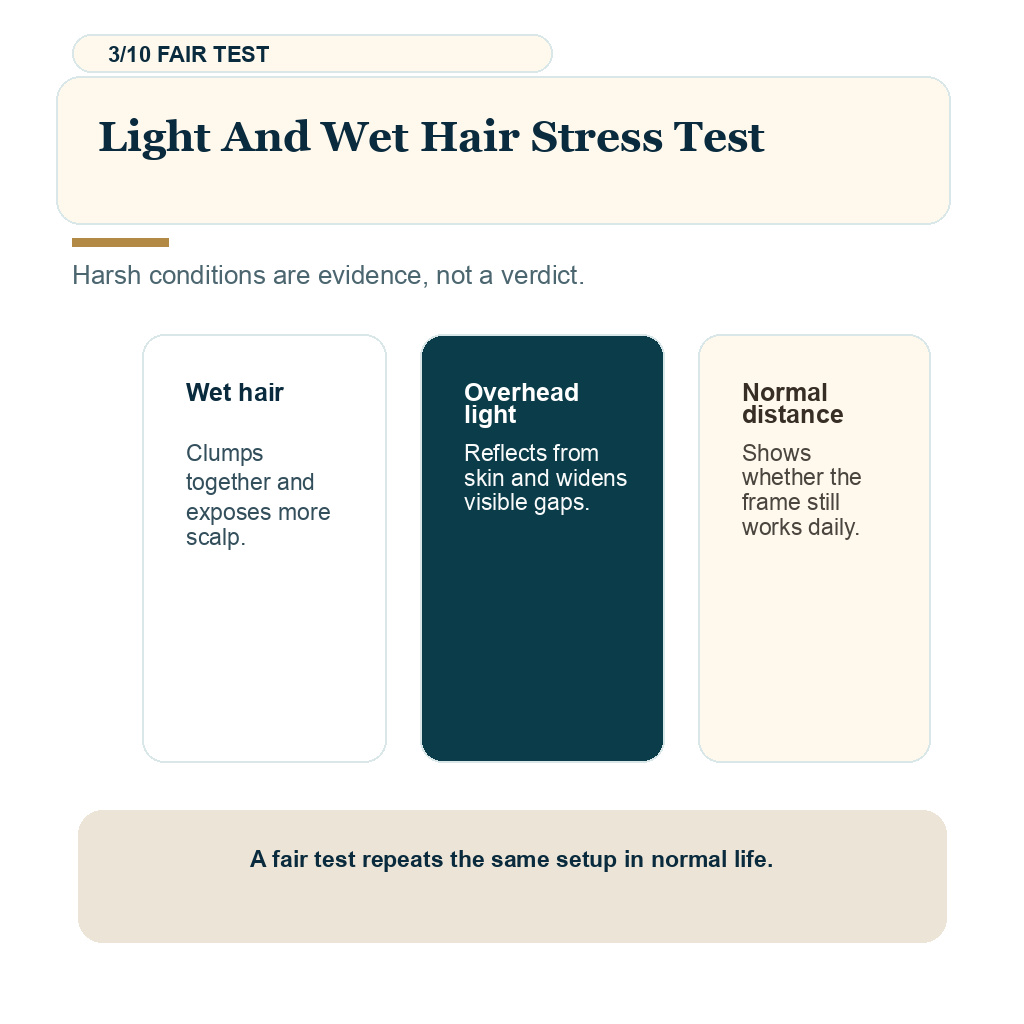
Wet hair often looks thinner because the hair groups together and exposes more of the scalp. 

Flat hair shows more scalp than textured hair. 

Harsh overhead light exaggerates show-through. 

A sharp part line can make the scalp look much more visible than it would appear in daily life. 

Even hair length changes the visual impression. Slightly longer hair can camouflage reduced fullness better than shorter hair, while hair brushed forward may appear denser than hair styled backward.

So when a patient stares at a close-up clinic photo and thinks, “This looks thin,” he may not be reacting only to the transplant itself. He may also be reacting to the photographic conditions.

This is one reason why simplistic online comparisons can be misleading. 

One clinic may photograph a patient under softer lighting, with favorable styling and a more forgiving angle. 

Another may show a close-up under harsher lighting that exposes every bit of scalp visibility. 

Those two photos may create very different impressions, even if the underlying quality of the surgery is not dramatically different.

That does not mean photographs are useless.

It means they have to be interpreted intelligently.

A good photo can still reveal a great deal. 

It can show whether the hairline looks too straight, whether the grafts appear too row-like, whether the frontal transition is soft or artificial, and whether the donor area seems overharvested. But when it comes to judging apparent fullness, the photo should never be treated as the entire truth on its own.

A transplant should not be judged only by the harshest close-up.

It should be judged by how it works in ordinary life.

That is the real standard.

Can Ongoing Native Hair Loss Make A Transplant Look Weaker, And Why Is Post-Operative Medical Treatment So Important?

Yes, absolutely, and this is one of the most overlooked points in hair transplantation.

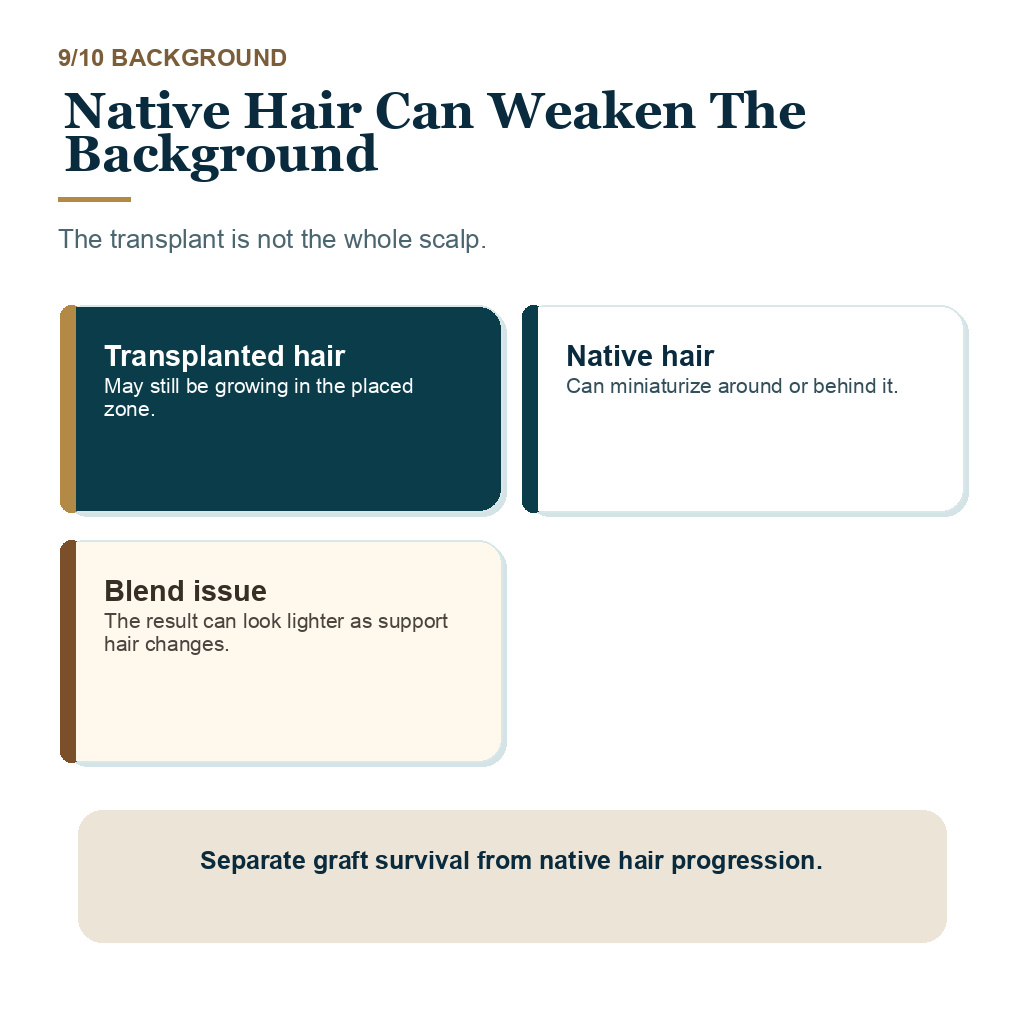
Sometimes the transplanted hair itself is not the main problem. The real issue is that the native hair behind, between, or around the transplanted grafts is still miniaturizing. When that surrounding hair continues to thin, the whole area can begin to look lighter, less blended, and less supportive.

In that situation, a patient may think the hair transplant failed, when in reality the transplanted grafts may have survived reasonably well. What changed is that the non-transplanted hair around them kept declining.

This distinction is very important.

A transplant does not freeze the rest of the scalp in time. It does not automatically halt the progression of androgenetic hair loss in native hair. If the surrounding hair continues to miniaturize after surgery, the overall visual result can gradually change, even if the implanted grafts remain.

This is one of the main reasons why a result that looked nicely blended in the earlier period may later appear more separated, patchier, or less dense. The transplanted hairs may still be there, but the native hair that once supported the overall appearance may no longer contribute the same visual effect.

I have seen this create a great deal of misunderstanding in patients. They look at the scalp later on and assume the surgery did not hold. But sometimes the more accurate explanation is that the surgery held reasonably well while the surrounding native hair continued to weaken.

This is exactly why long-term planning matters so much.

A surgeon should never think only about where to place grafts today. He also has to consider how the patient’s hair may continue to change. He has to consider whether the current native hair is stable, how aggressive the hair loss pattern appears, and whether the design and density strategy will still make sense if the surrounding hair continues to miniaturize.

And this is also exactly why post-operative medical treatment matters so much.

A hair transplant can improve the frontal frame and create a much stronger cosmetic starting point, but it does not automatically protect the non-transplanted native hair. If that hair is still vulnerable to ongoing thinning, the long-term appearance of the result may depend heavily on whether it is being medically supported or quietly continuing to weaken.

In my opinion, this is especially important in patients who already show ongoing miniaturization or active progression of hair loss.

For many men, the core post-operative medical discussion includes Finasteride, Dutasteride, and Minoxidil. Treatments such as PRP may also be considered as a supportive adjunct in selected cases. I do not see this medical side as some optional conversation after the surgery. I see it as part of responsible long-term hair restoration planning.

Because in reality, the operation and the medical strategy are not two separate worlds.

They are connected.

If a patient has ongoing miniaturization, that should be explained honestly. If medical treatment is likely to be important in preserving or strengthening the surrounding native hair, that should also be explained honestly. Patients deserve to understand that not every visual change later on comes from the grafts themselves. Sometimes the change comes from the hair that was never transplanted in the first place.

In my opinion, one of the biggest mistakes in hair transplantation is to judge the result without separating graft survival from ongoing native hair loss. Those are not the same thing, and if a patient does not understand the difference, he can easily misread the result.

This is also exactly the kind of explanation that should come from the surgeon.

A responsible surgeon should explain not only where the grafts will go, but also what may happen to the non-transplanted hair in the years ahead, why medical treatment can matter, and what role each option may or may not play.

And frankly, I do not think patients should expect that kind of detailed, individualized explanation in a hair mill clinic operating on 10-20 patients a day at around $3,500. Clinics built around that kind of volume usually focus on moving the case through the system. A proper discussion about Finasteride, Dutasteride, Minoxidil, PRP, ongoing miniaturization, and long-term planning requires time, judgment, and real surgeon involvement.

That is much more consistent with a surgeon-led clinic operating one patient per day than with a production-line model.

This is why I believe post-operative medical treatment should never be treated like a minor add-on.

Very often, surgery creates the opportunity for a better result, but post-operative medical treatment helps protect that result over time.

Can A Good Transplant Look Thin If It Is Judged Too Early?

Yes, absolutely.

Timing creates a great deal of confusion in hair transplantation, and in my opinion, this is one of the most common reasons patients misread their own results.

A transplant passes through different stages. It does not move from surgery day to final density in one straight, smooth line. 

Early growth can look irregular, immature, lighter, and much less convincing than the eventual outcome. The hairs do not all emerge at the same time, with the same thickness, or with the same visual strength. Some areas may begin to improve earlier, while others still look quiet, patchy, or underpowered.

This is exactly why a transplant can look weaker in the earlier period than it truly is.

The hair that begins to grow back early often does not yet show its final character. Hair caliber, texture, and overall maturity can continue to improve over time. 

A result that looks underwhelming too early can still become much better later as the hairs thicken, the coverage becomes more even, and the visual blending improves.

I have seen many patients become unnecessarily discouraged because they judged the surgery too early in the process rather than at the proper stage. They look at the scalp too early, see immature growth, uneven emergence, or temporary visual patchiness, and assume something went wrong. But very often what they are seeing is simply a normal, incomplete stage of development rather than true failure.

This is even more confusing because different zones of the scalp may not evolve in exactly the same way. A frontal area may start giving encouraging signs while another area, such as the mid-scalp or crown area, still looks lighter and less convincing. That kind of difference can make patients think the surgery is inconsistent, when in reality the process is still unfolding.

This is one reason I always tell patients not to rush to judgment in the earlier phases.

A hair transplant has to be judged at the right stage, not while it is still developing.

That is also why proper hair transplant aftercare and realistic follow-up matter so much. Patients need to understand not only what to do after surgery but also what they will see month by month. 

They need to know that an early appearance of thinness does not automatically mean weak growth, just as an early encouraging appearance does not always mean the process is fully complete.

In my opinion, one of the surgeon’s responsibilities is to prepare the patient for this timeline (18-24 months) honestly. 

Because when a patient understands that hair transplantation is a staged biological process, he is much less likely to panic at the wrong moment and much more likely to judge the result fairly.

When Does A Hair Transplant Truly Look Thin Because The Plan Was Weak?

This is the side of the subject that patients also need to understand properly.

Some results genuinely look poor because the planning itself was weak.

Sometimes grafts are spread across too large an area, so the patient receives coverage without real impact

Sometimes the hairline is set too low or too broad, leaving not enough grafts to provide proper support behind it. 

Sometimes the frontal zone is not prioritized correctly, so the patient is told that a large area was “treated,” but the face still does not receive the kind of framing that meaningfully changes appearance.

And sometimes the problem is not only how many grafts were used, but how they were arranged.

If the recipient sites are created in a rushed, repetitive, or row-like pattern, the result can immediately lose some of the soft irregularity that makes a transplant look natural. Even when the graft count sounds acceptable, poor planning and poor distribution can still make the scalp look more see-through, especially at the hairline. 

This is also why I believe patients should be careful when they hear only a large graft number and assume that must mean a strong result.

A simple example explains this clearly. A patient may hear 4,000 grafts and assume that must mean strong fullness. But if those 4,000 grafts are spread across the hairline, midscalp, and crown without a real priority strategy, the final result may still feel underpowered everywhere. The number sounds impressive. The visual effect still feels weak.

This is exactly why I do not judge a case by the number alone. I care much more about whether the grafts were used in the right area, in the right direction, with the right spacing, and with the right long-term strategy

Patients who want to understand that logic more deeply should also read how a surgeon calculates the graft number for a hair transplant.

A larger number does not automatically mean a stronger result.

A more moderate number can sometimes be used much more intelligently.

And in my opinion, that difference is often what separates a thoughtful hair transplant from a merely marketable one.

Why Do Donor Limits And Crown Expectations Make So Many Results Feel Thin?

Because many patients want one donor area to solve too many problems at once.

This is one of the central realities of hair transplantation. 

The donor is limited, but the area a patient wants improved can be very large. 

Once a patient starts thinking not only about the hairline but also the mid-scalp, the crown, and sometimes even future progression, the pressure on the donor increases very quickly.

This becomes especially important when the crown area enters the discussion.

The crown can accommodate a large number of grafts without producing the same cosmetic impact as frontal work. 

A patient may feel emotionally drawn to treating the crown because it represents baldness so clearly to him, but from a visual planning perspective, the crown is often much more expensive in graft terms than patients realize. It can absorb a large portion of the donor supply without producing the same immediate facial improvement as a well-built frontal zone.

That is where many cases begin to dilute.

If a patient wants the hairline, midscalp, and crown all treated aggressively in one plan, the final result can easily become too spread out. The surgery may technically cover a lot of territory, but the visual impact may still feel weaker than expected because the available grafts were asked to do too much at once.

Later, the patient may say the transplant looks thin.

But often the deeper problem is not that the surgery failed.

The deeper problem is that the donor was asked to do more than it could responsibly support.

This is exactly why candidacy matters so much. 

A patient must first be a good candidate for a hair transplant, not simply an eager patient who wants as much coverage as possible as quickly as possible.

Over the years, I have seen many men focus only on how low they can bring their hairline or how much territory they can cover in a single session. In reality, a lower hairline is not always better, and broader coverage is not always the best strategy. Sometimes those wishes create a future density problem that should have been avoided from the beginning.

This is where I believe responsible surgical judgment becomes very important.

A thoughtful surgeon does not only ask, “How much can I do today?”

He also asks, “What kind of result will still make sense later?”

If the donor is used too freely in the first surgery, especially across a wide frontal zone plus crown work, the patient may later be left with fewer good options if the native hair continues to thin. That is why I do not believe every area should be addressed automatically at once, just because the patient wants everything improved immediately.

Sometimes the stronger plan is the more selective plan.

Sometimes, the more intelligent plan is to build real impact in the frontal frame first, preserve donor strength, and avoid creating a diluted result across too much territory.

In my opinion, many thin-looking transplants are not thin because nothing was done.

They are thin because too much was attempted with a donor that was never strong enough to support all of it properly.

That difference matters enormously.

What Should Patients Ask Instead?

I believe patients should ask much better questions.

One of the most common mistakes in hair transplantation is asking the wrong question from the beginning. 

Many patients become fixated on a very simplistic idea of success. They ask, “Will my scalp never show at all?” or they judge everything through the fantasy of maximum density under every light, angle, and condition.

In my opinion, that is the wrong standard.

A more discerning patient should ask whether the result will look natural in daily life, not whether it will perfectly hide the scalp in every close-up. He should ask whether the donor area will still look normal, whether the available grafts are being used where they create the most important visual impact, whether the hairline suits his age and likely future hair loss, and whether the overall plan is trying to create a sustainable long-term result rather than just an emotionally attractive promise during the consultation.

Those are far better questions.

Because a good hair transplant is not simply the one that sounds impressive on paper. It is not the one with the biggest graft number, the lowest hairline, or the broadest area of coverage. It is the one that makes sense when you look at the patient as a whole.

That is why I often tell patients to focus less on fantasy density and more on what makes a good hair transplant result. A good result is not only about looking dense in one close-up. It is about looking natural, balanced, age-appropriate, and sustainable.

In my opinion, the best patient questions are the ones that reveal whether the surgeon is truly thinking long term.

Is the donor being protected?

Is the frontal frame being prioritized properly?

Is the plan realistic for my pattern of loss?

Will this still make sense if my native hair continues to thin?

Those are the kinds of questions that separate serious decision-making from emotional decision-making.

And in many cases, they separate a thoughtful surgical plan from a merely marketable one.

So, Are You Becoming Too Aware, Or Do Some Hair Transplants Really Look Thin?

Sometimes you become too aware.

But sometimes the transplant really does look thin.

The mistake is assuming there is only one explanation.

A visible scalp is not automatically a failure.

A result that looks lighter is not automatically a bad surgery.

A slightly airy appearance is not the same thing as poor planning.

An unnatural hairline is not always a true density problem.

A harsh photo is not always a reflection of real life.

Ongoing native hair loss is not always graft failure.

And a large number of grafts is certainly not automatic proof of quality.

As Dr. Mehmet Demircioglu, after more than 10 years of performing hair transplant surgery, I have learned that one of the biggest problems in this field is not only poor surgery but also a poor understanding of what a genuinely good result should look like.

In my opinion, the best hair transplant is not the one that chases an impossible teenage-density at any cost. It is not the one that sounds most impressive in a consultation. And it is not the one that simply covers the widest area on paper.

The best hair transplant is the one that creates the most natural, balanced, age-appropriate, and sustainable improvement possible while still respecting the donor area, the patient’s future hair loss, and the biological limits of the case.

That is the standard I believe patients should use when judging results.

And that is also the standard I believe every surgeon should use when planning them.