FUE After FUT and Old Strip Scar Planning
A previous strip scar can still leave room for carefully planned FUE in selected patients. Removing more grafts is only one part of another surgery decision, because the old strip scar changes what remains safe to use. I first need to examine the old linear scar, the hair above and below it, the remaining donor density, your usual haircut length, and the real goal of the second operation. An old FUT scar changes the donor map, so a second procedure should never be planned from a graft number alone. The reverse sequence has different risks. Scar behavior and the hair around it decide the usable donor area more than a second quote does. FUT after FUE needs a separate donor and scar review because the donor has already been changed by extraction.
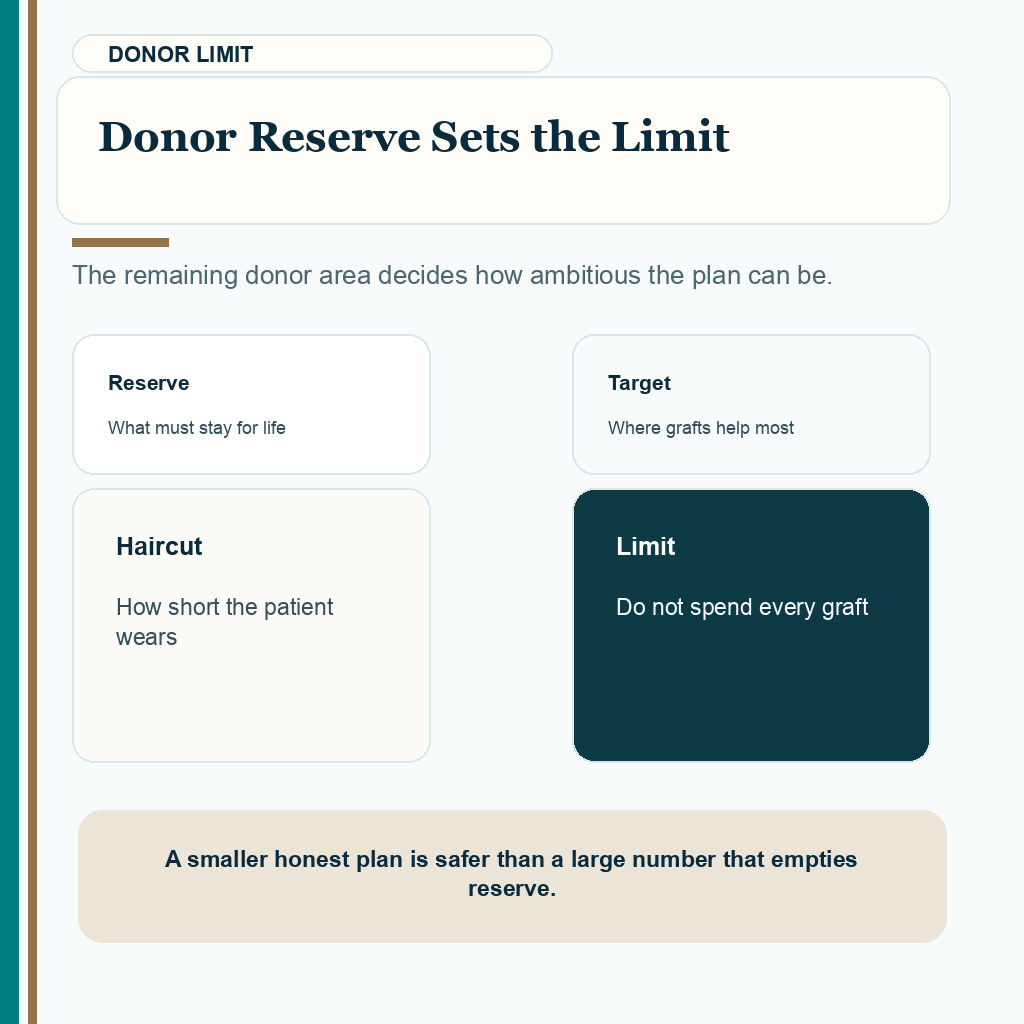
If the donor area has enough remaining hair, FUE may improve the hairline, mid scalp, crown, or specific thin areas. It may also help soften a strip scar in carefully chosen cases. But the old FUT surgery has already spent part of the donor reserve and changed the skin. Planning should protect what remains instead of treating the remaining donor as untouched.
FUE can be done after FUT only with donor review
FUE after FUT is possible when the remaining donor still has useful density, the old scar is stable, and the new goal is realistic. If you had strip surgery ten or fifteen years ago, you may still be a candidate for FUE. But the answer comes from the current scalp, not from the age of the scar alone.
The first operation matters. FUT strip surgery removes a strip of hair bearing skin from the donor area and closes that area as a line. The hair around that line may still be useful, but the surgeon has to respect the scar, the surrounding skin tension, and the way the old harvest changed the donor zone.
FUE after FUT can sound like an upgrade to a newer technique. I look at it differently. The second surgery is being performed on a donor area that already has history. It may still be strong. It may also be narrower, scarred, stretched, thin, or uneven. The examination decides which answer is true.
The strip scar changes the donor plan
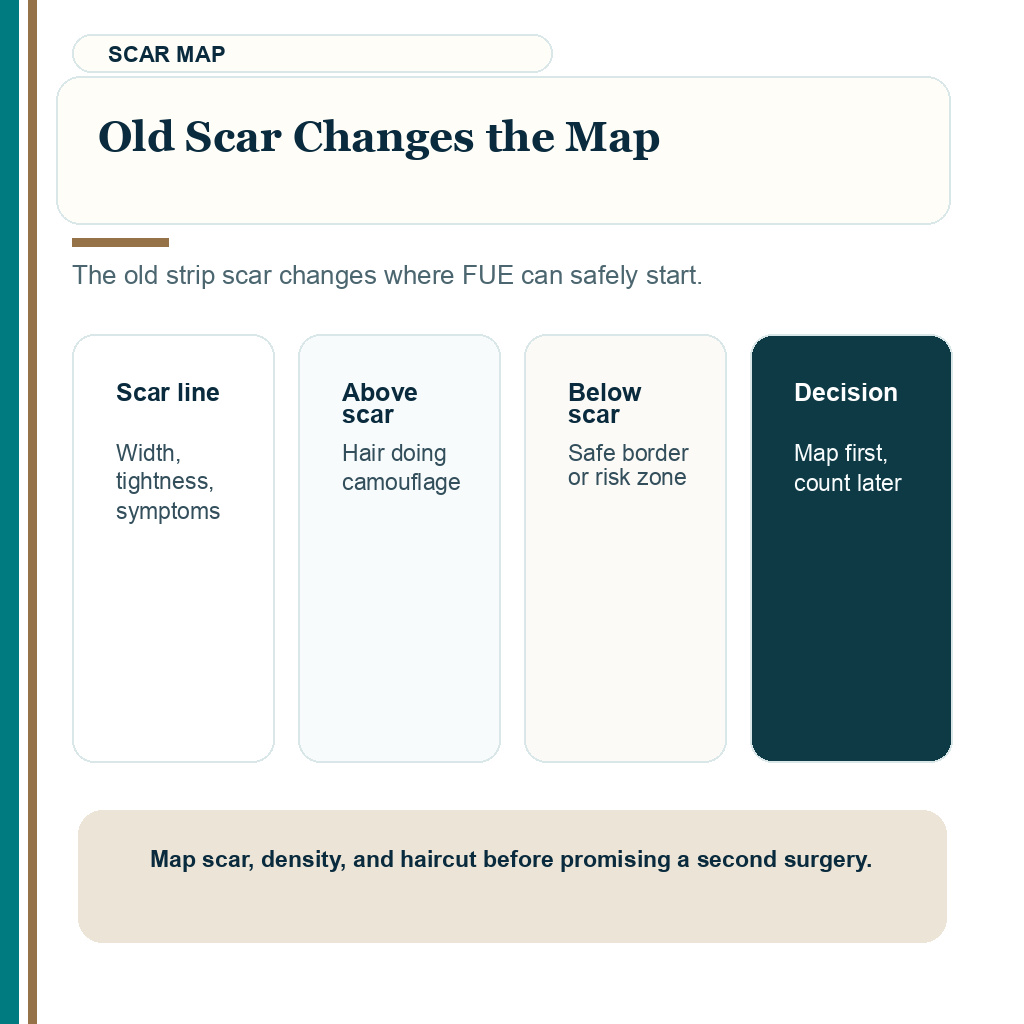
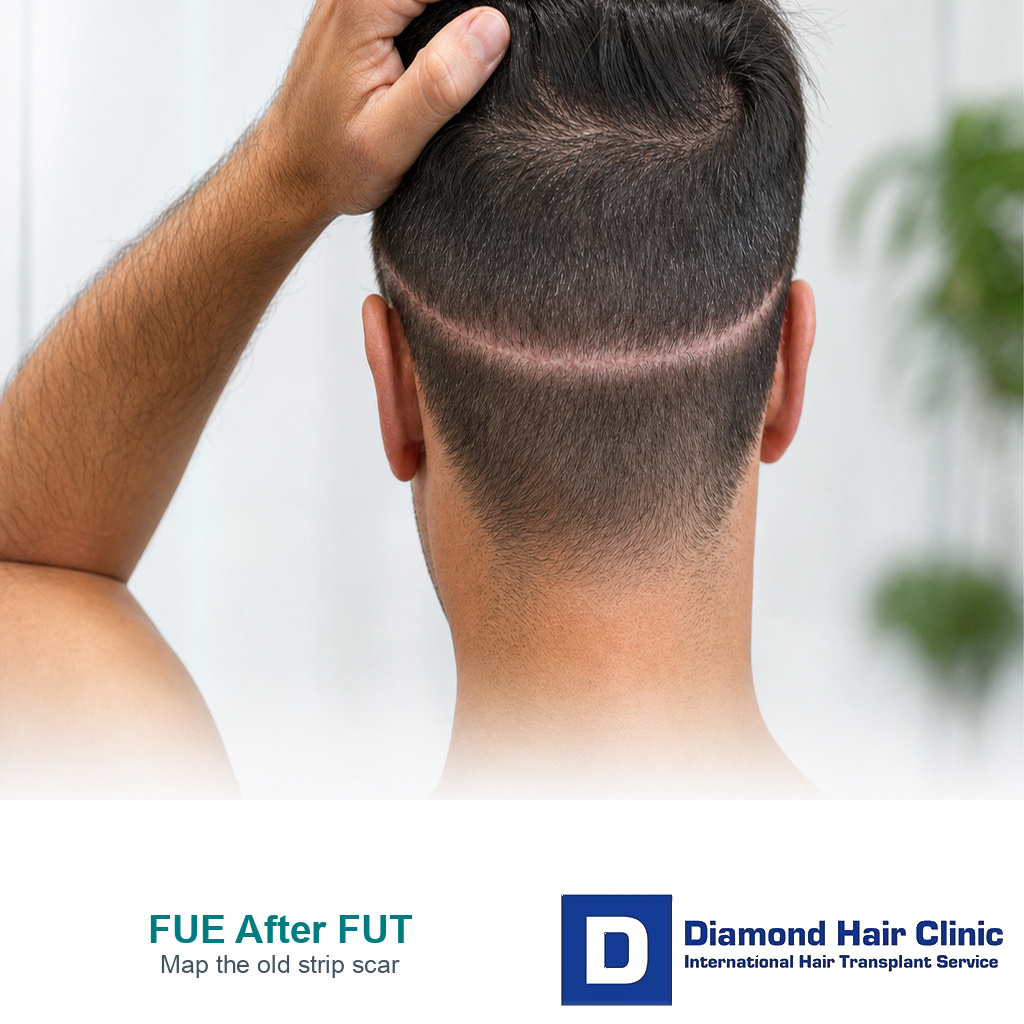
The old scar divides the donor area into zones. Hair above the scar, below the scar, and to the sides may not have the same density or long term value. The scar itself has different skin quality from normal scalp. The blood supply, texture, firmness, and healing behavior can be different. During examination, I also look at scar width, whether the line is raised or depressed, tenderness, numbness, skin tightness, and the hair direction around the closure. Do not plan FUE from the graft number alone, because the location of the remaining grafts matters as much as the number.
The general donor area has to be mapped again. I need to know how much hair remains inside the safer donor zone, whether the hair below the scar is too low or unstable, and whether the hair above the scar is needed to cover the line when you wear your normal haircut. Temple refinement adds a different donor need. FUE can select finer grafts one by one from suitable stable areas, while a second strip provides the hair within its planned line. I do not chase finer hair outside the safe donor zone, because a fine graft is useful only if it is likely to remain stable.
A careless second extraction can make the old scar more visible. If too much hair is removed around the scar, the surrounding camouflage becomes weaker. You may gain density in the front but lose confidence in the back of the head. That tradeoff has to be discussed before surgery, not discovered after the donor is shaved.
Name the hair that must keep covering the strip scar before any new FUE grafts are counted. If that cover is borrowed for the front, the scar can become the new visible problem.
Plan the second procedure around the old strip scar
FUE after FUT changes the donor calculation compared with an untouched donor area. The old strip scar, the hair above and below it, and the haircut the patient wants to keep all affect how many grafts can be removed without making the back of the head look weaker.
A wide, raised, pale, or stretched scar may need surrounding hair for camouflage. If too much hair is taken close to that scar, the front may gain density while the donor area becomes the new visible concern. That tradeoff should be mapped before another graft number is chosen.
Old records help, but the current examination matters more when the previous graft count is unclear. Map the scar boundary, the donor zones to avoid, the extraction spacing, and the recipient priority. A second surgery needs to preserve the cover that still makes the first scar wearable.
Shaving can reveal the old FUT scar
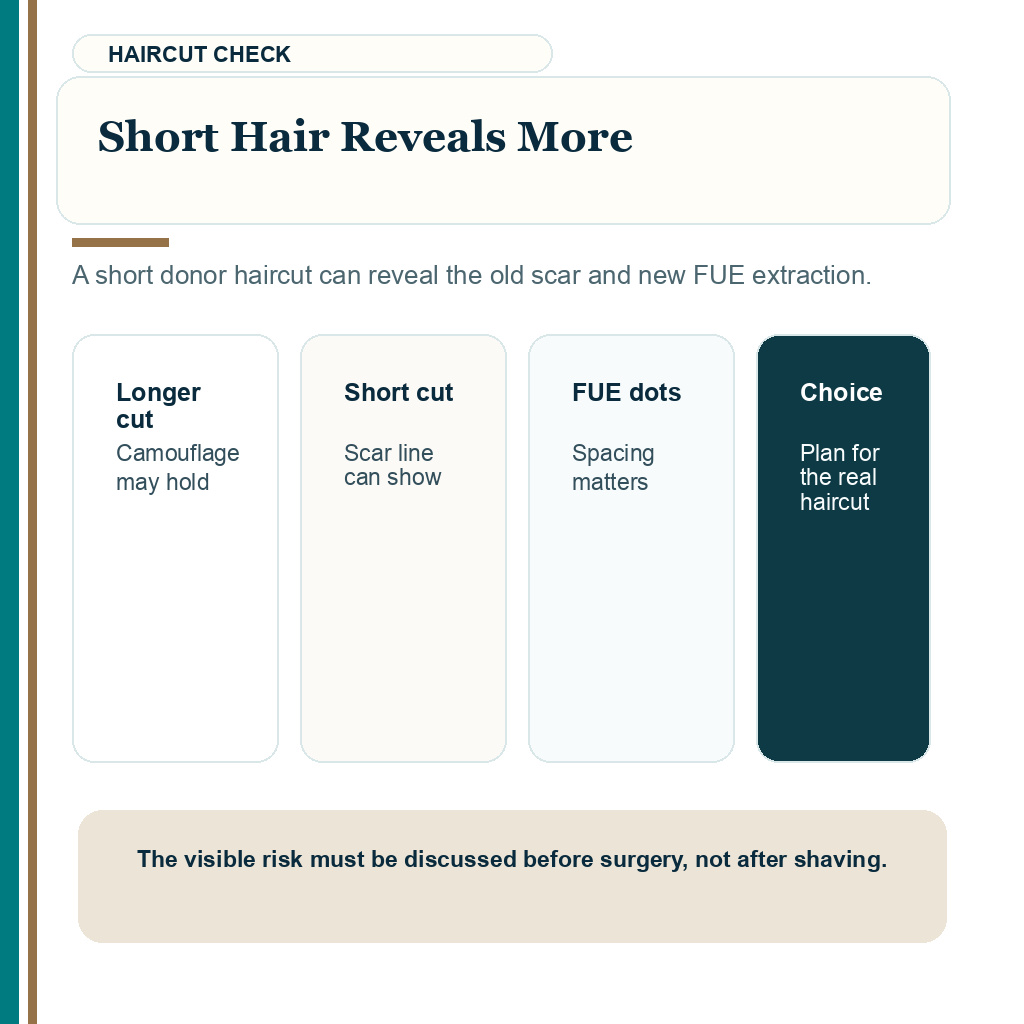
When FUE is performed after FUT, the donor area often needs shaving or partial shaving. That can expose the old strip scar temporarily. For some people, the line is covered again as the surrounding hair grows back. For others, the scar is already wide, pale, raised, stretched, or poorly hidden, so shaving makes the problem very obvious for several weeks.
Haircut length is part of the medical plan. A temporary surgical shave is different from choosing to live with a low fade, 0.5 guard, or very short buzz cut. If you normally wear very short hair, the old FUT scar may matter more than the recipient area. If you are comfortable keeping the donor longer, the same scar may be easier to hide. The lesson from short hair after FUE donor scars is similar. FUE also leaves marks, but in a different pattern from FUT.
Before making the decision, I need to see the donor area at your real haircut length, not only shaved for examination. Send or bring photos with the hair lying naturally and with the hair lifted above and below the scar, because both views matter. A scar that disappears under longer hair may still be visible after shaving for surgery. Confirm this before you make travel, work, or social downtime plans.

FUE after FUT should start with donor photos, haircut length, scar width, and a realistic map of what remains.
FUE after FUT can make the scar harder to hide
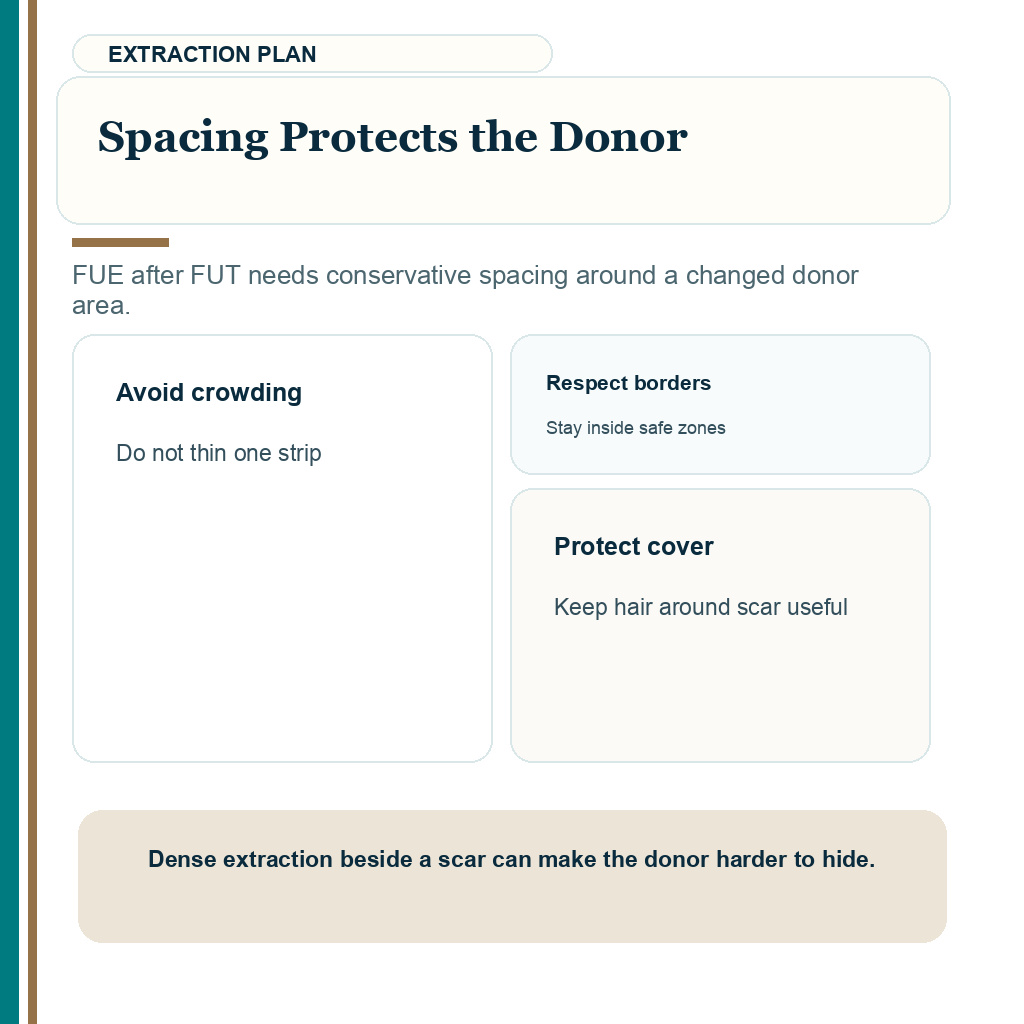
It can if the extraction pattern is careless. The old strip scar is often hidden by the hair immediately above and below it. If too many FUE grafts are removed from that camouflage zone, the scar may become easier to see even after the shaved donor hair grows back. I do not treat the area around the scar as ordinary donor scalp.
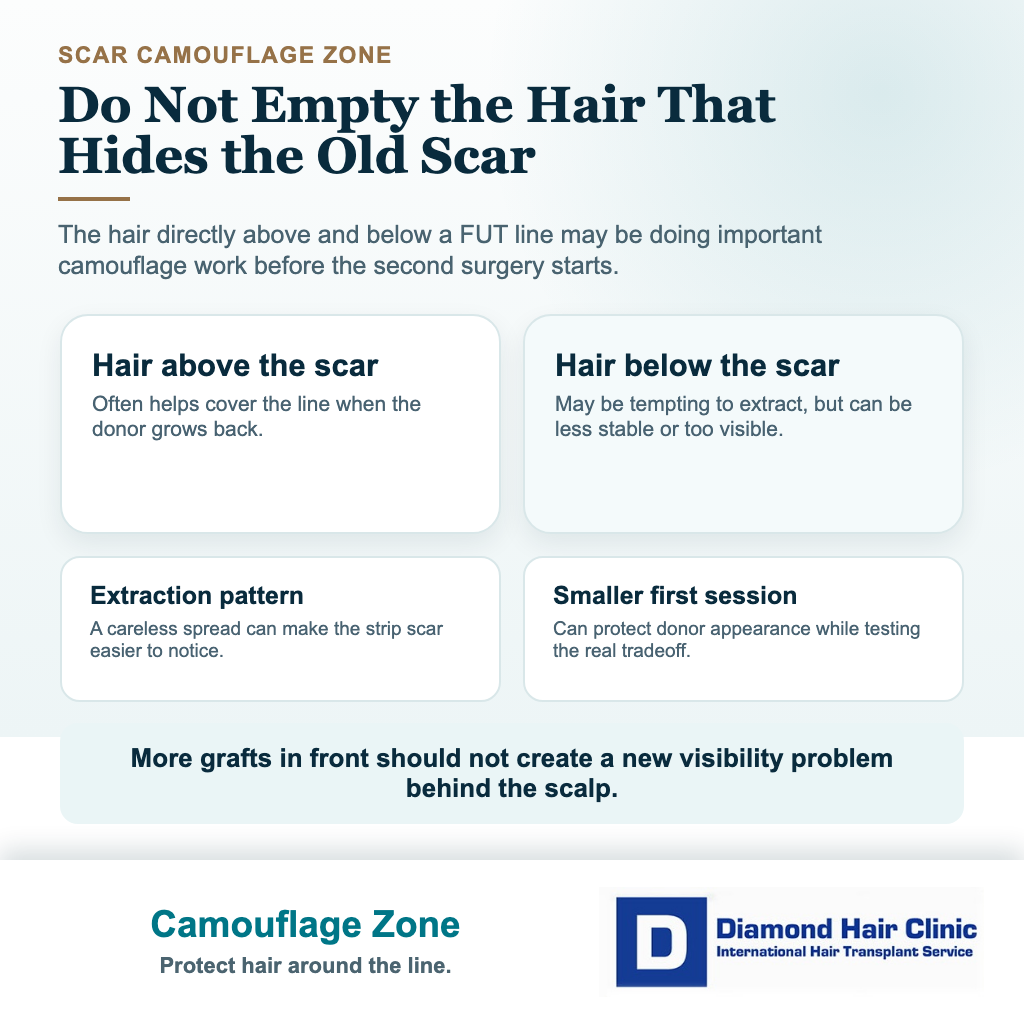
Before surgery, I look at the scar with your normal haircut length and then decide which zones should be protected. Sometimes the grafts with the lowest donor risk are not the closest grafts to the scar. Planning may leave more hair around the line, take fewer grafts from a tempting area, or use a smaller first session so the donor still covers the old FUT mark after healing. The plan should define a protected buffer around the scar so random FUE dots do not merge visually with the old line.
FUE grafts need careful donor zone selection
Grafts can sometimes be taken from areas above, below, and around the old FUT scar, but not every part is equal. Hair too low on the neck may not be stable enough for a long term transplant. Hair close to the scar may be needed for coverage. Hair above the scar may be useful, but excessive extraction can thin the donor surface.
The second plan has to balance three needs. It must protect the visible result in the recipient area, the donor appearance after extraction, and future hair loss. This donor budget logic is broader in second hair transplant decisions. After FUT, it becomes more specific because the scar has already spent one part of the donor design.
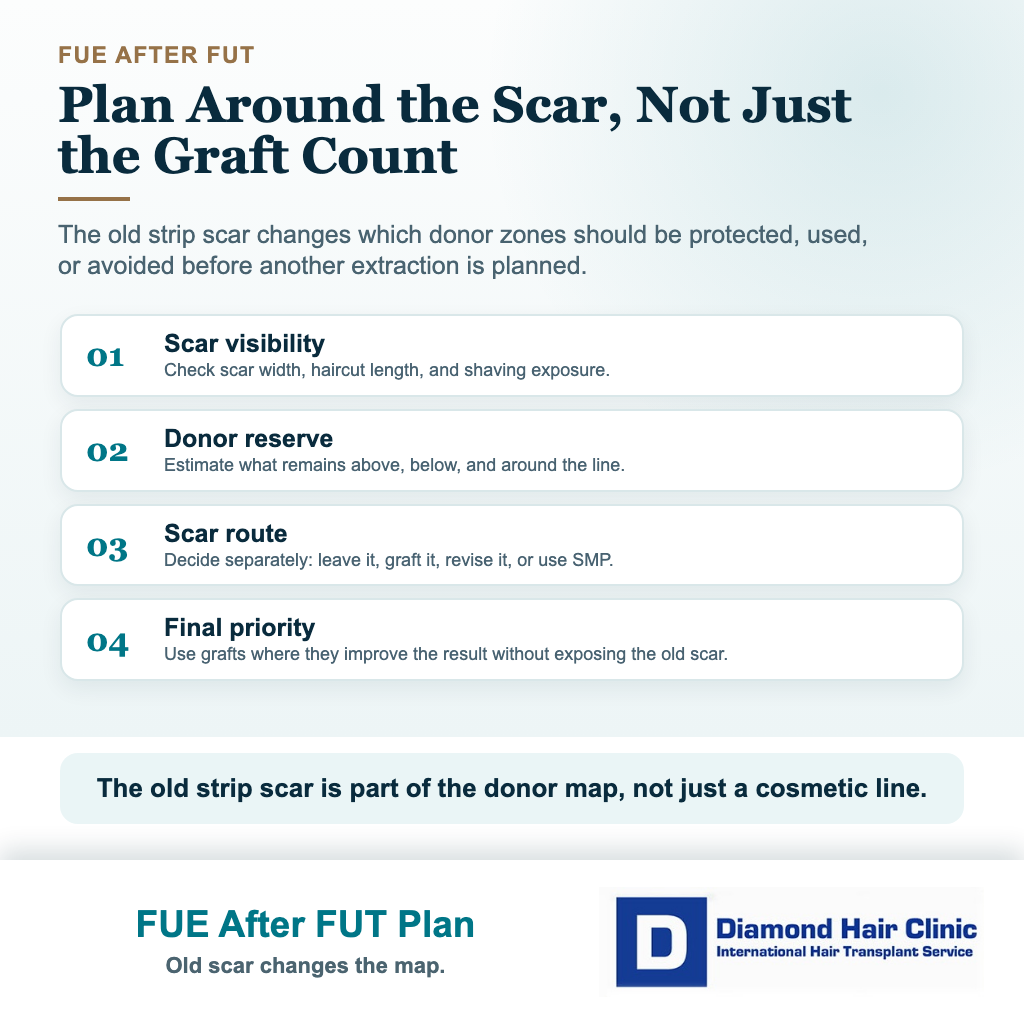
The second plan should protect the remaining donor area before promising new density.
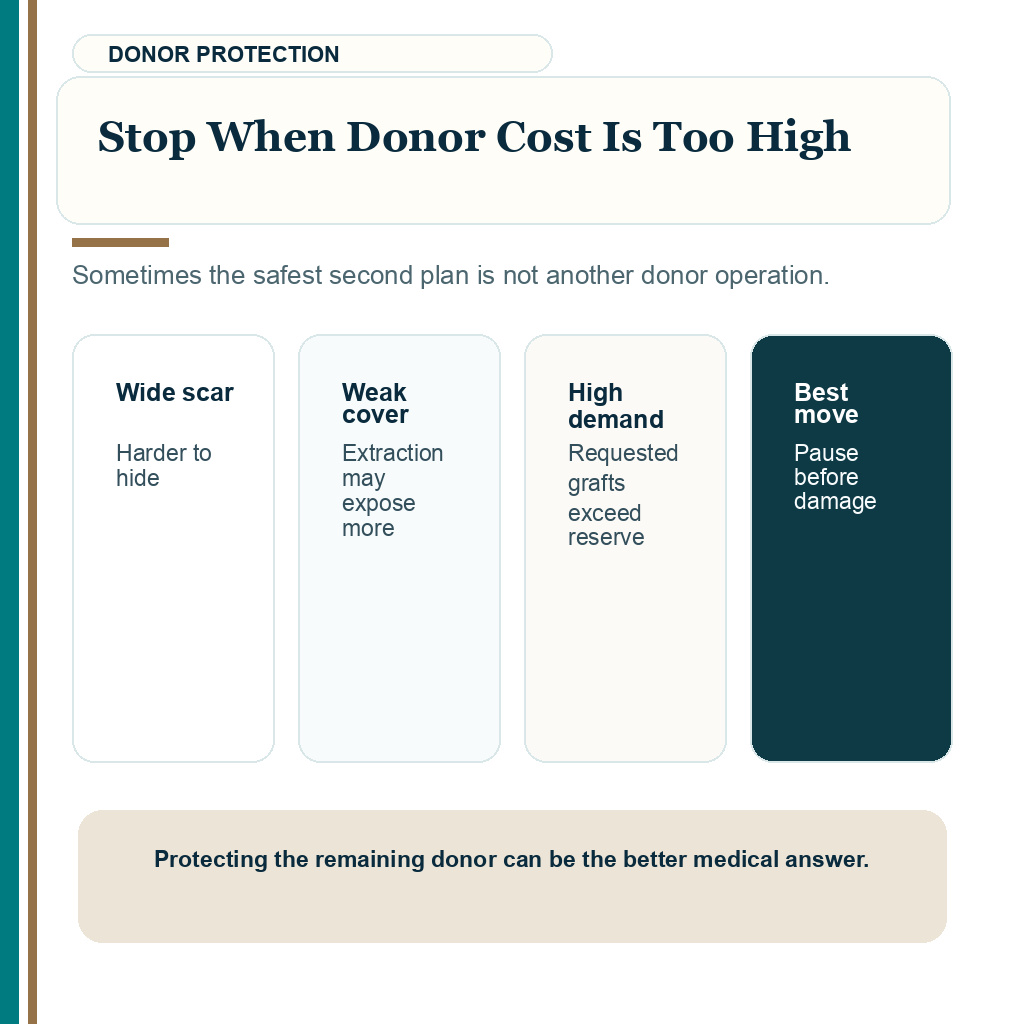
A very large FUE session can sometimes improve a disappointing old FUT result, but it cannot be treated as automatic compensation. Sometimes the donor area cannot support the number you want. A surgeon has to be willing to say no to a large number when the donor pattern is not strong enough.
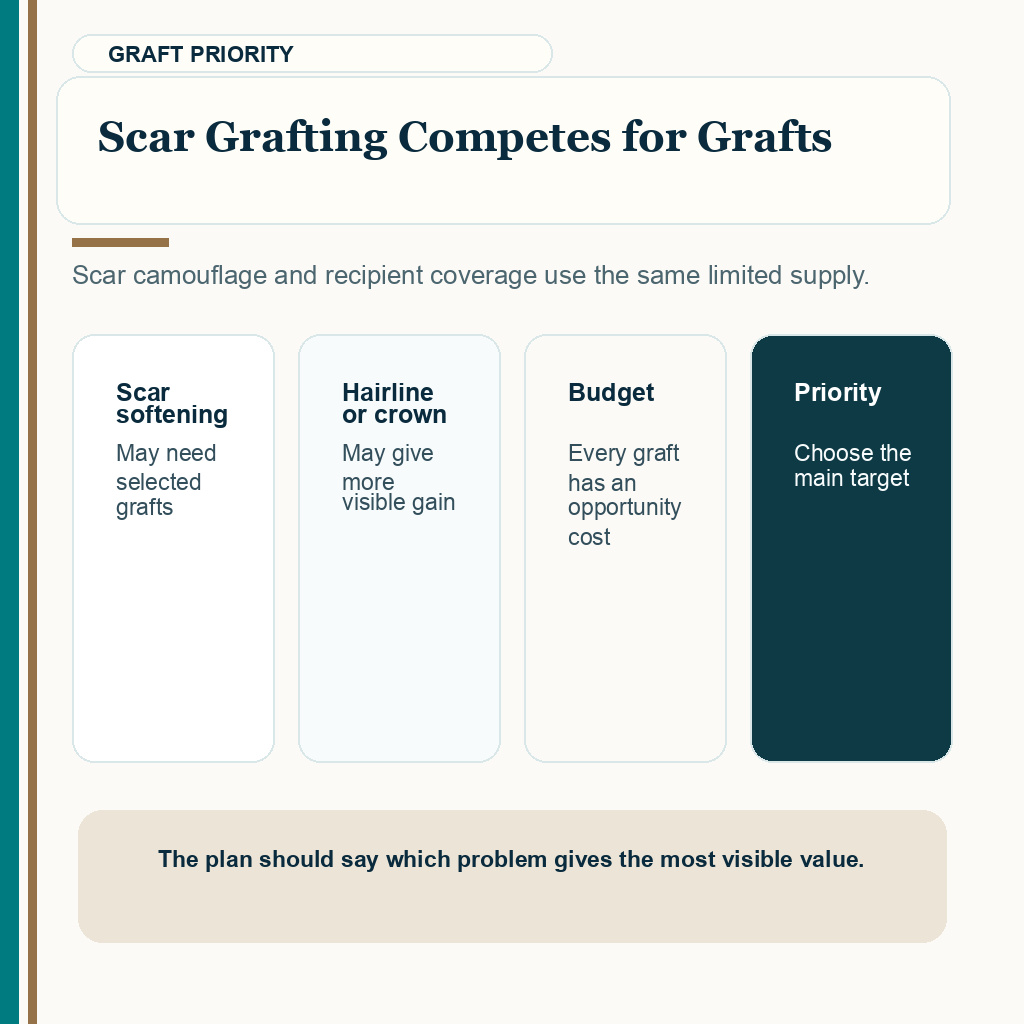
Scar grafting and recipient area work compete for grafts
Placing FUE grafts into a FUT scar can help selected scars, but it is not always the right step during a second transplant. Scar tissue is not normal scalp. Growth can be less predictable, and a narrow white line may need fewer grafts than you expect. A wide, tight, raised, painful, or unstable scar may need a different plan. The scar should be mature and quiet before grafting is used as camouflage, because inflamed or tense tissue can make the result less predictable.
Scar grafting is a separate decision. You may need recipient area improvement, scar camouflage, or both. These goals compete for the same limited graft supply. If the donor reserve is limited, spending good scalp grafts inside a scar may reduce what can be used for the hairline, mid scalp, or crown.
With FUE grafts for FUT scar repair, the timing question is when grafting into a scar can make sense. In a combined operation, I separate how much of the scar to treat, what type of hair to use, and whether the main cosmetic gain is better achieved elsewhere.
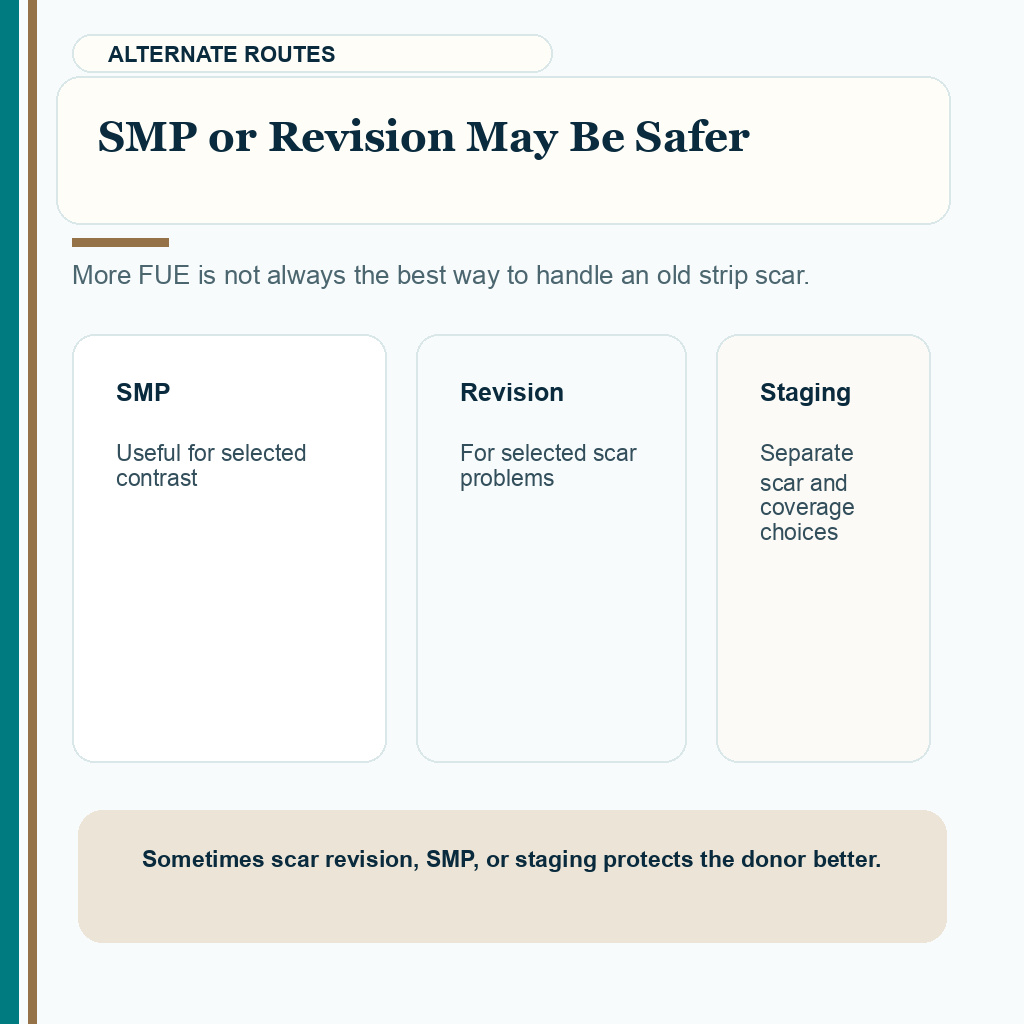
SMP or scar revision may be safer in some cases
Scalp micropigmentation, scar revision, and FUE grafting solve different problems. SMP changes color contrast, scar revision changes the scar shape, and grafting adds hair. SMP can reduce contrast when the scar is flat and the patient keeps the surrounding hair short enough for pigment to blend. Scar revision may help selected wide scars, but it also creates a new healing event and can widen again if tension is high. FUE grafting may soften a line when the scar tissue can support growth.
You may want the scar repaired while the main FUE transplant is being done. That can be reasonable, but only if the combined plan does not crowd the surgery or spend grafts poorly. If the donor reserve is limited, SMP or staged scar treatment may protect grafts for the area that changes the face most.
With scalp micropigmentation for a thin hair transplant, pigment can reduce contrast. It does not create hair, change hair direction, or repair a poor donor harvest.
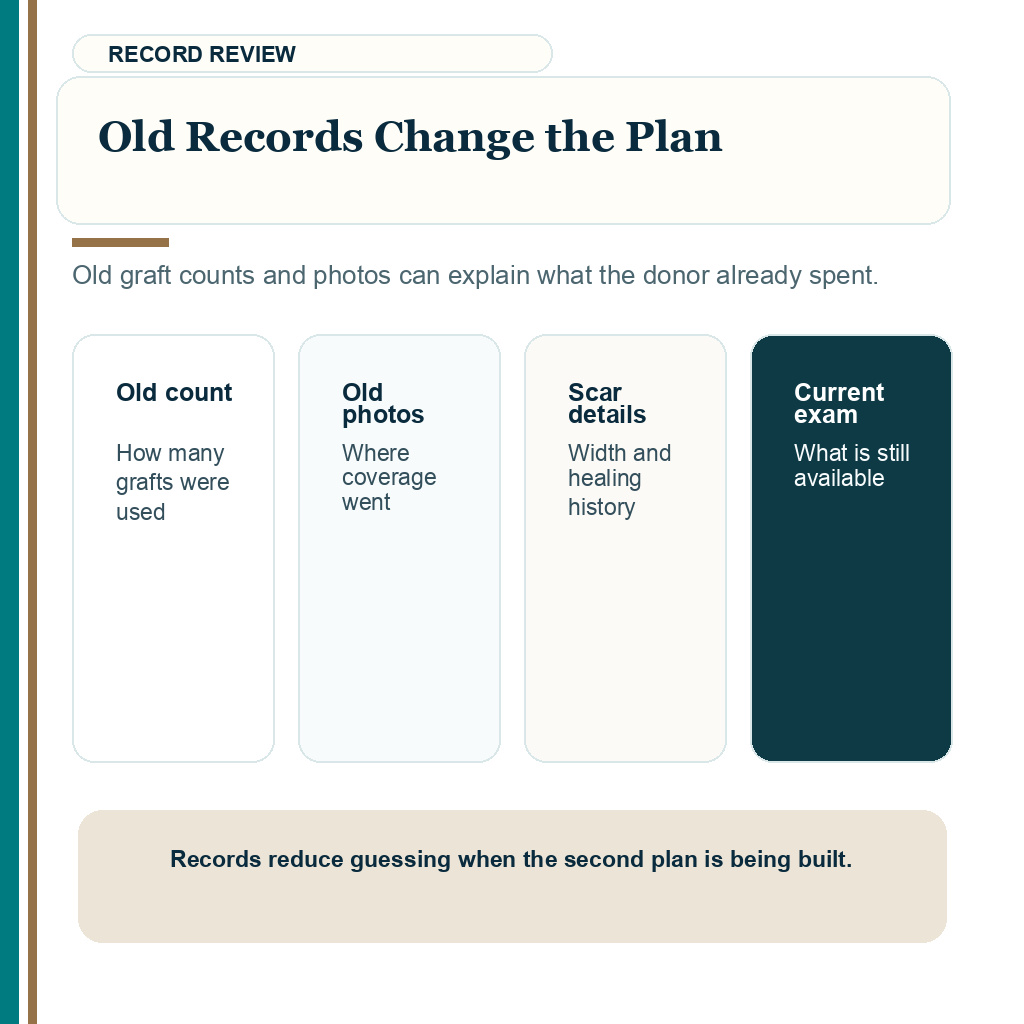
Records from the first FUT help the second plan
Bring the old graft count, old operative report if available, before surgery and immediate after surgery photos, donor scar photos, the original recipient area plan, and any follow up notes. Many people with older FUT surgery do not have complete records. In that case, current examination becomes even more important. If records are missing, I do not build the second plan from a remembered graft number or a quoted old total alone. Donor density, miniaturization, scar coverage, and recipient area survival have to be checked again.
Records from the first surgery matter because they help explain what was already used and what may still be available. A previous 2,500 graft FUT changes the remaining donor calculation differently from a 5,000 graft FUT, a stretched scar, or more than one strip surgery.
When records are vague, a confident new number becomes risky too quickly. Hair transplant graft count verification depends on reading documents, photos, and physical examination together.
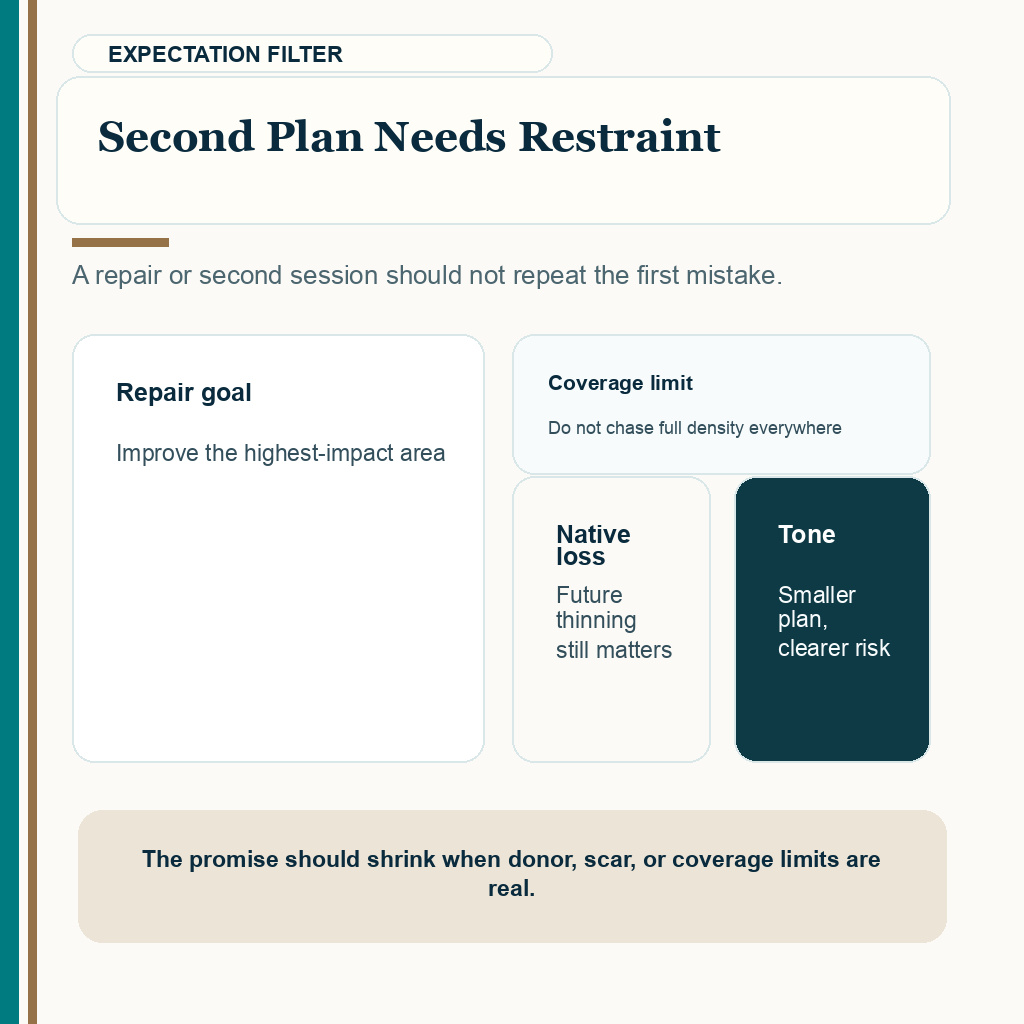
Second or third surgery changes expectations
After FUT, a later FUE is often a second surgery. Sometimes it is the third or fourth hair restoration step. Each operation reduces freedom. The remaining donor hair has to cover the old scar, support the new extraction, and still leave some future reserve if native hair loss continues.
A third procedure can still be reasonable when donor reserve, scalp condition, and priorities support it, but it needs a more conservative target. The final sessions are usually about prioritization, not chasing every thin area. Keep that in mind with third hair transplant safety.
At this point, a direct conversation matters. A hairline improvement may be more valuable than trying to fill the whole crown. A small scar softening plan may be more sensible than a large scar grafting session. If donor hair is unstable, medication review, styling changes, or scalp micropigmentation may be safer than another large surgery.
Beard or body hair can support selected scar plans
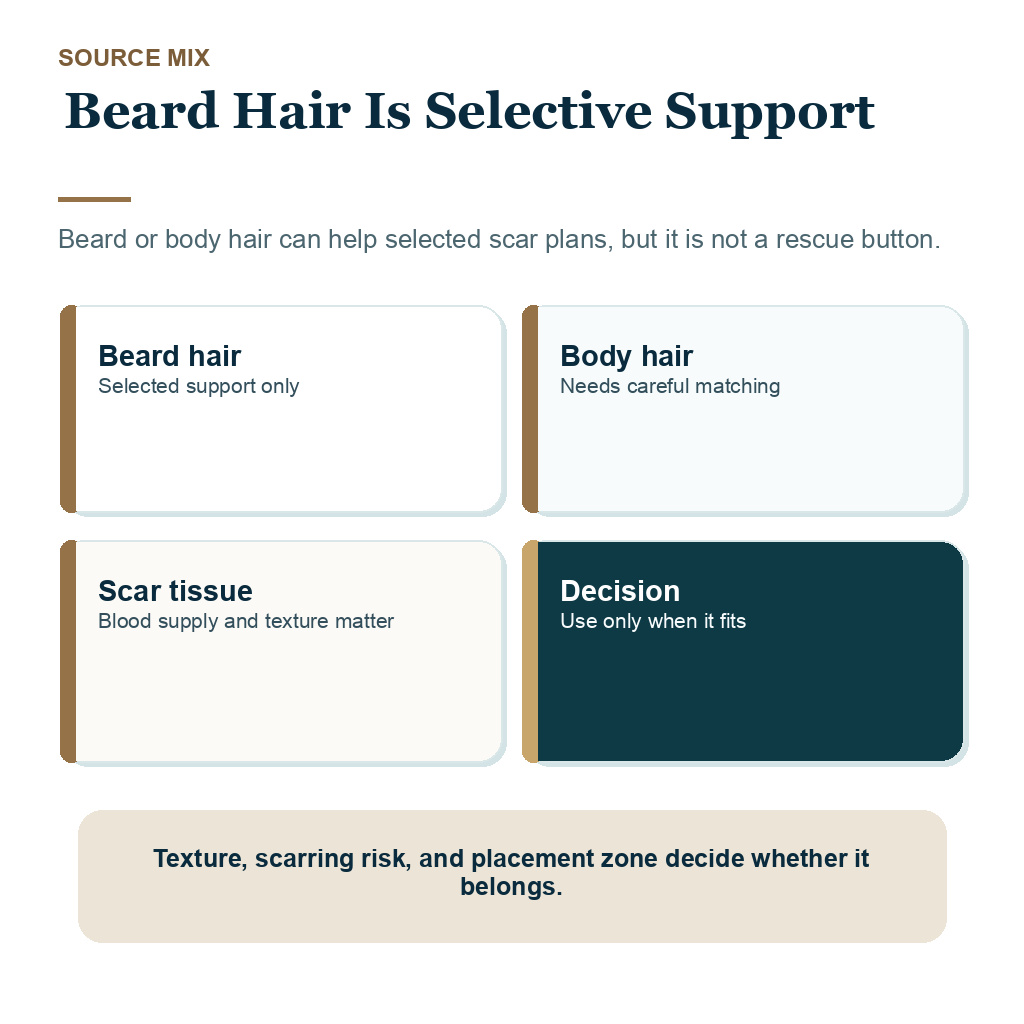
Beard or body hair can sometimes support a repair plan when scalp donor hair is limited, but it is not equal to scalp hair. Beard hair can be thicker, more wiry, and better suited for selected blending or scar camouflage than for a soft frontal hairline. Chest hair is usually less predictable and should be used with caution.
If the old FUT scar needs camouflage and scalp grafts are precious, non scalp hair may be discussed. The decision depends on hair caliber, color match, curl, expected survival, and where the grafts will be placed. Body hair is a supporting tool, not a direct substitute for scalp donor supply. Keep that in mind with beard and chest hair as donor sources.
Body hair near the hairline needs particular caution. The front needs softness and direction control. A donor scar camouflage plan can tolerate different hair qualities more than a frontal design, but even there the plan must stay realistic.
What I need before offering another donor operation?
Before recommending FUE after FUT, I need a current map of the strip scar, the hair above and below it, the safe extraction zones, and the haircut length the patient actually wants to wear. I also want the old graft count and photos if they exist, because the first operation already changed the donor reserve.
The plan may become smaller when the scar is wide, the skin is tight, the surrounding hair is doing most of the camouflage, or the patient also needs frontal or crown work. For some patients, grafting into scar tissue, SMP, scar revision, or no further surgery may protect the patient better than a large FUE session.
Beard or body hair is not a rescue button after FUT. It can help selected scar or crown plans, but only when the texture, scarring risk, and placement zone make sense. The full donor source discussion belongs in beard and chest hair donor planning.
Poor candidates for FUE after FUT need protection
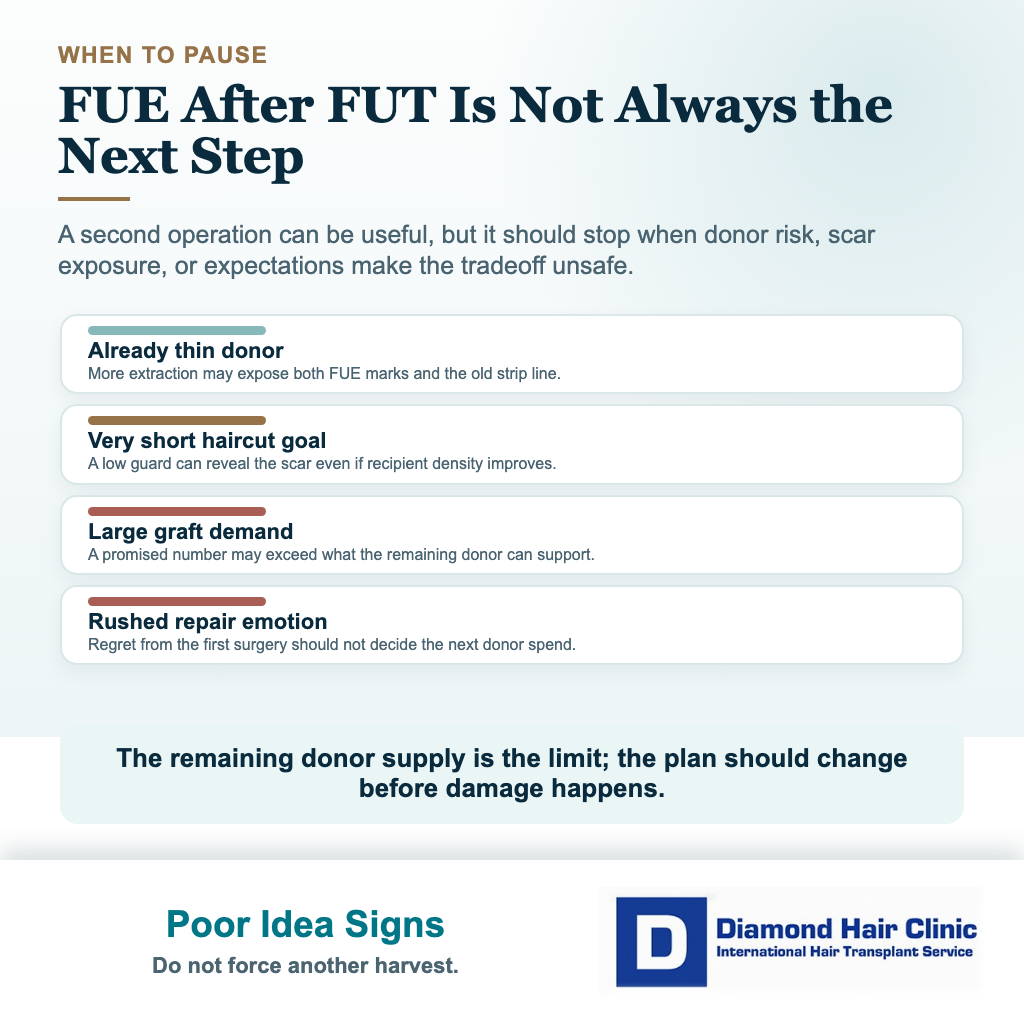
FUE after FUT may be a poor idea when donor reserve is already thin, the scar is wide and uncovered, the safe donor zone is weak, you want a very short haircut, or the requested graft number would damage the back of the scalp. A history of hypertrophic or keloid type scarring, a painful tight scar, or several old donor scars also changes the risk discussion. It can also be unwise when the real driver is anger from the first surgery and the new operation is being rushed.
The remaining donor supply is the limit. If the remaining donor cannot support the plan, the answer should change before surgery. Sometimes that means a smaller hairline refinement. Sometimes it means scar treatment first. Sometimes it means no further surgery until your expectations, medication plan, and donor reality are aligned.
If the old result was poor, the new surgeon should also diagnose why. Poor growth, wrong angles, a pluggy hairline, weak donor use, and unrealistic coverage promises are different problems. With bad hair transplant repair, repair planning should start with diagnosis, not another graft count.
These 10 FUE after FUT planning slides separate the old strip scar map, donor reserve, haircut visibility, extraction spacing, scar grafting versus recipient priorities, SMP or revision options, old records, second surgery expectations, beard hair support, and when stopping protects the donor. Swipe sideways, use the arrows one slide at a time, or choose a number below the image.