


Female Hair Transplant Candidacy Needs Diagnosis First For women, private travel and surgical timing should follow the diagnosis first, because hiding the surgery is not the same as choosing the right patient.
A woman can be a good candidate for hair transplant surgery when the hair loss has a clear diagnosis, donor supply is stable, and the target area is realistic. If the loss is temporary, still active, diffuse across the whole scalp, or linked to an untreated medical or hormonal problem, surgery usually needs to wait. The first decision is not graft number. It is whether the hair loss pattern can safely accept grafts. Female hairline lowering and diffuse female thinning need different conversations even when both start with photos. For women around menopause, this same logic is explained in more detail in the menopause hair loss and hair transplant planning guide. If the diagnosis is central centrifugal cicatricial alopecia, CCCA and hair transplant planning needs a stricter stability and donor safety review before graft numbers are discussed.
Female hair loss is often more complex than a simple receding hairline. You may need a refined hairline, medical treatment first, or a traction or scar assessment. If you are planning hair extensions after FUE, the recovery plan also needs to protect the donor and recipient areas from pulling. Some women are pushed toward surgery when the real problem is active shedding, an unstable diagnosis, or weak donor hair. A good result starts with separating these groups before anyone talks about a package, a discount, or a no shave method.
Strong female candidacy starts with diagnosis
Candidacy is stronger when the thinning is localized, the donor hair remains strong, and the reason for hair loss is understood. A stable hairline shape concern, a high forehead, a traction scar that no longer changes, or a permanent area of loss can sometimes be planned surgically. The plan still has to respect hair direction, hair caliber, density limits, and future thinning. A density goal is safer when the diagnosis explains why the part line is widening.
When the concern is mainly the front shape, the female hairline transplant design principles become central. The surgeon has to create softness, irregularity, direction, and proportion. Lowering the hairline too much can make the face look heavier, and the result can become difficult to repair later. For women already planning a visible front hairline operation, private travel after female hairline FUE belongs in the plan before headwear or no shave privacy becomes the focus.
Candidacy becomes weaker when the whole top of the scalp is miniaturizing, the part line keeps widening, shedding is still active, or the donor area also looks thin under magnification. In that setting, surgery may move hair, but it cannot create a full scalp of stable hair. If the donor hair is not reliable, the transplant plan is not reliable.
Diagnosis matters more than the graft number
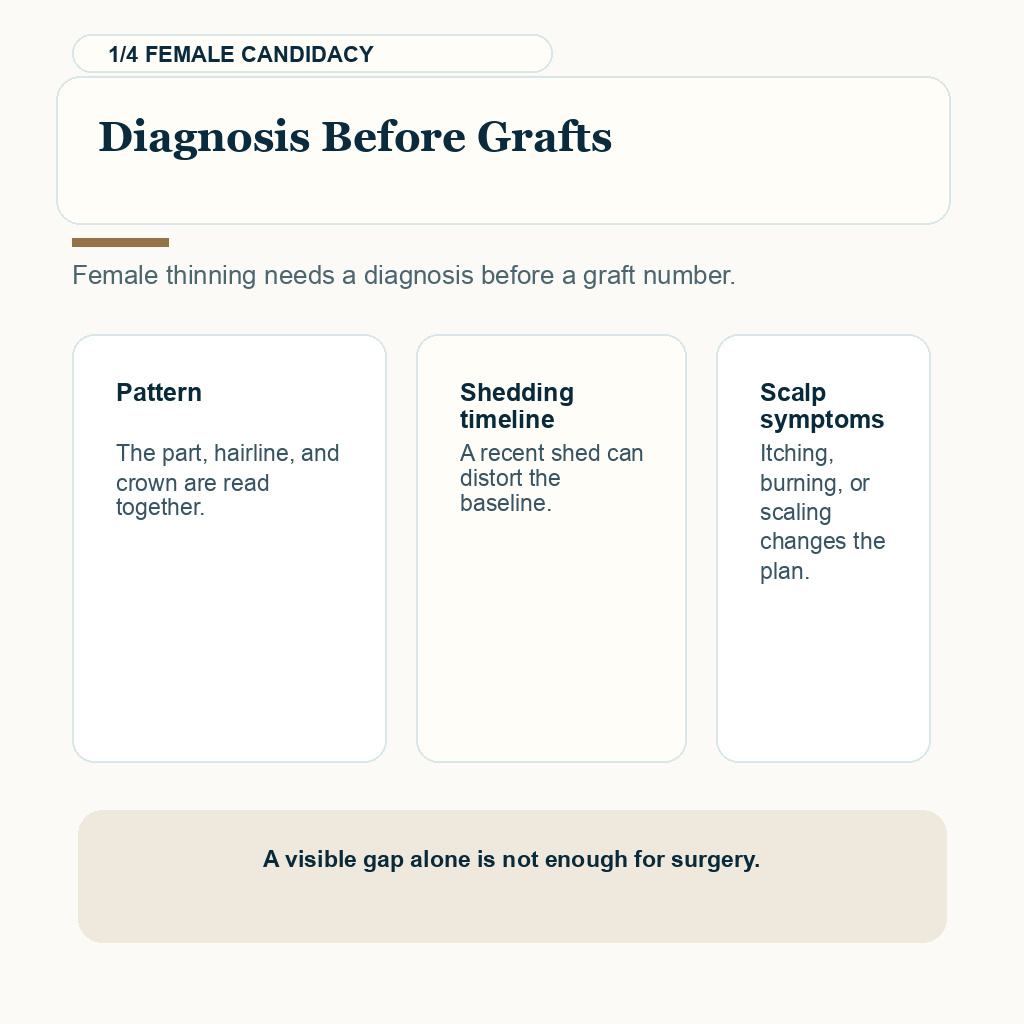
A graft number sounds concrete, but diagnosis tells us whether grafts will solve the right problem. For a young woman, a wider top part is still a diagnosis question before graft numbers are discussed. Early close photos, a high hairline worry, and diffuse thinning can feel similar, but they do not point to the same plan. Female pattern hair loss, telogen effluvium, traction alopecia, PCOS related thinning, thyroid disease, low ferritin, scarring alopecia, and postpartum shedding can look similar when you are worried, but they do not all need the same treatment. I do not collapse menopause, thyroid treatment, postpartum shedding, and traction history into one female hair loss label.
When I examine a woman for surgery, I separate permanent loss from temporary shedding, stable areas from active areas, and cosmetic preference from medical disease. I also check whether the donor zone is truly stronger than the area we want to treat. Without that separation, a clinic can quote 2,000 or 3,000 grafts and still miss the real risk. Part line photos can show the worry, but they cannot prove that diagnosis and donor strength support a density plan.
I separate active shedding from permanent thinning. Active shedding may improve when the cause is treated or time passes. Permanent thinning may need long term medical management, surgery in a defined area, or both. If those two situations are confused, the graft plan can be aimed at the wrong target.
I treat diffuse thinning and hair transplant surgery cautiously because native hairs are often still present between the planned grafts. Dense placement between weak native hairs can create trauma, shock loss, and disappointment if the underlying loss is not stable.
When the concern is frontal female pattern hair loss, I do not judge only the edge of the hairline. I also look at the hairs behind the front, the part line, the donor area, and whether miniaturization is still progressing. If surgery is used only to fill the hairline while the surrounding native hairs are actively thinning, the result can look weaker over time even when the grafts grow. Diagnosis and stabilization come before lowering or densifying the front.
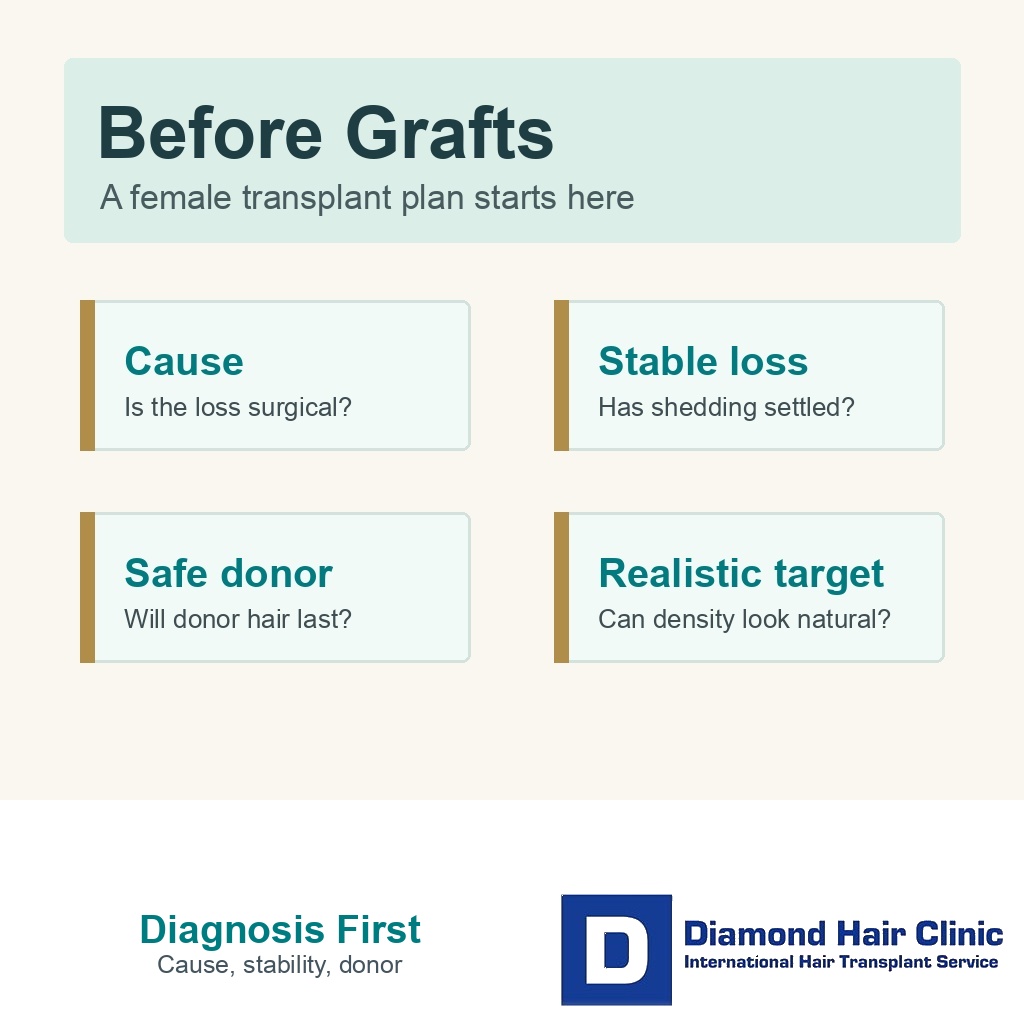
For women, graft planning is safer after the cause of hair loss, stability, donor strength, and realistic target have been checked.
Female hair loss patterns needing treatment before surgery
Active shedding needs time before surgery is planned. If hair is falling quickly after illness, stress, childbirth, medication changes, weight loss, low iron, or thyroid imbalance, the scalp may look surgically tempting while the true pattern is still moving. If the timing also involves conception plans, pregnancy, IVF, and hair transplant timing need a separate review before surgery is planned. When the medication history includes anti androgen treatment, spironolactone and FUE planning can help separate stabilization from a changing target. A recent pill start, stop, or switch needs to be part of the same diagnosis review, which is why I separate birth control changes before FUE from a simple graft number discussion.
Bring older photos from before the shedding started, not only today’s worst part line picture. The useful comparison is whether the pattern is new, returning, or stable enough for surgical planning.
A wide part photo should not carry the whole decision. The donor area, shedding history, and older photos have to show whether the pattern is stable enough for surgery.
When shedding behaves like telogen effluvium, the shedding needs to settle and the baseline density has to become clear. When the timing follows childbirth, postpartum hair loss and hair transplant timing becomes more relevant than a graft quote.
PCOS can create a different problem. Hairline or part line thinning may continue if the hormonal pattern is not addressed, so I review PCOS and hair transplant surgery for stability before planning grafts. That caution also applies when thyroid disease or low ferritin is suspected. Thyroid related hair loss and low ferritin or anemia must be reviewed before you are treated as a simple cosmetic case.
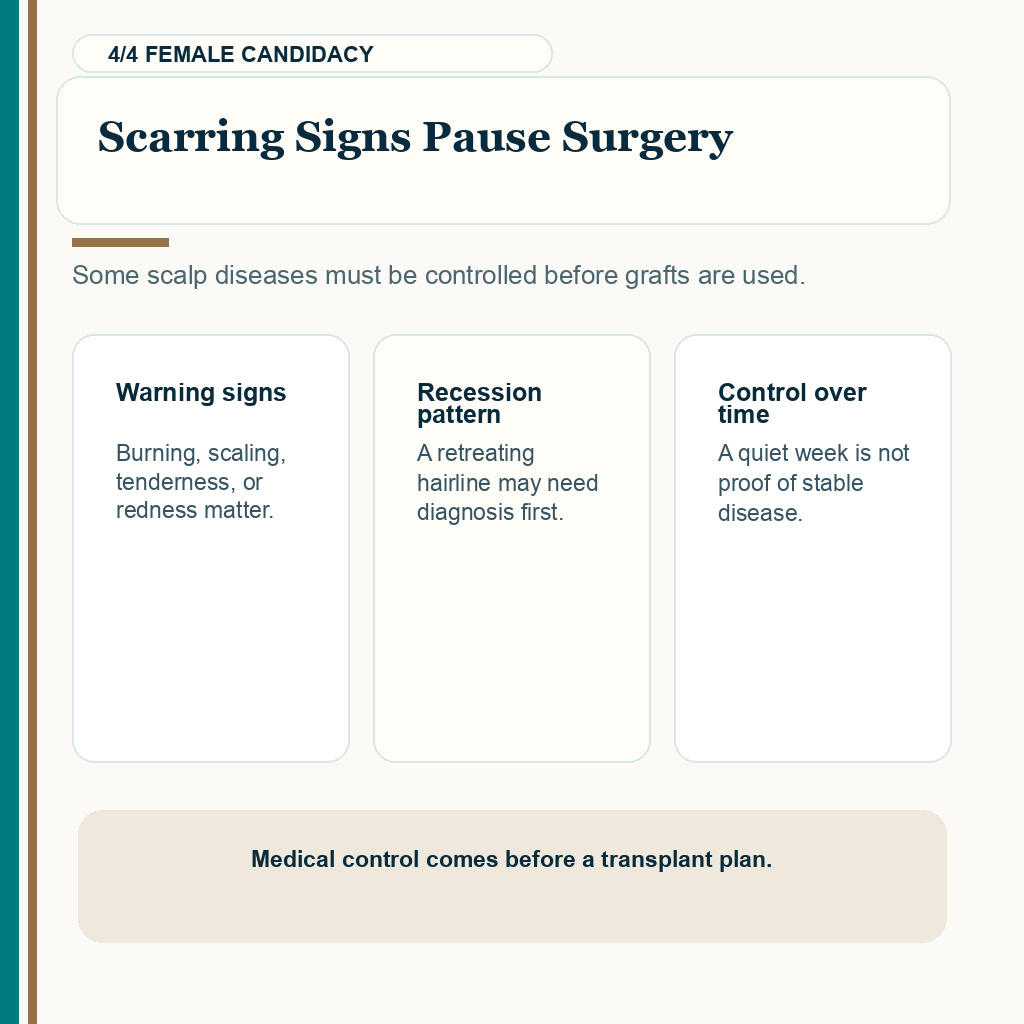
I also pause when the scalp itself looks inflamed or scarred. Ongoing itching, burning, scaling, tenderness, redness, or a hairline that keeps retreating can point to a medical scalp disease rather than a simple density problem. When scarring alopecia and lichen planopilaris transplant candidacy is part of the question, dermatology control and stability come before grafts are considered.
For scarring conditions, a quiet week is not the same as stable disease. I need evidence that itching, burning, redness, scaling, tenderness, and ongoing recession are controlled over time, ideally with the dermatologist’s diagnosis and treatment plan clear before surgical timing is discussed.
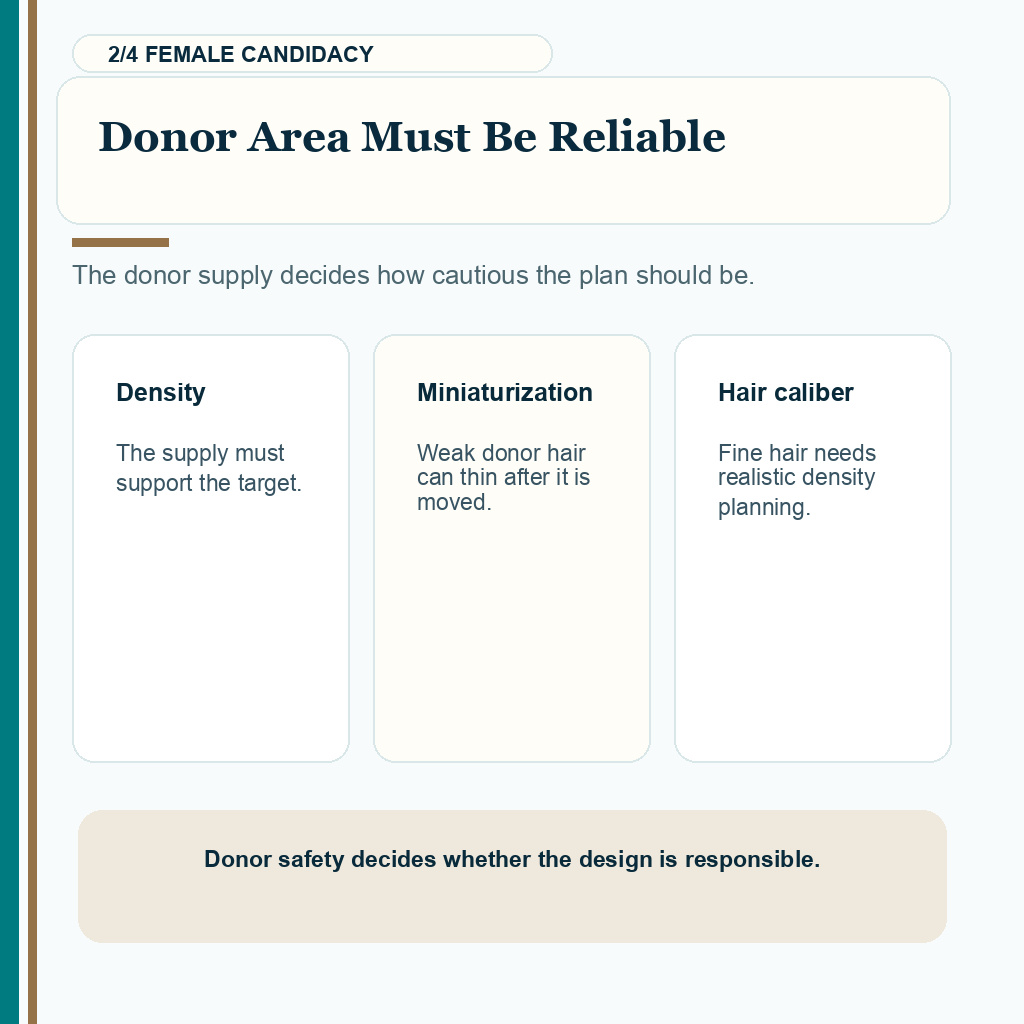
Female candidacy starts with diagnosis, and these 4 slides connect shedding pattern, donor strength, hormones, and when transplant planning makes sense. Swipe sideways, use the arrows, or choose a number below the image.

Surgery and diffuse thinning on the top of the scalp
In selected cases, surgery can help, but diffuse thinning is one of the hardest female transplant situations. The top of the scalp may still contain many weak native hairs. The surgeon has to decide whether there is enough safe space for grafts, whether the recipient area can tolerate the procedure, and whether the visual improvement will justify using donor hair.
Frontal female pattern hair loss needs a different decision from lowering a naturally high hairline. If the hairs behind the front are miniaturizing, I first ask whether the donor area is truly stronger and whether the medical plan is stable. Surgery may help a defined weak zone, but it should not be used to cover an active pattern that is still moving through the part line, temples, and mid scalp.
This is different from placing grafts into a clearly empty scar or stable hairline gap. With diffuse thinning, the surgeon is working between existing hairs, some of which may already be weak. The question is not only whether grafts can be placed, but whether placing them will create enough visible benefit without harming the hair that remains.
Diffuse thinning also changes expectations. The result may improve coverage, styling, or shadow under certain lighting, but it may not restore the dense appearance you remember from years earlier. Surgery can improve a selected area. It cannot reverse every active thinning process across the scalp.
A request for density across the frontal line, temples, mid scalp, and crown at the same time needs donor discipline. In a woman with limited donor strength, this can spend the donor reserve too quickly. A staged, conservative plan may protect the future better than a large single day promise.
Judging the donor area in a woman
Donor reliability is not judged only by how thick the back of the head looks in long hair. Long hair can hide miniaturization. I check density, hair shaft caliber, miniaturization, scalp visibility under separation, and the contrast between donor and recipient areas. If the donor is only slightly stronger than the thinning top, the surgical advantage becomes small.
Donor miniaturization changes the whole answer. If the supposedly safe donor zone contains miniaturized hairs, those grafts may not behave like stable donor hair after transfer. I separate cosmetic thickness in long hair from true donor reliability under examination.
Hair texture matters. Coarser, wavier, lower contrast hair can create more visual coverage than fine, straight, higher contrast hair with the same graft number. A woman with fine hair may need a more modest target even when the graft count sounds large.
The donor decision also affects method. FUT can preserve a larger unshaven surface for some women, but it creates a linear scar. FUE spreads small extraction marks but may require shaving and can thin the donor visually if overused. The method is secondary to donor safety and long term planning.
Match the evidence to both halves of the plan. If FUT is proposed, a strong gallery of female hairlines does not by itself show how that surgeon plans and closes a strip wound. A neat strip scar also does not prove refined female hairline design. Review female cases completed with the same harvesting method you are considering. Judge the donor closure and scar at the haircut length you wear, then judge the recipient edge for softness, direction, and balance. Method experience and design experience should be visible in the same case evidence.
Traction alopecia and scarred areas
Traction alopecia can be a good surgical indication when the pulling has stopped, the area is stable, and the skin can accept grafts. If the hairstyles or tension continue, transplanted hair can be placed into the same harmful environment. I treat traction alopecia hair transplant repair as a stability question first, not only a graft placement question.
Scarred areas need a different examination. Scar tissue may have weaker blood supply, a different angle, or less elasticity. Sometimes a smaller test area or staged plan is safer than trying to fill everything in one session. You also need to understand that transplanting into scar tissue can improve camouflage but may not behave exactly like untouched scalp.
For women with tight braiding history, chemical injury, burns, or prior surgery, the question is not only whether grafts can be placed. The question is whether the skin, cause, and future hairstyle habits support survival and natural direction.
For Black women or women with very curly or coiled hair, I do not separate the female candidacy question from the texture question. Edge loss, traction history, CCCA or scarring concern, donor access, hidden trimming, curl direction, and future styling all need to be discussed together. A result from a female case with straight hair does not answer those details by itself.
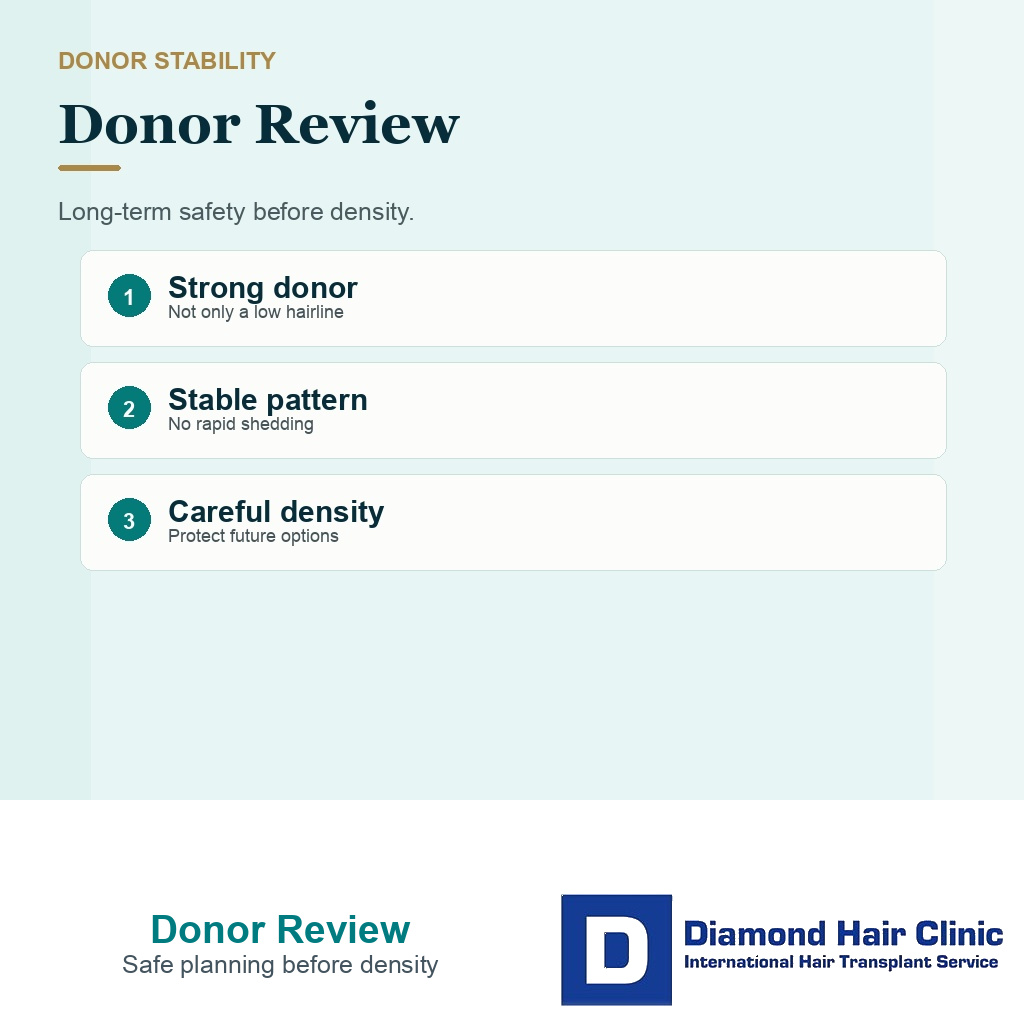
Donor stability matters because female hair loss can continue around transplanted areas if the diagnosis is incomplete.
No shave FUE is not always the right plan
No shave FUE can help privacy, but it does not make a weak plan safe. It may reduce visible downtime, yet it can also limit visibility, slow the work, and make extraction planning more demanding. If a woman is a poor candidate because diagnosis, donor strength, or target area is wrong, a no shave method does not fix that. A discreet method still needs a plan for the first workdays, when redness, styling limits, and shedding anxiety may be harder to hide than the shaved area.
Before choosing a shave plan, ask to see donor area photographs from female cases that used the same method and a similar graft range. A useful set includes a direct back view with the donor hair raised and another with the hair down. Those photographs cannot predict your own coverage, but they show more than a no shave label about the trim pattern a clinic may use.
No shave hair transplant planning can protect privacy, but for women the method has to serve the diagnosis, not the other way around. A clinic that starts with the selling point of no shaving before examining the donor and thinning pattern is starting from the wrong end.
Privacy matters, but medical clarity matters more. A smaller, clearly planned operation is better than a discreet operation that uses donor hair in the wrong place. If the method makes the surgeon less able to see and control the work, privacy becomes too expensive.
Stability before booking a clinic abroad
Before booking travel, the diagnosis, donor assessment, hairline target, medication review, timing, and follow up plan need to be clear. If you are traveling abroad, you have less room for vague promises because you may not be near the clinic when shedding, swelling, anxiety, or delayed growth questions appear.
If shedding is active, ask what needs to be documented before travel. That may include recent medical history, medication changes, blood test results when relevant, part line photos, donor photos, and any dermatologist notes. A travel plan should not be built only around a package quote.
When I review hair transplant packages in Turkey I read beyond the price. Low price is not the same as a safe plan. You need to know who evaluates the diagnosis, who designs the hairline, who performs the surgical steps, and how the clinic handles follow up after travel.
For female candidates, surgeon involvement in hair transplant surgery is not a luxury detail. It is central because the diagnosis and target may be less obvious than in a typical male pattern case.
Medication planning and future native hair loss
Many women need medical treatment before or after surgery. That may include topical minoxidil, oral minoxidil under medical supervision, spironolactone, hormonal evaluation, iron correction, thyroid treatment, or another plan depending on the diagnosis. I do not start or stop those medicines casually around surgery. The prescribing doctor and surgical team need to know the full medical picture.
Some medications used for hair loss have pregnancy, blood pressure, hormone, or side effect considerations. A young woman who may become pregnant needs a different discussion than a postmenopausal woman with stable female pattern hair loss. Medication safety and family planning can change the timing of surgery. Even period timing before hair transplant belongs in that planning when symptoms, cramps, heavy bleeding, or travel timing could make the surgery day harder to manage.
Hair transplant surgery also does not freeze future native hair loss. Transplanted hairs may be long lasting when donor hair is stable and the grafts grow well, but surrounding native hair can continue to thin. The plan has to include future photographs, follow up, medication tolerance, and whether a second stage might be needed later.
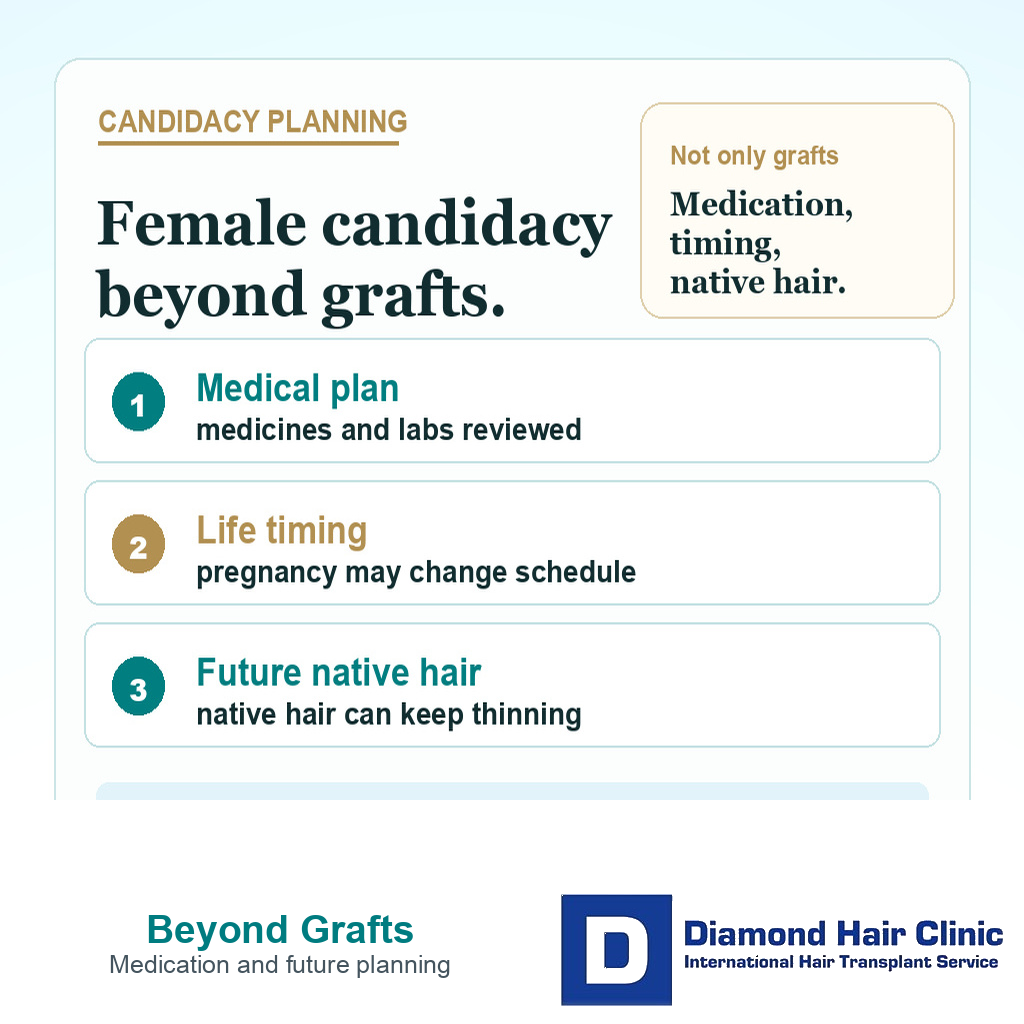
Female candidacy is stronger when medication review, life timing, and future native hair loss are planned before grafts are used.
Reasons a woman should pause the surgery plan
I pause when the diagnosis is unclear, shedding is active, the donor area looks weak, the clinic promises full density from a limited donor area, or the timing is being driven by an event date. I also pause when surgery is being driven mainly by photographs, harsh light, or online comparisons but the clinical pattern does not support an operation yet.
A pause is not rejection. It is a way to protect the donor area and avoid regret. The next step may be a dermatology diagnosis, blood tests, scalp microscopy, medical treatment, or simply waiting long enough to see whether shedding settles. Surgery may still be the right plan after that review. In selected unclear cases, the diagnostic path may also include scalp biopsy before surgery when the diagnosis remains unclear.
If two clinics give very different advice, a second opinion before hair transplant surgery can protect you from making a permanent decision under pressure. The useful second opinion is not just another graft quote. It is a diagnosis, donor, and expectation review.
What I need before I call a woman a candidate?
Before I call a woman a surgical candidate, I want the diagnosis, shedding timeline, donor reliability, medical history, medication plan, and target area to agree with each other. A neat graft number does not help if the pattern is still moving or the thinning is spread across the scalp.
I may delay the plan when the part line is changing quickly, the donor zone is only slightly stronger than the top, a hormone or iron problem is still being worked up, or the patient is hoping surgery will restore overall volume rather than improve a defined area.
For international patients, that decision belongs before flights are booked. The written plan should say what diagnosis is being treated, what is not being treated, why the donor supply is reliable enough, and what finding would make me pause after direct examination.
Diagnosis has to settle before grafts are spent
Female hair transplant planning starts with the cause of loss. Hairline shape, traction history, diffuse thinning, scarring disease, hormones, iron status, and medication history can point to different answers.
When surgery is reasonable, the target should stay defined. Softening the hairline, filling one stable area, or staging the work is often safer than trying to chase the whole scalp at once.
Waiting is useful when the diagnosis is still moving. It protects donor hair until the surgical target is clear.