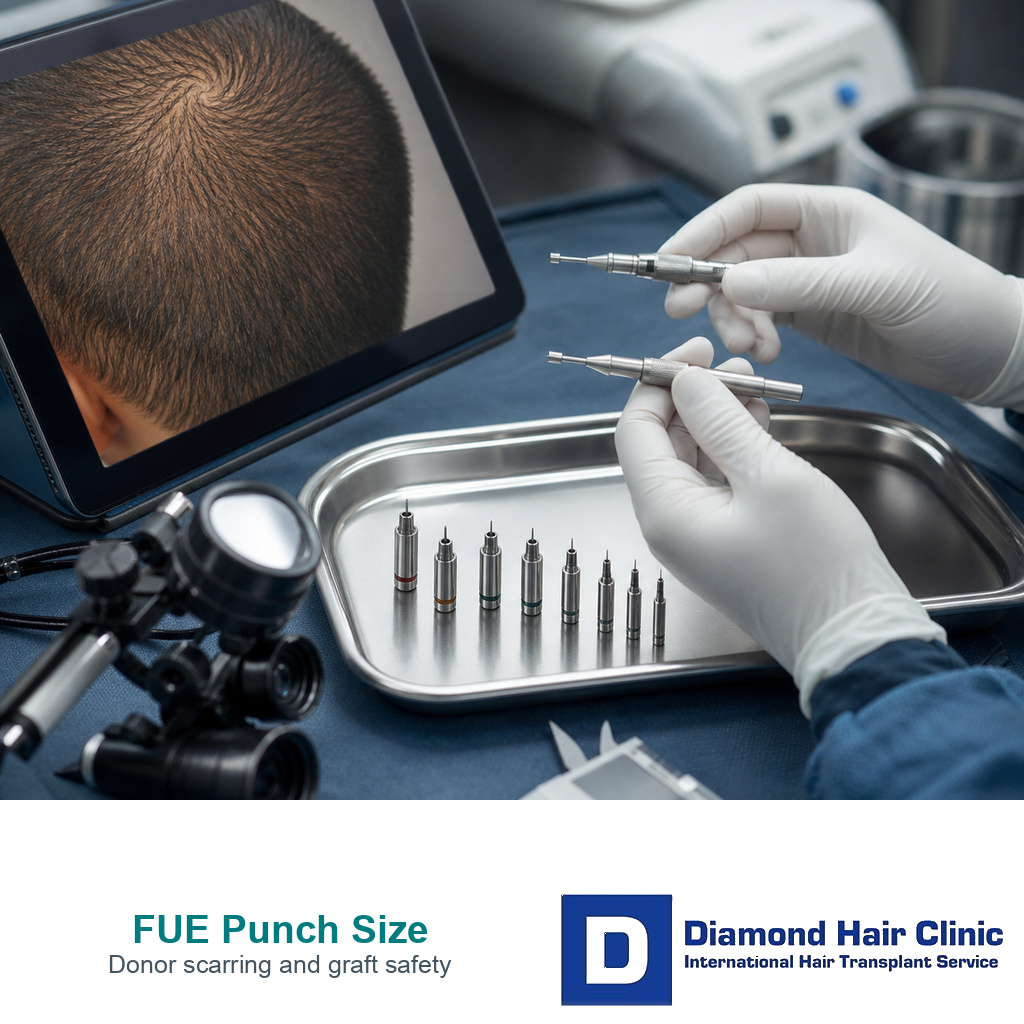
FUE Punch Size and Donor Scarring
A smaller FUE punch can reduce the skin opening in the donor area, but it is not safer by itself for every scalp. The punch still has to fit the follicular unit under the skin, follow the exit angle, and release the graft without cutting it. The best size is the smallest punch that safely surrounds the graft in front of me without forcing repeated passes. A smaller skin opening is not useful if it increases transection, strips the graft too aggressively, or spends a follicular unit that later gives weak growth.
If you are reading about topical metformin after FUE donor scar claims, keep that as a separate question. The first surgical issue is still punch fit, spacing, angle control, and extraction pattern.
I do not choose punch size as a marketing number. I look at hair caliber, curl, follicular unit size, skin thickness, donor density, extraction distribution, and future need for donor hair. A 0.7 mm punch can be excellent in one donor area and the wrong tool in another. A 0.9 mm punch can be too large in one case and safer in another. The decision is surgical, not cosmetic advertising. I keep that in mind because donor hair does not grow back after FUE.
The same punch size can behave differently in two donor areas. Hair curl, skin contrast, graft grouping, and the way a patient wears short fades can change whether the donor looks clean or obviously patterned.
Smaller punch does not always mean less scarring
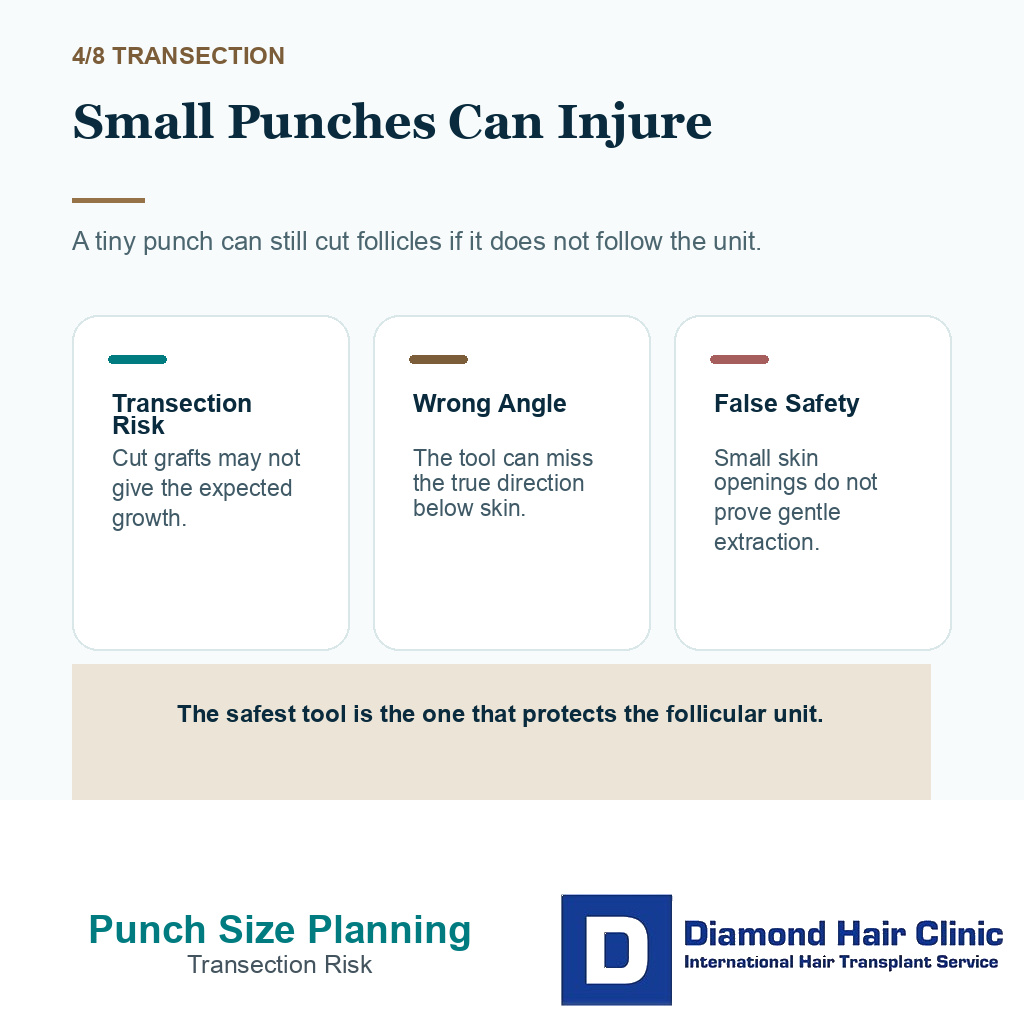
A smaller punch may create a smaller circular wound, and that can reduce visible dot scarring when the graft is released cleanly and the extraction pattern is spread well. But the word smaller does not protect the donor by itself. The punch must pass around the follicular unit without cutting the hairs below the skin.
If the punch is too tight, the surgeon may transect the graft, strip away too little protective tissue, or need repeated attempts that increase trauma. If the punch is too large, it may remove more tissue than necessary and make donor dots more visible at short haircuts. The practical balance is clear. Too small can injure grafts, and too large can leave more visible dots, so punch size has to fit the graft and donor pattern. Those details matter later if you ask about FUT after FUE, because existing punch scars change the donor background.
This matters especially if you wear a fade or very short sides. With short hair after FUE donor scars, the distinction matters because FUE avoids a linear strip scar, but it does not make the donor area scarless. The goal is discreet healing, not a scarless promise. If you notice pale dots after healing, I describe how to separate donor scar dots from flakes or folliculitis in white spots after FUE. If mature dot scarring remains visible, scalp micropigmentation after hair transplant can be reviewed as camouflage rather than a scarless guarantee. Claims about verteporfin and donor regrowth belong in a separate evidence discussion because scar improvement and donor hair return are different questions.
A patient who wants shaved sides should discuss the shortest acceptable clipper guard before extraction. Dot visibility is also a haircut decision, not only a punch size decision.
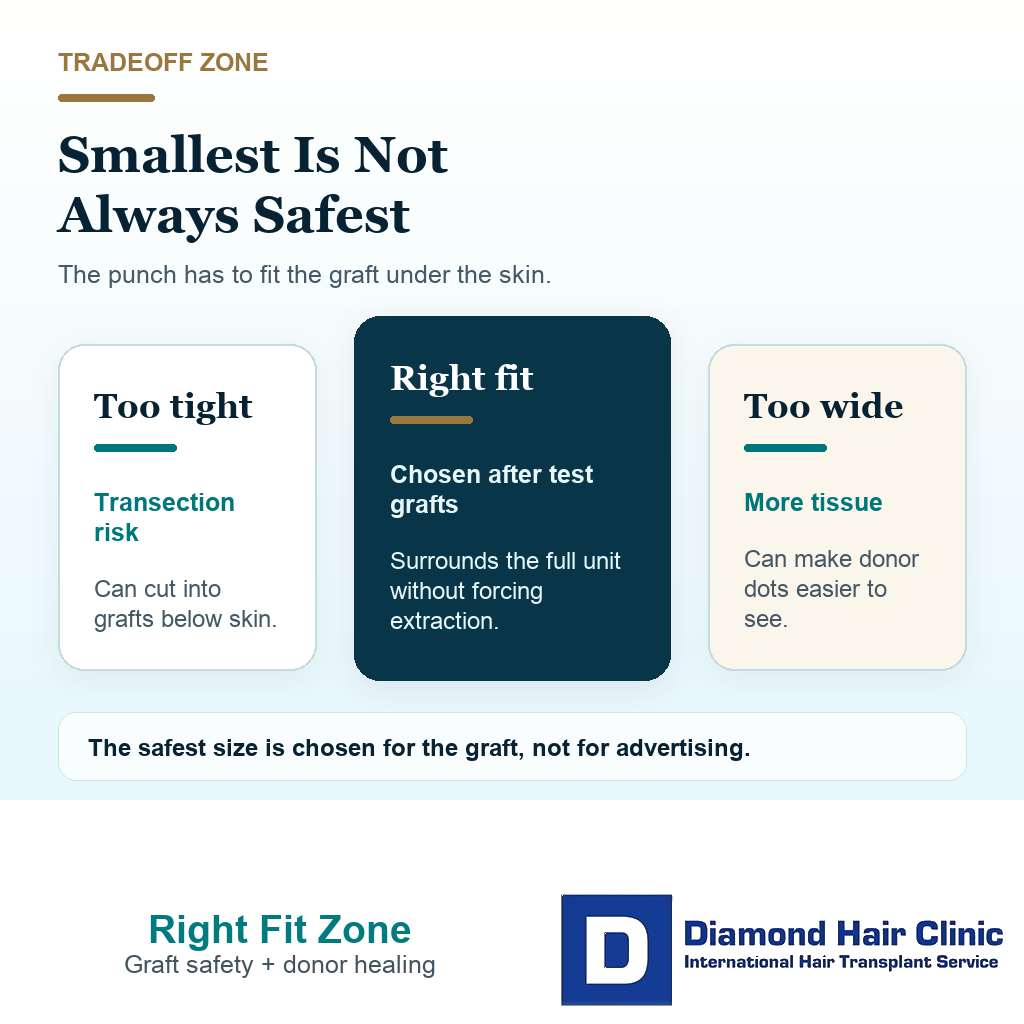
The safest FUE punch size is not the smallest advertised number. It is the size that fits the graft while protecting donor healing.
The tissue an FUE punch releases
In FUE, the surgeon removes follicular units one by one from the donor area. The punch makes a small circular incision around the graft so it can be released and lifted from the surrounding tissue. The target is not only the hair shaft you see above the skin. The target is the full follicular unit under the skin, where the hair can angle, curve, spread, or sit deeper than expected.
A punch decision has two responsibilities. It should keep the wound as small as practical, and it should preserve the graft as a living unit. The visible circle on the skin is only part of the story. The hidden path of the follicles is what makes extraction easy or difficult.
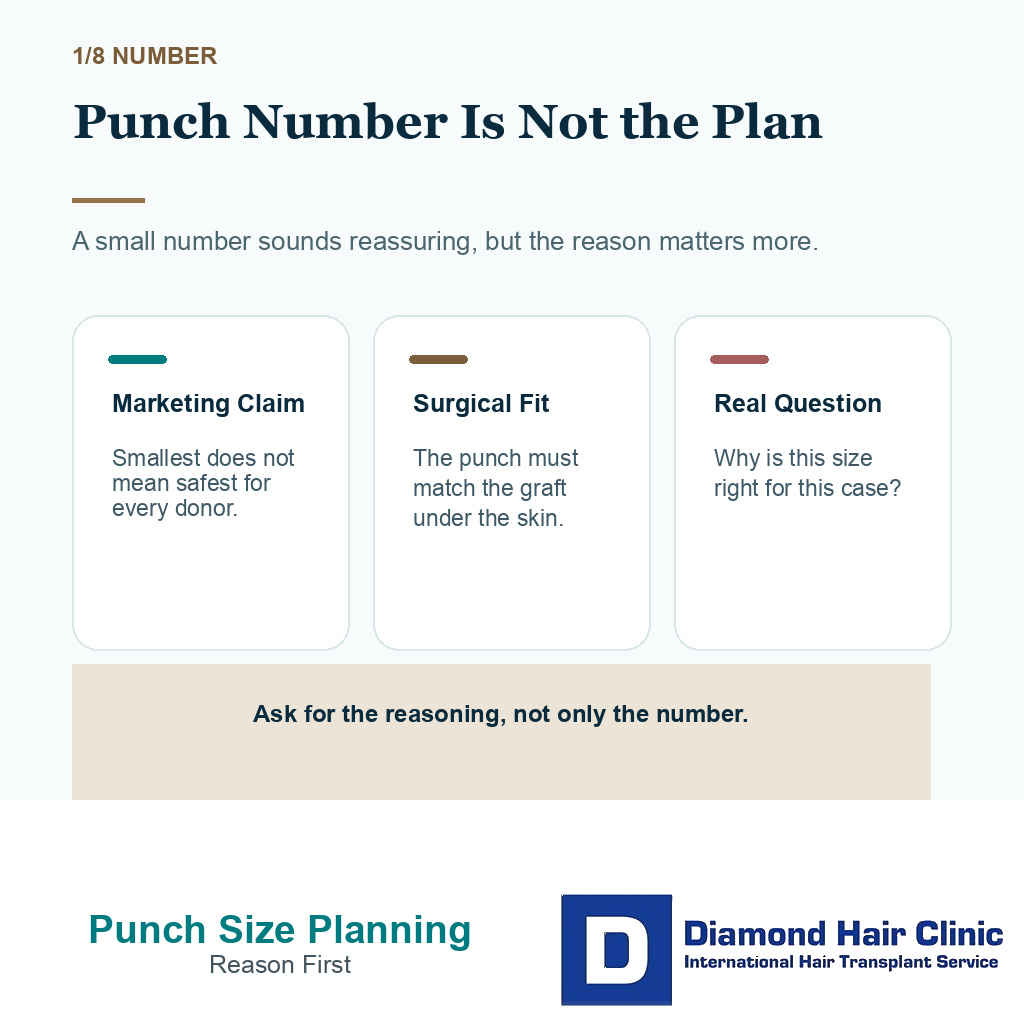
The printed punch number looks simple to compare between clinics. But a punch number without a donor assessment is incomplete. The questions I care about are whether the surgeon adjusted after test grafts, whether a too tight punch was abandoned when transection appeared, whether transection was monitored, and whether the extraction plan protected the donor area rather than simply chasing speed. The same comparison mistake happens with robotic FUE claims when the device name replaces donor assessment and extraction judgment.
A proper graft count verification should include extraction quality and donor safety, not only the final number written on a record.
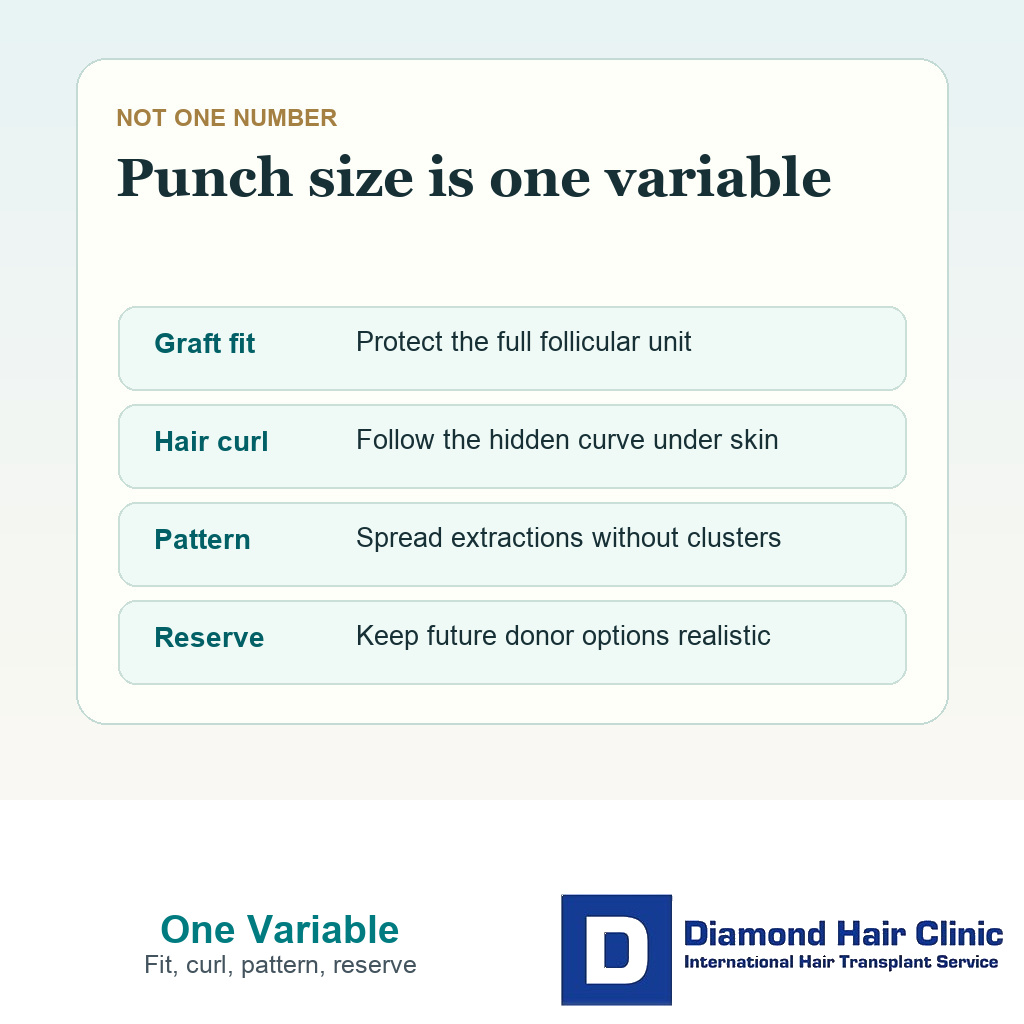
Punch diameter matters, but graft fit, hair curl, extraction pattern, and donor reserve matter with it.
For a skin fade or zero guard, healed donor examples at that same length matter more than donor photos hidden by longer hair. Short cuts reveal dot contrast, spacing, and pale marks much faster.
Very small punches can still damage graft quality
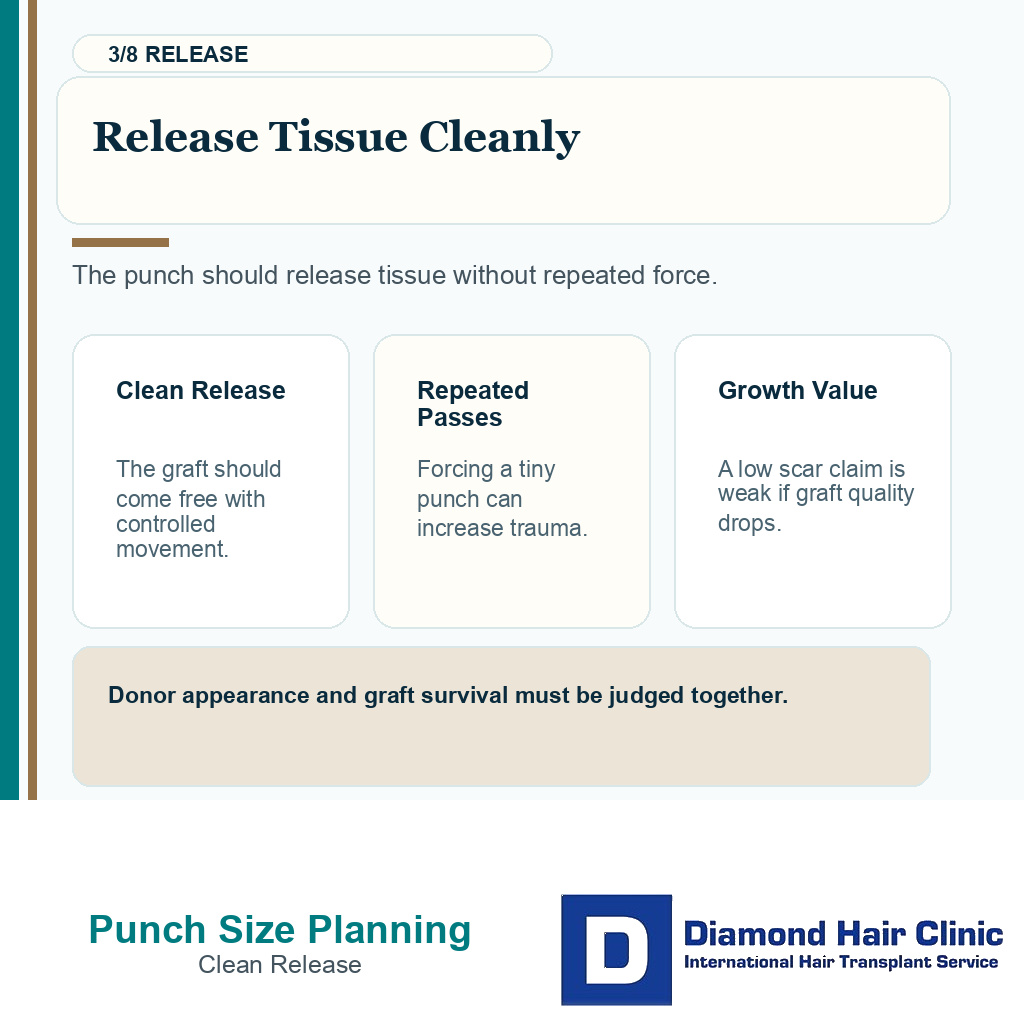
A very small punch can damage graft quality when the follicular unit is wider, deeper, curved, or angled differently than it appears at the surface. If the punch cuts through part of the graft, that is transection. Repeated passes around the same follicular unit can add trauma even when the skin opening looks small. A transected graft may not grow, may grow weakly, or may waste part of the limited donor supply.
A low transection rate matters because a damaged graft is a wasted donor unit. This is not only a survival issue for the recipient area. It is also a donor protection issue. If a graft is removed badly, the donor area has still spent that follicular unit, but you may not receive the full benefit in the transplanted zone.
Some grafts also need a small amount of surrounding tissue to remain stable during extraction, trimming, storage, and placement. In practice, I try to avoid both extremes. I do not want to remove unnecessary tissue, and I do not want to skeletonize the graft so aggressively that handling becomes less safe.
Slightly larger punch can be safer
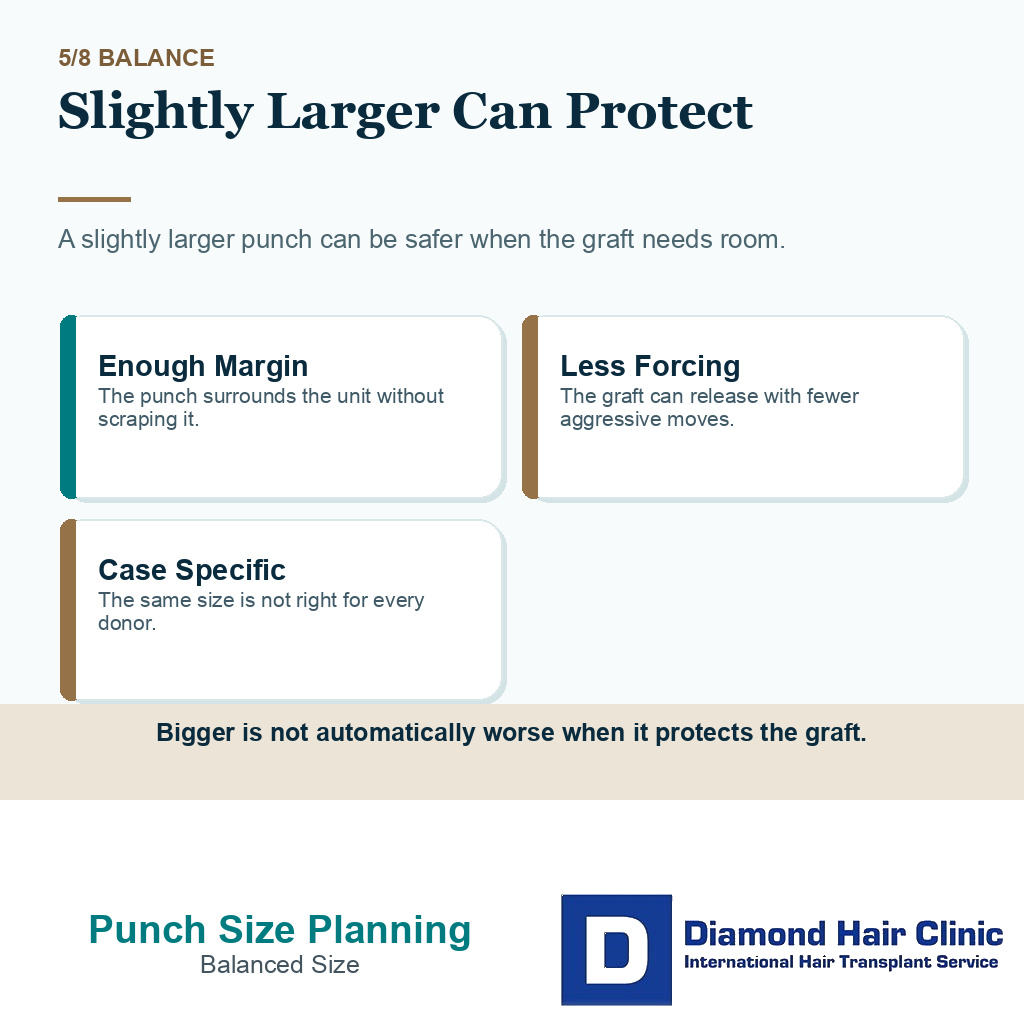
A slightly larger punch may be safer when the hair is coarse, the follicular units contain several hairs, the grafts spread below the skin, the skin is firm, or the extraction angle is difficult. It can also be safer when the surgeon sees early transection with a smaller size and needs to protect the grafts rather than force the original plan. When that happens, one clean release can be safer than repeated attempts with a punch that is too tight.
This does not mean larger is better. A larger punch removes more tissue and can create more visible donor marks if it is used unnecessarily or too densely. It means that the right size is the one that balances graft safety and donor healing for that specific donor area.
This is also true when clinics compare manual, motorized, sharp, blunt, serrated, or other punch designs. The device matters less than whether it is used with sound judgment. A poor extraction pattern with a small punch can still damage the donor, and a skilled plan with a slightly larger punch may protect grafts better in selected cases.
Curly hair changes the extraction path
Curly hair can change the decision because the curl may continue under the skin. The visible hair direction does not always show the exact path of the follicle. If the punch follows only the surface angle, it can cut into the curved part of the graft.
Afro textured or very curly hair transplantation should not be treated like a routine extraction case. The surgeon may need slower extraction, adjusted punch choice, adjusted angle, and more careful donor planning. Sometimes the visible curl is dramatic but the graft releases cleanly. Sometimes the subcutaneous curve is the real challenge.
For curly hair, punch size should not be reduced to the smallest possible number. The plan has to account for the hidden curve of the graft, because that is where transection risk can appear.
Factors that decide whether the donor looks scarred
Punch size is only one factor. Donor visibility also depends on how many grafts are removed, how close the extraction points are, whether the pattern is spread evenly, how strong the donor hair is, how short you cut the hair, skin and hair color contrast, healing biology, and whether future hair loss exposes the donor edge.
You can have small punches and still look overharvested if too many grafts are taken from a narrow zone. You can also have a moderate punch size and a clean looking donor if the extraction is well distributed and the donor density is strong. Donor area overharvesting is judged by donor measurement, safe extraction zone, extraction pattern, and future reserve.
The same distinction matters when someone sees a patchy donor area after a hair transplant. Early redness, short hair, and shock loss can exaggerate the appearance. A final patchy donor pattern months later is a different problem.
Reading 0.7 mm or 0.8 mm punch claims
Read those claims as one technical detail, not as proof of surgical quality. A clinic that says “we use 0.7 mm” has not yet explained whether that size fits your grafts, how it handles follicular units containing several hairs, what transection rate it accepts, who performs the extraction, when the punch size is changed during surgery, and how it protects the donor pattern.
The same number can mean different things in different hands. It can be a measured choice after test extraction, or it can be a sales phrase used before anyone has examined the donor properly. The punch size is part of donor management, not a marketing trophy.
A skin fade or zero guard is the strictest visibility test for FUE marks. That haircut needs healed donor examples at a similar length, not photos hidden by longer donor hair. The punch size number cannot promise how dot marks, contrast, and extraction spacing will look when the sides are cut that short.
Be skeptical of promises that imply a smaller punch allows unlimited harvesting. The donor area is limited, so you still need a realistic lifetime hair transplant graft budget, especially if the crown may need work later or if further hair loss is expected.
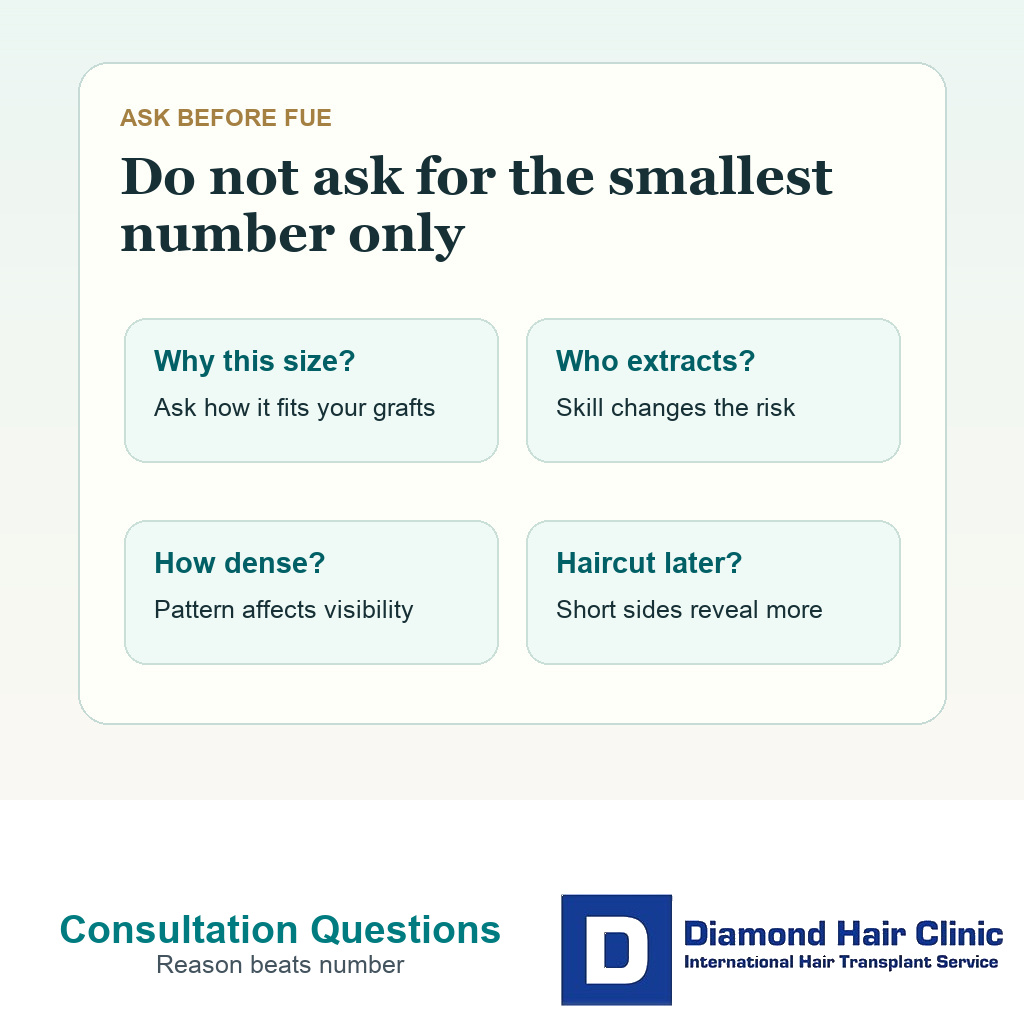
A useful consultation asks why the punch size fits your grafts, not just whether the number sounds small.
Questions to ask before surgery
Before surgery, the clinic should explain which punch size range fits your case and why it suits your hair caliber, curl, graft size, skin, and donor density. The explanation should also name who performs the extraction, how transection is monitored, how the donor is divided, and when the punch size or graft target changes if early grafts show damage.
For very short haircuts, discuss how short the donor area can realistically be cut after healing. A skin fade needs a different conversation from a longer donor haircut. The visibility test should match the haircut you actually wear.
The punch decision also has to fit the full graft plan. A large session done in one day may create more donor stress than a staged plan in the wrong case. Session size and donor reserve have to be judged together, especially with 5,000 graft sessions or smaller hair transplant sessions.
If the clinic proposes a very high number, confirm that the grafts are truly needed in that area. Too many grafts in one area can force density beyond what the tissue and donor plan can safely support.
These 8 punch planning slides keep the decision practical, including punch number, graft fit, tissue release, transection risk, curl, extraction spacing, haircut visibility, and future donor reserve. Swipe sideways, use the arrows, or choose a number below the image.