



Diabetes Control Decides Surgery Timing
A patient with diabetes can often have a hair transplant if the diabetes is well controlled, the medical history is clear, and the surgical team is comfortable that healing risk is acceptable. But diabetes is not a detail to mention casually on the morning of surgery. Prednisone before a hair transplant can add another blood sugar and healing question. It changes how I think about blood sugar control, wound healing, infection risk, medication timing, fasting before hair transplant surgery, travel, and aftercare.
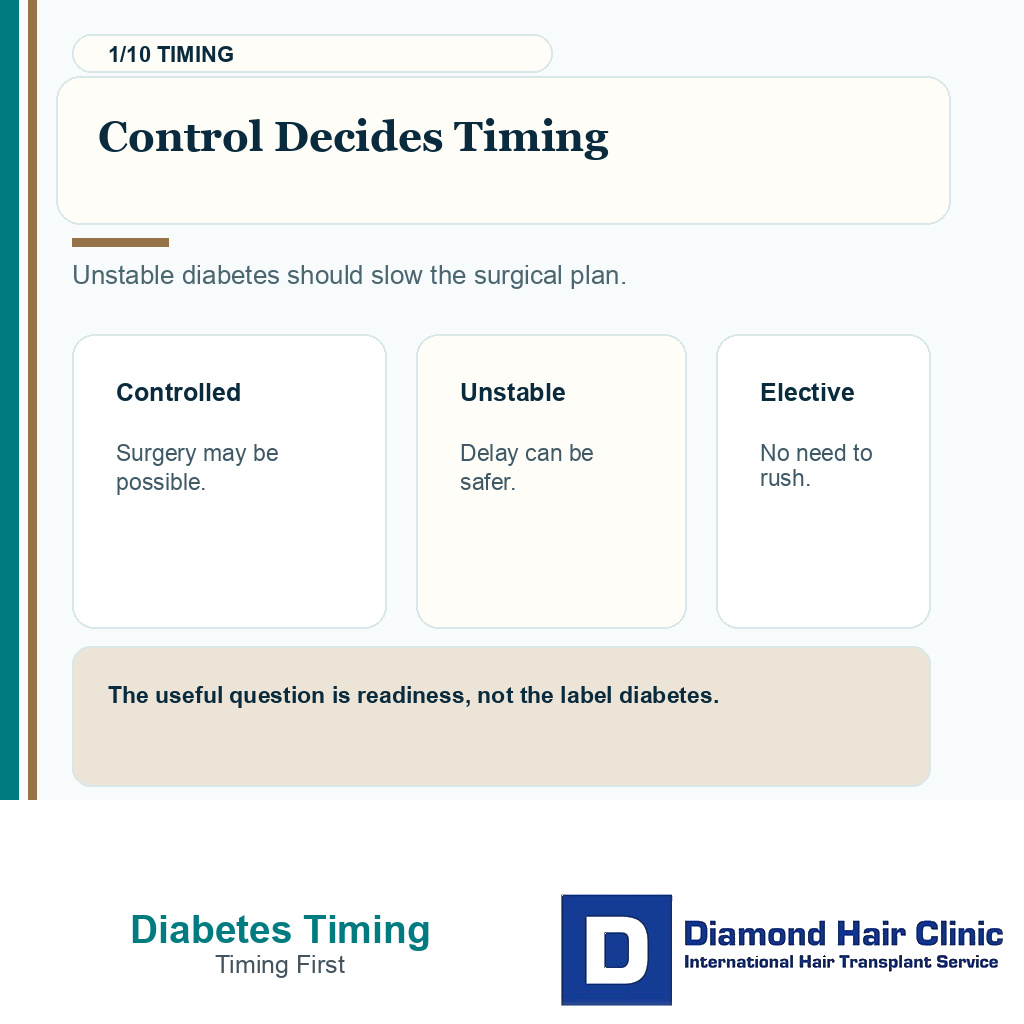
The key question is not only whether the patient has diabetes. It is whether the condition is stable enough for a long surgical day and predictable healing. Controlled diabetes may be compatible with hair transplant surgery. Poorly controlled diabetes, unstable readings, active infection, poor wound healing, or unclear medical clearance are reasons to slow down or delay. A hair transplant is elective. It needs planning when the patient is medically ready, not when the calendar says it is convenient. That same timing principle applies to Crohn disease or ulcerative colitis before a hair transplant.
One good recovery story from another patient with diabetes should not decide your own clearance. The useful details are your recent control, medication routine, healing history, infection history, and whether your treating doctor wants any limits for a long procedure day.
Bring numbers, not only the word controlled. Recent readings, HbA1c if available, infection history, and who manages your diabetes make the clearance discussion more concrete. For insulin users, the plan also needs meals, travel delays, and how low blood sugar symptoms will be handled during a long day. If you use a pump or continuous glucose monitor, the same review should include where an insulin pump or CGM sits during FUE, how the receiver stays reachable, and which spare supplies are available.
Diabetes matters before a hair transplant
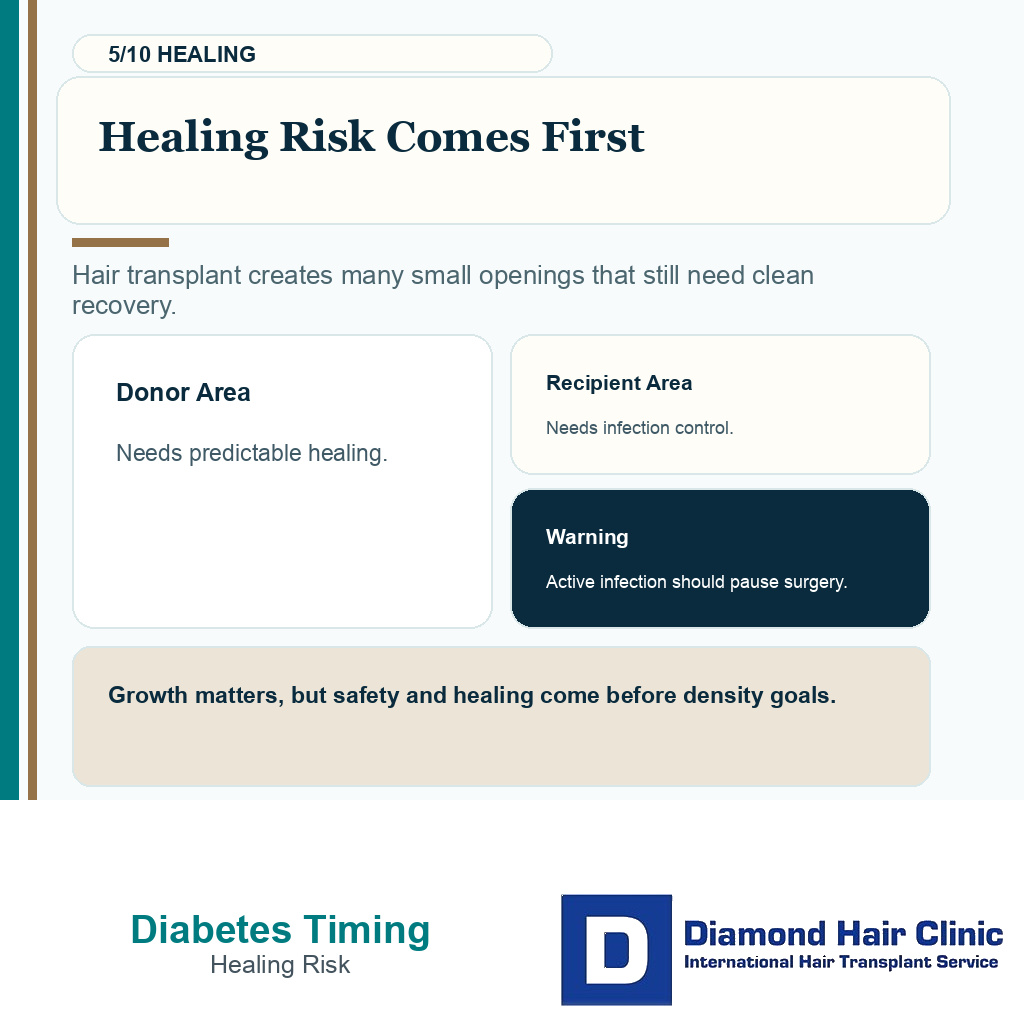
Diabetes matters because hair transplant surgery depends on clean healing. During FUE hair transplant surgery, the donor area and recipient area both need to recover from many tiny surgical openings. In a healthy and stable patient, this healing process is usually predictable. In a patient with poorly controlled diabetes, the body may heal more slowly and may have a higher risk of infection or delayed recovery.
A patient is not rejected only because they have type 1 or type 2 diabetes. I assess how controlled it is, which medication the patient uses, whether blood sugar is checked regularly, whether there have been wound healing problems, and whether the patient’s own doctor considers elective surgery reasonable.
Blood tests before a hair transplant are not a formality in this situation. Blood sugar control, general health, medication use, and infection risk all belong in the medical assessment. If something is not stable, the answer may be to treat the problem first and operate later.
Many patients think the only question is whether the transplanted grafts will grow. I think that question is too narrow. Before I think about growth, I think about whether the patient can go through the day safely and heal without unnecessary risk. Growth matters, but safety comes first.
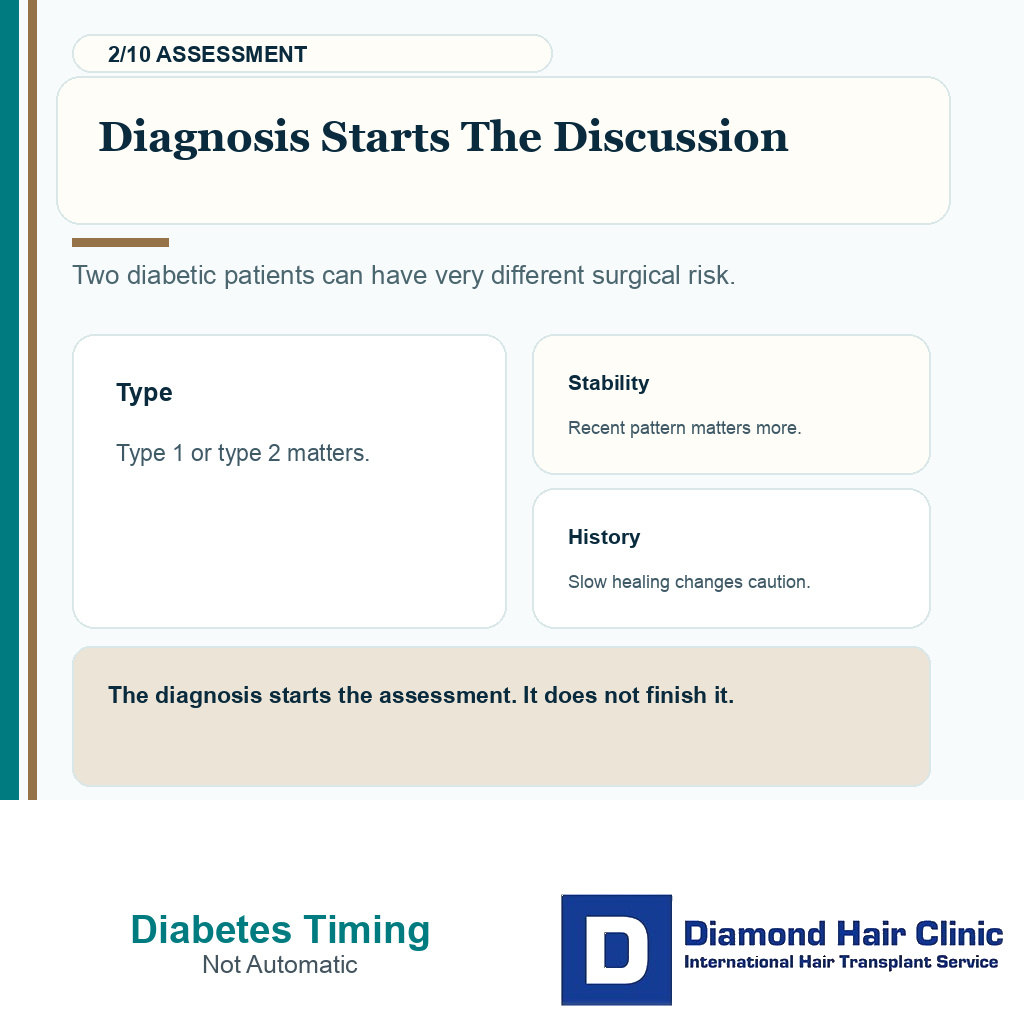
I treat diabetes as a condition that can be very different from one person to another. Two patients may both say, “I am diabetic,” but their surgical risk may not be the same at all. One may be stable for years, careful with medication, and followed regularly by a doctor. Another may have changing readings, missed medicines, infections, and no recent medical review. Those are not the same surgical situation.
Any answer that ignores control is too simple. The diagnosis starts the discussion. It does not finish it. The real decision comes from stability, healing history, medication discipline, and the size of the planned procedure.

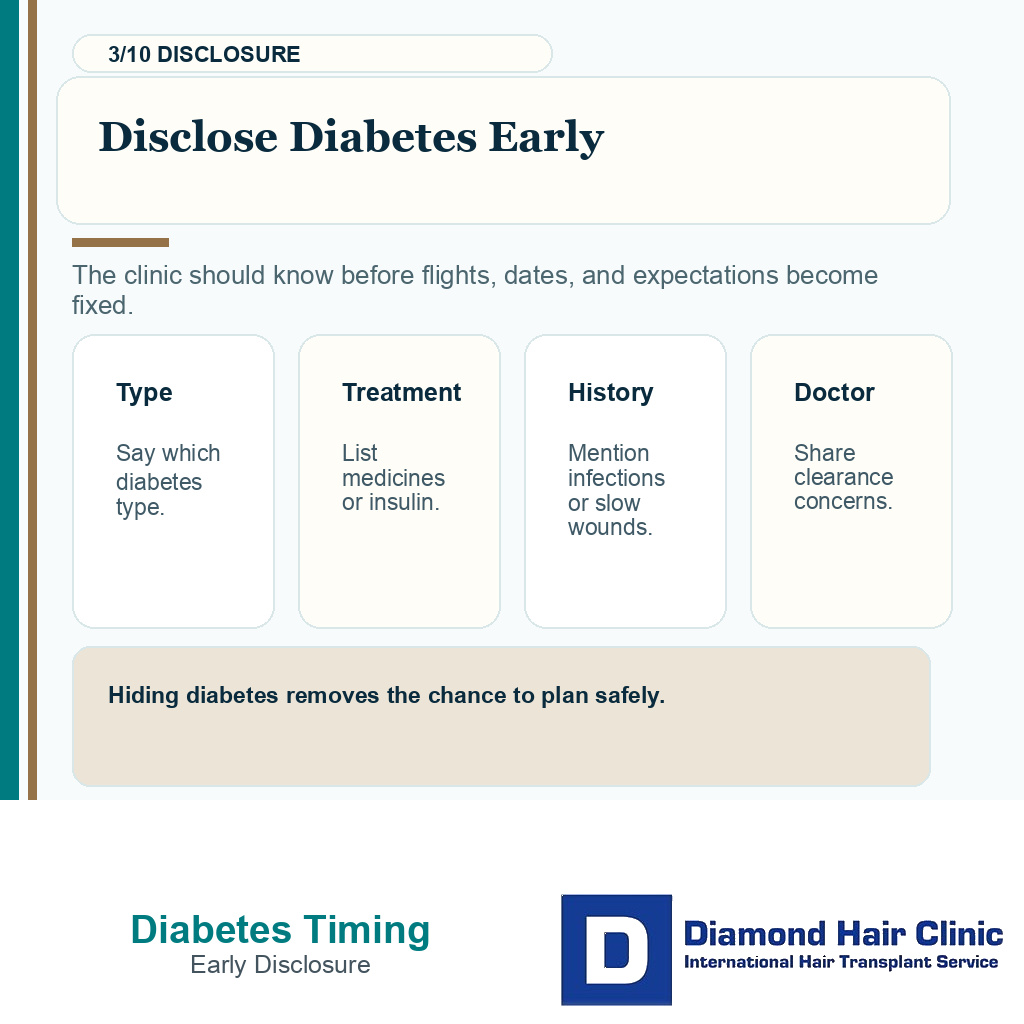
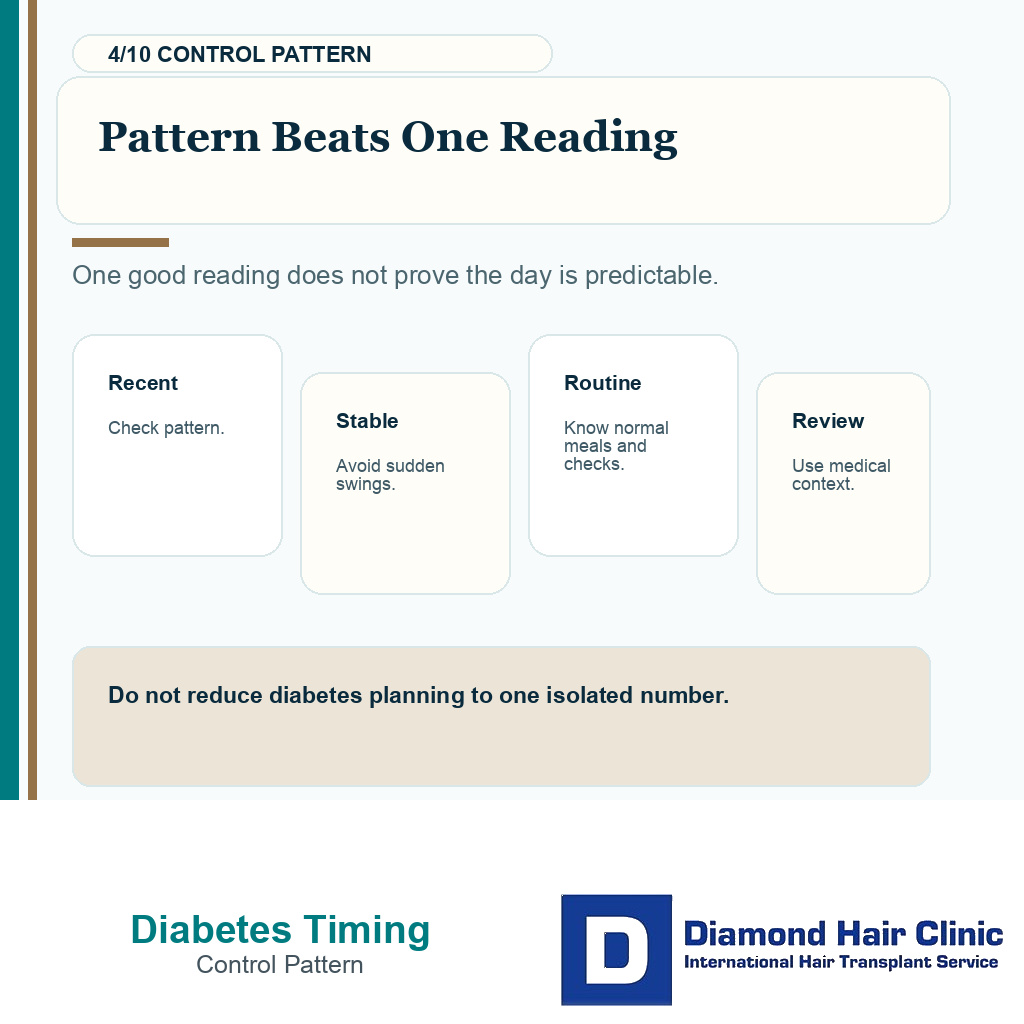
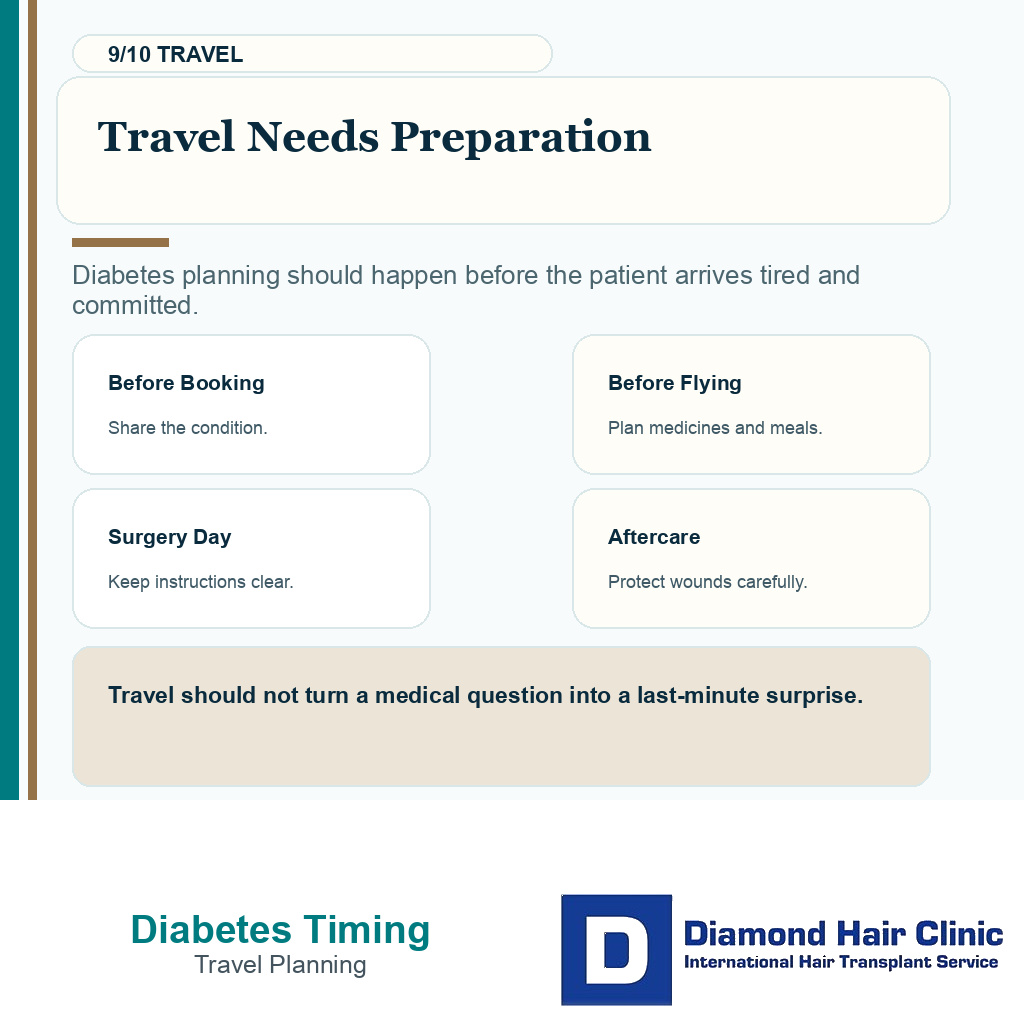
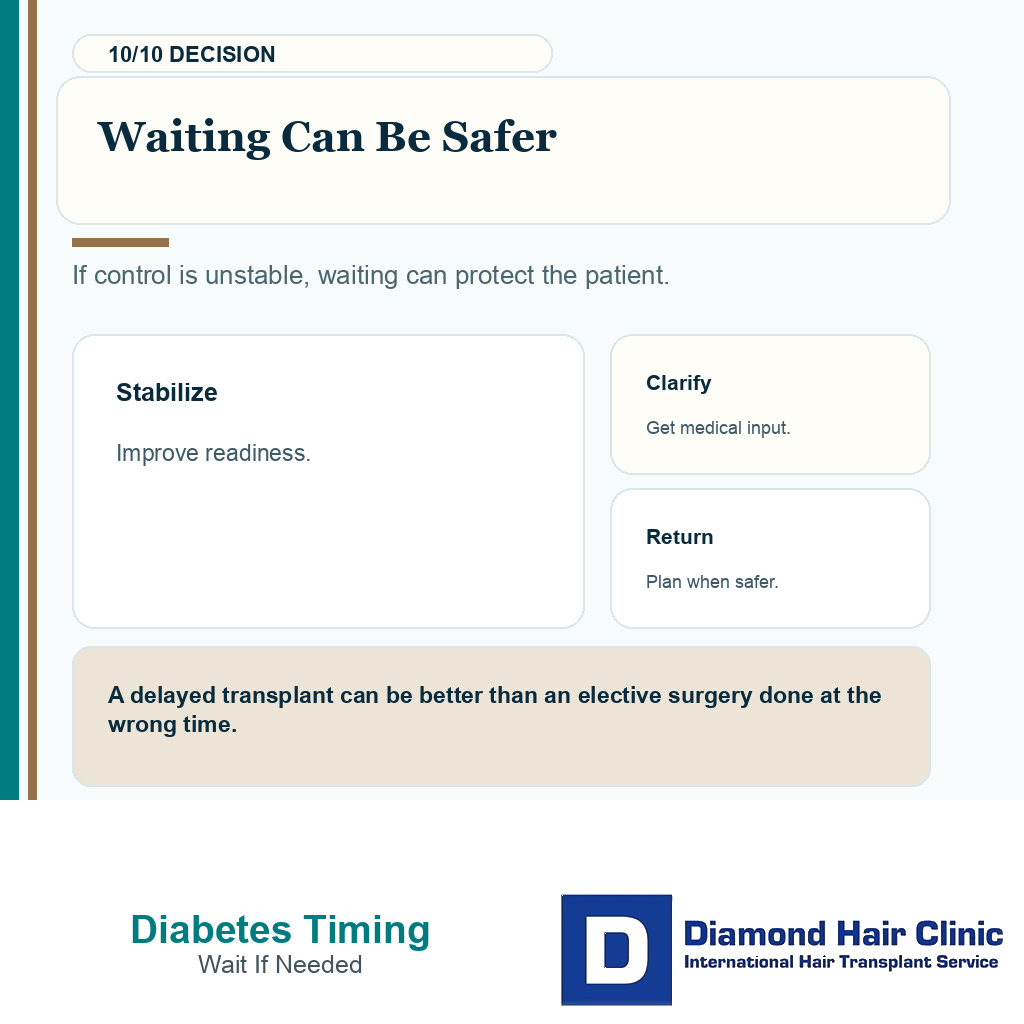
Use the 10 diabetes control slides below to see how surgery timing depends on stable readings, healing risk, medication planning, travel preparation, and medical disclosure. Swipe the carousel, use the arrows for one step at a time, or choose a number below the image to jump to that point.
Blood sugar information useful before surgery
When a diabetic patient asks whether surgery is reasonable, I do not accept “my sugar is fine” as the whole medical history. I need information that helps me understand the pattern. A recent HbA1c, usual fasting readings, typical daily range, low sugar episodes, and how often the patient checks blood sugar are all more useful than one vague sentence.
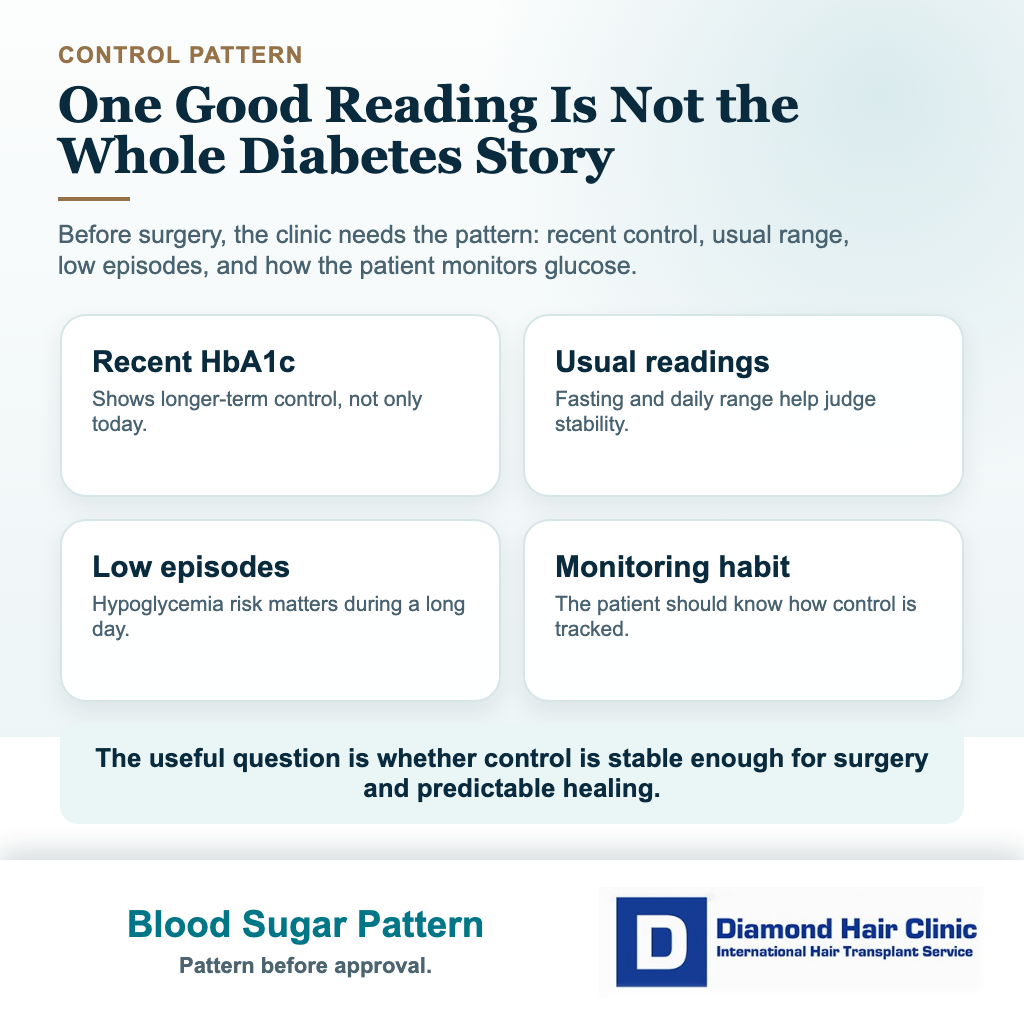
One number is not automatic approval or automatic rejection for every patient. A number must be interpreted with the whole story. A patient with stable readings, no infection history, and good medical follow up is different from a patient whose readings swing widely, who has recent wounds, or who cannot explain treatment clearly.
HbA1c and a same day blood sugar reading answer different questions. HbA1c helps show the recent pattern. A same day reading tells us whether the body is stable at that moment. A reasonable HbA1c does not help if the patient arrives dizzy, hypoglycemic, unwell, or with a very high reading on the day of surgery. One acceptable reading also does not erase months of poor control.
Blood sugar control should be known before travel. If the patient has not checked recent control, the clinic should not be asked to guess from scalp photographs. Hair transplant planning should not move faster than the medical information.
Reasons diabetes can delay surgery
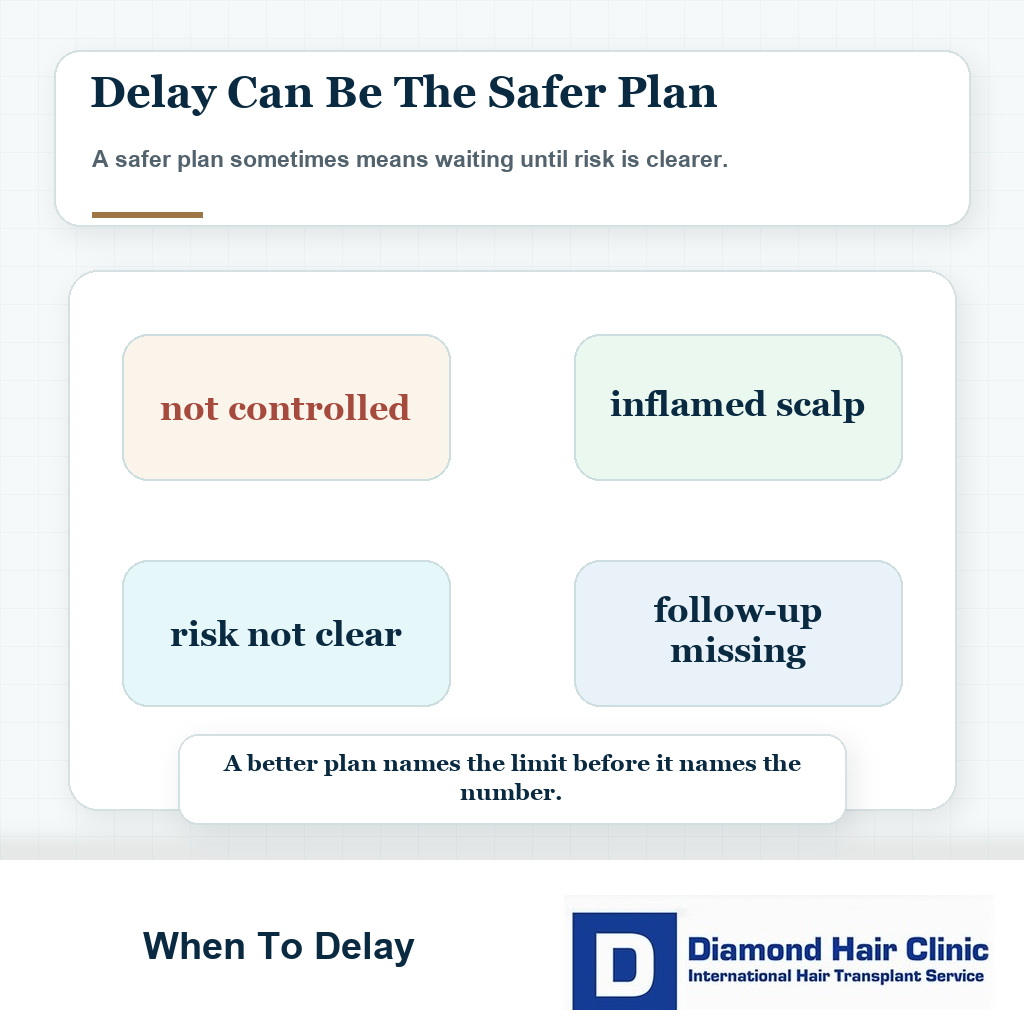
Diabetes is a reason to delay surgery when control is poor, readings are unstable, the patient has a recent infection, wounds heal slowly, or medication has changed recently without enough time to understand the response. It is also a reason to pause when the patient cannot explain treatment clearly.
My concern becomes stronger if the patient has neuropathy, circulation problems, kidney disease, heart disease, repeated infections, or a history of slow healing after small cuts or previous procedures. These details tell me that the case is not only a hair case. It is a medical case with cosmetic goals.
The planned size of the operation also matters. A very large session may be more demanding for a diabetic patient than a moderate session. The issue is not only the diagnosis. It is the combination of diagnosis, surgery length, graft number, donor quality, recipient area demand, and the patient’s ability to follow aftercare.
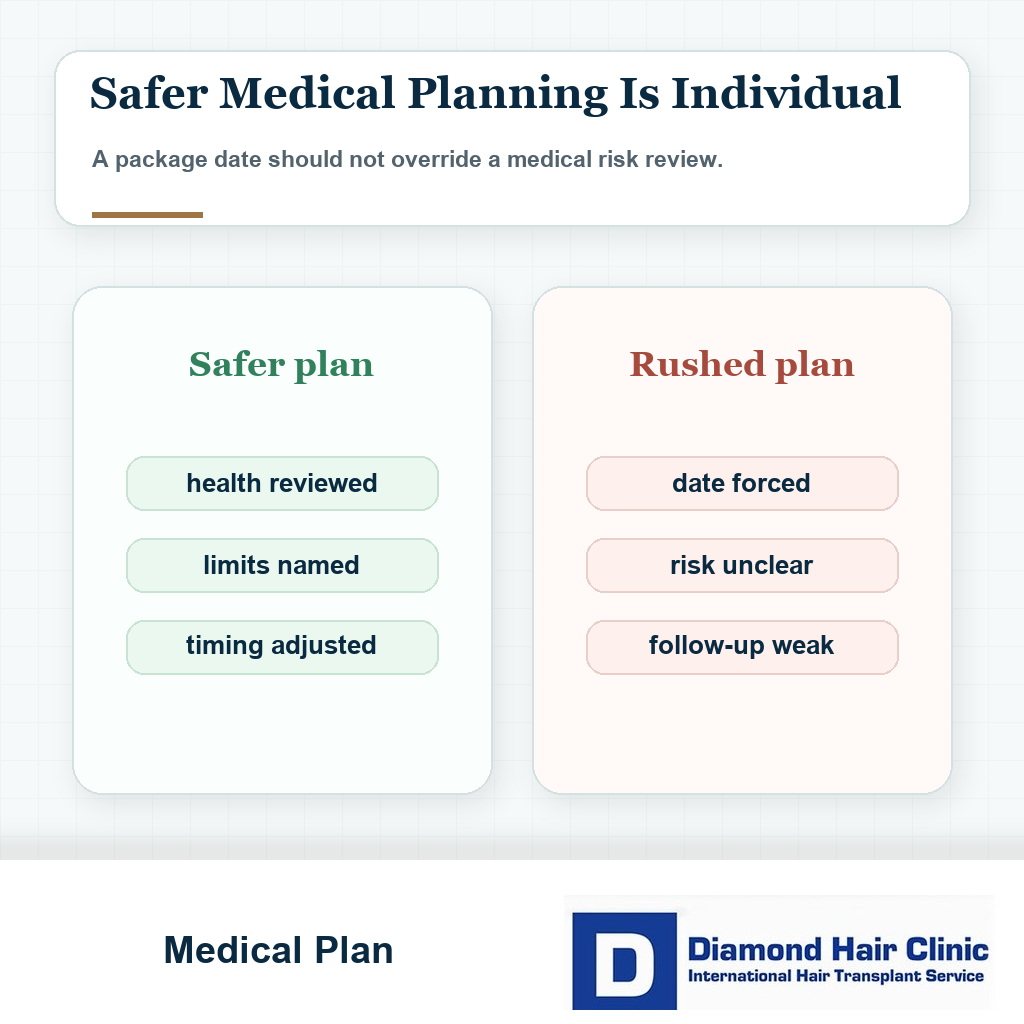
If delaying surgery allows the patient to improve blood sugar control, confirm medication instructions, or get medical clearance, then waiting is not wasted time. It is preparation. A safer operation later is better than a rushed operation today.
Patients sometimes feel disappointed when I recommend delay. I understand that. They may have imagined the hairline, planned time away from work, and prepared emotionally for surgery. But the body does not become ready because the patient is ready emotionally. The medical condition must also support the plan.
Temporary disappointment is better than exposing a patient to a preventable problem. This is especially true when the surgery is not urgent. Hair restoration can change how a person feels, but it is still elective. Elective surgery should be done under medically controlled conditions.
Diabetes details to disclose before booking
Disclose diabetes early, before travel is booked if possible. Say whether you have type 1 or type 2 diabetes, how long you have had it, which medication or insulin you use, how often you check blood sugar, whether your recent control has been stable, and whether your doctor has any concern about elective surgery.
Scalp photos alone are not enough when diabetes is part of the planning. Photos are useful, but they do not show the whole patient. Planning a hair transplant from photos can begin a consultation, but it cannot replace medical disclosure.
Also disclose poor wound healing, foot wounds, skin infections, kidney problems, heart problems, high blood pressure, blood thinner use, or smoking. These details may feel unrelated to the scalp, but they are not unrelated to surgery.
Some patients hide diabetes because they fear the clinic will refuse surgery. That is the wrong instinct. A careful clinic is not trying to punish you. It is trying to decide whether surgery is safe now, whether it needs preparation, or whether it should wait. Complete information protects the patient.
The way you communicate also matters. Do not simply write, “I have sugar.” That wording is too vague. Explain the diagnosis, how it is treated, whether it is stable, and whether your doctor has recently reviewed you. Clear information helps the surgical team give a clear answer.
If the clinic asks for more information, do not see that as an obstacle. See it as a sign that someone is taking the procedure seriously. A clinic that is careful before surgery is more likely to be careful during surgery.
Type 1 and type 2 diabetes need different planning
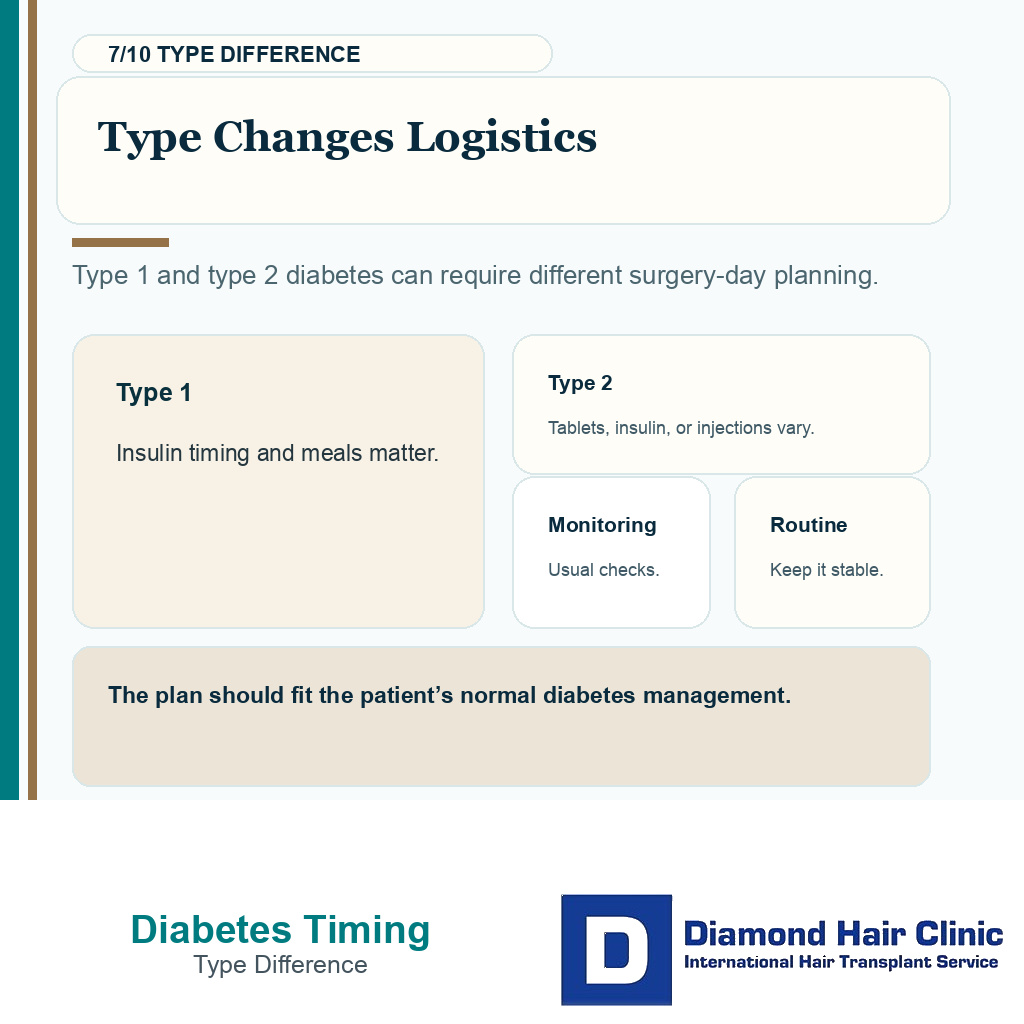
The planning can be different. A patient with type 1 diabetes often depends on insulin timing, meals, glucose monitoring, and a personal routine that should not be disrupted casually. A patient with type 2 diabetes may use tablets, insulin, weekly injections such as Ozempic, or a combination of treatments. The clinic should know which situation it is dealing with.
A long hair transplant day can change eating times, stress level, sleep, and normal routine. That matters for a diabetic patient. If the patient uses insulin, a pump, or continuous glucose monitoring, the plan needs review before the operation day, not improvised while the patient is already in the clinic.
I ask what usually happens when the patient’s blood sugar drops or rises. Some patients feel symptoms early. Others do not notice the change quickly. That detail matters during a long procedure because the patient may be lying still for hours.
Medication and blood sugar control affect the plan
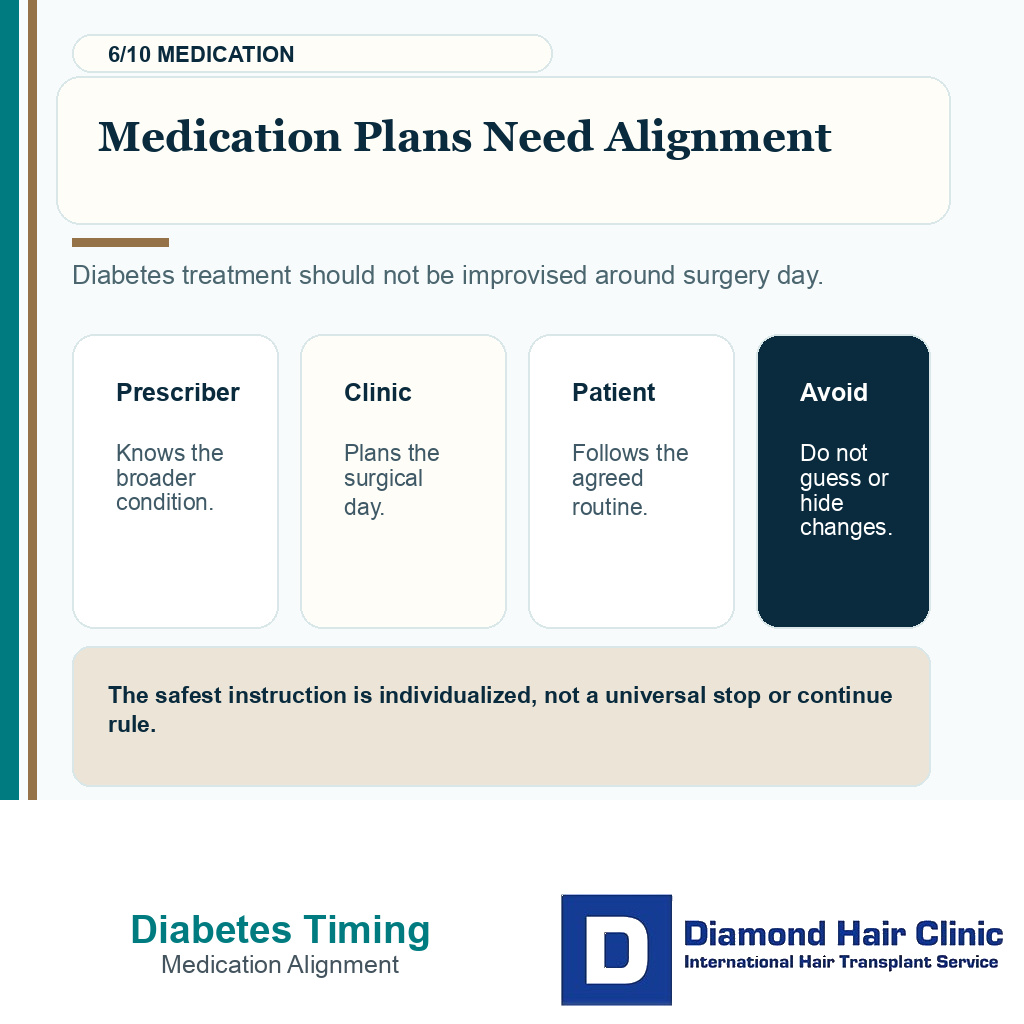
Medication timing matters because surgery day may involve fasting instructions, travel, local anesthesia, stress, and changes in normal routine. A patient using insulin or diabetes medication should not improvise. The prescribing doctor and surgical team should be aligned on what to do before, during, and after the procedure.
Some patients also use medicines for blood pressure, cholesterol, heart disease, pain, mood, or blood thinning. Medication before a hair transplant should be reviewed carefully. This is not only about which hair loss medicine you take. It is the full medical picture.
Universal advice such as “just stop this” or “just continue that” is risky when a patient has diabetes. Diabetes treatment is individualized. The responsible instruction is the one built around the patient’s own condition, the treating doctor’s advice, and the surgical plan.
Diabetes medication is not one single group. Tablets, insulin, weekly injections, pumps, and glucose monitors each create different day of surgery questions. Meals, fasting after a hair transplant, hydration, travel, and the patient’s usual pattern all matter, so those instructions should be agreed before the patient is lying in the chair.
Blood sugar control also affects how predictable the day can be. If a patient arrives with unstable readings, dizziness, weakness, or confusion, the procedure should not be treated as routine. The team must first understand whether the patient is medically stable enough to continue.
Normal routine matters too. A diabetic patient often knows their body well when the day is ordinary. Surgery day is not ordinary. They may wake earlier, eat differently, travel to the clinic, feel stress, sit for many hours, and focus on the operation. That change in routine is exactly why instructions should be individualized.
The plan should avoid surprises. It needs to make medication, monitoring, communication, and what to eat after hair transplant surgery clear before the operation. If anything is unclear, ask before surgery day. Confusion during the procedure is not the right time to solve a medication question. A diabetic patient must not fast, skip insulin, skip tablets, or change usual treatment unless the treating doctor and surgical team have given a clear plan.
Diabetes complications that make me more cautious
I become more cautious when diabetes has already affected healing, circulation, nerves, kidneys, eyes, or the heart. A history of foot ulcers, repeated skin infections, slow wound healing, neuropathy, kidney disease, heart disease, or hospital admission for blood sugar problems changes the conversation.
These details do not by themselves make surgery impossible, but they mean the operation should not be treated as a simple cosmetic booking. I may ask for medical clearance, a smaller plan, better preparation, or delay. I am not trying to frighten the patient. The plan should avoid pretending that all diabetic patients carry the same risk.
If heart disease, stents, blood thinners, or blood pressure problems are also present, the evaluation becomes broader. Hair transplant surgery with heart disease or a stent usually cannot be judged as a single isolated condition.
Diabetes and high blood pressure together
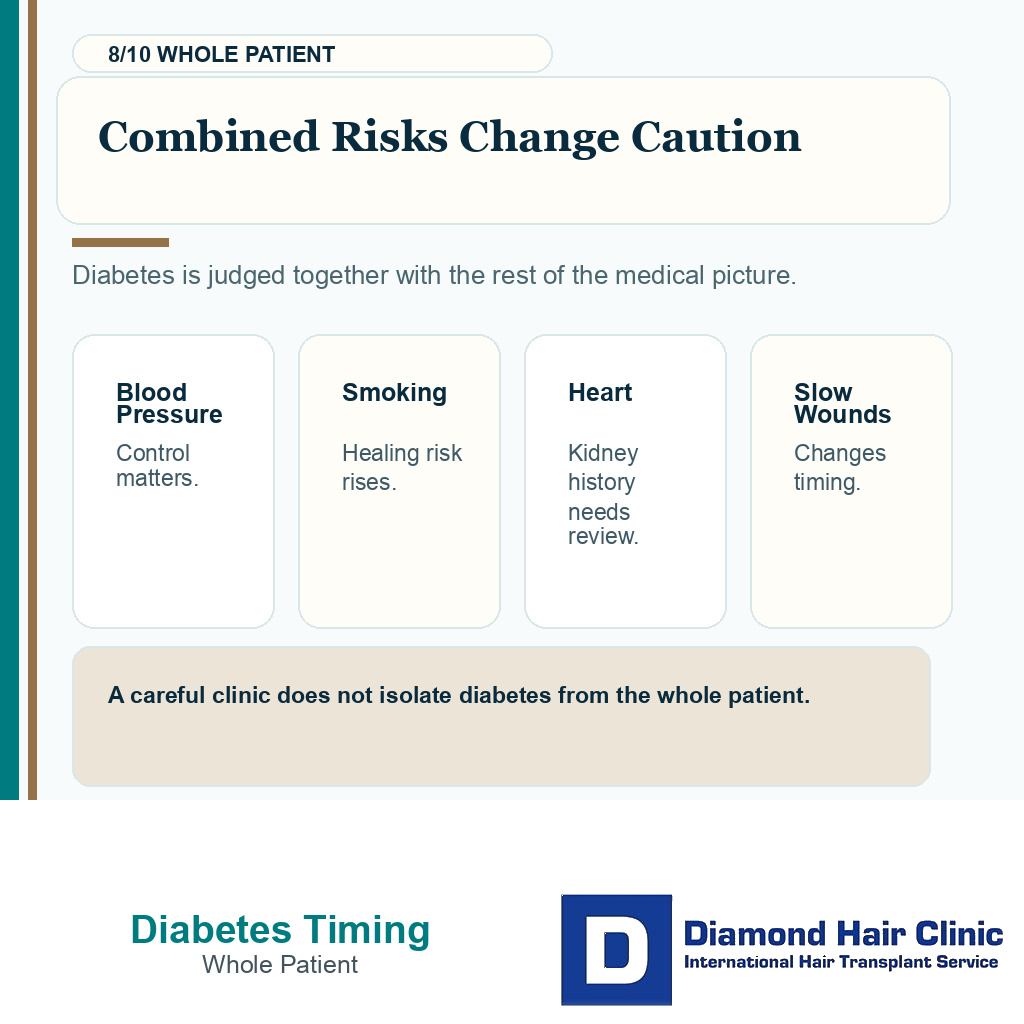
Diabetes and high blood pressure together require more careful judgment than either condition alone. Many patients have both, and many can still be considered for surgery if they are controlled. But when two medical factors affect circulation, healing, and surgical stress, the clinic should not treat the case as routine without review.
In these patients, the medical picture needs to be clearer before surgery feels comfortable. Stable blood sugar, controlled blood pressure, regular medication use, heart or kidney history, smoking, blood thinner use, and wound healing history all change the level of risk. I do not treat diabetes as one fixed answer.
I connect diabetes planning with my article about hair transplant surgery with high blood pressure. The principle is the same. A condition that is controlled and understood may be manageable. A condition that is uncontrolled, hidden, or dismissed should delay surgery.
Very large sessions need more caution when the patient has more than one medical risk factor. A moderate operation may be a better first step than trying to cover every area in one day. That is not a smaller vision. It is careful planning around the whole patient.
Infection and slow healing risk
It can. Diabetes, especially when poorly controlled, can make healing slower and can make infection more concerning. In hair transplant surgery, most openings are small, but there are many of them. The scalp still needs good circulation, immune response, clotting, and careful aftercare.
The purpose is not to frighten patients. Preparation matters because the same patient who heals well after minor cuts and has stable readings may be very different from a patient whose wounds stay open, become infected, or take a long time to settle.
The donor area must also be respected. If healing is slower, the patient may worry more when redness, crusts, or tenderness last longer than expected. A strong clinic should explain what is normal, what is not normal, and when to contact the team. Clear aftercare after hair transplant surgery needs extra attention when there is a medical condition behind the healing process.
Habits that worsen healing also matter. Smoking and nicotine can work against circulation and wound repair. If a diabetic patient also smokes, the concern becomes stronger. Smoking before and after hair transplant surgery should be taken seriously in this combination.
Healing is also emotional. If a diabetic patient expects every scab, redness, or tender area to disappear exactly like another person’s photos, they may panic too early. The aftercare conversation should prepare them for the normal range while also making warning signs clear. Clear monitoring is better than fear, but careless neglect is also wrong.
Patients should contact the clinic for infection warning signs such as spreading redness, increasing pain, discharge, fever, or healing that looks worse instead of better. These situations are not for guessing. Do not wait silently because of embarrassment. Early communication can prevent a small problem from becoming a larger one.
Graft numbers for diabetic patients
Sometimes yes, but not necessarily. The graft number should come from anatomy and safety, not from the patient’s wish or a clinic’s marketing target. If diabetes is controlled and the patient is otherwise fit, the plan may be similar to a patient without diabetes with the same hair characteristics. If control is uncertain, a more moderate plan may be wiser.
Surgical judgment matters here. A hair transplant is not only about what can be extracted. It is also about how long the procedure will last, how much stress the patient can tolerate, how well the scalp is likely to heal, and whether the patient can follow instructions afterward.
Very ambitious sessions in medically complex patients need extra caution. More coverage means more time, tissue work, and recovery responsibility. In a diabetic patient, tolerance and healing capacity should decide the limit, not the most impressive graft number.
Being a good candidate for hair transplant surgery is not decided by hair loss pattern alone. A patient may have a bald area that can technically be transplanted, but the timing, health status, and healing risk may still change the plan.
A smaller operation is not necessarily a weak operation. If the first priority is to rebuild the frontal frame naturally, a focused session may give the patient meaningful improvement while keeping the surgery day more predictable. In selected cases, that can be more intelligent than chasing full coverage immediately.
Donor management also matters. If diabetes or another medical factor makes me cautious, I try not to spend grafts carelessly. The donor area is a lifetime resource. It should not be used to prove that a clinic is willing to do a large number. It should be used to create a result that makes sense today and remains defensible later.
Clinic evaluation for a diabetic patient
A clinic should evaluate a diabetic patient as a whole person. It should ask about diabetes type, control, medicines, previous healing, infections, blood pressure, smoking, allergies, and medical clearance. It should also ask whether the patient understands the aftercare and can follow it carefully.
The evaluation should not be done only by a salesperson. A coordinator can collect information, but the decision belongs to the medical team. The person responsible for surgery should understand why operating is safe enough, or why waiting is safer. The patient needs to know who performs the hair transplant surgery and who carries medical responsibility on the day.
Some clinics simplify the answer. They may say, “No problem,” without asking how controlled the diabetes is. Others may use fear to sell extra treatments. Neither approach is good enough. An ethical clinic should explain the risk clearly, ask for the right information, and be willing to postpone if the medical picture is not stable.
When patients travel to Turkey, they often compare clinics by price, hotel, graft number, and photos. Those details matter, but medical communication matters more. Choosing a hair transplant clinic in Turkey should include asking who reviews your health before the operation.
I slow down with any clinic that gives the same answer to every diabetic patient. “Yes, no problem,” is not a medical evaluation. “No, never,” is also too simplistic. Surgery planning should come from control, treatment, healing history, other diseases, and the planned procedure.
The plan for surgery day should explain what happens if the readings are not acceptable. The plan may need postponement, medical review, or the surgeon may decide to reduce or stop the procedure. That clarity is not a bad sign. It shows that the clinic has a plan beyond selling the operation.
Travel preparation with diabetes
If you have diabetes, preparation should start before flights are booked. I need to know about a medical issue early, not after the patient has arrived tired, stressed, and financially committed.
Before travel, I check the diabetes type, the treatment used, recent control information if the clinic requests it, and whether the patient has a history of infections, slow wound healing, smoking, or wounds that healed poorly. I also want the patient’s own doctor involved when elective surgery under local anesthesia needs medical clearance.
Medication timing should not be improvised. Insulin, tablets, glucose monitoring, meals, and travel routine all matter. Bring medication, supplies, and any glucose monitoring equipment during travel, and do not arrive dehydrated, exhausted, or after a night of poor sleep. If you also use CPAP for sleep apnea, that plan needs review before travel.
If the medical situation is not stable enough, delay is safer than pretending everything is fine. A postponed operation is frustrating, but a poorly timed operation can create a much bigger problem.
Patients should also read the clinic’s instructions before hair transplant surgery because routine instructions may need extra attention when the patient has diabetes.
Travel itself can disturb routine. Meals change. Sleep changes. Stress rises. Do not treat the trip as if it has no medical effect. The better the travel planning, the more predictable the surgery day can be.
Keep communication simple and practical. Explain what you usually do if blood sugar drops or rises. Share whether you carry quick glucose or other supplies, and mention if you have ever fainted or become confused during medical treatment. These small details can matter during a long day.
Do not arrive with the idea that the clinic will solve every diabetes issue for you. The clinic can plan the surgery and monitor the day, but your diabetes doctor knows your broader medical condition. Good medical judgment works best when both sides are respected.
Unstable blood sugar on surgery day
If the patient arrives with symptoms of low or high blood sugar, the procedure should not simply continue as if nothing is happening. Dizziness, sweating, confusion, weakness, unusual sleepiness, vomiting, or feeling unwell must be taken seriously.
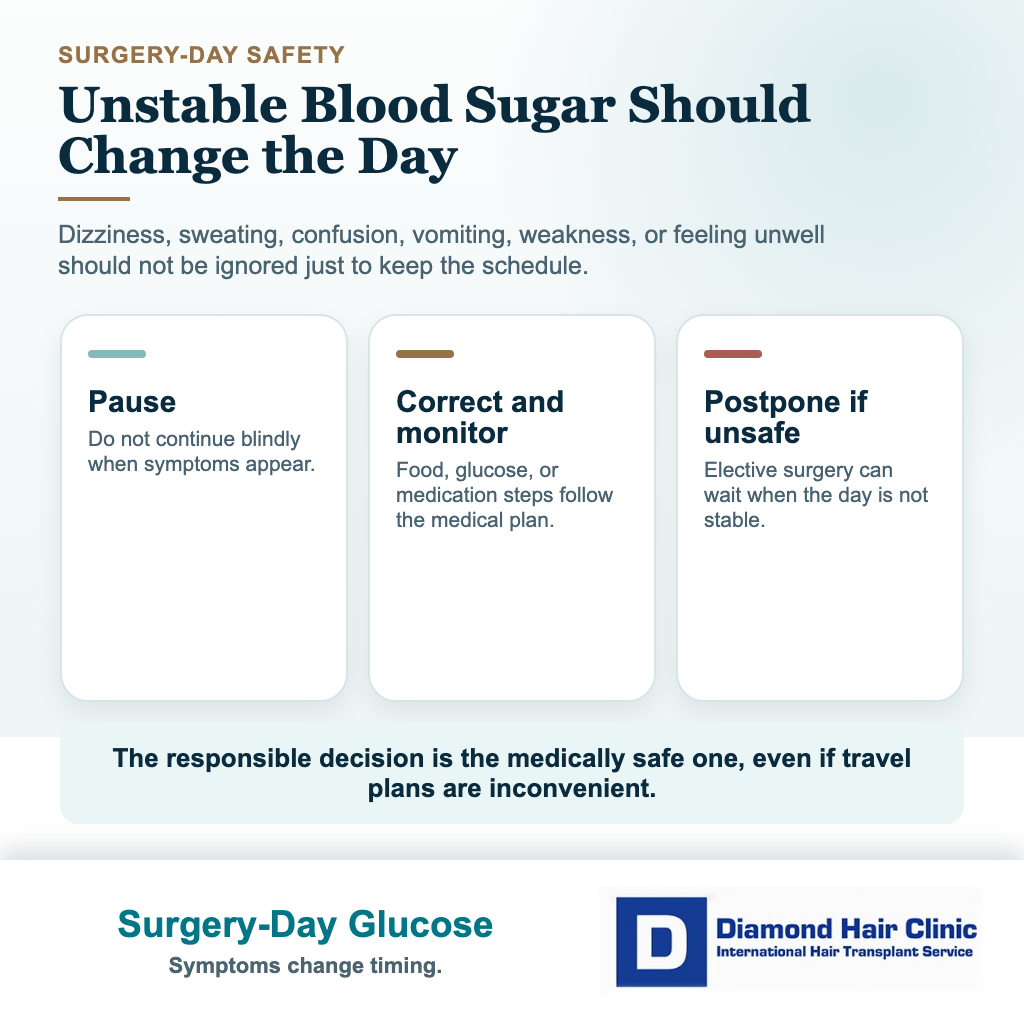
Sometimes the answer is a short pause, food or glucose according to the patient’s medical plan, monitoring, or contact with the patient’s doctor before the decision continues. If readings stay unstable, the responsible answer is to postpone, because healing and safety matter more than keeping a travel schedule. The surgeon should be willing to make that decision if the day is not medically safe.
Clear planning before surgery matters. If the patient knows they are prone to low sugar during long appointments, fasting, stress, or travel, I check that in advance. A written plan is safer than managing surprises in the chair.
Reasons to wait instead of operate with diabetes
Waiting is safer when blood sugar control is poor, when there is an active infection, when wounds are not healing well, when medication has recently changed, when the patient feels unwell, or when the clinic cannot give a clear medical reason for proceeding safely.
Waiting is also wiser when the patient is emotionally rushing. Hair loss can make people feel desperate. A patient may feel that every month matters, especially when photos are avoided or the face suddenly looks older. I understand that feeling. But emotional urgency should not overrule medical readiness.
If a patient needs more time to stabilize diabetes, that time may improve the operation. It may also make the patient more confident because they are no longer hoping that an unstable medical situation will behave well on the day. It can make the surgery day safer, the aftercare clearer, and the decision less stressful. A delayed transplant can still be a good transplant. A rushed transplant in the wrong medical condition can create unnecessary problems.
Surgery cannot compensate for poor medical control. A technically clean transplant still needs a body that can heal. Good incision design, careful graft handling, and clean aftercare all matter, but they do not make uncontrolled diabetes irrelevant.
When diabetes is stable, the conversation becomes much more positive. Then I can focus on the hairline, donor area, density goals, crown strategy, and natural result. That is the position to reach, not simply being approved for surgery, but being genuinely ready for a medically sensible plan.
If diabetes is well controlled, disclosed, and medically understood, hair transplant surgery may be possible. If diabetes is uncontrolled, hidden, or treated casually, surgery should wait. Surgery should be done only when the patient is ready enough to heal safely and benefit from the result.