


SMP can soften some FUE donor scars
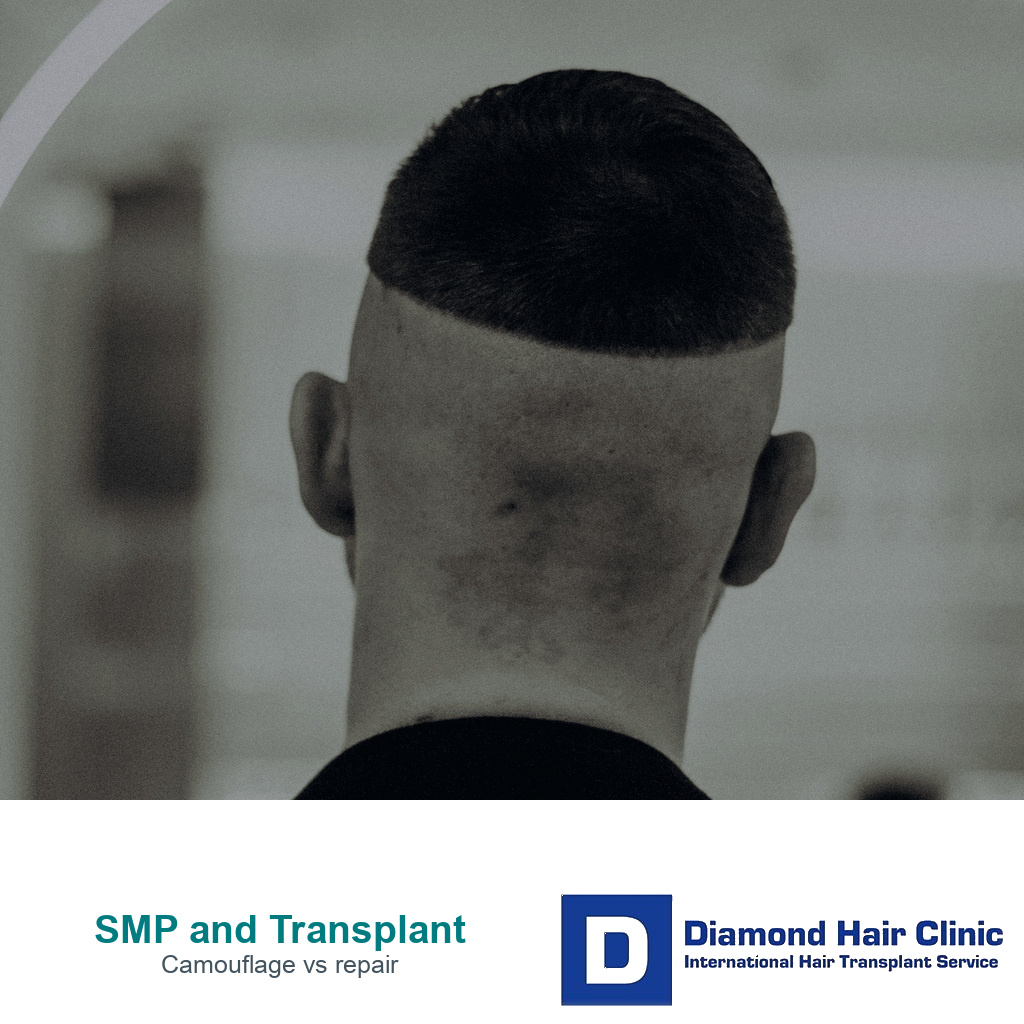
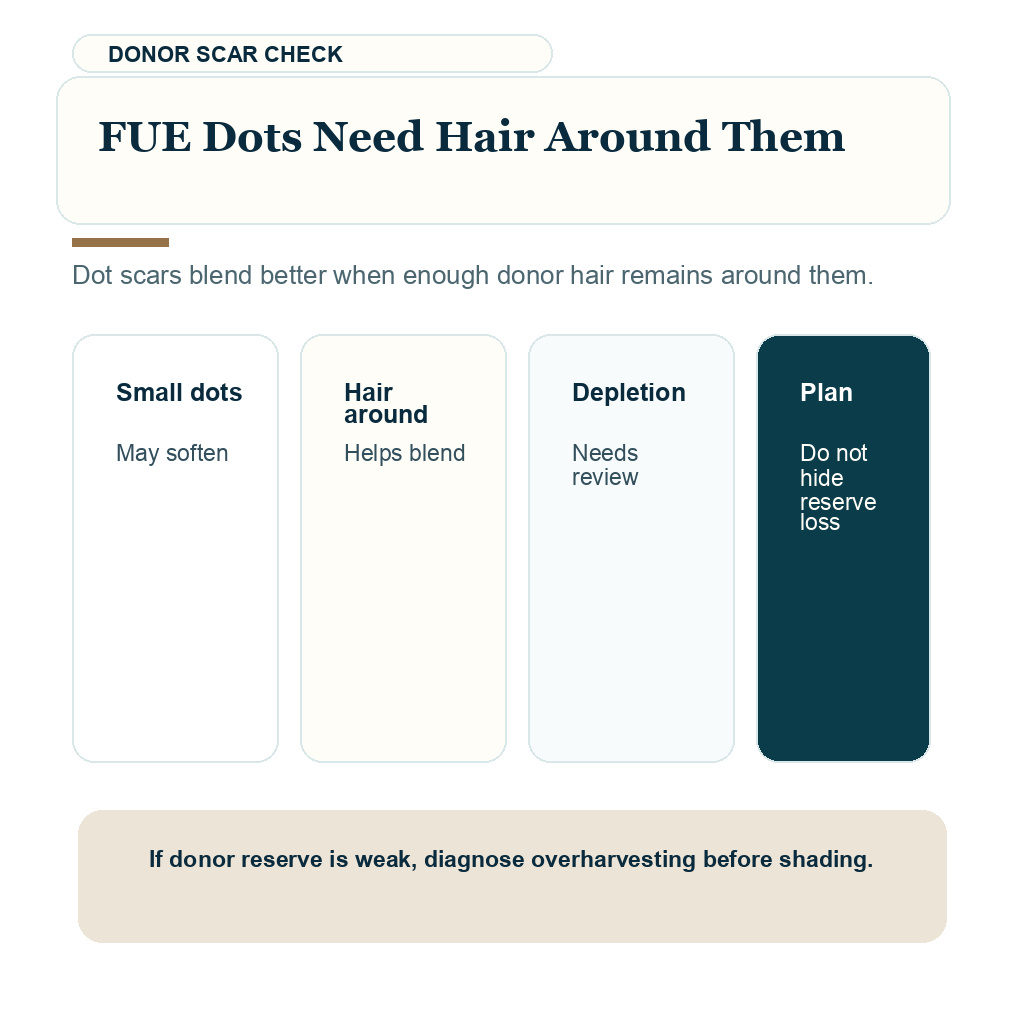
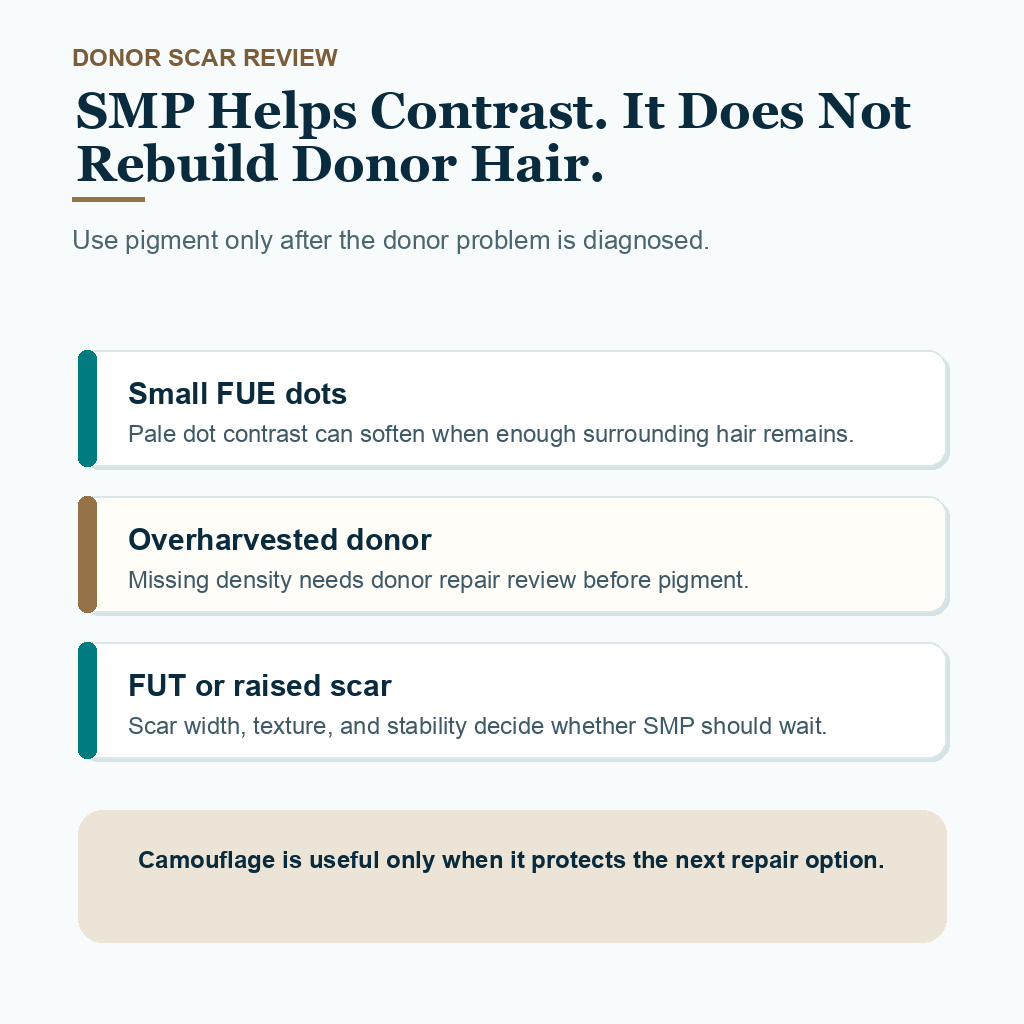
SMP can sometimes soften the appearance of FUE donor scars because those scars are often small pale dots. Pigment can reduce the contrast between the dots and surrounding scalp. It works best when the donor area still has enough hair around the dots, the haircut is kept short enough for the pigment to blend, and the scarring pattern is not severely depleted.
There is a limit. If the donor area was overharvested, pigment cannot replace the missing hair. It can darken the background, but it cannot rebuild the natural transition from thick donor hair to thinner zones. Overharvested donor area repair has to be assessed as a repair problem first, not only a cosmetic shading problem.
The haircut goal matters as much as the pigment. A very low fade can reveal dot scarring even when the transplant was performed carefully. This is the practical issue behind short hair after FUE donor scars. Short hair makes SMP easier to blend. Longer hair can sometimes expose the mismatch between real hair texture and flat pigment shadow.
SMP and low density have limits
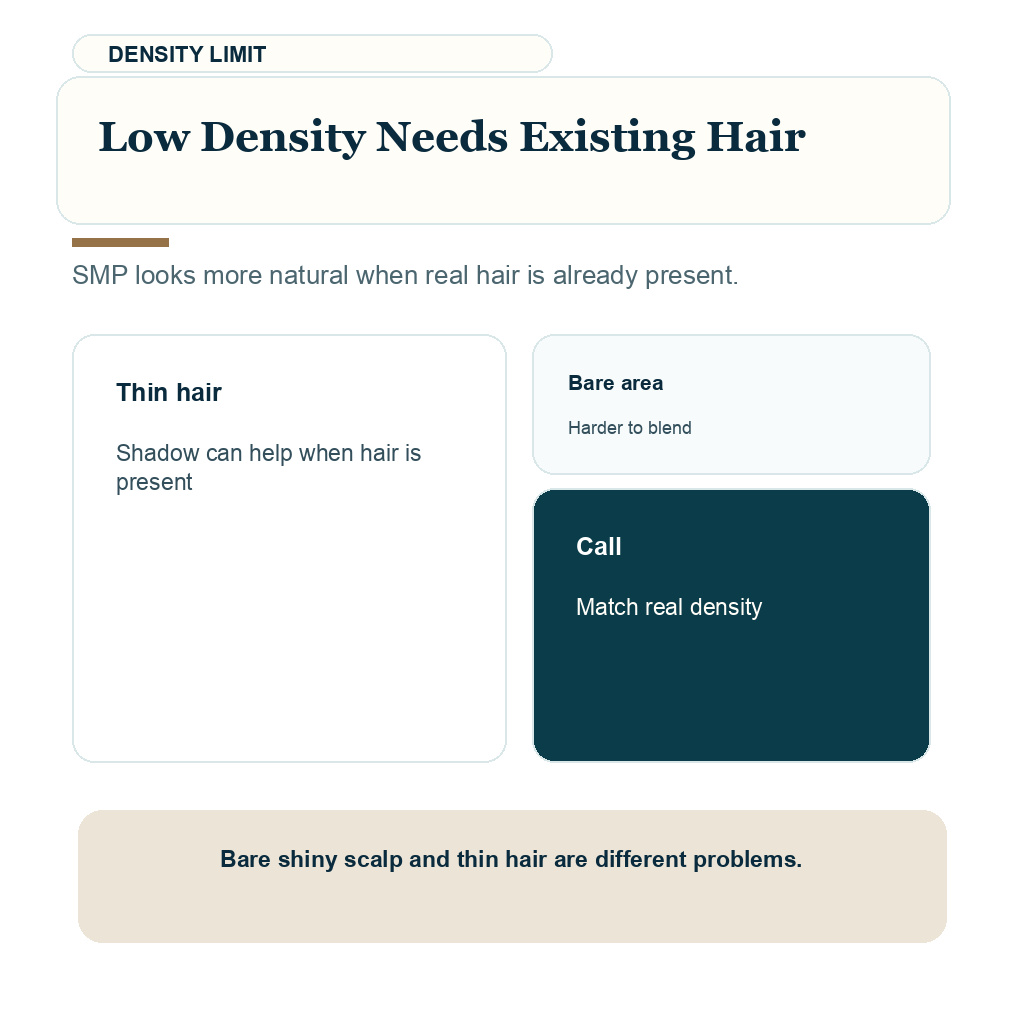
SMP can improve the appearance of low density only when enough hair is present to create a natural blend. It reduces the light scalp contrast between hairs. It does not add hair shafts, direction, layering, or movement. A bare shiny area and an area with thin but present hair are not the same problem. Under strong light, wet hair, long hair separation, and close inspection, the difference between pigment and real hair can still be visible.
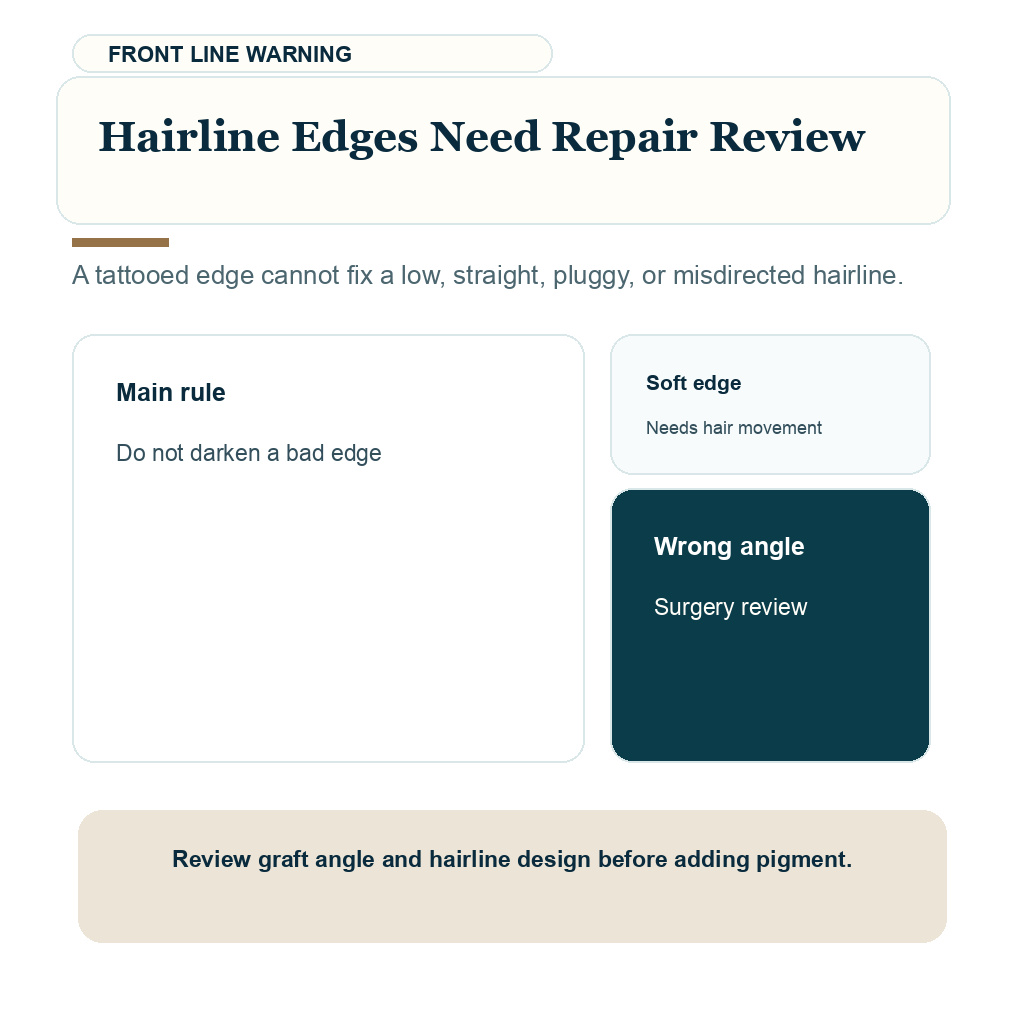
The hairline is where SMP limits become most visible. A natural hairline needs soft single hair grafts, irregularity, correct angle, and correct direction. Pigment may help behind a hairline in selected cases, but it cannot make a straight, pluggy, too low, or badly angled hairline look naturally transplanted. If the visible edge is wrong, a bad hair transplant repair assessment comes first.
SMP should not create a new frontal hairline by itself after a transplant. A tattooed edge in front of sparse, pluggy, or misdirected grafts can look rigid because it has no hair movement. If the front line is the main concern, I review graft angle, hairline height, and possible repair before placing pigment near the visible border.
For the crown, the situation is different. Crown hair opens in a whorl, light reflects from different directions, and full coverage can demand many grafts. SMP may help reduce scalp contrast in selected crown cases, but it has to fit the real hair pattern and future hair loss. If donor supply is limited, the discussion may overlap with beard hair for crown transplant, but donor hair from outside the scalp and pigment both have limits.
When repair surgery is more important than camouflage?
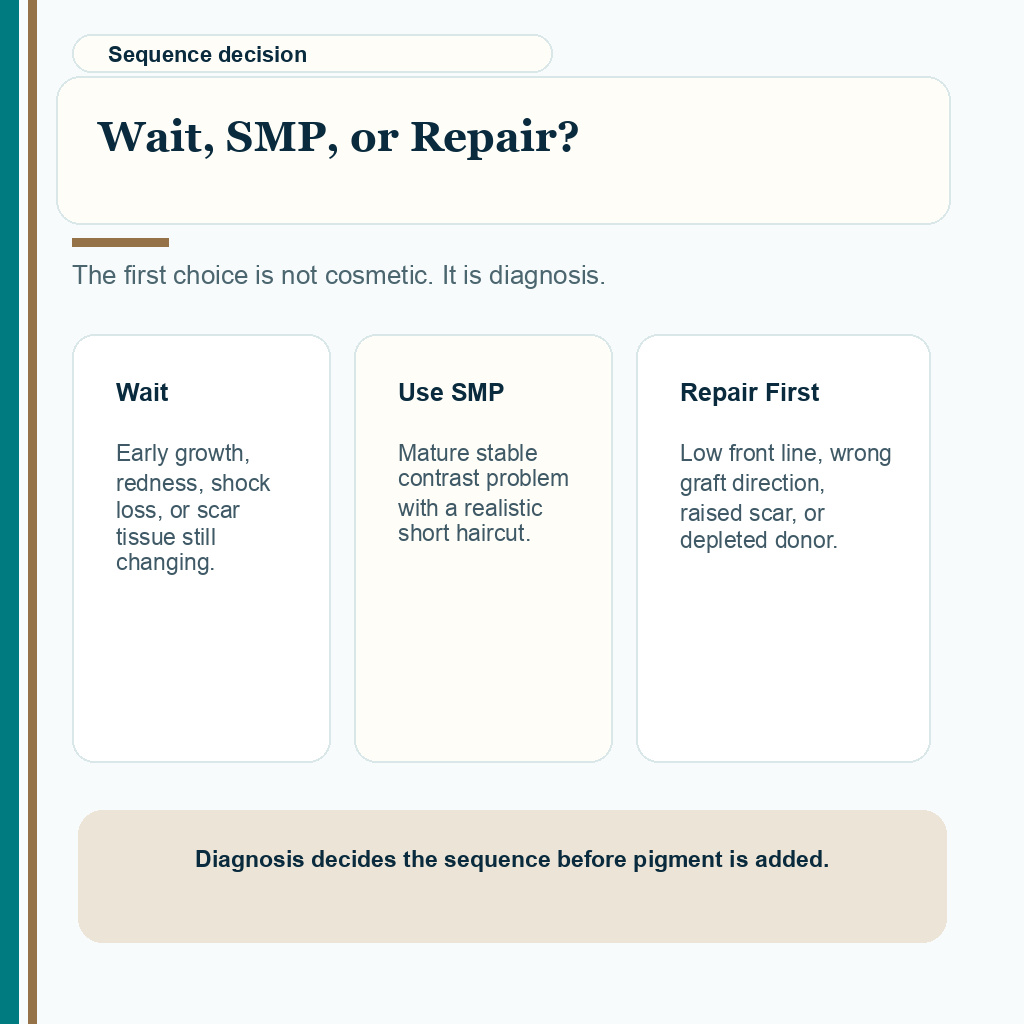
SMP is not the first answer when the main problem is surgical design. A low unnatural hairline, wrong direction, pluggy grafts, visible grafts with too many hairs at the front, a hard temple angle, active infection, open wounds, or unstable scarring needs diagnosis before camouflage. Poor direction and a low hairline need surgical diagnosis first.
After a poor result, it is understandable to want the fastest visual cover. But if pigment is placed over a problem that later needs laser removal, graft removal, scar revision, or additional surgery, the repair may become more complicated. Records to review before refund or repair matter here because photographs, graft count records, operative notes, and timing can change the next step.
Repair planning begins with the donor area, recipient area, hairline, scar tissue, and future hair loss pattern. If the remaining donor supply is weak, I may need to decide whether a small surgical correction is realistic or whether camouflage is the more responsible route. If surgery is still possible, pigment should not block clear evaluation of the scalp.
FUT scars and scar tissue
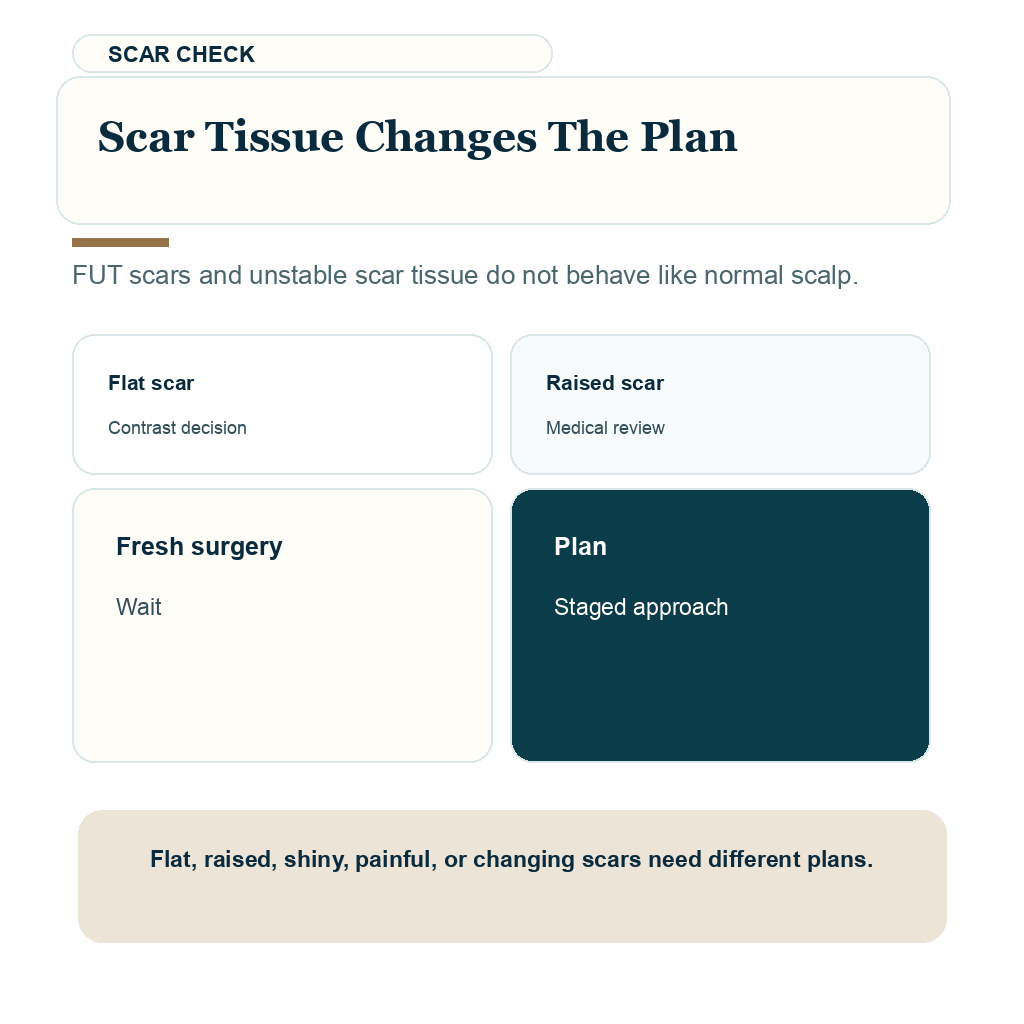
A FUT scar is different from scattered FUE dots. A strip scar has tension, width, color, and tissue quality issues. SMP can sometimes reduce the color contrast, but it may not fully hide a wide, raised, depressed, or shiny scar. A scar is different from normal scalp. A flat pale scar, a wide stretched scar, and a raised or irritated scar need different decisions. Pigment behavior can be less predictable in scar tissue than in healthy scalp, especially when the surface is raised or shiny.
Some scars are better treated with grafting, some with scar revision, some with SMP, and some with a staged combination. FUE grafts for FUT scar repair often require staged thinking, not quick fixes. Hair growth in scar tissue also depends on scar blood supply and tissue thickness.
If the scar is unstable, inflamed, painful, raised, recently operated, or still changing, cosmetic pigment should wait. The scar first has to be medically settled enough to judge. Pigment over irritated or unstable tissue is a poor tradeoff.
Hair length does not decide natural SMP
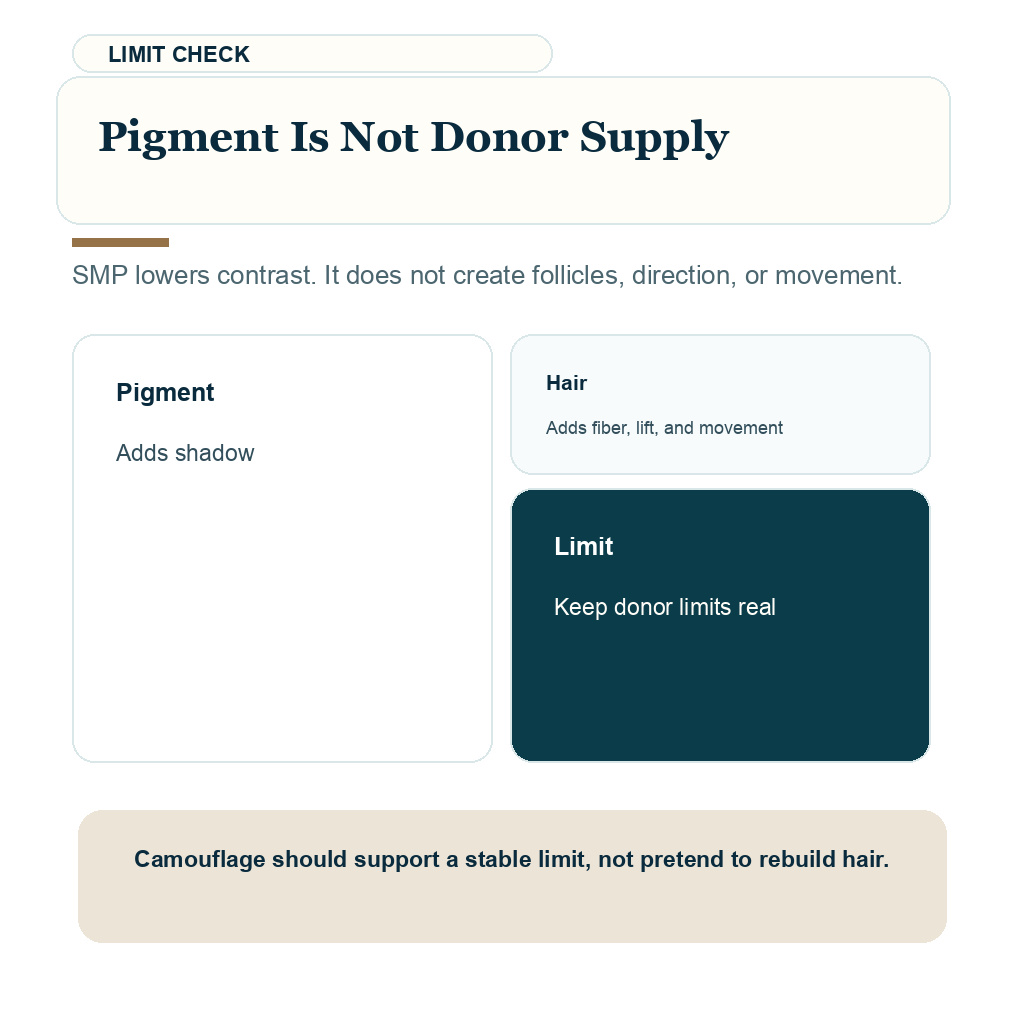
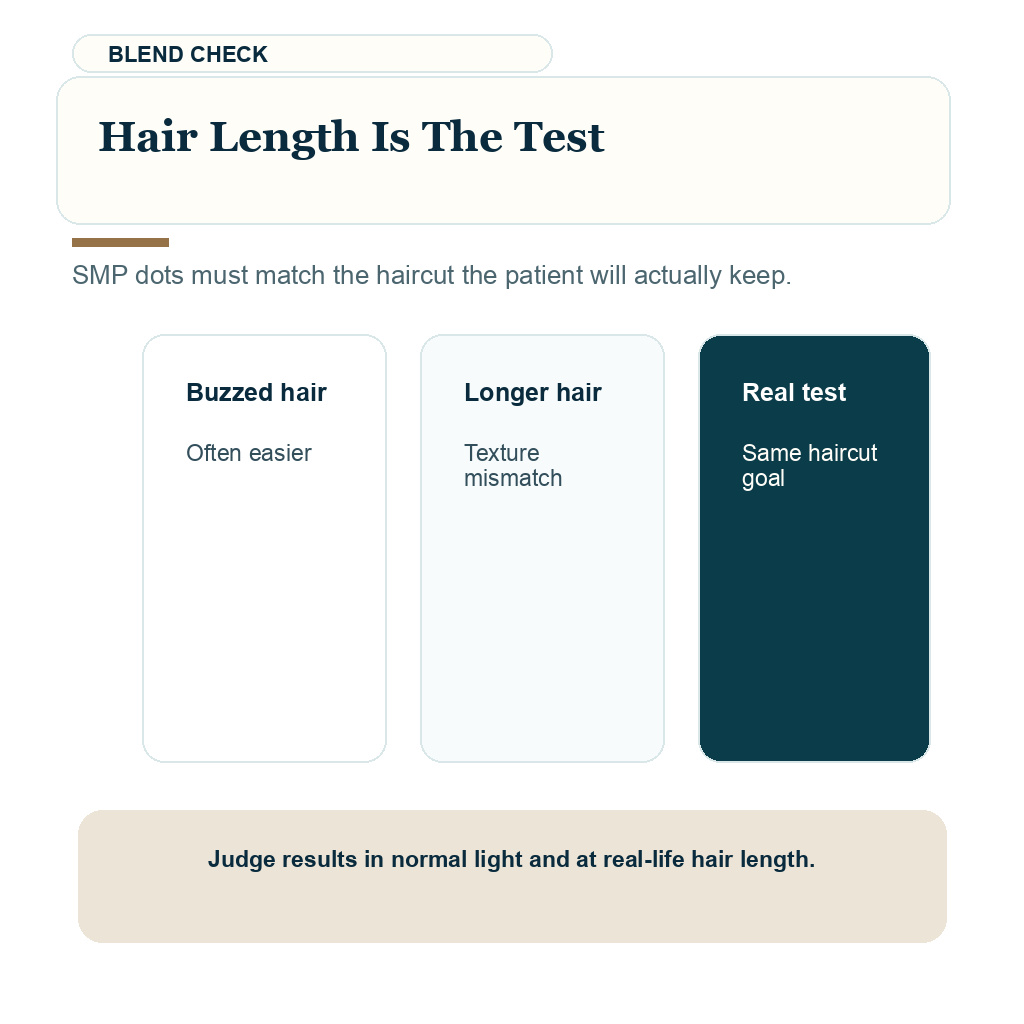
SMP creates dots or shadow. Hair creates fibers, lift, movement, and direction. The more the surrounding hair grows, the more the flat pigment has to match a three dimensional texture. SMP often looks more natural with a buzzed or very short style than with longer hair that parts and moves.
People sometimes imagine SMP as permanent hair fibers under the skin. That expectation is not accurate. If the hair around the pigment grows longer, the scalp may show a dark base with separate hairs above it. In the wrong case, that contrast can become more obvious than the original thinning.
Skin color, hair color, hair caliber, scar color, and lighting all change the result. A dark pigment that looks good under one light can look too heavy in another. A soft pigment can fade too quickly or fail to cover a white scar. The decision has to be matched to your real haircut habits, not only a close image before and after photo.
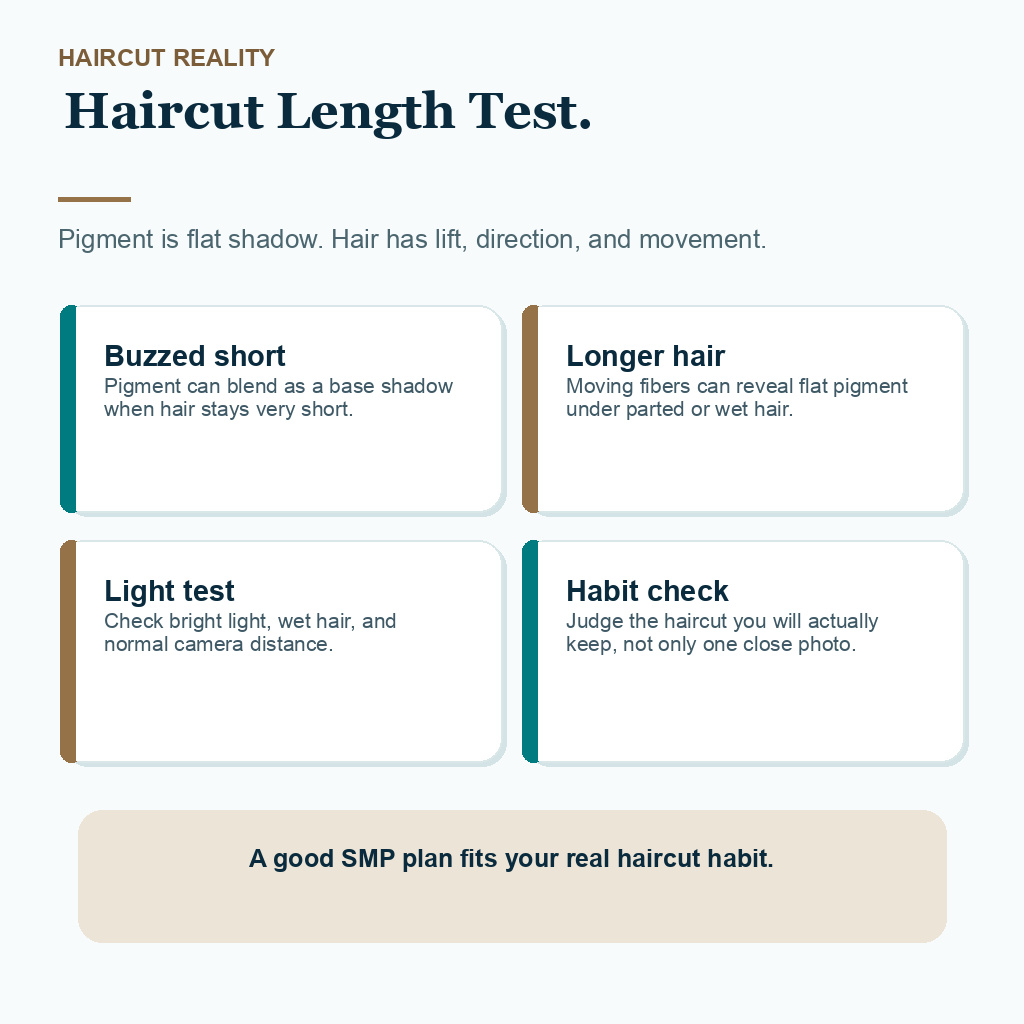
Judge SMP at the haircut length you actually plan to keep.
Future surgery planning before pigment
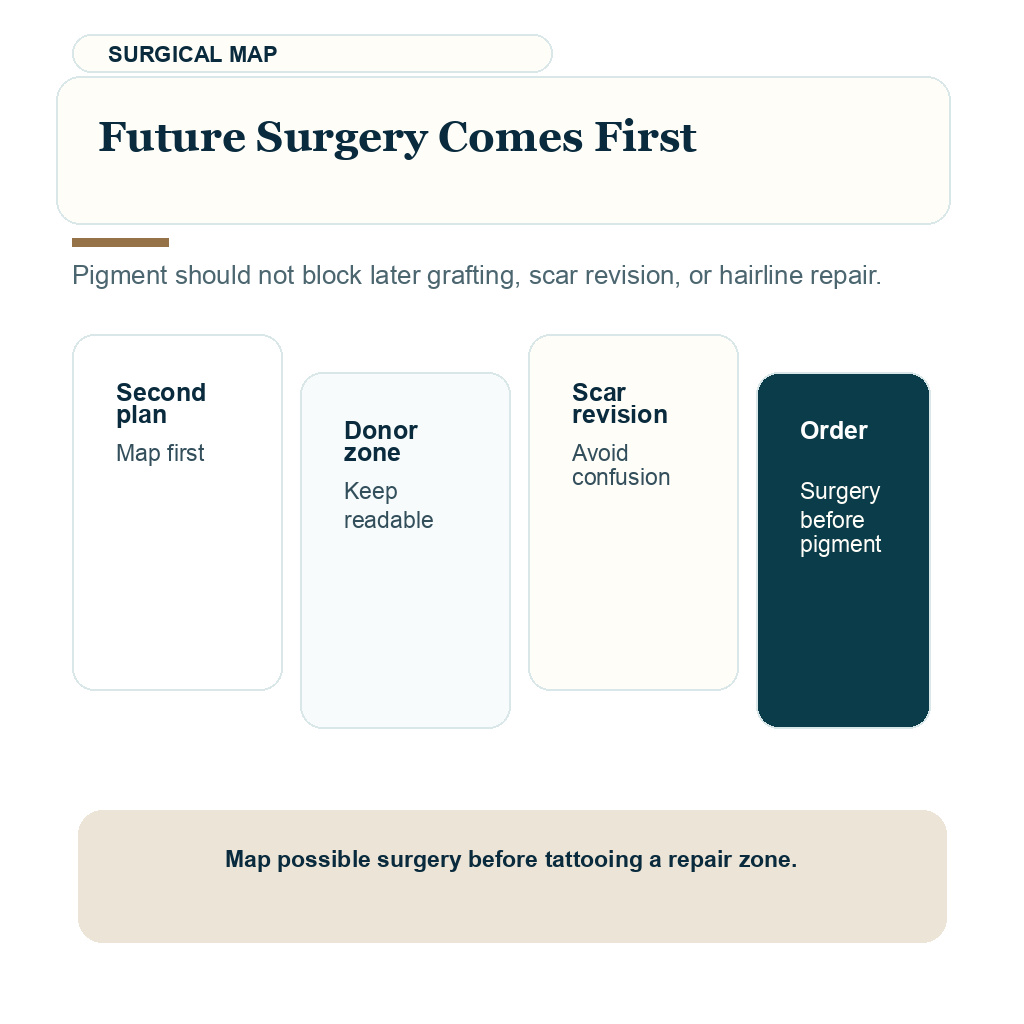
It can be done before another transplant in selected cases, but the surgical plan should come first. I need to know where future grafts may be placed, what donor supply remains, whether the hairline will change, and whether you are likely to keep shaving the scalp short. Plan future surgery before adding pigment.
If you may need a second hair transplant decision, the graft strategy has to be clear before pigment is added. If you are already considering a third hair transplant, remaining donor capacity becomes even more important. Pigment can improve appearance, but it cannot create new donor reserve.
If another transplant, scar revision, or graft removal may happen, share the SMP plan with the surgeon before pigment is placed. Pigment across a planned hairline change, donor repair zone, or scar revision area can make later assessment harder and may limit clean repair options.
There are cases where SMP helps a combined plan. For example, a conservative transplant may build the frontal frame, while SMP later reduces contrast in a broad crown or donor scar. The timing has to respect healing, future hair loss, and the surgical map. A rushed cosmetic sequence can make the final result less flexible.
Risks to check before scalp micropigmentation
SMP breaks the skin with needles, so it carries cosmetic tattoo risks. Infection, allergy, pigment color change, fading, poor dot size, blurred pigment, and an unnatural appearance are real concerns. If you are prone to keloid scars, you need special caution before any cosmetic procedure that uses needles. Sterile technique and realistic color matching matter.
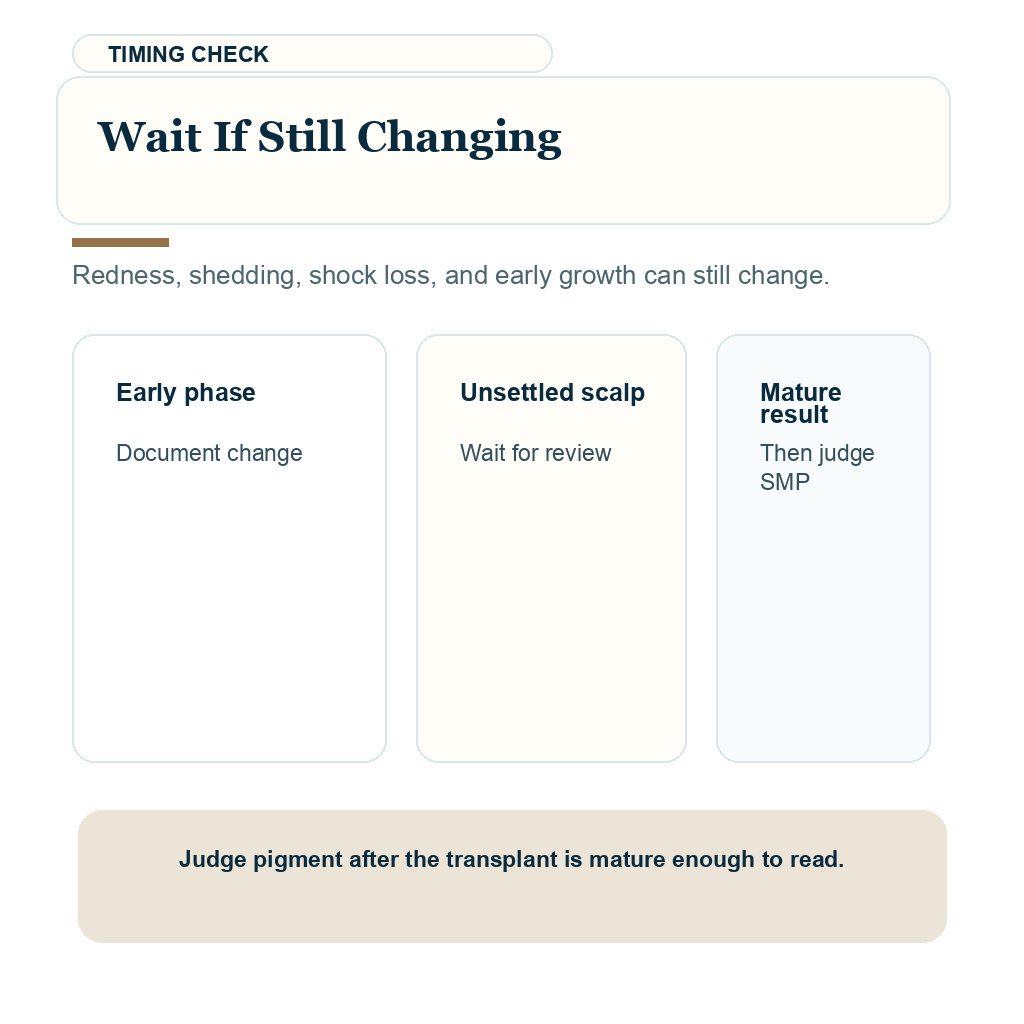
Medical timing matters as well. I avoid SMP on active infection, open wounds, strong irritation, unstable scar tissue, fresh surgery, or unexplained scalp symptoms. If the scalp is still healing from transplant surgery, the skin needs time before another cosmetic procedure using needles is added.
Removal can be difficult. Laser removal can require repeated sessions, may be costly, and may irritate scarred or previously operated scalp. A result that is too dark, too straight, too blue gray, or placed in the wrong pattern can become harder to correct than people expect.
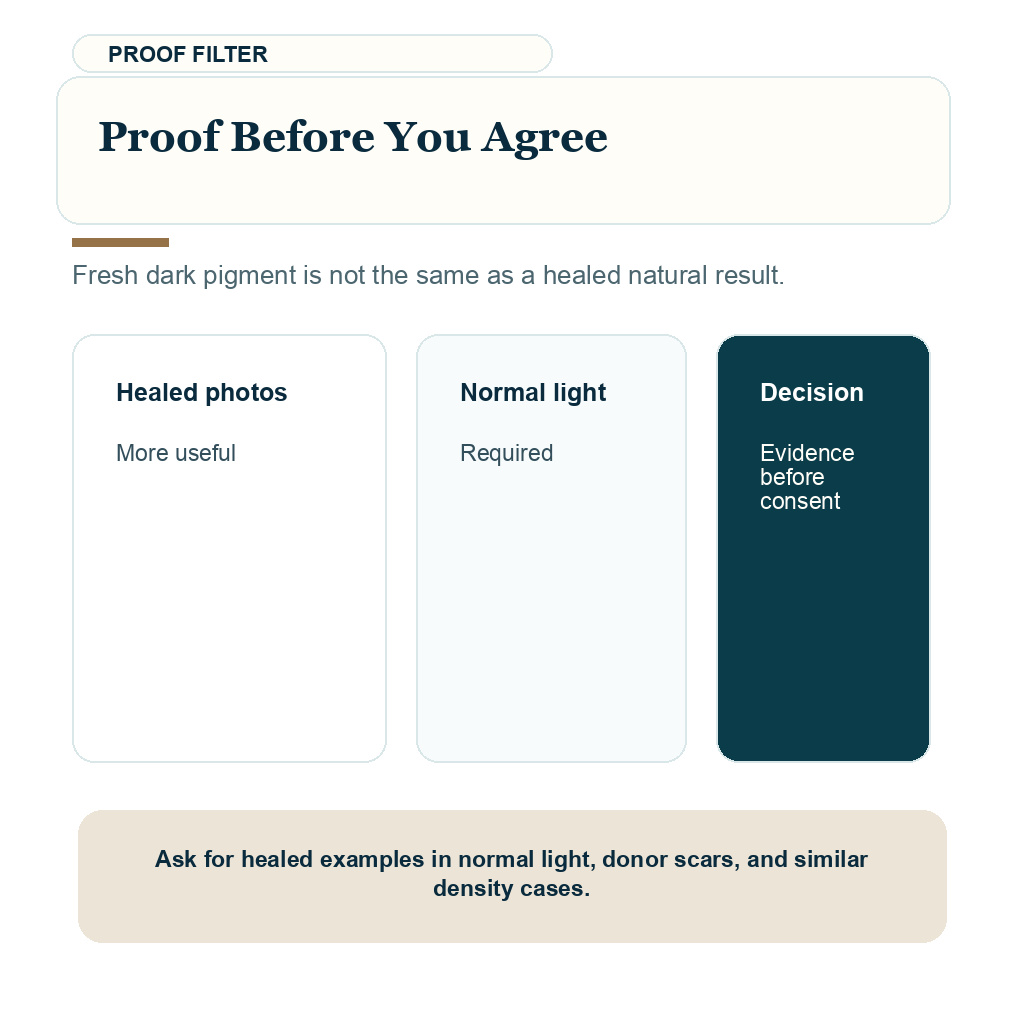
Fresh SMP photos are not enough proof. Fresh pigment can look sharp before it softens, fades, or changes tone. After a transplant, the evidence should include healed results in normal light, with the same haircut length you plan to wear, and with examples of donor scars or low density transplant areas rather than only fully shaved scalp work.
The most useful SMP record follows the same person. It shows the pigment after the initial treatment has settled, later with that person’s usual haircut, and after a maintenance visit if one was needed. The lighting, camera distance, and haircut length should stay as comparable as possible. This sequence will not predict your result, but it shows how that practitioner documents change and upkeep over time.
Waiting, SMP, and repair surgery
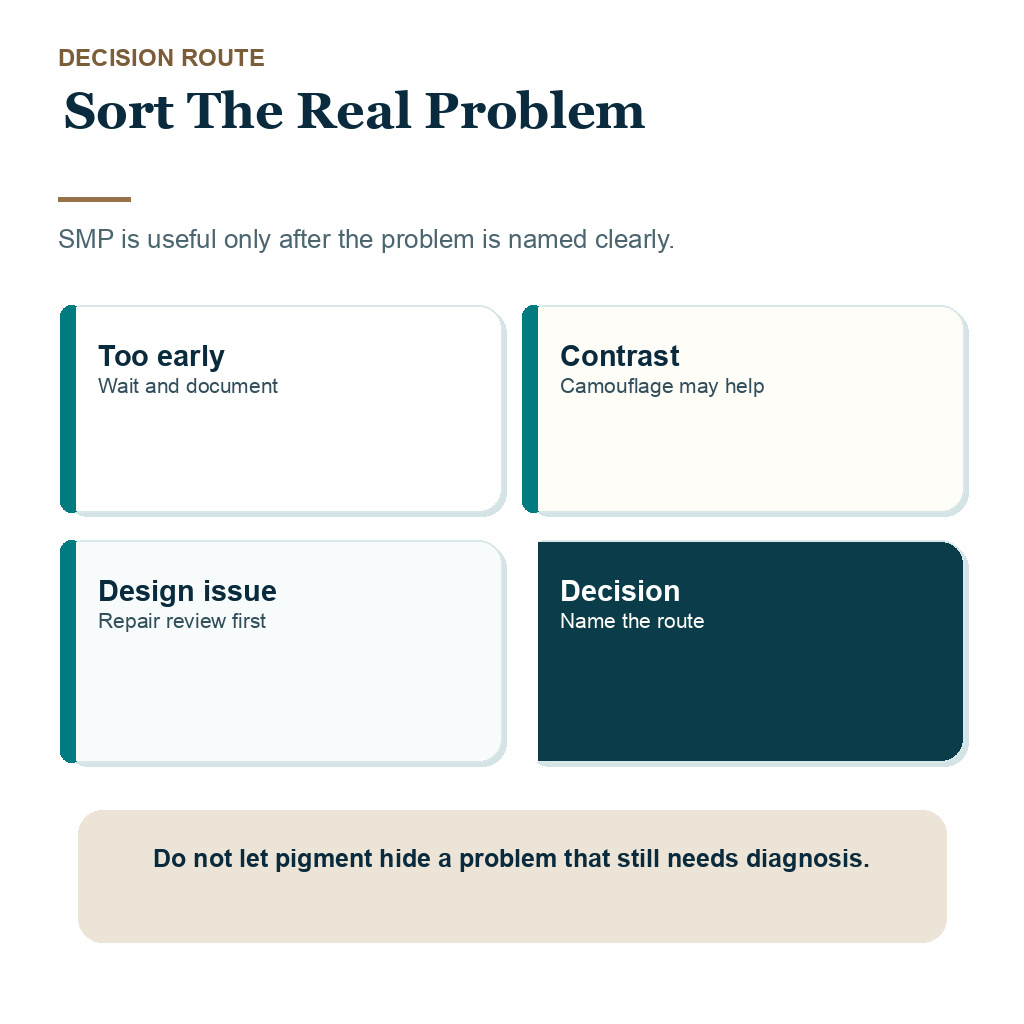
Diagnosis should come before SMP planning. If the transplant is early, wait and document progress. If temporary redness, shock loss, short hair, or lighting explains the concern, SMP may be premature. If the result is mature and the issue is mainly contrast, SMP may be reasonable. If the issue is poor design, graft direction, a depleted donor, or scar instability, repair evaluation comes first.
After that diagnosis, I look at the donor area, recipient area, scars, hairline edge, hair direction, density, future hair loss, and your real haircut plan. I also ask whether medication, another procedure, scar revision, or simply more time may give a better answer than pigment.
A good decision may still be conservative. Some people are better served by accepting a slightly thinner look than chasing another cosmetic layer. Others benefit from a small, careful SMP plan after the transplant result has matured. The decision should protect the remaining options.
Checks before agreeing to SMP
I check whether the transplant is mature enough, whether the scalp is medically settled, whether future surgery is likely, whether the planned haircut is realistic, and whether the practitioner has natural results in hair transplant scars, not only shaved scalp SMP. I also look at examples in normal light, not only edited clinic lighting.
The design must be soft. A boxed hairline, dense black dots, or pigment placed too heavily can look more artificial than thinning hair. For a shaved or very short style, SMP may help the frame look darker, but it still does not create hair length, texture, or density. For donor scars, the goal is usually contrast reduction. For low density, the goal is shadow support, not pretending that pigment is real hair.
Your SMP quote should make clear which sessions are included at the start and whether later maintenance visits would cost extra. An included touchup to finish the original treatment does not mean that future upkeep is covered.
If you are considering SMP after a transplant, bring clear photos at different hair lengths and lighting conditions. Bring your graft count, donor photos, surgery records if available, and your current haircut goal. A careful review may show that SMP is useful, but it may also show that waiting, repair planning, or accepting the current limit is safer.
My clinical judgment is simple. Use SMP when it improves a stable cosmetic contrast problem. Avoid it when it hides an unresolved surgical or medical problem. Never let pigment replace clear donor and repair planning.