


Vitamins Need a Clear Reason After Surgery
Vitamins are support, not a replacement for surgical planning, graft protection, or correcting a true deficiency. They are most useful when the body is healing from surgery, nutrition has been poor, iron or vitamin D is low, or the patient is recovering from dieting, illness, or stress. Vitamins can support recovery, but they cannot rescue poor planning, poor nutrition, or force grafts to grow faster than biology allows.
After surgery, every shed hair and every slow week can make a person wonder whether they should be taking something extra. That question is understandable. Vitamins should not be ignored, but they also should not turn into a pile of products taken out of fear. Bring the exact supplement list for review, because two products with different labels can repeat the same ingredient. They work best when there is a clear reason for using them. The supplement list should be clear before surgery as well, because supplements before hair transplant surgery can affect bleeding, monitoring, and medication review.
Before buying another supplement kit, list what is already inside each pill. Duplicate biotin, iron, zinc, vitamin A, herbal blends, or high dose formulas can turn a simple recovery plan into a stack no one can interpret.
For a supplement stack, the useful record is the label, dose, start date, duplicate ingredients, and side effects, not the promise on the bottle. Who recommended the stack also matters, because clinic instructions, your own purchases, and outside advice are not the same.
The distinction I make is between correcting a real deficiency or nutritional gap and taking products because anxiety is high. If there is a deficiency, poor protein intake, restrictive dieting, or another health issue, we should identify it and correct it. If the body is already well supported, a basic reviewed routine is enough. Vitamins belong to recovery support. They do not decide whether the hairline was planned well, whether the donor was protected, or whether the grafts were handled properly.
Vitamins can help only when there is a reason
Healing does not happen only in the scalp. The recipient area, donor area, skin barrier, blood supply, inflammation response, and general energy level all depend on the patient’s overall health.
After surgery, the patient’s body needs enough building material to heal. Protein intake, iron stores, vitamin D, B vitamins, zinc, hydration, and a stable diet can all matter in the right patient, especially after rapid weight change, restrictive dieting, or weight loss medicine. That point does not mean every patient needs the same supplement. It means recovery should not be treated as washing instructions alone. If the main concern is calorie restriction rather than a vitamin, dieting during hair transplant recovery should still protect protein, hydration, and iron status.
Good hair transplant aftercare protects the grafts from the outside. Vitamins and nutrition support the patient from the inside. Recovery is clearer when both parts are respected. One without the other is incomplete.
I think about this even more in patients who arrive tired, stressed, dieting heavily, or recovering after weight loss surgery. In these patients, the transplant should not be treated as separate from the body. The scalp is not isolated from nutrition, sleep, medical stability, and the stress the body has recently been through.
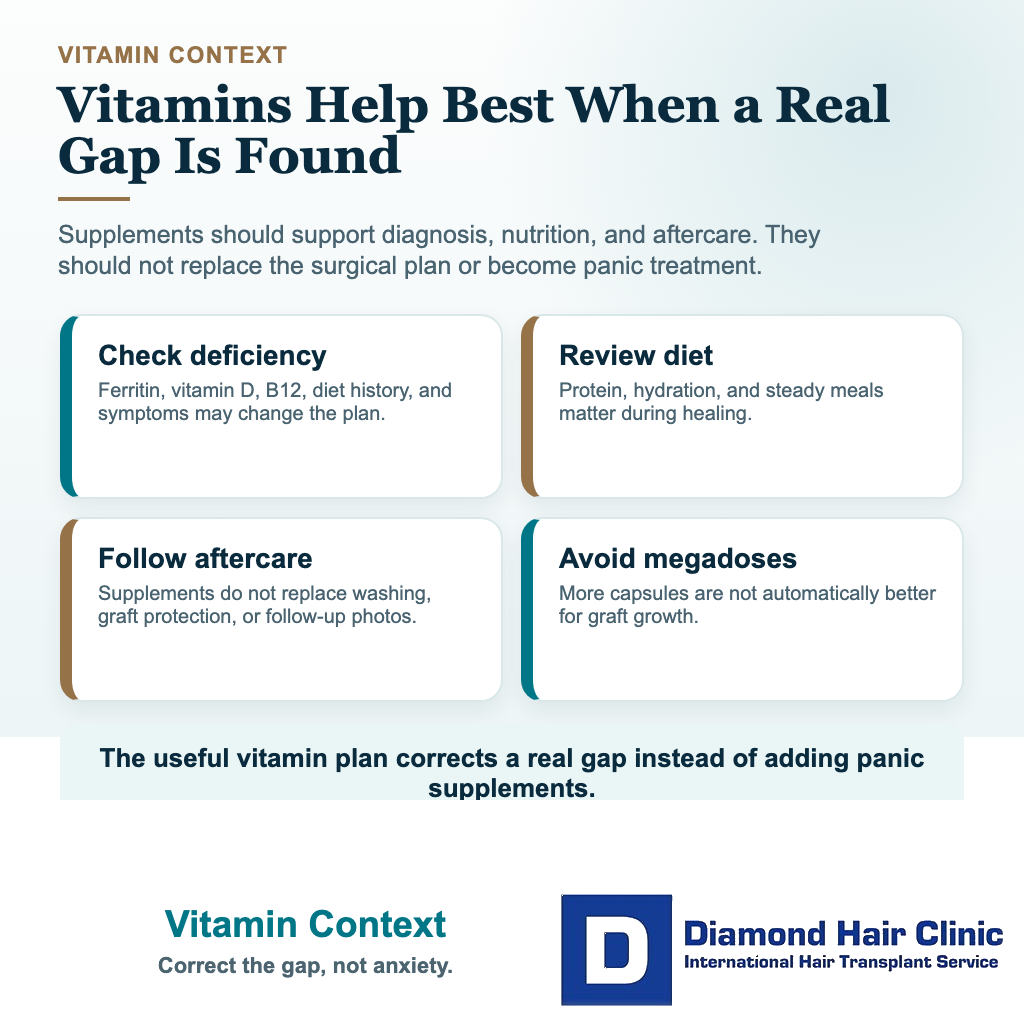
Vitamins do not make grafts grow better by themselves
They can help create a healthier growth environment, especially if the patient has poor nutrition, low iron stores, low vitamin D, stress on the body, or a diet that is not supporting recovery. I do not tell patients that vitamins force grafts to grow on command. Hair growth still follows biology, and the early months still require patience.
A transplanted graft has already been through surgery. It has been extracted, handled, placed, and then asked to heal in a new recipient area. In surgical terms, every avoidable weakness around that graft should be reduced. Nutrition is one of those factors.
A targeted plan is better than random products. If the patient needs support, we support that need. If there is a deficiency, we correct it. If the patient is already healthy, the routine should stay reasonable and avoid unnecessary excess.
The plan should not chase faster growth by adding more products. The goal is steady recovery, stable healing, and a better setting for the grafts and the surrounding native hair. Vitamins should have a reason after surgery. Mesotherapy kits after transplant surgery also need a clear purpose. Support should never become a shortcut.
Nutrition still matters after good surgery
Good surgery is the foundation, but healing still belongs to the patient’s body. A careful operation gives the grafts a strong start. The recovery period then determines how steadily the body passes through swelling, crusting, shedding, early resting, and gradual growth.
I focus on vitamins because I focus on the full result, not only the day of surgery. A patient can have a technically good transplant and still have slower recovery if the body is depleted. A patient can also have healthy graft growth but weak native hair around the transplanted area because the underlying hair loss or general health is not being managed.
I do not separate the operation from the recovery period. The surgery, aftercare, nutrition, medical planning, and long term follow up should all point in the same direction.
Deficiency and nutrition problems matter most
The problems I pay attention to are the ones that affect healing, blood health, energy, and hair quality. Some are nutritional, such as low ferritin, anemia, low vitamin D before hair transplant, low B12, poor protein intake, zinc deficiency, or restrictive dieting. Others, such as thyroid problems, are medical issues that can look like a nutrition problem if they are not checked properly.
If I suspect a problem, evaluation is better than guessing. A patient with low ferritin or anemia should not be treated the same as a patient who simply wants an extra boost. The first patient may need correction and follow up. The second may only need a balanced supplement, enough protein, and reassurance that more pills will not improve the result by themselves.
Supplements should fill a real gap, not become a recovery scorecard. A normal diet, known deficiency, blood test, and product ingredient list all matter more than buying every hair vitamin.
In this context, blood tests before a hair transplant can be useful. They help us see whether the patient is nutritionally and medically ready. I do not want a patient to spend months taking the wrong product while the real problem remains hidden.
Biotin zinc vitamin D and collagen need context
They can contribute when they are part of the right plan, but I do not treat one ingredient as the answer. Vitamin D, zinc, iron support, amino acid or protein support, and sometimes biotin or collagen may be discussed when there is a specific reason. Biotin is very different in a patient with poor intake or deficiency than it is in a healthy patient taking a high dose hair formula out of fear.
The final result depends on layers of good decisions. The donor area must be protected. The grafts must be handled gently. The recipient area must be designed naturally. The patient must heal well. Ongoing hair loss must be understood. Nutrition and vitamins support this chain, but they do not replace the chain.
The product choice starts with what we are trying to correct. When it is a deficiency, we choose support for that deficiency. When it is general recovery, we keep the routine reviewed and sensible. When it is fear, I pause the conversation, because anxiety can push patients into taking too many things at once.
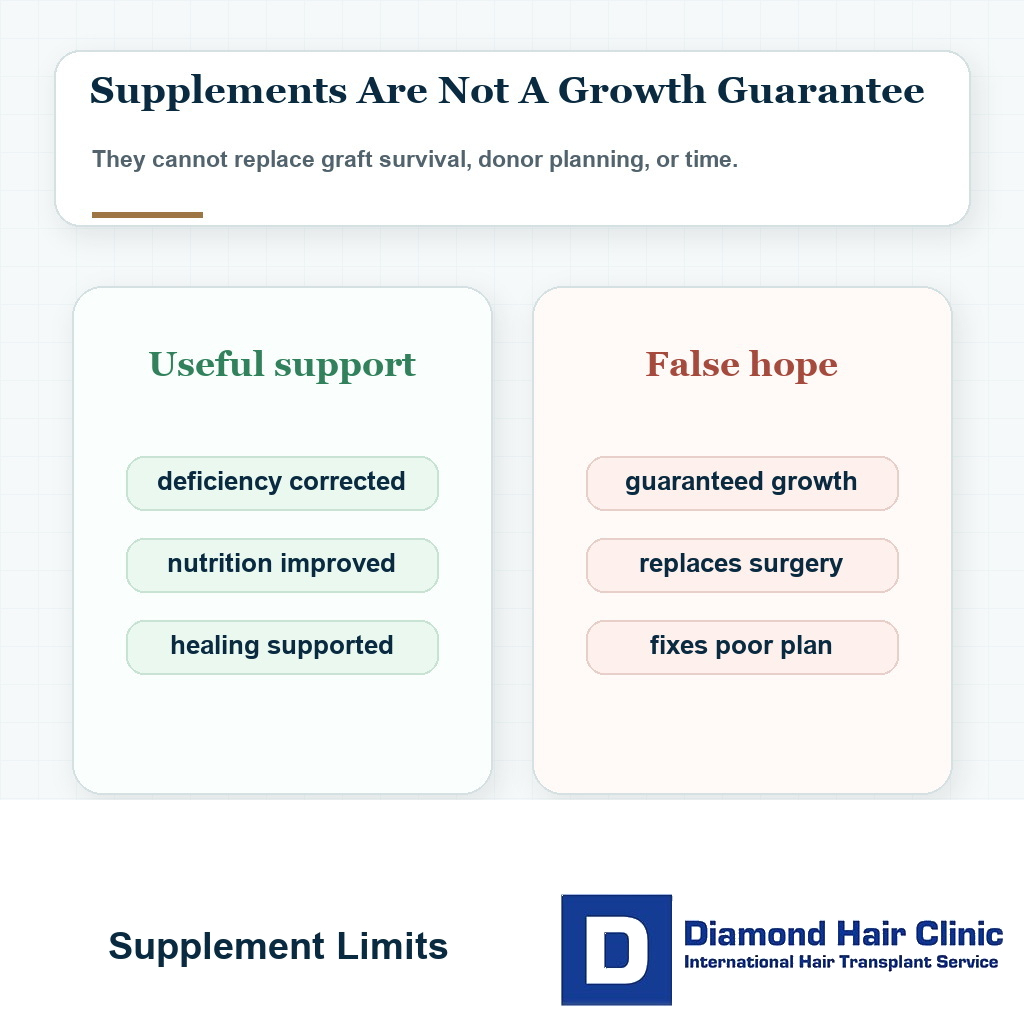
High dose biotin is not usually necessary
High dose biotin is not a requirement after a hair transplant. If a patient has a deficiency or poor intake, support may be useful. If the patient is not deficient, a large dose does not make grafts grow faster or thicker by itself.
High dose biotin before FUE also deserves caution because it can interfere with some blood test results. This matters if a patient is being checked for thyroid function, hormones, heart related markers, or other medical issues. If a doctor orders blood tests, the patient needs to say exactly what they are taking, especially hair, nail, or high dose biotin formulas. Supplement decisions connect with thyroid problems before a hair transplant and general medical review.
A reviewed, steady routine is more useful than dramatic dosing. Enough protein, correction of real deficiencies, and no hidden products before surgery or during recovery matter more than treating biotin as a shortcut.
Vitamins cannot replace medical hair loss treatment
They are different tools. Vitamins support recovery and general hair health. Finasteride and minoxidil are used for different reasons, usually related to ongoing hair loss or hair miniaturization in suitable patients. PRP and exosomes are also supportive, but they are not the same as vitamins.
For example, if a patient has progressive androgenetic hair loss, the discussion may include finasteride before or after a hair transplant. If minoxidil is appropriate, I may discuss oral minoxidil before or after surgery. Vitamins do not replace those conversations.
The same is true for PRP and exosomes after a hair transplant. I see these as supportive options in selected cases. The patient needs to understand what each support is meant to do. Confusion begins when everything is sold as a growth guarantee.
Too many supplements can create risk
More is not better by default. This is true in graft numbers, and it is also true in supplements. Iron, selenium, vitamin A, high dose vitamin E, fish oil, and herbal blends are not all harmless just because they are sold without a prescription. Some products can affect bleeding tendency, stomach tolerance, blood pressure, sleep, liver metabolism, lab results, or interactions with medication. Fish oil is one example where fish oil before hair transplant surgery needs its own dose and restart timing review.
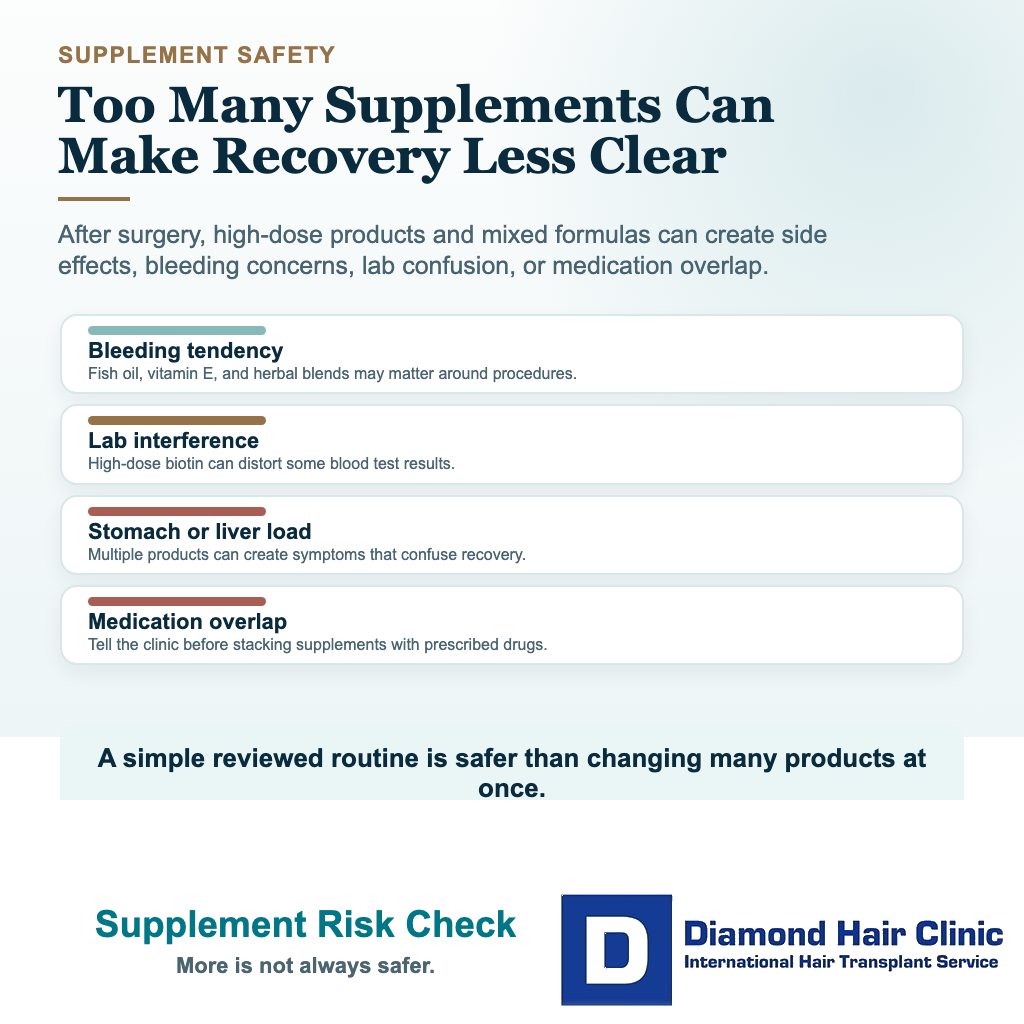
Before surgery, I check everything the patient takes. This includes vitamins, herbal products, fish oil, sports supplements, hormone related products, hair formulas, blood thinning medication, acne medication, antidepressants, and blood pressure medication. A product can look harmless and still matter medically.
Supplement planning should sit beside medication before a hair transplant. The patient must not hide products from the surgeon, and the surgeon should not give the same instruction to every patient without checking the medical context.
The first month needs a steady plan
During the first month, steadiness matters. Continuing a reviewed product is different from starting five new products because you are nervous. A simple prescribed correction or reviewed multivitamin is not the same as stacking high dose supplements, herbal blends, sports products, and hair formulas together. Do not change the routine every few days. Do not take high doses because you think faster healing comes from stronger pills.
The first month is about clean healing, stable nutrition, enough protein, hydration, sleep, and following the clinic’s instructions. If vitamins are part of the recovery plan, take them consistently and sensibly. If a product causes stomach discomfort, rash, dizziness, or any unusual symptom, stop guessing and ask your medical team.
Patients who train heavily sometimes ask about creatine after a hair transplant. My approach is the same. I review the product, the timing, the dose, and the patient’s general health. The name of the supplement matters less than the full picture.
Patients need to avoid starting a strong new routine immediately after surgery without guidance. The early recovery period is not the time for experiments. If we use vitamins, the plan should be stable, clean, and easy to follow without confusion.
Growth needs patience, not supplement panic
Vitamins can support the process, but they do not remove the normal waiting period. Shedding can happen. Early growth can be uneven. One area can look slower than another. The patient may feel that nothing is happening, even when the scalp is moving through a normal stage.
With slow growth, I look at the timeline, photographs, donor condition, recipient area healing, and the original plan. It is more helpful to track hair transplant growth with a steady photo routine than to keep adding products because one week looked disappointing.
There is a balance here. Patients need to take recovery seriously without becoming afraid of every normal change. A supplement plan should make the recovery feel more organized. If it turns into a daily search for the next product, it is no longer helping in the right way.
Vitamins are not enough when the main problem is elsewhere
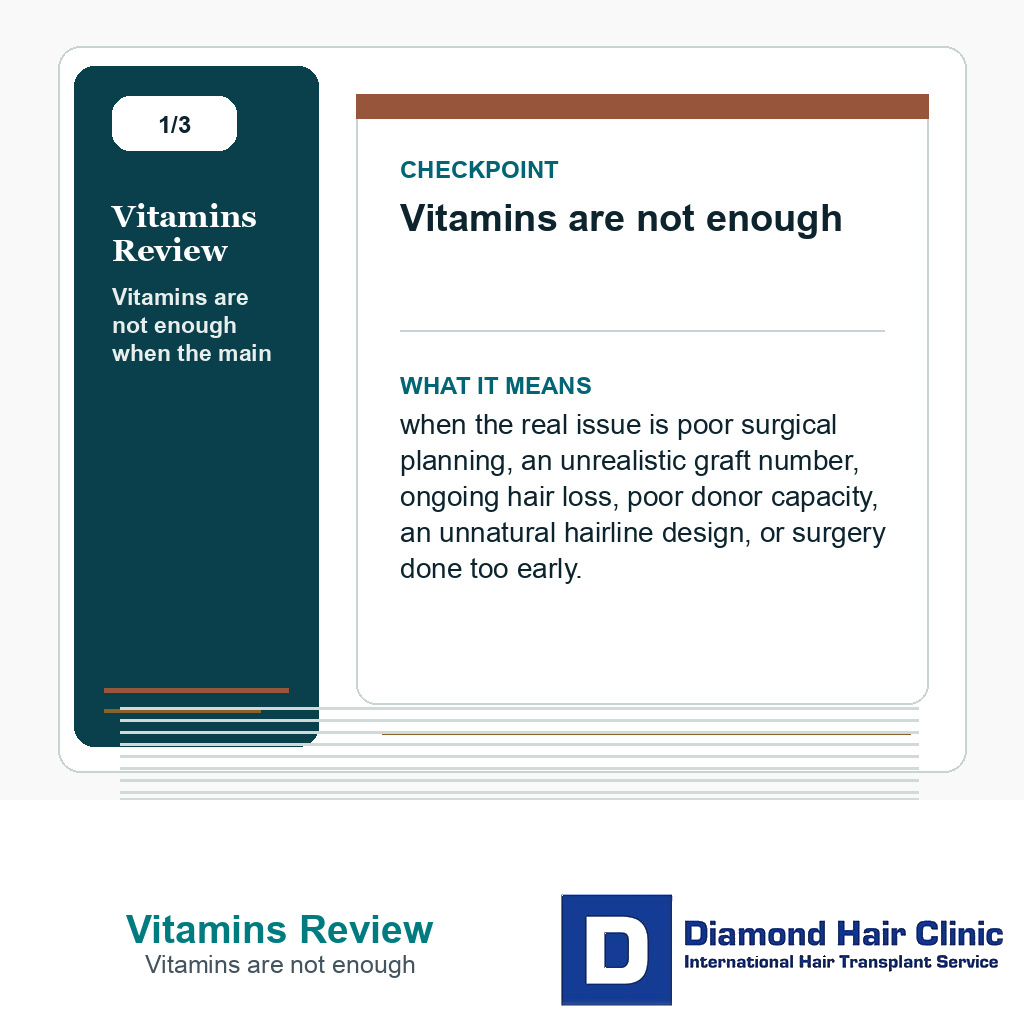
Vitamins are not enough when the real issue is poor surgical planning, an unrealistic graft number, ongoing hair loss, poor donor capacity, an unnatural hairline design, or surgery done too early. In these situations, supplements may support the body, but they cannot correct the main mistake.
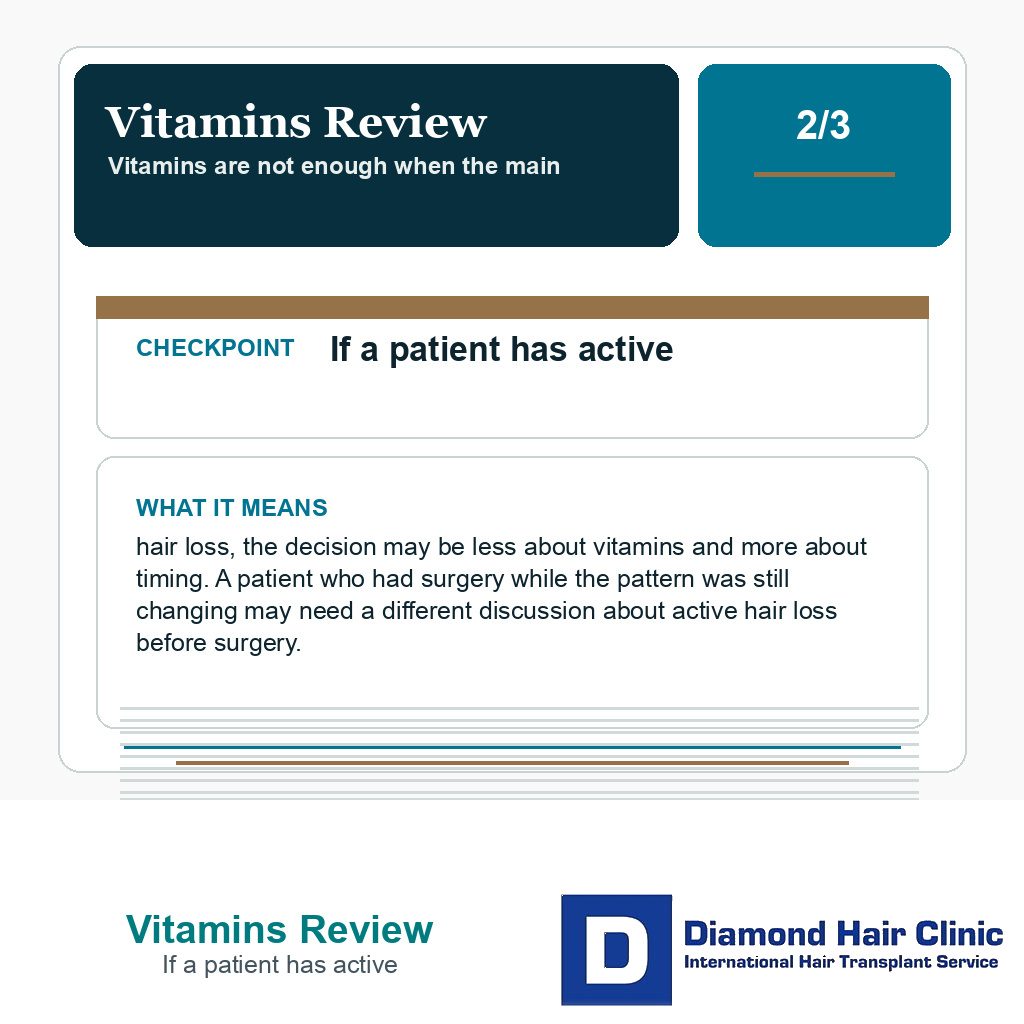
If a patient has active hair loss, the decision may be less about vitamins and more about timing. A patient who had surgery while the pattern was still changing may need a different discussion about active hair loss before surgery. The right support does not remove the need for the right indication.
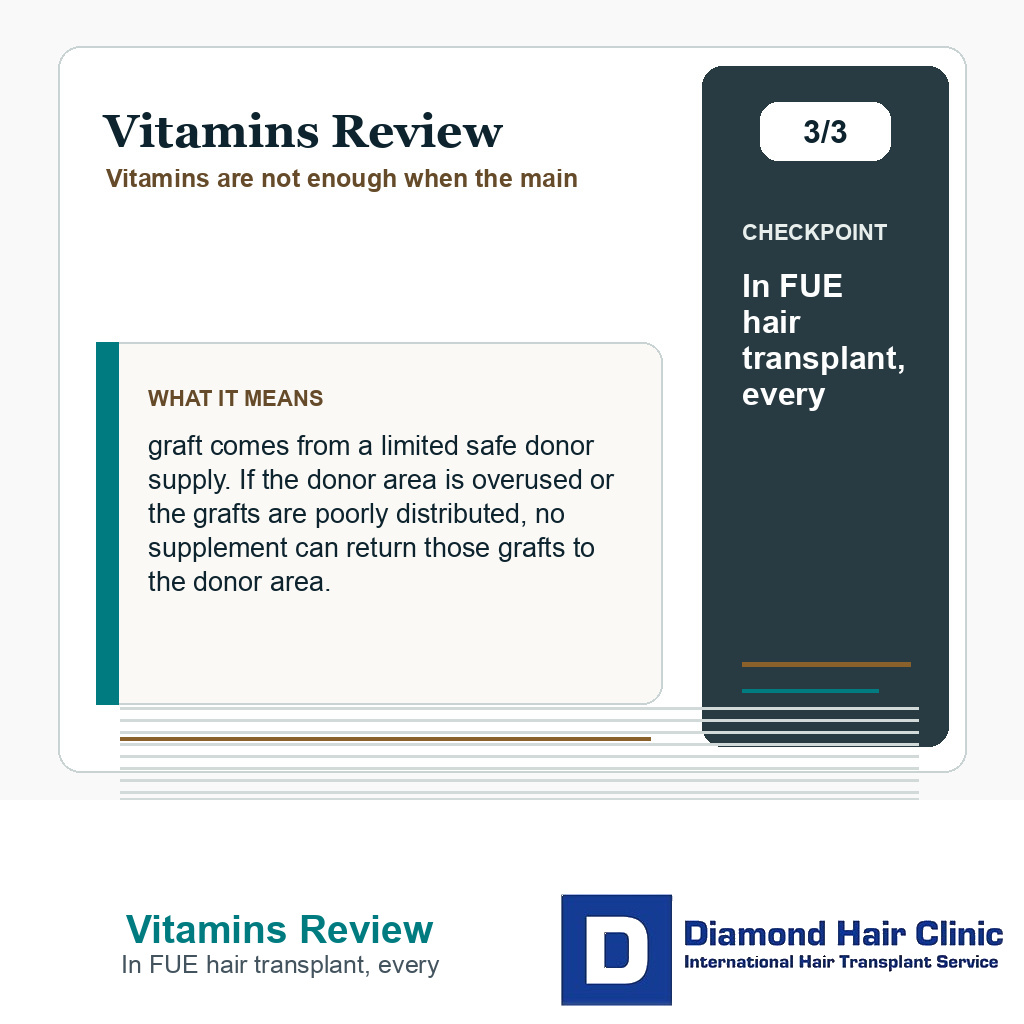
Vitamins also cannot change the limits of the donor area. In FUE hair transplant, every graft comes from a limited safe donor supply. If the donor area is overused or the grafts are poorly distributed, no supplement can return those grafts to the donor area.
The 3 slides here keep vitamins tied to blood results, diet, and real deficiency rather than guesswork. Swipe sideways, use the arrows, or choose a number below the image.
Vitamins help only when the foundation is sound
Vitamins should be taken seriously without letting fear drive the plan. They can be useful after surgery, especially when they correct a real deficiency or nutritional gap. They should be chosen with medical judgment, not panic.
The two extremes both cause confusion. One says vitamins are everything. The other says they do not matter at all. The more useful position is between those two. Vitamins can support the recovery plan, but the strongest results still come from good candidacy, careful surgery, clean aftercare, realistic planning, and long term medical thinking.
The useful way to use hair transplant vitamins is to support a strong surgical plan, not to rescue a poor one. When the operation is done carefully and the patient’s body is supported well, the recovery period becomes easier to manage and more favorable for the result the surgery can realistically deliver.
A good transplant is not finished when the last graft is placed. The months after surgery matter. If the patient eats poorly, ignores deficiencies, changes products every few days, or takes supplements without telling the surgeon, the recovery becomes less controlled. Clear instructions, proper medical review, and supportive treatment should help the patient reach the strongest result that the surgery and donor capacity can realistically provide.

Read this review excerpt
Diamond Hair was the only clinic asking for medications, treatments I've done before, and other type of questions that make me feel confident on the professionalism that they practice with their clients.